
Foreign trade website product display and interactive experience optimization plan

  • Independent website industry application
  • Foreign trade stations
Posted by 广州品店科技有限公司 On Sep 02 2025

With the rapid development of the global e-commerce market, more and more foreign trade companies are focusing on their online brand image and customer experience. An effective foreign trade website needs to go beyond simply displaying product information; it should also enhance customer engagement and purchase desire through a carefully designed interactive experience. This article will delve into the best practices for optimizing product display and interactive experiences on foreign trade websites, helping foreign trade companies improve their website conversion rates and win the favor of the global market.

1. Core elements of product display on foreign trade websites

  1. High-quality product images and videos <br data-start="219" data-end="222">When displaying products, foreign trade companies use images and videos as the most direct means of engaging with users. To attract potential customers, websites must provide clear, high-quality product images that showcase the product from various angles, details, and actual usage whenever possible. Using high-resolution images with appropriate zoom capabilities can boost user confidence.

    • 3D product display : Provide customers with interactive 3D product display, users can rotate the mouse to view the product from all angles, thereby enhancing the interactivity of the product display and user experience.

    • Product video : Use short videos to show product usage scenarios to help customers better understand product functions and advantages, thereby increasing their urge to buy.

  2. Clear presentation of product information <br data-start="485" data-end="488">Product descriptions should be detailed and concise, clearly conveying the product's main features, dimensions, materials, uses, and other information. For foreign trade websites, accurately conveying product information can effectively reduce customer concerns and increase user recognition of the product.

  3. Enhanced product filtering and search functions <br data-start="591" data-end="594">Foreign trade websites should provide customers with convenient search and filtering functions so that customers can easily find the products they are interested in. Filter options can be set according to product category, price, brand, etc. to quickly and accurately display qualified products.

    • Intelligent recommendation system : Recommend related products based on customers’ browsing history and preferences, which helps to increase product exposure and conversion rate.

2. Optimization strategy for interactive experience of foreign trade websites

  1. Responsive design and adaptation to various devices <br data-start="775" data-end="778">With the popularization of mobile Internet, more and more customers browse foreign trade websites through mobile phones, tablets and other devices. Therefore, it is crucial to ensure that foreign trade websites have good responsive design, can be adaptively displayed on different devices, and provide a consistent browsing experience.

    • Fast loading speed : Use static site generators, compress images, optimize code, etc. to increase the loading speed of the website. This not only improves the user experience, but also effectively improves search engine rankings.

  2. Clear navigation and concise UI design <br data-start="964" data-end="967">The UI design of a foreign trade website should be simple and intuitive, with a clear navigation system to ensure that customers can find the information they need in a short time. Place the most important functions in a prominent position, reduce the complexity of the page, and avoid confusing users.

  3. Adding interactive elements <br data-start="1060" data-end="1063">To increase user participation, you can add interactive elements to your foreign trade website, such as:

    • Live chat function : Provide customers with instant consulting services, answer their questions and enhance customer experience.

    • Customer reviews and feedback : Display other customers’ reviews and feedback to increase social proof and enhance user trust.

    • Interactive Q&A : Set up an FAQ page or add frequently asked questions and answers to product pages to help customers quickly get the information they need.

  4. Optimize the shopping process <br data-start="1253" data-end="1256">Simplify the shopping process and reduce the number of steps required to purchase. Avoid losing potential customers due to cumbersome steps. Design clear shopping carts, checkout pages, and order tracking functions to enhance the customer's purchasing experience.

  5. Support multi-language versions <br data-start="1344" data-end="1347">Foreign trade websites serve global customers, and supporting multi-language versions can improve the global adaptability of the website. Through the multi-language switching function, it provides users in different regions with a localized shopping experience and increases customer stickiness.
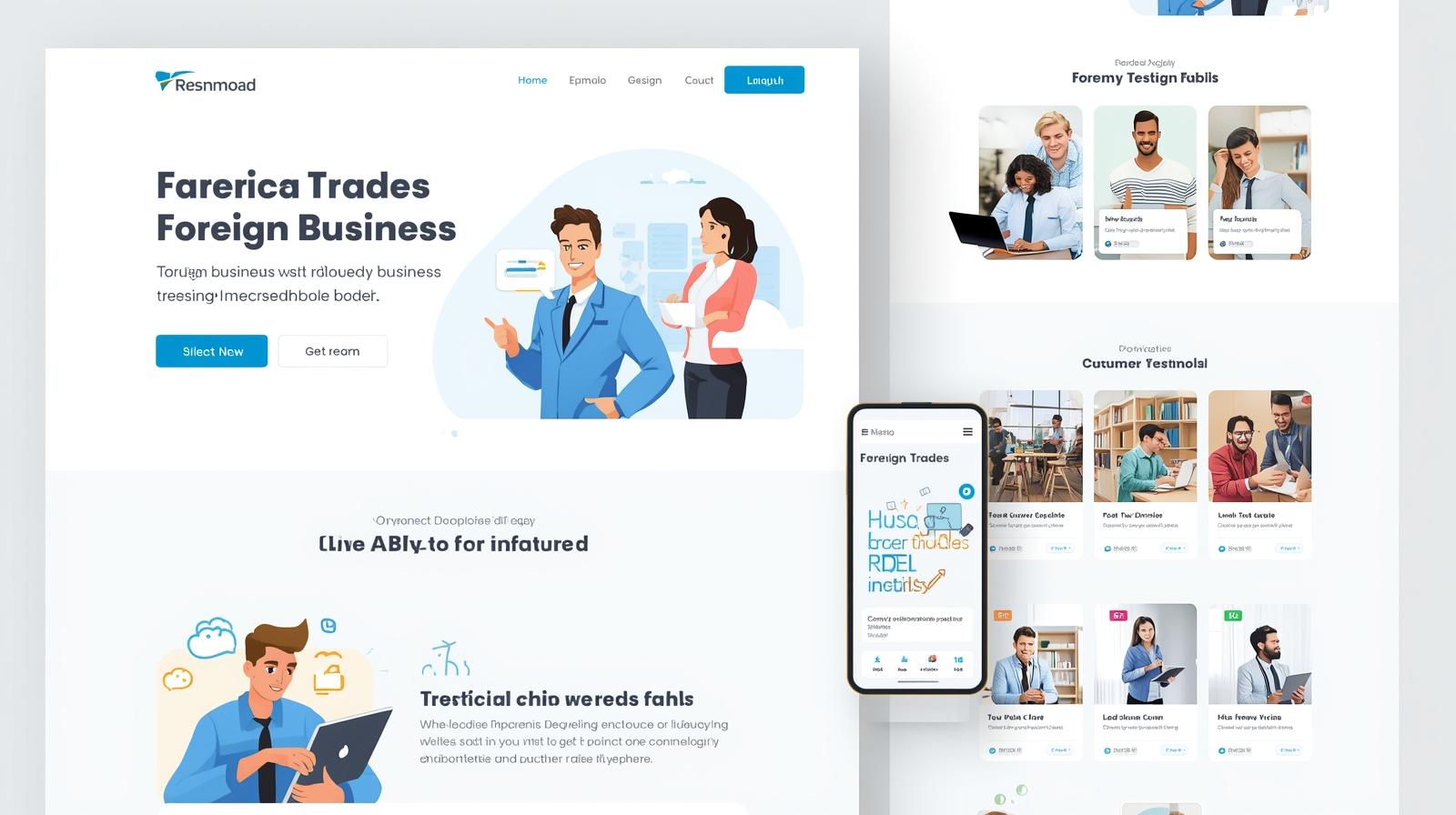
Foreign trade website interactive experience optimization strategy

3. How to improve conversion rate through foreign trade website building

  1. Perfect product display and interactive design <br data-start="1461" data-end="1464">Foreign trade websites can effectively increase user engagement by optimizing product display and enhancing interactive experience, and enhance product exposure through intelligent recommendation systems, thereby promoting more conversions.

  2. Integrate AI technology to optimize operations <br data-start="1547" data-end="1550">Foreign trade websites can use AI technology to help companies achieve functions such as automated content generation and intelligent customer service, reducing labor costs and improving operational efficiency. At the same time, AI can also analyze customer behavior data to help companies develop more precise marketing strategies.

  3. SEO Optimization and Global Exposure <br data-start="1652" data-end="1655">Foreign trade websites should use reasonable SEO strategies to improve their rankings in search engines like Google and increase their exposure. Multilingual support, optimized product information, and keyword placement are all important factors in increasing traffic and rankings for foreign trade websites.

IV. Conclusion

Building a website for foreign trade isn't just about showcasing products; it's also about improving user experience and conversion rates. By optimizing product display and enhancing the interactive experience, combined with intelligent recommendation systems, AI technology, and SEO optimization, foreign trade companies can stand out in the global market and attract more inquiries and conversions.


CTA:

Want to improve your website's conversion rate and user experience? Contact Pinshop now . We offer customized website building solutions to help you efficiently build a high-conversion website and easily expand into the global market.

Pinshop foreign trade website

【Extended Reading】

How to achieve extremely fast access through static site in foreign trade website construction
What is foreign trade intelligence?

Learn about foreign trade customer acquisition software

特色博客
Is it difficult to break through traditional website SEO? 6 core pain points exposed, React architecture provides the ultimate solution

Is it difficult to break through traditional website SEO? 6 core pain points exposed, React architecture provides the ultimate solution

Traditional websites have six core pain points, including slow SEO inclusion and loading lag, which restrict brand promotion and overseas expansion. Pinshop relies on the React+Next.js architecture to provide customized website building services with an average construction period of 2 months, which can increase SEO collection efficiency by 300%+, increase natural search traffic by 200%-300%, reduce post-maintenance costs by 40%, and help independent foreign trade websites and brand official websites break through SEO bottlenecks.

Is it difficult to break through traditional website SEO? Change to React architecture and see immediate results

Is it difficult to break through traditional website SEO? Change to React architecture and see immediate results

Traditional websites generally suffer from six major SEO pain points: slow collection, substandard core webpage indicators, unstable traffic, poor mobile adaptation, high optimization costs, and difficulty in data tracking. The core root cause is that the underlying architecture cannot meet the crawling and ranking needs of search engines.

Use Next.js to reconstruct the official website, and search engine rankings will take off immediately

Use Next.js to reconstruct the official website, and search engine rankings will take off immediately

Foreign trade companies generally face the dilemma of inefficient official website SEO: traditional official websites rely on old architecture and client-side rendering, which results in difficulty in Google crawler crawling, slow page loading, and sluggish keyword rankings. Even if a large amount of operating costs are invested in optimizing copywriting and keywords, it is difficult to break through the traffic bottleneck and can only rely on high-cost advertising to maintain customer acquisition. Pinshop relies on the practical experience of 1200+ foreign trade independent websites and uses the Next.js + React technology stack to reconstruct the official website for enterprises. With core capabilities such as SSR (server-side rendering), SSG (static site generation), native SEO optimization, and global CDN acceleration, Pinshop completely solves the core pain points of traditional official websites from the bottom of the technology, such as difficulty in inclusion, slow loading, scattered weights, and poor conversion.

React+Next.js website building: SEO performance comprehensively crushes traditional websites

React+Next.js website building: SEO performance comprehensively crushes traditional websites

Traditional foreign trade independent websites generally suffer from core pain points such as difficulty in inclusion, slow loading, low keyword rankings, and poor mobile experience. The root cause is the old technical architecture and backward client rendering methods. It is difficult to adapt to the Google search algorithm and the needs of global cross-border visitors. Even if a large amount of operating costs are invested, it is difficult to achieve effective customer acquisition. The React+Next.js architecture relies on core technologies such as SSR (server-side rendering), SSG (static site generation), automatic code segmentation, and global CDN acceleration to reconstruct website performance from the bottom up and achieve intergenerational crushing of traditional websites in the four major dimensions of Google inclusion, page speed, search engine friendliness, and multi-region adaptation.

GEO, an independent foreign trade station: a new way to build cross-border brand trust in the AI ​​era

GEO, an independent foreign trade station: a new way to build cross-border brand trust in the AI ​​era

Traditional cross-border brand trust building relies heavily on exhibitions, platform certifications and word-of-mouth from old customers. In the era of AI search, it has been difficult to reach new buyers. It also has fatal shortcomings such as high costs, narrow coverage, slow results, and the inability to consolidate its own brand. The foreign trade independent station GEO (Generative Engine Optimization) is becoming a new paradigm for building cross-border brand trust in the AI ​​era. Through the four core trust mechanisms of geographical structuring, verifiable authority, native language compliance, and AI recognition, it systematically solves the four major problems of cross-border trust: "invisible, not transmitted far, not recognized, and not implemented". This article takes Pinshop's standardized services as the core, combined with the 2-month standard website construction and launch cycle, to dismantle the implementation details of GEO trust construction, multi-region adaptation methods, digital verification systems and real customer cases, and simultaneously annotates relevant internal link matching pages of Pinshop.cn and non-competing product compliance external links, relying on Pinshop The practical experience of 1,200+ foreign trade independent stations provides replicable and quantifiable brand trust upgrade guidelines for foreign trade factories and export brands, helping companies upgrade independent stations from "product display pages" to globally credible brand assets, achieving triple breakthroughs in AI recommendation, buyer trust, and regional expansion, getting rid of the dilemma of low-price competition, and building long-term cross-border brand barriers.

Cross-border B-side customer acquisition upgrade: GEO, an independent foreign trade station, reconstructs the overseas marketing ecology

Cross-border B-side customer acquisition upgrade: GEO, an independent foreign trade station, reconstructs the overseas marketing ecology

Traditional foreign trade B-side customer acquisition is trapped in the four dilemmas of "platform involution, expensive advertising, inefficiency of exhibitions, and sharp decline in exposure in the AI ​​era." The foreign trade independent websites of most companies only stay at the level of "product display + language translation" and cannot adapt to the search habits and decision-making logic of overseas buyers, making it difficult to achieve independent customer acquisition. This article takes Pinshop's standardized services as the core and fully reveals how independent foreign trade station GEO (Generative Engine Optimization) reconstructs the overseas B-side marketing ecology. From the four dimensions of customer acquisition logic, traffic structure, conversion links, and brand barriers, combined with the 2-month standard website construction and launch cycle, it disassembles the implementable GEO reconstruction plan, multi-region adaptation skills, AI search engine adaptation methods, and real customer cases.