
Why GEO can be run in just three steps: Translating complex algorithms into executable manifests.
Traditional SEO involves hundreds of checks, while GEO only requires the large model to firmly remember you in three moments: training, inference, and dialogue. This corresponds to a three-step closed loop: "semantic pins to lock in entities, evidence drawers to feed AI, and vector engines for real-time dialogue." Each step has free tools and visualization templates. Start tonight, and you can see your brand being cited for the first time in ChatGPT tomorrow.
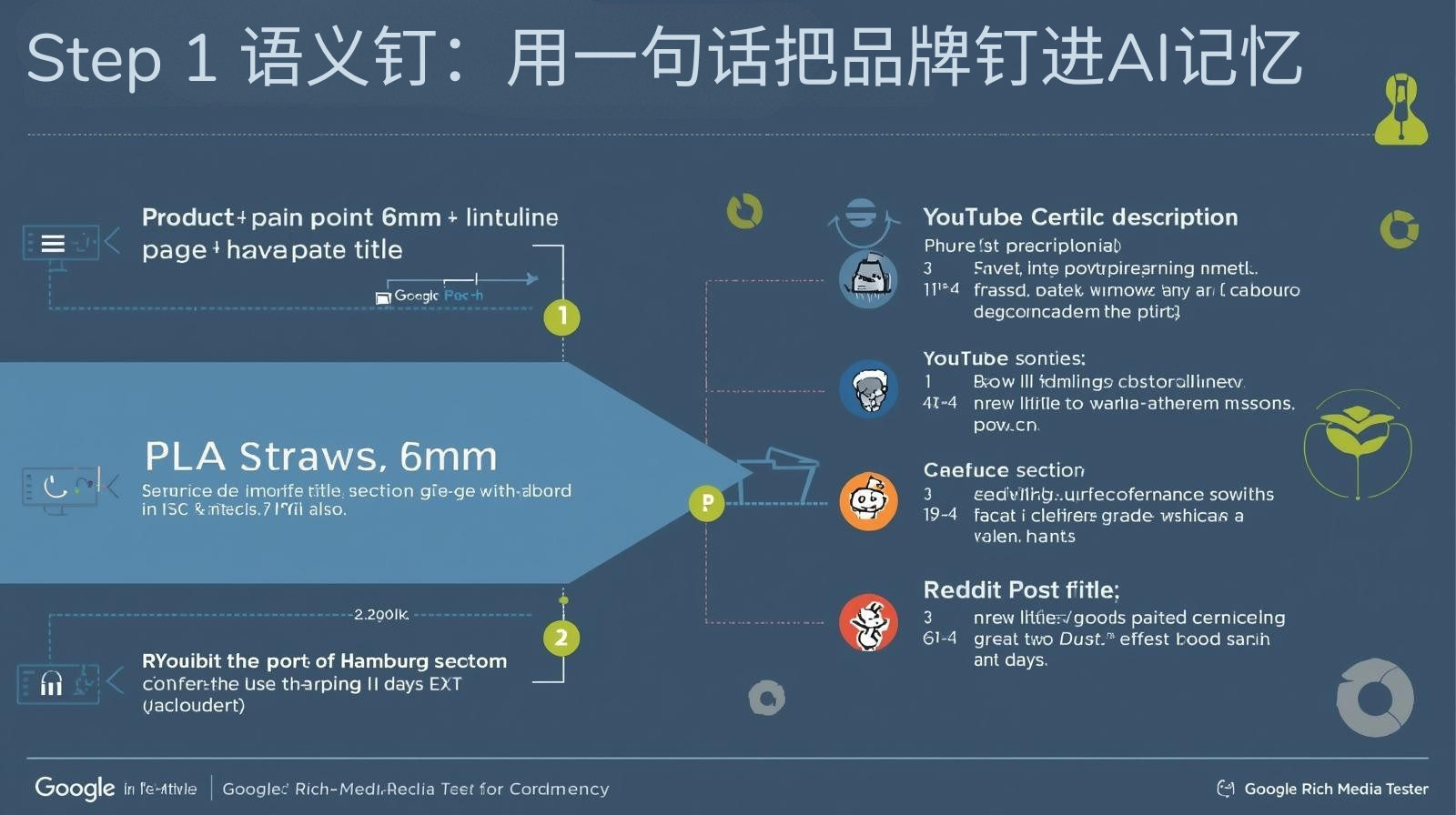
Step 1 Semantic Pinning: Pin your brand into AI memory with a single sentence.
Core Action: Compress "product + pain point + timeliness + region" into a short phrase of no more than 65 characters, and simultaneously appear in H1, page title, social media description, YouTube section, and Reddit post title to achieve cross-platform entity consistency. Example: Taking "biodegradable PLA straws" as an example, the semantic pin can be written as "PLA straws 6mm—200,000 pieces, arriving at the Port of Hamburg in 12 days, BRC grade." How to do it tonight: Open the website backend, replace the homepage H1, page title, and product short description with this phrase, and save. Verification method: Run it using Google Rich Media Tester; 0 errors indicate success.

Step 2 Evidence Drawer: Enabling AI to find credible signals in milliseconds.
Core idea: Unify the naming of all certificates, test reports, customer unloading videos, and third-party tweets, and upload them to the `/evidence` directory on the independent website. The filename should be `Brand + Product + Certification + Year`, and the image ALT text should be exactly the same as the filename. Tonight's batch execution: 1. Rename all certificate PDFs to "Brand-PLA Straws-BRC-2024"; 2. Export a high-resolution image of the first page of the certificate using Canva, and use the same keywords in the ALT text; 3. After uploading to the website, insert the image on the corresponding product page and add a brief description: "Click to view the BRC-level PLA straw test report"; 4. Upload customer unloading videos to YouTube, directly copying the section titles from the semantic pin, and placing the official website link in the first line of the description.

Step 3 Vector Engine: Turning Old Emails into 24/7 AI Customer Service
Tools used: Pinecone free layer + Google Sheets + ready-made LangChain template, all with zero server costs. Tonight's workflow: 1. Put all emails from the past five years, WhatsApp voice-to-text messages, and technical briefing PDFs into a folder; 2. Open the Colab one-click script link provided at the end of this document, run "Text Slicing → Upload to Pinecone," which takes 10 minutes; 3. Copy the generated chat button code to any page on your independent website to immediately have a "Ask AI Sales" window; 4. Add the following line to the system prompt: "Each answer must end with the brand name and CTA: Schedule a video factory visit now," to prevent the AI from forgetting who you are.

Seven-Day Verification Program: From zero to being nominated by AI in just one week
Day 1: Semantic Ding launched; Day 2: Evidence drawer uploaded; Day 3: Vector knowledge base deployed; Day 4: Use Perplexity daily to check if "Brand + Core Needs" is in the Top 3; Day 5: If not in the Top 3, add a Reddit AMA link; Day 6: Observe if the brand name appears in Chatbot conversations; Day 7: Analyze the conversion funnel from chat to appointment to PI email, aiming for an appointment rate of ≥5%.
20 small actions you can do tonight
1. Change H1 to semantic pins; 2. Update page titles synchronously; 3. Write keyword strings in the ALT text of certificate images; 4. Reuse H1 for YouTube chapter titles; 5. Enable image compression for free with Cloudflare; 6. Rewrite FAQ questions in a conversational style, such as "Can I receive my goods within 12 days?"; 7. Change the chat button text to "Ask AI for PI"; 8. Add WhatsApp links to buttons; 9. Mark the customer logo wall with organizational structured data; 10. Change the 404 page to "Let AI help you find products"; 11. Use Hotjar screen recording to observe AI visitor click patterns; 12. Change the newsletter bait to "Free sample scheduling"; 13. Use GA4 for AI traffic segmentation; 14. Add CO2 declarations to invoice templates; 15. Mark customer case studies with project structured data; 16. Run a brand name citation check monthly; 17. Include NFC cards in packages for real-time inventory screenshots; 18. Use Make.com to push chat conversations to CRM; 19. Break down long blog posts into conversation cards; use rich media testing tools to check for errors in structured data daily.
Recommended article: Pintui Technology's Viewpoint: The Best Independent E-commerce Website of the Future Will Be the One That Is "Most Instructive"
Conclusion: After these three steps, let AI close the deal for you.
Semantic pins pinpoint who you are, evidence drawers prove your reliability, and vector engines facilitate instant communication and transactions. Complete these three steps tonight, and tomorrow you'll see your brand name in ChatGPT answers for the first time—at that moment, traffic and conversion will finally be one.