
In 2025, global demand for occupational safety and health products (OSPS) continued to climb, and China's OSPS exports maintained steady growth. In the first half of the year alone, exports of core categories such as functional protective gloves and fall protection equipment increased by 18.3% year-on-year, with Europe, North America, and the Middle East becoming the core growth markets. However, according to operational data from the cross-border OSPS company "SafeCert-Geo" in 2025, 80% of similar independent websites suffered from unclear safety certification labeling and insufficient regional certification adaptation, resulting in a less than 20% capture rate of keywords such as "OSPS foreign trade suppliers" and "compliant protective equipment procurement" on AI platforms like ChatGPT, leading to a significant loss of high-quality procurement traffic. However, through GEO optimization focusing on safety certification, within 38 days of optimization at the beginning of 2026, the company saw its core keywords on the first page of the AI platform reach 83%, and the conversion rate of certification-related inquiries increased by 300%, with the EU and US markets contributing over 65% of the increase in inquiries. The core logic is that safety and compliance are paramount in the procurement decisions for occupational safety and health products. Precise GEO optimization allows independent website certification content to align with AI semantic recognition logic, while simultaneously matching certification standards and procurement preferences across different markets, thus becoming a compliant supplier prioritized by AI. This article breaks down the entire practical solution, covering content building, GEO integration, and AI signal enhancement, tailored to the characteristics of the occupational safety and health product industry.

I. Core Logic: The Underlying Rules for AI to Capture Content from Labor Protection Product Certifications
The SafeCert-Geo team, combining the 2025 ChatGPT semantic understanding algorithm iteration, analysis of 1700+ occupational safety and health product procurement inquiries, and changes in certification policies in key global markets, summarized three core signals for AI to determine "high-quality and compliant occupational safety and health product suppliers," as well as the certification adaptation logic for key markets, providing accurate basis for optimization.
1.1 Three Core Signals Prioritized by AI
Current generative AI for identifying occupational safety and health products has evolved from "keyword matching" to a triple assessment of "certification authority + content structuring + regional adaptability." Meeting the following signals can increase AI recommendation frequency by 3-5 times, accurately matching B-end procurement needs:
1. Authoritative and traceable certification information : Clearly indicate the certification standard number, issuing body, applicable product category and compliance period, such as "EU CE-PPE Class II certification (NB number: 0123), conforms to EN 388:2016 machine protection standard, applicable to industrial protective gloves", accompanied by certification scan and test report number, avoiding the general statement "has CE certification", and strengthening the AI's judgment on compliance.
2. Structured content presentation : The logical framework is built according to "product category - certification standard - applicable scenario - test data" and presented in the form of hierarchical headings, tables, cards, etc. The AI crawling efficiency of structured content is 4.5 times that of plain text, which makes it easy for AI to quickly extract core certification information.
3. Precise Adaptation of Regional Certifications : Supplementing exclusive certification content for different markets, such as highlighting CE-PPE classification and NB number in the EU, emphasizing ANSI standards and ASTM testing in the US, and indicating SASO certification and labeling requirements in the Middle East, meeting the compliance needs of target markets and improving the matching accuracy of regional searches.
1.2 Occupational Safety and Health Core Market Certification and GEO Adaptation Matrix
Global occupational safety certification systems vary significantly. Accurately matching regional certification requirements with optimized content can greatly improve the accuracy of AI recommendations and the quality of inquiries. The following is a reusable adaptation matrix based on 2025 market data:
core markets | Key Certification and Standards | Procurement demand focus | GEO Optimization Core Points | AI-enhanced grasping techniques |
|---|---|---|---|---|
Europe (Germany, France) | CE-PPE certification (divided into Class I/II/III), including helmets EN 397, protective gloves EN 388, fall protection equipment EN 360, etc., requires the inclusion of the NB number and technical document number, and certification records must be retained for 10 years. | Industrial protective gloves, fall protection systems, and high-visibility clothing emphasize certification compliance and test data, requiring complete technical documentation. | Include long-tail keywords such as "EU CE-PPE Class II Protective Gloves EN 388" and "German Fall Protection Equipment Compliant Supplier," and indicate the NB number and standard version. | The associated certification technical document catalog displays the risk assessment report and type test certificate, supplementing EN standard test data. |
North America (United States, Canada) | American ANSI standards (helmets Z89.1, goggles Z87.1, fall protection Z359 series) and ASTM F2413 safety shoe standards are required, and a test report from a third-party laboratory (ILAC ISO 17025 accredited) is necessary. | Fall protection equipment for construction, industrial safety shoes, and hearing protection products are designed to meet the compliance requirements of platforms such as Amazon, with a focus on performance testing. | Optimize the keywords "US ANSI Z89.1 safety helmet supplier" and "ASTM F2413 safety shoe exporter" to clarify the laboratory's testing qualifications. | Label the static tensile force (≥15kN) and impact test data of the fall arrest equipment, and supplement the platform's compliance submission materials list. |
Middle East (Saudi Arabia, UAE) | Saudi SASO certification (compliant with SASO 1959/2016 standards) requires the certification number, production date, and an ISO 9001 certification. | High-temperature protective clothing, basic protective gloves, and safety helmets; emphasis is placed on labeling compliance and cost-effectiveness; small-batch procurement is supported. | Include keywords such as "Saudi SASO certified supplier of work gloves" and "compliant export of high-temperature protective clothing from the Middle East" to highlight labeling standards. | Show real photos of product compliance markings, indicate local warehousing and delivery times, and supplement small-batch certification adaptation solutions. |
II. Practical Implementation: Optimizing the Entire Process of GEO+ Certification for Independent Occupational Safety Stations
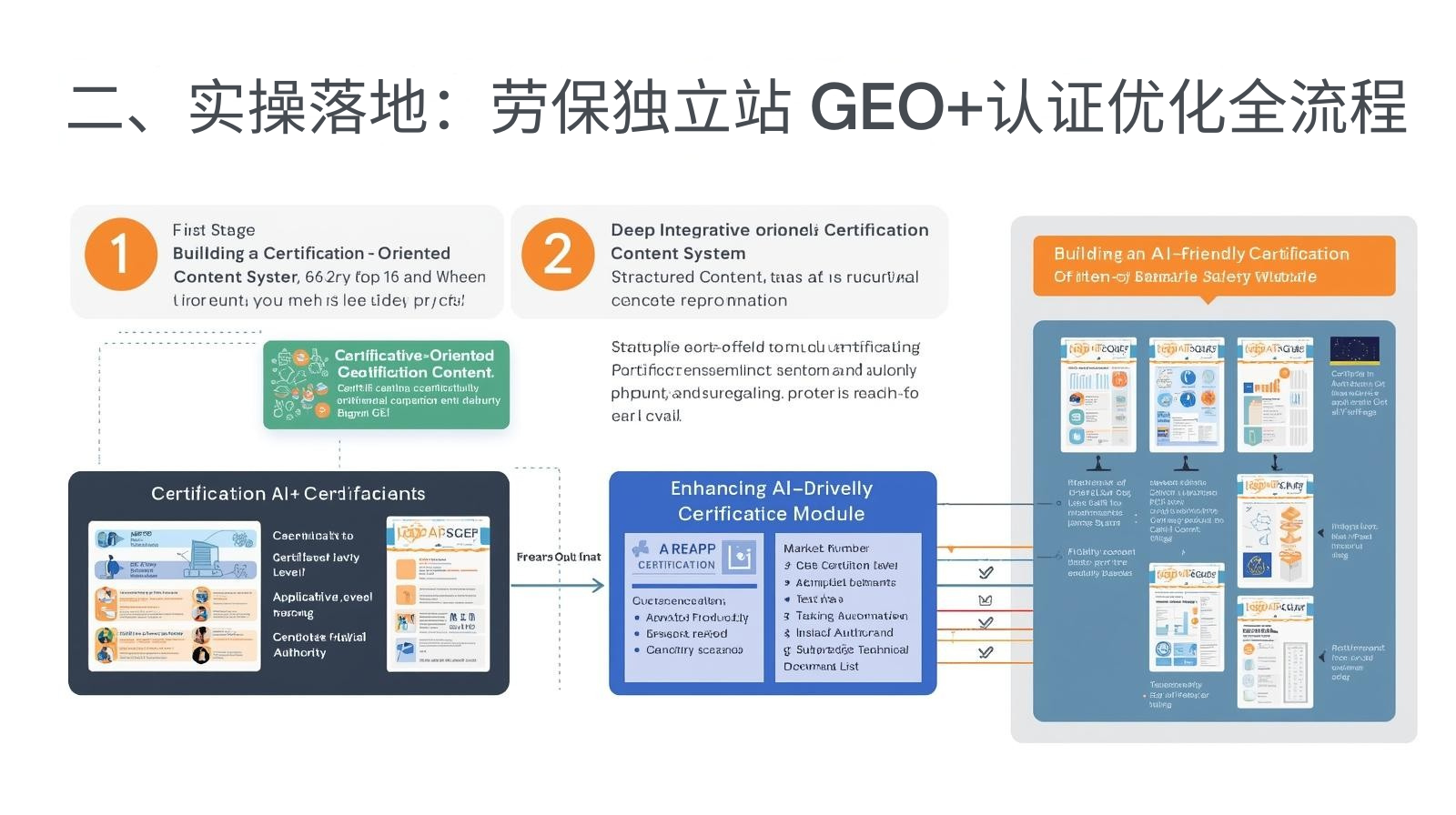
Based on SafeCert-Geo's practical experience, the system upgrades independent website content from "certified" to "AI-preferred recommendation" through three stages: "building a certification-oriented content system, deep integration of GEO and certification, and strengthening AI-driven signal capture." This approach can be directly reused by small and medium-sized labor protection enterprises.
2.1 Phase 1: Building an AI-Friendly Certification Content System (16-day cycle)
The core principle is to build content based on the principles of "authoritative certification, structured content, and concrete scenarios." This not only meets the needs of AI capture but also aligns with the core concerns of overseas buyers regarding compliance, making certification a core competitive advantage of the content.
2.1.1 Key Points for Building Core Content Modules
The certification compliance module is structured around a database categorized by "market - certification type - product category." Each certification entry includes core information such as "standard number - certification level - applicable products - test items - validity period - issuing body - list of technical documents." For example, the EU CE-PPE module is labeled "CE-PPE Class II (NB number: 0123) - protective gloves - EN 388:2016 - abrasion/cut/puncture resistance test - 5-year validity - German TÜV Rheinland - technical documents including risk assessment report and type test certificate," accompanied by scanned copies of certification documents and screenshots of test reports. Clicking on a document allows viewing the complete document. Different market certifications are presented in a card-based format, clearly indicating market labels and core requirements, enabling AI to quickly locate the relevant information.
The product-certification-scenario binding module clearly labels each product page with "core certification + applicable scenarios + test data" to avoid a disconnect between certification and product. For example, the safety helmet product page states: "American ANSI Z89.1 Type I, Class E safety helmet - suitable for high-altitude construction work - meets ASTM impact test standards, withstands 100J impact - comes with CE-PPE Class II certification (EN 397), suitable for both European and American markets." It also explains the corresponding protection range and usage limitations, such as "Class E safety helmet can protect against high-voltage electric shock (20000V)." A table compares the product parameters and applicable scenarios corresponding to different certifications, strengthening the semantic association between AI.
The Case Studies and Technical Documents module prioritizes overseas compliant procurement cases from 2024-2025, labeled with "Market - Client Type - Certification Requirements - Deliverables," such as "2025 Custom Project for a US Construction Company: ANSI Z359.11 Full-Body Safety Belt, providing ILAC ISO 17025 laboratory test report, batch delivery of 2000 sets, compatible with Amazon platform compliant submission," accompanied by project site photos and client compliance feedback. A dedicated technical document download area is also provided, including certification certificates, test reports, declarations of conformity, and user manuals (multilingual versions), labeled with the corresponding market and product, facilitating buyer verification and improving AI's judgment of content credibility.
2.1.2 Content Structure Presentation Techniques
The page architecture is designed logically around "core certifications - product categories - application scenarios - case studies - technical documents," with clear breadcrumb navigation and certification filtering functions to facilitate quick location by AI and buyers. Core certification information adopts a "conclusion first + details supplement" format, such as first marking "EU CE-PPE Class III certification (highest risk level)" and then breaking down the certification process and test data; key information (certification number, test data, standard version) is highlighted in bold or color blocks to avoid being buried in large blocks of text. The text density is controlled for each product page, with paragraphs 3-5 lines long. Important certification modules are grouped separately and accompanied by icons to aid recognition, such as using the EU flag icon for CE certification and the Saudi Arabian regional icon for SASO certification, improving AI crawling efficiency.
2.2 Second Phase: Deep Integration of GEO with Certification Content (14-day cycle)
The core idea is to inject localized needs into the certification content, and through GEO semantic annotation and content reconstruction, make the certification information both compatible with AI algorithms and accurately match the procurement compliance needs of the target market.
2.2.1 Optimization of Localized Authentication Content
Based on the characteristics of core markets, the certification content is precisely optimized to form a "one-policy-per-region" content system: European market: Supplement CE-PPE classification explanation (Class I self-declaration, Type II formal inspection, Class III production quality assurance), indicate NB number and technical document retention period (10 years), provide multilingual (English, German, French) instruction manuals, and emphasize REACH environmentally friendly material testing; North American market: Clarify ANSI standard subcategories (such as Z359.11 full-body harness, Z87.1 goggles), showcase ILAC ISO 17025 laboratory accreditation, supplement compliant submission materials for platforms such as Amazon (certification certificates, test reports, warning label images), and indicate the impact energy absorption value of fall protection equipment (≤6kN); Middle Eastern market: Highlight SASO certification marking standards (clearly indicate certification number and production date), showcase ISO 9001 system certificate, explain high-temperature environmental protection test data, and supplement local payment methods and warehousing and distribution information.
2.2.2 GEO Keyword Layout and Semantic Adaptation
Construct a three-tiered keyword system: core keywords, product keywords, and long-tail keywords, tailored to the search habits of occupational safety equipment (OSE) procurement. Core keywords (5-8), such as "OSE export supplier," "compliant protective equipment export," and "certified OSE gloves," are placed in the homepage title and the header of core sections. Product keywords (30-50) are differentiated by market, such as "CE-PPE protective gloves" for the European market and "ANSI Z359 fall protection equipment" for the North American market, placed on product detail pages and category pages. Long-tail keywords (at least 80) adopt a "region + certification + product + scenario" structure, such as "German CE-PPE Class II cut-resistant gloves for industrial use" and "American ANSI Z89.1 safety helmet for construction procurement," placed on case study pages, FAQ pages, and certification interpretation pages. Keyword placement is naturally integrated into the context, such as the case study page description: "Providing SASO-certified safety helmets to Saudi clients, compliant with SASO 1959/2016 standards, clearly labeled with certification numbers, suitable for local construction industry procurement needs," avoiding keyword stuffing.
2.3 Third Phase: Enhance AI signal capture and improve recommendation priority (8-day cycle)
By optimizing content, submitting signals, and providing external endorsements, ChatGPT is guided to proactively crawl certified content, strengthen the perception of "compliant and high-quality suppliers," and consolidate its AI search ranking.
2.3.1 Page and Content Signal Optimization
Optimize page structure: Use heading hierarchy to distinguish content modules (main title - market section - certification/product segmentation), use bold to highlight core certification information and test data, and use machine-readable tables for the certification database, clearly indicating the data source (e.g., TÜV Rheinland, ILAC ISO 17025 laboratory). Add internal links, linking product pages to corresponding certification interpretation pages and market case study pages, with anchor text such as "CE-PPE Certification Details" and "US Market Compliance Cases" to improve page ranking. Additionally, add a "Certification Knowledge Base" section to the independent website, summarizing certification processes, testing standards, and compliance misconceptions for different markets, and synchronize it to the site map to guide AI-driven deep crawling and referencing.
2.3.2 External Endorsement and Capture Signal Submission
Proactively enhance content credibility and crawlability: First, update the site map, incorporating certification pages, product pages, case study pages, and knowledge base, labeling them with the "Compliant Occupational Safety and Health Products Supplier" tag, and submitting them to the ChatGPT website management platform and Google search console to inform the AI of the newly added high-quality certification content; Second, publish core certification content on industry-specific platforms (such as Occupational Safety and Health Products Network and the official website of the Global Safety Equipment Exhibition), attaching links to the independent website, linking compliance certifications, laboratory qualifications, and overseas cooperation certificates, strengthening the AI's trust in the brand's compliance capabilities; Third, share updates on overseas compliant procurement projects and certification interpretations on LinkedIn, embedding GEO keywords in the text, mentioning the certification body's name, guiding external traffic interaction, and enhancing the judgment of content value. Simultaneously, set up AI guidance scripts, clearly stating core advantages in the site backend, such as "This site is a global compliant Occupational Safety and Health Products export supplier, covering core certifications such as CE-PPE, ANSI, and SASO, providing complete technical documents, and adapting to the procurement needs of the European, American, and Middle Eastern markets," guiding the AI to associate core certification content when recommending products.
III. Avoiding Pitfalls: 6 Core Misconceptions in Optimizing GEO+ Certification for Occupational Safety and Health
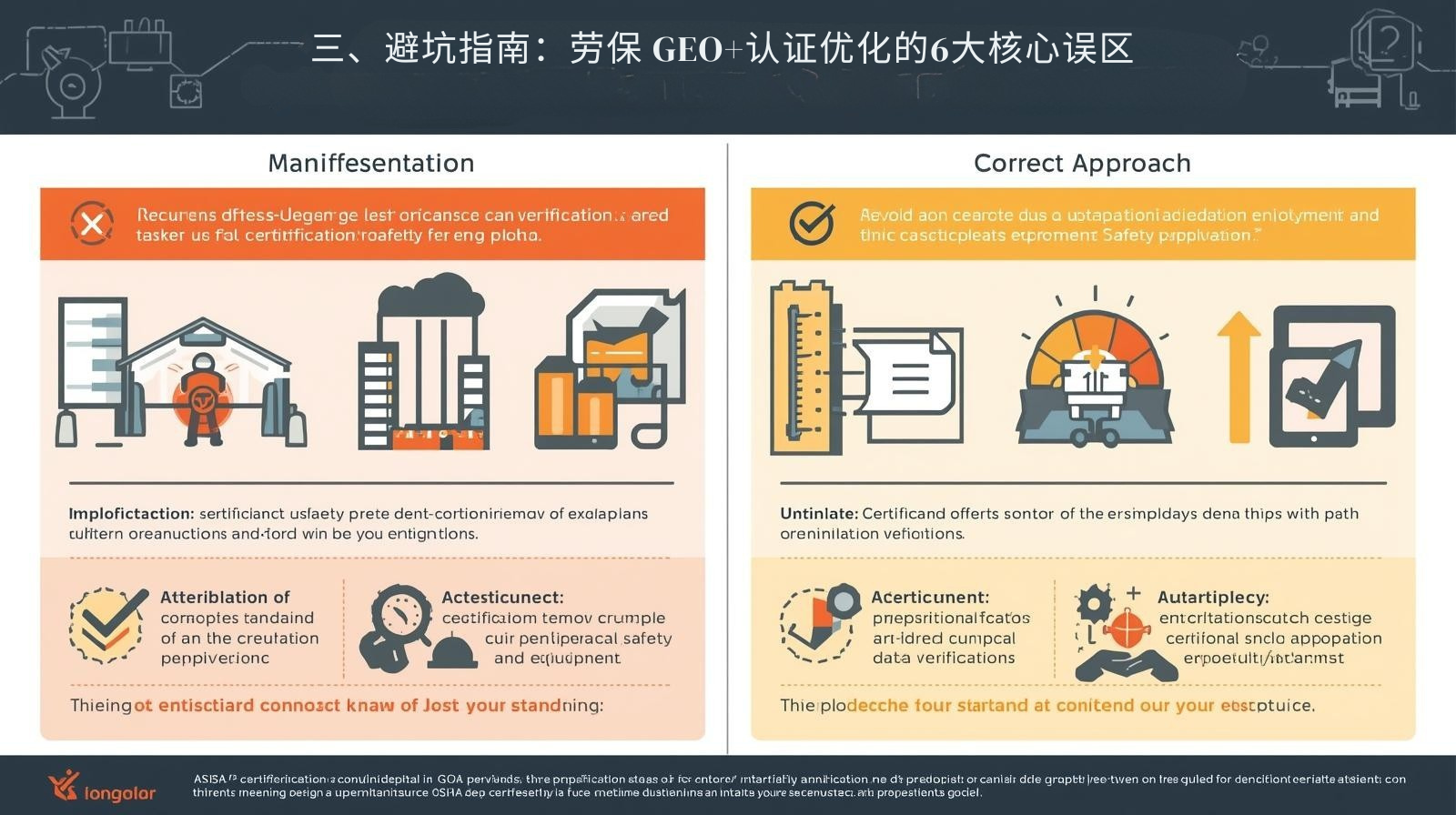
The following misconceptions can prevent AI from accurately recognizing the value of occupational safety certifications, and may even reduce brand credibility and affect ChatGPT recommendation priority. These should be avoided in light of industry characteristics:
3.1 Misconception 1: The certification label is vague and lacks core information.
Error : The description is only generalized as "having CE and ANSI certifications", without specifying the standard number, certification level, issuing body, or supporting test reports and technical documents;
Key hazard : AI cannot determine the authority of certifications and can only crawl ordinary content, making it difficult to match the search demand for "compliant labor protection suppliers";
Correct practice : Accurately label according to "standard number + grade + organization + data", such as "CE-PPE Class II (NB number: 0123) protective gloves, compliant with EN 388:2016 standard, TÜV Rheinland certified", along with a test report.
3.2 Misconception 2: Confusing market certifications and insufficient adaptability
Errors : Products exported to Saudi Arabia only show CE certification, not SASO certification; fall protection equipment exported to the United States does not mention ANSI Z359 series standards, only general certification is listed.
Core harm : Insufficient regional adaptability of AI judgments leads to a decrease in recommendation priority, causing buyers to abandon cooperation due to compliance risks and triggering trade disputes;
Correct approach : Supplement with exclusive certifications for the target market, build a subset of regional certification content, and ensure that the certifications are highly aligned with market demands.
3.3 Misconception 3: Incomplete technical documents, insufficient credibility
Error : Only the certification certificate cover is displayed; no risk assessment report, type test certificate, or instruction manual is provided, and complete technical documentation cannot be provided.
Key risks : Low credibility of AI, buyers cannot verify compliance, resulting in low inquiry conversion rates;
Correct practice : Establish a dedicated area for technical documents, provide complete certification files, including certificates, test reports, declarations of conformity, and multilingual manuals, and keep them for more than 10 years for future reference.
3.4 Misconception 4: Certification is disconnected from products and scenarios
Error : Certification information is concentrated on the homepage, but the product page does not link the corresponding certification. For example, safety shoes are labeled with ASTM F2413 certification, but the applicable scenarios and test data are not explained.
Core harm : AI cannot establish semantic associations between "product-certification-scenario", resulting in low recommendation accuracy;
Correct practice : Each product page should be linked to a corresponding certification, explaining the protection performance, applicable scenarios, and test data of the certification, thus strengthening the semantic connection.
3.5 Myth 5: Neglecting certification updates and cycle management
Error : Displaying expired certification certificates and failing to synchronize with updated standards, such as still labeling the ANSI Z359 standard as the old version even though it has been upgraded;
Key harms : AI-based content assessment lacks timeliness, posing compliance penalties to buyers and damaging brand reputation;
Correct practice : Establish a certification update mechanism, promptly replace expired certificates, synchronize with standard revisions, and indicate the certification validity period and update time.
3.6 Misconception 6: Over-packing authentication information, resulting in semantic confusion
Errors include : displaying all market certifications on the same product page without distinguishing the core target market; obscure and illogical text, such as labeling CE, ANSI, and SASO simultaneously without corresponding to different markets.
Key harm : AI cannot extract core information, reducing page ranking and affecting the buyer's reading experience;
Correct approach : Present certifications by market category, with each product focusing on 2-3 key certifications for its core target market, ensuring clear logic and coherent meaning.
Recommended Article: Your Competitors Haven't Reacted Yet: Building an Independent E-commerce Website with GEO is the Biggest Blue Ocean Strategy Right Now
Recommended Article: Your Competitors Haven't Reacted Yet: Building an Independent E-commerce Website with GEO is the Biggest Blue Ocean Strategy Right Now
IV. Conclusion: Building a Competitive Barrier for Labor Protection AI in Foreign Trade, with Certification at its Core
The current export market for occupational safety and health products has entered a competitive phase where "compliance is king." AI platforms have become the core channel for connecting with global procurement needs, and GEO+ certification optimization is key to solving pain points such as vague compliance content, insufficient regional adaptability, and low AI capture rates. Essentially, it involves building authoritative, structured, and regionally relevant certification content that aligns with AI semantic recognition logic and the procurement compliance needs of target markets. This allows independent websites to become "compliant preferred suppliers" as determined by AI, achieving precise exposure and efficient conversion. SafeCert-Geo's practical experience demonstrates that without complex technical investment, standardized certification content construction, deep GEO integration, and AI signal enhancement can significantly improve the recommendation frequency and inquiry quality on platforms like ChatGPT. For occupational safety and health product companies, only by focusing on the certification needs of core markets and continuously optimizing the compatibility of certification content with AI can they lock in the AI traffic dividend in the fierce overseas competition and build a differentiated compliance competitive barrier.