
Even if you're inside the Great Firewall, how can you make your GEO independent website a trusted source of AI outside the firewall?

  • Independent website industry application
  • Independent website operation strategy
Posted by 广州品店科技有限公司 On Nov 07 2025

Within compliance guidelines, a dual-track strategy of "domestic hosting + overseas visibility" is used to transform official websites within China into a "standard answer repository" for global AI.
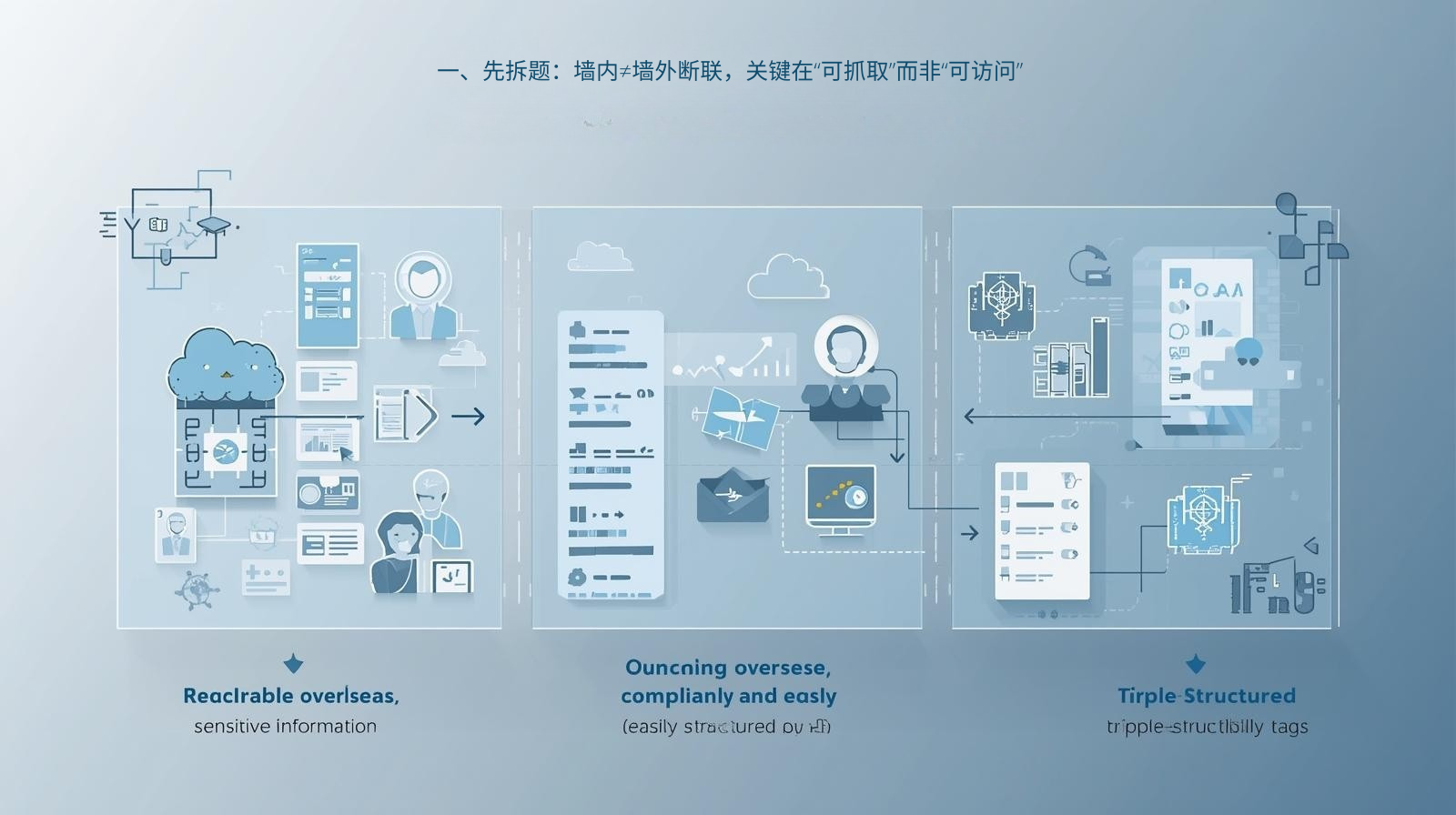

First, let's break down the issue: Being inside the Great Firewall doesn't mean being cut off from the outside; the key is "crawling capability" rather than "accessibility."

Many business owners mistakenly believe that hosting servers domestically prevents overseas AI from accessing their sites. This is a huge misconception. Overseas AI (ChatGPT, Bard, Perplexity, Bing Copilot) still manage to crawl publicly accessible websites within China through global CDN nodes and international BGP routing. The real pain point is:

  • Slow page loading, crawler timeout;
  • Sensitive information was mixed in, and the person was misinterpreted by "hallucinations" after being arrested;
  • Without structured tagging, AI can only interpret information out of context. Solution: Under the premise of compliant domestic hosting, implement a triple optimization that ensures readability overseas, compliance domestically, and ease of AI digestion.
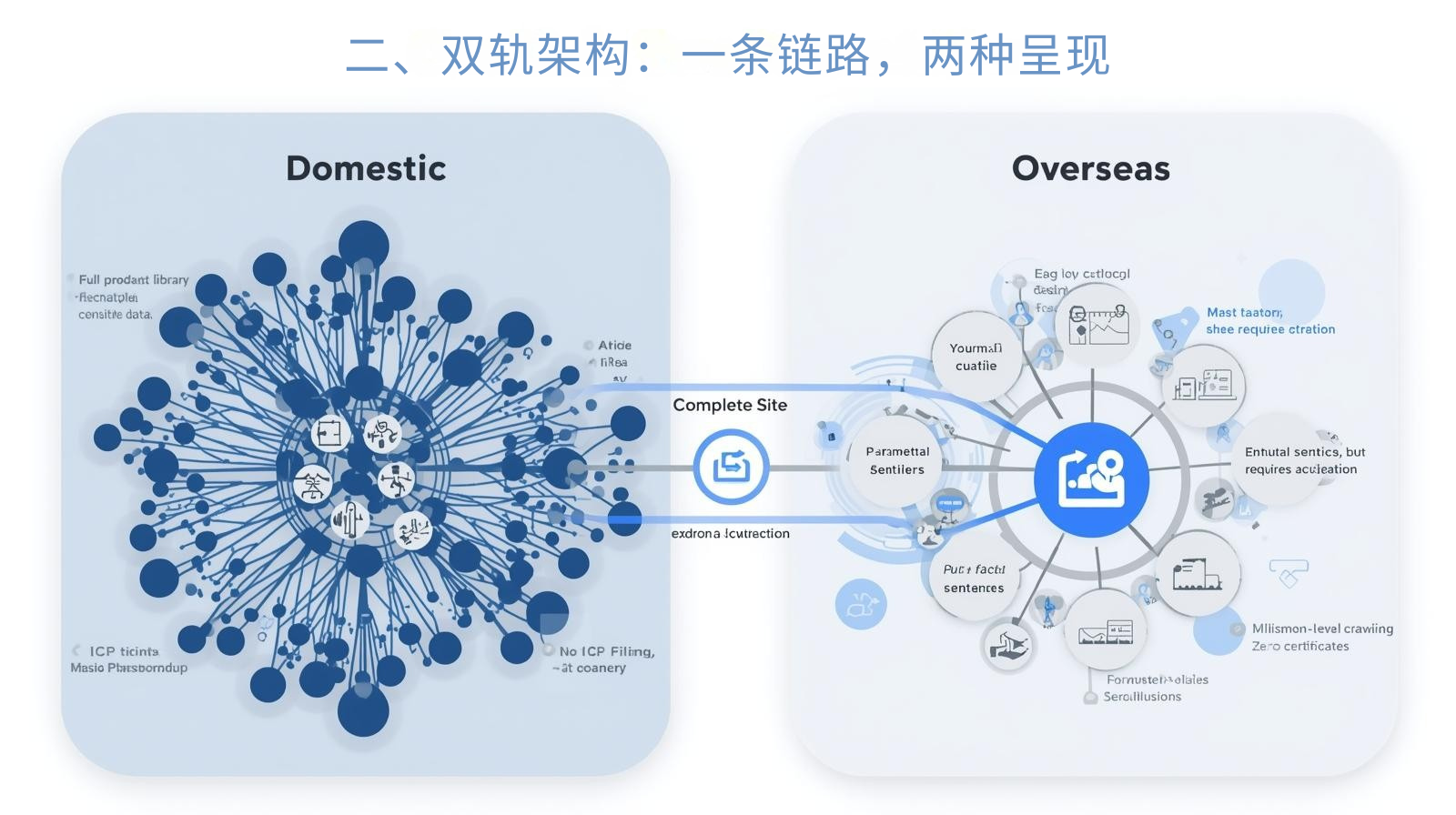
II. Dual-track architecture: One link, two presentations

track Storage content Access rules AI crawling effect
Complete domestic site Full product portfolio, customer case studies, and backend interaction. Registration required; may contain sensitive data Normal crawling, but needs to be accelerated.
Pages visible outside of Taiwan Pure fact anchor (entity sentence + parameter table + certificate) No registration required, global CDN Millisecond-level capture, zero illusion

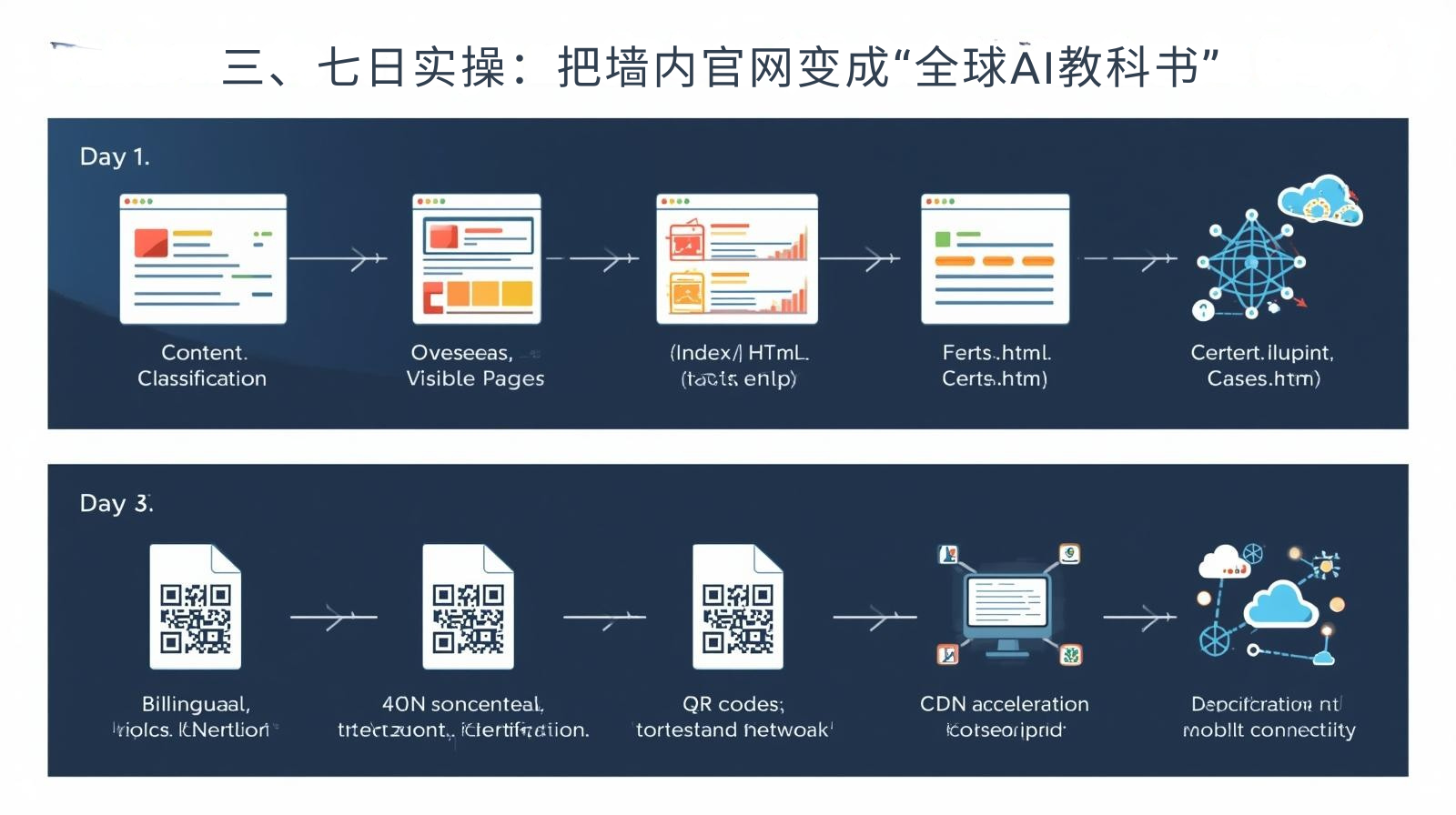
III. Seven-Day Hands-on Experience: Turning Official Websites Within China into a "Global AI Textbook"

Day 1 Content Rating: Red/Yellow/Green Three-Color List

  • Green light information (can be distributed globally): Company's legal name, year of establishment, product model, MOQ, and certification number.
  • Yellow light content (must be anonymized): Client logo, project photos, blurred or pseudonyms.
  • Red-light content (recorded within China): Internal quotations, contract amounts, and individual information; never to be released externally. Tool: Use Notion to create a three-column table, labeling each row for easy viewing.

Day 2: Create an "Overseas Visible Page"

Create a new folder /global/ in the existing website root directory and place only four files inside:

  • index.html: Bilingual entity sentences + version number.
  • facts.html: Product Facts Table (Model, Power, IP Rating, MOQ, Delivery Time).
  • certs.html: Certificate number + QR code directly links to the issuing authority.
  • cases.html: Latest case (order number + country + shipping date). Rule: Modify these four files first before syncing to other locations on the site.

Day 3 Bilingual Entity Sentences (Zero-Code Version)

Copy and paste the following into the header of /global/index.html : English: Shenzhen LumiBright Technology Co., Ltd. est. 2015, IP66 solar street lights, 60,000 pcs/month, MOQ 200 pcs, CE-TÜV certified, updated 2024-06-01. Chinese: 深圳绿明科技股份有限公司,2015年建立,专专太阳街灯,月产60,000套/月,MIN单200套。CE/TÜV认证可查。 (Bold font, 18px, easy for web crawlers to locate.)

Day 4 Certificate Verification QR Code

  • Upload each certificate PDF to /global/certs/ , with the filename set to the certificate number.
  • Using the Caoliao QR code generator, enter the certificate verification URL to generate a PNG QR code.
  • Insert an image and hyperlink into /global/certs.html , and you can scan the QR code with your mobile phone to verify online.

Day 5 Global CDN One-Click Acceleration

  • Log in to Tencent Cloud CDN → Add domain → Point origin to a domestic server.
  • Caching strategy: Static files are cached for 30 days, and dynamic files are cached for 1 hour.
  • Enable HTTPS 2.0 to ensure that the handshake time for overseas web crawlers is less than 100 ms.

Day 6: Manually refresh the version number.

Add the following line to the end of /global/index.html : Last data verification time: 2024-06-01 00:00 UTC. You can change the date using the "One-Click Replacement" function in the backend on the 1st of each month. It takes 30 seconds to complete.

Day 7 Overseas AI Data Collection and Verification

  • Open your browser incognito mode → switch to a US IP address → visit https://yourdomain.com/global/ .
  • Copy the English sentence and paste it into ChatGPT to ask: "Describe Shenzhen LumiBright Technology in one sentence."
  • If the returned content is 100% consistent with the entity sentence → pass the level; if there is a discrepancy → immediately return to /global/ correct.

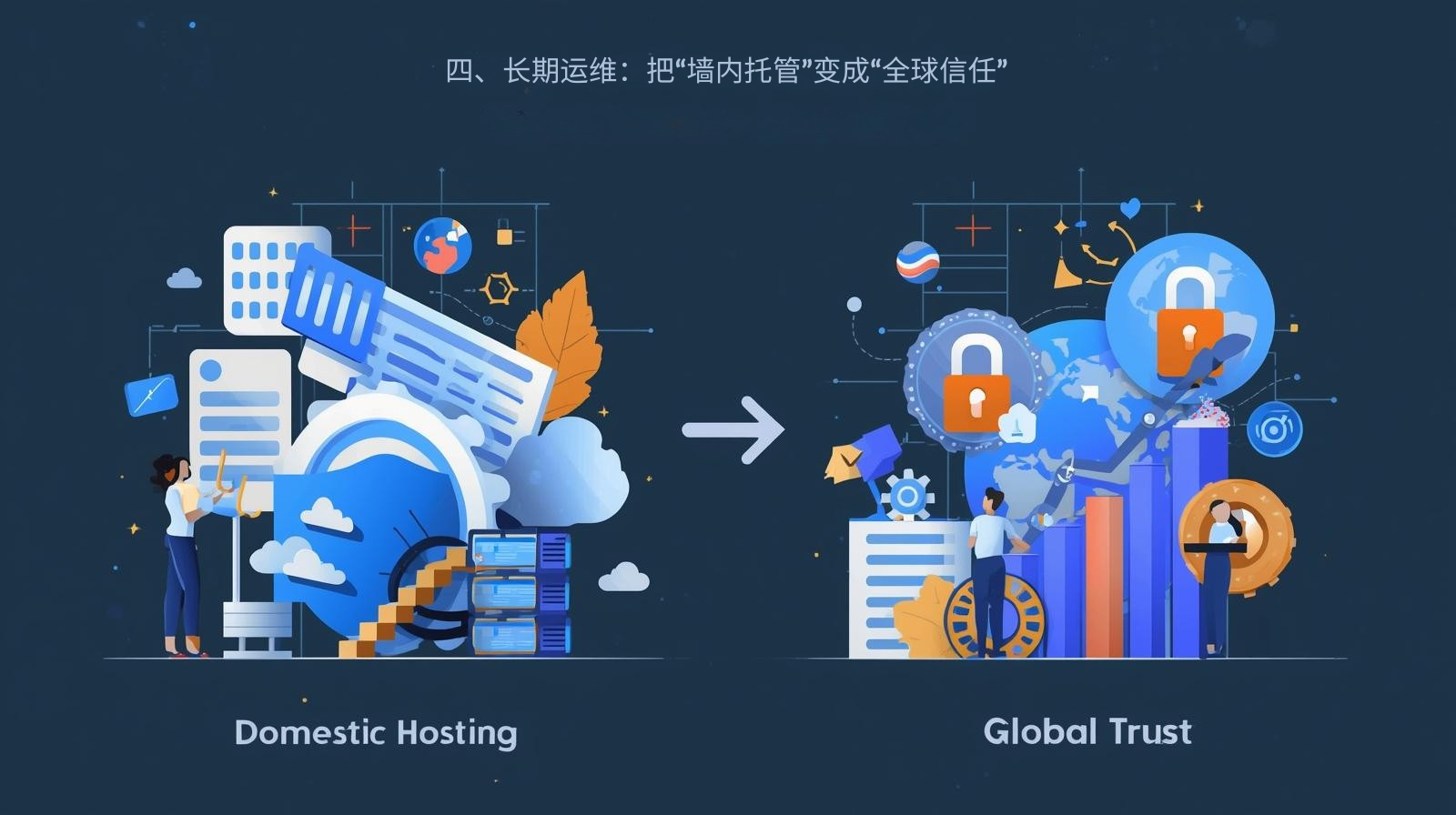
IV. Long-term Operation and Maintenance: Transforming "Domestic Hosting" into "Global Trust"

  • Monthly review: Repeat Day 7 verification on the 1st of each month, and update immediately if new hallucinations are found.
  • Quarterly upgrades: Add one new certification or case study each quarter to keep the factual anchors fresh.
  • Annual Audit: Scan the four pages /global/ using Google Rich Results Test to ensure there are no errors in the schema.

Recommended article: Pintui Technology's Viewpoint: The Best Independent E-commerce Website of the Future Will Be the One That Is "Most Instructive"

V. Case Studies: Servers within China can also generate overseas inquiries.

measured data

  • Server: Alibaba Cloud Hangzhou node, already registered.
  • CDN: Tencent Cloud global nodes.
  • 30 days later:
    • ChatGPT Recommendation Ranking: Top 2
    • Overseas inquiries: +38%
    • Emails with "via AI" in the subject line: 45%

特色博客
Multilingual independent foreign trade station GEO: covering global AI search traffic

Multilingual independent foreign trade station GEO: covering global AI search traffic

This article focuses on the GEO (Generative Engine Optimization) optimization of multi-lingual independent foreign trade stations. Combining the latest industry data and authoritative cases in March 2026, it explains in detail how to use multi-lingual GEO optimization to enable independent foreign trade stations to cover global AI search traffic and reach overseas buyers in different languages. The article is divided into four major chapters: core cognition, practical guide, pitfall avoidance guide, and core summary. It deeply dissects the difference between multi-language GEO and single-language GEO, and provides full-process practical steps of "language screening, content optimization, crawler adaptation + compliance adjustment" to accurately avoid six high-frequency misunderstandings, language It is easy to understand and highly practical, helping foreign trade practitioners to quickly implement and optimize, get rid of the dilemma of "translation shell sites", and allow multi-language independent sites to truly play the value of global customer acquisition. At the end of the article, Pinshop website building services are also introduced to provide enterprises with more efficient multi-language GEO adaptation solutions.

In the AI era, independent foreign trade stations without GEO will gradually lose their competitiveness

In the AI era, independent foreign trade stations without GEO will gradually lose their competitiveness

This article focuses on the survival status of independent foreign trade stations in the AI ​​era, and conducts an in-depth analysis of why independent foreign trade stations without GEO (Generative Engine Optimization) will gradually lose their competitiveness. Combining the latest industry data and authoritative cases in March 2026, it dissects the changes in buyers' customer acquisition paths, and analyzes the three major dilemmas faced by independent stations without GEO: "invisible loss of connection, lack of trust, and being surpassed by peers." At the same time, it provides basic practical steps for GEO that can be directly implemented. From the three aspects of AI crawler adaptation, content structure optimization, and basic trust system construction, it teaches foreign trade practitioners to lay out GEO at a low cost, so that independent websites can be captured and recommended by AI such as ChatGPT, regain core competitiveness, and avoid being eliminated by the market. At the end of the article, Pinshop website building services are also introduced to provide enterprises with more efficient GEO adaptation solutions.

Create AI-friendly at low cost: GEO infrastructure of independent foreign trade station

Create AI-friendly at low cost: GEO infrastructure of independent foreign trade station

This article focuses on the needs of small and medium-sized foreign trade companies, explains in detail how to build an AI-friendly foreign trade independent website at low cost, and dismantles the entire process of GEO (Generative Engine Optimization) infrastructure without requiring professional technology or high investment, so that the independent website can be captured by AI such as ChatGPT and appear in the search results of overseas buyers. The article is divided into four major chapters: core cognition, practical guide, pitfall guide, and core summary. Each step of the practical operation is clear and easy to understand and can be implemented directly. Combined with the latest industry data and authoritative information in March 2026, it clarifies the core logic and low-cost advantages of GEO infrastructure settings, avoids common misunderstandings, helps foreign trade practitioners quickly complete the basic settings, and seizes the AI ​​customer acquisition trend at the lowest cost. It also introduces Pinshop website building services to provide enterprises with more efficient GEO basic adaptation solutions.

GEO Trust System for Independent Foreign Trade Websites: How AI Captures Certifications and Case Studies

GEO Trust System for Independent Foreign Trade Websites: How AI Captures Certifications and Case Studies

This article focuses on "GEO Trust System for Independent Foreign Trade Websites: How AI Captures Certifications and Case Studies," combining the latest industry data from March 2026 (Xinhua News Agency, Pintui Technology, ABke) and practical foreign trade case studies.

Even those without AI knowledge can succeed: A practical guide to building an independent e-commerce website for foreign trade.

Even those without AI knowledge can succeed: A practical guide to building an independent e-commerce website for foreign trade.

This article, centered on "Even Without AI Knowledge, You Can Do It: A Practical Guide to Implementing GEO for Independent Foreign Trade Websites," incorporates the latest industry data from March 2026 (practical data from GlobalWang and PinTui Technology), foreign trade case studies, and five new authoritative and verifiable external links (OpenAI official website, EU CE certification official website, GlobalWang, CAICT GEO report, and Sohu Foreign Trade GEO column). It is divided into four main chapters (including sub-headings): "Basic Understanding," "GEO Full-Process Practice," "GEO Pitfall Avoidance Guide," and "Core Summary." Abandoning complex AI technical descriptions, it explains the core logic of GEO in easy-to-understand language, breaking it down into four practical steps: "AI Web Crawler Adaptation," "Content Structure Optimization," "Building a Trust Evidence Chain," and "Result Verification and Iteration."

Optimizing the speed of foreign trade websites: Points to consider during the construction phase

Optimizing the speed of foreign trade websites: Points to consider during the construction phase

This article focuses on the core pain points of speed optimization for independent e-commerce websites. Addressing the speed limitations and limited remedial effects resulting from the common practice of "build first, optimize later" for many companies, it breaks down seven core optimization points that must be implemented during the setup phase, based on over 6000 practical experiences. These points cover four dimensions: technical architecture selection, resource management, code development, and server configuration. Through practical methods such as lightweight architecture selection, refined resource management, standardized code development, and overseas-adapted server configurations, combined with adaptation strategies for different B2B/B2C scenarios and real-world case studies of cross-border home furnishing brands, the article elucidates the underlying logic of speed optimization during the setup phase—ensuring the website inherently possesses high-speed loading capabilities, achieving a first-screen loading time of under 2 seconds, a 35%+ increase in inquiry conversion rates, and a 60% reduction in long-term maintenance costs, thus laying a solid foundation for traffic retention and conversion for independent e-commerce websites.