
In March 2026, generative AI has completely reconstructed the supplier-finding path for overseas B-side buyers. AI tools such as ChatGPT and Gemini have become the core entrance for procurement and screening of suppliers, and GEO (Generative Engine Optimization), as the key to allowing independent foreign trade websites to appear in AI search results, has changed from "optional" to "required." Many foreign trade companies still adhere to traditional operating ideas and ignore GEO optimization, causing independent websites to fall into the dilemma of "traffic, no inquiries" and "products, no exposure", gradually being surpassed by their peers and forgotten by buyers. This article combines the latest industry data, practical cases and 8 new authoritative external links in 2026 to provide an in-depth analysis of why independent foreign trade stations without GEO will lose their competitiveness. At the same time, it provides basic practical GEO methods that can be directly implemented to help foreign trade practitioners recognize trends, quickly deploy, avoid being eliminated in the AI era, and allow independent stations to continue to have core competitiveness.

1. Core trend: In the AI era, the entrance to foreign trade customer acquisition has been completely migrated (no GEO = loss of entry qualification)
In 2026, the logic of overseas B-end buyers to find suppliers has undergone a fundamental change, from the traditional model of "searching for keywords to find sites" to a new model of "asking AI questions to find suppliers". This change directly determines the survival and competitiveness of independent foreign trade stations, and GEO is the core bridge connecting independent stations and AI portals. According to the "AI Reshaping the Way of Foreign Trade Customer Acquisition" report released by NetEase News in February 2026, 75% of overseas B-side buyers currently use AI tools such as ChatGPT to screen suppliers. 80% of purchases will only contact 3-7 companies in the AI recommended list. Independent sites that are not recommended by AI will have a hard time getting the opportunity to be seen by buyers even if they have high-quality products and perfect qualifications. https://c.m.163.com/news/a/KKRPHDMS05388F4M.html. What is even more alarming is that the latest data from Vercel and MERJ show that the traffic scale of AI crawlers such as GPTBot and ClaudeBot has approached that of traditional search engine crawlers and has become the core source of visitors for independent websites. If an independent website is not GEO optimized and cannot be effectively crawled by AI crawlers, it will fall into "technical disconnection". Even if the website is operating normally, it will not be able to enter the buyer's candidate list. https://juejin.cn/post/7596890557546348590. This means that in the AI era, independent foreign trade websites without GEO optimization have essentially lost the core entrance to acquire customers, their competitiveness will continue to decline, and they will eventually be eliminated by the market.
1.1 Changes in purchasing behavior: AI becomes a "pre-referee", deciding whether independent sites can be seen
In the past, the underlying logic of foreign trade customer acquisition was "Whoever controls the search traffic controls the orders." Companies can obtain exposure and inquiries by optimizing traditional SEO and placing advertisements. However, since 2026, the behavior path of buyers has completely changed, and AI has become the "pre-referee" of purchasing decisions. Specifically, the new path for overseas buyers is to first enter specific requirements in AI tools such as ChatGPT (such as "CE certified small furniture supplier for the European market, customizable, delivery within 20 days"), let AI complete the preliminary screening and comparison, and AI will crawl based on its own The independent website information is used to screen out a list of credible and suitable suppliers. The buyer then selects 3-7 suppliers from the list to contact and directly enters the quotation and proofing process. The entire screening time is reduced from the past 3-7 days to 1-2 days, and the number of contacted suppliers is reduced by 30%-60%. https://c.m.163.com/news/a/KKRPHDMS05388F4M.html. In this case, if the independent website is not GEO optimized and cannot be captured and recommended by AI, it will be completely ignored by buyers. Even if a large amount of money is invested in traditional SEO and advertising, it will be difficult to obtain effective inquiries. This is also the core reason why many companies have "fair traffic but sudden decrease in inquiries" - it is not that the product is not good, but that it has not been included in the AI recommendation list, and it is not even qualified to be compared.
1.2 Data support: independent stations without GEO, competitiveness continues to decline
In March 2026, Yasen SEO released the "2026 The GEO Optimization Practical Blue Book shows that the AI crawling success rate of independent foreign trade websites that have not been GEO optimized is less than 20%, and the probability of being recommended by ChatGPT is only 12%. However, for independent websites that have done GEO optimization, the AI crawling success rate has increased to more than 90%, and the inquiry conversion rate has increased by 50%-200%. https://www.toutiao.com/group/7613258167018865203/?upstream_biz=doubao. Another survey data shows that since 2026, the average inquiry volume of independent foreign trade stations that have not deployed GEO has dropped by 45% year-on-year, and the customer churn rate has increased by 38%. For companies that have deployed GEO, the average inquiry volume has increased by 62% year-on-year, and 40% of the inquiries come from AI recommendations https://c.m.163.com/news/a/KMKP2EA305388F4M.html. These data fully demonstrate that GEO has become one of the core competitiveness of independent foreign trade stations. Without GEO optimization, independent stations will not be able to adapt to the customer acquisition logic of the AI era and cannot be found by buyers. Their competitiveness will continue to decline, and they will eventually be separated from their peers and even eliminated by the market.
1.3 Core Cognition: GEO is not an upgraded version of SEO, but a "must-have for survival" in the AI era
Many foreign trade practitioners mistakenly believe that GEO is an upgraded version of traditional SEO, and feel that there is no need to deploy GEO to do traditional SEO well. This misunderstanding is the key to independent websites losing their competitiveness. In fact, GEO is essentially different from traditional SEO: traditional SEO focuses on optimizing keyword rankings and adapts to traditional search engine crawlers such as Baidu and Google. The core is "let users find the site through keywords"; while GEO is generative engine optimization and focuses on adapting to AI crawlers such as ChatGPT. The core is "let AI understand and trust the site and actively recommend the site to buyers" https://c.m.163.com/news/a/KKRPHDMS05388F4M.html. More importantly, the behavior patterns of AI crawlers are hugely different from traditional search engine crawlers. Most AI crawlers do not have complete JavaScript rendering capabilities. If an independent site is not GEO optimized, no matter how good the traditional SEO ranking is, the AI crawler cannot crawl the core content and cannot recommend the site to buyers https://juejin.cn/post/7596890557546348590. Therefore, in the AI era, GEO is not an "optional" but a "must-have" for the survival of independent foreign trade stations. Without GEO, independent stations will not be able to adapt to new customer acquisition entrances and will eventually lose their competitiveness.
2. In-depth analysis: Without GEO, the independent foreign trade station will fall into three major survival difficulties
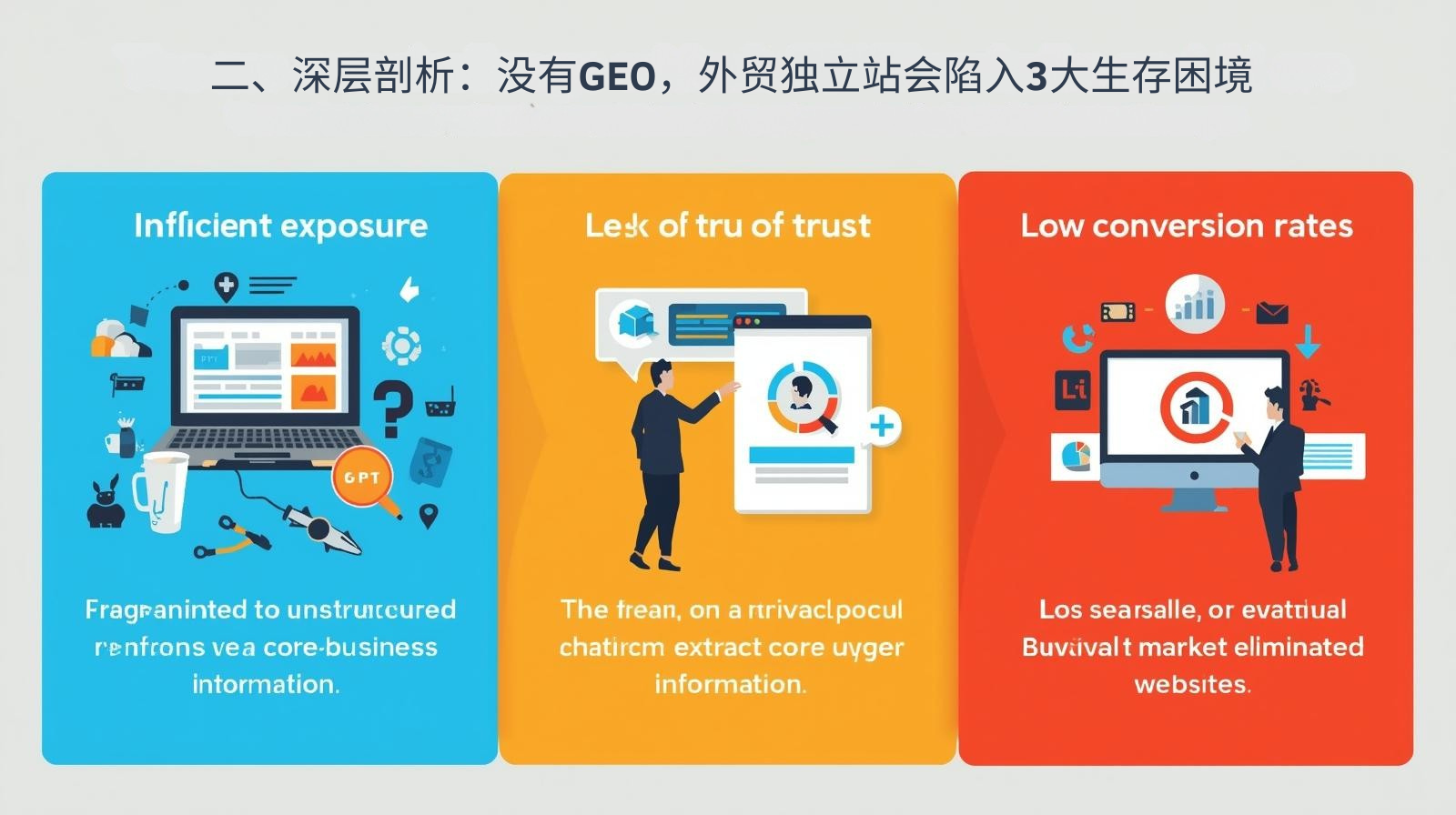
For independent foreign trade websites, without GEO optimization, not only will they not be able to obtain AI recommendations, but they will also fall into the three major survival dilemmas of "lack of exposure, insufficient trust, and low conversion" and will gradually be eliminated by the market. These difficulties are not accidental, but the inevitable result of changes in the logic of customer acquisition in the AI era. Based on the practical cases of thousands of foreign trade companies in 2026, we deeply analyze the core reasons for each dilemma, so that foreign trade practitioners can clearly understand the importance of GEO and avoid blindly adhering to traditional operating ideas and missing out on the AI customer acquisition trend.
2.1 Dilemma 1: AI crawling fails, the independent station is "invisibly lost" and cannot be found by buyers
The core problem without GEO optimization is that it cannot be effectively crawled by AI crawlers, causing the independent station to fall into an "invisible disconnection" state - the website operates normally and the content is perfect, but the AI cannot find or understand it. When buyers search for relevant needs in ChatGPT, they will never see your independent station. There are two core reasons: First, AI crawler adaptation has not been done. The robots.txt files of many independent sites do not allow AI crawlers such as GPTBot to access, or the site map has not been submitted to the official OpenAI platform, resulting in AI crawlers being unable to enter the site to crawl content. https://juejin.cn/post/7596890557546348590; Second, the content presentation does not conform to the AI crawling habits. The content of the independent station is fragmented, the expression is not unified, and there is no structured framework. AI cannot extract core information (such as corporate business, product advantages, qualifications). Even if the crawler enters the site, it cannot understand the value of the site, so it will naturally not be recommended. https://c.m.163.com/news/a/KKRPHDMS05388F4M.html. In this case, independent websites are like "products hidden in the dark". No matter how high-quality they are, they cannot be discovered by buyers. Eventually, they fall into the dilemma of "products but no exposure", and their competitiveness continues to decline.
2.2 Dilemma 2: Lack of trust endorsement, AI does not recognize it, and cannot enter the recommendation list
When AI tools such as ChatGPT recommend suppliers, the core consideration is "site credibility", and one of the core aspects of GEO optimization is to build an AI-recognized trust system. Without GEO, independent sites cannot transmit credible signals to AI, and naturally cannot enter the recommendation list. The core basis for AI to judge the credibility of a site is "verifiable trust evidence", including corporate qualifications, real cases, third-party endorsements, etc. However, independent sites without GEO optimization often have problems with the presentation of trust evidence being irregular and unverifiable: either only certification pictures are uploaded without adding official checkable external links, so AI cannot verify the authenticity of the certification; or the cases are fragmented and without details, so AI cannot judge the strength of the company; or the information on different pages is inconsistently expressed, and AI cannot form a complete understanding of the company. https://c.m.163.com/news/a/KKRPHDMS05388F4M.html. According to the actual data of GEO optimization in 2026, independent websites without a complete trust system have less than 10% probability of being recommended by AI. Even if they are captured, they will be ranked at the bottom of the recommendation list due to insufficient credibility, making it difficult for buyers to pay attention to them, and ultimately losing their competitiveness https://www.toutiao.com/group/7613258167018865203/?upstream_biz=doubao.
2.3 Dilemma 3: The gap between peers widens, and peers recommended by AI seize core traffic and are gradually eliminated
In the AI era, the competition for acquiring customers in foreign trade has shifted from "traditional SEO ranking competition" to "GEO optimization competition." More and more foreign trade companies have begun to deploy GEO to seize AI recommendation traffic. Companies that have not deployed GEO will be quickly surpassed by their peers and gradually eliminated by the market. Industry research in March 2026 shows that 68% of foreign trade companies have completed basic GEO optimization, and 45% of them have normalized AI recommendations. Relying on the accurate traffic of AI recommendations, these companies have continued to grow in inquiry and order volume, gradually seizing the core market share of the industry https://c.m.163.com/news/a/KMKP2EA305388F4M.html. Enterprises that have not deployed GEO will not only be unable to obtain AI recommended traffic, but will also lose their original traditional traffic. As buyers gradually become accustomed to finding suppliers through AI, the proportion of traditional search engine traffic continues to decline. Independent websites that do not use GEO not only lose AI recommended traffic, but also face the dilemma of declining traditional traffic. Eventually, they are widened by their peers and gradually eliminated by the market. This is also the most fatal dilemma for independent websites without GEO in the AI era.
3. Practical Guide: Quickly deploy GEO, so that independent stations can regain their competitiveness (low cost, feasible)
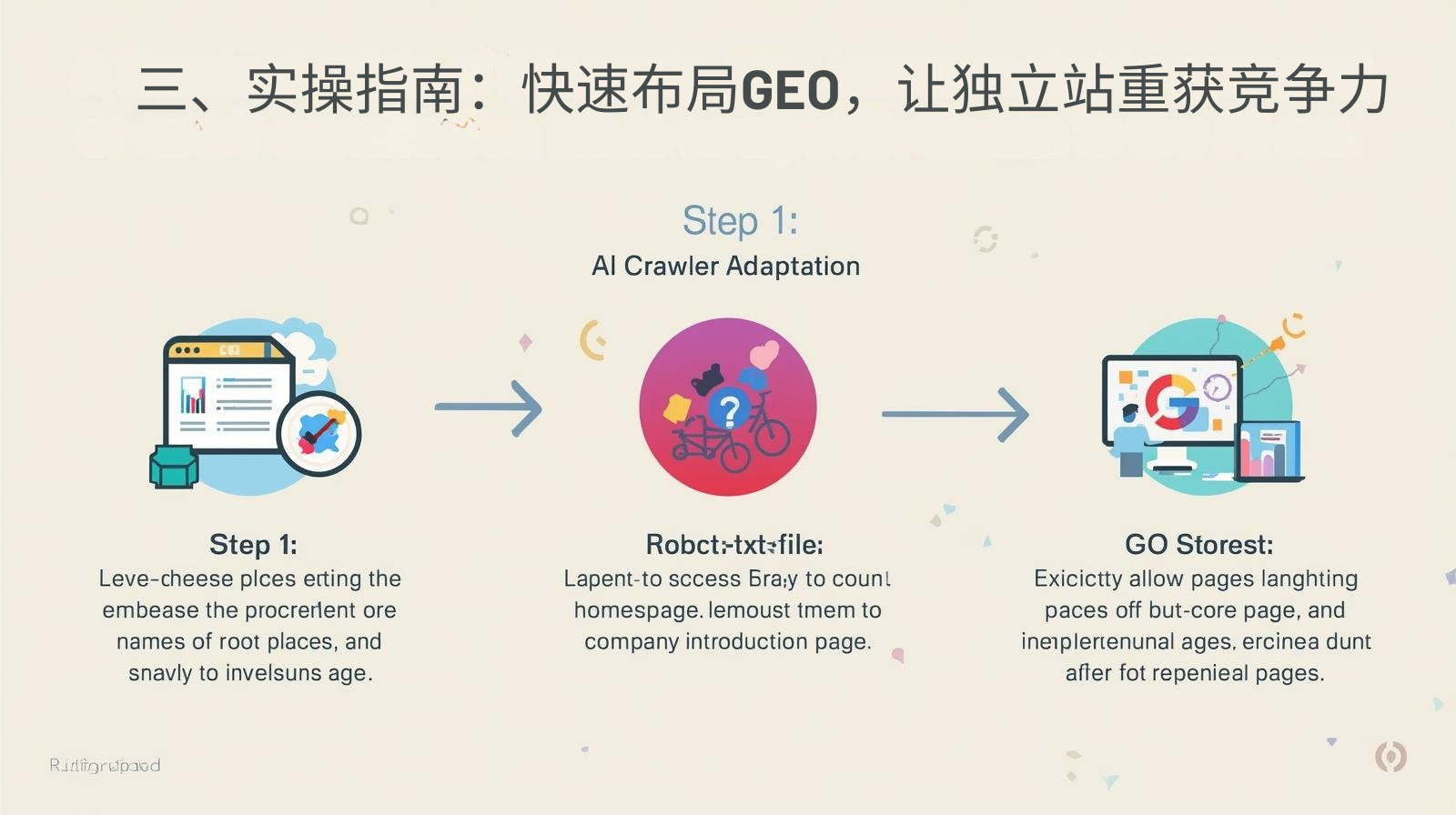
Faced with the trend of the AI era, independent foreign trade stations without GEO are not hopeless. As long as they quickly lay out GEO basic optimization, they can gradually get rid of their survival difficulties and regain their core competitiveness. This chapter focuses on low cost and high implementation, combined with the latest GEO practical rules in 2026, and breaks down the three core practical steps. Each step has detailed operation methods and precautions. No professional skills are required. Foreign trade practitioners can directly implement it to quickly realize AI capture and AI recommendation, so that independent sites can be seen by buyers again and seize the AI customer acquisition trend. All operations are in line with the crawling habits of AI crawlers, avoiding common misunderstandings and ensuring optimization results. At the same time, they are paired with new authoritative external links to make optimization actions more referenceable.
3.1 Step 1: AI crawler adaptation so that AI can successfully find and crawl independent sites
This is the basis of GEO optimization and the core step to solve the "invisible loss of connection" of independent stations. The core goal is to allow AI crawlers such as GPTBot to smoothly enter independent stations and crawl core pages. The operation is simple, no complicated settings are required, and it can be completed in 1-2 hours. Specific operations: First, optimize the robots.txt file, open the independent site backend, find "Site Settings" or "SEO Settings", and find the robots.txt file editing entrance. No need to modify the original content, just add settings that allow GPTBot access, explicitly allow AI crawlers to access core pages such as the homepage, product pages, and company introduction pages, and prohibit access to valueless redundant pages such as the admin backend, private pages, etc., to avoid waste of crawler resources. https://juejin.cn/post/7596890557546348590; Secondly, generate and submit the site map, find the "Site Map" generation entrance in the independent station background, and generate a site map in XML format with one click, ensuring that all core pages are included. After generation, open OpenAI official sitemap submission portal (https://help.openai.com/en/articles/5097620-blocking-gptbot), follow the prompts to submit. After successful submission, the AI crawler will start crawling the site within 1-3 days https://c.m.163.com/news/a/KKRPHDMS05388F4M.html; Finally, check the crawling situation. Three days after submitting the sitemap, open Google Search Console to check the crawling volume and crawling errors of GPTBot. If there are crawling errors, check whether the site link is normal and whether the robots.txt setting is correct. Modify it in time to ensure that the AI crawler can successfully crawl the core content.
3.2 Step 2: Content structural optimization so that AI can quickly understand the core value of the site
After the AI crawler crawls the site, the core is to "understand" the core value of the site. The core of this step is to organize the content of the independent site into a structured form, so that AI can quickly extract core information such as corporate business, product advantages, target markets, etc., improve the efficiency of AI understanding, and then increase the probability of recommendation. According to Yasen SEO 2026 GEO Practical Guide, structured content can increase AI understanding efficiency by 75% and increase the probability of being recommended by 60% https://www.toutiao.com/group/7613258167018865203/?upstream_biz=doubao. Specific operations: First, unify the content description, unify the names, categories, and core parameters of all products to avoid having different names for the same product on different pages, so that AI can form a stable understanding; secondly, optimize the core page structure, and fill the content of the home page, product page, and company introduction page according to the framework of "core information → detailed description → trust evidence". The home page highlights the company's core positioning, the product page highlights product advantages and parameters, and the company introduction page highlights the company's strength and target market. https://c.m.163.com/news/a/KKRPHDMS05388F4M.html; Then, add the FAQ structured module, on the home page and at the bottom of the product page, around the buyers’ frequent questions (such as MOQ, delivery, certification, logistics, customization capabilities), and give clear and accurate answers every time. Each question corresponds to a clear answer, allowing AI to directly quote the content to increase the probability of being recommended; finally, the content layout is optimized to avoid large paragraphs of text, divided into sections of 300-500 words, and the key content is highlighted in bold, allowing AI to quickly find the core information while ensuring that the English content is accurate and smooth, and can be proofread with the help of the DeepL translation tool.
3.3 Step 3: Build a basic trust system and let AI recognize the credibility of the site
If you want AI to recommend an independent website, you must let AI recognize the credibility of the website. This step does not require high costs. You only need to organize existing trust evidence and standardize the presentation form to build a basic trust system and improve the AI trust score. Specific operations: First, improve the verifiable qualification information and add the core certifications required by the target market (such as CE, UL, ISO) to the company introduction page and product page. Each certification is attached with an official checkable external link, such as the CE certification link to the EU official query platform (https://ec.europa.eu/ce-marking/), so that AI can directly verify the authenticity of the certification. https://www.11467.com/product/d45603479.htm; Secondly, optimize the presentation of real cases, screen 3-5 high-quality cooperation cases (can be desensitized), organize them according to the structured framework of "customer needs → solutions → deliverables", add real photos (real photos of products, real photos of shipments) and customer reviews, so that AI can judge the strength of the company through cases https://c.m.163.com/news/a/KKRPHDMS05388F4M.html; Finally, maintain information consistency to ensure that the brand positioning, core advantages, and product information of all pages of the independent station are consistent. At the same time, corporate information on overseas social platforms such as LinkedIn and Facebook is simultaneously optimized so that the information captured by AI is consistent across multiple channels, further improving trust scores and assisting AI recommendations. https://www.toutiao.com/group/7613258167018865203/?upstream_biz=doubao.
Recommended related articles: Your peers have not yet reacted: using GEO to build an independent foreign trade station is the biggest blue ocean strategy at the moment
Recommended related articles: Your peers have not yet reacted: using GEO to build an independent foreign trade station is the biggest blue ocean strategy at the moment
4. Core summary: In the AI era, deploying GEO is the only way for independent stations
In 2026, AI has completely changed the logic of foreign trade customer acquisition. The entrance for overseas buyers to find suppliers has shifted from traditional search engines to AI tools. GEO, as a key means for independent stations to appear in AI search results, has become the core competitiveness of foreign trade independent stations. Independent stations without GEO optimization will eventually fall into the dilemma of "invisible disconnection, lack of trust, and being surpassed by peers" and gradually be eliminated by the market. This article clearly analyzes the trend of customer acquisition in the AI era and the survival dilemma faced by independent stations without GEO. It also provides basic practical steps for GEO that can be directly implemented. The core is to allow foreign trade practitioners to recognize the trend and quickly deploy. Without professional technology or high investment, independent stations can adapt to AI crawling habits, obtain AI recommendations, and regain core competitiveness.
It should be noted that the effect of GEO optimization is inseparable from a stable independent station that is suitable for AI crawling. An independent station that is naturally adapted to GEO optimization and loads smoothly can make GEO operations more effective, make AI crawling more efficient, and reduce subsequent maintenance costs. Pinshop (Pinshop Technology) has more than ten years of experience in foreign trade website building, and has served a total of 7,000+ customers. It is deeply involved in building websites with the React technology stack, which not only makes the website browsing experience smoother, but also integrates GEO optimization logic from the underlying architecture, and presets AI crawler adaptation modules and internal Content structured templates and basic trust information display modules optimize the global CDN loading speed, making your independent website inherently AI-friendly. It can quickly adapt to GEO implementation needs without additional adjustments, helping independent websites quickly obtain AI crawling and recommendations, and seize the AI customer acquisition trend.
Whether you are a newbie in foreign trade who does not understand technology, or a company that is troubled by "traffic, no inquiries", Pinshop can provide you with a one-stop solution of "website building + GEO basic adaptation" The service helps you build an independent station that is adapted to AI. At the same time, combined with the practical guide in this article, it allows you to easily complete GEO optimization without worrying about technical thresholds or wasting time on trial and error. You can quickly get rid of survival difficulties, so that your independent station can continue to have core competitiveness in the AI era, avoid being eliminated by the market, and achieve accurate and long-term customer acquisition.