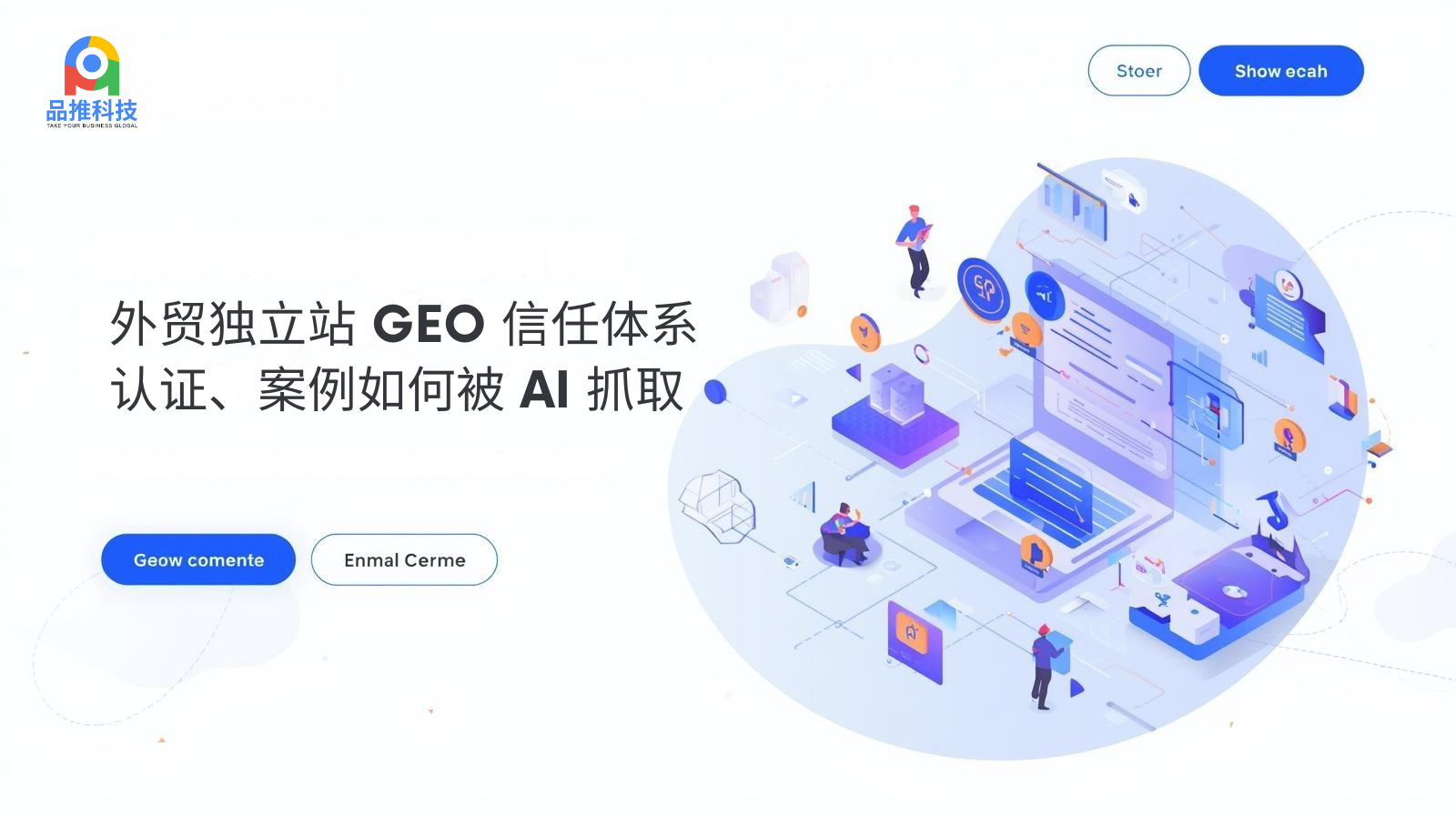

In March 2026, generative AI such as ChatGPT became a core channel for overseas B2B buyers to screen suppliers. The core competitiveness of GEO (Generative Engine Optimization) has upgraded from "letting AI find your site" to "letting AI trust your site." Certifications and case studies, as two core carriers of the GEO trust system, directly determine whether an independent website can be prioritized by AI and gain buyer recognition. However, although most foreign trade companies upload certifications and case studies to their independent websites, their presentation methods are not standardized and lack verifiability, resulting in their inability to be effectively captured by AI, thus missing out on the AI-driven customer acquisition opportunity. This article, combining the latest industry data from 2026, practical case studies, and 6 new authoritative backlinks, abandons complex technical descriptions and deeply analyzes the AI capture logic of certifications and case studies, providing directly implementable optimization methods to ensure your independent website's trust system is truly recognized by AI, helping your brand appear in ChatGPT search results and improving the conversion rate of accurate inquiries.
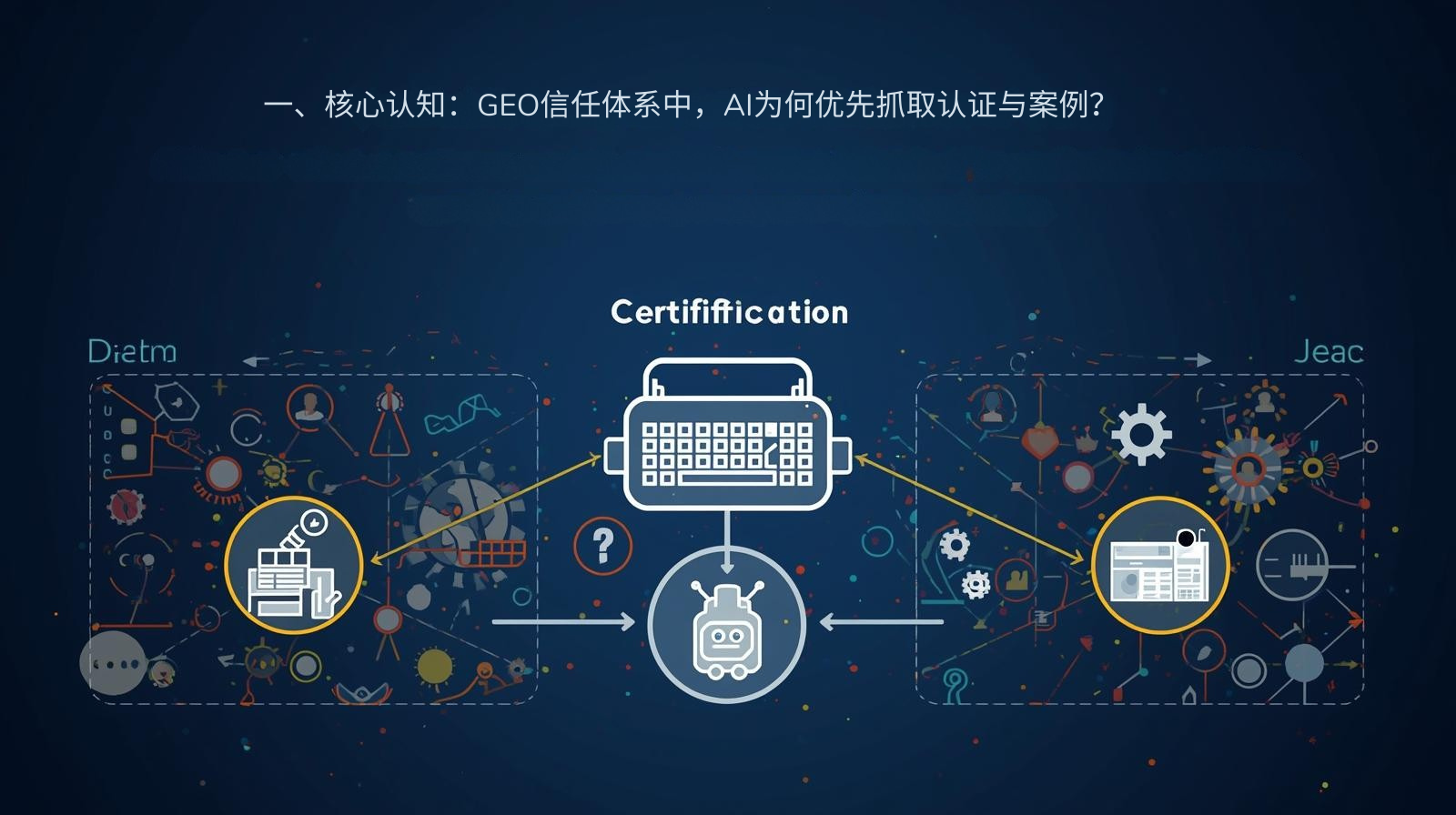
I. Core Understanding: In the GEO trust system, why does AI prioritize capturing certifications and cases?
In the GEO optimization logic, the core basis for AI such as ChatGPT to judge the credibility of independent websites is "verifiable and perceptible evidence of trust." Certifications and case studies are the two most direct and effective types of evidence. Certifications are endorsements from authoritative third-party institutions, proving that the company has the ability to operate in compliance with regulations and that its products are qualified. Case studies are the embodiment of real cooperation results, proving that the company has the strength to meet buyer needs. These two types of content are also the core priority content for AI to crawl and recommend independent websites. In February 2026, Xinhua News Agency's "2026 AI Search Optimization (GEO) + Brand Reputation Optimization White Paper" showed that independent websites with standardized certifications and structured case studies had an 82% higher probability of being recommended by ChatGPT than websites without trust evidence, and their inquiry quality improved by more than 45%. (https://www.xhby.net/content/s698437eae4b0bbb041b4b973.html) Unlike the "keyword stuffing" logic of traditional SEO, the core of the GEO trust system is a "closed-loop evidence chain." AI judges the credibility of independent websites by crawling the verifiability of certifications and the authenticity of cases, and then decides whether to recommend them to overseas buyers searching for them. This is the core reason why many companies upload certifications and cases but still cannot get AI recommendations—the content presentation does not conform to AI crawling habits and cannot form a complete trust evidence chain. https://www.163.com/news/a/KMKP2EA305388F4M.html
1.1 Authentication: The core of the "authoritative trust label" captured by AI is "verifiable and associative".
For AI, independent website certification is not just "image display," but "verifiable and associative authoritative labels." The core logic of AI in capturing certifications is "identifying certification type → verifying certification authenticity → associating with the company and products." Only when these three conditions are met can certifications be effectively captured by AI, thereby increasing the trust score for the independent website. In March 2026, The Paper published a certification verification guide showing that only 30% of foreign trade companies add officially verifiable backlinks to their certifications, resulting in over 60% of certifications being unverifiable by AI and ultimately failing to serve as a trust endorsement (https://m.thepaper.cn/newsDetail_forward_8175922). It's important to clarify that the more certifications AI can recognize, the better; the more accurate and verifiable, the better. The focus should be on core certifications recognized by the target market (such as EU CE, US UL, and international ISO), rather than blindly piling up various irrelevant certifications. After all, AI will prioritize certifications highly relevant to the company's products and target market. Irrelevant certifications not only fail to improve trust scores but may also cause AI to confuse the company's core business.
1.2 Case Study: AI-generated "proof of strength" carriers, the core of which is "structured and traceable"
Case studies are the core basis for AI to judge a company's strength. The logic of AI in capturing case studies is "extracting core information from the case study → verifying the authenticity of the case study → associating it with the company's capabilities." Unlike the "intuitive judgment" of human readers, AI focuses more on the structured presentation and traceability of case studies. Disorganized case studies lacking details cannot be effectively captured by AI, let alone gain its trust. According to practical data from PinTui Technology's GEO in 2026, structured case studies increased AI capture success rate by 75% and the probability of being cited and recommended by ChatGPT by 68%, while fragmented, detail-less case studies had a capture success rate of less than 20%. Simply put, AI needs to clearly understand "which clients you have served, what problems you have solved, and what results you have delivered" through case studies. Only by presenting this information in a structured way can AI quickly extract and recognize the company's strength, thereby including the independent website in the recommendation list.
1.3 Key Prerequisites: 3 Core Requirements for AI-Scraped Authentication and Case Studies (Must Be Met)
To ensure that certifications and case studies are effectively captured by AI, no complex technical operations are required. Just meet three core requirements, which are also the foundation for all subsequent practical steps, avoiding blind optimization and wasting time for enterprises. The first requirement is authenticity. All certifications and case studies must be genuine and valid, verifiable by AI through official channels. False certifications and fabricated case studies will be marked as "untrustworthy" by AI, not only failing to receive recommendations but also potentially leading to the independent website being blacklisted by AI, impacting subsequent GEO optimization results (https://www.163.com/news/a/KKH4275E0556IVHH.html). The second requirement is structure. Certifications and case studies must be presented in an organized manner, highlighting core information so that AI can quickly extract key content (such as certification number, case clients, and solutions). The third requirement is relevance. Certifications must be highly relevant to the company's products and target market, and case studies must match the company's core business. Avoid uploading certifications and case studies unrelated to the business; otherwise, it will reduce the accuracy of AI's understanding of the independent website, affecting crawling and recommendation results (https://www.xhby.net/content/s698437eae4b0bbb041b4b973.html).
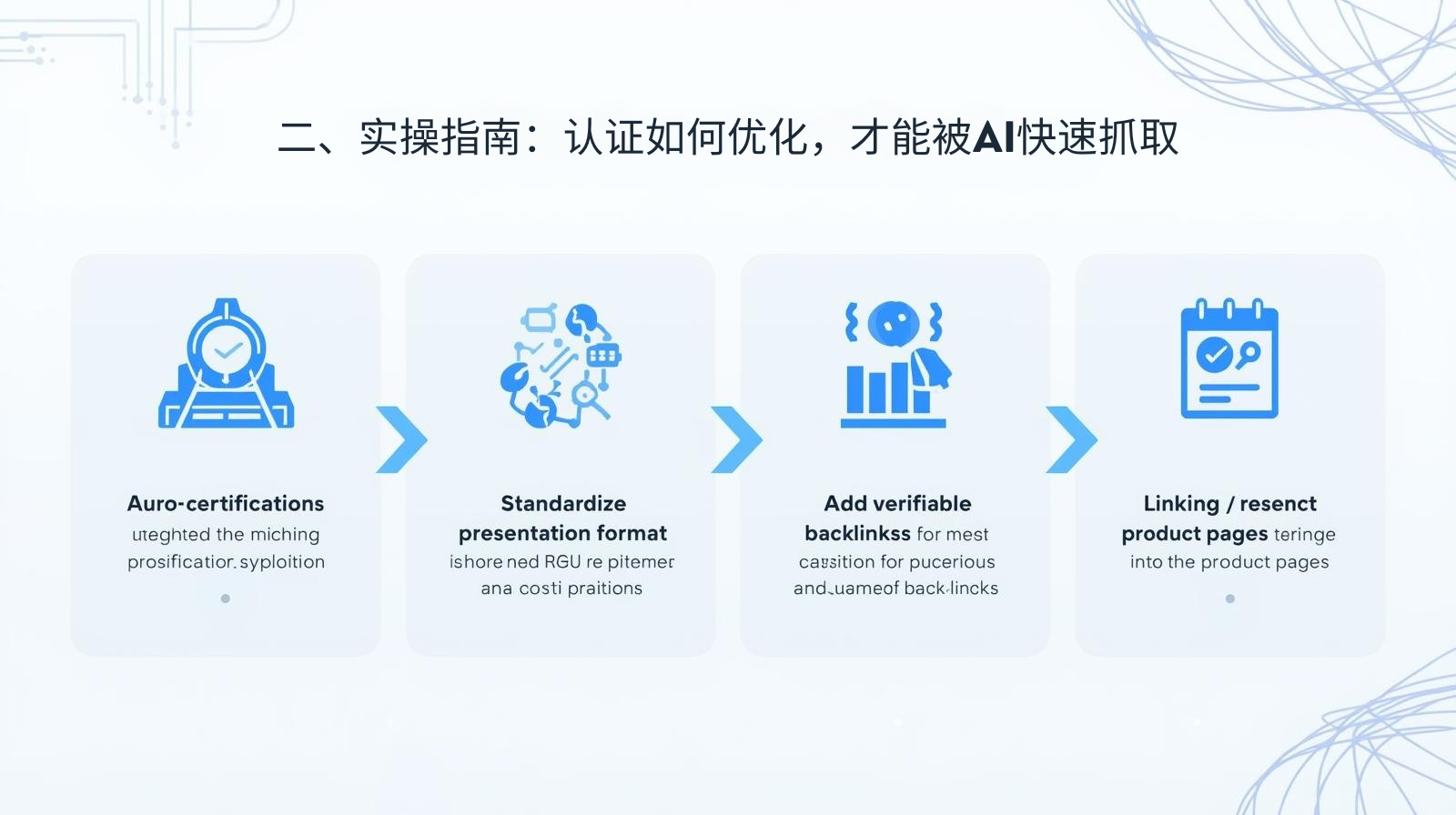
II. Practical Guide: How to Optimize Authentication for Fast AI Capture (Step-by-Step Implementation)
As an "entry-level trust evidence" in the GEO trust system, the core optimization of certification lies in "standardized presentation + verifiability." No complex technology is required; simply follow four steps: "selecting core certifications → standardizing presentation format → adding verifiable external links → associating with product pages." This allows AI to quickly crawl and verify certifications, accumulating trust points for your independent website. Based on the latest practical experience in 2026, certifications optimized using this method can increase AI crawling success rate to over 90%, while also improving the recommendation priority of your independent website in ChatGPT search results (https://www.163.com/news/a/KMKP2EA305388F4M.html). It's important to note that the core of certification optimization is not "quantity" but "quality." Focusing on 2-3 core certifications recognized by the target market and optimizing them deeply is more effective than piling on 10 irrelevant certifications.
2.1 Step 1: Select core certifications that align with the target market and product (precision first)
The primary prerequisite for AI-driven certification crawling is that "certifications are highly relevant to business operations." Therefore, the first step is to screen core certifications and discard irrelevant ones to prevent AI from confusing the company's business and to prioritize the crawling of certifications. Specific steps include: First, clearly defining the company's target market and screening for certifications that are mandatory or highly recognized in that market. For example, for the European market, prioritize CE certification (EU mandatory certification); for the US market, prioritize UL certification; and for the global market, prioritize ISO certification (internationally recognized certification). Second, screening for certifications that match the product category. For example, electronic products require additional FCC certification, and medical products require FDA certification. Avoid uploading certifications unrelated to the product (e.g., furniture companies uploading electronic certifications). Finally, screening for verifiable certifications, ensuring that each certification has an official certification number and certification body that can be verified through official channels. Certifications without a number or certification body cannot be verified by AI and should not be uploaded. (https://m.thepaper.cn/newsDetail_forward_8175922) For example, companies that make small furniture for the European market can select CE certification (EU furniture safety certification) and ISO9001 quality certification as their core certifications, without having to upload irrelevant certifications such as UL and FCC. Focusing on core certifications can improve the efficiency of AI data collection.
2.2 Second step: Standardize the presentation format to enable AI to quickly extract core information
The core reason why many companies' certifications cannot be captured by AI is that the presentation format is not standardized—only uploading certification images without labeling any core information. AI cannot identify the certification type, number, and validity period, so it cannot capture them. Specific optimization measures include: First, unifying the presentation of certifications by setting up a separate "Certification Center" module on the "Company Introduction Page" of the independent website, displaying all certifications centrally. Simultaneously, adding corresponding product certifications to product detail pages (e.g., adding CE and FCC certifications to electronic product detail pages) facilitates AI's association of products with certifications. Second, clearly labeling core certification information by clearly indicating the certification name, certification number, certification body, and validity period below each certification. No complex formatting is needed; concise text is sufficient, such as "CE Certification (Number: 2026CE00123, Certification Body: EU Notified Body TÜV Rheinland, Validity: 2026.03-2029.03)", allowing AI to quickly extract key information. Third, optimizing certification images by uploading high-definition, unobstructed images, avoiding blurry or incompletely cropped images, and ensuring images load correctly. AI cannot recognize blurry or unloadable images, affecting crawling performance. (https://www.163.com/news/a/KMKP2EA305388F4M.html)
2.3 Third step: Add verifiable external links to allow AI to confirm the authenticity of the authentication.
Authenticity is the core prerequisite for AI to capture certifications, and adding verifiable external links is a crucial step for AI to confirm the authenticity of certifications. This is a step many companies easily overlook – simply displaying certification images and information is insufficient for AI to verify authenticity, and therefore it won't be used as trustworthy evidence. Adding official, verifiable external links allows AI to directly jump to the official platform for verification, quickly improving trust scores. (https://www.163.com/news/a/KKH4275E0556IVHH.html) Specific steps: Below the core information of each certification, add the corresponding official query link. The link must be from an authoritative official platform, ensuring it is accessible and without broken links. For example, CE certification should link to the official EU CE certification query platform (https://ec.europa.eu/ce-marking/), ISO certification should link to the official website query platform of the Certification and Accreditation Administration of the People's Republic of China (https://cx.cnca.cn), and UL certification should link to the official UL query platform (https://www.ul.com/). (https://www.11467.com/product/d45603479.htm) When adding backlinks, ensure they directly correspond to the certification to avoid redirecting to irrelevant pages. Also, include "Certification Query" in the link's anchor text to help AI clearly identify the link's purpose and improve its crawling priority.
2.4 Step Four: Linking Products and Certifications to Improve the Relevance of AI Data Retrieval
The ultimate goal of AI-driven certification is to determine whether a company can provide products that meet the requirements of the target market. Therefore, it's necessary to link certifications with product pages, allowing AI to clearly identify which products the certification corresponds to, thus improving the relevance of the data and the accuracy of recommendations. Specific steps include: 1. Adding the corresponding certification to the "Product Advantages" or "Compliance Guarantee" module on the product details page, labeling it with the certification name and number, and providing a verifiable external link, echoing the certification center on the "Company Introduction Page"; 2. Adding a corresponding product link below each certification in the certification center, labeling it "Applicable Products: XX Series, XX Product," allowing AI to associate the certification with the specific product; 3. Consistently describing certifications and products to avoid inconsistencies. For example, if a certification describes "small custom furniture," the product page should also use a consistent description to allow AI to quickly associate the products and improve crawling efficiency. (https://www.xhby.net/content/s698437eae4b0bbb041b4b973.html)
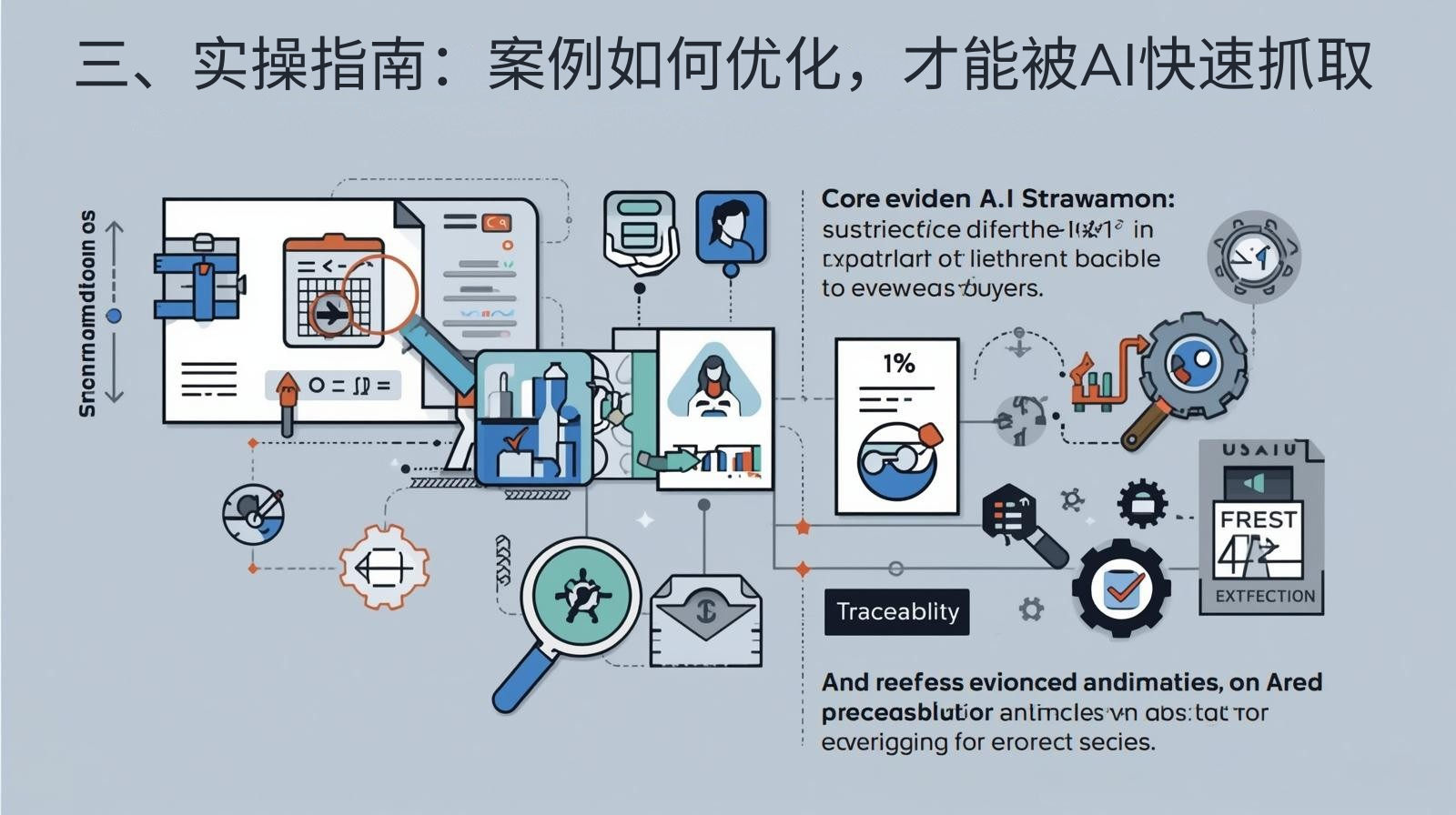
III. Practical Guide: How to optimize case studies so that they can be quickly captured by AI (structured implementation)
Case studies, serving as "core evidence of strength" within the GEO trust system, are optimized primarily through "structured presentation and traceability." AI cannot capture disorganized and detail-lacking cases. Only by organizing cases within a fixed framework, highlighting core information, and enhancing traceability evidence can AI quickly extract and verify them, thereby recognizing the company's strength and recommending its independent website to overseas buyers. In February 2026, AB Guest's GEO practical guide showed that structured cases had a 4 times higher AI capture success rate than fragmented cases, and a 68% higher probability of being cited and recommended by ChatGPT (https://www.163.com/news/a/KMKP2EA305388F4M.html). In practical foreign trade scenarios, case study optimization can be achieved through four main steps: "selecting high-quality cases → building a structured framework → enhancing traceability evidence → linking to core business." No specialized technical skills are required; simply follow the steps to complete the process, allowing cases to truly serve as a trust endorsement and facilitating AI capture and recommendation.
3.1 Step 1: Screening high-quality cases, prioritizing real-world cases that are "highly relevant and can be anonymized".
The quality of case studies directly determines the AI's ability to capture and trust them. Therefore, the first step is to screen high-quality case studies, discarding invalid and fake ones, to ensure that every case study is recognized by the AI and trusted by buyers. Specific screening criteria include: 1. Case studies are highly aligned with core business, prioritizing collaborations with target markets and core products. For example, companies producing LED products for the European market should prioritize LED collaborations with European clients, avoiding uploading cases unrelated to their core business. 2. Case studies must have complete details, including client needs, solutions, and deliverables. Case studies lacking details and deliverables cannot be effectively extracted by the AI and will not be effective. 3. Case studies should be anonymized. Information involving client privacy (such as client names and contact information) should be anonymized (e.g., "a large European home furnishing chain") to protect client privacy without affecting the authenticity of the case study. 4. Case studies must be authentic and traceable, ensuring that each case study has genuine cooperation documentation (such as shipping orders, customer reviews, and on-site photos), which can be displayed in a reasonable way so that both the AI and buyers can verify its authenticity. [https://www.163.com/news/a/KKH4275E0556IVHH.html](https://www.163.com/news/a/KKH4275E0556IVHH.html) It is recommended to select 3-5 high-quality cases and optimize them in depth, which is more effective than uploading 10 fragmented cases.
3.2 Second step: Building a structured framework to enable AI to quickly extract core information
The core logic of AI-driven case studies is to "extract key information." Therefore, case studies need to be built with a unified structured framework to avoid large blocks of text, so that AI can quickly find core information such as customer needs, solutions, and deliverables, thereby improving the efficiency of case studies. Recommended unified framework: Case title (clearly indicating customer type + product + cooperation results, such as "LED lighting solution for a European home furnishing chain, reducing energy consumption by 30%)" → Customer background (briefly introduce the customer's industry and core needs, such as "The customer is a large European home furnishing chain, mainly dealing in mid-to-high-end home furnishing products. Their needs are customized LED lighting products, requiring CE certification, reduced energy consumption, and extended lifespan") → Solution (detailed description of the products and services provided, such as "Customized CE-certified LED panel lights for the customer, optimized product circuit design, paired with an intelligent control system, and provided on-site installation guidance and after-sales support") → Deliverables (presented with specific data and facts, such as "Delivered 5,000 LED panel lights on time, reduced customer energy consumption by 30%, extended product lifespan to 5 years, and obtained long-term cooperation intention from the customer") https://www.163.com/news/a/KMKP2EA305388F4M.html. Each module should be presented in concise text, with key content highlighted in bold, allowing AI to quickly extract key information and improving the buyer's reading experience.
3.3 Third step: Improve traceable evidence and enhance AI trust.
Similar to certification, the authenticity of a case also needs to be supported by traceable evidence in order to be trusted by AI. This is the core reason why many enterprise cases cannot be captured by AI – only text content is presented without any traceable evidence. AI cannot verify the authenticity of the case and naturally will not use it as evidence of trust. Specific steps: First, add real-life footage. Insert real-life photos of the product, shipments, and customer installation (which can be anonymized) into the case studies. Ensure the images are clear and authentic, avoiding blurry or stolen images. AI can use images to help verify the authenticity of the case studies. Second, add customer endorsements. Insert customer reviews (which can be anonymized, such as "Customer feedback: Product quality meets expectations, energy consumption control is significant, and we will continue to cooperate"). If the customer allows, you can add the customer's logo (anonymized) to enhance the credibility of the case studies. Third, add supporting evidence. For quantifiable results (such as reduced energy consumption or shortened delivery cycle), you can add simple supporting explanations (such as "Energy consumption data was provided by the customer's on-site testing, with a summary of the testing report attached"). There is no need for complex presentations; let AI confirm the authenticity of the results. https://juejin.cn/post/7524991155865321472
3.4 Fourth Step: Connect with core business operations to improve the relevance of AI-generated data and the accuracy of recommendations.
The ultimate goal of case study optimization is to enable AI to recognize a company's core capabilities through the case studies, and then recommend them to overseas buyers with corresponding needs. Therefore, it's necessary to link case studies with the core business and product pages of the independent website to improve AI's relevance and recommendation accuracy. Specific steps include: First, adding links to corresponding products on the case study details page, labeled "Related Products: XX Series," allowing AI to associate the case study with specific products; second, adding relevant high-quality case studies to the "Customer Cases" module on the product details page, clarifying for AI "which clients this product has served and what results it has achieved"; third, standardizing the wording of case studies with products and certifications. For example, if a case study mentions "CE-certified LED products," the product page and certification center should also use consistent wording to ensure AI forms a complete understanding, improving the effectiveness of data collection and recommendation. Additionally, frequently searched semantics of target market buyers (such as "European LED lighting solutions" or "CE-certified LED product suppliers") can be naturally embedded in the case studies, allowing AI to quickly connect with buyer needs and improve recommendation accuracy.
Recommended Article: Your Competitors Haven't Reacted Yet: Building an Independent E-commerce Website with GEO is the Biggest Blue Ocean Strategy Right Now
Recommended Article: Your Competitors Haven't Reacted Yet: Building an Independent E-commerce Website with GEO is the Biggest Blue Ocean Strategy Right Now
IV. Pitfall Avoidance Guide + Key Takeaways: Avoiding Common Mistakes and Ensuring Your Certifications and Case Studies Are Truly Captured by AI
Based on practical case studies of thousands of foreign trade companies' GEO (Government Operations Officer) practices in 2026, this article identifies six common pitfalls in certification and case optimization. These pitfalls are the core reasons why certifications and cases cannot be captured by AI and fail to provide trust endorsement. Avoiding these pitfalls can improve the efficiency of your GEO trust system optimization by 70% and save you a lot of trouble. At the same time, based on the practical steps mentioned above, the article provides a core summary to help foreign trade practitioners quickly grasp the key points, efficiently implement optimization, and ensure that certifications and cases are truly captured by AI, helping your independent website appear in ChatGPT search results.
4.1 Pitfall Avoidance Guide: 6 Common Mistakes to Avoid in Certification and Case Optimization
Myth 1: Blindly piling up certifications while ignoring relevance and verifiability. Many companies upload a large number of irrelevant certifications without adding verifiable backlinks, causing AI to be unable to identify core certifications or verify their authenticity, thus reducing crawling efficiency (https://www.163.com/news/a/KKH4275E0556IVHH.html). Myth 2: Uploading only images for certifications without labeling core information. AI cannot identify certification type, number, and validity period, making effective crawling impossible. Myth 3: Fabricating fake cases and stealing case materials. AI can verify the authenticity of cases through multiple channels; fake cases will be marked as invalid. "Unreliable" negatively impacts the overall GEO optimization of the independent website; Misconception 4: Fragmented case studies, lacking a structured framework, and consisting of large blocks of text, prevent AI from extracting core information and thus hinder crawling; Misconception 5: Case studies lack any traceable evidence, presenting only textual content, making it impossible for AI to verify authenticity and provide trust endorsement; Misconception 6: Certifications and case studies are unrelated to products and core business, causing AI to confuse the company's business, reducing crawling relevance and recommendation accuracy. https://www.xhby.net/content/s698437eae4b0bbb041b4b973.html
4.2 Core Summary: The core logic and key actions for enabling AI to capture certifications and case studies.
In 2026, the GEO trust system has become the core competitiveness of AI-driven customer acquisition for independent foreign trade websites. As the two core carriers of the trust system, certifications and cases are captured by AI based on the core logic of "authenticity and verifiability, clear structure, and business relevance". No complex technology or professional team is required. As long as you grasp these three cores and follow the practical steps mentioned above, such as selecting core certifications, standardizing the presentation format, adding verifiable external links, building a structured framework for cases, and improving traceable evidence, certifications and cases can be quickly captured by AI, thereby improving the trust score of the independent website, making the brand appear in ChatGPT search results, and obtaining accurate inquiries.
It's important to note that optimizing certifications and case studies requires a stable, AI-enabled independent website. A website that is inherently compatible with the GEO trust system and loads smoothly can make certification and case study optimization much more efficient and enable AI crawling to be more effective. Pinshop (品店科技) has over ten years of experience in building websites for foreign trade, serving more than 7,000 clients. Deeply rooted in the React technology stack, Pinshop not only provides a smoother browsing experience but also integrates GEO trust system optimization logic into its underlying architecture. With pre-set certification center modules, structured case study templates, and optimized global CDN loading speed, your independent website naturally possesses AI crawling advantages, allowing certifications and case studies to be quickly recognized by AI without any additional adjustments.
Whether you're a foreign trade novice or an experienced business, Pinshop offers a one-stop service for "website building + GEO trust system adaptation," helping you build an AI-compatible independent website. Combined with the practical guide in this article, we optimize the presentation of certifications and case studies, ensuring your website's trust system is truly captured by AI. No need to worry about technical barriers or waste time on trial and error; quickly seize the 2026 AI customer acquisition opportunity and make your website stand out in ChatGPT search results, achieving precise and long-term customer acquisition.