
In March 2026, the global application of generative AI has fully penetrated the field of foreign trade, with AI tools such as ChatGPT and Gemini It has become the core entrance for global B-end buyers to find suppliers, and the multi-language foreign trade independent station serves as the core carrier to connect global buyers. Its GEO (generative engine optimization) optimization level directly determines whether the company can cover global AI search traffic and seize multi-regional market share. Although many foreign trade companies have built multi-lingual independent websites, due to neglect of GEO optimization or improper optimization methods, multi-language content cannot be captured by AI, unable to reach target buyers in different languages, and miss out on the global AI customer acquisition trend. This article combines the latest industry data in 2026, multi-language GEO practical cases and 8 new authoritative external links to deeply dismantle the optimization logic and practical methods of multi-language independent foreign trade station GEO, focusing on the three cores of multi-language adaptation, AI capture, and regional compliance, so that foreign trade practitioners can quickly implement optimization, so that multi-language independent stations can truly achieve global AI search traffic coverage and help companies expand the global market.
1. Core Cognition: Multi-language + GEO is the global customer acquisition password for an independent foreign trade station
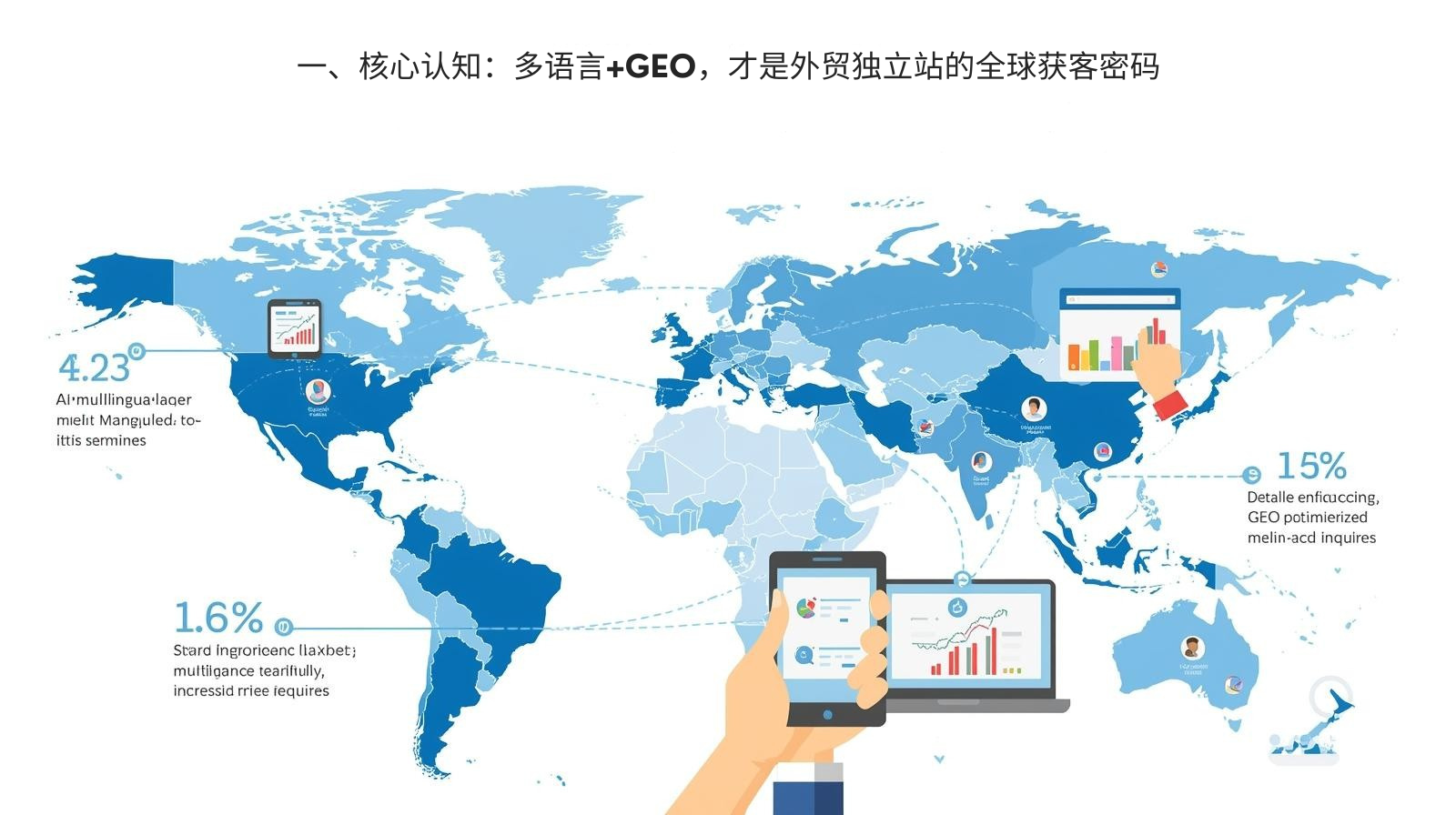
Under the trend of global AI customer acquisition, single-language independent foreign trade websites can no longer meet the global market demand. If multi-language independent websites lack GEO optimization, they will only become "merely superficial" language shells that cannot be effectively captured by AI and naturally cannot reach buyers in different languages. In March 2026, the "2026 GEO Industry Panoramic Analysis" released by Tianji.com showed that for independent foreign trade stations that have done multi-lingual GEO optimization, AI search traffic coverage increased by 78%, and multi-regional inquiries increased by 65% year-on-year. Among them, the growth rate of small language market inquiries exceeded 80%. However, for multi-language independent stations that have not done GEO optimization, the AI crawling success rate is less than 25%, and the multi-language advantage cannot be used at all. https://wap.yesky.com/news/408/330408.shtml. The core logic of GEO, a multi-lingual independent foreign trade station, is not a simple "language translation + regular GEO", but a combination of "multi-language semantic adaptation + AI crawling optimization + regional compliance adaptation". It not only allows content in different languages to be accurately recognized by AI, but also fits the search habits of buyers in different regions and meets the compliance requirements of the target market. Only in this way can it truly cover global AI search traffic and achieve multi-regional customer acquisition.
1.1 Why do multi-language independent sites need GEO optimization?
Many foreign trade companies have misunderstandings. They believe that as long as they build a multi-language independent station, they can naturally obtain global traffic without the need for GEO optimization. In fact, this is not the case. GEO optimization of multi-language independent stations is the core prerequisite for achieving AI search traffic coverage, and its necessity is mainly reflected in three aspects. First, solve the problem of AI language recognition. Although AI tools such as ChatGPT support multi-language search, they have strict requirements for the capture and understanding of multi-language content. Without GEO optimization, multi-language content will have problems such as semantic deviation and structural confusion. AI cannot accurately identify it and naturally cannot recommend it to buyers of the corresponding language. https://juejin.cn/post/7582815307438833715; Second, adapt to the search habits of buyers in different regions. Buyers in different regions have different search semantics and core needs. For example, European buyers pay more attention to compliance certification, and Southeast Asian buyers pay more attention to price and delivery. GEO optimization can make multi-language content fit regional search habits and improve the accuracy of AI recommendations. https://www.163.com/dy/article/KMS5KGJ205388F4M.html; Third, to avoid regional compliance risks, compliance regulations in various countries around the world continue to tighten. The EU GDPR and China's "Internet Information Services Management Measures" have set clear requirements for multi-language content and data security. The compliance adaptation in GEO optimization can enable independent stations to meet the compliance requirements of different regions, avoid being blocked by AI due to violations, and ensure that multi-language content is captured normally. https://www.11467.com/product/d47063138.htm.
1.2 The core difference between multi-language GEO and single-language GEO (avoiding cognitive misunderstandings)
Many foreign trade companies equate multilingual GEO to "copy and paste of single-language GEO". After simply translating the Chinese or English content, they think that multilingual GEO optimization has been completed. This approach will only cause the multilingual content to be unable to be captured by AI, wasting the advantages of multilingual layout. The core differences between the two are mainly reflected in three aspects: First, the optimization core is different. Single-language GEO focuses on "AI crawling adaptation + content structuring", while multi-language GEO focuses on "multi-language semantic accuracy + regional adaptation + compliance adaptation". The core is to make content in different languages can be understood by AI and recognized by regional purchasers. https://wap.yesky.com/news/408/330408.shtml; Second, the focus of optimization is different. Single-language GEO only needs to focus on content optimization in one language, while multi-language GEO needs to take into account the semantic accuracy and uniformity of expressions in different languages, while adapting to the compliance requirements and search habits of different regions. For example, German nouns need to follow capitalization rules, French needs to pay attention to the display of special symbols, and the EU market needs to add GDPR compliance-related content https://www.11467.com/product/d42704300.htm; Third, the effect orientation is different. The goal of single-language GEO is to cover AI search traffic in a single region, while the goal of multi-language GEO is to cover AI search traffic in multiple regions and languages around the world, achieving global customer acquisition https://juejin.cn/post/7582815307438833715.
1.3 Multilingual GEO core trends in 2026: precise adaptation, rejecting "translation shell sites"
In 2026, multi-language GEO optimization has entered the stage of "accurate adaptation and high-quality implementation". AI's standards for capturing multi-language content have been greatly improved. "Translation shell sites" (simple translation, no semantic adaptation, no regional adaptation) can no longer be captured by AI, and will even be marked as low-quality sites by AI, affecting the weight of the entire independent site. According to the multilingual website optimization guide released by Rare Earth Nuggets at the end of 2025, only 30% of foreign trade companies can accurately adapt to multilingual GEO. The AI crawling success rate of these companies’ multilingual independent stations is more than 90%, while the AI crawling success rate of “translation shell stations” is less than 20%. https://juejin.cn/post/7582815307438833715. The core trend of multilingual GEO in 2026 is "fewer but better". It is not that more languages are better, but to focus on the core target market and make accurate adaptation of the corresponding languages. Prioritize coverage of mainstream languages such as English, Spanish, French, and German, and then gradually expand minor languages such as Japanese, Korean, and Indonesian according to the needs of emerging markets to ensure that the content of each language has semantic accuracy, structural integrity, and regional adaptability. Only in this way can we truly cover global AI search traffic. https://wap.yesky.com/news/408/330408.shtml.
2. Practical Guide: GEO Core Optimization Steps for Multilingual Foreign Trade Independent Stations (can be implemented directly)
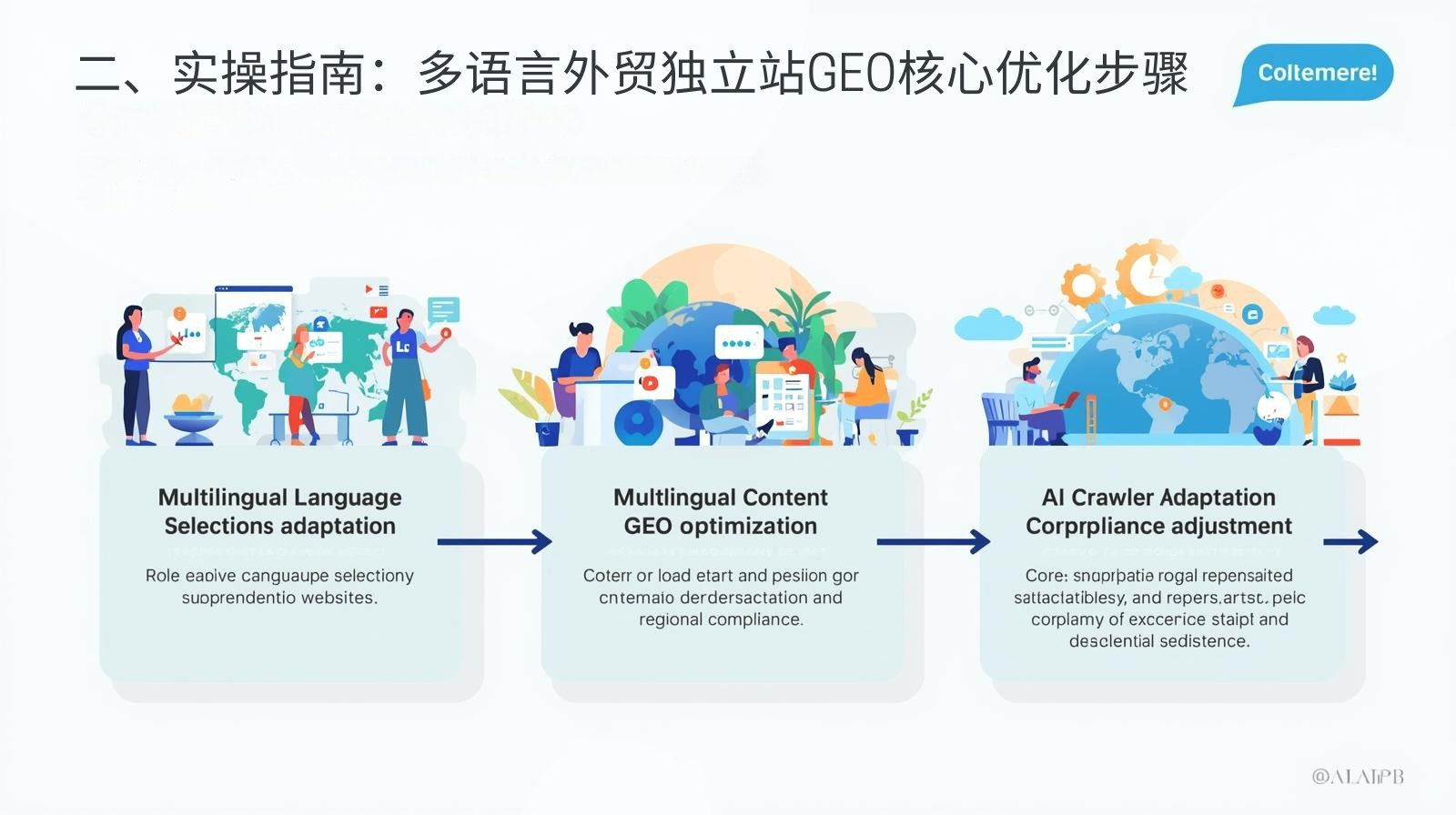
The core of GEO optimization for multi-language independent foreign trade stations is "semantic precision + AI crawling + regional compliance". No complicated technology is required. Just follow the three core steps of "multi-language screening and adaptation → multi-language content GEO optimization → AI crawler adaptation and compliance adjustment", so that multi-language content can be quickly captured by AI and cover global AI search traffic. Combining the latest practical experience in 2026 and AB's GEO optimization strategy, the multi-language independent station optimized according to this step can increase the AI crawling success rate to more than 85%, and the multi-regional inquiry volume will increase by an average of 58% https://www.163.com/dy/article/KMS5KGJ205388F4M.html. It should be noted that the optimization focus is slightly different in different languages and different regions, but the core operation logic is the same, and the optimization details can be flexibly adjusted according to the target market.
2.1 Step 1: Screen core languages and do regional adaptation (reject blind stacking)
The premise of multi-language GEO optimization is "accurate language selection". Blindly stacking multiple languages will not only increase the optimization cost, but also cause each language to be insufficiently optimized and unable to be effectively captured by AI, which will in turn affect the overall optimization effect. Specific operations: First, based on the company's target market, select core languages and give priority to mainstream languages and high-value market languages. For example, for the European and American markets, prioritize English, German, French, and Spanish; for emerging markets, you can add Japanese, Korean, Indonesian, and Turkish. It is recommended that the core languages be controlled between 10-15 to avoid more than 20, which will lead to a decrease in optimization efficiency. https://juejin.cn/post/7582815307438833715; Secondly, clarify the regional adaptation focus of each language. For example, English is adapted to global scenarios, German is adapted to German-speaking areas such as Germany and Austria, and compliance certification and product quality need to be highlighted. French is adapted to French-speaking areas in France and Canada, and attention must be paid to semantic rigor and compliance expressions. Small Southeast Asian languages need to highlight price advantages and delivery time advantages. https://wap.yesky.com/news/408/330408.shtml; Finally, establish unified language management rules and clarify the expression specifications of each language to avoid different expressions of the same product and the same core advantages in different languages, so that AI can form stable cognition and improve crawling efficiency https://www.11467.com/product/d42704300.htm.
2.2 Step 2: Multi-language content GEO optimization, allowing AI to accurately identify and efficiently capture
This is the core step of multi-language GEO optimization. The core goal is to enable content in different languages to be accurately recognized by AI for semantic meaning, and to fit the search habits of regional buyers. It also has structured features to increase the probability of AI crawling and recommendation. Specific operations: First, ensure accurate semantics and avoid the stiffness and semantic deviation of machine translation. It is recommended to adopt the method of "professional manual translation + AI proofreading" to ensure that the content of each language is semantically accurate, fluent in expression, and in line with local language habits. For example, "customized" in English can correspond to "maßgeschneidert" in German to avoid semantic deviations caused by literal translation. At the same time, professional translation tools such as DeepL can be used for proofreading to improve translation quality. https://juejin.cn/post/7582815307438833715; The second is to optimize the content structure. The core pages of each language (home page, product page, company introduction page) are all according to "Core Positioning → Product Advantages" → Compliance Certification → Case Presentation → FAQ” frame fill content, focusing on the core information that regional buyers are concerned about. For example, the EU language page focuses on CE certification and GDPR compliance-related content, and the Southeast Asian language page focuses on MOQ, delivery time, and price advantages. https://www.163.com/dy/article/KMS5KGJ205388F4M.html; The third is to add a multi-lingual FAQ module to sort out the corresponding Q&A content for high-frequency questions from buyers in different languages. For example, buyers from the German-speaking area focus on compliance details, while buyers from the English-speaking area focus on product parameters and customization capabilities. This ensures that the semantics of each question and answer are accurate and the answers are clear, so that AI can directly quote these contents and increase the probability of recommendation. https://wap.yesky.com/news/408/330408.shtml; The fourth is to associate multi-lingual content and add two-way links between pages in different languages. For example, adding links to corresponding product pages in German and French on English product pages allows AI to quickly capture content in all languages, form a complete content system, and increase the overall weight.
2.3 Step 3: AI crawler adaptation + regional compliance adjustment to ensure global crawling without dead ends
If a multi-language independent website cannot be effectively crawled by AI crawlers or has compliance risks, no matter how good the content is, it will not be able to cover global AI search traffic. The core of this step is to ensure that AI crawlers can smoothly crawl content in all languages, while meeting the compliance requirements of different regions and avoiding being blacklisted or punished by AI. Specific operations: First, AI crawler adaptation, open the independent site background, optimize the robots.txt file, allow AI crawlers such as GPTBot and ClaudeBot to access core pages in all languages, prohibit access to redundant pages, and generate a site map containing core pages in all languages, and submit it to the OpenAI official platform (https://help.openai.com/en/articles/5097620-blocking-gptbot) to ensure that AI crawlers can quickly find content in all languages. https://www.163.com/dy/article/KMS5KGJ205388F4M.html; Secondly, regional compliance adjustments are made to optimize multi-language content according to the compliance requirements of different regions. For example, language pages for the EU market are added with GDPR compliance-related content, including cookie pop-ups, multi-lingual privacy policies, and EU representative information to ensure that cookie pop-ups support users’ independent choices, and the privacy policy complies with GDPR requirements and is updated regularly. https://www.11467.com/product/d47063138.htm; Finally, optimize the global loading speed, adopt cloud server distributed deployment, deploy node servers in major markets such as North America, Europe, and Southeast Asia, and combine it with the CDN content distribution network to ensure smooth loading speed when buyers from different regions access corresponding language pages, avoiding AI crawling failure or loss of buyers due to slow loading. https://www.11467.com/product/d42704300.htm.
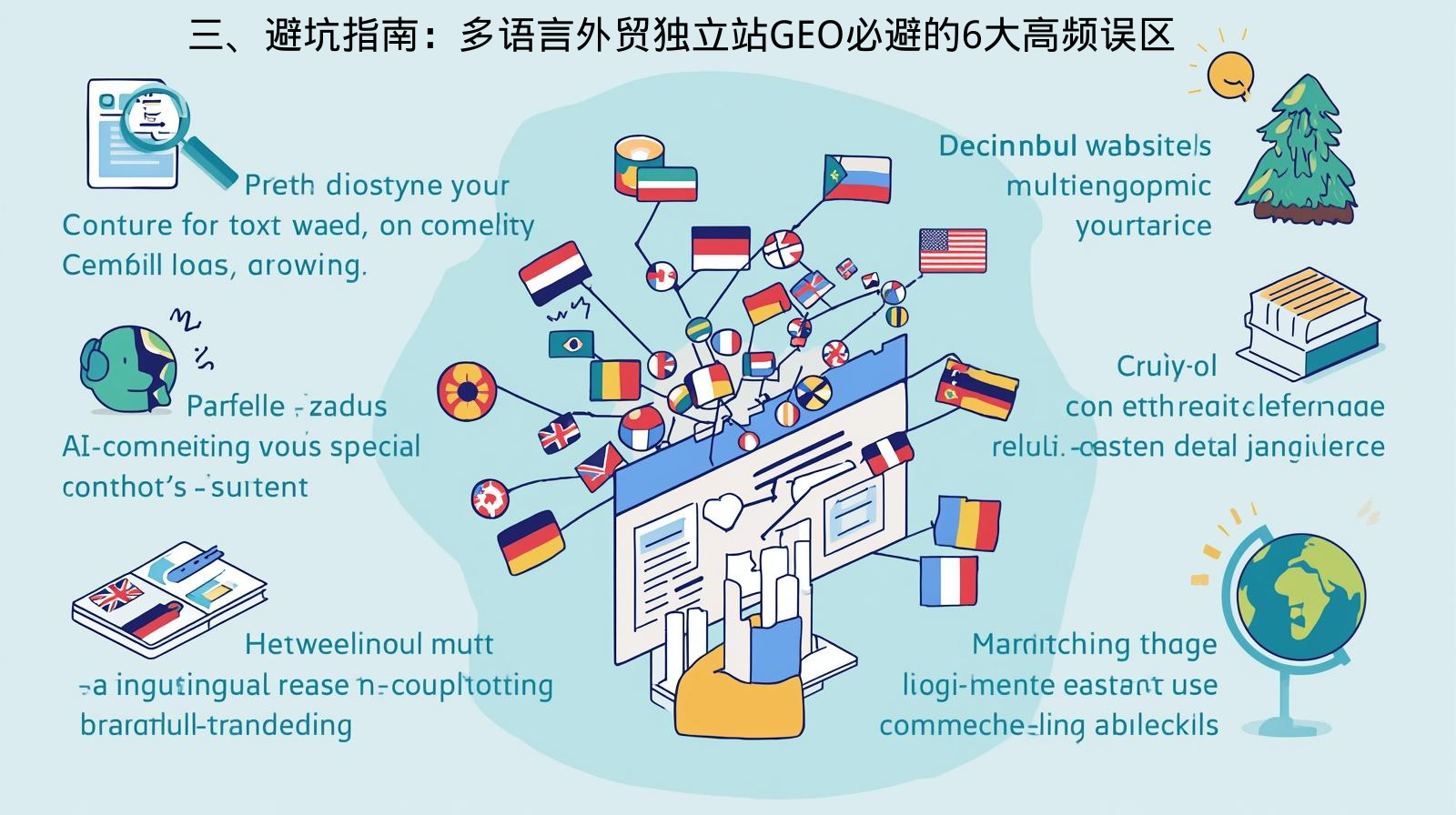
3. Pitfall avoidance guide: 6 high-frequency misunderstandings that multi-lingual foreign trade independent station GEO must avoid
Combined with the multi-language GEO practical cases of thousands of foreign trade companies in 2026, we sorted out 6 high-frequency misunderstandings. These misunderstandings prevent multi-language independent stations from being caught by AI. The core reason why global AI search traffic cannot be captured and covered is also an issue easily overlooked by many foreign trade practitioners. Avoiding these misunderstandings can increase the efficiency of multi-language GEO optimization by 70%, avoid many detours, ensure that every investment can obtain corresponding returns, and truly achieve global AI traffic coverage.
3.1 Misunderstanding 1: Blindly stacking languages and ignoring semantic accuracy (reducing into a "translation shell site")
In pursuit of "globalization", many companies have blindly added more than 20 or more languages without semantic adaptation. They only use machine translation to simply convert the content, resulting in semantic deviations and blunt expressions that cannot be accurately recognized by AI and cannot be understood by buyers. Ultimately, they cannot be captured by AI and cannot obtain inquiries. https://juejin.cn/post/7582815307438833715. Key points to avoid pitfalls: Focus on the core target market, screen 10-15 core languages, and accurately adapt the semantics of each language. Use the "manual translation + AI proofreading" method to ensure smooth content and accurate semantics. Reject "translation shell sites" and prefer less to more. https://wap.yesky.com/news/408/330408.shtml.
3.2 Misunderstanding 2: Multi-language content expression is not uniform, leading to AI cognitive confusion
In the multi-lingual content of some companies, the same product and the same core advantage are inconsistently expressed. For example, the English page is marked with "CE certification", the German page is marked with "ISO certification", or the same product name has different translations in different languages. As a result, AI cannot form a stable cognition and cannot quickly capture and associate content, which affects the optimization effect. https://www.11467.com/product/d42704300.htm. Key points to avoid pitfalls: Establish unified rules for multi-lingual expressions, clarify the unified expression of product names, core advantages, and certification information in each language to ensure that the content in different languages is consistent, so that AI can quickly identify and associate it, and improve the crawling efficiency.
3.3 Misunderstanding 3: Ignoring regional compliance leads to the site being blocked by AI
Many companies ignore the compliance requirements of different regions, especially the EU GDPR, North American data security regulations, etc., and do not make compliance adaptations for multi-language content. For example, no multi-language privacy policy is added, and cookie pop-ups do not meet the requirements, resulting in the site being marked as illegal by AI, unable to be crawled, or even blocked. https://www.11467.com/product/d47063138.htm. Key points to avoid pitfalls: Understand the compliance requirements of the target market in advance, add corresponding compliance content to the language pages in different regions, ensure that the multi-language independent station meets the compliance standards of major global markets, and avoid compliance risks.
3.4 Misunderstanding 4: Only optimize content and ignore AI crawler adaptation
Some companies spend a lot of effort optimizing multi-language content, but do not adapt it to AI crawlers. The robots.txt file does not allow AI crawlers to access, or does not submit a multi-language site map. As a result, AI crawlers cannot enter the site, cannot crawl multi-language content, and no matter how good the content is, it cannot be recommended. https://www.163.com/dy/article/KMS5KGJ205388F4M.html. Key points to avoid pitfalls: AI crawler adaptation is the basis for multi-language GEO optimization. While optimizing content, be sure to set up robots.txt and generate and submit sitemaps to ensure that AI crawlers can smoothly crawl core content in all languages.
3.5 Misunderstanding 5: Ignoring the optimization of small languages and missing out on emerging market traffic
Many companies only focus on the optimization of mainstream languages such as English and German, and ignore the optimization of minor languages such as Japanese, Korean, and Indonesian. In 2026, the AI search traffic growth rate in emerging markets such as Southeast Asia and Latin America will exceed 80%, and optimization of minor languages has become the key to covering global traffic. https://wap.yesky.com/news/408/330408.shtml. Key points to avoid pitfalls: On the basis of optimizing mainstream languages, combined with the needs of emerging markets, focus on optimizing 1-2 small potential languages, do semantic adaptation and regional adaptation, and seize the AI customer acquisition trend in emerging markets.
3.6 Misunderstanding 6: No more maintenance after optimization is completed, resulting in traffic loss
Many companies believe that multi-language GEO optimization is a "one-time operation" and will no longer be maintained after completion. This results in outdated multi-language content, semantic deviations, and compliant content that has not been updated. The success rate of AI crawling continues to decline, and eventually global AI search traffic is lost. https://www.163.com/dy/article/KMS5KGJ205388F4M.html. Key points to avoid pitfalls: Regularly maintain multilingual content, check semantic accuracy and uniformity of expressions once a month, update compliance content and FAQs quarterly, adjust AI crawler adaptation settings in a timely manner, ensure that multilingual independent stations always have AI-friendly attributes, and continue to cover global AI search traffic.
Four. Core summary: Multi-language + GEO, unlocking new possibilities for global AI customer acquisition for independent foreign trade stations
In 2026, the trend of AI globalization is irreversible. The search behavior of overseas buyers has fully shifted to AI tools. Multi-language foreign trade independent stations serve as the core carrier to connect global buyers, and their GEO optimization has become a must for companies to cover global AI search traffic and expand the global market. This article clearly analyzes the core logic, practical steps and common misunderstandings of GEO, a multi-language independent foreign trade station. The core is to tell all foreign trade practitioners: the core value of a multi-language independent station lies in "being found by buyers in different languages around the world", and GEO optimization is The key to realizing this value does not require complicated technology or high investment. As long as we focus on core languages, do semantic adaptation, AI crawler adaptation and regional compliance, we can quickly capture multi-language content by AI, cover global AI search traffic, and achieve accurate customer acquisition in multiple regions.
It should be noted that the effect of multi-language GEO optimization is inseparable from a stable, smooth independent website that is adapted to multi-language and AI crawling. An independent website that is naturally adapted to multi-language GEO optimization and loads smoothly can make multi-language content optimization more effective, make AI crawling more efficient, and at the same time improve the browsing experience of global buyers and reduce customer churn. Pinshop (Pinshop Technology) has more than ten years of experience in foreign trade website building, and has served a total of 7,000+ customers. It is deeply involved in building websites with the React technology stack, which not only makes the website browsing experience smoother, but also integrates multi-language GEO optimization logic from the underlying architecture, and presets multi-language adaptation modules and AI crawler adaptation. Equipped with modules and compliance adaptation templates, it supports unified management of multilingual content, optimizes global CDN loading speed, and makes your multilingual independent station inherently AI-friendly. It can quickly adapt to GEO implementation needs without additional adjustments, helping the independent station cover global AI search traffic and expand the global market.
Recommended related articles: Your peers have not yet reacted: using GEO to build an independent foreign trade station is the biggest blue ocean strategy at the moment
Recommended related articles: Your peers have not yet reacted: using GEO to build an independent foreign trade station is the biggest blue ocean strategy at the moment
Whether you are a foreign trade company that is laying out a multi-language independent website, or a practitioner who has built many multi-language websites but cannot get AI traffic, Pinshop can provide you with a one-stop service of "website building + multi-language GEO adaptation" The service will help you build an independent website adapted to AI and multi-language. At the same time, combined with the practical guide in this article, you can easily complete multi-language GEO optimization without worrying about technical thresholds or wasting time on trial and error. Quickly unlock new possibilities for global AI customer acquisition, let your multi-language foreign trade independent website stand out in global AI searches, and achieve continuous expansion of the global market and long-term customer acquisition.