
Independent station brand visual identity system: consistency from logo to packaging

  • Independent website marketing and promotion
  • Independent website operation strategy
  • Foreign trade website
Posted by 广州品店科技有限公司 On Aug 23 2025

In the digital age, independent websites have become crucial platforms for branding, customer engagement, and sales conversion. However, many companies focus solely on functionality and traffic when developing their independent websites, neglecting the integrity of their brand's visual identity system (VIS). The consistency of a brand's visual system, from logo to packaging, directly impacts customer perception and trust in the brand.

Core elements of a brand’s visual identity system

A brand’s visual identity system is more than just a logo; it’s the overall specification of a company’s visual expression, encompassing:

  • Logo design : reflects the core concept of the brand, has high recognition, and is suitable for use in multiple scenarios.

  • Color system : unify primary color, auxiliary color and functional color to ensure brand visual consistency.

  • Font standards : Unify the brand font style to maintain consistency in information communication.

  • Graphics and image style : The visual elements are unified in style, making it easy to extend them to independent websites and social media.

  • Packaging and material design : Product packaging and promotional materials maintain brand consistency and enhance customer experience.

According to research by the China Industrial Design Association , a complete brand VIS can significantly enhance a company's professionalism and credibility in the minds of customers, bringing the company a higher customer retention rate.
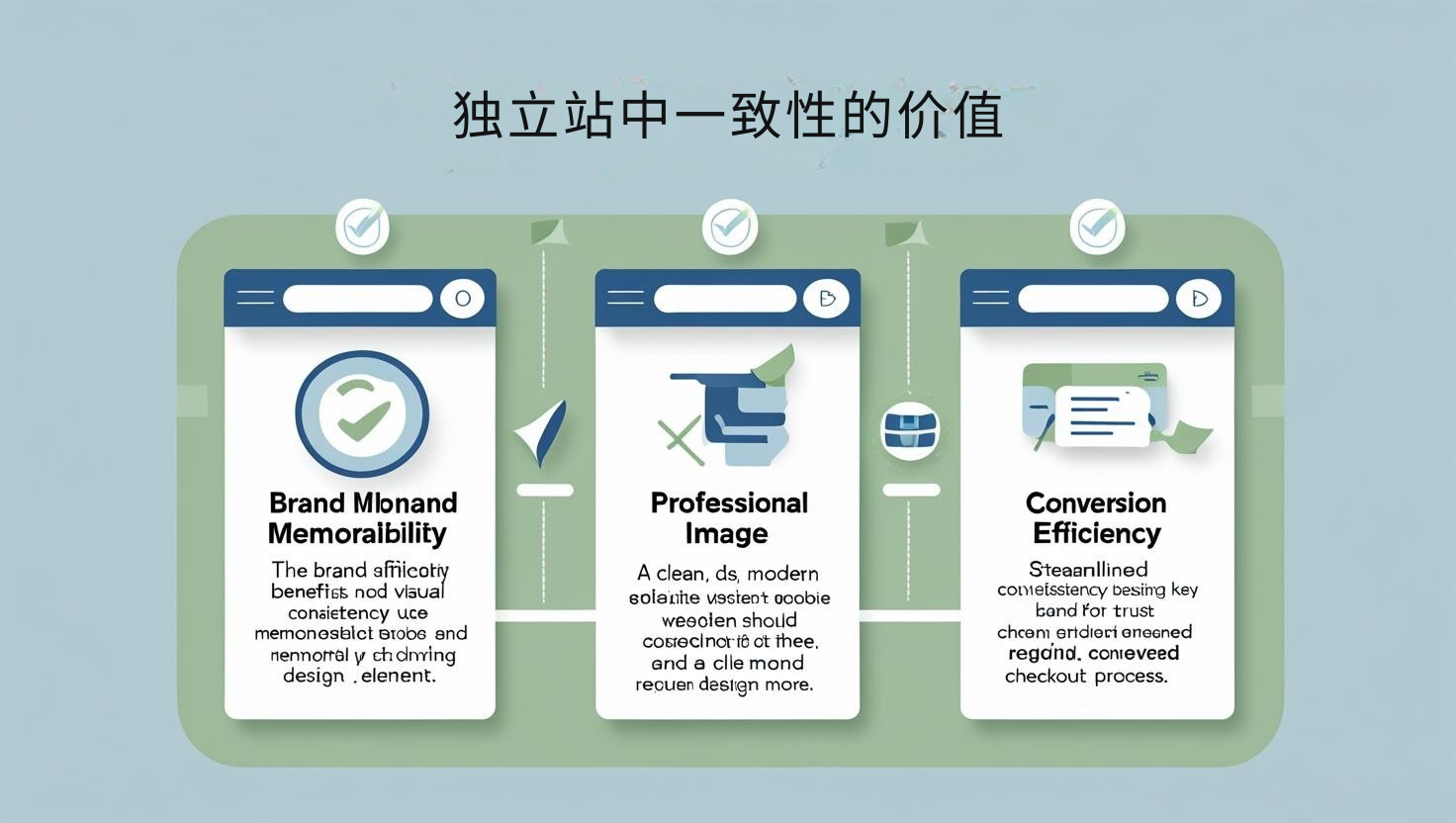
The Value of Consistency in Standalone Sites The Value of Consistency in Standalone Sites

On independent websites, consistency in visual identity systems has direct business value:

  • Improve brand memorability : Unified visual elements help customers quickly identify the brand and increase their willingness to return.

  • Strengthen professional image : A consistent design style makes the independent website more trustworthy and authoritative in the industry.

  • Improve conversion efficiency : Consistent visual experience reduces user cognitive costs and speeds up purchasing decisions.

Interbrand points out that visual uniformity is an important factor in enhancing brand value, especially in cross-border e-commerce and independent website operations, where it has a significant impact on potential customer trust and brand loyalty.

Design process and independent station integration strategy

The key to establishing a complete VIS lies in systematization and implementation:

  1. Brand research and positioning : Analyze target customers, industry trends and competitive brands, and determine visual expression strategies.

  2. Establishment of design system : Logo, color scheme, fonts, graphics, and packaging are standardized and standardized, and a design manual is formed.

  3. Independent website implementation : Extend VIS to the independent website homepage, product pages, shopping cart and social media content to maintain consistency across the entire chain.

  4. Continuous optimization : Regularly evaluate visual effects, user feedback, and data performance, and dynamically adjust and optimize the visual system.

Research by the World Design Organization (WDO) shows that combining brand vision with user experience can significantly increase customer retention time and conversion rates on independent sites.

How to achieve consistency from logo to packaging

  • Templated design : Use unified templates and elements in independent websites and advertising materials to reduce design fragmentation.

  • Brand manual guidance : The VIS manual guides the design of all online and offline materials to ensure consistent execution across the team.

  • Packaging extends the visual experience : Product packaging maintains a unified style with the independent website’s visual style, enhancing customer purchasing confidence.

  • Multi-channel extension : Social media, emails, advertising materials, etc. maintain visual consistency to form a complete brand ecosystem.

VIS is not only a display of visual beauty, but also a tool for conveying brand value. In independent websites and cross-border e-commerce scenarios, a complete VIS helps companies stand out in the fiercely competitive market.


Establish a consistent brand visual identity system and make your independent website the core platform for brand display and customer conversion. Using the Pinshop website building platform , companies can easily extend VIS to every page of their website, unifying logos, color schemes, fonts, and packaging design to achieve a complete brand presentation across the independent website and multiple channels, thereby enhancing customer awareness, strengthening trust, and ultimately driving business growth.

Recommended related articles: Multilingual Independent Station Strategy: Balancing Localization and Internationalization


Pinshop foreign trade website

特色博客
Pintui Technology: GEO one-stop solution for independent foreign trade station

Pintui Technology: GEO one-stop solution for independent foreign trade station

This article introduces the GEO (Generative Engine Optimization) one-stop solution for the independent foreign trade station of Pintui Technology. It focuses on AI capture and trust rules and provides fully closed-loop implementation services from the four modules of structured website building, content system, technology adaptation, and data operation. It also clarifies the 30-60 day standardized implementation process and combines the latest AI rules and authoritative external links in March 2026 to help the independent foreign trade station appear stably in ChatGPT search results and achieve sustainable AI customer acquisition.

GEO Structured Layout for Independent Foreign Trade Websites: AI's Favorite Page Structure

GEO Structured Layout for Independent Foreign Trade Websites: AI's Favorite Page Structure

This article focuses on the core of GEO (Geometric Orientation) for independent e-commerce websites in 2026—structured layout—clearly pointing out that the key to AI crawling and recommendation lies in page structure rather than visual effects. The article details AI-friendly structures for four core pages: homepage, product pages, company introduction pages, and compliance pages, providing directly replicable layout templates. Based on the latest official rules from Google, OpenAI, Semrush, and others in 2026, it summarizes six golden rules of structured layout and a three-step implementation method, accompanied by authoritative and verifiable backlinks throughout, helping e-commerce companies quickly build AI-favored page structures and increase their exposure and recommendation probability on ChatGPT.

GEO for independent e-commerce websites is not about optimizing the website, but about optimizing AI cognition.

GEO for independent e-commerce websites is not about optimizing the website, but about optimizing AI cognition.

This article revolves around the core concept that "GEO for independent foreign trade websites is not about optimizing the website, but about optimizing AI cognition." It combines the latest industry data from March 2026 (China Daily GEO Analysis Report, "GEO Generation Search Optimization White Paper," NetEase News GEO Evaluation), practical foreign trade case studies, and authoritative backlinks (OpenAI, Google, Semrush, etc.). Divided into four core chapters (including sub-headings): "GEO Core Cognition," "Four Dimensions of AI Cognition Optimization," "3 Steps to Practical Implementation," and "6 Pitfall Avoidance Guidelines," this article delves into the underlying logic of GEO optimization for AI cognition. It breaks down directly implementable cognition optimization methods and practical processes, avoiding common pitfalls, adhering to long sentence formatting requirements, avoiding complex technical descriptions, and seamlessly integrating all backlinks into the text. Balancing professionalism and practicality, this article helps foreign trade companies avoid the misconception of "website optimization" and achieve precise customer acquisition for independent websites through optimizing ChatGPT cognition.

Why do 90% of independent e-commerce websites fail to see results despite implementing GEO (Geometric Orientation)?

Why do 90% of independent e-commerce websites fail to see results despite implementing GEO (Geometric Orientation)?

This article revolves around the core question, "Why do 90% of independent foreign trade websites fail to see results despite implementing GEO?" It combines the latest industry data from March 2026 (Jiemian News GEO Ineffective White Paper, China Academy of Information and Communications Technology GEO Report, Gartner Research Report), practical foreign trade case studies, and authoritative, verifiable backlinks (OpenAI, Google, Semrush, etc.). Divided into four core chapters (including subheadings): "The Core Truth Behind GEO Ineffectiveness," "4 Core Reasons for Ineffectiveness," "4-Step Rectification Plan," and "5 Common Pitfalls to Avoid," this article delves into the underlying logic behind the ineffectiveness of 90% of GEO campaigns. Paired with real-world case studies, it provides directly implementable rectification solutions, breaks down common pitfalls, and adheres to a concise, well-structured format. Avoiding complex technical descriptions, all backlinks are seamlessly integrated into the text, balancing professionalism and practicality. This helps foreign trade companies accurately identify the root causes of GEO ineffectiveness, avoid internal conflicts, and ensure GEO truly functions effectively for precise customer acquisition via ChatGPT. It also provides standardized article summaries, meta descriptions, and specified slugs, and concludes with a natural recommendation of a product store website building service.

How long does it take for an independent e-commerce website doing GEO (Google Originator) to be found on ChatGPT?

How long does it take for an independent e-commerce website doing GEO (Google Originator) to be found on ChatGPT?

This article focuses on the core question, "How long does it take for an independent foreign trade website to be found in ChatGPT after implementing GEO?" It combines the latest industry data from March 2026 (Gartner forecast report, China Academy of Information and Communications Technology GEO report, and Jiemian News practical guide), foreign trade case studies, and authoritative backlinks (OpenAI, Google, Semrush, etc.). Divided into four core chapters (including sub-headings): "Effective Time for Different Base Sites," "Core Influencing Factors," "Practical Acceleration Solutions," and "Effect Verification and Pitfall Avoidance," this article provides an in-depth analysis of the effectiveness of GEO optimization. It breaks down the effective timeframes at three levels, identifies four core influencing factors, outlines five directly implementable acceleration measures, provides a three-step effect verification method, and addresses four common pitfalls. Adhering to long sentence formatting requirements, it avoids complex technical descriptions, seamlessly integrating all backlinks into the text. Balancing professionalism and practicality, this article helps foreign trade companies clearly understand the effective timeframe for GEO, quickly achieve visibility in ChatGPT searches, and seize the AI-driven customer acquisition opportunities. It also provides standardized article summaries, meta descriptions, and specified slugs, and concludes with a natural recommendation of a product store website building service.

React-based standalone website and social media integration: A high-efficiency traffic conversion solution driven by automated SEO.

React-based standalone website and social media integration: A high-efficiency traffic conversion solution driven by automated SEO.

This article focuses on the core pain point of "high investment and low conversion" in social media traffic acquisition for foreign trade enterprises, providing a full-process solution for linking React independent websites with social media (Facebook/LinkedIn/Instagram). It breaks down the collaborative logic of React website performance optimization (compressing redirect loading time, cross-device adaptation), social media-website content consistency (unified topics, value extension), and automated SEO keyword interoperability (two-way empowerment, traffic feedback). Combined with a real-world case study of a cross-border e-commerce brand achieving a 50% increase in social media traffic conversion, it shares cost optimization techniques, implementation steps, and effectiveness verification methods. This helps enterprises break down the disconnect between social media and independent websites, efficiently converting social media traffic into inquiries while simultaneously boosting the organic ranking of independent websites, achieving synergistic growth across both channels.