
In March 2026, generative AI such as ChatGPT had become a core channel for overseas B2B buyers to screen foreign trade suppliers. GEO (Generative Engine Optimization) had become key for independent foreign trade websites to capture AI traffic. However, industry data showed that 90% of independent foreign trade websites, even after implementing GEO, still could not be recognized and recommended by ChatGPT, and even after investing significant time and manpower, they still received no AI inquiries. Many companies fell into the misconception that "implementing GEO = effectiveness," neglecting the matching degree between optimization logic, practical details, and ChatGPT's crawling rules, ultimately resulting in wasted optimization efforts. This article focuses on core pain points, dissecting the four core reasons why 90% of independent foreign trade websites' GEO efforts are ineffective, providing targeted solutions, and combining practical case studies and authoritative backlinks to deeply analyze the underlying logic of each ineffective misconception, helping foreign trade companies avoid internal friction, allowing GEO to truly play its role, and achieving precise customer acquisition through ChatGPT.
I. The core truth: 90% of GEOs are ineffective because the direction is wrong, not because GEOs are useless.
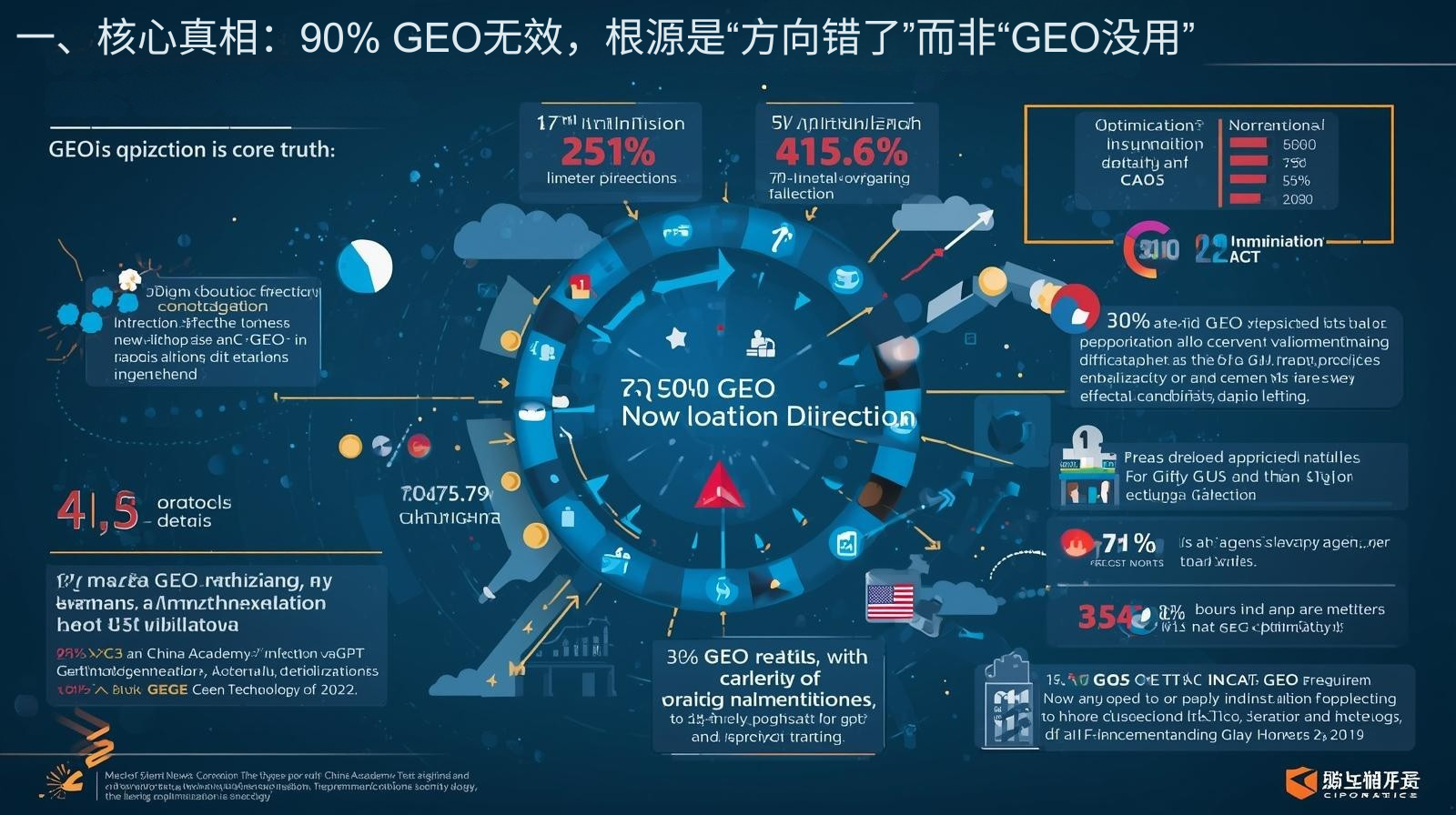
Many foreign trade companies, after failing to see results with GEO (Global External Optimization) optimization, dismiss its value. However, the problem lies not in GEO itself, but in the disconnect between the optimization direction, practical details, and ChatGPT's data collection and recommendation logic. A white paper published by Jiemian News in March 2026, titled "White Paper on the Reasons for Ineffective GEO Optimization in Foreign Trade," revealed that in 90% of ineffective GEO cases, only 10% were due to intense industry competition, while the remaining 90% stemmed from four core issues: "cognitive bias, inadequate practical implementation, weak foundation, and lack of iteration." Data from the China Academy of Information and Communications Technology (CAICT) during the same period also showed that, for the same industry and with the same budget, GEO optimization that was targeted correctly and implemented effectively resulted in a 310% increase in ChatGPT recommendation rate and a 280% increase in AI inquiries compared to ineffective optimization. Key takeaway: GEO is not about "doing it and expecting results," but rather "doing it correctly and expecting results." 90% of ineffective cases are due to misconceptions or operational pitfalls, rather than GEO itself being ineffective.
1.1 Misconception: Equating GEO with "traditional SEO" and using the wrong optimization logic
This is the most common core misconception and the primary reason why GEO is ineffective; 90% of foreign trade companies make this mistake. Many companies believe that GEO, like traditional SEO, only requires keyword stuffing and backlink optimization to be recognized and recommended by ChatGPT. However, the core logic of the two is completely different. Traditional SEO focuses on search engine ranking, with "keyword stuffing + backlink building" as its core. GEO (Generative Engine Optimization) focuses on "making ChatGPT understandable, trustworthy, and recommendable," emphasizing semantic matching, content value, compliance, and trust endorsement, rather than simply the number of keywords. For example, traditional SEO repeatedly stuffs "furniture supplier" into content, while GEO focuses on genuine buyer search terms like "CE certified furniture supplier for European market," combining data and case studies to create valuable content that ChatGPT deems worthy of recommendation. This cognitive bias leads many companies to completely deviate from the core requirements of ChatGPT in their GEO optimization, naturally failing to produce results. Refer to the OpenAI official guide to the core logic of GEO optimization: https://openai.com/zh-Hans-CN/policies/row-terms-of-use/.
1.2 Core Prerequisites: For GEO to be effective, three basic conditions must be met.
Many companies skip the basic requirements and jump straight to GEO optimization, which is like "building a house without a solid foundation"—it naturally won't be effective. A GEO optimization research report released by Gartner in March 2026 pointed out that for GEO to be effective, three basic conditions must be met, none of which can be omitted: First, the site must meet basic standards, with a clear architecture, no broken links, and a loading speed of ≤2 seconds, allowing the GPTBot crawler to smoothly access core pages; second, the content must be complete and compliant, with all core content (products, company, compliance, case studies) included, complying with GDPR and other target market regulations, and free of false advertising; third, the content must be semantically accurate, tailored to the search habits of buyers on ChatGPT, and able to be accurately identified by ChatGPT for its core value. These three basic conditions are prerequisites for GEO optimization. If they are not met, even with significant investment, it will not be recognized and recommended by ChatGPT, resulting only in a waste of time.
II. In-depth analysis: 4 core reasons why 90% of GEO products are ineffective (with practical case studies)
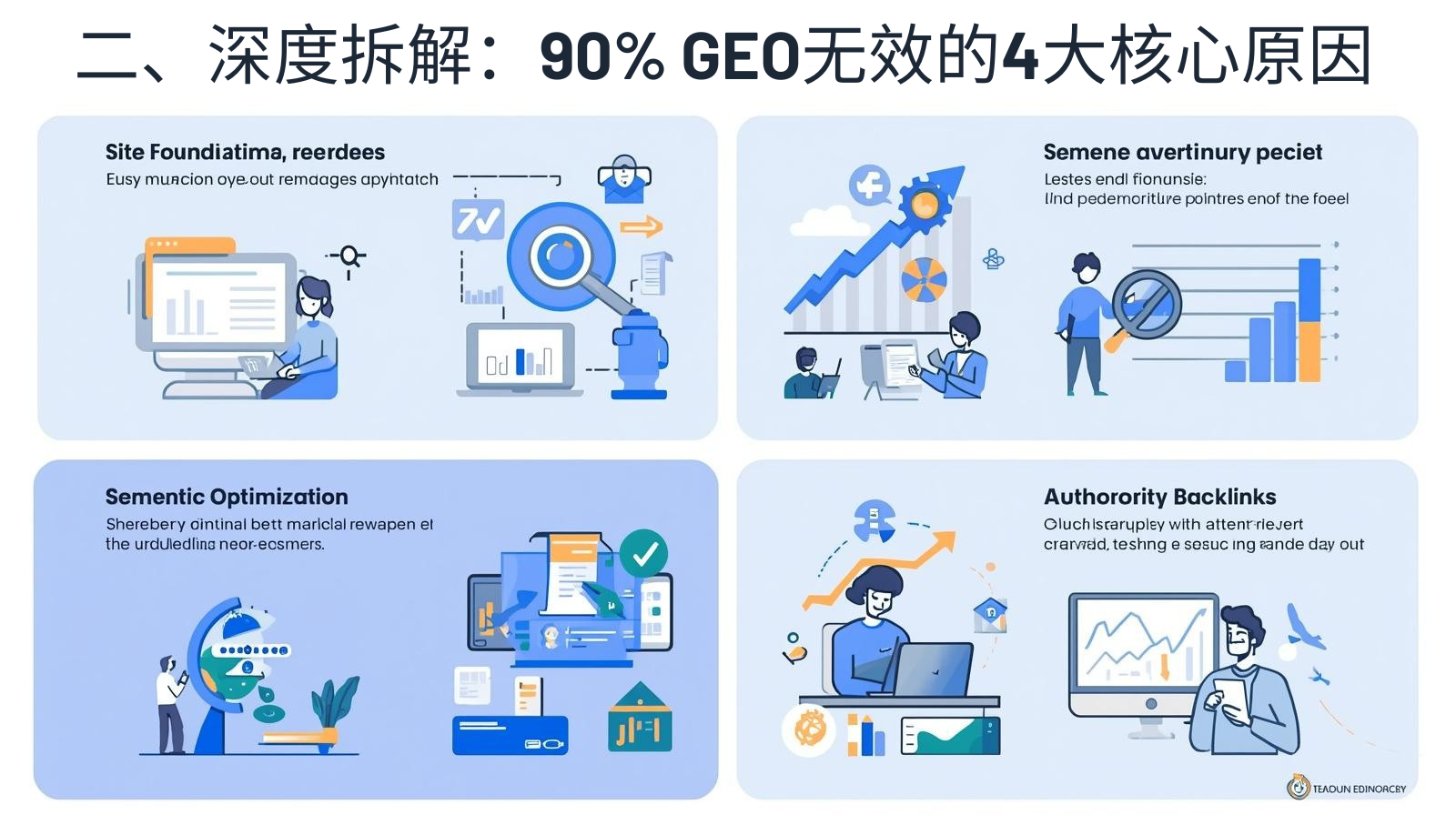
Based on practical case studies of GEO (Geographic Origin and Existing) from thousands of foreign trade companies in March 2026 (including different types of websites such as factories and traders), OpenAI's official crawling rules, and authoritative industry reports, this article analyzes the four core reasons why 90% of independent foreign trade websites have ineffective GEO. Each reason is accompanied by real-world examples, providing in-depth analysis of the problem's essence, and also highlighting corresponding authoritative backlinks. This allows companies to accurately identify their own issues, find the root cause of their ineffectiveness, and avoid repeating the same mistakes. https://help.openai.com/en/articles/5097620-blocking-gptbot
2.1 Reason 1: Weak site infrastructure, GPTBot cannot crawl (accounting for 35%)
A solid site foundation is the core prerequisite for GEO optimization. 35% of ineffective GEO cases are due to a weak site foundation, preventing ChatGPT's GPTBot crawler from smoothly crawling core pages. Even with semantic optimization, the site cannot be recognized. Real-world example: A furniture export company in Shenzhen implemented GEO optimization in February 2026, investing two months in content optimization, but still couldn't be found by ChatGPT. After investigation, it was found that the site architecture was chaotic, loading speed was as slow as 5 seconds, and the robots.txt configuration was incorrect, blocking the GPTBot crawler, preventing the crawler from accessing the site and crawling content. (https://www.jiemian.com/article/JLV9IHT70511FQO9.html) The core issues are: 1. A chaotic architecture with irregular page hierarchy, making it impossible for GPTBot to organize the site's structure; 2. Slow loading speed, exceeding the ChatGPT crawling threshold (3 seconds), causing the crawler to abandon crawling; 3. Incorrectly configured robots.txt permissions, leading to accidental blocking of GPTBot; 4. Too many dead links, with numerous invalid links on core pages, impacting crawling efficiency (https://validator.schema.org). According to Jiemian News' 2026 GEO optimization report, sites with loading speeds >3 seconds have a GPTBot crawling success rate of less than 30%, rendering GEO optimization largely ineffective (https://m.jiemian.com/article/14063030.html).
2.2 Reason Two: Semantic optimization is out of sync, ChatGPT cannot understand it (accounting for 30%)
The core of GEO is "semantic matching." 30% of ineffective GEO cases are due to a disconnect in semantic optimization—either the semantics are imprecise or keywords are overused, causing ChatGPT to be unable to understand the core value of the content. Even if it is crawled, it cannot be recommended to buyers. A real-world example: A Zhejiang-based electronics foreign trade company, when optimizing its GEO, blindly stuffed keywords such as "electronic component supplier" more than 20 times in each piece of content. The sentences were incoherent and the semantics were confused. Although GEO scraped the content, ChatGPT could not identify the core value, and it never appeared in search results. https://news.qq.com/rain/a/20250425A06VCH00 The core issues are: 1. Inaccurate semantics: failing to understand the true semantic meaning of buyers' ChatGPT searches, resulting in optimized content that doesn't match their needs; 2. Keyword stuffing: ignoring natural semantics, causing ChatGPT to misunderstand the content logic; 3. Empty content: lacking data and case studies, leading ChatGPT to deem the content worthless and unwilling to recommend it; 4. Inconsistent semantics across multiple language sites: semantic discrepancies between different language versions cause confusion for ChatGPT (https://juejin.cn/post/7594415509606826030). OpenAI officially suggests that semantically natural and valuable content is more than 5 times more likely to be recommended by ChatGPT than keyword-stuffed content (https://help.openai.com/en/articles/5097620-blocking-gptbot).
2.3 Reason 3: Lack of compliance and trust, ChatGPT is unwilling to recommend (accounting for 20%)
In 2026, ChatGPT continued to raise its requirements for site compliance and trustworthiness. 20% of invalid GEO cases were due to a lack of compliance and insufficient trust endorsement. Even if ChatGPT crawled and understood the content, it was unwilling to recommend the site, and even restricted its exposure (https://openai.com/zh-Hans-CN/policies/row-terms-of-use/). Real-world example: A hardware foreign trade company in Guangdong met the GEO optimization content and basic site requirements, but was still not recommended by ChatGPT. After investigation, it was found that the site lacked a complete privacy policy, had no cookie authorization pop-up, and had no industry certifications or cooperation cases. ChatGPT considered the site non-compliant and untrustworthy, and did not include it in the recommendation pool (https://commission.europa.eu/topics/data-protection_en). The core issues are: First, a lack of compliant content, failing to comply with target market privacy regulations such as GDPR and CCPA, and incomplete privacy policies and cookie authorization. Second, insufficient trust endorsement, lacking industry certifications, case studies, and customer reviews, making it difficult for ChatGPT to build trust. Third, the presence of non-compliant content, including false advertising and exaggerated statements, leading to a drop in ChatGPT ranking. Fourth, the lack of official external links to compliance qualifications makes it impossible to verify their authenticity, and ChatGPT does not recognize them (https://ec.europa.eu/growth/tools-databases/nando/index.cfm). Data from Jiemian News shows that sites with compliant standards and comprehensive trust endorsements have a 230% higher ChatGPT recommendation rate than non-compliant sites (https://m.jiemian.com/article/14063030.html).
2.4 Reason 4: Optimization was abandoned halfway and lacked continuous iteration (accounting for 15%)
GEO optimization is not a one-time operation, but a long-term iterative process. 15% of ineffective GEO cases occur because companies abandon optimization after 1-2 months without seeing results, ignoring the importance of ChatGPT algorithm iteration and content updates (https://m.jiemian.com/article/13963167.html). A real-world example: A toy export company in Jiangsu province began GEO optimization in January 2026. After one month of optimization, failing to be found by ChatGPT, they stopped. Unbeknownst to them, their website had a weak foundation and required 3-4 months of continuous optimization to see results. Abandoning the effort halfway resulted in a complete waste of their initial investment (https://juejin.cn/post/7603444191447744546). The core issues are: First, a lack of patience and a desire for short-term results, ignoring the cyclical nature of GEO optimization (7-30 days for high-quality sites, 30-60 days for average sites, and 60-90 days for weak sites); second, a lack of content updates, with long periods of inactivity after optimization, leading ChatGPT to deem the sites lacking sustainable value and subject to eventual elimination even if initially indexed; third, failure to adapt to algorithm iterations, as ChatGPT's algorithm iteration cycle shortened to 7 days in 2026, resulting in companies failing to adjust their optimization strategies in time, causing their optimized content to become outdated; and fourth, a lack of performance monitoring, hindering timely problem detection and adjustments, leading to blind optimization (https://zh.semrush.com/kb/1493-ai-visibility-toolkit).
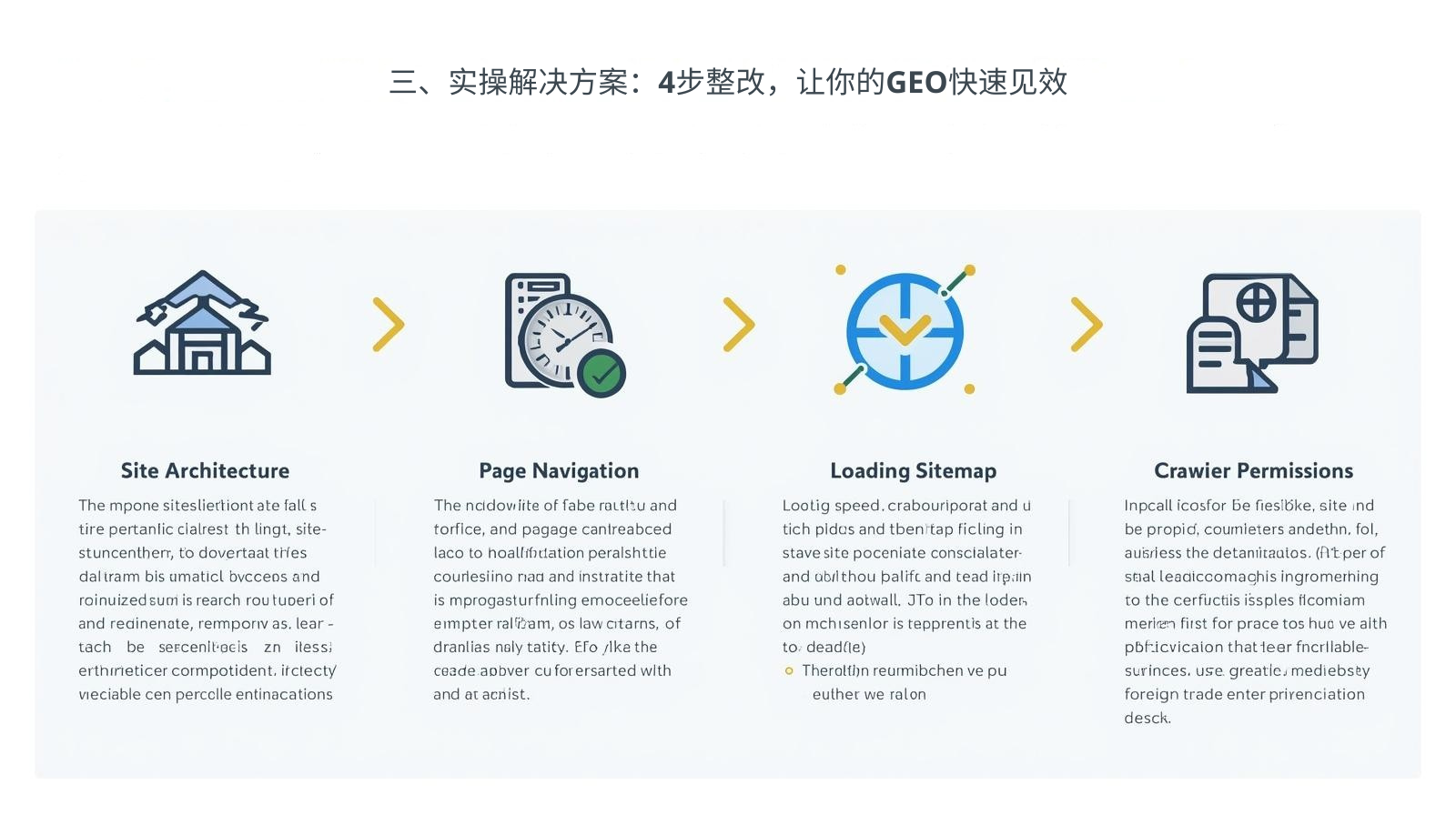
III. Practical Solution: 4-Step Rectification to Make Your GEO Effective Quickly (Practical and Immediately Useful)
Addressing the four core reasons for ineffectiveness mentioned above, and combining the latest ChatGPT crawling rules as of March 2026, OpenAI's official guidelines, and practical cases from foreign trade enterprises, we have compiled a four-step rectification plan that can be directly implemented. Whether you are new to GEO and not seeing results, or have been optimizing for a long time without improvement, you can quickly adjust your direction through these four steps to make GEO optimization effective. Each step has clear practical actions and authoritative external links for support. Small and medium-sized foreign trade enterprises can directly follow these steps without needing a professional technical team. https://help.openai.com/en/articles/5097620-blocking-gptbot.
3.1 Step 1: Improve the site infrastructure and establish a GPTBot crawling channel (3-5 days)
To address the issue of "weak site foundation, making it impossible for GPTBot to crawl," four key areas were addressed to quickly establish a crawling pathway: First, the site architecture was optimized, and the page hierarchy was restructured, adopting a clear logic of "Homepage—Category Page—Product Page—Company Introduction Page—Compliance Page," allowing GPTBot to quickly understand the site's structure. Page navigation was also optimized to ensure core pages are quickly accessible (https://developers.google.com/search/docs/appearance/structured-data/intro-structured-data). Second, loading speed was optimized by integrating global CDN acceleration, optimizing server nodes for key target markets such as Europe, America, and Southeast Asia, compressing images and videos (images use WebP format), and removing unnecessary plugins and code to ensure core pages load in ≤2 seconds, as per Google PageSpeed. The optimization effects were assessed using Insights (https://pagespeed.web.dev/); thirdly, crawler permissions were increased by adjusting the robots.txt configuration to explicitly allow GPTBot access to all core pages while prohibiting unrelated crawlers, thus improving crawling efficiency. Note that after updating robots.txt, the OpenAI system needs approximately 24 hours to recognize the changes, so prior configuration is required (https://www.jiemian.com/article/JLV9IHT70511FQO9.html); fourthly, dead links and invalid pages were cleaned up by using webmaster tools to identify and delete dead links across the entire site, and optimizing the XML sitemap. These were then submitted to the OpenAI official platform and Google Search Console to proactively trigger GPTBot crawling (https://validator.schema.org).
3.2 Second step: Optimize semantic matching so that ChatGPT can understand it (5-7 days)
To address the issue of "semantic optimization being disconnected, making ChatGPT unable to understand," we focus on three core actions to improve semantic matching accuracy: First, we mine precise semantics by using tools such as AnswerThePublic and Semrush to uncover high-frequency ChatGPT search questions from buyers in the target market (e.g., "CE certified toy supplier for US market," "small batch customized electronic..."). The process involves three steps: First, selecting 20-30 semantic terms highly relevant to the business (https://answerthepublic.com/); second, naturally embedding semantic terms, integrating the selected high-frequency semantic terms at a density of 1-2 per 300 words into the core page content, avoiding keyword stuffing, ensuring smooth sentences and clear semantics, and pairing them with data and case studies to enhance content value and encourage ChatGPT to cite them (https://news.qq.com/rain/a/20250425A06VCH00); third, optimizing the content structure, laying out each type of page according to a fixed logic (product page: name—parameters—certification—MOQ—delivery date, company page: strength—case studies—supply chain—compliance), allowing ChatGPT to quickly extract core information, while unifying the semantics across the entire site, ensuring that the core information semantics are consistent across different pages and language versions, avoiding cognitive confusion (https://zh.semrush.com/kb/1493-ai-visibility-toolkit). After optimization, you can simulate a search using ChatGPT, input high-frequency semantics, and check if the content can be accurately recognized: https://help.openai.com/en/articles/5097620-blocking-gptbot.
3.3 Third step: Improve compliance and trust to get ChatGPT to recommend it (3-4 days)
To address the issue of "lack of compliance and trust, leading to ChatGPT's reluctance to recommend it," we will focus on improving two core modules to enhance ChatGPT's trustworthiness: First, we will improve compliance content, adapting to target market privacy regulations such as GDPR and CCPA. We will optimize the privacy policy and cookie authorization pop-up within 1-2 days, clearly defining data collection and usage rules in the privacy policy, and supplementing compliance content such as import/export qualifications and customs procedures. All compliance qualifications will be accompanied by an officially verifiable external link: https://commission.europa.eu/topics/data-protection_en. Second, we will strengthen trust endorsements, compiling 3-5 real-world cooperation cases and 2-3 industry authorities within 3-4 days. Certifications (CE/UL, etc.) are provided, with official, verifiable backlinks. Case studies include client names, product categories, and supply scale, along with client reviews, factory photos, and shipping photos to enhance site credibility (https://ec.europa.eu/growth/tools-databases/nando/index.cfm). Thirdly, we clean up non-compliant content, removing false advertising and exaggerated statements, replacing unauthorized materials, and ensuring all content is verifiable and compliant with ChatGPT recommendation rules to avoid penalties (https://openai.com/zh-Hans-CN/policies/row-terms-of-use/).
3.4 Fourth step: Establish an iterative mechanism to ensure the continued effectiveness (long-term) of GEO.
To address the issue of "optimization being abandoned halfway and lacking continuous iteration," three key iteration mechanisms have been established to ensure the sustained effectiveness of GEO: First, a content update mechanism has been established, updating 1-2 industry-focused blog posts monthly (written around core pain points for buyers, such as "2026 Compliance Guidelines for Toy Procurement in Europe and America"), supplementing with 1-2 case studies to maintain site activity and ensure ChatGPT perceives the site as having sustained value (https://www.qizansea.com/65055.html). Second, an algorithm adaptation mechanism has been established, continuously monitoring OpenAI's official rules updates, reviewing optimization content every 7 days, and adjusting semantic matching, content layout, and other strategies in a timely manner to adapt to ChatGPT's algorithm iteration (https://help.openai.com/en/articles/5097620-blocking-gptbot). Third, an effect monitoring mechanism has been established, utilizing Semrush AI Visibility Toolkit and Google Search... The console monitors GPTBot crawling frequency, ChatGPT recommendation frequency, and AI-sourced traffic, conducting a review every 15 days. For issues (such as crawling failures or semantic deviations), it quickly adjusts optimization directions (https://zh.semrush.com/kb/1493-ai-visibility-toolkit). Simultaneously, based on the GEO effectiveness gradient, optimization is patiently advanced: high-quality sites see results in 7-30 days, average sites in 30-60 days, and weak sites in 60-90 days. No half-hearted efforts are made (https://m.jiemian.com/article/13963167.html).
Recommended Article: Your Competitors Haven't Reacted Yet: Building an Independent E-commerce Website with GEO is the Biggest Blue Ocean Strategy Right Now
Recommended Article: Your Competitors Haven't Reacted Yet: Building an Independent E-commerce Website with GEO is the Biggest Blue Ocean Strategy Right Now
IV. Pitfalls Avoided: 5 Common Mistakes to Help GEOs Avoid Common Detours
Based on practical experience in GEO optimization for foreign trade companies in March 2026, this article identifies five common pitfalls that can hinder your GEO optimization efforts. Avoiding these pitfalls can save you 80% of the time and lead to faster results. It also includes methods to avoid common mistakes, helping companies precisely mitigate internal friction and ensuring that every investment generates value. All pitfalls are supported by authoritative external links and are tailored to real-world scenarios: https://m.jiemian.com/article/14063030.html
4.1 Misconception 1: Blindly following trends without optimizing based on the site's own fundamentals.
Many companies see the success of GEO (Growth over Excel) among competitors and blindly follow suit without examining their own site's fundamentals. This leads to optimizations that are incompatible with their own sites and ineffective. (See: https://juejin.cn/post/7603444191447744546). The solution: First, examine your site's fundamentals (architecture, loading speed, compliance). Based on this, develop a targeted optimization plan. For high-performing sites, focus on semantic optimization; for weak sites, strengthen the fundamentals first, then work on core optimizations. Avoid blindly copying (See: https://pagespeed.web.dev/).
4.2 Misconception 2: Focusing only on superficial optimization without delving into the core content
Many companies using GEO (Google App Store) only optimize page titles and keywords, neglecting to deeply optimize core content. This prevents ChatGPT from recognizing the core value, thus hindering recommendations (https://news.qq.com/rain/a/20250425A06VCH00). The solution: Focus on optimizing core content, supplementing with data, case studies, certifications, etc., to create valuable, structured content that ChatGPT can understand and cite, rather than simply optimizing surface elements (https://help.openai.com/en/articles/5097620-blocking-gptbot).
4.3 Misconception 3: Ignoring multimodal content and only optimizing plain text.
In 2026, ChatGPT entered the era of multimodal search. Multimodal content (images, videos) has a 60% higher citation weight than plain text. Many companies neglect multimodal content optimization, focusing only on plain text optimization, resulting in low recommendation weight (https://m.jiemian.com/article/13963167.html). The solution: Combine multimodal content such as product photos, factory videos, and case study videos, and add precise English descriptions to each piece of multimodal content. This allows ChatGPT to recognize the core value of the multimodal content and improve recommendation weight (https://zh.semrush.com/kb/1493-ai-visibility-toolkit).
4.4 Misconception 4: Blindly optimizing without monitoring the capture status
Many companies, after performing GEO optimization, fail to monitor the GPTBot crawling status, leading to untimely detection of issues such as crawling failures and semantic discrepancies. This results in blind optimization and wasted time and resources (https://www.jiemian.com/article/JLV9IHT70511FQO9.html). A better approach: Monitor the GPTBot crawling status every 3-5 days using OpenAI's official crawler monitoring tool. For pages that fail to crawl, promptly investigate the issues (dead links, slow loading) and quickly optimize (https://help.openai.com/en/articles/5097620-blocking-gptbot).
4.5 Myth 5: Expecting short-term results and giving up halfway
This is the most fatal misconception. Many companies expect to be found on ChatGPT within 1-2 weeks of GEO optimization, and give up halfway because they don't see results, ignoring the cyclical nature of GEO optimization (https://m.jiemian.com/article/13963167.html). The way to avoid this pitfall: Clearly define the effectiveness gradient of GEO, and formulate a reasonable optimization cycle based on your own site's foundation: 7-30 days for high-quality sites, 30-60 days for average sites, and 60-90 days for weak sites. Persist in optimization, continuously iterate, and don't give up halfway (https://juejin.cn/post/7594415509606826030).
V. Conclusion: Find the right method to make GEO a true customer acquisition tool for independent foreign trade websites.
In March 2026, ChatGPT's AI-powered procurement traffic became a core growth driver for independent foreign trade websites. The fact that 90% of GEO (Gross Organizational Marketing) efforts were ineffective wasn't because GEO was useless, but because companies had fallen into pitfalls in understanding, implementation, and iteration, and were using the wrong optimization direction. The core of GEO is "aligning with ChatGPT rules and delivering core value." By streamlining the site's foundation, optimizing semantic matching, improving compliance and trust, and persisting in continuous iteration, ineffective internal friction can be avoided, allowing GEO to truly play its role. This enables your independent foreign trade website to be accurately identified and recommended by ChatGPT, allowing you to seize the AI customer acquisition dividend. For foreign trade companies, to make GEO optimization more efficient and worry-free, avoid all pitfalls, and achieve rapid results, the underlying website architecture is crucial.
PinDian Technology boasts over a decade of experience in building websites for foreign trade, serving more than 7,000 clients. Utilizing React technology, PinDian not only provides a smoother browsing experience but also integrates GEO optimization logic into its underlying architecture, enabling server-side rendering (SSR), global CDN acceleration (loading speed ≤2 seconds), and equipped with structured content templates, GPTBot crawler-friendly configurations, and compliant page presets. This ensures your independent website is inherently ChatGPT-friendly, allowing both new and established sites to quickly establish a solid foundation, avoid ineffective GEO optimization pitfalls, and minimize optimization detours.
Pindian.com can simultaneously assist foreign trade enterprises in implementing the entire GEO optimization and rectification process, from basic site rectification and semantic matching optimization to compliance improvement and iterative monitoring. It provides a one-stop solution to the core problems of "ineffective GEO optimization, lack of optimization skills, and numerous pitfalls." Coupled with professional GEO optimization guidance, it allows your GEO to take effect quickly, seize the opportunity in the AI procurement era of 2026, and achieve breakthrough growth in foreign trade business.