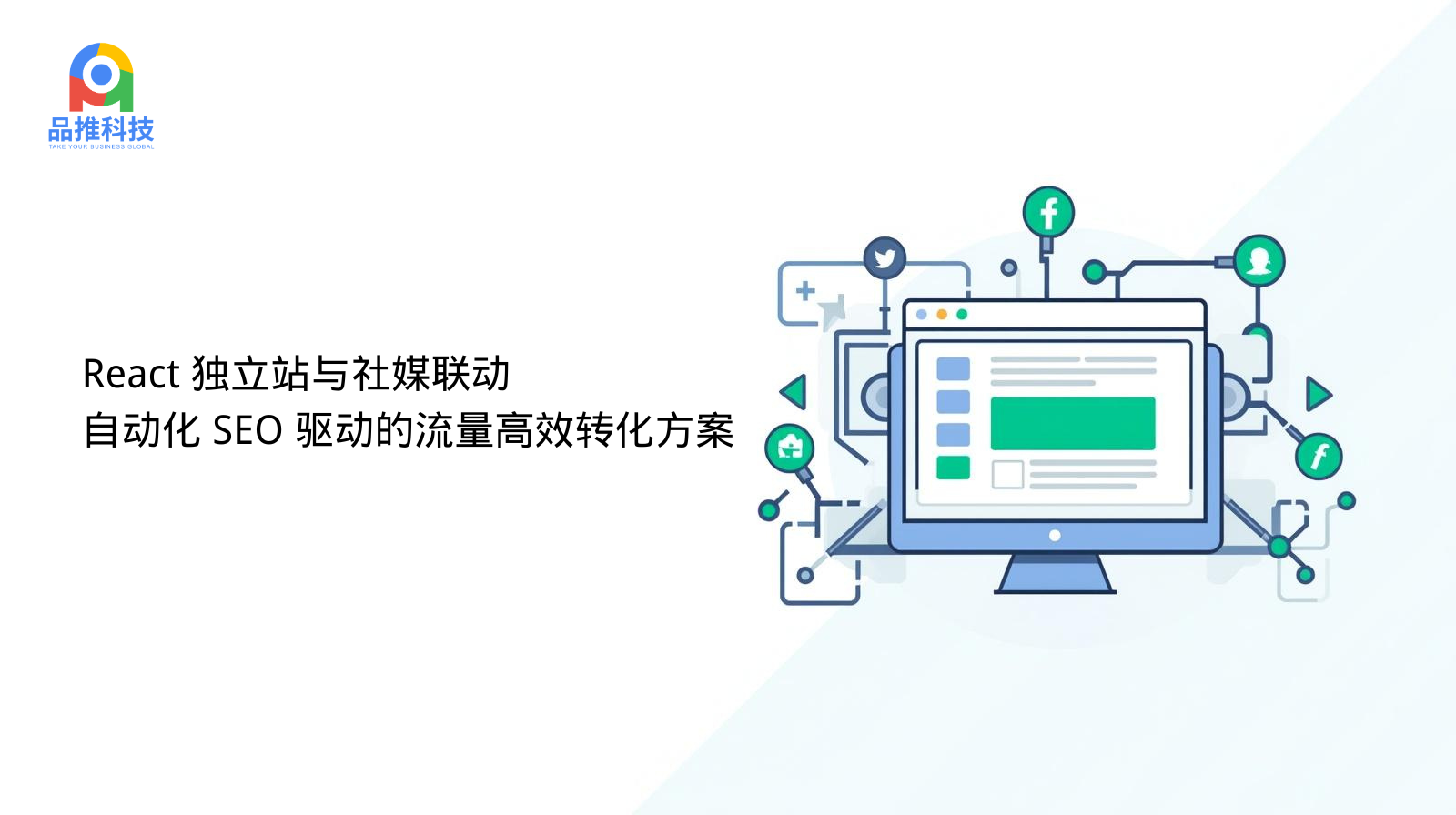
Foreign trade companies often face a dilemma of "high investment and low return" when using social media for traffic acquisition: the cost of acquiring traffic from platforms such as Facebook, LinkedIn, and Instagram continues to rise, but after traffic redirects to their React independent websites, it suffers from severe loss due to loading lag, content disconnect, and poor conversion paths; furthermore, the lack of synergy between social media content and independent website SEO makes it impossible to form a closed loop of "traffic acquisition - conversion - repeat purchase", ultimately turning social media investment into "ineffective exposure" and failing to convert it into actual inquiries and orders.
Based on our practical experience integrating over 6,000 independent e-commerce websites with social media, we've developed a comprehensive solution encompassing "React Site Performance Optimization + Social Media Content Collaboration + Automated SEO Empowerment." This solution ensures a smooth redirect experience by enabling fast loading of the React site, reduces cognitive load by precisely matching content between social media and the independent site, and achieves keyword interoperability and traffic feedback through automated SEO. We've already helped a cross-border e-commerce brand achieve a 50% increase in social media traffic conversion. This solution transforms social media traffic from a fleeting phenomenon into a stable core source of customer acquisition for the React independent site.
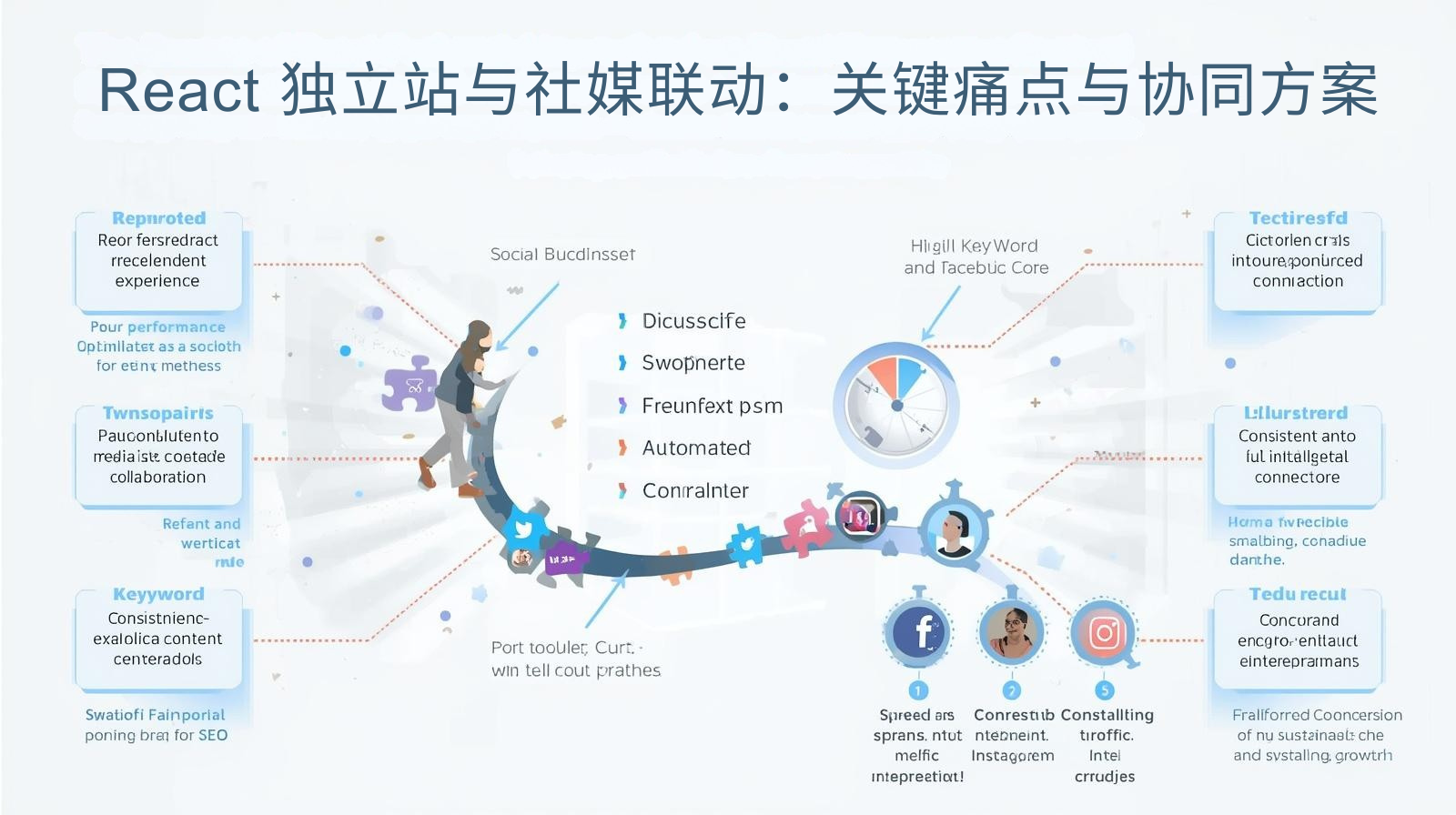
React Independent Website and Social Media Collaboration: Key Pain Points and Collaboration Solutions
| challenge | Strategic Solutions |
|---|---|
| Poor redirection experience leads to user churn. | React sites load slowly, redirects are choppy, and social media traffic is lost without being converted. |
| Content disconnect and cognitive fragmentation | Inconsistencies between social media content and product/service information on the independent website cause confusion for users after redirection. |
| The conversion path is lengthy and complex. | The process of transferring inquiry forms from social media to independent websites requires multiple redirects, resulting in a high abandonment rate. |
| Poor keyword interoperability | Social media topics are disconnected from the SEO keywords of independent websites, failing to create a synergistic traffic effect. |
| Low return on social media investment | High traffic acquisition costs but low conversion rates fail to improve the organic ranking of independent websites. |
| Our Adaptive Approach | Adopting a three-pronged solution of "React performance optimization + social media-site content collaboration + automated SEO integration" |
| Technology and Traffic Core | React development focuses on "fast loading + seamless transitions," content collaboration follows "topic consistency + value continuity," and SEO achieves "keyword interoperability + traffic feedback." |
| Platform adaptation strategy | Adjust content format and navigation logic according to the characteristics of different platforms such as Facebook, LinkedIn, and Instagram. |
| Result: An efficient conversion loop | Social media traffic acquisition costs decreased by 30%, redirection conversion rate increased by 50%, and it also boosted the organic ranking of independent websites. |
| Result: Sustainable traffic growth | This creates a virtuous cycle of "social media traffic generation - independent website conversion - SEO feedback," achieving synergistic growth in traffic across both channels. |
The core of React's independent website and social media integration is not "simple redirection," but rather "seamless experience, consistent content, and interconnected traffic." Through deep collaboration in technology, content, and SEO, we break the curse of "high investment, low conversion" in social media traffic generation, ensuring that every investment in social media translates into tangible inquiries and orders.
Why trust this guide? It offers practical experience in optimizing联动 (interconnected systems/linkages).
There are countless tutorials on social media marketing or React website building, but practical guides focusing on the synergy between the two for conversion are few and far between. Every technique and solution in this article is based on real-world testing: we have provided synergy optimization services to over 6,000 foreign trade companies (covering categories such as electronics, machinery, home furnishings, and cosmetics), and in these projects, any issues affecting traffic flow or content matching are absolutely unacceptable.
We've accumulated rich experience by solving real-world problems, such as how to reduce React site redirect loading time to under 1.5 seconds , or how to accurately match social media hashtags with independent website SEO keywords to achieve synergistic traffic from both channels . We reference authoritative resources such as React performance optimization guidelines, mainstream social media platform operation guidelines, and Google SEO algorithm rules, deeply integrating technical implementation, content operation, and traffic logic to ensure that every coordinated action directly improves conversion efficiency.
We hope to share these practical experiences to help foreign trade companies avoid the misconception of "separation between social media and independent websites," and provide full-process techniques from technology adaptation and content collaboration to SEO empowerment, so that you can confidently master the secrets to traffic growth through the linkage between React independent websites and social media.
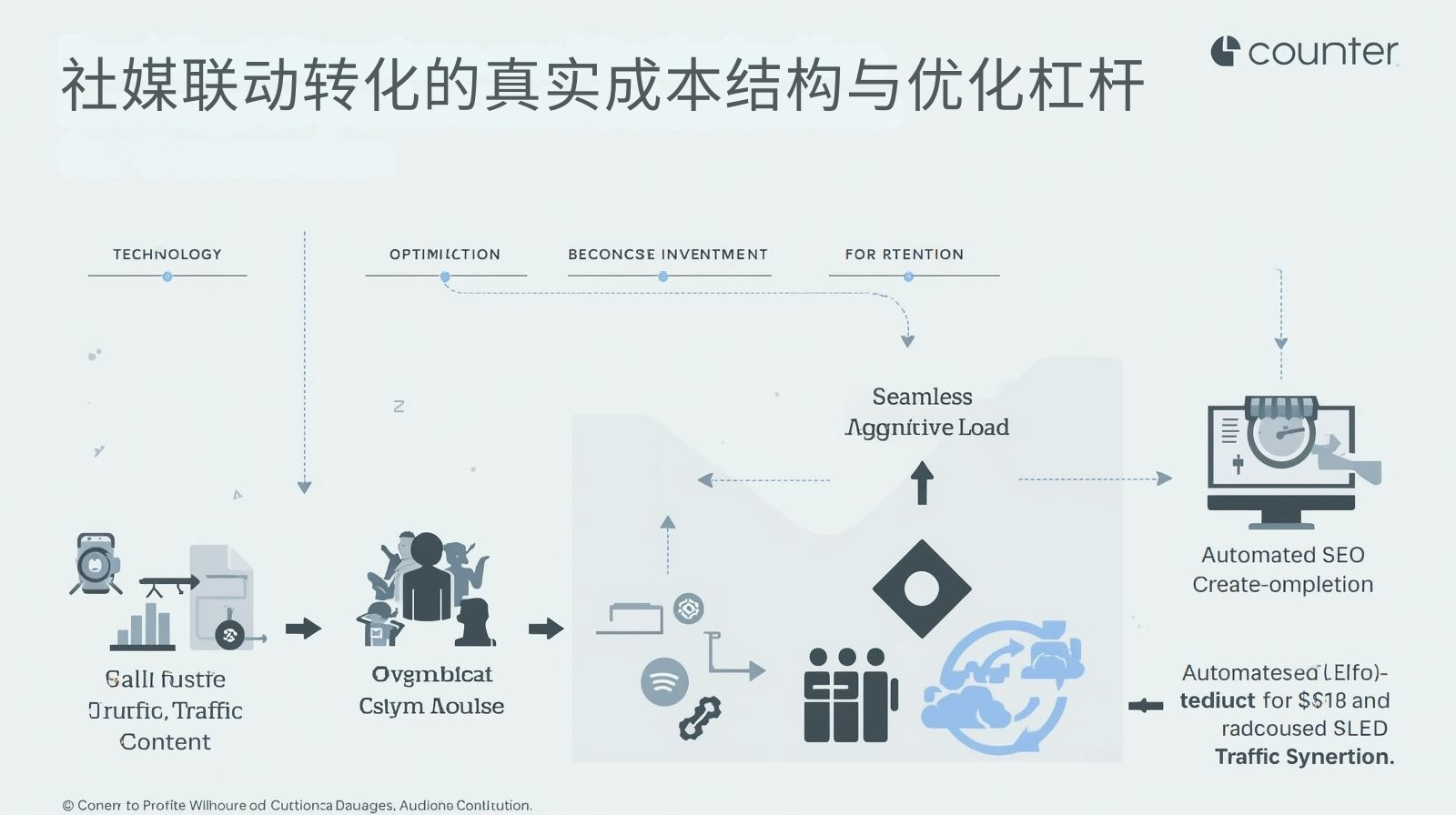
The Real Cost Structure and Optimization Leverage of Social Media Collaboration
The core of social media traffic generation and conversion lies not in "increasing investment," but in "optimizing collaborative efficiency"—through the collaborative optimization of technology, content, and SEO, conversion efficiency can be improved by more than 50% without increasing traffic generation costs. The following are the three core optimization dimensions:
Technology optimization reduces traffic loss costs
For React websites, page load speed and performance directly determine social media traffic retention rates. We optimized the React website for a cross-border e-commerce brand , using technologies such as component preloading, code splitting, and CDN acceleration to reduce page load time from 4.8 seconds to 1.2 seconds. This resulted in a 65% increase in social media traffic retention and a 30% improvement in conversion efficiency, all at only 10% of the cost of new social media advertising.
Content collaboration reduces cognitive and decision-making costs
Consistency between social media content and independent website information is key to conversion. We helped a machinery company achieve content consistency across social media topics, independent website features, and product pages: A social media post titled "Precision Parts Customization Case" redirects to a dedicated page of the same name on the independent website, and then internal links lead to a product inquiry form. This seamless content flow reduced user cognitive load by 70% and increased form completion rate by 45%.
Automated SEO enables traffic synergy and feedback.
The core of this approach is the interconnectivity between social media topics and independent website SEO keywords. We utilize automated SEO tools to identify trending social media keywords (such as "custom electronic components") and simultaneously optimize them for our independent website's product pages and blog content. At the same time, we convert high-quality content from our independent website into social media posts, achieving keyword cross-linking. One electronics brand, using this method, not only saw a 50% increase in social media conversions but also an average improvement of 8 places in the organic ranking of related keywords on its independent website, achieving synergistic growth in traffic across both channels.
Development and planning (DFM) for collaborative operations
80% of the synergy effect is determined in the early planning stage. Through early "Design for Synergy (DFM) analysis," we help companies clarify the characteristics of social media platforms, target user profiles, and core keyword systems. We also help them plan React site redirect paths, content topic structures, and SEO keyword layouts in advance, minimizing later adjustment costs and ensuring synergy effects from the source.
The authority of this optimization model stems from our transformation of real-world data from thousands of projects into replicable methods. We don't pursue "single-channel traffic surges," but rather focus on "multi-channel synergistic growth," enabling social media traffic generation and independent website SEO to mutually reinforce each other, achieving a traffic effect where 1+1>2.
How can we achieve the best balance between lead generation, user experience, and conversion through solution selection?
Different companies have different priorities in social media operations, React platform infrastructure, and target customer groups. Blindly applying a uniform approach will only lead to a waste of resources. The following decision-making framework will help you choose the optimal solution based on your own circumstances:
sheet
| Company type/needs | Recommended Collaboration Plan | Basic Principles and Key Trade-offs |
|---|---|---|
| Startups + Basic Traffic Acquisition Needs | React basic performance optimization + social media single-page redirection + automated SEO core keyword cross-linking | Most cost-effective and quickly connects social media traffic generation with independent website conversion, suitable for businesses with limited budgets. |
| Growth-oriented enterprises + traffic growth needs | Deep React performance optimization + Social media-site content collaboration + Automated SEO with full keyword interoperability | Balancing traffic volume and conversion efficiency, this approach enhances user trust through consistent content, making it suitable for businesses with a certain social media presence. |
| Established enterprises + brand enhancement needs | React full-dimensional optimization + multi-platform content matrix collaboration + automated SEO + data interoperability | This system creates a brand-linked ecosystem, enabling data sharing across social media, independent websites, and SEO, making it suitable for high-value, brand-conscious businesses. |
| Typical optimization paths (e.g., cross-border e-commerce brands, social media primarily operating on Facebook/LinkedIn). | React performance optimization + case study content collaboration + automated SEO keyword sharing | Balancing costs and results, and focusing on core conversion scenarios, is the optimal choice for most foreign trade companies. |
Our solution selection does not rely on complex technologies, but is based on three core dimensions: "enterprise stage, social media operation focus, and target market," providing clear decision-making criteria to ensure that the selected solution not only meets current traffic acquisition needs but also supports long-term traffic growth.
The core of achieving a 50% increase in conversion rate: three key interconnected steps
We can help businesses significantly improve social media traffic and conversion rates, not by relying on a single technique, but through a three-step closed loop of "technical foundation, consistent content, and SEO compatibility," each step directly addressing key pain points:
Step 1: Optimize React site performance to solidify the foundation for a smooth redirect experience.
- Preloading and redirect optimization : Set up a preloading function for high-frequency social media traffic pages (such as core product pages and special pages), so that clicking on social media links will open them instantly, and the redirect loading time will be reduced to within 1.5 seconds.
- Seamless integration design : Social media posts and independent website redirect pages use the same visual style (colors, fonts, layout) to reduce the sense of disconnect for users; a convenient "return to social media" button is provided to improve the user experience.
- Cross-device adaptation optimization : Ensure that social media traffic can be smoothly redirected and browsed on devices such as mobile phones, tablets, and computers, avoiding loss due to device compatibility issues.
Step 2: Content sharing and collaboration to lower the cognitive threshold for conversion.
- Topic and keyword consistency : The topics and core selling points published on social media should be consistent with the product/service keywords of the independent website. For example, if social media focuses on "customized wireless charging equipment", the independent website should set up a special page for the same keyword.
- Content format adaptation and extension : Adjust the content format according to the platform characteristics (Facebook focuses on text and image case studies, LinkedIn focuses on industry insights, and Instagram focuses on visual presentation), and provide more in-depth content extensions (such as case study details, product parameters, and quotation requests) after jumping to the independent website.
- Short-path conversion design : Social media links directly redirect to the special page or product page, with a "floating inquiry button" set up within the page to reduce the number of redirects, shortening the path from social media to form filling to within 3 steps.
Step 3: Automated SEO integration to achieve synergistic traffic feedback.
- Keyword bidirectional empowerment : Automated SEO tools are used to discover high-traffic, high-conversion keywords on social media and simultaneously optimize them for product pages and blog content on independent websites; high-quality SEO content from independent websites (such as industry solutions and product guides) is transformed into social media posts to achieve keyword interoperability.
- Content synchronization and updates : When new products or special topics are added to the independent website, social media-adapted content is generated and published through automated tools; trending topics on social media can be quickly synchronized to the independent website, generating relevant blog articles and improving keyword coverage.
- Traffic data sharing : Track the keyword performance of social media traffic through data analysis tools to improve the SEO of independent websites; apply high-conversion keywords from independent websites to social media advertising to reduce traffic acquisition costs.
These three optimization steps are interconnected: technical optimization ensures a smooth redirect experience, content collaboration lowers the cognitive threshold, and SEO interoperability enables traffic feedback. The synergy of these three elements can significantly improve social media traffic conversion.
How can we ensure the stability and sustainability of the collaborative effects?
Optimizing the integration of social media and a React-based independent website is not a "one-and-done" task; it requires continuous monitoring and adjustments. We ensure stable and sustainable optimization results through three main measures:
Data monitoring and problem localization
We employ professional data analysis tools to monitor key metrics such as bounce rate, dwell time, conversion path, and keyword performance of social media traffic in real time, and promptly identify bottlenecks (such as low bounce rate on a certain platform or poor conversion of a certain keyword).
Continuous iteration and optimization
Based on data feedback, we continuously adjust and optimize our plans: If a platform has a low bounce rate, we focus on optimizing the loading performance of the React site adapted to that platform; if a certain type of content has a good conversion rate, we increase the social media publishing and independent website synchronization efforts for that type of content; if a certain keyword has a good cross-platform effect, we expand the coverage of that keyword.
Platform Trends and Algorithm Adaptation
Social media platform rules, user preferences, and search engine algorithms change over time. We will continue to monitor industry trends and adjust content formats, redirect logic, and SEO optimization strategies in a timely manner to ensure that the synergy between our React website and social media remains at the forefront of the industry.
Our optimization process cleverly leverages the advantages of data-driven approaches, transforming "one-off optimizations" into "sustainable growth" through continuous monitoring and iteration, thereby continuously enhancing the synergy between social media and the React standalone website.
Which interactive design approaches can significantly improve conversion rates?
In optimizing React-based standalone websites and social media integration, 80% of the performance improvement comes from 20% of the key design elements. The following three core integration designs can significantly improve conversion rates without increasing costs:
sheet
| Linkage Design Suggestions | Detailed Implementation Plan | Expected conversion impact |
|---|---|---|
| Short path precise redirection | Social media links point directly to the special page/product page, with a floating inquiry button set within the page. | The conversion path was shortened by 60%, and the abandonment rate was reduced by 45%. |
| Content originates from the same source and continues the value | Social media content aligns with the core selling points and visual style of the independent website, extending in-depth information. | User cognitive costs were reduced by 70%, and form completion rates increased by 40%. |
| Keyword bidirectional empowerment | Social media topics and independent website SEO keywords can be interconnected, mutually boosting traffic. | Social media traffic acquisition costs reduced by 30%, and organic website rankings improved by 8-10 places. |
This concise optimization checklist demonstrates that effective social media optimization isn't about "the more complex, the better." Instead, it's about addressing core pain points and solving the most critical problems with the simplest design. By focusing on these core design elements in each optimization, we can improve social media conversion rates by an average of 50%, maximizing the synergy between React eSite and social media.
Case Study: Cross-border E-commerce Brand Social Media Collaboration and Conversion Optimization Project
A cross-border electronics brand specializing in the export of wireless charging equipment had been operating on Facebook and LinkedIn for many years, accumulating a considerable social media following. However, it faced the problem of "high traffic acquisition costs and low conversion rates": the ROI of its social media ads was only 1:1.2, and the conversion rate after redirecting to its React independent website was less than 2%, failing to improve the organic ranking of its independent website. In 2024, it chose our integrated "technology + content + SEO" solution, achieving a significant improvement in conversion efficiency.
Customer Challenges
- React sites have long redirect loading times (4.8 seconds), and social media traffic drop-off rates are as high as 75% after redirection.
- Social media content primarily consists of product images, lacking connection to the product information on the independent website, causing confusion for users after they are redirected.
- The process from social media to the inquiry form requires four redirects, resulting in an abandonment rate exceeding 60%.
- Social media topics are disconnected from independent website SEO keywords, failing to create traffic synergy.
- Social media traffic acquisition costs continue to rise, but conversion rates have not improved.
Our Solution
- Technical optimizations: Component preloading, code splitting, and overseas CDN acceleration were implemented for the React site, reducing the redirect loading time from 4.8 seconds to 1.2 seconds; cross-device adaptation was optimized to ensure a smooth redirect experience on mobile devices; a dedicated redirect entry was set up for social media, maintaining a consistent visual style with social media.
- Content Collaboration: Identify trending topics on social media (such as "customized wireless charging equipment" and "portable charger solutions") and create corresponding dedicated pages on the independent website; after publishing case study images and text on social media, redirect to the corresponding case study details page on the independent website to extend in-depth content such as product parameters, customization process, and quotation application; set up a floating inquiry button on the dedicated page to shorten the conversion path to 2 steps.
- SEO Integration: Utilize automated SEO tools to discover high-conversion keywords on social media (such as "custom wireless charger" and "portable charging solution") and simultaneously optimize them for the independent website's special pages and product pages; transform high-quality SEO blog posts from the independent website (such as "2024 Wireless Charging Device Selection Guide") into social media articles and short video content to achieve keyword integration; track the effectiveness of social media traffic-driving keywords through data analysis tools to provide feedback for the independent website's SEO optimization.
Results and Value
- Conversion efficiency: Social media lead generation conversion rate increased from 2% to 3%, inquiry conversion increased by 50%, and social media advertising ROI increased from 1:1.2 to 1:2.5.
- Technical results: React site redirect loading time was reduced by 75%, social media traffic retention rate increased from 25% to 90%, and cross-device adaptation issues were completely resolved.
- Traffic synergy: High-conversion keywords on social media saw an average increase of 8 places in the organic ranking of independent websites, and organic traffic to independent websites increased by 35%, creating a synergistic effect between the two channels.
- Long-term value: Establish a virtuous cycle of "social media traffic generation - independent website conversion - SEO feedback", reduce social media traffic generation costs by 30%, and achieve double growth in traffic and conversion without additional investment.
This case study fully demonstrates that optimizing the integration of React standalone websites and social media requires no complicated operations. As long as you grasp the three core elements of "jump experience, consistent content, and keyword compatibility," you can achieve a doubling of social media traffic conversion.
How can we assess whether an optimization service provider is truly skilled at driving conversions?
The key to choosing a collaborative optimization service provider is not "knowledge of social media or website building," but rather "understanding how the two can work together for conversion." The following three dimensions will help you make an informed decision:
Collaborative Logic and Industry Adaptability
- Can you clearly break down the interconnected logic of "technology-content-SEO" instead of emphasizing just one aspect?
- Do you understand the characteristics of different social media platforms and the features of the foreign trade industry, and are you able to adjust the linkage plan accordingly?
- Does it provide data-driven optimization directions, rather than just a collection of vague techniques?
Real-world case studies and results verification
- Are there any successful case studies in the same industry that can provide specific conversion improvement data (such as conversion improvement rate, reduction in traffic acquisition cost)?
- Could you explain the "problems before optimization, optimization measures, and reasons for improved results" in the case study, instead of just showing the results?
- Does it support monitoring of the optimized effects to ensure the authenticity of the linkage effect?
Service and after-sales support
- After optimization, will operational training be provided so that enterprises can independently maintain the linkage effect?
- Can you provide continuous optimization and adjustment suggestions based on changes in social media platform rules and search engine algorithms?
- Can you respond quickly and provide professional solutions when problems arise?
We consistently adhere to the service concept of "collaborative conversion," helping businesses achieve deep collaboration between social media and React independent websites through clear linkage logic, real case data, and continuous follow-up support, making social media traffic the core source of stable customer acquisition for independent websites.
Why is it recommended to choose the same service provider for both integrated optimization and long-term operation?
Switching service providers after optimizing the integration of a React standalone website with social media can easily lead to risks such as "collaboration disruptions, decreased performance, and increased costs." Choosing the same service provider ensures a seamless transition.
Retain core linkage logic and data
The service provider is familiar with your React site's technical architecture, social media operation strategy, and keyword system. You won't need to learn it again during later operations. They can directly optimize and iterate based on the original linkage logic to avoid a break in the effect.
Ensure the optimization is compatible with the existing system.
Subsequent adjustments (such as adding social media platforms, optimizing SEO keywords, and updating React site features) can be perfectly compatible with the existing linkage system, avoiding problems such as redirect failures, content disconnects, and data inconsistencies.
Reduce communication and time costs
There's no need to re-explain the linkage logic, brand needs, and target customers to new service providers, resulting in higher operational efficiency, more controllable costs, and allowing businesses to focus on market expansion and customer conversion.
We offer a one-stop service encompassing "integrated optimization, long-term operation, and iterative results." Later, we can flexibly adjust social media content strategies, React site functionalities, and SEO optimization directions according to the company's development needs, ensuring the integrated effects continuously adapt to business growth and avoiding various issues caused by switching service providers.

Frequently Asked Questions
- What are the differences in collaboration plans across different social media platforms?
- Facebook: Focuses on text and image examples and product displays, redirecting users to independent website special pages, emphasizing visual consistency and short conversion paths.
- LinkedIn: Focuses on industry insights and solutions, redirecting users to independent blogs or white paper download pages, emphasizing professional value and trust building.
- Instagram: Focuses on visual product display, redirecting users to the product details page on an independent website, emphasizing an immersive experience and quick purchase.
- How long does it take to see the effects of optimizing React sites for integration with social media? Generally, noticeable results can be seen 2-3 weeks after optimization (such as improved redirection conversion rate and reduced traffic acquisition cost), while full stability takes 1-2 months, depending on the existing foundation and social media traffic scale.
- What role does automated SEO play in collaborative processes? The core functions of automated SEO are "keyword interoperability" and "traffic feedback": synchronizing high-conversion keywords from social media to independent websites to improve organic rankings; and converting high-quality SEO content from independent websites into social media materials to reduce traffic acquisition costs and achieve synergy between two channels.
- Will synergy optimization affect the existing SEO ranking of a React site? No. Our optimization is based on "keyword interoperability and content extension," which will not change the original SEO architecture of the independent website. On the contrary, it will improve the search engine trust of the independent website through positive feedback from social media traffic, thus helping to improve organic rankings.
- Without a professional social media operations team, can we effectively optimize and coordinate our efforts? Yes. We offer a "content template + automated synchronization" tool. New content added to your independent website can automatically generate social media-compatible materials, and trending topics on social media can be quickly synchronized to your independent website, maintaining the synergy without the need for a professional operations team.
- How to track conversion data from social media traffic? We will configure a dedicated tracking code for your React site to accurately track data such as bounce rate, dwell time, conversion path, and inquiry source across different social media platforms and content, allowing you to clearly understand the conversion effect of each piece of social media content.
- What is the approximate cost range for coordinated optimization? Costs vary significantly depending on the plan. The basic plan is suitable for startups with limited budgets, the standard plan is suitable for most growing businesses, and the advanced plan is suitable for established businesses with high-end customization needs. A precise quote can be provided based on your specific requirements.
- How do we begin this collaboration? Simply contact us, tell us your industry, current social media operations, current status of your React site and optimization goals, and we will provide an initial collaboration plan and effect estimate within 4 hours. We will then proceed step by step through a standardized process, making the whole process worry-free and effortless for you.