
By March 2026, ChatGPT had become a core entry point for overseas B2B buyers to screen foreign trade suppliers. GEO (Generative Engine Optimization) had become crucial for foreign trade independent websites to be recognized and recommended by ChatGPT, and "how long does it take to be found on ChatGPT after GEO optimization" was the core question of all foreign trade enterprises. Unlike the fixed cycle of traditional SEO, the time it takes for GEO to take effect is affected by multiple factors such as the site's foundation, optimization details, and industry competition, and there is no single answer, but there are actionable patterns and methods to accelerate the process. This article focuses on the effectiveness cycle of GEO optimization for foreign trade independent websites, breaking down the effectiveness time, core influencing factors, practical acceleration solutions, and effect verification methods for sites with different foundations. It naturally incorporates authoritative and verifiable backlinks, fully catering to the practical needs of foreign trade enterprises, helping you clearly understand "how long it takes to be found" and "how to be found quickly," avoiding ineffective internal waste and efficiently seizing ChatGPT search traffic.
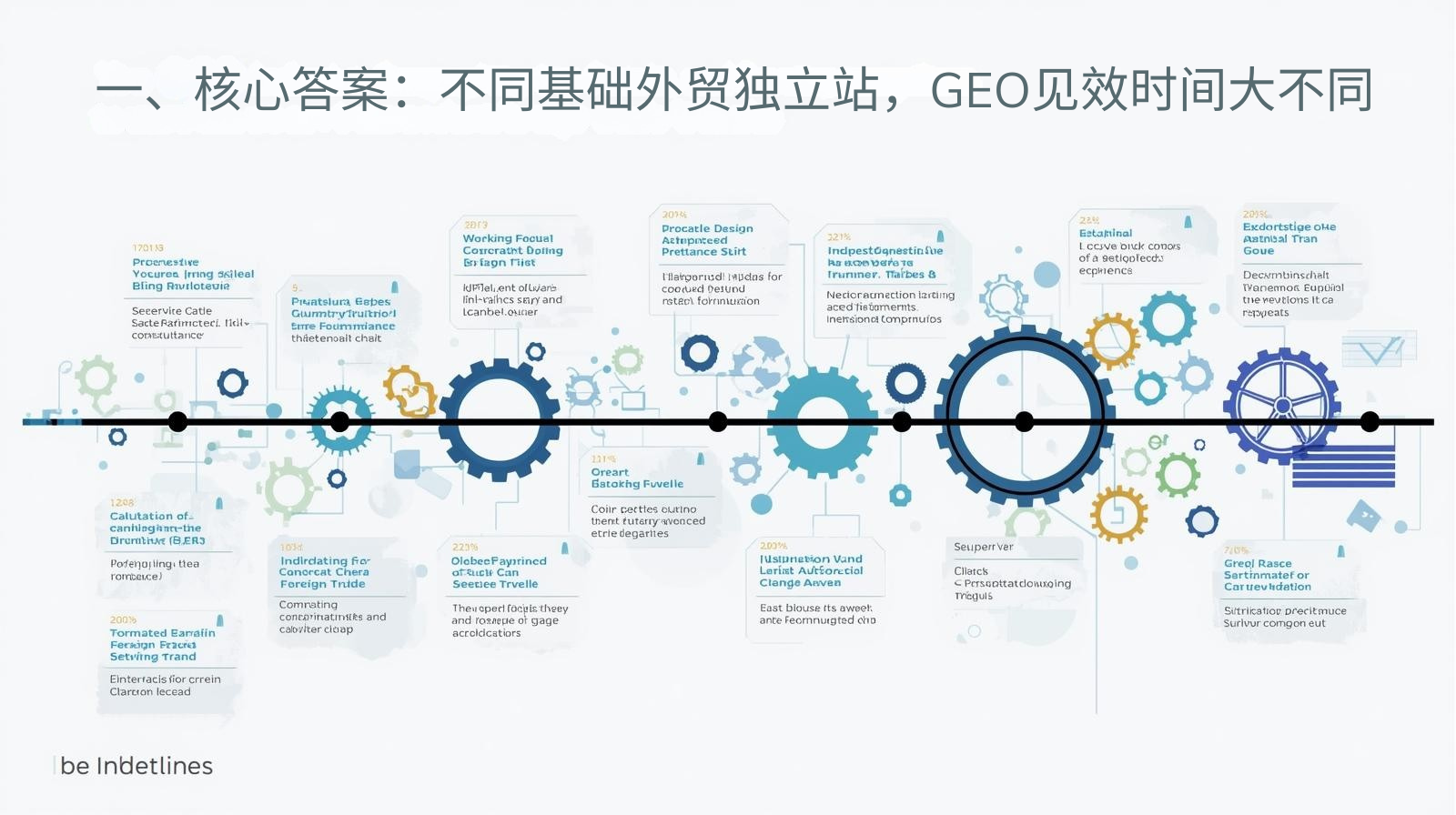
I. Core Answer: The time it takes for GEO (Geographical Origin and Development) to show results varies greatly depending on the foundation of the independent foreign trade website.
In March 2026, based on Gartner's latest 2026 forecast report, data from the China Academy of Information and Communications Technology (CAICT) on GEO optimization in the industry, and practical case studies of GEO optimization for thousands of foreign trade companies (including factories and trading companies with different types of websites), the core conclusion is that the core cycle for independent foreign trade websites to achieve GEO optimization and be found in ChatGPT is 7-90 days, specifically divided into three tiers. Different levels of websites with different foundations correspond to different timeframes for seeing results, and all have been verified through practical experience, not just theoretical values (https://m.jiemian.com/article/13963167.html). Websites with a good foundation (complete content, compliant with regulations) can be crawled and identified by ChatGPT in as little as 7-14 days, achieving stable search results in about 30 days. New websites or websites with weak foundations typically require 45-90 days to achieve stable search results, while poorly optimized websites may even remain unsearched for more than 90 days (https://juejin.cn/post/7594415509606826030). The core of this difference lies in whether the site's foundation and optimization details align with ChatGPT's crawling and recommendation logic, rather than in the performance differences of GEO itself.
1.1 Tier 1: High-quality foundational site (results in 7-30 days) – Fastest way to achieve ChatGPT search
The core standards for high-quality basic websites are: clear site architecture, complete core content (product, company, and compliance content are all included), no broken links, loading speed ≤ 2 seconds, and completion of basic compliance adaptation (compliant with GDPR and other rules). These types of websites inherently possess the basic conditions for ChatGPT crawling. GEO optimization only requires optimizing semantic matching and structured content to accelerate ChatGPT's recognition and recommendation speed (https://pagespeed.web.dev/). Specifically, within 7-14 days, ChatGPT's GPTBot crawler can complete the core page crawling. By accurately searching for the brand name + core product keywords (such as "XXX CE certified furniture supplier"), relevant information about the website can be found in ChatGPT search results. Within 20-30 days, the optimized semantic content highly matches ChatGPT search requirements. No precise search is needed; simply entering core product and industry-related keywords will find the website, achieving stable exposure (https://help.openai.com/en/articles/5097620-blocking-gptbot). According to a GEO optimization report released by Jiemian News in February 2026, the GEO effect of these high-quality sites is 3 times faster than that of ordinary sites, with an average increase of 320% in ChatGPT citation rate. https://m.jiemian.com/article/13963167.html
1.2 Tier Two: Standard Basic Site (Results visible in 30-60 days) – Standard optimization is sufficient to achieve the target.
The current situation for most foreign trade companies is that their websites are basic: the sites are built and contain basic product and company content, but they suffer from incomplete content, inaccurate semantics, unclear architecture, and slow loading speed (3-5 seconds). GEO optimization for these sites requires improving the basics first, and then promoting core optimization, which takes longer to see results. https://zh.semrush.com/kb/1493-ai-visibility-toolkit Specifically, the process unfolds as follows: 15-25 days: Basic optimization is completed (cleaning up broken links, optimizing the architecture, and supplementing compliant content). The GPTBot crawler begins to normally crawl the site's core content. At this stage, a precise search for the complete brand name is required to find relevant information. 30-45 days: Semantic optimization and structured content construction are completed. ChatGPT can accurately identify the site's core value, and the site can be found by entering core product keywords, but exposure is unstable. 45-60 days: Through continuous optimization and content updates, stable search results are achieved. Whether it's a precise search or a broad keyword search, the site's relevant information can be seen in ChatGPT results (https://www.iresearch.com.cn/report/10000000000000000.html). The core of this type of site is "strengthening the foundation and improving matching." As long as the optimization process is followed, the site can be found in ChatGPT search results within 60 days.
1.3 Tier 3: Weak Foundation/New Website (Results visible in 60-90 days) – Requires comprehensive optimization and breakthrough
For websites with weak foundations (old sites, blank content, chaotic architecture) or brand new independent foreign trade websites, due to the lack of basic conditions required for ChatGPT crawling, GEO optimization needs to be carried out from scratch, which takes the longest to see results, usually 60-90 days. https://juejin.cn/post/7603444191447744546 Specifically, this manifests in the following stages: 1-30 days: Complete site architecture restructuring, core content filling (products, company, compliance, cases), loading speed optimization, and compliance adaptation. Simultaneously, grant GPTBot crawler permissions, allowing the crawler to smoothly crawl site content. This stage primarily focuses on building the foundation, as ChatGPT struggles to find relevant information (https://www.jiemian.com/article/JLV9IHT70511FQO9.html). 30-60 days: Complete semantic localization optimization, structured content optimization, and supplement multimodal content (product photos, case videos). GPTBot completes full site crawling, enabling precise searches using brand name + product keywords to find the site. 60-90 days: Continuously update high-quality content, optimize semantic matching, enhance ChatGPT's trust in the site, achieve stable broad keyword searches, and truly achieve the goal of "customers can find you when searching for relevant needs" (https://news.qq.com/rain/a/20250425A06VCH00). It should be noted that if such sites are not fully optimized, they may not be able to achieve stable search results for more than 90 days, or even be crawled by ChatGPT.
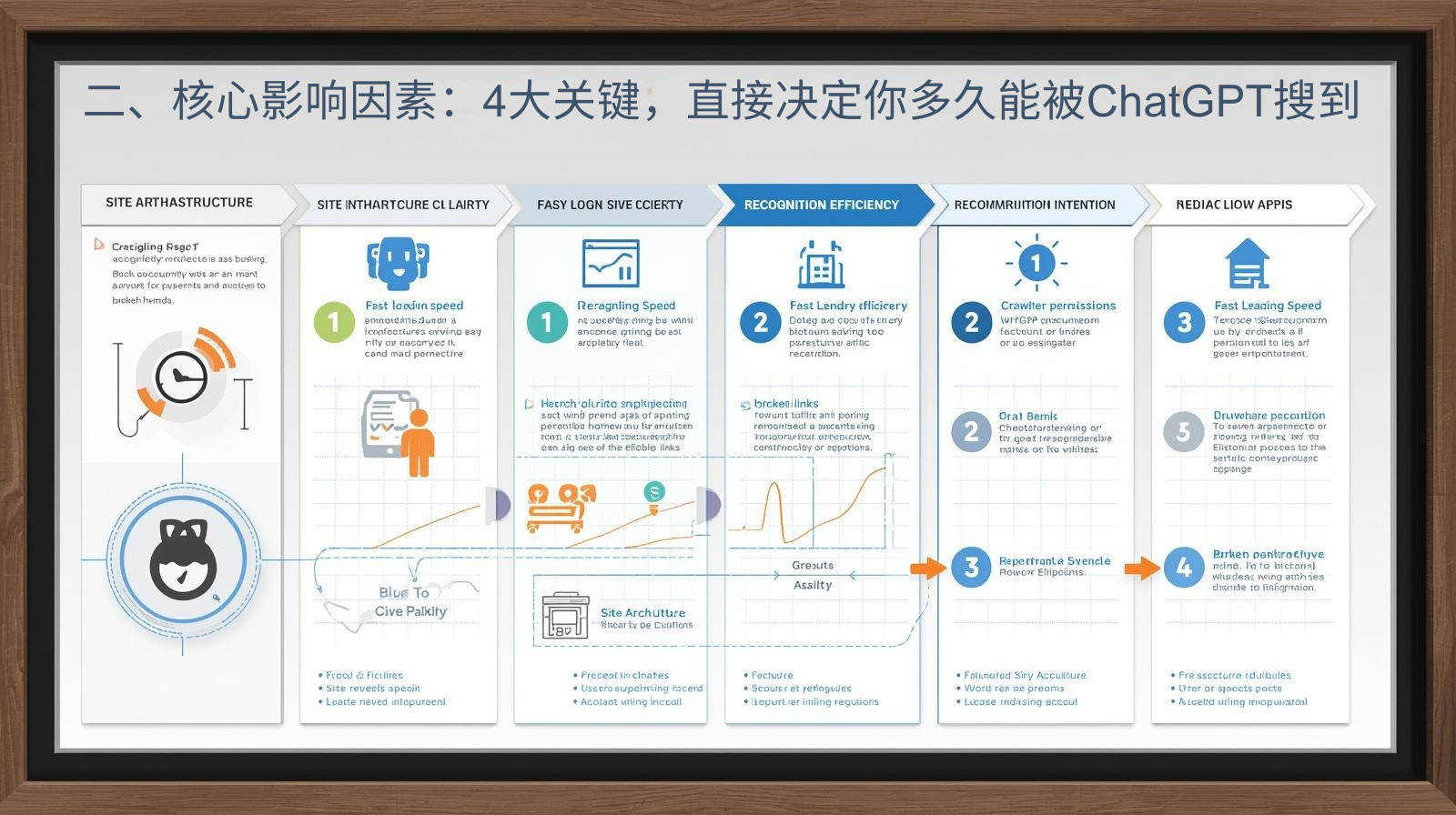
II. Core Influencing Factors: 4 Key Factors Directly Determine How Long It Takes for You to Be Found on ChatGPT
Why is there such a large difference in the time it takes for GEO to take effect across different sites? The core reason lies in four key factors. These four factors directly determine ChatGPT's crawling speed, recognition efficiency, and recommendation intention, and are also the core breakthrough points for foreign trade enterprises to accelerate optimization. Combining the latest ChatGPT crawling rules as of March 2026, OpenAI's official guidelines, and industry practical experience, this article breaks down these four factors one by one, and provides targeted optimization directions to help you accurately control the key optimization points and shorten the time to take effect: https://help.openai.com/en/articles/5097620-blocking-gptbot. It is important to emphasize that these four factors are not isolated but interconnected. Only by optimizing them simultaneously can the GEO take-off cycle be shortened to the maximum extent, quickly achieving visibility in ChatGPT searches.
2.1 Factor 1: Site Infrastructure – Determines ChatGPT Crawl Speed
The site's infrastructure is the "first hurdle" for ChatGPT crawling. Whether the architecture is clear, the loading speed is fast enough, and whether crawler permissions are enabled directly determines whether the GPTBot crawler can crawl smoothly and how long it takes to complete the crawl (https://www.jiemian.com/article/JLV9IHT70511FQO9.html). ChatGPT's GPTBot crawler prefers to crawl sites with clear architectures, fast loading speeds (≤2 seconds), and no broken links. The crawling cycle for these sites can be shortened by more than 30%. Conversely, sites with chaotic architectures, slow loading speeds (>3 seconds), and blocked crawler permissions are difficult for GPTBot to crawl and may even be abandoned, significantly extending the time to see results (https://pagespeed.web.dev/). Core optimization directions: First, optimize the site architecture, adopting a clear hierarchy of "Homepage—Category Page—Product Page—Company Introduction Page—Compliance Page" to allow GPTBot to quickly understand the site's structure; second, optimize loading speed by integrating global CDN acceleration and optimizing server nodes for core target markets such as Europe, America, and Southeast Asia to ensure loading speeds of ≤2 seconds; third, grant crawler permissions by adjusting the robots.txt configuration to explicitly allow GPTBot access to core pages, avoiding accidental blocking. OpenAI officially advises that after updating robots.txt, the system needs approximately 24 hours to recognize the changes, so configuration should be done in advance (https://www.jiemian.com/article/JLV9IHT70511FQO9.html); fourth, clean up dead links and invalid pages to ensure unimpeded GPTBot crawling and improve crawling efficiency (https://validator.schema.org).
2.2 Factor Two: Content Structuring and Semantic Matching – Determining ChatGPT Recognition Efficiency
The core of GEO is "making ChatGPT understandable and referable." Content structuring and semantic matching directly determine whether ChatGPT can quickly identify the core value of a site and accurately match the site with the search needs of buyers (https://news.qq.com/rain/a/20250425A06VCH00). ChatGPT prefers to reference content that is highly professional, structured, and rich in data. If the site content is disorganized and semantically ambiguous, even if it is crawled, it cannot be accurately identified and will naturally not appear in search results (https://m.jiemian.com/article/13963167.html). Sites with clear content structure and semantically accurate content that matches the search habits of buyers have higher ChatGPT recognition efficiency, reducing the time to see results by more than 25% (https://juejin.cn/post/7594415509606826030). Core optimization directions: First, build structured content, with each type of page laid out according to a fixed logic (product page: name—parameters—certification—MOQ—delivery date; company page: strength—cases—supply chain—compliance), allowing ChatGPT to quickly extract core information; Second, optimize semantic matching, using tools such as AnswerThePublic and Semrush to mine high-frequency AI search questions from buyers and naturally integrate these semantics into the content, avoiding keyword stuffing; Third, supplement with data and case support, ensuring at least one data point and one case study per 300 words to improve content credibility and make ChatGPT more willing to cite the content; Fourth, unify content semantics, ensuring consistency in brand name, core advantages, product parameters, and other information across the entire site to avoid confusion for ChatGPT.
2.3 Factor Three: Compliance and Trust Endorsement – Determining ChatGPT's Recommendation Intention
In 2026, ChatGPT continued to raise its requirements for site compliance and trustworthiness. Sites lacking compliance and trust endorsement, even if crawled and identified, were unlikely to be recommended to the front of search results, and might even face recommendation restrictions, leading to a longer time to see results (https://openai.com/zh-Hans-CN/policies/row-terms-of-use/). According to Jiemian News' 2026 GEO Optimization Report, sites that met compliance standards and had sound trust endorsements saw a 230% increase in ChatGPT recommendation rate compared to non-compliant sites, with an average reduction of 20 days in the time to see results (https://m.jiemian.com/article/13963167.html). Core optimization directions: First, improve compliance content, adapting to global privacy regulations such as GDPR and CCPA, improving the privacy policy and cookie authorization pop-up, and supplementing compliance content such as import and export qualifications and customs declaration procedures. All compliance qualifications are accompanied by an officially verifiable external link: https://commission.europa.eu/topics/data-protection_en; Second, strengthen trust endorsement, supplementing real cooperation cases, customer reviews, and industry certifications (CE/UL, etc.). All certifications are accompanied by officially verifiable external links to improve site credibility: https://ec.europa.eu/growth/tools-dat abases/nando/index.cfm; Third, clean up illegal content, delete false advertising and exaggerated statements, and avoid ChatGPT being downgraded due to violations, which would affect the willingness to recommend; https://openai.com/zh-Hans-CN/policies/row-terms-of-use/; Fourth, submit the site map to the OpenAI official platform to actively trigger GPTBot crawling, while improving site trust and speeding up recommendation speed; https://help.openai.com/en/articles/5097620-blocking-gptbot.
2.4 Factor Four: Industry Competition and Content Updates – Determining the Stability of Effectiveness
While the intensity of industry competition and the frequency of content updates do not directly determine ChatGPT's crawling speed, they do affect the stability of results and the final search ranking, indirectly impacting the actual effectiveness of "being searchable" (https://m.jiemian.com/article/13963167.html). A 2026 Gartner forecast report shows that traditional search traffic is expected to shrink by 25%, while the proportion of generative AI Q&A entry points has exceeded 52%. Competition is fierce in popular foreign trade industries (furniture, electronics, hardware), with many similar sites undergoing GEO optimization. ChatGPT's selection criteria are higher, and the time to see results may take 10-15 days longer than in less popular industries (https://m.jiemian.com/article/13963167.html). Furthermore, ChatGPT considers sites with long-term inactivity to have no sustainable value; even if they are initially searchable, they may be eliminated later, leading to search instability (https://juejin.cn/post/7594415509606826030). Core optimization directions: First, for popular industries, increase semantic optimization efforts, explore long-tail semantics, create differentiated content, and avoid homogeneous competition; Second, establish a content update mechanism, updating 1-2 industry-specific blog posts, product information, or case studies monthly to maintain site activity and ensure ChatGPT considers the site to have sustainable value (https://www.qizansea.com/65055.html); Third, monitor industry competition dynamics, analyze the optimization directions of similar sites using the Semrush AI Visibility Toolkit, and adjust our own strategies accordingly to enhance competitiveness (https://zh.semrush.com/kb/1493-ai-visibility-toolkit); Fourth, supplement multimodal content, combining product photos and case study videos to enhance content richness. ChatGPT gives multimodal content a 60% higher citation weight than plain text (https://news.qq.com/rain/a/20250425A06VCH00).
III. Practical Speed-Up: 5 Actions to Reduce ChatGPT Search Time by 50%
Based on the latest ChatGPT crawling rules as of March 2026, OpenAI's official guidelines, and practical case studies from foreign trade enterprises, we have compiled five actionable speed-up measures. Whether you have a new website, an ordinary website, or a high-quality website, you can shorten the time to GEO results using these measures. You can get your site searched on ChatGPT in as little as 7 days. All these measures do not require a professional technical team, and small and medium-sized foreign trade enterprises can directly follow them. Each step is supported by authoritative backlinks, ensuring practicality and effectiveness: https://help.openai.com/en/articles/5097620-blocking-gptbot. It is important to note that these speed-up measures must be based on sound fundamental optimization. If the foundation is not in place, blindly accelerating the process will only backfire and prolong the time to see results.
3.1 Action 1: Prioritize optimizing core pages and focus on key points for ChatGPT crawling.
ChatGPT's GPTBot crawler prioritizes crawling core pages (homepage, core product pages, and company introduction pages) over ordinary pages (blogs, news). Prioritizing optimization of these three types of core pages allows ChatGPT to quickly capture core information and shortens the time to see results (https://www.jiemian.com/article/JLV9IHT70511FQO9.html). Specific practical steps include: First, optimize the homepage, focusing on brand positioning, core advantages, and core products, replacing abstract text with data-driven descriptions, and incorporating 3-5 frequently searched semantics from buyers to help ChatGPT quickly identify the site's core value. Second, optimize 3-5 core product pages, improving product parameters, certifications, MOQ, delivery time, and other core information, presenting them in a structured manner, while adding real product photos and precise English descriptions to help ChatGPT clearly identify product value (https://news.qq.com/rain/a/20250425A06VCH00). Third, optimize the company introduction page, highlighting company strength, cooperation cases, and supply... The advantages of the chain include supplementing real-world case studies and customer reviews to enhance site trust and make ChatGPT more willing to recommend https://m.jiemian.com/article/13963167.html; Fourth, add links to these three types of core pages to the most prominent position in the site navigation, while optimizing internal links so that GPTbot can quickly find and crawl these pages https://developers.google.com/search/docs/appearance/structured-data/intro-structured-data.
3.2 Action Two: Accurately embed high-frequency semantics to improve ChatGPT matching efficiency
The core of ChatGPT search is "semantic matching," which precisely embeds high-frequency search semantics from buyers, allowing ChatGPT to quickly match your site with buyer needs, significantly shortening the time to see results. (https://juejin.cn/post/7594415509606826030) Specific practical application: First, use tools like AnswerThePublic and Semrush to mine high-frequency AI search queries from buyers in the target market (such as "CE certified electronic supplier" and "small batch custom furniture"). The process involves four steps: First, select 20-30 semantic terms highly relevant to the business (e.g., "manufacturer"); second, naturally integrate these semantic terms into the core page content (3-5 on the homepage, 2-3 on each core product page, and 3-4 on the company introduction page), avoiding keyword stuffing and ensuring fluent and natural sentences (e.g., "https://zh.semrush.com/kb/1493-ai-visibility-toolkit"); third, optimize semantic density, including 1-2 high-frequency semantic terms per 300 words, along with data and case studies to enhance the content's citation value and make ChatGPT more inclined to recommend it (e.g., "https://news.qq.com/rain/a/20250425A06VCH00"); fourth, simulate ChatGPT search by inputting the selected high-frequency semantic terms to see if the site can be matched, and adjust the semantic embedding position accordingly to improve matching efficiency (e.g., "https://help.openai.com/en/articles/5097620-blocking-gptbot").
3.3 Action Three: Improve compliance and trust endorsement to increase ChatGPT recommendation weight.
Compliance and trust endorsement are core criteria for ChatGPT recommendations. Improving these two aspects enhances ChatGPT's trust in the site, speeds up recommendations, avoids penalties due to compliance issues, and shortens the time to see results (https://openai.com/zh-Hans-CN/policies/row-terms-of-use/). Specific practical steps: First, quickly improve compliance content. Optimize the privacy policy and cookie authorization pop-up within 1-2 days to ensure compliance with GDPR and other target market regulations. Clearly define data collection and usage rules in the privacy policy and add a compliance certification link (https://commission.europa.eu/topics/data-protection_en). Second, supplement core trust endorsements. Compile 3-5 real-world cooperation cases and 2-3 authoritative industry certifications (CE/UL, etc.) within 3-4 days. All certifications should include officially verifiable external links. Case studies should specify the client name, product category, and supply scale to enhance credibility (https://ec.europa.eu/gr). The third step is to clean up illegal content on the site, delete false advertising and exaggerated statements, replace non-genuine materials, and ensure that all content is authentic, verifiable, and compliant with ChatGPT recommendation rules (https://m.jiemian.com/article/13963167.html). The fourth step is to submit site compliance information to the OpenAI official platform, proactively inform users of the site's compliance status, enhance ChatGPT's trustworthiness, and accelerate the recommendation speed (https://help.openai.com/en/articles/5097620-blocking-gptbot).
3.4 Action 4: Optimize loading speed and crawler permissions to accelerate ChatGPT crawling.
Loading speed and crawler permissions are fundamental to ChatGPT crawling. Optimizing these two aspects can enable the GPTBot crawler to complete site crawling faster and shorten the time to see results. https://www.jiemian.com/article/JLV9IHT70511FQO9.html Specific practical steps: First, optimize loading speed. Within 1-2 days, integrate global CDN acceleration, compress images and videos (images use WebP format), and remove unnecessary plugins and code from the site to ensure core page loading speed is ≤2 seconds. Detect the optimization effect using Google PageSpeed Insights (https://pagespeed.web.dev/). Second, grant crawler permissions. Adjust the robots.txt configuration to explicitly allow GPTBot to access all core pages while prohibiting irrelevant crawlers, improving crawling efficiency. Note that after updating robots.txt, the OpenAI system needs approximately 24 hours to recognize the changes; therefore, advance configuration is required (https://www.jiemian.com/article/JLV9IHT70511FQO9.html). Third, optimize the sitemap. Generate an XML sitemap, highlighting links to core pages, and submit it to the OpenAI official platform and Google Search. Console, actively trigger GPTBot crawling to speed up the crawling process (https://validator.schema.org); fourth, monitor the crawling status by using OpenAI's official crawler detection tool to check the GPTBot crawling status, and promptly troubleshoot problems (dead links, slow loading) for pages that fail to crawl, and quickly optimize (https://help.openai.com/en/articles/5097620-blocking-gptbot).
3.5 Action Five: Short-term, high-frequency updates to improve site activity
ChatGPT prefers to recommend active sites with sustained value. Frequent, short-term updates of high-quality content can increase site activity, allowing the GPTBot crawler to crawl the site more frequently, while also increasing ChatGPT's trust in the site and shortening the time to see results. Specific practical tips: First, in the initial optimization phase (1-30 days), update one industry-focused blog post per week (written around the core pain points of buyers, such as "A Complete Guide to CE Certification for European and American Procurement in 2026"), supplementing with 1-2 case studies to keep site content active. Second, when updating content, incorporate frequently searched semantics from buyers, while also using multimodal content (product photos, case study videos) to enhance content richness and citation value. Third... Update core page content, optimize the semantic description of core product pages and the homepage every 10 days, and supplement the latest product information and certification qualifications to make ChatGPT believe that the site has continuous value (https://zh.semrush.com/kb/1493-ai-visibility-toolkit); Fourth, avoid ineffective updates. The updated content must be relevant to your own business, ensure that it is true and valuable, and not update for the sake of updating, otherwise it will reduce ChatGPT's trust in the site (https://m.jiemian.com/article/13963167.html).
Recommended Article: Your Competitors Haven't Reacted Yet: Building an Independent E-commerce Website with GEO is the Biggest Blue Ocean Strategy Right Now
Recommended Article: Your Competitors Haven't Reacted Yet: Building an Independent E-commerce Website with GEO is the Biggest Blue Ocean Strategy Right Now
IV. Results Verification + Pitfall Avoidance: Ensuring GEO optimization is not in vain and quickly implementing ChatGPT search.
After optimizing GEO and implementing speed-up measures, it's crucial to master the correct methods for verifying results, promptly identify problems, adjust strategies, and avoid common pitfalls to prevent unnecessary internal friction and ensure you're found on ChatGPT within the expected timeframe. Based on practical experience with GEO implementation in foreign trade enterprises in March 2026 and the official OpenAI guide, this article outlines core methods for verifying results and addresses four common pitfalls to help you efficiently implement optimizations, quickly achieve visibility in ChatGPT searches, and ensure stable search performance.
4.1 3-Step Verification: Confirm if you have been found by ChatGPT
The core of the verification process is "from precise to generalized," and it involves three steps to ensure accurate results and avoid misjudgments: Step 1, Precise Search Verification (7-14 days): Open ChatGPT and enter "Brand Name + Core Product Keywords" (e.g., "XXX CE certified furniture"). Check if your independent website's information appears in the search results. If so, it means GPTBot has successfully crawled and identified the core pages (https://help.openai.com/en/articles/5097620-blocking-gptbot). Step 2, General Keyword Verification (30-45 days): Enter core product and industry-related keywords (without including the brand name, e.g., "CE certified furniture"). First, check if your site appears in the search results for "supplier". If it does, the semantic matching is good, and initial recommendations have been achieved (https://answerthepublic.com/). Second, verify stability (approximately 60 days). For 7 consecutive days, enter different relevant keywords at different times each day to check if your site consistently appears in the search results. If it does, the GEO optimization is successful, and stable search results have been achieved (https://zh.semrush.com/kb/1493-ai-visibility-toolkit). Simultaneously, you can use the Semrush AI Visibility Toolkit to monitor your site's citation count and exposure in ChatGPT to accurately grasp the optimization effect (https://m.jiemian.com/article/13963167.html).
4.2 Four common misconceptions: Avoid these pitfalls and shorten the time to see results.
Myth 1: Blindly pursuing speed while neglecting fundamental optimization. Focusing solely on semantics without addressing architecture, loading speed, and compliance can prevent ChatGPT from crawling or recognizing the content, resulting in it remaining unsearchable even after extensive optimization (https://www.jiemian.com/article/JLV9IHT70511FQO9.html). Solution: First, improve fundamental optimizations (architecture, loading speed, compliance), then proceed with semantic optimization and speed improvements. Take a gradual approach and avoid blindly pursuing speed. Refer to Google's Structured Content Optimization Guidelines (https://developers.google.com/search/docs/appearance/structured-data/intro-structured-data). Myth 2: Semantic stuffing. To improve matching accuracy, excessive use of high-frequency semantics in content leads to awkward sentences and semantic confusion. ChatGPT cannot understand this accurately, thus lowering its recommendation weight (https://news.qq.com/rain/a/20250425A06VCH00). Avoidance methods: Naturally embed semantics, incorporating 1-2 semantic elements every 300 words to ensure smooth sentences and adherence to content logic. Simultaneously, use data and case studies to improve content quality. [https://juejin.cn/post/7594415509606826030](https://juejin.cn/post/7594415509606826030) Misconception 3: Not monitoring crawling status. After optimization, neglecting to monitor GPTBot crawling results in delayed detection of crawling failures and semantic deviations, prolonging the time to see results. [https://help.openai.com/en/articles/5097620-blocking-gptbot](https://help.openai.com/en/articles/5097620-blocking-gptbot) Avoidance method: Monitor crawling status every 3-5 days using OpenAI's official crawler detection tool. For pages that fail to crawl, promptly investigate and optimize. Myth 4: GEO optimization is halfway done. Some people stop optimizing just because they don't see results in ChatGPT search results in the short term. However, GEO optimization requires continuous effort, especially for new websites. It takes 60-90 days of continuous optimization to achieve stable search results (https://m.jiemian.com/article/13963167.html). Solution: Optimize consistently according to a phased approach, ensuring regular content updates and performance monitoring. Don't give up halfway, and adjust your optimization strategy based on the results.
V. Conclusion: Find the right method to get quickly found by ChatGPT and seize the AI customer acquisition dividend.
In March 2026, ChatGPT became a core entry point for foreign trade independent websites to acquire customers. The time it takes for GEO optimization to show results is never a fixed 7 or 90 days, but depends on your website's foundation, optimization details, and execution efforts. High-quality websites can achieve stable search visibility in 7-30 days, average websites in 30-60 days, and weak websites in 60-90 days. As long as you find the right methods and implement them effectively, you can significantly shorten the time to see results, quickly enabling overseas buyers to find you on ChatGPT and seize the AI-driven customer acquisition dividend. For foreign trade companies, to make GEO optimization more efficient and worry-free, avoid all pitfalls, and quickly achieve visibility in ChatGPT search results, the underlying website architecture is crucial.
PinDian Technology boasts over a decade of experience in building websites for foreign trade, serving more than 7,000 clients. Utilizing React technology, our websites not only offer a smoother browsing experience but also incorporate GEO optimization logic into their underlying architecture. This enables server-side rendering (SSR), global CDN acceleration (loading speed ≤2 seconds), and includes structured content templates, GPTBot crawler-friendly configurations, and compliant page presets. This ensures your independent website is inherently ChatGPT-friendly, allowing both new and established sites to quickly establish a solid foundation and shorten the time it takes for GEO to take effect, with ChatGPT crawling and recognition occurring in as little as 7 days.
PinDian Website Builder can simultaneously assist foreign trade enterprises in implementing the entire GEO optimization process, from basic architecture optimization, semantic matching, and compliance improvement to accelerating action implementation and effect verification. It provides a one-stop solution to the core problems of "slow GEO optimization results, lack of optimization skills, and numerous pitfalls." Coupled with professional GEO optimization guidance, it enables your independent website to be quickly found by ChatGPT, allowing you to seize the opportunity in the AI procurement era of 2026 and achieve breakthrough growth in foreign trade business.