
By March 2026, generative AI tools like ChatGPT had become the primary entry point for overseas B2B buyers to find suppliers. The fundamental reason why most independent foreign trade websites failed to achieve results after implementing GEO (Generative Engine Optimization) was not insufficient content, but rather a chaotic page structure that AI simply couldn't understand . The core of GEO is enabling AI to quickly, accurately, and completely understand your brand, products, strengths, and compliance information. The most crucial step in achieving this is creating a correctly structured layout . This article avoids complex code, focusing instead on page structures that AI truly prefers and can be directly implemented. Combined with authoritative backlinks and practical templates, this ensures your independent website's architecture conforms to AI crawling rules, making it easily recognized and recommended by ChatGPT.
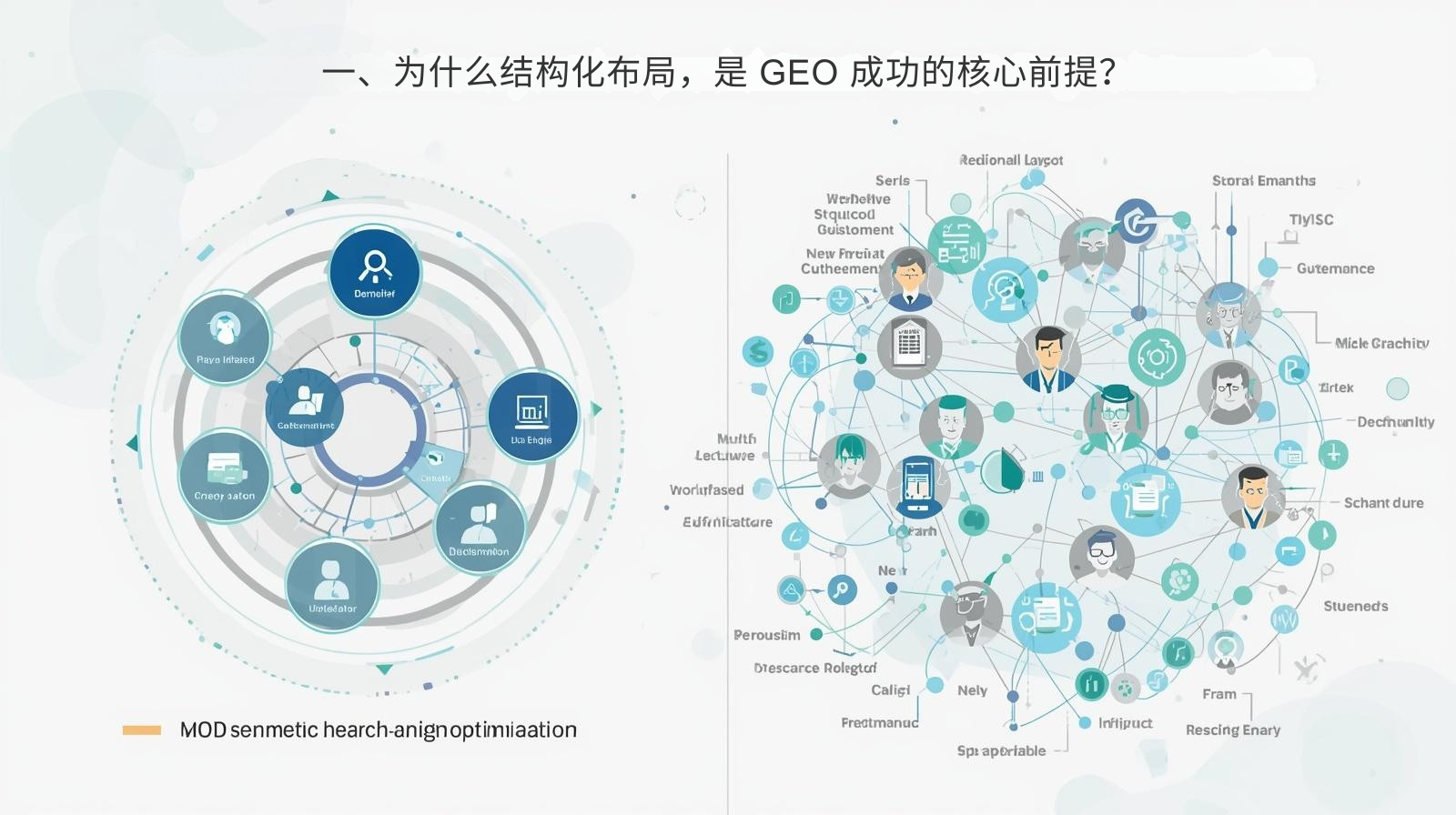
Why is a structured layout a core prerequisite for GEO success?
AI doesn't "browse web pages" like humans. It understands your website through web crawling, semantic parsing, and information extraction. If your page structure is disorganized, information is scattered, and logic is unclear, AI cannot form a stable understanding and will not recommend your site to buyers.
1.1 Structured layout = Reduced AI understanding cost
According to the content crawling guidelines jointly updated by Google and OpenAI in 2026, structured content is 4.2 times more likely to be recognized and cited by AI than messy content (https://developers.google.com/search/docs/appearance/structured-data/intro-structured-data ). AI prefers "predictable, hierarchical, and complete" structures—that is, pages that are predictable, hierarchical, and informative. The clearer the structure you provide to AI, the more willing it is to index and recommend it.
1.2 90% of foreign trade websites have structural errors, directly leading to GEO ineffectiveness.
A survey titled "Foreign Trade GEO Failure Survey" published by Jiemian News in March 2026 revealed that over 90% of independent websites had completely ineffective GEOs because their page structures did not conform to AI crawling habits (https://m.jiemian.com/article/14063030.html ). Common problems included: information scattered everywhere, product parameters hidden in images, company advantages written in large blocks of text, lack of compliance information, and excessively deep page hierarchy. These issues have little impact on human browsing, but they are simply "unreadable" by AI.
1.3 The essence of GEO's structured layout: Giving AI a "reading manual"
True GEO structuring isn't about beautifying the page, but about reorganizing information according to AI's reading habits , so that it knows exactly what it's doing from the moment it enters the page:
- What brand is this?
- What products to sell
- What certifications and advantages are there?
- What value can we provide to our customers?
- How can I trust you? The clearer the structure, the more the AI will like you, and the higher the probability of you appearing in ChatGPT.
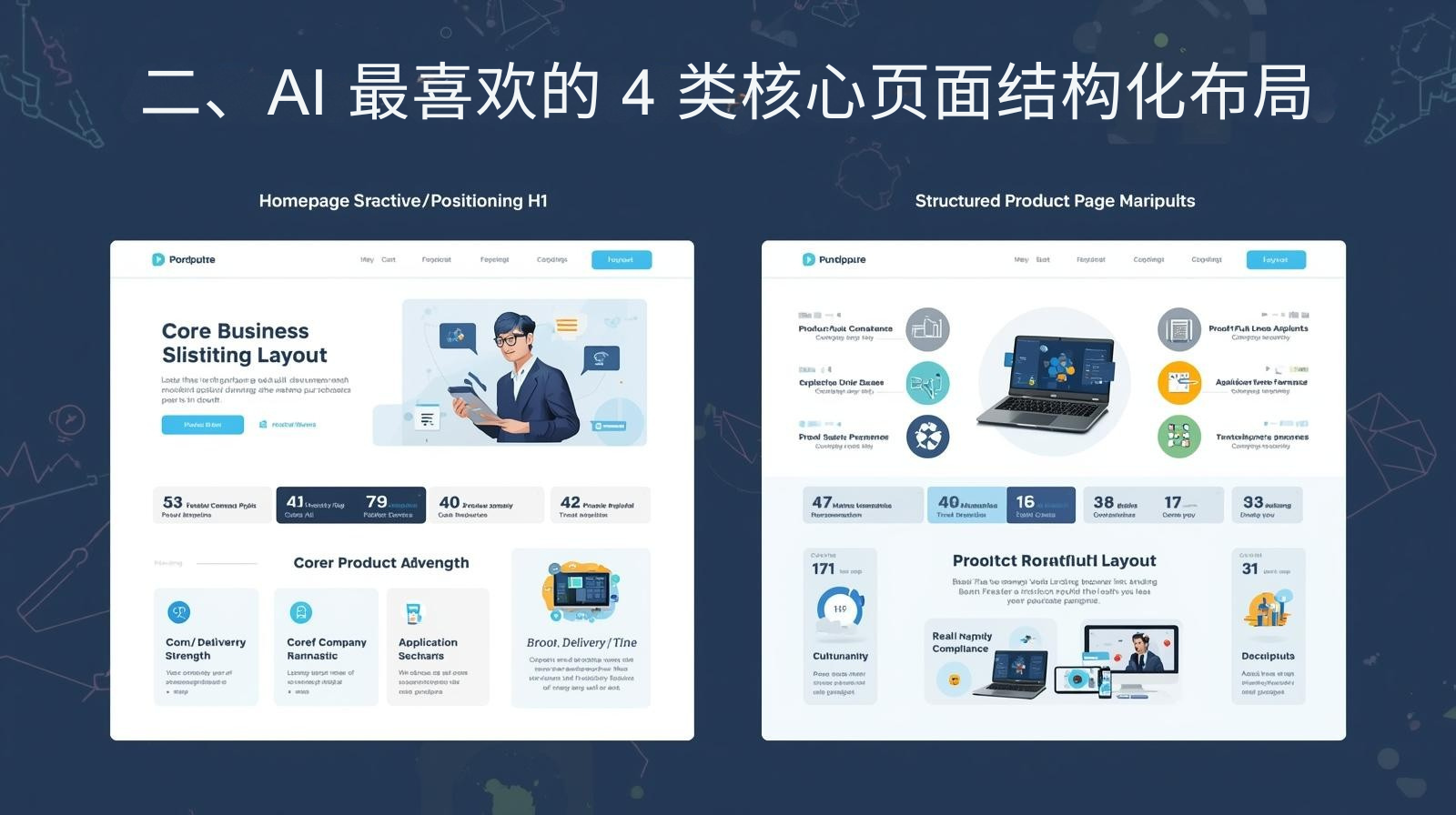
II. The 4 types of core page structured layouts that AI prefers (can be copied directly)
Below is a standard structured layout that best suits the crawling habits of large models such as ChatGPT and Gemini in 2026. It can all be implemented directly without code; you only need to arrange it according to the structure.
2.1 Homepage Structured Layout (AI First Impression Page)
The homepage is the first point of entry for AI to recognize a brand, so it must have highly condensed information, a fixed structure, and a clear hierarchy .
AI-friendly homepage structure:
- Brand name + one-sentence positioning (H1)
- Core Business/Product Overview
- 3–4 core advantages (each with data or certification)
- Core product entry points (structured classification)
- Brief proof of a company's strength (factory, production capacity, qualifications)
- Compliance and trust certifications (CE, ISO, GDPR, etc.)
- Clear contact information and inquiry portal
This structure allows AI to establish brand recognition within 1 second, and it is also the homepage structure preferred by OpenAI GPTBot (https://help.openai.com/en/articles/5097620-blocking-gptbot ).
2.2 Structured Layout of Product Pages (GEO, the Most Important Page)
Product pages are the pages that AI most frequently crawls and is most likely to recommend to buyers, so they must be extremely structured, parameterized, and standardized .
AI's favorite product page structure:
- Product Name (H1 Unique)
- Product positioning in one sentence (purpose + scenario)
- Key selling points (3-5 short sentences)
- Product parameters (listed in bullet points: material, size, power, certification, standards)
- Application scenarios (specify industry and customer type)
- MOQ, delivery time, packaging information
- Certification and compliance (CE/FCC/RoHS/ISO, etc.)
- Real photos/videos (with text descriptions)
- Recommended related products
The Semrush 2026 AI Search Report shows that **product pages with complete parameters and a consistent structure saw a 270% increase in AI citation rates**. https://zh.semrush.com/kb/1493-ai-visibility-toolkit
2.3 Structured Layout of Company Introduction Page (AI Trust Page)
AI's recommendations are based on "trust," and the About page is the most crucial page for building trust.
AI-driven trust-based enterprise page structure:
- Company full name + year of establishment
- Positioning and main products
- Scale and capabilities (factory, production lines, capacity, personnel)
- Core strengths (technology, quality, delivery time, service)
- Partners and Case Studies (Brief Description)
- Certifications and Qualifications (with authoritative and verifiable sources)
- Factory/workshop real shot display
- Mission/Positioning/Service Philosophy
Official EU data shows that company pages with complete, compliant, and transparent information receive higher AI trust scores: https://commission.europa.eu/topics/data-protection_en .
2.4 Compliance Page Structured Layout (AI Security Bottom Line Page)
In 2026, AI's compliance requirements will reach an all-time high; without a compliance framework, even the best content may not be recommended.
Required compliant page structure:
- Privacy Policy (GDPR/CCPA Compliant)
- Cookie Statement
- Returns and after-sales policy
- Payment and Shipping Instructions
- Certification page (with official verification link)
OpenAI's 2026 content policy clearly states that non-compliant websites will have their ranking reduced or even be excluded from indexing : https://openai.com/zh-Hans-CN/policies/row-terms-of-use/ .
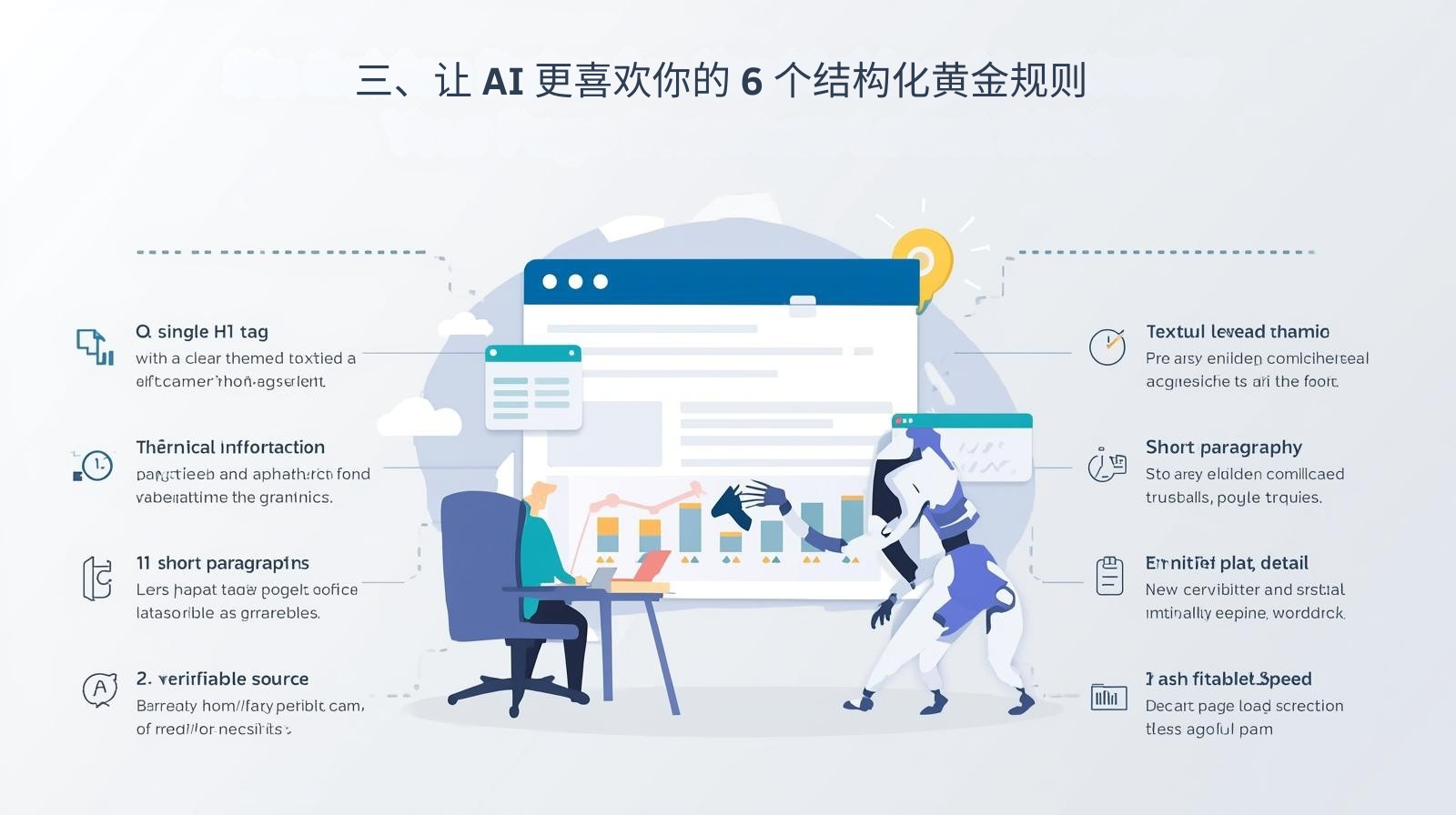
III. Six structured golden rules to make AI like you more (2026 latest)
These rules are all from publicly available documents from Google, OpenAI, and Semrush 2026, and are the true basis for AI to judge page quality.
3.1 Each page should focus on only one core theme (H1 should be unique).
AI hates cluttered page themes. A page should only have one H1 tag, expressing only one core message. For example, a product page should only talk about the product, and the homepage should only talk about brand positioning. (See https://developers.google.com/search/docs/appearance/structured-data/intro-structured-data ).
3.2 Information must be presented in text form, not hidden in images.
AI currently cannot fully read text within images. Product parameters, certifications, models, and advantages must all be presented in text. This is the most basic GEO requirement in 2026. (https://m.jiemian.com/article/13963167.html )
3.3 Use short paragraphs, bullet points, and subheadings; avoid long blocks of text.
AI prefers short sentences, bullet points, and clearly structured content; long blocks of unstructured text are judged as low-value content. https://zh.semrush.com/kb/1493-ai-visibility-toolkit
3.4 Page hierarchy should not exceed 3 levels.
The optimal crawling depth for AI is from homepage to list page to detail page. Crawling beyond three layers can easily result in lost crawling data (https://help.openai.com/en/articles/5097620-blocking-gptbot ).
3.5 All certifications and qualifications should be accompanied by officially verifiable sources whenever possible.
AI will verify the authenticity of information. Verifiable and trustworthy information will significantly increase the probability of making recommendations. For example, CE, FDA, ISO, etc. can be queried via the link https://ec.europa.eu/growth/tools-databases/nando/index.cfm .
3.6 Page load time ≤ 2 seconds
In 2026, AI web crawlers will have stricter speed requirements; crawling will be abandoned if the crawling time exceeds 3 seconds. CDN and technical architecture will be key. (https://pagespeed.web.dev/ )
Recommended Article: Your Competitors Haven't Reacted Yet: Building an Independent E-commerce Website with GEO is the Biggest Blue Ocean Strategy Right Now
Recommended Article: Your Competitors Haven't Reacted Yet: Building an Independent E-commerce Website with GEO is the Biggest Blue Ocean Strategy Right Now
IV. How to quickly implement a structured GEO layout? (3 practical steps)
4.1 Step 1: Unify Page Structure
All website pages are categorized into four unified templates: "Homepage, Product Page, Company Page, and Compliance Page," ensuring that AI can quickly identify them each time it crawls.
4.2 Second step: Information textualization, parameterization, and structuring
Convert all key information in the images into text, list product parameters, and highlight advantages.
4.3 Step 3: Submit the site map to accelerate AI crawling.
Generate and submit XML sitemaps to allow GPTBot and GoogleBot to quickly crawl your structured pages : https://developers.google.com/search/docs/crawling-indexing/sitemaps/overview .
Once this structure is implemented, the vast majority of sites can be re-identified by AI within 7–30 days and begin to appear in ChatGPT related searches.
If the structure is right, GEO is 80% successful.
In 2026, the competition among foreign trade GEOs will no longer be about keywords, but about structure, perception, and trust . AI doesn't care how visually appealing your website is; it only cares about the clarity of its structure, the completeness of its information, and whether it's worth recommending.
If your structured layout is good, AI will naturally like you; if your structured layout is wrong, no amount of optimization will be of any use.
If you want your independent website to conform to AI preferences from the ground up and double the GEO effect, the key is to choose a website building system that natively supports GEO structured architecture .
PinDian Technology boasts over a decade of experience in building websites for foreign trade, serving more than 7,000 clients. We utilize React technology to construct independent websites, resulting in smoother pages, faster loading times, and a structure naturally adapted to AI crawling logic. Our architecture incorporates GEO structured layout from the ground up: unified page templates, parameterized product structure, AI-friendly hierarchy, compliant page presets, and global CDN acceleration. This ensures your website conforms to ChatGPT's preferred structure from launch, eliminating the need for later modifications. GEO delivers faster, more stable, and longer-lasting results.
Want to make your independent website AI's favorite site? Start with a structured layout.