I. Why Traditional Calendars Fail: Three Fatal Failures
When the content calendar is used only to record publication dates, it will result in:
- Demand and production are out of sync : Customer pain points reported by customer service are not being processed on the calendar, resulting in the continuous production of ineffective content.
- Departments are working in silos : the marketing department is writing technical documents, while engineers are creating marketing copy.
- The post-mortem review was merely a formality : only checking "whether it was published" while ignoring "whether it was effective."
According to a survey by the Shenzhen Cross-Border E-commerce Association , 83% of companies wasted 45% of their content budget due to this.
II. Five-Step Operation Process: Making the Calendar a Growth Engine
Step 1: Dynamic Requirement Pool Management (Solving the "What to Write" Problem) Core Mechanism: All departments contribute requirements to the same pool.
- Demand comes from four sources :
- Customer Service: Export the top 20 most frequently asked questions each week (e.g., "How to respond to the new EU battery regulations")
- SEO: High impressions, low clicks keywords (e.g., "localization solution for foreign trade websites")
- Sales: Key concerns of clients who did not close a deal (e.g., "risks associated with Turkish letters of credit")
- Industry News: Policy Warning Released by the China Academy of Information and Communications Technology (Automatic Keyword Extraction)
- Demand Value Assessment Matrix :
- Kanban Rules :
- Red label: Policies/crises requiring a response within 48 hours (such as FDA surprise inspection notices).
- Gold Standard: High-Value Themes (Score ≥ 8.5)
Step Two: The Four-Dimensional Scheduling Method (Solving the "When to Write" Problem) goes beyond a simple timeline, aligning business rhythms across multiple dimensions.
- Time dimension : Fixed column rhythm (e.g., the "Monthly Report on Tariff Policy" is published on the 1st of each month).
- Event Dimension : Tied to industry exhibitions/peak seasons (e.g., issuing the "Sample Preparation Checklist" 15 days before the Canton Fair).
- Funnel Dimensions : Layered releases based on the user journey (Awareness Phase → Solution Phase → Decision Phase)
- Resource maintenance : Coordinate expert time (e.g., the chief engineer can review technical documents on the 25th of each month).
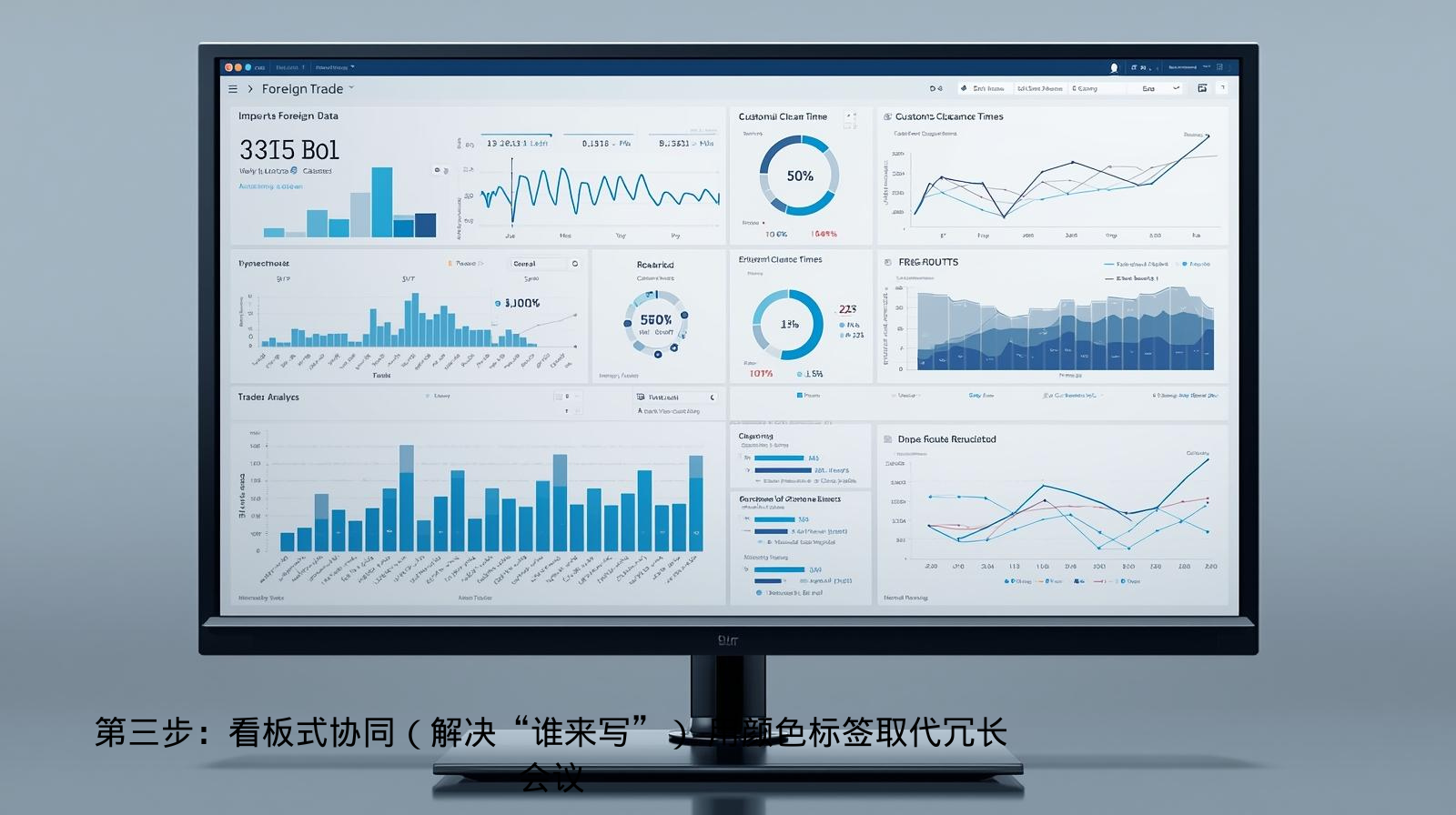
Step 3: Kanban-style collaboration (solving the "who writes" problem) – replacing lengthy meetings with color-coded labels.
- Four-color state tracking :
- Blue: Data collection in progress (customs data needs to be provided by the purchasing department)
- Huang: In progress (copywriting team to submit by March 12th)
- Green: Pending review (Legal Department marks compliance risk points)
- Purple: Released
- Block the early warning mechanism :
- The task will automatically tag the responsible person after 48 hours.
- A video conference is triggered for a complex task (limited to 15 minutes).
Step 4: Bi-weekly Data Simulation (Addressing "Poor Results") Replaces subjective debriefing with three sets of data .
- Efficiency indicators :
- Average production cycle (target ≤ 7 days)
- The top 3 collaboration bottlenecks (such as "waiting for approval" accounting for 35%)
- Quality Indicators :
- Content depth rating (using AI tools to benchmark against the top 3 competitors)
- Accuracy of technical terminology (verified using the terminology database of the China E-Commerce Association )
- Performance indicators :
- Target achievement rate (e.g., the rate of decrease in "resolving customer service inquiries")
- Knowledge reuse rate (number of times this content is used by other departments)
Step 5: Knowledge Crystallization (Solving the "Reinventing the Wheel") – Transforming experience into reusable digital assets.
- Constructing a topic knowledge tree :
- Branches: Core themes (e.g., "cross-border payments")
- Ye: Solution Card (“Guide to Dealing with the Turkish Lira Collapse”)
- Automatic labeling and warehousing :
- Each piece of content generates 3-5 keyword tags (e.g., #foreignexrisk #emergingmarkets).
- Save to enterprise-level wiki and sync with Pinshop content library
III. Case Study: The Calendar Reform Results of an Industrial Valve Company
- Before the reform : The average monthly output was 24 articles, 37% of which were not cited, and sales staff complained that "usable material could not be found."
- Reform actions :
- Import after-sales fault records into the demand pool (accounting for 53% of the content topics selected that month).
- Establish a knowledge tree based on equipment type (gate valve/ball valve/safety valve solution branch).
- Use sandbox data to eliminate inefficient sections (corporate news clicks dropping to zero).
- Results : ▶ Customer service response rate using content references increased to 68% ▶ Sales order closing cycle shortened by 11 days ▶ Selected as a "Benchmark Case of Content Platform in Manufacturing Industry" by the Shenzhen Cross-Border E-commerce Association
Ending CTA
A true calendar system requires dynamic demand integration and automated data feedback capabilities. Pinshop's Content War Room has achieved: ✅ Intelligent Demand Capture : Automatically synchronizes customer service tickets/GSC keywords/policy library ✅ Four-Dimensional Scheduling Engine : One-click coordination of content flow, event flow, and resource flow ✅ Sandbox Review Panel : Real-time tracking of content ROI and knowledge reuse rate. Upgrade your content engine now and evolve your calendar from a planning tool into a growth hub.