
Anyone who does cross-border B2C foreign trade knows that C-side customers and B-side buyers are completely different things: they will not spend hours researching your factory qualifications, they will only use ChatGPT to search for "large size yoga clothes, slimming, breathable, free shipping in the United States", 3 If you don’t see content that meets your expectations within seconds, you will delete it. For B2C independent websites, the core of GEO (Generative Engine Optimization) is not "to make the brand searchable", but "to impress customers immediately and promote orders after being searched". The opportunity that ChatGPT brings to C-side independent stations is that it can accurately match "customers' concrete needs" - as long as your content can catch the small but key demands of "slimming", "free shipping" and "no deformation after washing", the conversion efficiency will far exceed that of traditional search engines. This article will focus on the B2C scenario, from the four dimensions of C-end customer search logic, content optimization, trust building, and conversion path, dismantle GEO techniques that can be directly implemented, and help you turn every exposure recommended by ChatGPT into a real order.
1. First understand: the "search-conversion" logic of C-end clients in the ChatGPT environment
C-side customers use ChatGPT to search for products. The essence is to "find answers with questions" rather than "find suppliers with needs." Their decision-making link is extremely short. After ChatGPT recommends your independent website, whether it can be converted depends entirely on "whether the content accurately solves his immediate questions."
1.1 Search logic: scenario-based questions + emotional value requirements, rejecting general words
B-side buyers will search for "yoga clothing suppliers", but C-side customers will only search for "postpartum recovery yoga clothes, high elasticity, no curling" and "student party affordable yoga clothes, washable" "Whitening" - hidden in these keywords are "usage scenarios (postpartum recovery/student party)", "core needs (high elasticity/washability)" and "emotional appeals (whitening/affordable)". ChatGPT will give priority to recommending independent sites with “1:1 matching of keywords and content”. If you are still optimizing for general words like “yoga clothes USA”, you will never receive accurate traffic.
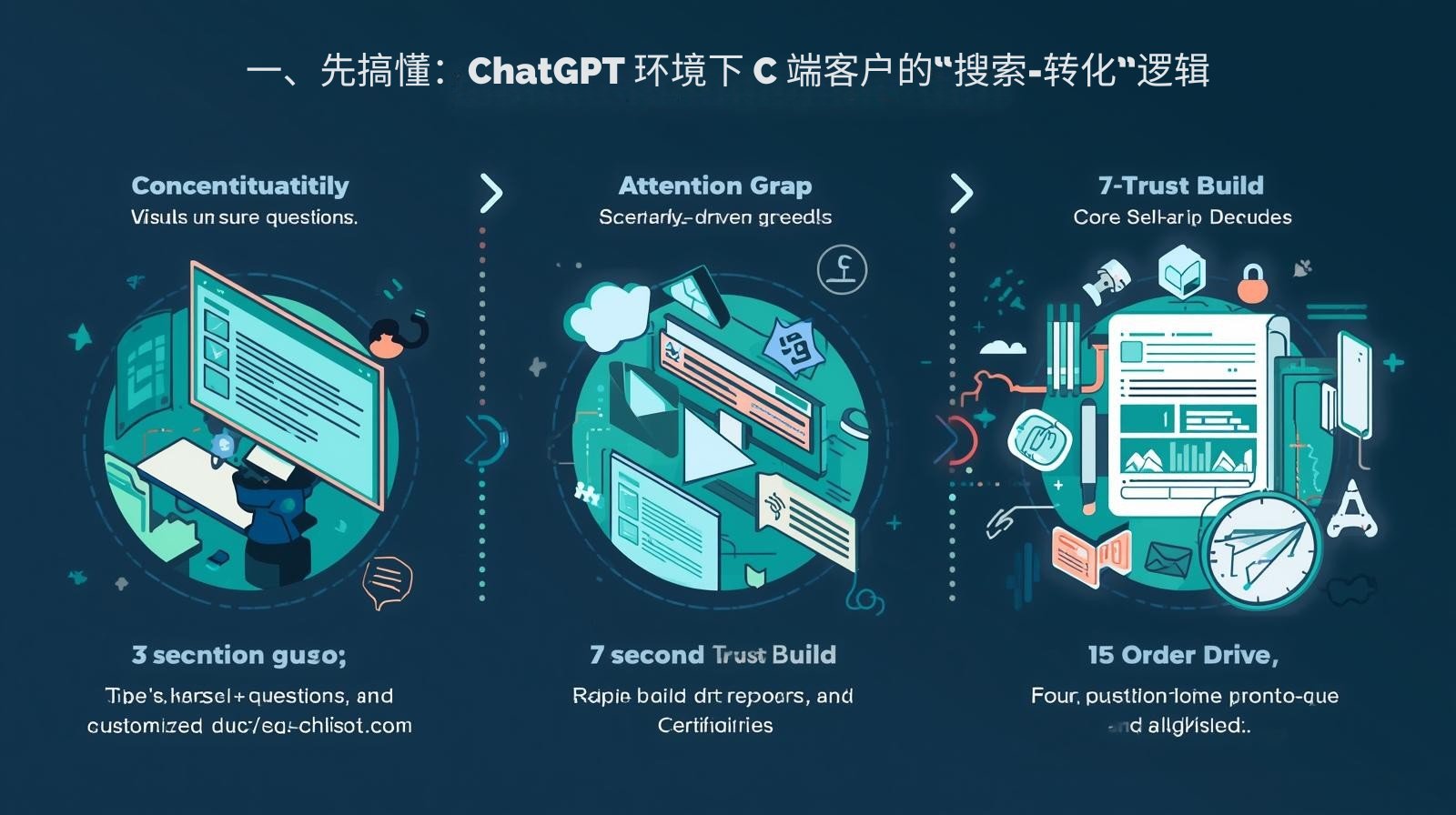
1.2 Conversion logic: 3 seconds to catch eyeballs, 7 seconds to build trust, 15 seconds to attract orders
C-side customers have limited patience. After ChatGPT displays your brand information, they will go through three decision-making stages: ① Judge "whether this is what I want" within 3 seconds (see whether the core selling points match the demand); ② 7 Determine within seconds "Is this product reliable?" (look at reviews, certifications, after-sales); ③ Determine "is it convenient to place an order" within 15 seconds (look at price, logistics, purchase entrance). Your GEO optimization must design content around these three stages. Failure in any link will lead to the loss of customers.
1.3 ChatGPT’s recommended preferences: real experience> official words, short content> long copy
C-side customer letter "experience of ordinary people" is far better than "bragging of the brand", and the same is true for ChatGPT - content including "customer reviews, real photos, usage scenarios" has a higher weight than the official copywriting of "Our product quality is first-class". At the same time, C-side customers don’t have time to read long articles. A 15-second short video, 3 lines of core selling points, and 5 real reviews. This kind of lightweight content is more likely to be recommended by ChatGPT first, and it is easier to promote conversions.
2. Core skills: 4-dimensional GEO optimization from "being searched" to "ordering"
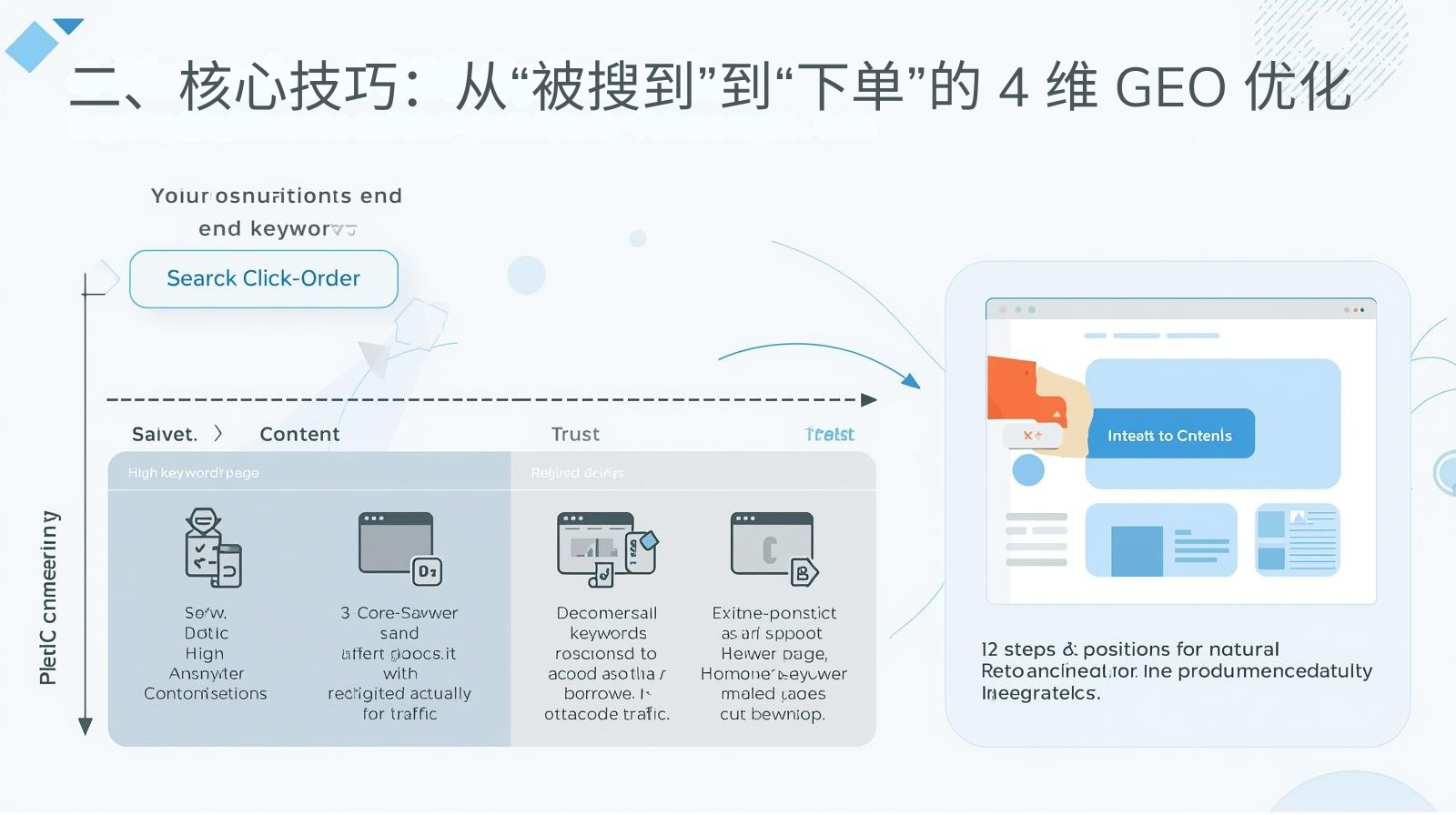
This part of the skills is completely designed for B2C scenarios. From the four dimensions of keywords, content, trust, and conversion, it covers the entire "search-click-order" link. Each skill is attached with C-end category cases such as clothing and home furnishings, which can be used directly by copying.
Dimension 1: Keyword optimization - lock "C-end high-converting words" and reject invalid traffic
The core of C-side keywords is "accurate to personal needs". Use 2 free tools to dig words, and then classify and layout according to "scenario + demand" to ensure accurate matching when recommended by ChatGPT.
1.2.1 Tool: 2 steps to dig out words that "customers will really search for"
1. Step 1: Use AnswerThePublic to capture "scenario-based questions": Enter the core word "yoga pants USA", which will generate questions frequently asked by customers, such as "yoga pants for post-pregnancy high waist" (postpartum high waist yoga pants), "yoga pants that don't roll down" "cheap" (affordable yoga pants without cuffs), these are high-conversion words with built-in demand; 2. Second step: Use ChatGPT to expand "emotional value words": Enter the prompt word "As a 25-35-year-old American woman, what keywords do you search for when buying yoga pants? Include scene (postpartum/fitness), demand (no cuffs/show buttocks), budget (affordable/high-end)", and filter out "butt-revealing yoga pants with high elasticity" after generation Words with conversion attributes such as "Free shipping to the United States".
1.2.2 Layout: 3 core positions, allowing keywords to blend in naturally
The C-side independent station has few pages and focuses on three places: "product page, homepage, and blog" to avoid stacking: 1. Product page: H1 title uses "scenario + core demand + product", such as "Postpartum recovery yoga pants, high elasticity and no curling, free shipping in the United States"; the first screen copy includes 2-3 related words, such as "High-waisted yoga pants specially designed for postpartum mothers, high-elastic fit without curling, free shipping within the United States for purchases over $39, and will not deform after washing"; 2. Homepage: Use "crowd + demand" in the first-screen carousel image copy, such as "Affordable yoga pants for students | Washable whitening 2 pairs for $29.9"; 3. Blog: The title uses "question-type keywords", such as "Yoga pants that American girls love to wear: How to choose without curling and showing the hip line?", and the words "high elastic yoga pants" and "free shipping yoga clothes in the United States" are naturally embedded in the article.
Dimension 2: Content optimization - making lightweight content that is “understandable and relatable to the C-end”
C-side content does not need to be complicated. The core is "speaking human words and showing the truth". Using the combination of "short video + short copy + UGC", ChatGPT can capture content that "customers are willing to see" and increase clicks and conversions.
1.2.1 Product page content: 3-segment structure, 3 seconds to capture demand
Abandon long product descriptions and use a three-section structure of "pain point-solution-proof", with each paragraph no more than 2 lines: 1. Pain point: "Wearing yoga pants after childbirth always curls up? Can't you hide belly fat?" (Talk directly to the specific problems of C-end customers); 2. Proposal: "The high-waist design hides the belly, the high-elastic fabric does not curl, and it is breathable and skin-friendly, suitable for daily wear" (solutions are provided according to the pain points); 3. Proof: "5,000+ mothers in the United States have tested and praised it, and it does not deform after washing" (use real data to build trust). Paired with actual photos of the product (how it looks when worn by a postpartum mother), customers can get "this is what I want" within 3 seconds.
1.2.2 Short video content: 15 seconds scene-based, showing "use value"
C-side customers buy "usage experience", not "product parameters". Take yoga clothes as an example, the 15-second short video script: 0-3 seconds (pain point): A girl wears ordinary yoga pants and curls them up, frowning and pulling; 3-10 seconds (plan): Put on your yoga pants, do squats and stretches without curling them, and the camera closes up the high waist to hide the belly effect; 10-15 seconds (guidance): "Free shipping to the United States, click the link to get a $5 coupon for new users." It was shot with the original camera of the mobile phone, edited and subtitled (emphasis on "no curling, high waist"), with brisk background music, no professional editing required, and the film was released in 10 minutes.
1.2.3 Blog content: "Practical Guide" instead of "Product Promotion"
C-side customers are disgusted with hard advertising, so they use "guidelines to solve problems" to attract searches and naturally embed products. For example, the blog of a yoga clothing brand has the following title: "2025 U.S. Yoga Pants Buying Guide: 3 Tips to Avoid Curling and Fat Minefields"; content: 1. Talking about "Why some yoga pants are curled" (professionalism builds trust); 2. Giving purchasing tips "Choose high waist + elastic fiber fabric" (implanted product selling point); 3. Recommending "styles suitable for postpartum mothers" (introducing your product and attaching a purchase link). This kind of content will be judged as "high value" by ChatGPT and will be recommended first when searching for related issues.
Dimension 3: Trust optimization - the "final step" for C-side conversion, build trust in 7 seconds
C-side customers are most worried about "buying the wrong product or being cheated" before placing an order. The three signals of "evaluation + certification + after-sales" allow ChatGPT to capture a "reliable" brand image and accelerate customer decision-making.
1.2.1 Customer reviews: Highlighting "realism" is more important than "more positive reviews"
Fake reviews are easy to spot, only real "reviews with pictures and details" will work: 1. Collect reviews: Invite customers who placed orders by email or text message to post photos and reviews, and get a $3 coupon (low cost and good results); 2. Display skills: Add the "Customer Photos" module to the product page, and each review includes "Customer photos (coded) + review content + purchase specifications", such as "Sarah | 3 months postpartum | Wearing size M: high waist just covers the belly, no curling at all when doing yoga, no deformation after washing 3 times"; 3. Negative review processing: Keep real negative reviews (such as "Logistics is slower than expected 1 days"), and attached the customer service reply "The logistics channel has been optimized and you will be compensated with a $5 coupon", which reflects the responsibility of after-sales and increases trust.
1.2.2 Authoritative authentication: Focus on "security authentication that C-side cares about"
The factory certification that the B-side focuses on is useless for the C-side, focusing on "product safety and compliance certification": 1. Apparel category: OEKO-TEX 100 ecological textile certification (no harmful substances), US CPSC children's clothing safety certification; 2. Household category: U.S. FDA food contact level certification (such as thermos cup), EU CE safety certification; 3. Display method: Put the certification icon + short description in the "Trust Mark" area of the product page, such as "OEKO-TEX certification: safe fabric that can also be touched by babies". There is no need to put the complete certificate. C-side customers only see "whether it is there" and "what it is".
1.2.3 After-sales policy: "Transparency + Humanization" to eliminate ordering concerns
C-side customers are afraid of "the trouble of returning or exchanging goods", so they write the after-sales policy simply and straightforwardly: 1. Core information: "No reason to return or exchange within 30 days in the United States, full freight insurance coverage" "Free reissues for quality problems, no need to send back old products"; 2. Display position: The home screen of the product page, the shopping cart page, and the checkout page should all be prominent, using bold red fonts; 3. Humanized supplement: "Not sure about the size? Contact online customer service to send your height and weight, and help you make accurate recommendations" to reduce customers' hesitation due to "fear of buying the wrong thing."
Dimension 4: Conversion path optimization - shorten the link, guide order placement in 15 seconds
C-side customers make decisions quickly, and the shorter the conversion path, the better. Through "ChatGPT content diversion + independent station path optimization", customers can take no more than 3 steps from seeing recommendations to placing orders.
1.2.1 ChatGPT traffic diversion: directly add "direct link" and skip invalid pages
In the content that ChatGPT can crawl (such as blogs and social platform posts), add "direct product links" instead of independent website homepage links: 1. End of blog: "Click the link below to directly purchase Sarah's same postpartum yoga pants, and newcomers will get an immediate discount of 5 US dollars → [Product page link]”; 2. LinkedIn post: “American moms are grabbing these non-rolled yoga pants, click the link to order in 2 steps → [Product page link]”; 3. Tips: Use tools such as Bitly to shorten long links to facilitate ChatGPT display and customer clicks.
1.2.2 Independent station path: 3-step ordering to reduce "abandonment rate"
Optimize the independent website purchase process, from "click to buy" to "complete payment" in no more than 3 steps: 1. Step 1: The "Add to Cart" button on the product page is fixed at the bottom of the screen, the color is a highly saturated color (such as red), and the copy says "Buy Now" instead of "Add to Cart"; 2. Second step: The "Checkout" button is directly displayed on the shopping cart page, without the additional step of "going to checkout", and shipping costs and discounts are automatically calculated; 3. Third step: The checkout page supports "tourist ordering". There is no need to register an account. You only need to fill in your name, address, and payment information. It also provides multiple payment methods such as PayPal, credit card, and Apple Pay to cover different customer habits.
1.2.3 Personalized recommendations: "Guess you like it" increases unit price
Add the "Personalized Recommendation" module to the product page and shopping cart page to take advantage of the "impulsive consumption" psychology of C-end customers: 1. Product Page: "Customers who bought this yoga pants also bought → [Same color sports bra link]"; 2. Shopping Cart Page: "Over 59 Free shipping in U.S. dollars, choose another pair of sports socks to meet the standard → [Sports Socks Link]"; 3. Tips: Keep the price of recommended products between 1/3-1/2 of the main product (for example, yoga pants are US$39, and sports socks are recommended for US$12), which will make it easier for customers to accept and increase the unit price.
3. B2C GEO Pitfall Guide: 5 Mistakes That Lose Conversions
C-side conversion is extremely sensitive to details. Avoiding these mistakes can improve your GEO optimization effect by 80% and avoid traffic becoming a "passer-by".
3.1 Avoid Pitfall 1: Keywords are too general, attracting "non-target customers"
Wrong approach: Optimize the general term "yoga clothes in the United States" to attract B-end customers who want to wholesale or "price comparison parties" who only want to watch the food; Correct approach: Focus on "scenario + demand" long-tail words, such as "Postpartum yoga clothes without hems in the United States" to ensure that it attracts C-end customers with clear purchasing intentions.
3.2 Pitfall 2: The content is too official and has no "C-side resonance"
Wrong way: on the product page, write "This product is made of 80% nylon + 20% spandex, with excellent elasticity". C-end customers can't understand it and don't care; correct way: translate it into "high elastic fabric, can do squats and stretch well, wash 10 "It won't change every time" and replace "parameter language" with "experience language" that customers can understand.
3.3 Avoid pitfall 3: The reviews are all "good reviews" and appear unreal
Wrong approach: Delete all negative reviews, leaving only empty positive reviews of "good quality, fast delivery"; Harm: C-end customers will feel "fake" and dare not place orders; Correct approach: Keep real negative reviews and respond seriously to reflect brand integrity, which is easier to gain trust than full positive reviews.
3.4 Avoid Pitfall 4: The conversion path is too long and customers give up because they find it too troublesome
Wrong way: When customers click on the link to enter the homepage, they need to "find a category → select products → add purchases → register an account → fill in information → pay", more than 6 steps; correct way: guide directly to the product page, support tourists to place orders, and complete payment in 3 steps. Each additional step will increase the abandonment rate by 30%.
3.5 Pitfall 5: Ignore mobile optimization and lose "main traffic"
Wrong approach: Only optimize the computer page, the mobile button is too small, the text is blurred, and the loading is slow; Harm: 70% of C-end customers use mobile phones to shop, directly losing most of the traffic; Correct approach: Use Shopify/WordPress The built-in "mobile preview" function ensures that the button size is ≥44px, the text is clear, the page loading time is <3 seconds, and the payment process operates smoothly on the mobile phone.
Ending
The GEO optimization of cross-border B2C independent stations is essentially "accurate matching centered on C-side customers" - not what you want ChatGPT to recommend, but what customers need, and ChatGPT will recommend it. From the precise keywords of "postpartum yoga clothes without curling", to the 15-second scene-based short video, to the convenient 3-step ordering path, every step is to "catch" the immediate needs of customers.
Now, you no longer need to worry about "why it was searched but not converted". You only need to start from "keyword mining in dimension 1" and spend 30 minutes to dig out 5 long-tail words of "scenario + demand", and then use the "pain point-solution-proof" template on the product page to modify the first-screen copy. When you complete these two steps and then look at the traffic conversion recommended by ChatGPT, you will find that the impulse of C-side customers to place orders can actually be easily ignited by accurate content.
The biggest opportunity that ChatGPT brings to B2C foreign trade people is to "allow small brands to accurately reach target customers" - there is no need to spend money on advertising, just to make the content into the customer's "needs", ChatGPT can Become your "free traffic engine" and turn every search recommendation into a real order.