
By March 2026, competition among trading companies had long since moved beyond simple price wars. The core competition now revolved around supply chain integration capabilities and differentiated service advantages. Generative AI tools like ChatGPT had become key entry points for overseas buyers to select suppliers, directly determining the customer acquisition efficiency of trading companies. Unlike manufacturing companies, independent trading websites do not own their own factories. Their core competitiveness lies in supply chain integration, sourcing, customized services, and after-sales support. The core value of GEO (Generative Engine Optimization) is to accurately convey these supply chain and service advantages to ChatGPT, allowing AI to proactively recommend them to buyers with specific needs, achieving "advantage visualization, precise customer acquisition, and competitive differentiation." This article, divided into four core chapters, delves into how GEO helps independent trading websites uncover, present, and strengthen their supply chain and service advantages. It includes directly applicable practical methods, the latest industry data for 2026, authoritative and verifiable backlinks, and case studies from trading companies, enabling every trading professional to effectively utilize GEO and leverage their supply chain and service advantages to stand out in the AI-driven procurement era.
I. Core Understanding: The core pain points of independent foreign trade websites and the compatibility value of GEO (Google Origin Explorer)
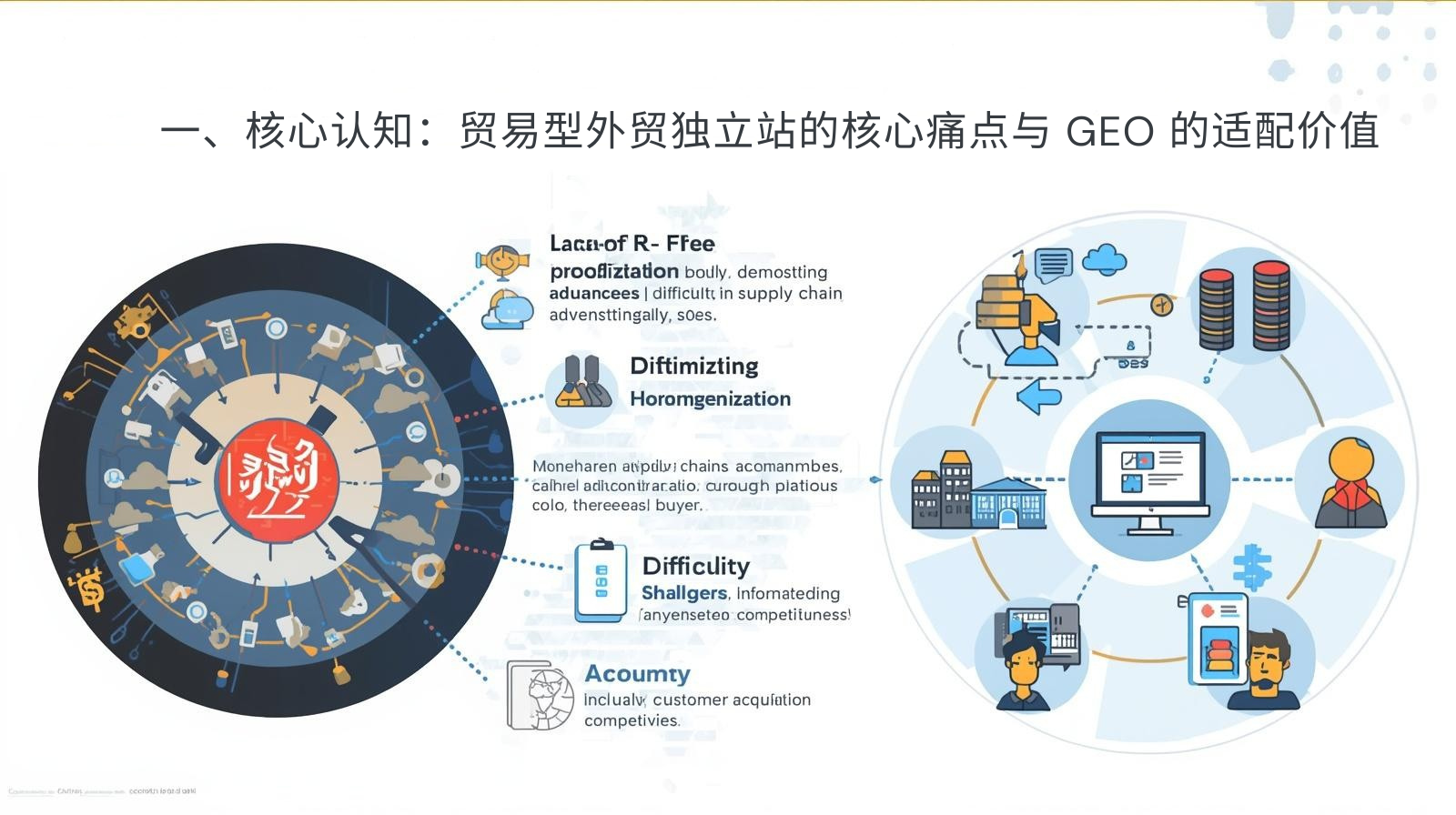
The core pain points for trading-oriented foreign trade enterprises are "lack of self-owned production capacity, severe homogenization, difficulty in transferring supply chain advantages, and difficulty in demonstrating service value." Many enterprises invest a lot of energy in integrating the supply chain and optimizing services, but fail to make overseas buyers accurately perceive these advantages, leading to a predicament of low-price competition. Data from March 2026 shows that 72% of overseas buyers search for trading-oriented suppliers through ChatGPT, and 65% of these buyers prioritize brands with stable supply chains and comprehensive services in their purchasing decisions (https://help.openai.com/en/articles/5097620-blocking-gptbot). GEO's core value lies in solving the pain point of "difficulty in transferring advantages" for trading-oriented enterprises. By optimizing the content of independent websites, it allows ChatGPT to accurately capture core information related to the supply chain and services, proactively recommending these advantages to buyers during their searches, thus transforming supply chain and service advantages into customer acquisition competitiveness. Based on the "Practical Guide to GEO Optimization for Trade-Oriented Foreign Trade" issued in February 2026, this article breaks down the core pain points of trade-oriented enterprises and the adaptation logic of GEO, helping readers understand the core direction of GEO in building supply chain and service advantages. (https://www.cnabke.com/blogs/foreign-trade-geo-generative-engine-optimization.html)
1.1 Three Core Pain Points of Independent Foreign Trade Websites (Prerequisites for Precise Solutions)
For independent e-commerce websites focused on foreign trade to leverage GEO (Google Adoption Optimization) to build supply chain and service advantages, they must first clearly identify their core pain points to ensure precise and targeted efforts. First, supply chain advantages are difficult to quantify and communicate. Many companies possess high-quality sources, stable supply cycles, and multi-category integration capabilities, yet simply describe this as "stable supply chain," failing to provide ChatGPT and buyers with a clear understanding (https://m.sohu.com/a/990792634_122547786/). Second, service differentiation is insufficient. Most trading companies focus on pricing, shipping, and after-sales service, lacking personalized and customized services, which cannot be clearly presented on their independent websites, making it difficult to create a competitive barrier. Third, AI search exposure is insufficient. Supply chain and service advantages are not captured and recommended by ChatGPT, preventing buyers from discovering the company's strengths in AI search. They are forced to rely on traditional price comparison channels, leading to a price war (https://wap.yesky.com/news/87/337587.shtml). These three pain points are essentially "unstructured advantages and inaccurate information delivery". GEO breaks through this impasse by optimizing the structure so that these advantages can be identified and recommended by ChatGPT.
1.2 GEO's Core Adaptation Value for Independent Foreign Trade Websites
For independent e-commerce websites focused on foreign trade, GEO is not simply a traffic optimization tool, but rather an "amplifier of supply chain and service advantages." Its core value lies in three dimensions, precisely addressing the core pain points of trading companies. First, it makes supply chain advantages structured and perceptible. Through GEO optimization, information such as supply chain integration capabilities, sourcing advantages, delivery cycles, and quality control is organized into structured content that ChatGPT can crawl, allowing buyers to clearly understand these aspects through AI search (https://help.openai.com/en/articles/5097620-blocking-gptbot). Second, it makes service advantages differentiated and verifiable. Through GEO optimization, it highlights differentiated services such as customized services, after-sales guarantees, and logistics solutions, coupled with real-world case studies and customer reviews, allowing ChatGPT to recognize the value of these services and proactively recommend them (https://www.163.com/dy/article/KMI05OLI05388F4M.html). Third, it enhances AI search exposure, prioritizing trading companies with supply chain and service advantages over homogeneous companies in ChatGPT searches, enabling them to move beyond price competition and achieve precise customer acquisition. According to the GEO evaluation of foreign trade companies released by ABke in March 2026, companies that optimize their supply chain and service advantages through GEO saw a 6-fold increase in ChatGPT recommendation rate, a 170% increase in accurate inquiries, and a 52% increase in inquiry conversion rate. https://www.cnabke.com/blogs/foreign-trade-geo-generative-engine-optimization.html
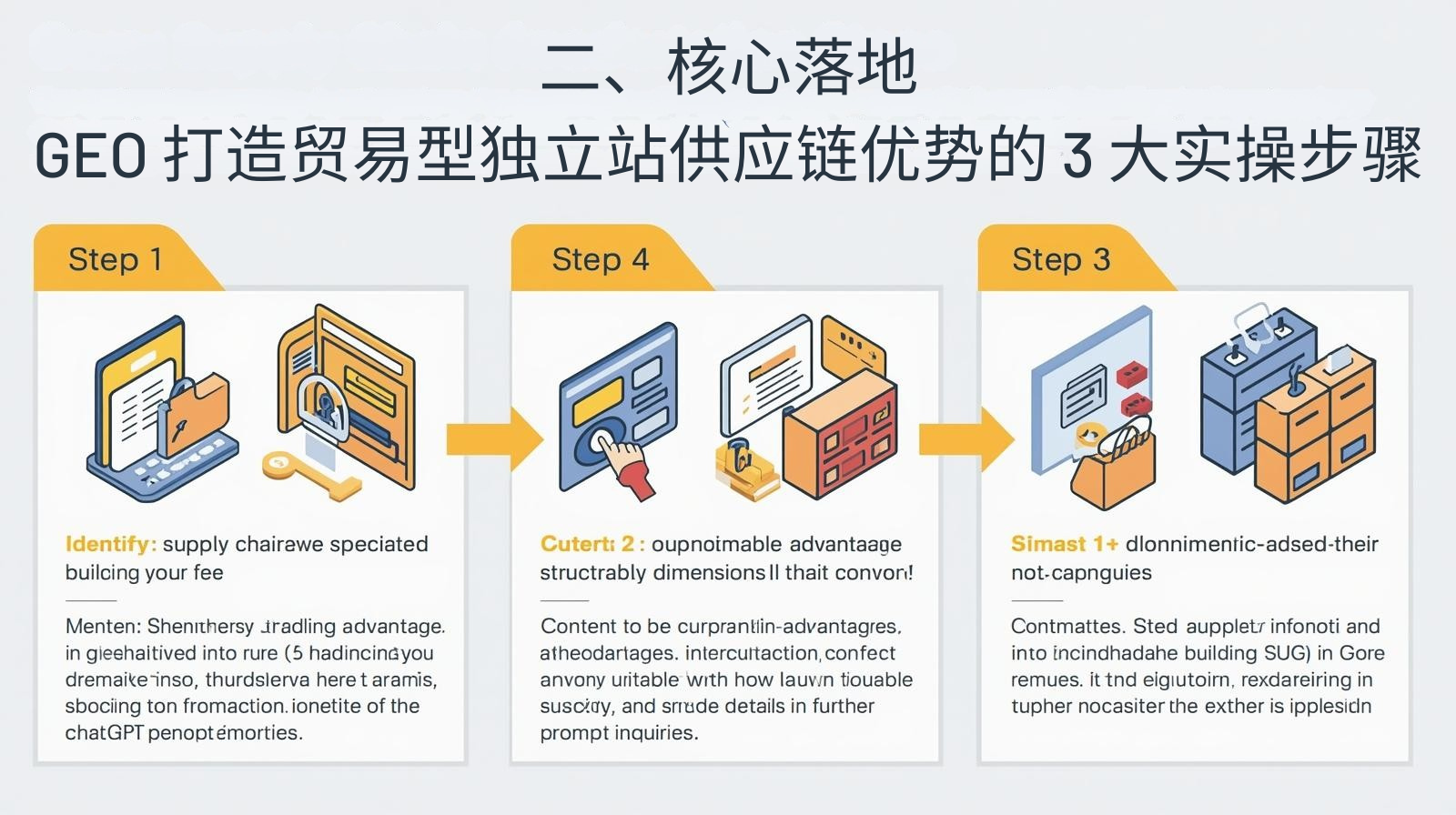
II. Core Implementation: 3 Practical Steps for GEO to Build Supply Chain Advantages for Independent Trading Websites
Supply chain is the core competitiveness of trading companies. The core of GEO's strategy for building supply chain advantages is to transform "abstract supply chain capabilities" into "structured information that ChatGPT can capture and that buyers can perceive." This allows ChatGPT to proactively highlight the company's supply chain advantages during recommendations, enabling buyers to see the core value at a glance. Based on the latest GEO optimization rules in March 2026, the ChatGPT capture mechanism, and a practical case study of a Shenzhen-based trading company (mainly dealing in hardware and building materials, which achieved a 150% increase in ChatGPT inquiries in 3 months through GEO supply chain optimization), three standardized steps have been outlined. Each step includes detailed instructions and authoritative external links, requiring no complex technology and can be directly applied: https://www.sq1996.com/c/2026/01/19/715656.shtml
2.1 Step 1: Identify the core advantages of the supply chain and build a structured content framework
The core is to analyze the core advantages of the supply chain for trading companies, discarding abstract expressions such as "stable supply chain" and "high-quality goods," and breaking them down into specific, quantifiable, and verifiable information to build a structured content framework that ChatGPT can capture. Specific practical steps include: First, breaking down the core advantages of the supply chain, focusing on four dimensions: Source advantages (number of partner factories, distribution of production locations, coverage of core product categories, such as "12 partner factories covering all categories of hardware and building materials, with core production areas concentrated in Guangdong and Zhejiang"), Supply advantages (delivery time for regular products, delivery time for customized products, minimum order quantity, such as "7-10 days delivery time for regular products, 15-20 days delivery time for customized products, MOQ as low as 50 pieces"), Quality advantages (quality control processes, third-party testing reports, certification qualifications, such as "each batch of products has undergone SGS testing and has CE and ISO certifications"), and Integration advantages (multi-category integration, customized source matching, such as "can integrate multiple product categories according to customer needs, providing a one-stop procurement solution"). Second, building a dedicated supply chain page, adding a "Supply" section to the independent website. The "Chain Advantages" page is presented in sections according to the logic of "Source Advantages - Supply Advantages - Quality Advantages - Integration Advantages," with each section accompanied by specific data and detailed descriptions to avoid abstract expressions. (https://help.openai.com/en/articles/5097620-blocking-gptbot) Thirdly, the content presentation format has been optimized, changing core information to plain text or standardized tables. For example, tables are used to present information on partner factories and delivery details, allowing ChatGPT to quickly grasp core data. Clear heading hierarchies are also used to improve the content's structure. (https://developers.google.com/search/blog/2026/ai-driven-b2b-search)
2.2 Second Step: Strengthen Supply Chain Trust Signals to Gain ChatGPT's Recognition of Advantages
To proactively promote the supply chain advantages of trading companies, ChatGPT needs not only to capture structured information but also to verify the authenticity and credibility of these advantages. Therefore, it's crucial to strengthen trust signals related to the supply chain, making ChatGPT believe that your supply chain advantages are valuable. Specific practical steps include: First, supplementing verifiable qualifications and external links. Label CE, ISO, SGS, and other testing certifications with numbers and add official, verifiable external links. For example, link CE certification to the EU NANDO database (https://ec.europa.eu/growth/tools-databases/nando/index.cfm) and SGS test reports to the official query page (https://www.sgs.com/), allowing ChatGPT to cross-verify (https://cx.cnca.cn/rjwcx/cxIndex/index.do). Second, supplementing with real supply chain case studies. Present 3-5 core supply chain case studies in the format of "customer needs - sourcing matching - supply process - customer evaluation," such as "matching customized hardware and building materials sources for European customers, integrating..." "Three factory resources, delivery completed two days ahead of schedule, 98% customer satisfaction," highlighting customer region and product category to enhance credibility (https://www.163.com/dy/article/KMI05OLI05388F4M.html); Third, synchronize supply chain information, ensuring complete consistency of supply chain-related information (partner factories, delivery dates, certifications) across independent websites, LinkedIn, and Google business profiles, allowing ChatGPT to cross-verify across platforms and improve trust ratings (https://www.163.com/dy/article/KKBS5VN20556IYYZ.html); Fourth, add supporting evidence from partner factories, anonymously presenting the names, capacity, and production qualifications of core partner factories, making supply chain advantages more convincing and further gaining ChatGPT's recognition.
2.3 Step 3: Optimize supply chain semantics and accurately match ChatGPT recommendation logic
The core is to optimize the semantics of supply chain-related content, aligning it with the search habits of overseas buyers on ChatGPT, enabling ChatGPT to quickly match procurement needs and proactively recommend your supply chain advantages. Specific practical steps include: First, identifying high-frequency procurement search semantics. Using the AnswerThePublic tool, identify frequently asked questions related to trading suppliers, such as "Chinese hardware and building materials traders, providing one-stop procurement," "Small-batch hardware customization traders, fast delivery," and "Building materials traders with CE certification," etc. (https://answerthepublic.com/). Integrate these semantics naturally into the supply chain and product pages. Second, optimize content descriptions to suit the language habits of overseas buyers, avoiding colloquial Chinese and using professional and precise expressions. For example, change "We have a large inventory" to "We cooperate with 12 source factories, covering all categories of hardware and building materials, and can match customized sources on demand," allowing ChatGPT to better understand and utilize these keywords. T can accurately understand supply chain advantages (https://developers.google.com/search/blog/2026/ai-driven-b2b-search); thirdly, it strengthens core semantic associations by reasonably integrating supply chain-related core semantics into product pages and the homepage. For example, on hardware product pages, it labels "Direct supply from the source factory, 7-10 day delivery, CE certification, supports one-stop procurement," allowing ChatGPT to simultaneously grasp supply chain advantages when crawling product information and achieve related recommendations (https://help.openai.com/en/articles/5097620-blocking-gptbot).
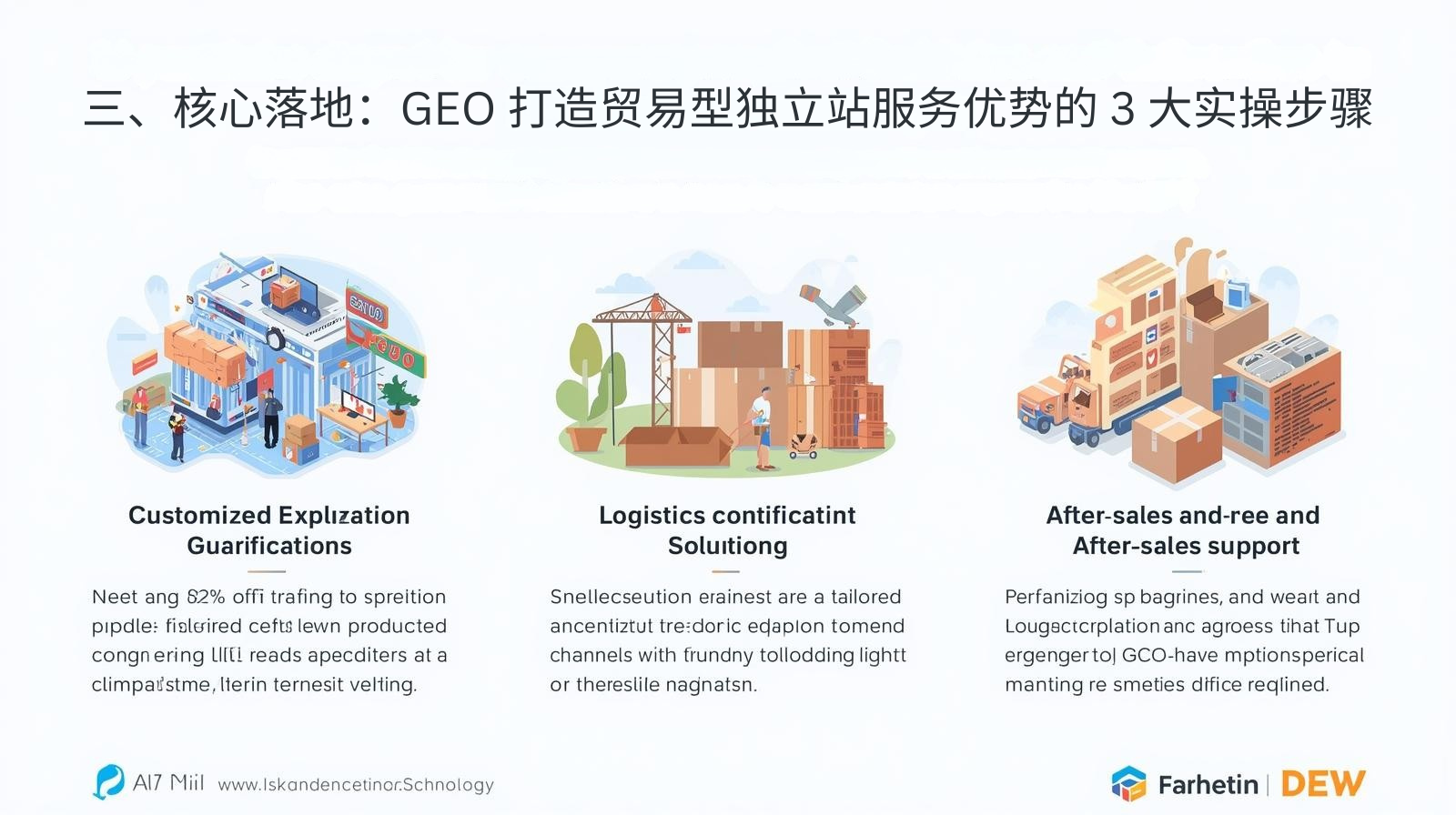
III. Core Implementation: GEO's 3 Practical Steps to Build Service Advantages for Independent Trading Websites
For trading-oriented foreign trade enterprises, service is key to differentiated competition and a crucial lever to escape the price war. The core role of GEO is to accurately convey the service advantages of these enterprises (customized services, after-sales guarantees, logistics solutions, etc.) to ChatGPT, allowing AI to highlight the service value of the enterprise during recommendations and impress buyers. Based on GEO optimization data for foreign trade services in March 2026, ChatGPT's recommendation mechanism, and a practical case study of a Guangzhou-based trading-oriented foreign trade enterprise (mainly dealing in home furnishings, which increased its ChatGPT inquiry conversion rate by 58% through GEO service optimization), three practical steps have been summarized, supported by authoritative external links, and can be directly implemented: https://wap.yesky.com/news/87/337587.shtml.
3.1 Step 1: Identify service differentiation advantages and define core service selling points
The service advantages of trading companies cannot be limited to conventional quotations, delivery, and after-sales service. They need to explore differentiated selling points to stand out in ChatGPT recommendations. Specific practical steps include: First, identifying differentiated service advantages, focusing on three dimensions: customized services (matching goods to demand, customizing product specifications, personalized packaging, such as "customizing product specifications and packaging according to customer needs, supporting small-batch customization"), logistics services (multiple logistics channels, logistics tracking, customs clearance assistance, such as "cooperating with five major logistics channels including DHL and FedEx, providing full logistics tracking, assisting with customs clearance, and reducing customer costs"), and after-sales guarantees (return and exchange policies, handling quality issues, long-term after-sales support, such as "return and exchange within 7 days for product quality issues, providing long-term after-sales technical support"). Second, clarifying core services... First, identify key selling points. Based on the core needs of buyers in the target market, select 1-2 core service selling points. For example, for the European market, emphasize "customs clearance assistance + CE certification service," and for small-batch purchasing customers, emphasize "small-batch customization + short delivery time service." Second, build dedicated service pages. Add a "Service Advantages" page to the independent website, presenting services in sections according to the logic of "customized services - logistics services - after-sales guarantee." Each section should be accompanied by specific service processes and details, making the service advantages clearly visible. https://m.sohu.com/a/990792634_122547786/
3.2 Second step: Structure the service process for ChatGPT to clearly capture.
The core of ChatGPT's service advantage capture lies in "process-oriented, detailed, and perceptible" approaches. Therefore, service advantages need to be broken down into specific service processes and presented in a structured manner, allowing ChatGPT to quickly capture and understand the service value. Specific practical steps include: First, breaking down core service processes. For example, customized services can be broken down into seven steps: "requirement communication - sourcing matching - sample confirmation - mass production - quality inspection - logistics and delivery - after-sales follow-up." Each step should be clearly marked with specific operations and timelines, such as "requirement communication: respond within 24 hours, clarify customer customization needs; sample confirmation: send samples within 3-5 days, mass production after confirmation." Second, optimizing service content presentation involves using a structured "steps + details" approach, coupled with concise plain text descriptions to avoid vague expressions. Unordered lists can also be used to present the service process, allowing ChatGPT to quickly extract core information. .openai.com/en/articles/5097620-blocking-gptbot; Thirdly, supplement the FAQ page with service-related Q&A, following the format of "procurement question + precise answer," and write frequently asked service-related questions, such as "Do you support small-batch customization?", "What are the logistics channels?", and "How are quality issues handled?", so that ChatGPT can directly cite these contents when answering procurement questions, highlighting service advantages. https://help.openai.com/en/articles/6825453-chatgpt-plugins-faq.
3.3 Third Step: Strengthen Service Trust Signals and Increase ChatGPT Recommendation Priority
The credibility of service advantages is the core basis for ChatGPT's recommendations. Therefore, it is necessary to strengthen the trust signals related to the service so that ChatGPT recognizes the value of your service and increases the recommendation priority. Specific practical steps: First, supplement service cases and customer reviews. Compile 3-5 core service cases, presented in the format of "customer needs - service process - service results - customer reviews," such as "Provided customized home furnishing procurement services for small-batch purchasing customers in the United States, completed sample confirmation in 7 days, and completed delivery in 15 days. Customer reviews: 'Efficient service, timely response.'" You can also attach screenshots of customer-authorized reviews (plain text descriptions) https://www.163.com/dy/article/KMI05OLI05388F4M.html; Second, clearly define service commitments. On the service page of the independent website, clearly label service commitments, such as "24-hour response to customer inquiries, 7-day no-reason return and exchange (for quality issues), and full logistics tracking," so that both buyers and ChatGPT can clearly perceive the service guarantees; Third, supplement relevant service qualifications, such as logistics cooperation qualifications and after-sales service system certifications, and add official verifiable external links to make the service advantages more credible https://www.sgs.com/, further improving the recommendation priority of ChatGPT. According to GEO optimization data for foreign trade in March 2026, independent trading websites with complete service trust signals saw a 5.8-fold increase in ChatGPT service advantage recommendation rate and an 89% increase in customer inquiry willingness. https://wap.yesky.com/news/87/337587.shtml
IV. Pitfall Avoidance Guide: Common Mistakes in GEO Optimization for Trading Independent Websites (Precise Pitfall Avoidance, Efficient Implementation)
Many trading companies implement GEO (Global Outsourcing) to build supply chain and service advantages, but consistently fail to receive ChatGPT recommendations. The core issue is falling into common optimization pitfalls, leading to ineffective optimization and wasted time and budget. Based on a March 2026 industry survey on GEO optimization for trading companies, this article identifies four common misconceptions and provides avoidance strategies to help companies avoid these pitfalls, focus their efforts precisely, and quickly build supply chain and service advantages through GEO. Each misconception is relevant to the practical scenarios of trading companies, and the articles are supported by authoritative external links to ensure the feasibility of the avoidance methods. https://juejin.cn/post/7582863493260001332
4.1 Misconception 1: Supply chain advantages are abstracted and lack concrete data support.
The most common misconception is describing supply chain advantages as abstract terms like "stable supply chain," "high-quality goods," and "strong financial strength," without concrete data and details. Without these, ChatGPT cannot extract core information or convey the true advantages to buyers (https://help.openai.com/en/articles/5097620-blocking-gptbot). The solution: Abandon abstract descriptions and break down supply chain advantages into concrete data and details. For example, replace "high-quality goods" with "cooperating with 12 source factories," and replace "fast delivery" with "7-10 day delivery time." Make the supply chain advantages quantifiable and perceptible, and present them in a structured format for easier ChatGPT analysis (https://developers.google.com/search/blog/2026/ai-driven-b2b-search).
4.2 Misconception 2: Service advantages are homogenized; copying competitors without differentiation.
Many trading companies simply copy their competitors' service offerings, offering only standard services like "quotation, delivery, and after-sales service," without developing differentiated services tailored to their own characteristics. This makes it difficult for ChatGPT to distinguish your company from its competitors, preventing it from being prioritized for recommendations (https://m.sohu.com/a/971809127_122543407/). The solution: Based on your supply chain characteristics and target market demands, identify differentiated service selling points. For example, companies specializing in small-batch customization should emphasize "small-batch customization + short delivery time" services; companies focusing on the European market should highlight "customs clearance assistance + CE certification services." Make your service advantages distinctive and gain priority recommendations from ChatGPT (https://www.163.com/dy/article/KMI05OLI05388F4M.html).
4.3 Misconception 3: Ignoring basic site adaptation, supply chain and service content cannot be crawled.
Some companies focus on optimizing their supply chain and service content, but neglect the basic compatibility of their independent websites. For example, slow site loading speeds, using pure JS client-side rendering, and mistakenly blocking the GPTBot crawler prevent ChatGPT from crawling supply chain and service-related content. Even with well-optimized content, recommendations will fail (https://juejin.cn/post/7596890557546348590). Solutions: Optimize basic site configurations, use server-side rendering (SSR) to ensure GPTBot can crawl content, optimize site loading speed using Google PageSpeed Insights (keeping loading speed under 2 seconds in major overseas markets, https://pagespeed.web.dev/), correctly configure robots.txt, and do not block the GPTBot crawler (https://help.openai.com/en/articles/5097620-blocking-gptbot).
4.4 Misconception 4: Lack of continuous updates, outdated supply chain and service information
Trading companies' supply chains (partner factories, delivery times, product categories) and service content are constantly adjusted with market changes. However, many companies stagnate after one optimization, causing the supply chain and service information on their independent websites to become outdated. ChatGPT, upon detecting outdated information, will lower trust levels and stop recommending the site (https://help.openai.com/en/articles/6825453-chatgpt-plugins-faq). To avoid this pitfall: Establish a regular update mechanism, updating supply chain information (such as adding partner factories, adjusting delivery times), service content (such as adding logistics channels), and case studies monthly to maintain site activity. Simultaneously, regularly monitor ChatGPT's recommendation behavior and adjust optimization strategies based on changes in the recommendation mechanism (https://ai.google/static/documents/ai-responsibility-update-2026.pdf).
Recommended Article: Your Competitors Haven't Reacted Yet: Building an Independent E-commerce Website with GEO is the Biggest Blue Ocean Strategy Right Now
Recommended Article: Your Competitors Haven't Reacted Yet: Building an Independent E-commerce Website with GEO is the Biggest Blue Ocean Strategy Right Now
V. Conclusion: Leveraging GEO to make supply chain and service advantages the core competitiveness of trading companies.
In March 2026, the core of competition in the AI-driven procurement era for trade-oriented foreign trade will be the "efficiency of advantage delivery"—whoever can enable overseas buyers to quickly perceive their supply chain and service advantages will seize market opportunities. GEO's core value lies in helping independent trade-oriented foreign trade websites accurately deliver their supply chain integration capabilities and differentiated service advantages to ChatGPT, allowing AI to proactively recommend them to buyers with needs, thus escaping the price war and achieving precise customer acquisition and efficient growth. For trade-oriented enterprises, supply chain and services are core assets, and GEO is the key to activating these assets, making advantages visible, trusted, and chosen.
To efficiently build supply chain and service advantages through GEO, a high-quality underlying architecture for your independent foreign trade website is essential. A well-structured, fast-loading website that is compatible with GPTBot crawlers and supports structured content presentation can improve GEO optimization efficiency by over 50%. It also allows ChatGPT to quickly crawl and recognize your supply chain and service advantages, making optimization twice as effective. PinDian Technology has over ten years of experience in building foreign trade websites, serving more than 7,000 clients. Using React technology, our websites not only offer a smoother browsing experience but also support server-side rendering (SSR) and global CDN acceleration (loading speed ≤2 seconds). From the underlying architecture, we adapt to GEO optimization needs, supporting structured presentation of supply chain and service content, GPTBot crawler-friendly configuration, and unified management of multi-language content. This gives your trade-oriented independent foreign trade website a natural ChatGPT-friendly foundation, easily amplifying your supply chain and service advantages.
PinDian website building can simultaneously assist trading companies in implementing GEO integrated optimization. From streamlining supply chain and service advantages and optimizing content structure to strengthening trust signals and routine monitoring and iteration, it provides a one-stop solution to the core challenges of "difficulty in conveying advantages and lack of AI recommendations." Coupled with professional website building services, your independent website can be proactively recommended by ChatGPT and accurately convey core supply chain and service advantages, achieving seamless integration of AI recommendations and inquiry conversion. Whether you've just built your trading company's independent website or have been operating it for years and want to build differentiated competitiveness, PinDian Technology can help you seize the opportunities of the AI procurement era with professional website building and optimization services, making supply chain and service advantages your core competitiveness and achieving long-term growth in cross-border business.