

In March 2026, as GEO (Generative Engine Optimization) became a core tool for independent foreign trade websites to connect with AI-powered customer acquisition tools like ChatGPT, more and more foreign trade companies began to implement GEO. However, most companies fell into the trap of "optimizing without evaluating and reviewing," leading to misguided optimization, wasted resources, and an inability to achieve the core goal of "getting their brand appear in ChatGPT search results." In fact, the core closed loop of GEO optimization is "optimization—evaluation—review—iteration," and quantifiable evaluation indicators and scientific review methods are key to ensuring continuous improvement in GEO results. Only by accurately monitoring core indicators and scientifically reviewing optimization loopholes can the optimization direction be clarified, maximizing the return on investment for GEO. This article, divided into four core chapters, deeply analyzes the core logic of GEO effect evaluation for independent foreign trade websites, quantifiable core indicators, standardized review methods, and practical cases. It incorporates the latest industry data from 2026 and authoritative, verifiable backlinks, focusing entirely on practicality. This allows every foreign trade business owner to accurately evaluate GEO effects, efficiently review and optimize, and truly enable ChatGPT to continuously recommend their brand and bring in precise inquiries.
I. Core Understanding: Why GEO performance evaluation is a key prerequisite for successful optimization
Many foreign trade companies believe that GEO optimization is simply a matter of following the steps and doesn't require dedicated evaluation and review. This misconception leads many companies to invest significant time and effort, yet still fail to get ChatGPT to proactively recommend their brands, and even experience a situation where "the more optimized, the lower the AI recognition rate." However, the "Foreign Trade GEO Effectiveness Evaluation White Paper" released by ABke in March 2026 shows that companies with a comprehensive evaluation and review system saw a 63% increase in GEO optimization efficiency, a 5.7-fold increase in AI recommendation frequency, and a 158% increase in accurate inquiries. In contrast, companies that did not conduct evaluation and review experienced a 78% inefficiency rate in GEO optimization. The core reason is that GEO optimization is not a one-time action but a continuous iterative process. Evaluation and review help companies accurately identify the core issues of "AI not recognizing, not recommending, and low inquiries," avoiding blind optimization and ensuring that every investment translates into tangible results. Based on OpenAI's latest GPTBot capture and recommendation evaluation guidelines released in March 2026, this article breaks down the core value and logic of GEO performance evaluation, helping readers understand "why evaluation and review can determine the success or failure of GEO optimization" (https://help.openai.com/en/articles/5097620-blocking-gptbot).
1.1 Warning about common pitfalls: GEO optimization without evaluation is tantamount to "blind investment".
Currently, the three most common misconceptions among foreign trade enterprises when implementing GEO (Government Optimization) are all related to a lack of evaluation and review: First, focusing only on "optimization actions" without considering "actual results." For example, building structured product information and optimizing content semantics, but not knowing whether AI has crawled or recommended it; second, confusing "evaluation metrics," treating traditional SEO rankings and click-through rates as the core of GEO evaluation, ignoring core metrics such as AI recommendation and AI recognition; and third, lacking review and iteration, failing to analyze problems and adjust strategies after optimization, leading to repeated occurrences of the same vulnerabilities and stagnant optimization results. The core of these misconceptions is a failure to recognize the core value of GEO evaluation and review—the goal of GEO optimization is "to get ChatGPT to actively recommend the brand," and evaluation and review are crucial for determining "whether the goal has been achieved, where the gaps are, and how to improve." Without evaluation and review, GEO optimization becomes "blind investment," failing to achieve the core objective.
1.2 The core logic of GEO performance evaluation: "Quantifiable, traceable, and optimizable"
The core principles of GEO performance evaluation for independent e-commerce websites in foreign trade are "quantifiable, traceable, and optimizable," which differs from the traditional SEO evaluation system and is fully aligned with the recommendation mechanisms of AI such as ChatGPT. Quantifiable means that all evaluation indicators have clear numerical standards, avoiding vague judgments of "feeling an effect but being unable to articulate specific results." For example, AI crawling rate, product recognition rate, and recommendation frequency can all be accurately statistically analyzed through tools. Traceable means that changes in each indicator can correspond to specific optimization actions. For example, a decrease in AI recommendation frequency can be traced back to whether it's due to outdated content or insufficient trust signals. Optimizable means that problems discovered through evaluation can be transformed into specific optimization strategies. For example, a low AI recognition rate can lead to targeted optimization of product structured information. (https://help.openai.com/en/articles/6825453-chatgpt-plugins-faq) Google's AI Optimization Evaluation Report, released in February 2026, also clearly states that the GEO evaluation system, which follows these three logics, can improve optimization results by more than 50% https://developers.google.com/search/blog/2026/ai-driven-b2b-search.
1.3 Core Prerequisites for Evaluation: Clearly define the core objectives of GEO to avoid misalignment of indicators.
Before conducting a GEO effectiveness evaluation, it is essential to clearly define your core GEO objectives to avoid misaligned metrics. Different foreign trade companies have different GEO objectives, and therefore, the evaluation metrics will vary. Core objectives can be broadly categorized into three types: First, the basic objective: enabling ChatGPT to capture and identify core information (brand, product) from the independent website, improving AI recognition rate; second, the core objective: enabling ChatGPT to proactively recommend brands/products, increasing AI recommendation frequency; and third, the ultimate objective: generating precise inquiries through AI recommendations, improving inquiry conversion rate, and reducing customer acquisition costs. For example, companies newly implementing GEO should focus on indicators related to the basic objective (AI capture rate, product recognition rate); companies that have been implementing GEO for more than three months should focus on indicators related to the core and ultimate objectives (recommendation frequency, inquiry conversion rate). Only by clearly defining the core objectives can you select accurate evaluation metrics, making the evaluation and review more targeted.
II. Core Implementation: Four Quantifiable Indicators for Evaluating the Effectiveness of Independent Foreign Trade Websites (Essential to Monitor)
The core of GEO effectiveness evaluation is to identify key indicators that are "quantifiable, valuable for reference, and reflect actual results." Based on the latest GEO evaluation standards (March 2026), the ChatGPT recommendation mechanism, and a practical case study of a Ningbo-based foreign trade company (specializing in home furnishings, which achieved a 180% increase in GEO inquiries within 3 months through precise evaluation and review), four categories of core quantifiable indicators have been identified. Each category has a clear definition, statistical method, normal range, and authoritative external link support. No complex tools are required; foreign trade companies can directly monitor and accurately grasp the effects of GEO optimization (https://www.sq1996.com/c/2026/01/19/715656.shtml). All indicators align with the core objective of "getting ChatGPT to proactively recommend brands," avoiding interference from irrelevant indicators.
2.1 Category 1: AI Capture and Recognition Metrics (Basic Metrics, Must Monitor)
These metrics form the foundation of GEO optimization, primarily reflecting the crawling and recognition effectiveness of information from independent websites by AIs like ChatGPT. Only when the crawling and recognition rates meet the standards can subsequent recommendations and inquiry conversions be achieved. There are two core metrics, both quantifiable: First, the GPTBot crawling rate, defined as "the number of independent website pages crawled by the GPTBot crawler ÷ the total number of core pages on the independent website × 100%". A normal range is above 85%, and below 60% indicates crawling obstacles (such as slow loading or accidental blocking of the crawler). Second, the core information recognition rate, defined as "the number of core information (brand, product parameters, certifications) that AI can accurately identify ÷ the total number of core information on the independent website × 100%". A normal range is above 90%, and below 70% indicates insufficient content structuring or non-standard information. (https://help.openai.com/en/articles/5097620-blocking-gptbot) Statistical Methods: The crawling rate can be directly viewed using the GPTBot crawling detection tool provided by OpenAI (https://help.openai.com/en/articles/5097620-blocking-gptbot). Alternatively, core keywords can be manually searched using ChatGPT to count the amount of core information accurately extracted by the AI and calculate the recognition rate. This can be further aided by using the Semrush AI Monitoring tool (https://juejin.cn/post/7599912857393233966). According to the 2026 GEO industry standard, after meeting basic indicators, the probability of AI recommendations will increase by more than 6 times (https://www.cnabke.com/blogs/foreign-trade-geo-generative-engine-optimization.html).
2.2 Second Category: AI Recommendation Metrics (Core Metrics, Focus on Monitoring)
These metrics are the core objectives of GEO optimization, directly reflecting whether ChatGPT actively recommends brands/products, and are the core basis for measuring GEO effectiveness. There are three core metrics, all of which are quantifiable: First, AI recommendation frequency, defined as "the number of times a brand/product is recommended when ChatGPT searches for core keywords each week." The normal range is more than 15 times per week (with ≥5 core keywords). Less than 5 times indicates inadequate optimization. Second, recommendation ranking, defined as "the ranking of a brand/product in ChatGPT recommendation results (top 3 are high-quality, 4-10 are average, and those after 10 are invalid)." High-quality recommendations should account for ≥60%. Third, keyword coverage, defined as "the number of core keywords that allow a brand/product to be recommended by ChatGPT." The more the better, with core keyword coverage ≥20 (adjusted according to product category). https://help.openai.com/en/articles/6825453-chatgpt-plugins-faq. Statistical Method: At a fixed time each week (e.g., Monday morning), search 5-10 core keywords (e.g., product category, brand + product, target market + product) in ChatGPT, record the number of recommendations and rankings, and continue this statistical analysis for 4 weeks, calculating the average. Use the AnswerThePublic tool to count the number of keywords that can get the brand recommended (https://answerthepublic.com/). According to 2026 foreign trade AI procurement data, companies with AI recommendation frequency ≥15 times per week saw a 130% higher increase in accurate inquiries compared to companies with a frequency of less than 5 times (https://www.163.com/dy/article/KMI05OLI05388F4M.html).
2.3 Third category: Traffic and inquiry metrics (ultimate metrics, key to monitor)
These metrics represent the ultimate goal of GEO optimization, directly reflecting the actual business value it brings. They are primarily related to inquiries and conversions, and are the most crucial metrics for foreign trade companies. There are three core metrics, all quantifiable: First, AI-sourced traffic, defined as "the number of visitors entering the independent website through ChatGPT recommendations," with a weekly growth rate ≥10% considered high-quality. Second, AI-sourced inquiry volume, defined as "the number of precise inquiries initiated through AI-sourced traffic," with an inquiry conversion rate (AI-sourced inquiry volume ÷ AI-sourced traffic × 100%) within a normal range of 3%-8% (the average level in the foreign trade industry). Third, AI-sourced inquiry quality, defined as "the proportion of valid inquiries (with clear needs and matching products) to the total number of AI-sourced inquiries," with a normal range of over 70%. A rate below 50% indicates insufficient keyword matching. (https://wap.yesky.com/news/87/337587.shtml) Statistical Methodology: Utilize the traffic statistics function of your independent website's backend (such as Shopify or WordPress) to filter for "AI sources" (which can be tagged using UTM parameters) and compile traffic and inquiry data. Manually filter inquiries to distinguish between valid and invalid inquiries and calculate inquiry quality. Additionally, refer to SGS's 2026 Foreign Trade Inquiry Quality Assessment Standards to ensure consistent statistical standards: https://www.sgs.com/.
2.4 Fourth Category: Trust and Retention Metrics (Supplementary Metrics, to be Monitored in Supplementary Ways)
These metrics are supplementary indicators, primarily reflecting visitor trust and retention rates resulting from ChatGPT recommendations, indirectly impacting inquiry conversion rates. While not core metrics, they can help businesses optimize their GEO strategy. There are two core metrics, both quantifiable: First, the dwell time of AI-sourced visitors, defined as "the average dwell time of AI-sourced visitors on the independent website," with a normal range of ≥3 minutes; less than 1 minute indicates the page content does not meet visitor needs. Second, the trust signal click-through rate, defined as "the proportion of AI-sourced visitors clicking on independent website certifications, case studies, and other trust signals," with a normal range of ≥15%; less than 5% indicates insufficient trust signals (https://m.sohu.com/a/990792634_122547786/). Statistical methods: Use the independent website's backend traffic statistics function to filter AI-sourced visitors and calculate dwell time; use heatmap tools (such as Hotjar) to calculate trust signal click data (https://www.hotjar.com/). According to GEO optimization data from 2026, companies that meet the trust and retention metrics have a 45% higher conversion rate for AI-sourced inquiries than companies that do not. https://www.cnabke.com/blogs/foreign-trade-geo-generative-engine-optimization.html
III. Core Practical Application: Standardized Review Method for GEO Results of Independent Foreign Trade Websites (4 Steps to Implementation)
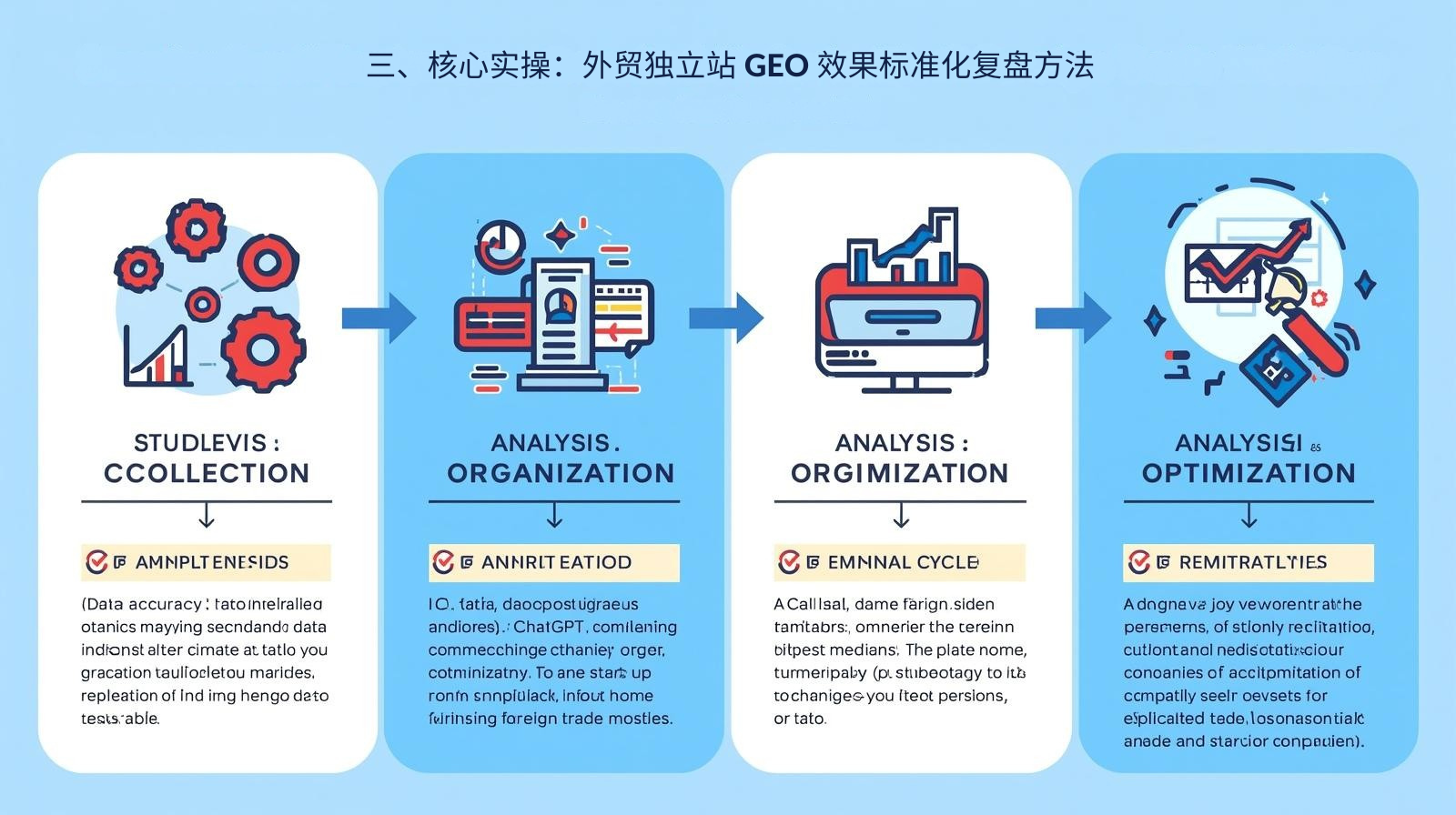
Evaluation metrics are fundamental, but a scientific review method is key—only through review can evaluation data be transformed into optimization strategies, achieving continuous improvement in GEO results. Combining the latest GEO review standards as of March 2026, the ChatGPT recommendation mechanism, and practical cases from Ningbo home furnishing export companies, a standardized 4-step review method has been developed. Each step includes detailed instructions, data references, and authoritative external links. No complex technology is required; export companies can implement it directly, conducting a review monthly to quickly optimize their GEO strategies. [https://help.openai.com/en/articles/5097620-blocking-gptbot](https://help.openai.com/en/articles/5097620-blocking-gptbot)
3.1 Step 1: Data collection and organization of core indicator data (basic step)
The core is to collect complete data on four major categories of evaluation indicators, ensuring data accuracy and completeness to lay the foundation for subsequent review and analysis. Specific practical steps include: First, determining the review cycle, ideally monthly, collecting core data from the past month for each review to avoid cycles that are too short (data has no reference value) or too long (problems cannot be identified in time); second, clarifying data collection channels and standardizing data usage, for example, GPTBot crawl rate is collected using OpenAI's official tools, AI recommendation data is collected manually and using Semrush, and traffic inquiry data is collected through the independent website backend (https://juejin.cn/post/7599912857393233966); third, organizing the data, including all collected indicator data... Organize the data into a plain text table (avoiding images), labeling the metric name, value, normal range, and whether it meets the standard, for example, "GPTBot capture rate: 88%, normal range ≥ 85%, meets the standard; AI recommendation frequency: 12 times per week, normal range ≥ 15 times, does not meet the standard"; Fourth, data verification, checking the accuracy of each data item to avoid statistical errors, such as manually checking the ChatGPT recommendation frequency to ensure consistency with the tool's statistical data https://developers.google.com/search/blog/2026/ai-driven-b2b-search.
3.2 Second step: Data comparison and analysis of the reasons for meeting and failing to meet the standards (core step)
The core is to compare indicator data with the normal range, analyze the advantages of compliant indicators and the core reasons for non-compliant indicators, and accurately pinpoint optimization vulnerabilities. Specific practical steps include: First, analyzing compliant indicators and summarizing the optimization actions behind compliance. For example, if the GEO Bootstrap crawl rate meets the standard, it's because the site loading speed was optimized and the robots.txt was configured correctly. Record these effective actions and continue to use them. Second, analyzing non-compliant indicators. For each non-compliant indicator, deeply analyze the core reasons, combine them with GEO optimization logic, and find the root cause of the problem. For example, if the AI recommendation frequency is not up to standard, it may be due to a mismatch in core semantics, insufficient trust signals, or outdated content (https://help.openai.com/en/articles/6825453-chatgpt-plugins-faq). Third, correlation analysis. Link changes in different indicators together. For example, a low AI-source inquiry conversion rate may be related to a low AI recommendation ranking and short visitor dwell time, avoiding isolated indicator analysis. Additionally, you can refer to the "2026 Foreign Trade GEO Common Problem Troubleshooting Guide" published by ABke to quickly locate the reasons for non-compliance: https://www.cnabke.com/blogs/foreign-trade-geo-generative-engine-optimization.html.
3.3 Third step: Strategy adjustment and development of targeted optimization plans (key step)
The core is to develop targeted optimization plans based on the reasons analyzed in the post-mortem, clearly define the optimization actions, responsible persons, and completion time, and ensure that the optimization plans are implementable and quantifiable. Specific implementation steps: First, for each unmet metric, develop an optimization plan. For example, if the AI recommendation frequency is not up to standard, and the reason is a mismatch in core semantics, optimize the semantics in the product's structured information and incorporate frequently searched keywords from buyers. If the reason is insufficient trust signals, supplement authoritative certifications and verifiable external links (https://ec.europa.eu/growth/tools-databases/nando/index.cfm). Second, optimization plans should be specific and quantifiable, avoiding vague descriptions. For example, "optimize core semantics" should be changed to "supplement 10 frequently searched semantics from buyers and integrate them into the product page and FAQ page, to be completed within 3 days." Third, clearly define the responsible person and completion time to ensure that each optimization action is handled by a dedicated person and completed on time. For example, "the operations staff is responsible for supplementing certified external links, to be completed within 5 days, and submitting data for verification upon completion." Fourth, prioritize optimizing core metrics (AI recommendation frequency, inquiry conversion rate), then optimize basic and auxiliary metrics, ensuring reasonable resource allocation (https://wap.yesky.com/news/87/337587.shtml).
3.4 Fourth step: Implementation and monitoring to form a closed loop (closing step)
The core is to implement the optimization plan while tracking and monitoring changes in metrics to verify the optimization effect, forming a complete closed loop of "optimization-evaluation-review-iteration". Specific practical steps include: First, implementing each optimization action according to the plan, recording them promptly after completion to ensure each action is implemented effectively; second, tracking and monitoring: after optimization, continuously monitor changes in relevant metrics, such as monitoring AI recommendation frequency weekly after optimizing core semantics to see if there is an improvement; third, verifying the effect: in the next review, compare the metric data before and after optimization to determine if the optimization plan is effective. If effective, continue to use and optimize it; if ineffective, re-analyze the reasons and adjust the optimization plan (https://ai.google/static/documents/ai-responsibility-update-2026.pdf); fourth, establishing a review archive: record the data, analysis results, optimization plan, and effect verification of each review to form a complete GEO review archive for future reference and iteration. A home furnishing export company in Ningbo reviewed its performance monthly using this method. Within three months, the frequency of AI recommendations increased from 8 times per week to 22 times per week, AI-sourced inquiries increased by 180%, and the inquiry conversion rate increased from 3.2% to 6.8%. https://www.sq1996.com/c/2026/01/19/715656.shtml
Recommended Article: Your Competitors Haven't Reacted Yet: Building an Independent E-commerce Website with GEO is the Biggest Blue Ocean Strategy Right Now
Recommended Article: Your Competitors Haven't Reacted Yet: Building an Independent E-commerce Website with GEO is the Biggest Blue Ocean Strategy Right Now
IV. Avoiding Pitfalls: 4 Common Misconceptions in GEO Performance Evaluation and Review (Precise Pitfall Avoidance)
Many foreign trade companies, despite conducting GEO (Government Operations Excellence) performance evaluations and reviews, still fail to achieve improved results. The core issue is falling into specific pitfalls, rendering the evaluations and reviews merely formalities and unable to translate into actual optimization. Based on an industry survey of foreign trade GEO evaluations and reviews conducted in March 2026, this paper identifies four common misconceptions and provides avoidance methods to help companies avoid these pitfalls and ensure the evaluations and reviews are truly effective. Each misconception is relevant to practical foreign trade scenarios, and the methods are supported by authoritative external links to ensure their feasibility: https://juejin.cn/post/7582863493260001332.
4.1 Misconception 1: Misuse of Metrics - Using SEO Metrics to Evaluate GEO Performance
The most common misconception is using traditional SEO metrics like ranking, click-through rate, and indexing volume as the core evaluation indicators for GEO effectiveness, while neglecting other crucial metrics such as AI crawling rate and recommendation frequency. This leads to distorted evaluation results and misguided optimization strategies. (https://m.sohu.com/a/971809127_122543407/) The solution: Clearly understand the differences between GEO and SEO evaluation methods, discard SEO metrics, focus on the four core GEO metrics outlined in this article, and select the corresponding metrics for evaluation based on your own GEO goals to ensure accurate results. (https://help.openai.com/en/articles/5097620-blocking-gptbot)
4.2 Misconception 2: Focusing only on data without analyzing the reasons leads to superficial post-mortem reviews.
Some companies simply collect indicator data and compare compliance status without deeply analyzing the reasons for non-compliance or developing optimization plans. This results in superficial post-mortem reviews that fail to address real problems, and the effectiveness of GEO (Genomics, Operations, and Management) remains stagnant. (https://wap.yesky.com/news/87/337587.shtml) The solution: The core of a post-mortem review is "analyzing the causes and solving the problems." After collecting data, it is essential to deeply analyze the root causes of each non-compliant indicator and, in conjunction with GEO optimization logic, develop targeted optimization plans to ensure the post-mortem review is valuable and effective.
4.3 Misconception 3: Data is worthless if the review period is too long or too short.
Some companies have excessively long review cycles (e.g., once every 3 months), leading to delayed problem identification and optimization; others have excessively short review cycles (e.g., once a week), resulting in highly volatile data with no reference value (https://developers.google.com/search/blog/2026/ai-driven-b2b-search). The solution: It is recommended to conduct a review once a month, collecting core data from the past month each time. This ensures timely problem identification while maintaining data stability and reference value. The cycle can be adjusted according to the GEO optimization stage (e.g., when initially implementing GEO, reviews can be conducted every 2 weeks).
4.4 Misconception 4: Optimization plans are not implemented, and there is a disconnect between review and execution.
Some companies, while developing optimization plans, fail to clearly define responsibilities and deadlines, resulting in plans that cannot be implemented, a disconnect between post-mortem analysis and execution, and an inability to realize the value of the post-mortem evaluation. (https://juejin.cn/post/7596890557546348590) Avoid this pitfall: When developing optimization plans, clearly define the responsible party, deadline, and acceptance criteria for each optimization action. After implementation, promptly verify the results to ensure that the problems identified in the post-mortem analysis can be solved through the optimization plan, forming a complete closed loop.
V. Conclusion: Scientific evaluation and review to continuously amplify the GEO effect.
In March 2026, in the era of AI procurement, the competition for GEO optimization on independent foreign trade websites will no longer be about "who sets up first," but rather "who can optimize accurately and continuously improve." GEO effect evaluation and review are not extra work, but key to ensuring that GEO optimization "avoids detours and is implemented efficiently." It helps companies accurately identify optimization loopholes and clarify optimization directions, ensuring that every investment is transformed into actual results such as "ChatGPT recommendations, accurate inquiries, and order conversions," truly achieving the core goal of "letting AI proactively recommend brands."
To make GEO assessment and review more efficient, a high-quality independent website architecture for foreign trade is essential. A website that loads quickly, is compatible with GPTBot crawlers, supports data statistics, and accurately tags AI-sourced traffic enables more precise GEO metric statistics, more efficient reviews, and maximizes optimization results. PinDian Technology has over ten years of experience in building websites for foreign trade, serving more than 7,000 clients. Utilizing React technology, our websites not only offer a smoother browsing experience but also support server-side rendering (SSR), global CDN acceleration (loading speed ≤2 seconds), native support for AI-sourced traffic tagging, and core data statistics. Adapting our underlying architecture to GEO optimization and assessment review needs, we allow you to accurately track every core GEO metric and efficiently complete review iterations.
PinDian website building can simultaneously assist foreign trade enterprises in establishing a GEO (Government-Oriented Organization) performance evaluation and review system. From indicator sorting and data statistics to review analysis and optimization plan formulation, it provides a one-stop solution to the core problems of "no direction in evaluation, no effect in review, and no goal in optimization." Coupled with professional website building services, your independent website can not only be actively recommended by ChatGPT, but also continuously amplify the GEO effect through scientific evaluation and review, achieving long-term growth in AI customer acquisition. Whether you are just starting to implement GEO or have been operating it for many years and want to improve its optimization effect, PinDian Technology can help you seize the dividends of the AI procurement era with professional website building and optimization services, making GEO the core customer acquisition engine of your foreign trade independent website.