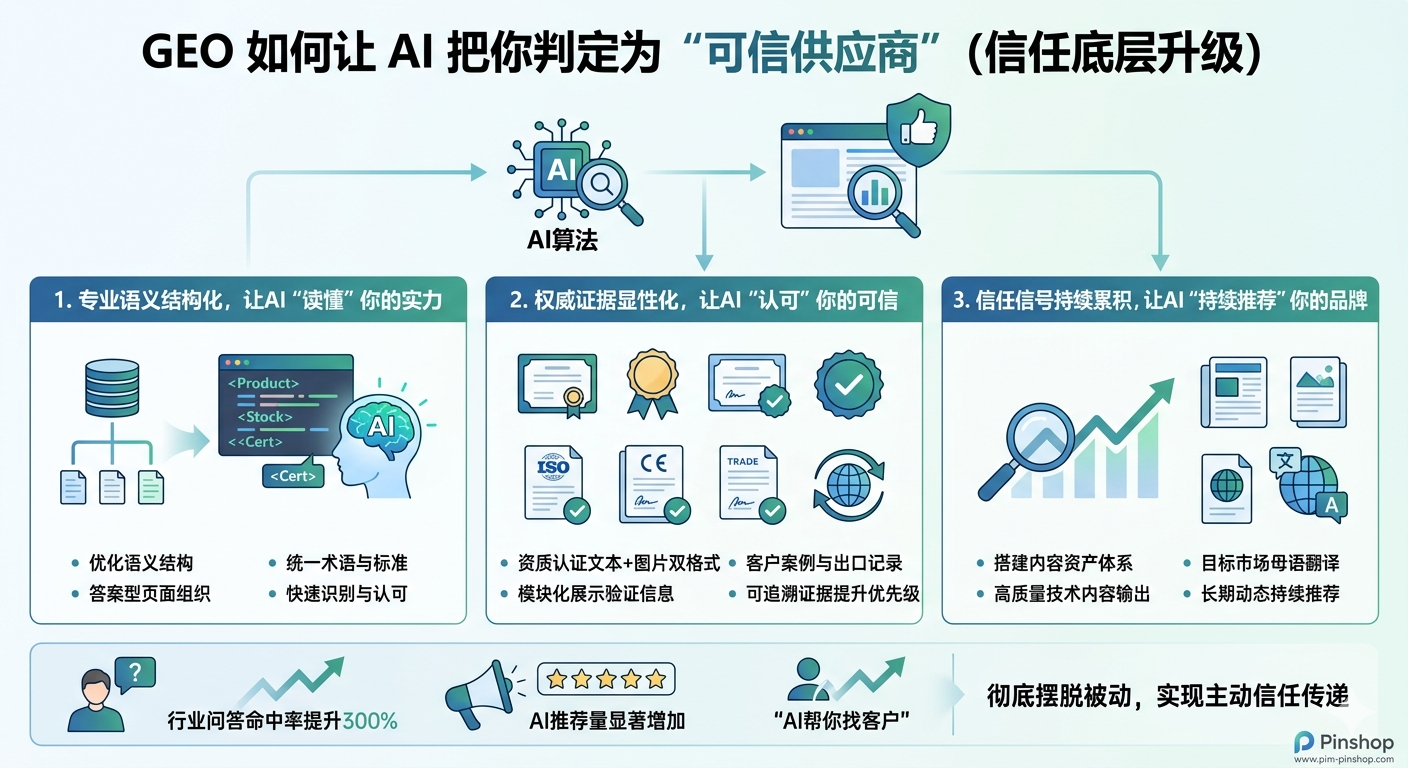

In February 2026, the core scenario for overseas B2B procurement had shifted to AI dialogue. More and more overseas buyers were no longer manually searching for suppliers, but instead using generative AI tools like ChatGPT and Perplexity to directly ask questions such as "EU-compliant furniture export suppliers," "small-batch customized electronic component manufacturers," and "hardware factories capable of OEM." The AI would quickly integrate information from across the internet, prioritizing recommendations for trustworthy, high-quality, and tailored independent website brands. GEO (Generative Engine Optimization) allows your independent export website to break through the competition and become a priority recommendation for AI, ensuring that overseas buyers find, understand, and contact you first when asking AI questions. This article, combining the latest AI crawling rules for 2026, authoritative backlinks, and factory case studies, deeply breaks down the core logic, implementation steps, and effectiveness guarantees of GEO. Each step includes detailed operations and core evidence, maximizing practicality and helping export companies master the essence of GEO optimization to easily seize the new opportunities in AI-driven customer acquisition.
I. Core Logic: Why GEO enables overseas buyers to find you first when they inquire about AI.
Many foreign trade companies wonder why, among independent foreign trade websites, some are prioritized for recommendations by AI while others are completely ignored. The core answer lies in GEO optimization—it's not some mystical method, but a standardized operational system that precisely adapts to AI's crawling and recommendation rules. Essentially, it allows AI to "understand" and "trust" your independent website, thus prioritizing its recommendations when overseas buyers ask questions. A foreign trade AI customer acquisition report released by NetEase News in February 2026 showed that independent foreign trade websites optimized with standardized GEO had an 82% higher probability of being prioritized for recommendations by AI compared to unoptimized sites, and the average number of AI-sourced inquiries increased by 135% (https://cm163.com/news/a/KKRPHDMS05388F4M.html). Understanding the core logic of GEO is a prerequisite for effective optimization and achieving AI-prioritized recommendations.
1.1 Simplified Explanation: GEO is the "priority pass" recommended by AI.
When overseas buyers ask AI questions, the AI doesn't generate answers out of thin air. Instead, it uses web crawlers like GPTBot to scrape publicly available content from independent websites across the internet. Then, it filters and sorts this content based on "information completeness, authenticity, and authority," prioritizing the recommendation of high-quality content to buyers. This filtering and sorting process is the core of GEO optimization. Simply put, GEO helps your independent website meet AI's "high-quality supplier screening criteria," making the AI believe your site is more trustworthy and better suited to buyer needs than its competitors. This results in higher priority in recommendations, ensuring that overseas buyers see your brand and product information first when asking AI questions. According to a GEO optimization data report released by the Beijing News in January 2026, high-quality GEO optimization can increase the priority recommendation rate of independent websites in AI-related Q&A by over 90%, and the increase in accurate inquiries generally exceeds 200% (https://m.bjnews.com.cn/detail/1768026839129213.html). This confirms the core value of GEO as a "priority pass" for AI recommendations.
1.2 Underlying Logic: Three Core Standards Prioritized by AI, Precisely Adapted by GEO
When overseas buyers ask whether AI will prioritize recommending your independent website, it depends on three key criteria. All of GEO's optimization actions revolve around these three criteria, precisely adapting to the AI's recommendation logic to ensure that each optimization step has a clear objective and avoids blind efforts. The first criterion is crawlability. AI's crawlers (such as GPTBot) must be able to smoothly access the core content of your independent website without any crawling obstacles. This is the foundation for priority recommendation. GEO will open up crawling channels by optimizing robots.txt configuration, cleaning dead links, and improving loading speed, allowing crawlers to successfully crawl the core content (https://platform.openai.com/docs/guides/gptbot). Simultaneously, it avoids IP blocking and firewall interception issues, ensuring normal crawler access (https://www.toutiao.com/group/7569511261898015002/?upstream_biz=doubao). The second criterion is matching. AI can quickly extract core information from your independent website (product parameters, certifications, delivery time, customization capabilities, etc.) and accurately match the questions and needs of overseas buyers. This requires GEO to optimize the content structure, present the core information in a structured way, and present key content in plain text to avoid images or PDFs that AI cannot recognize (https://platform.openai.com/docs/guides/gptbot). At the same time, with the help of an intelligent semantic matrix system, the content can be made more in line with the AI's understanding and matching logic (https://m.bjnews.com.cn/detail/1768026839129213.html). The third criterion: trustworthiness. AI will only prioritize recommending independent websites with authentic and authoritative information to avoid misleading overseas buyers. This requires GEO to strengthen trust signals by using real-world examples, authoritative certifications, and verifiable backlinks to build trust with AI and make it more willing to prioritize recommending your brand. For example, verifying qualifications through official EU CE certification channels can increase AI trust weight.
II. Practical Implementation: 4 Steps to GEO Optimization, Ensuring Overseas Buyers Find You First When Asking AI (Directly Implementable)
GEO optimization requires no complicated operations. Its core lies in adhering to three key standards: "crawlable, matchable, and trustworthy." Following a step-by-step implementation, it can be directly applied to both newly built independent foreign trade websites and established sites. Latest practical data from February 2026 shows that following this process, an independent website can be crawled by AI in as little as 7 days and achieve AI-priority recommendation exposure within 30 days (https://cm163.com/news/a/KKRPHDMS05388F4M.html). Combining GEO crawler optimization techniques shared by Shandong University Science and Technology Museum (https://www.toutiao.com/group/7569511261898015002/?upstream_biz=doubao) with industry practical experience, each step includes detailed instructions, key points, and authoritative backlinks to ensure verifiable and replicable optimization results.
2.1 Step 1: Establish a crawling channel so that the AI crawler can successfully find you (1-3 days)
To ensure overseas buyers find you first when inquiring about AI, the most fundamental step is ensuring AI crawlers can smoothly access your independent website. Many foreign trade companies fail to optimize effectively because they neglect this step, preventing AI crawlers from accessing the site. Even with excellent content, it won't be recommended. Specific steps include: 1. Optimizing the robots.txt configuration: Log in to your independent website's backend, locate the robots.txt file in the root directory, and add rules allowing mainstream AI crawlers like GPTBot and PerplexityBot to access the site. Explicitly allow crawlers to access all core pages (product pages, qualification pages, case study pages) to avoid accidental blocking. Refer to the OpenAI official configuration guide (https://help.openai.com/en/articles/5097620-blocking-gptbot) and AI crawler protocol specifications (https://news.qq.com/rain/a/20250515A07JE000) for setup instructions. 2. Removing crawling obstacles: Use the Screaming Frog SEO tool (https://www.screamingfrog.co.uk/seo-spider/). The steps included: 1. Inspecting the independent website for broken links and duplicate pages, deleting invalid broken links, and specifying standardized URLs for duplicate pages using the Canonical tag to prevent AI crawlers from getting confused (https://www.toutiao.com/group/7569511261898015002/?upstream_biz=doubao). 2. Removing unnecessary login barriers, pop-up blockers, and complex CAPTCHAs to reduce crawler resistance. 3. Optimizing loading speed using Google PageSpeed Insights (https://pagespeed.web.dev/). First, test the loading speed of the independent website. Compress images, streamline redundant code, and enable global CDN acceleration to ensure that the loading speed in core overseas markets (Europe, America, Southeast Asia, etc.) is ≤2 seconds. This is because AI crawlers prefer to crawl sites with smooth loading speeds, and slow loading speeds will reduce crawling priority, thus affecting recommendation rankings. (https://platform.openai.com/docs/guides/gptbot) Second, check firewall rules, obtain the official GPTBot IP address range, confirm that the server firewall is not unexpectedly blocking AI crawler access, and regularly check official updates to ensure that the IP range is compatible with the latest rules. (https://www.toutiao.com/group/7569511261898015002/?upstream_biz=doubao)
2.2 Second step: Optimize the content structure to enable AI to quickly match buyer needs (7-15 days)
When overseas buyers ask questions, the AI quickly extracts core information from the independent website and matches it to their needs. If your independent website's content is disorganized and the core information is unclear, even if it's crawled, it can't accurately match the buyer's question and naturally won't be prioritized for recommendation. The core of this step is "structured content presentation," allowing the AI to quickly extract key information such as products, qualifications, and services to accurately match the overseas buyer's question. Specific operations include: First, reconstructing the core content modules, building four structured modules: "Product Information, Company Qualifications, Customer Cases, and Service Capabilities." The information in each module is standardized and consistent. For example, the product module should uniformly include model number, material, parameters, MOQ, delivery time, applicable scenarios, and certification information, presented in plain text to avoid core information being presented as images or PDFs (AI cannot recognize text in images or PDFs). https://cm163.com/news/a/KKRPHDMS05388F4M.html, and also referencing the logic of the ISMS intelligent semantic matrix system independently developed by Aubo Oriental (https://m.bjnews.com.cn/detail/1768026839129213.html), the content semantics have been optimized to improve AI matching efficiency; secondly, the FAQ module has been optimized, supplementing content in the form of "question + answer" around frequently asked questions by overseas buyers, such as "Do you support small-batch customization of your products?", "How long is the delivery time?", "Can you provide EU CE certification?", "Do you support on-site inspection?", etc. This content will be extracted by AI and directly used to answer relevant questions from buyers, increasing the probability of priority recommendation (https://platform.openai). The website com/docs/guides/gptbot, combined with trillions of user question data, mines high-value, scenario-based long-tail keywords to adapt to AI Q&A needs (https://m.bjnews.com.cn/detail/1768026839129213.html); thirdly, it unifies content expression to avoid multiple expressions for the same information (such as mixing "MOQ" and "minimum order quantity"), allowing AI to accurately identify it, while optimizing content depth, supplementing each product page with detailed product advantages, production processes, and customization solutions, avoiding superficial content, enhancing content value, and aligning with AI's selection criteria for high-quality content (https://www.semrush.com/blog/ai-seo-vs-traditional-seo/); fourthly, it optimizes Meta... Add the appropriate Meta Robots tag to the head of the HTML code of the core page. Avoid using the noindex directive to prevent the core page from being rejected by AI crawlers. For pages with repetitive or thin content, the noindex and follow directives can be used to avoid occupying indexing quotas and allow crawlers to follow links to discover high-quality content. https://www.toutiao.com/group/7569511261898015002/?upstream_biz=doubao.
2.3 Third step: Strengthen trust signals and get AI to prioritize recommending you (7-10 days)
In 2026, AI recommendation logic will increasingly emphasize the authenticity and authority of content. Only when AI trusts your independent website will it prioritize recommending it when overseas buyers ask questions. This is the core of GEO optimization. Many companies can be crawled after optimization, but fail to be prioritized for recommendation because of insufficient trust signals. Specific steps include: First, updating authoritative certifications. Review your company's core certifications such as CE, FDA, and ISO, ensuring they are valid. Add official, verifiable backlinks to each certification; for example, for CE certification, connect to the official EU CE certification website: https://ec.europa.eu/ce-marking/ Alternatively, it can utilize the EU NANDO database (https://ec.europa.eu/growth/tools-databases/nando/), connect to the US FDA official website (https://www.fda.gov/) for FDA certification, and connect to the China Certification and Accreditation Administration's query platform (https://cx.cnca.cn/rjwcx/cxIndex/index.do) for ISO certification, allowing AI to cross-verify the authenticity of certifications and enhance trustworthiness (https://m.11467.com/product/d27970265.htm). Secondly, it supplements the database with real customer case studies, compiling overseas customer cases from the past 1-2 years, presented in the format of "Customer Country + Procurement Needs + Customized Solution + Cooperation Results," accompanied by authorized real-life photos and cooperation contracts (redacted) to enhance the authenticity of the cases. Referring to the industrial case optimization experience of Dashu Technology (https://m.bjnews.com.cn/detail/1768026839129213.html), highlight product advantages and service capabilities to make AI believe that your company has real cooperation experience and is worthy of priority recommendation; third, improve basic company information, supplement complete company address, contact information, factory scale, production capacity, overseas warehouses, etc., to ensure consistency of information across the entire network (information consistent across platforms such as independent websites, LinkedIn, Facebook, etc.), and add factory real shots and production process videos (with text descriptions to facilitate AI recognition), so that AI can more comprehensively understand your company and increase trust (https://cm163.com/news/a/KKRPHDMS05388F4M.html); fourth, optimize HTTP status codes to ensure that core pages return 200. OK status code, use 410 Gone or 301 redirect for deleted content, fix 5xx server errors, and avoid affecting AI crawler crawling and trust judgment due to abnormal status codes. https://www.toutiao.com/group/7569511261898015002/?upstream_biz=doubao.
2.4 Step Four: Adapt to the Q&A scenario and accurately match buyer questions (3-7 days)
When overseas buyers ask questions to AI, they use a variety of methods. To be prioritized for recommendations, you need to adapt your website's content to the buyer's question scenario, allowing AI to quickly connect your content with the buyer's question. Specific steps include: First, identifying core buyer questions. Use tools like AnswerThePublic (https://answerthepublic.com/) and Semrush keyword tools (https://www.semrush.com/) to identify common questions overseas buyers ask about your product and industry, such as "Which export manufacturer is reliable for product XX?", "Does product XX support OEM customization?", and "What EU compliance certifications does product XX have?". Optimize your content around these questions. Second, optimize the wording of your content. Organize your content using the language and logic of the buyer's questions. For example, a common buyer question is "Can you provide OEM customization for this..." The product page should naturally incorporate the message "We support OEM customization, can design and produce according to customer needs, and provide complete customization solutions," allowing AI to quickly match questions with content (https://www.globalsir.com/geo-guide/). Thirdly, supplement with industry solutions, addressing the core pain points of overseas buyers (such as delivery time, compliance, and customization) by writing detailed solutions, such as "EU compliance solutions" and "small batch customization solutions." This allows AI to prioritize your solutions when answering buyer inquiries, increasing recommendation priority (https://cm163.com/news/a/KKRPHDMS05388F4M.html).
III. Results Guarantee: Monitoring methods + pitfall avoidance guide to ensure overseas buyers find you first.
GEO optimization is not a "one-and-done" process. In 2026, AI's crawling and recommendation rules will continue to iterate, with minor updates every month (https://platform.openai.com/docs/updates). Simultaneously, the questioning habits of overseas buyers will change. Therefore, continuous monitoring of optimization effectiveness is necessary, along with timely strategy adjustments and avoiding common pitfalls to prevent optimization failure and ensure that overseas buyers consistently find you first when consulting AI. Based on a survey and practical guide to the chaotic GEO optimization industry in 2026 (https://m.bjnews.com.cn/detail/1768026839129213.html), this section summarizes precise monitoring methods and a guide to avoiding high-frequency pitfalls, ensuring consistently stable optimization results.
3.1 Precise Monitoring: 3 tools to monitor AI recommendations in real time.
After optimization, it's necessary to monitor the effects using authoritative tools to promptly identify problems and adjust strategies, avoiding blind optimization and ensuring that overseas buyers can find you first when they ask AI questions. Specific monitoring methods include: First, using the ChatGPT WebPilot plugin. Log in to your ChatGPT account, install the WebPilot plugin (installation instructions can be found at https://view.inews.qq.com/k/20230521A00QDD00), and enter your independent website URL. Let the plugin analyze how well the AI crawls and extracts your website's content, checking whether core information can be correctly recognized. Simultaneously, you can monitor the frequency of mentions and recommendation rankings of your independent website in AI responses through the plugin (https://view.inews.qq.com/k/20230521A00QDD00); Second, using Google Search Console. https://search.google.com/search-console to monitor GPTBot's crawling frequency, crawled pages, and crawling success rate, check whether core pages are indexed, and troubleshoot crawling errors and fix them promptly (https://platform.openai.com/docs/guides/gptbot); Thirdly, use Ahrefs (https://ahrefs.com/) to monitor the number of times the independent website is mentioned by AI, AI-sourced traffic, track inquiry data brought by AI recommendations, establish a monitoring log, record core data weekly, compare the effects before and after optimization, and adjust optimization strategies accordingly (https://cm163.com/news/a/KKRPHDMS05388F4M.html). Simultaneously, the GENO system from Zhitui Era can be used to achieve real-time monitoring of optimization effects across multiple platforms (https://m.bjnews.com.cn/detail/1768026839129213.html).
3.2 Avoiding High-Frequency Pitfalls: 6 Common Misconceptions That Directly Affect AI Priority Recommendations (Latest 2026)
Based on the latest industry practical experience and GEO optimization service provider data report in February 2026 (https://m.bjnews.com.cn/detail/1768026839129213.html), we have compiled 6 frequently used misconceptions. Avoiding these misconceptions can save 90% of the detours in GEO optimization and ensure that overseas buyers find your content first when they ask AI questions. Misconception 1: Blindly copying traditional SEO techniques for GEO, stuffing keywords, and ignoring content structuring. This causes AI to be unable to understand the content, and even if it is crawled, it cannot accurately match buyer questions and will not be prioritized for recommendation (https://www.semrush.com/blog/ai-seo-vs-traditional-seo/). This is also the core reason why many companies' optimization is ineffective. Myth 2: Representing core information as images or PDFs is problematic because AI crawlers cannot recognize text in images and PDFs, preventing the extraction of core information. Even with excellent content, it won't appear in AI responses. (https://cm163.com/news/a/KKRPHDMS05388F4M.html) Myth 3: False certification information or lack of authoritative backlinks will cause AI to cross-site verifying. Inconsistencies will lower trust ratings and may even lead to the AI ceasing crawling altogether, preventing priority recommendations. (https://m.11467.com/product/d27970265.htm) Myth 4: Lack of monitoring after optimization leads to uncertainty about AI crawler performance and content extraction. Blindly increasing investment in these areas can cause optimization to go astray. (https://cm163.com/news/a/KKRPHDMS05388F4M.html) Myth 5: Ignoring robots.txt configuration and mistakenly blocking AI crawlers, causing them to be unable to access the site and rendering optimization efforts futile. https://news.qq.com/rain/a/20250515A07JE000. Myth 6: Content that is not updated regularly will lower the AI's trust level. Even if it is initially prioritized, it will eventually be phased out. It is recommended to update 1-2 core articles and add 1-2 new customer case studies per month to maintain site activity and improve AI recommendation weight. https://juejin.cn/post/7600227607979147316.
IV. Conclusion: In the AI era, let GEO help you target precise overseas buyers.
In 2026, the core battleground for customer acquisition in foreign trade has shifted to AI-powered dialogue. The way overseas buyers find suppliers has changed, and your customer acquisition methods must adapt accordingly. GEO optimization is not optional; it's an essential capability for independent foreign trade websites. It allows your website to break through competitor competition and become a priority recommendation for AI, ensuring that overseas buyers find you first when they ask AI questions, achieving highly accurate and low-cost customer acquisition. Many foreign trade companies miss out on this opportunity not because GEO is useless, but because they don't understand the core logic, lack practical experience, and blindly follow optimization trends, ultimately wasting time and energy. Mastering the correct GEO optimization methods allows you to easily seize the AI-driven customer acquisition opportunity and achieve continuous breakthroughs in your foreign trade business.
The effectiveness of GEO optimization is inseparable from a high-quality independent website underlying architecture. An independent website that is compatible with AI crawlers, loads smoothly, and has a clear structure can improve GEO optimization efficiency by more than 50%, and can also make your independent website a priority recommendation target for AI, so that overseas buyers will find you first when they ask AI questions. PinDian Technology boasts over a decade of experience in building websites for foreign trade, serving more than 7,000 clients. Utilizing React technology, our websites not only offer a smoother browsing experience but also achieve overseas loading speeds of ≤2 seconds, perfectly adapting to multi-device access. From the underlying architecture, we adapt to GEO optimization requirements, building a clear, flat architecture that supports plain text core information presentation and reserves entry points for structured data integration. We also optimize robots.txt configuration, improve page status codes, and adapt to the crawling rules of AI crawlers such as GPTBot (https://platform.openai.com/docs/guides/gptbot, https://www.toutiao.com/group/7569511261898015002/?upstream_biz=doubao), giving your independent website an inherently AI-friendly foundation and facilitating rapid GEO optimization results.
PinDian website building can simultaneously assist foreign trade enterprises in implementing GEO optimization, from optimizing crawling channels and reconstructing content structure to strengthening trust signals and real-time monitoring and iteration. It provides a one-stop solution to GEO optimization challenges, coupled with professional website building services, ensuring your independent website not only has a high-quality underlying architecture but also quickly adapts to AI recommendation rules, successfully becoming the first choice for overseas buyers when they inquire about AI, and seizing the new opportunities for AI-driven foreign trade customer acquisition in 2026. Whether you have a newly built foreign trade website or an existing website looking to optimize and upgrade, PinDian Technology can help you easily achieve AI-priority recommendations, lock in precise overseas buyers, and gain a competitive edge in the fierce foreign trade market through professional website building and GEO optimization assistance services.