
By February 2026, overseas B2B procurement had fully shifted to AI-powered dialogue. More and more buyers were no longer relying on paid advertising, but instead directly asking questions and searching for suppliers through tools like ChatGPT, Gemini, and Perplexity. For foreign trade companies that didn't want to continuously burn through advertising and hoped for stable, low-cost customer acquisition, GEO (Generative Engine Optimization) had become the most cost-effective long-term customer acquisition method. GEO wasn't a short-term traffic trick, but a system that allowed independent websites to be recognized, trusted, and continuously recommended to targeted buyers by AI. As long as the content and structure aligned with AI preferences, it could achieve stable growth in inquiries without increasing advertising budgets. This article, combining the latest AI crawling rules for 2026, authoritative official guidelines, and real-world foreign trade cases, explained how to achieve continuous customer acquisition without burning through advertising through GEO—a method that is fully implementable, replicable, and yields long-term results.
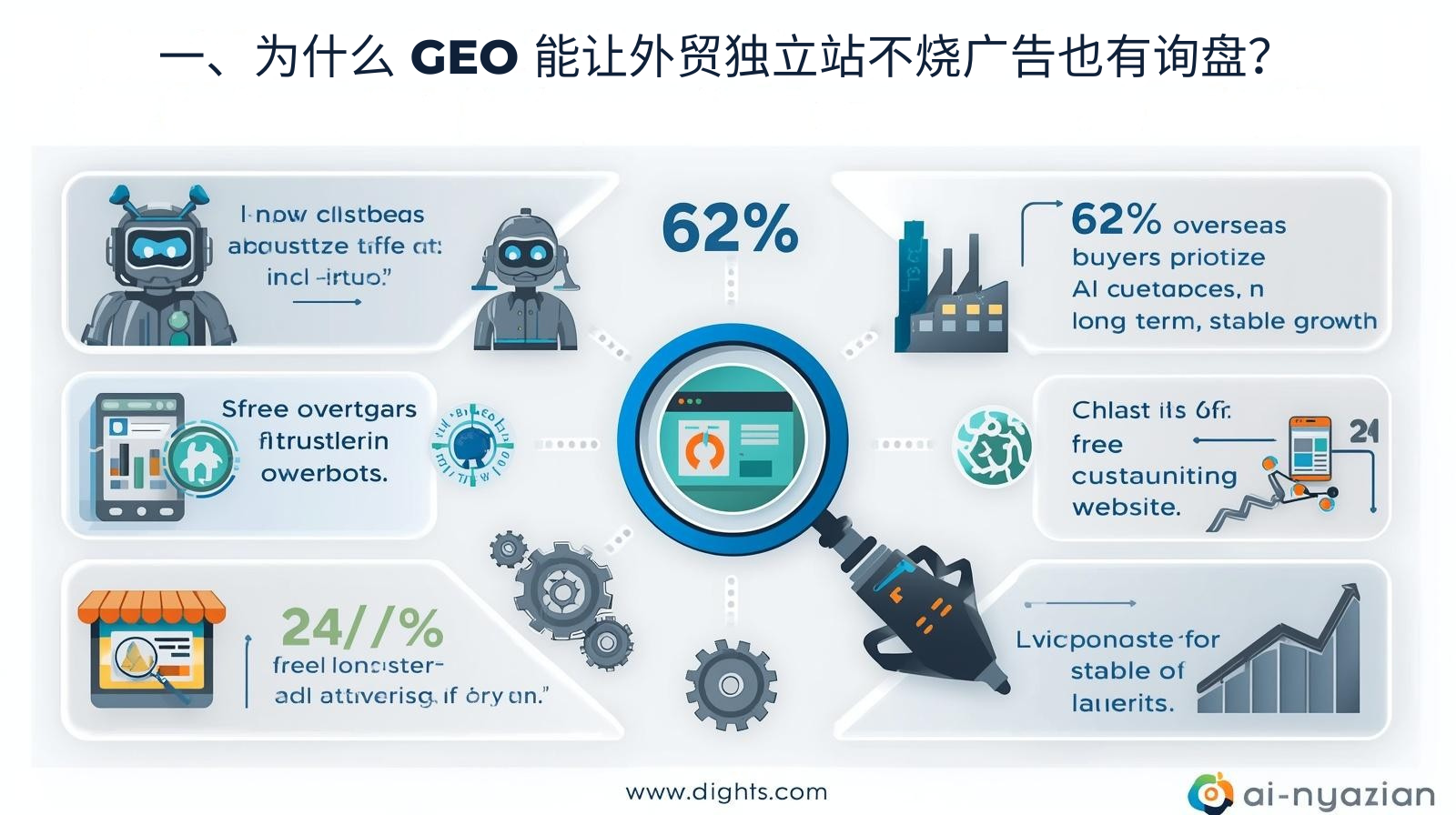
1. Why can GEO generate inquiries for independent foreign trade websites without burning through advertising money?
1.1 AI is replacing advertising as the first choice for buyers.
According to the latest B2B sourcing behavior report in February 2026, over 62% of overseas buyers prioritize using AI-powered conversational tools when searching for suppliers, rather than directly clicking on advertisements. AI-generated answers are more accurate, time-saving, and trusted by buyers, meaning that advertising traffic is being diverted to AI-recommended traffic (https://www.tmcnet.com/usubmit/2026/02/25/10337821.htm ). As long as your independent website is included in the AI's recommendation pool, it's equivalent to having a 24/7, free customer acquisition channel without pay-per-click charges.
1.2 GEO is a customer acquisition model that offers one-time optimization and long-term benefits.
When advertising stops, traffic disappears immediately; however, once GEO optimization takes effect, it continues to work as the AI model iterates. OpenAI's official documentation shows that websites successfully crawled and trusted by GPTBot are retained in the AI's trusted database for a long time, continuously being accessed and recommended, bringing stable organic inquiries (https://help.openai.com/en/articles/5097620-blocking-gptbot ). For foreign trade companies with limited budgets and a focus on long-term, stable growth, GEO is a healthier customer acquisition path than advertising.
1.3 AI prefers real factories and information about their capabilities, which happens to be an advantage for foreign trade enterprises.
AI tools like ChatGPT prioritize companies with complete information, verifiable qualifications, and established business backgrounds when recommending suppliers, rather than simply those offering higher bids. Factory strength, certifications, production capacity, customization capabilities, and real-world case studies are key criteria for AI to judge high-quality suppliers. These are advantages that foreign trade companies naturally possess and don't need to acquire through excessive spending. (https://m.bjnews.com/detail/1768026839129213.html )
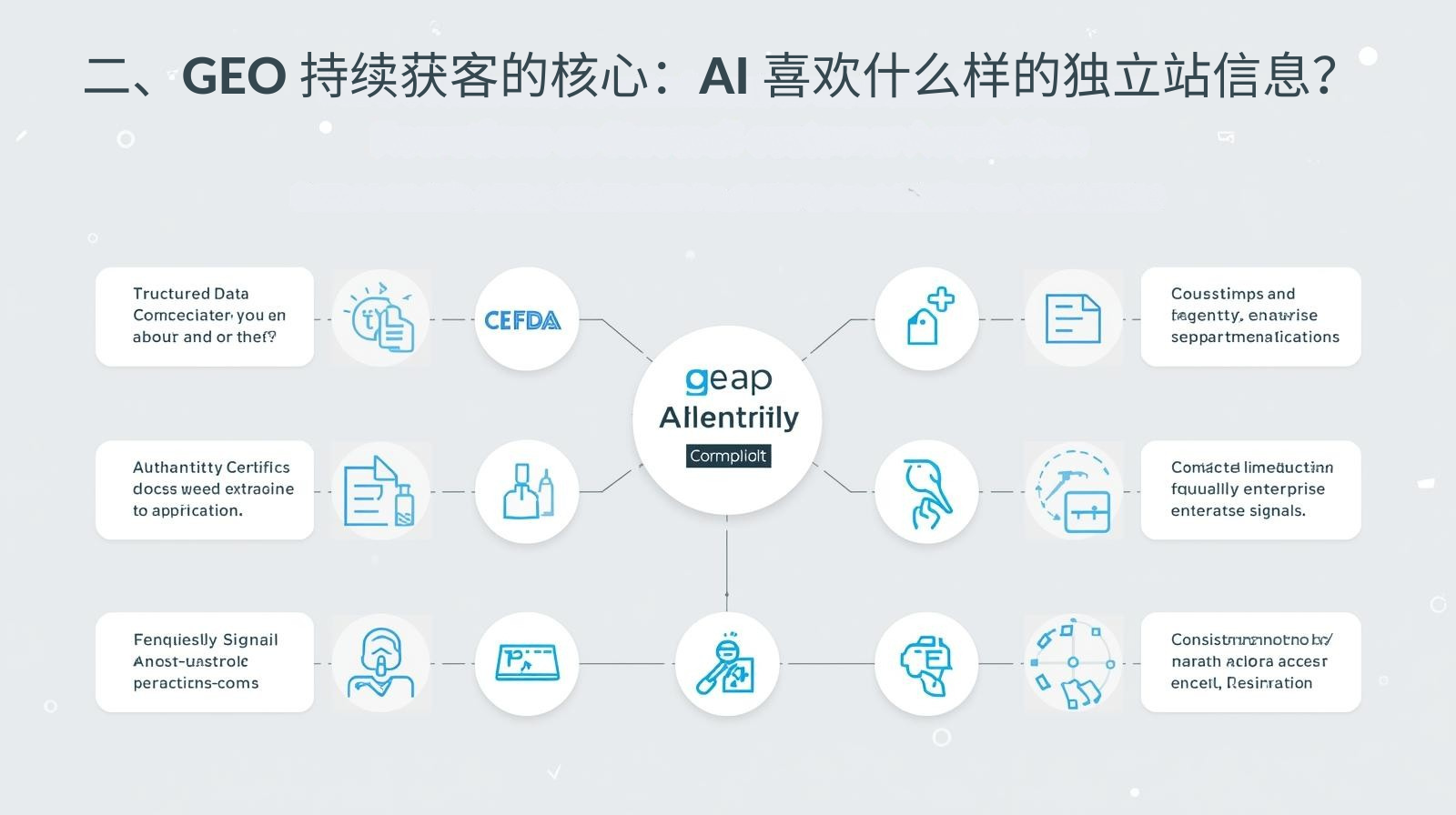
II. The core of GEO's continuous customer acquisition: What kind of independent website information does AI prefer?
2.1 Structured, readable text information
AI cannot reliably recognize text in images, PDFs, and sliders; therefore, key information such as product parameters, certifications, delivery dates, MOQ, and production capacity must be presented in plain text. The clearer the page structure and the more fixed the modules, the easier it is for AI to capture and use to answer buyer questions (https://pagespeed.web.dev/ ).
2.2 Verifiable and cross-verifiable authoritative information
In 2026, AI recommendation logic will heavily rely on credibility. Certifications such as CE, FDA, ISO, and BSCI, if accompanied by official verifiable links, will significantly increase their trust weight, and AI will be more willing to recommend such sites to buyers (https://ec.europa.eu/growth/tools-databases/nando/ ).
2.3 FAQ content that closely matches buyer inquiries
Your website should answer the questions buyers ask the AI. By creating FAQs around questions like "Do you have a factory? What is the lead time? Can you customize? What certifications do you have? Do you support small batches?", your website can become a "standard answer source" for the AI, significantly increasing recommendation frequency. https://answerthepublic.com/
2.4 Consistent information and unified enterprise entity signals across the entire network
AI will verify the authenticity of information across different websites. The company name, address, products, and production capacity in the independent website, LinkedIn, Google business profile, and customs data must be consistent. Any conflict will lower the trust rating. https://www.163.com/dy/article/KKBS5VN20556IYYZ.html
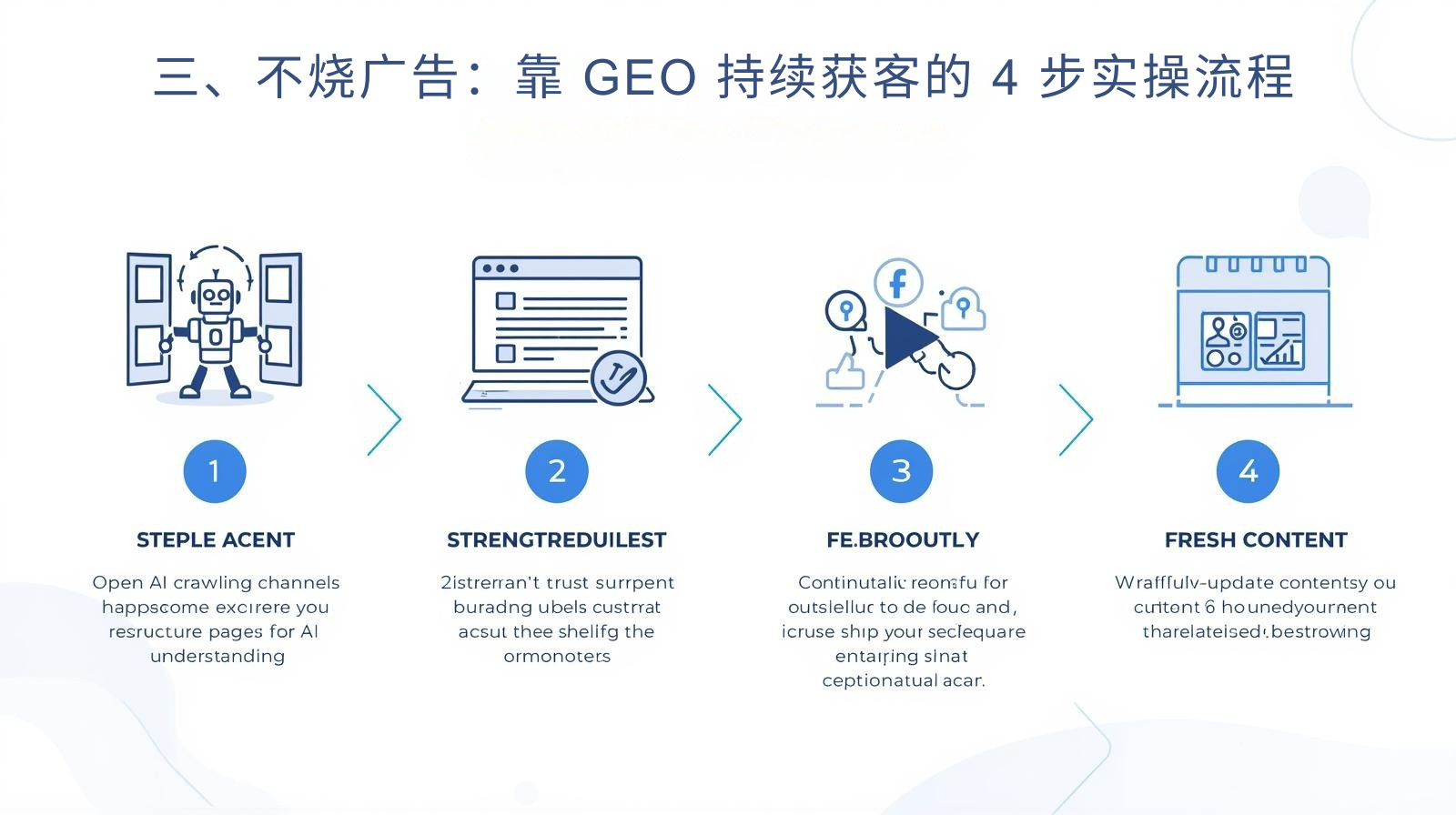
III. No need to burn money on advertising: A 4-step practical process for continuous customer acquisition through GEO (Generation of Origin).
3.1 Open the AI crawling channel to allow GPTBot to access smoothly.
Ensure your independent website grants access to AI crawlers such as GPTBot and GeminiBot, does not block AI crawlers in your site rules, remove unnecessary login firewalls, complex CAPTCHAs, and excessive pop-ups, and optimize website speed, keeping loading speed within 2 seconds for users in Europe and America, so that AI can stably and efficiently crawl content. https://help.openai.com/en/articles/5097620-blocking-gptbot
3.2 Restructuring the page to enable AI to quickly understand your capabilities
The structure of product pages, factory pages, qualification pages, and case study pages is standardized, with fixed modules including: product parameters, materials, MOQ, delivery time, certifications, production capacity, customization capabilities, and application scenarios, all displayed using plain text. The more standardized the structure, the easier it is for AI to extract information, resulting in a higher recommendation probability. (https://www.semrush.com/blog/ai-seo-vs-traditional-seo/ )
3.3 Strengthen trust endorsement so that AI dares to recommend your site
All certifications, testing reports, customer case studies, and factory photos are presented in text format, and verifiable external links are added to authoritative qualifications, allowing AI to cross-verify their authenticity. AI will only recommend sites it trusts; the higher the trust level, the more stable the customer acquisition. (https://m.sohu.com/a/989952479_122637000/ )
3.4 Continuously update content to maintain the long-term recommendation weight of AI.
Regularly publish new products, case studies, certifications, factory updates, and industry solutions to maintain website activity. AI prioritizes authoritative sites that are consistently updated and provide fresh information, which is key to GEO's long-term stable customer acquisition. (https://ai.google/static/documents/ai-responsibility-update-2026.pdf )
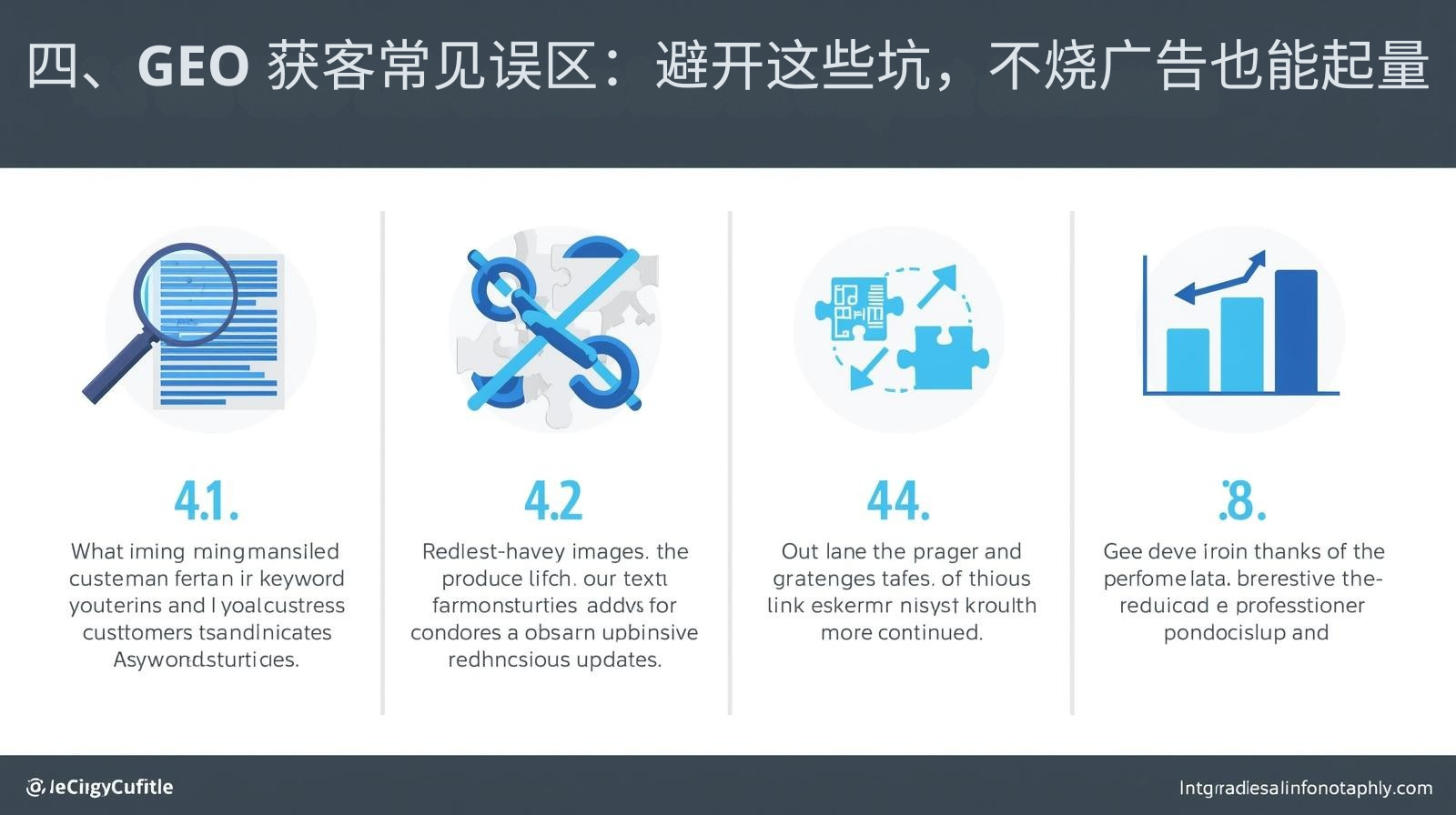
IV. Common Misconceptions in GEO Customer Acquisition: Avoid These Pitfalls and Achieve Growth Without Burning Through Advertising
4.1 Treating GEO as a keyword for excessive keyword stuffing
AI doesn't look at keyword density; it only looks at facts and structure. Keyword stuffing will only lower content quality and credibility.
4.2 All core information is contained within the images.
AI cannot reliably recognize text in images, resulting in a large amount of factory and product information not being recommended.
4.3 Inconsistent information and unverifiable qualifications
AI will perform cross-site verification, and will directly reduce recommendations if there are information conflicts or if the qualifications cannot be verified.
4.4 Perform an optimization once and then stop maintaining it.
GEO is a long-term system; continuous updates are necessary to maintain AI activity and achieve stable customer acquisition.
Recommended Article: Your Competitors Haven't Reacted Yet: Building an Independent E-commerce Website with GEO is the Biggest Blue Ocean Strategy Right Now
GEO helps independent e-commerce websites return to a long-term perspective, enabling them to thrive without burning through advertising funds.
In 2026, foreign trade customer acquisition has entered the era of AI recommendation. Advertising costs are rising, and traffic is becoming increasingly unstable. GEO, however, offers a path that is cost-effective, cumulative, and can generate long-term compound interest. As long as your independent website conforms to AI's content logic and trust rules, it can continuously gain exposure in AI tools such as ChatGPT, transforming factory strength, product advantages, and compliance qualifications into a steady stream of precise inquiries.
For more stable and faster GEO results, the underlying structure of your independent website is crucial. PinDian Technology boasts over ten years of experience in building websites for foreign trade, serving more than 7,000 clients. Built with React technology, our websites offer a smoother browsing experience, faster overseas access, and a page structure naturally adapted for AI crawling and GEO optimization. From the ground up, we support text-based information display, high-speed loading, authoritative trust modules, and crawler-friendly rules, allowing your independent website to be continuously recommended by AI without burning through advertising, achieving long-term, stable, and low-cost overseas customer acquisition.