
In February 2026, over 60% of overseas B2B buyers were using AI-powered dialogue tools like ChatGPT and Gemini to find suppliers. Traditional keyword ranking is being replaced by direct AI recommendations, and GEO (Generative Engine Optimization) has become a core determining factor in whether an independent website can be recognized, trusted, and recommended to targeted buyers by AI. Many foreign trade companies invest significant effort in updating content but consistently fail to appear in AI responses. The root cause is a lack of understanding of AI's content preferences and information extraction logic. This article, based on OpenAI GPTBot official rules, Google's 2026 AI Content Guidelines, and practical data from the foreign trade industry, comprehensively dissects the information structure, content paradigm, and trust system of independent websites favored by AI. It provides directly applicable practical methods to make your independent website information a high-quality content source prioritized for AI extraction and recommendation.
I. AI's Understanding of Independent Websites' Underlying Logic: From "Keywords" to "Entities and Facts"
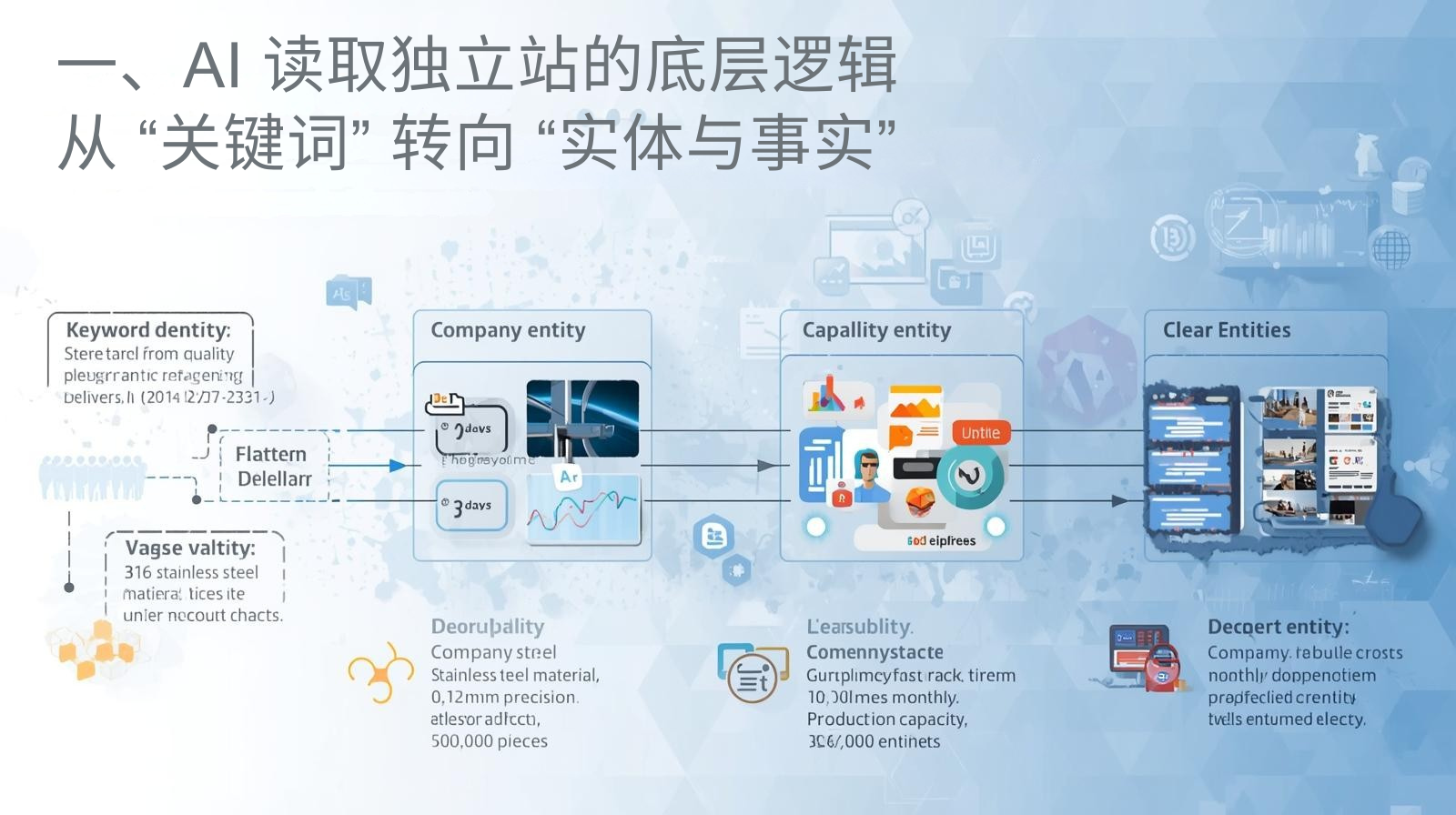
The core of AI's judgment of content value is no longer keyword density, but whether the information is structured, whether the facts are verifiable, and whether the entities are clear . This is the underlying understanding that GEO content optimization must first establish.
1.1 AI only recognizes "structured facts," not vague wording.
The 2026 OpenAI official GPTBot document explicitly states that AI crawlers should prioritize extracting standardized, quantifiable, and clearly attributed factual information, rather than promotional copy filled with adjectives (https://help.openai.com/en/articles/5097620-blocking-gptbot ). For independent websites, expressions like "high quality, fast delivery" cannot be recognized by AI. Instead, structured facts such as "316 stainless steel material, 0.01mm precision, 7-12 day delivery time, monthly production capacity of 500,000 units" are what AI is willing to crawl and use to answer buyer inquiries.
1.2 AI needs "defined entities," not jumbled information.
In its AI Content Responsibility Report released in February 2026, Google emphasized that AI recommendations will prioritize sites with clear entity identities, including a clearly defined company name, main products, certifications, production capabilities, and service scope (https://ai.google/static/documents/ai-responsibility-update-2026.pdf ). Independent website content must revolve around three core elements: the company entity, the product entity, and the capability entity. This allows AI to instantly identify your industry, identity, and strengths, rather than wasting computing power sifting through cluttered information.
1.3 AI trusts "multi-source consistency" and rejects information conflicts.
AI assesses credibility by verifying information consistency across pages and platforms. Information on independent websites, LinkedIn, Google business profiles, customs data, and industry directories must be consistent, including company name, address, product range, production capacity, and certifications. Any conflict will lower the AI's trust rating, which is a key reason why many companies' content is crawled but not recommended. https://www.163.com/dy/article/KKBS5VN20556IYYZ.html
II. AI's Favorite 4 Types of Independent Website Information: Content Paradigms That Can Be Directly Copied
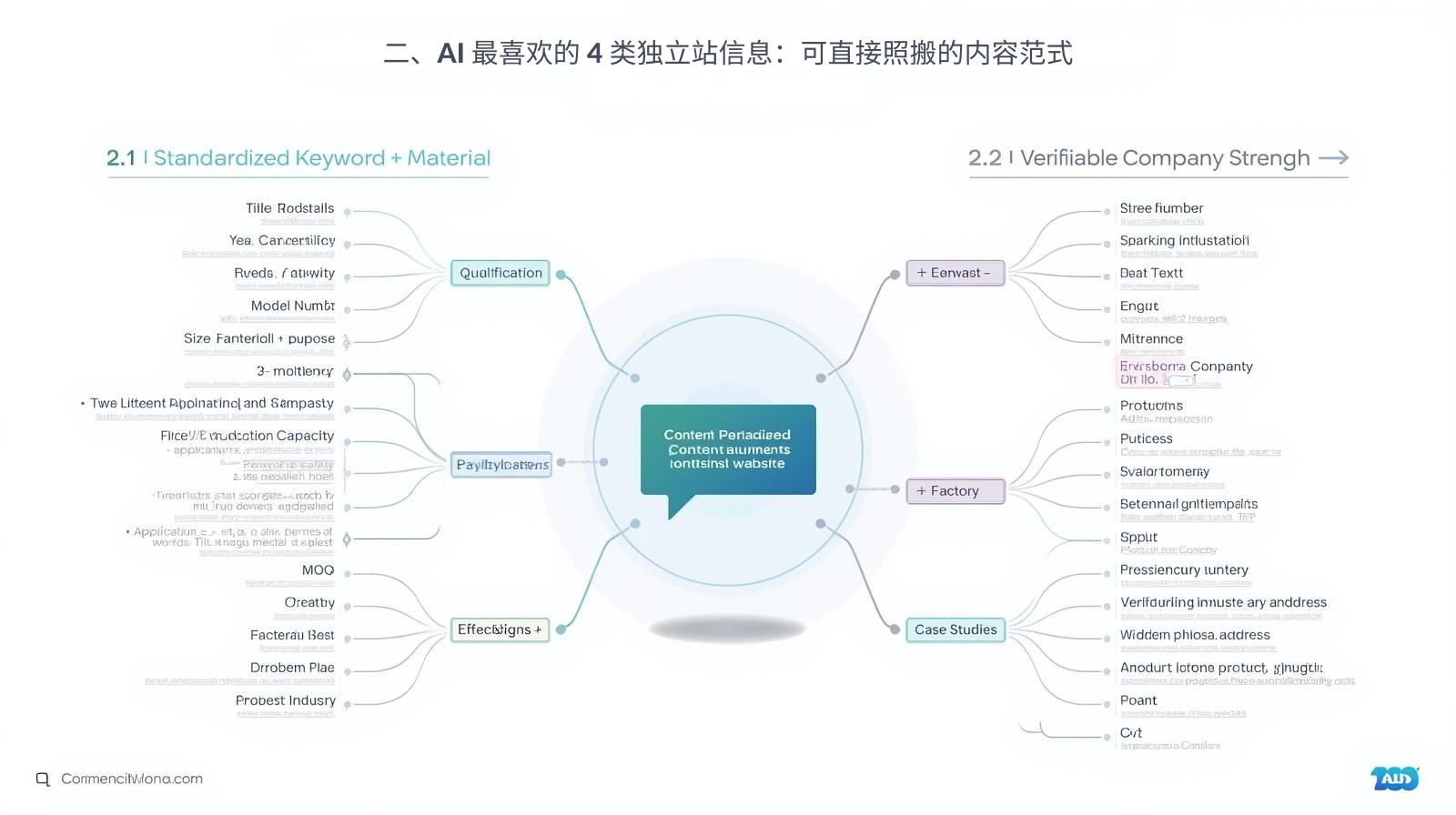
AI has a clear preference for information types on independent websites. Organizing content according to the following paradigm can increase the crawling and recommendation rates by more than 80%. All modules are tailored to foreign trade scenarios and can be implemented without coding.
2.1 Standardized Product Information: Full Coverage of Parameters, Attributes, and Scenarios
The easiest information for AI to extract and the most frequently accessed by buyers is product information, so it must adhere to the principles of "plain text for parameters, structured attributes, and explicit scenarios." Product titles should include core keywords, material, and intended use. The product details page should consistently present the model number, material, size, precision, MOQ, delivery time, certifications, and application industry. All key parameters should be displayed in plain text to avoid placing them in images or PDFs, which would prevent AI from reading them. Additionally, descriptions of applicable scenarios should be added to the product so that AI can match frequently asked buyer questions such as "XX industry uses XX product." (https://m.cifnews.com/article/179412 )
2.2 Verifiable company strength: qualifications, production capacity, factories, case studies
Company strength is the core criterion for AI to select high-quality suppliers, and it must be presented as a verifiable factual module. The qualifications section lists certifications such as CE, FDA, ISO, and BSCI, indicating their validity and verifiable channels. The production capacity section clearly states the factory area, number of production lines, monthly/annual output, and equipment models. The factory section presents the actual address, actual workshop photos, and accompanying text descriptions. The case studies section is presented by customer region, purchased products, customized needs, and collaborative results. This content directly serves as a trust endorsement when AI makes recommendations. (https://m.sohu.com/a/989952479_122637000/ )
2.3 Question-and-answer FAQ content: Directly matches buyer AI with questions.
FAQs are the most frequently extracted content type by AI because overseas buyers on ChatGPT mostly ask questions. Pre-planning Q&A content can significantly increase the probability of being recommended. Focus on frequently asked questions such as "Do you have a factory? What is the lead time? Can I customize? What certifications do I have? What is the MOQ? Can you ship to XX country?" Write your answers in the format of "Question + Direct Answer + Supplementary Facts." Keep your answers concise, clear, and include key data. AI will directly extract this content to reply to buyers, essentially turning your independent website into a standard answer library for AI. (https://m.cifnews.com/article/179412 )
2.4 Authoritative Trust Signals: Third-Party Endorsement, Compliance Information, Continuous Updates
In 2026, the AI content evaluation system will heavily rely on authoritative signals. Independent websites need to proactively present trustworthy content that can be cross-verified, including third-party testing reports, industry association certifications, genuine feedback from overseas customers, media reports, and compliance policy explanations. At the same time, they must maintain regular content updates; new products, capacity upgrades, new certifications, and new case studies will all be considered activity signals by AI, increasing their long-term recommendation weight. (https://www.163.com/dy/article/KKBS5VN20556IYYZ.html )
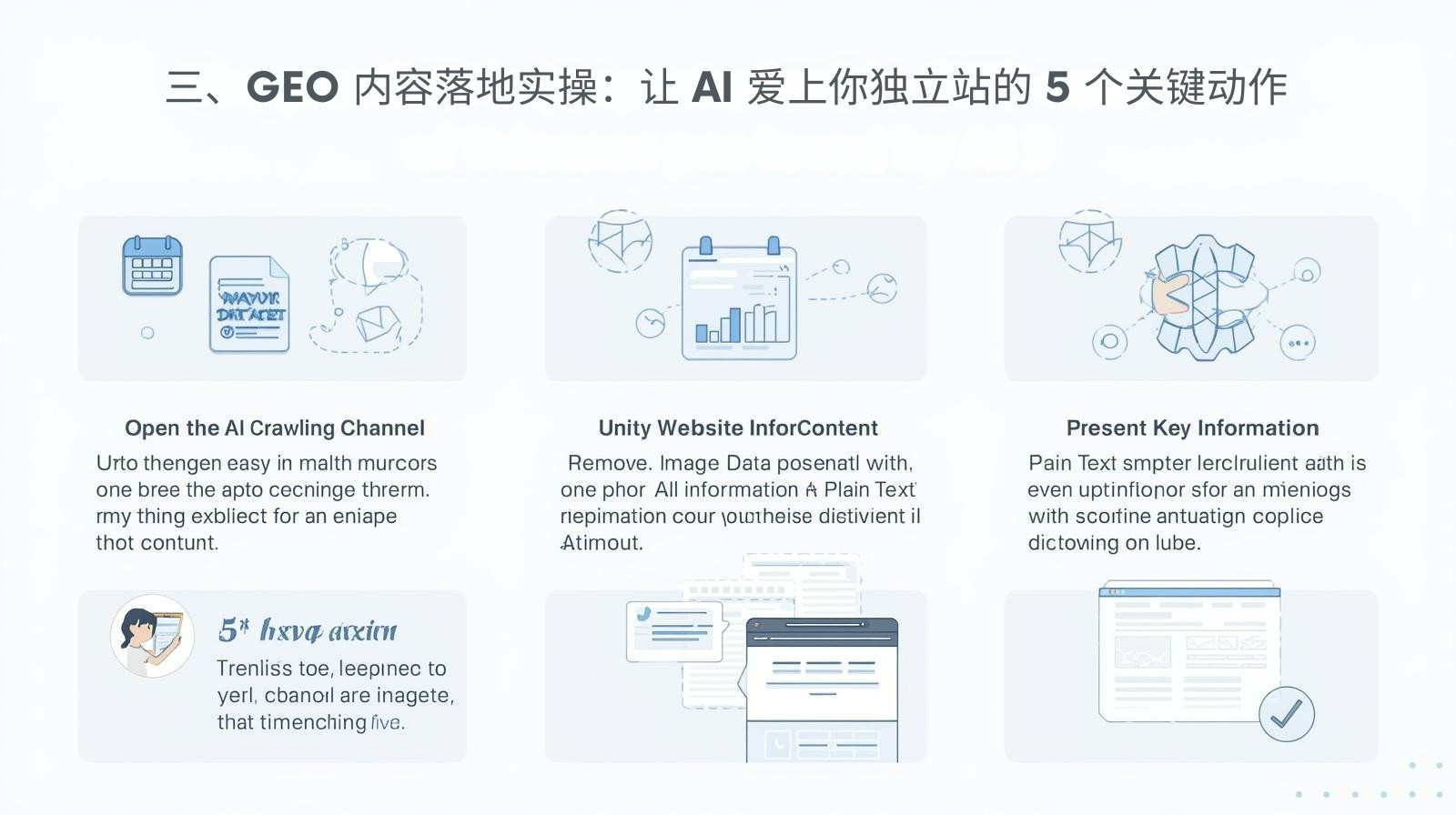
III. Practical Implementation of GEO Content: 5 Key Actions to Make AI Love Your Independent Website
All operations require no technical background. Simply follow the steps to fully adapt your independent website's content to the AI reading logic. Based on the latest GEO practical data for foreign trade in February 2026, you can see changes in AI mentions and inquiries within 15-30 days after optimization.
3.1 Open the AI crawling channel to allow GPTBot to access smoothly.
Ensure your independent website allows access from mainstream AI crawlers such as GPTBot and GeminiBot. Enable core page permissions in your site's access rules to prevent firewalls, login barriers, and complex CAPTCHAs from hindering crawling. You can directly refer to the OpenAI official guide to complete the basic configuration: https://help.openai.com/en/articles/5097620-blocking-gptbot . Simultaneously, optimize page loading speed using Google PageSpeed Insights, aiming for under 2 seconds in Europe and America. Faster loading speeds encourage more active AI crawling: https://pagespeed.web.dev/ .
3.2 Unify information across the entire site to eliminate trust barriers for AI.
We meticulously reviewed all pages on the independent website to ensure complete consistency in the descriptions of the company, products, production capacity, and certifications, avoiding discrepancies such as "factory area 5000㎡" and "6000㎡." We also synchronized information from external platforms like LinkedIn and Google business profiles to create a unified entity signal, ensuring seamless cross-site verification by AI. (https://www.semrush.com/blog/ai-seo-vs-traditional-seo/ )
3.3 Content is no longer image-based; key information is presented in plain text.
Extract product parameters, certification information, production capacity data, and delivery date information from images and PDFs, and clearly display them as plain text on the page. AI cannot reliably recognize text within images, which is the core reason why a large amount of corporate strength information is wasted. The combination of text and images should be "text-based with images as supplementary" to ensure that core information can be directly read. https://m.cifnews.com/article/179412
3.4 Write according to the buyer's intentions and align with the AI question-and-answer logic.
Use tools like AnswerThePublic and Semrush to uncover genuine questions from overseas buyers. Organize content around core intents such as manufacturer, factory, custom, wholesale, and certified. Avoid deliberately piling up keywords; use natural paragraphs to express facts and advantages. Content with clear semantics and explicit intent is more likely to be matched and recommended by AI. https://answerthepublic.com/
3.5 Regularly update factual content to maintain AI activity.
Update 1-2 pieces of real information each month, including new product launches, capacity increases, new certifications, new customer case studies, industry news, etc. Continuous factual updates will make AI consider your site an active and trustworthy source of information, maintaining a high crawling and recommendation priority in the long term. https://ai.google/static/documents/ai-responsibility-update-2026.pdf
Recommended Article: Your Competitors Haven't Reacted Yet: Building an Independent E-commerce Website with GEO is the Biggest Blue Ocean Strategy Right Now
Recommended Article: Your Competitors Haven't Reacted Yet: Building an Independent E-commerce Website with GEO is the Biggest Blue Ocean Strategy Right Now
IV. Avoiding GEO Content Pitfalls: These Practices Will Cause AI to Ignore You
In the 2026 foreign trade GEO optimization, 80% of ineffective operations come from the following misconceptions. Avoiding these misconceptions in time can double the optimization efficiency.
4.1 Misconception 1: Treating GEO like traditional SEO, and frantically stuffing keywords.
AI does not calculate keyword density; keyword stuffing only makes content stiff and reduces trustworthiness. The core of GEO is facts and structure, not keywords. https://www.semrush.com/blog/ai-seo-vs-traditional-seo/
4.2 Misconception 2: Putting all the core information in images, sliders, and pop-ups.
AI struggles to read dynamic components and non-textual content; key capabilities and parameters must be presented in static plain text (https://help.openai.com/en/articles/5097620-blocking-gptbot ).
4.3 Misconception 3: Inconsistent information and inconsistencies across multiple platforms
AI will perform cross-source verification, and information conflicts will directly lower the trust rating or even stop crawling https://www.163.com/dy/article/KKBS5VN20556IYYZ.html .
4.4 Misconception 4: The content is empty and lacks facts; it's all propaganda and descriptive language.
AI only extracts facts and does not accept subjective descriptions. Content without data and qualification support will not be used for recommendations. https://m.sohu.com/a/989952479_122637000/
Use the right GEO content to make AI your 24/7 overseas sales tool.
In 2026, the competition among independent e-commerce websites has shifted from "who is better at SEO" to "who is better understood by AI." GEO content logic is not some mystical art, but a scientific system based on official AI rules and crawling habits. When your independent website information aligns with AI preferences, it will be prioritized for identification, trust, and recommendation when buyers search for suppliers through ChatGPT, transforming your hard strengths—products, qualifications, factories, and production capacity—into a continuous stream of precise inquiries.
The effectiveness of GEO content optimization highly depends on the underlying architecture of the independent website. A well-structured, fast-loading, and text-friendly site can improve AI crawling and recommendation efficiency by more than 50%. PinDian Technology has over ten years of experience in building websites for foreign trade, serving more than 7,000 clients. Built with React technology, our websites offer smooth browsing, stable global access, and a page structure naturally adapted to AI reading logic. From the ground up, we support plain text core information presentation, unified entity management, high-speed loading, and crawler-friendly rules, making your GEO content optimization twice as effective and quickly transforming you into a high-quality foreign trade supplier prioritized by AI.