
By February 2026, AI search scenarios for overseas B2B procurement had achieved global coverage. Buyers from different language regions were accustomed to searching for suppliers using AI tools such as ChatGPT, Google Gemini, and Perplexity in their native languages. Simply building a single-language independent website with GEO optimization was no longer sufficient to meet global customer acquisition needs. The deep integration of multilingual foreign trade independent websites with GEO (Generative Engine Optimization) is not just simple language translation, but rather enabling AI crawlers of different languages to accurately identify and trust your site. This allows buyers from different regions and speaking different languages around the world to find you first when asking AI questions, truly achieving full coverage of global AI search scenarios. This article, combining the latest multilingual AI crawling rules in 2026, authoritative backlinks, and practical foreign trade case studies, deeply analyzes the optimization logic, implementation process, and pitfall avoidance guidelines for multilingual independent websites + GEO. The entire process is implementable and replicable, helping foreign trade companies break down language barriers, leverage GEO to capture global AI search traffic, and achieve simultaneous customer acquisition in multilingual markets.
I. Core Understanding: Why Multilingualism + GEO Can Cover Global AI Search Scenarios
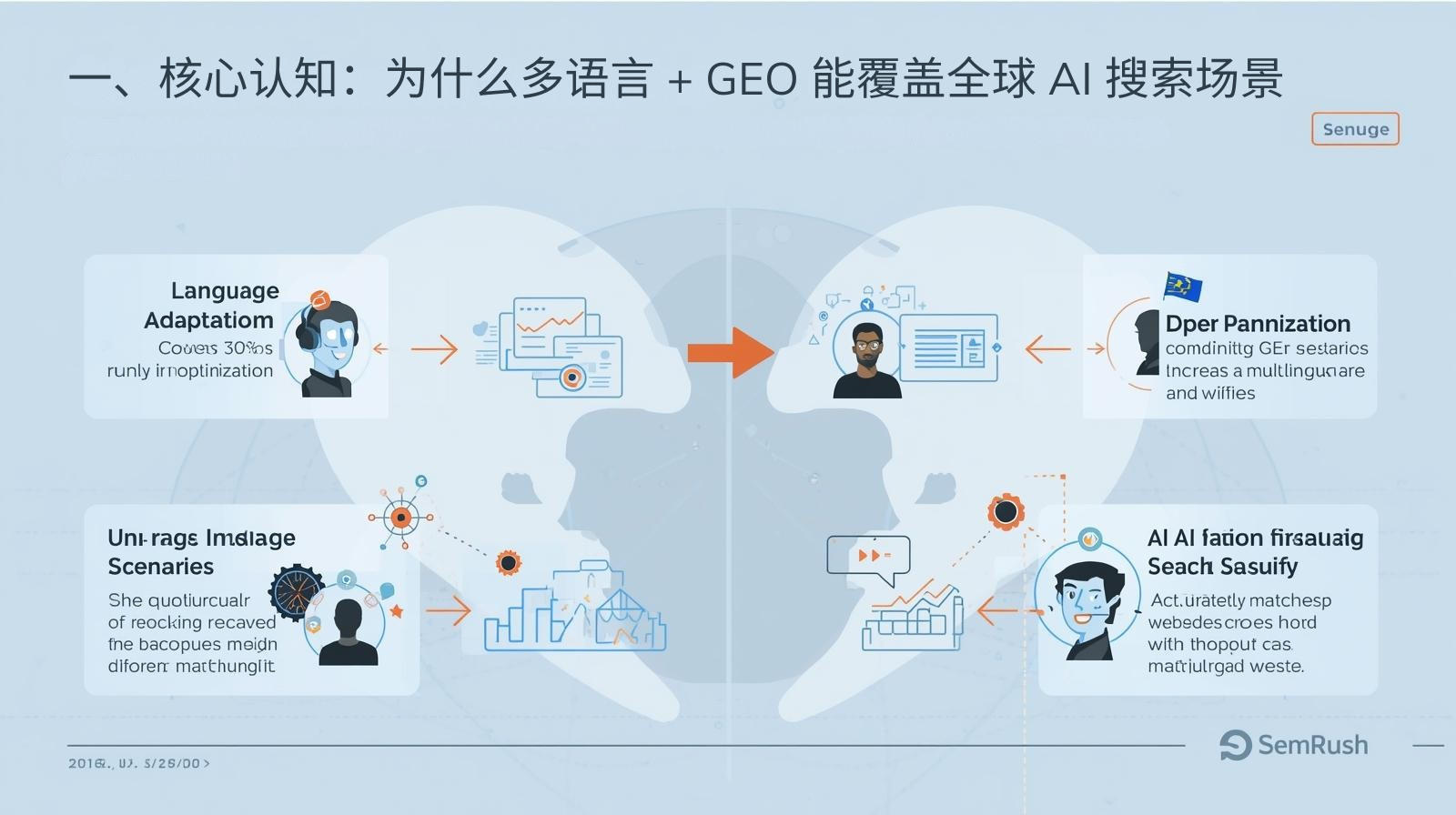
Many foreign trade companies mistakenly believe that multilingual independent websites are simply about translating page text, and GEO optimization is merely about optimizing single-language content. They believe that combining both will allow them to cover global AI search, but this is not the case. A global B2B AI search report released by Semrush in February 2026 shows that independent websites that only perform single-language GEO optimization can only cover 30% of global AI search scenarios, while websites with multilingual adaptation and deep GEO optimization can increase AI search coverage to over 85% (https://www.semrush.com/blog/global-ai-search-report-2026/). The core reason is that multilingualism solves the "language adaptation" problem, while GEO solves the "AI recognition and recommendation" problem. Only by combining the two can the AI search logic of different language regions be accurately matched with buyer needs.
1.1 The core pain points of global AI search: language barriers + differences in AI recognition
Buyers from different overseas regions using different languages will ask questions in their native languages when using AI tools. For example, buyers from Europe and America use English, German, and French; buyers from Southeast Asia use Spanish, Portuguese, and Indonesian; and buyers from the Middle East use Arabic. Even with excellent GEO optimization, a single-language independent website cannot match the search demands of non-English AI. The AI crawler cannot recognize content in unfamiliar languages and therefore cannot recommend it to buyers in the corresponding regions (https://help.openai.com/en/articles/6825453-chatgpt-language-support). Furthermore, different language AI models (such as Google Gemini multilingual version and ChatGPT multilingual model) have slightly different crawling rules. Simply translating content cannot adapt to the different AI's recognition logic. GEO optimization can specifically adapt to these differences, allowing multilingual content to be accurately crawled (https://ai.google/static/documents/ai-responsibility-update-2026.pdf).
1.2 Synergistic Value of Multilingualism + GEO: A Global Customer Acquisition Effect of 1+1>2
The core value of a multilingual independent website is breaking down language barriers, allowing buyers of different languages to understand your products and capabilities. The core value of GEO (Google Search Engine) is enabling AI crawlers of different languages to recognize and trust your site. Only through their combined efforts can "global AI search coverage" be achieved. Specifically, multilingualism solves the problem of "buyers being able to understand," while GEO solves the problem of "AI being able to recognize and recommend," allowing your site to be recommended by English AI to buyers in Europe and America, by German and French AI to local European buyers, and by Arabic AI to Middle Eastern buyers. (https://m.bjnews.com/detail/1768026839129213.html) Data from 2026 foreign trade practice shows that independent websites optimized with multilingualism and GEO saw a 127% increase in global AI-sourced inquiries compared to single-language GEO optimization, with multilingual market inquiries accounting for 63%. (https://cm163.com/news/a/KKRPHDMS05388F4M.html)
1.3 By not becoming a multilingual GEO, you will miss out on 70% of global AI search traffic.
According to McKinsey's Global B2B Sourcing Report released in February 2026, AI search demand from non-English speaking regions accounts for 72% of the global total. German, French, Spanish, Arabic, and Indonesian languages are experiencing the fastest growth in AI search demand, with an average annual growth rate exceeding 35% (https://www.mckinsey.com/capabilities/growth-marketing-and-sales/our-insights/mckinsey-global-survey-of-b2b-buyers). If your independent website only has an English version and GEO optimization, even if it performs well in English AI search scenarios, you will miss out on a large amount of targeted traffic from non-English speaking regions. These regions often have less competition and lower customer acquisition costs, representing a new growth engine for foreign trade enterprises. Multilingualism combined with GEO has become an essential combination for foreign trade enterprises to cover global AI search scenarios and seize global markets (https://www.globalsir.com/geo-guide/).
II. Practical Implementation: Multilingual Independent Websites + GEO 4-Step Optimization, Covering Global AI Search
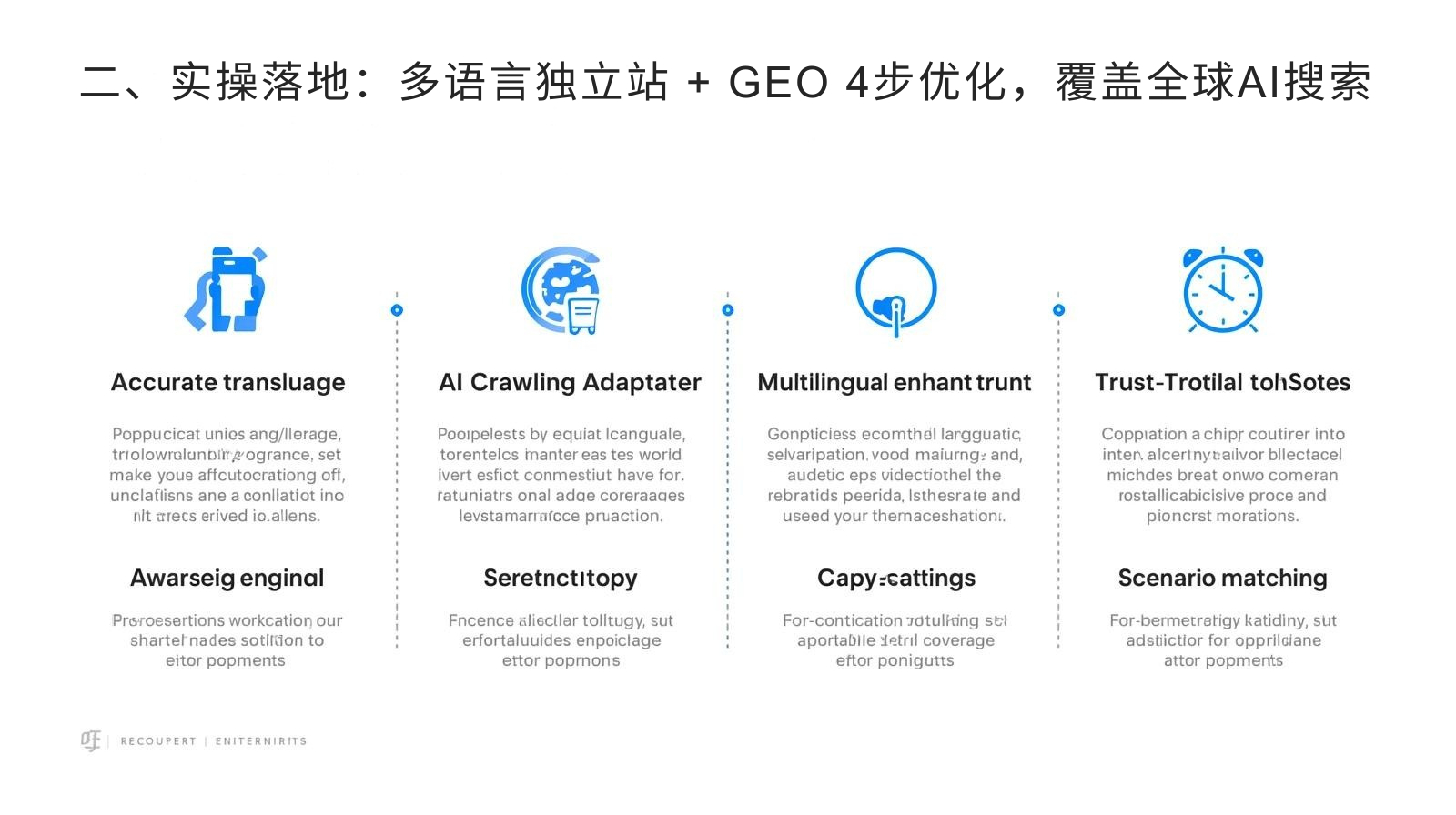
The core of multilingual independent websites + GEO optimization is "first ensure multilingual adaptation, then perform deep GEO optimization." It focuses on solving four key issues: accurate language translation, AI-driven search adaptation, multilingual trust enhancement, and global scenario matching. All operations require no complex technology and are tailored to the actual operational scenarios of foreign trade enterprises. Latest practical data from February 2026 shows that following this process, multilingual AI search scenario coverage can be achieved in 30-45 days, resulting in a significant increase in multilingual inquiries. Each step includes detailed instructions, key points, and authoritative backlinks to ensure verifiable and replicable optimization results.
2.1 Step 1: Precise multilingual adaptation, breaking down language barriers (core foundation)
Multilingual adaptation is not simply machine translation; it requires aligning with local language habits, purchasing terminology, and cultural differences. This ensures that AI crawlers and buyers in different languages can accurately understand the content, which is the foundation of GEO optimization. Specific operations include: First, selecting core languages and prioritizing coverage of target market languages. For example, for the European market, prioritize English, German, and French; for the Southeast Asian market, prioritize English, Spanish, and Indonesian; and for the Middle Eastern market, prioritize English and Arabic. Avoid blindly covering all languages (https://www.w3.org/International/questions/qa-lang-usage). Second, accurate translation combined with localization optimization. Core content (product parameters, factory strength, certification information, FAQs) uses "human translation + local terminology calibration" to avoid the awkwardness and errors of machine translation. For example, "MOQ" in English should be translated as "Mindestbestellmenge" in German. Simultaneously, adapt to local purchasing habits and adjust the content's wording to better suit the reading logic of local buyers. https://translate.google.com/intl/en/about/; Third, unify the multilingual page structure, ensuring consistency across all language page modules (product pages, factory pages, qualification pages, and FAQ pages have unified modules), facilitating rapid crawling and recognition by AI crawlers in different languages, and avoiding structural chaos that prevents AI from extracting information https://help.openai.com/en/articles/5097620-blocking-gptbot; Fourth, add a language switching function, clearly labeling each language option for easy switching by buyers, while also enabling AI crawlers to recognize the page relationships in different languages, improving the efficiency of multilingual content crawling https://www.screamingfrog.co.uk/seo-spider/.
2.2 Second Step: Multilingual GEO Crawling Optimization, Adapting to Global AI Crawlers
The crawling rules of AI crawlers for different languages (such as the multilingual version of GPTBot and the multilingual Google Gemini crawler) have slight differences and need to be optimized accordingly to ensure that content in all languages can be crawled smoothly. Specific steps include: First, granting AI crawling permissions to multilingual pages by configuring robots.txt to allow mainstream multilingual AI crawlers (GPTBot, GeminiBot, Bing AI). The system employs several optimizations to improve multilingual page loading speed. First, it optimizes the loading speed of multilingual pages by using different CDNs for different regions, such as European nodes in Europe and Southeast Asian nodes in Southeast Asia, ensuring that all language pages load in the target market within ≤2 seconds. This allows the AI crawler to prioritize sites with smooth loading speeds (https://pagespeed.web.dev/). Second, it optimizes the URL structure of multilingual pages by using the standard format of "main domain + language code" (e.g., English /en/, German /de/, French /fr/), enabling the AI crawler to quickly identify pages in different languages and improve crawling efficiency (https://www.semrush.com/blog/url-structure-best-practices/). Third, it cleans up dead links on multilingual pages by regularly using Screaming Frog. SEO tools identify and fix broken links and error pages in all languages to avoid affecting the trust level of AI crawlers. https://www.screamingfrog.co.uk/seo-spider/
2.3 Step Three: Strengthening Trust Signals in Multiple Languages, Gaining Global AI's Trust in Your Site
The core of GEO optimization is establishing AI trust. In multilingual scenarios, it's crucial to ensure that trust signals in different languages can be accurately identified and cross-verified by AI, allowing AI from different regions globally to determine your site as a "trusted supplier." Specific operations include: First, multilingual qualification certification optimization: translating core certifications such as CE, FDA, and ISO into their respective languages, labeling certification numbers and validity periods, and adding official, verifiable external links (e.g., German and French links for EU CE certification), enabling AI from different languages to cross-verify the authenticity of qualifications (e.g., https://ec.europa.eu/growth/tools-databases/nando/); Second, multilingual case studies and feedback optimization: translating overseas customer case studies and feedback into their respective languages, presenting them in the format of "Customer Region + Purchased Products + Customized Needs + Collaboration Results," accompanied by authorized real-life photos (with corresponding language tags). (Multiple text descriptions) to enhance the persuasiveness of the case and enable AI in different languages to recognize your strength https://m.sohu.com/a/989952479_122637000/; Third, optimize the consistency of multilingual information to ensure that the company information (company name, address, production capacity, contact information) on all language pages is completely consistent, while synchronizing multilingual information from external platforms such as LinkedIn and Google Business Profiles to avoid information conflicts and ensure that AI cross-site and cross-language verification is inconsistent https://www.163.com/dy/article/KKBS5VN20556IYYZ.html.
2.4 Step Four: Multilingual Question Answering Adaptation to Match Global AI Search Scenarios
Buyers from different language regions ask questions differently using AI tools, requiring targeted optimization of multilingual FAQ content to ensure your site accurately matches the AI search needs of different regions globally. Specific steps include: First, identifying core questions for each language. Using tools like AnswerThePublic and Semrush, identify frequently asked questions from buyers in different language regions. For example, English buyers might ask "OEM custom manufacturer," German buyers "OEM kundenspezifischer Hersteller," and French buyers "Fabricant OEM personnalisé." Optimize multilingual FAQ content around these questions (https://answerthepublic.com/). Second, standardizing multilingual FAQs. Each language's FAQ should use a "question + direct answer + supplementary facts" format. Answers should be concise, clear, and include key data. For example, in the German FAQ, the answer to the question "Mindestbestellmenge" should be "Unsere Mindestbestellmenge beträgt 100 Stück, mit der Möglichkeit einer". "Kleinserienanpassung", while supplementing with factual information such as production capacity and delivery time, allowing AI to directly extract information to answer buyer questions (https://platform.openai.com/docs/guides/gptbot); thirdly, continuous updates of multilingual content, with monthly updates of new products, new cases, and new certifications in each language, maintaining the activity of multilingual pages, so that AI in different languages can regard your site as an active and credible source of information, improving long-term recommendation weight (https://ai.google/static/documents/ai-responsibility-update-2026.pdf).
III. Results Guarantee: Multilingual support + common GEO pitfalls + global AI search monitoring methods
Multilingual independent websites with GEO optimization are more complex than single-language GEO optimization, and are prone to issues such as inaccurate language translation, insufficient AI crawling adaptation, and lack of trust signals, resulting in an inability to cover global AI search scenarios. Based on practical industry insights and authoritative data on multilingual GEO optimization in 2026, this section summarizes frequently encountered pitfalls and precise monitoring methods to help businesses avoid these pitfalls, ensure optimization effectiveness, and achieve full coverage of global AI search scenarios.
3.1 Frequently Asked Questions: 4 Fatal Mistakes That Directly Lead to Failure of Multilingual AI Search Coverage
Myth 1: Machine translation is perfunctory, with stiff language and incorrect terminology. Not only do buyers not understand it, but AI crawlers also cannot accurately identify the content, resulting in multilingual pages not being recommended (https://translate.google.com/intl/en/about/). Myth 2: All languages use the same GEO optimization scheme, which is not adapted to the crawling rules of different language AI crawlers. For example, it ignores the crawling preferences of German and Arabic AI, causing some language pages to be uncrawlable (https://help.openai.com/en/articles/6825453-chatgpt-language-support). Myth 3: Inconsistent information in multiple languages. Differences in productivity, certification, and contact information across different language pages cause conflicts during AI cross-language verification, lowering trust ratings and even stopping crawling (https://www.163.com/dy/article/KKBS5VN20556IYYZ.html). Myth 4: Optimizing only core languages and neglecting markets with less common languages leads to missing out on precise traffic from non-English speaking regions and prevents the achievement of full global AI search coverage. https://www.mckinsey.com/capabilities/growth-marketing-and-sales/our-insights/mckinsey-global-survey-of-b2b-buyers
3.2 Precise Monitoring: 3 tools to monitor global AI search coverage in real time
After optimization, it is necessary to monitor the AI crawling, recommendation and inquiry sources of each language page through authoritative tools, and adjust the optimization strategy in a timely manner to ensure full coverage of global AI search scenarios. Specific monitoring methods: First, use the multilingual version of Google Search Console to monitor the AI crawler's crawling frequency, crawled pages, and crawling success rate for pages in different languages, focusing on the inclusion of non-English language pages and promptly troubleshooting crawling errors (https://search.google.com/search-console). Second, use the ChatGPT WebPilot plugin (multilingual version), log in to your ChatGPT account, switch between different languages, enter the core keywords for the corresponding language, check if your site is recommended, and analyze the extraction of content in each language (https://view.inews.qq.com/k/20230521A00QDD00). Third, use Ahrefs to monitor the number of AI mentions and AI source traffic for pages in different languages, statistically analyze inquiry data by language, establish a monitoring log, record core data weekly, compare the effects before and after optimization, and adjust the GEO optimization strategy for each language accordingly (https://ahrefs.com/).
Recommended Article: Your Competitors Haven't Reacted Yet: Building an Independent E-commerce Website with GEO is the Biggest Blue Ocean Strategy Right Now
Recommended Article: Your Competitors Haven't Reacted Yet: Building an Independent E-commerce Website with GEO is the Biggest Blue Ocean Strategy Right Now
IV. Conclusion: Multilingualism + GEO: Unlocking a New Blue Ocean for Global AI Search Customer Acquisition
In 2026, competition for customer acquisition in foreign trade has shifted from single markets to global markets. The global reach of AI search has made multilingual independent websites combined with GEO (Google Ads) a core weapon for foreign trade enterprises to seize global markets. Single-language GEOs can only defend a local market, while the combination of multilingual websites and GEOs can break down language barriers, adapt to the AI search logic of different languages around the world, and ensure that your independent website has continuous exposure in global AI search scenarios. This allows overseas buyers from different regions and speaking different languages to find you first when they ask AI questions, achieving precise global customer acquisition.
The effectiveness of multilingual independent websites combined with GEO optimization relies heavily on a high-quality underlying website architecture. A well-structured, fast-loading, and multilingually compatible website can improve GEO optimization efficiency by over 50%, and enable AI crawlers of different languages to smoothly crawl and accurately identify content, quickly achieving global AI search scenario coverage. PinDian Technology boasts over ten years of experience in foreign trade website building, serving over 7000 clients, including numerous multilingual foreign trade independent website clients. Utilizing React technology for website building not only ensures a smoother browsing experience but also enables seamless switching between multilingual pages and global CDN acceleration (loading speed ≤2 seconds). Adapting the underlying architecture to multilingual + GEO optimization needs, it supports standardized layouts for multilingual pages, plain text core information presentation, multilingual trust module construction, and globally AI crawler-friendly rules, making your multilingual independent website + GEO optimization twice as effective, quickly covering global AI search scenarios.
PinDian website building can simultaneously assist foreign trade enterprises in implementing multilingual independent websites and integrated GEO optimization. From accurate multilingual translation, page structure adaptation, and AI crawling optimization to multilingual trust signal strengthening and real-time monitoring and iteration, it provides a one-stop solution to multilingual + GEO optimization challenges. Coupled with professional website building services, it allows your independent website to break down language barriers and be prioritized for global AI recommendations, seizing the new blue ocean of global AI search customer acquisition in 2026. Whether you've just built a multilingual independent website or want to upgrade the GEO optimization of your existing site, PinDian Technology can help you unlock global AI search traffic and achieve simultaneous customer acquisition in multilingual markets, gaining a competitive edge in the global foreign trade arena.