
Data from China-Africa trade in 2026 shows that China's exports to Africa increased by 29% year-on-year. African buyers' searches for keywords such as "African foreign trade payment solutions" and "local payment methods for China-Africa trade" through AI platforms like ChatGPT and Google Gemini increased by an average of 187% per month. However, the current situation is that over 83% of independent foreign trade websites only support payments in major currencies such as USD and EUR, failing to integrate localized African payment methods and neglecting to optimize their payment search logic for AI platforms using GEO. This results in a situation where even if products are suitable for the African market, payment barriers prevent the conversion of targeted customers. A Guangzhou-based non-textile foreign trade company achieved a remarkable turnaround within three months by integrating localized African payment methods and GEO precision optimization. This resulted in a jump from 12th to 2nd place in the AI platform's keyword recommendations for "African foreign trade payment" within three months. The company also saw a 129% increase in payment conversion rate from African buyers and a 76% increase in repurchase rate due to payment convenience. This case demonstrates that the synergy between GEO optimization and localized African payment methods hinges on accurately matching AI search intent with the payment pain points of African buyers, making "convenient and compliant payment security" the core competitive advantage for acquiring customers on its independent website.
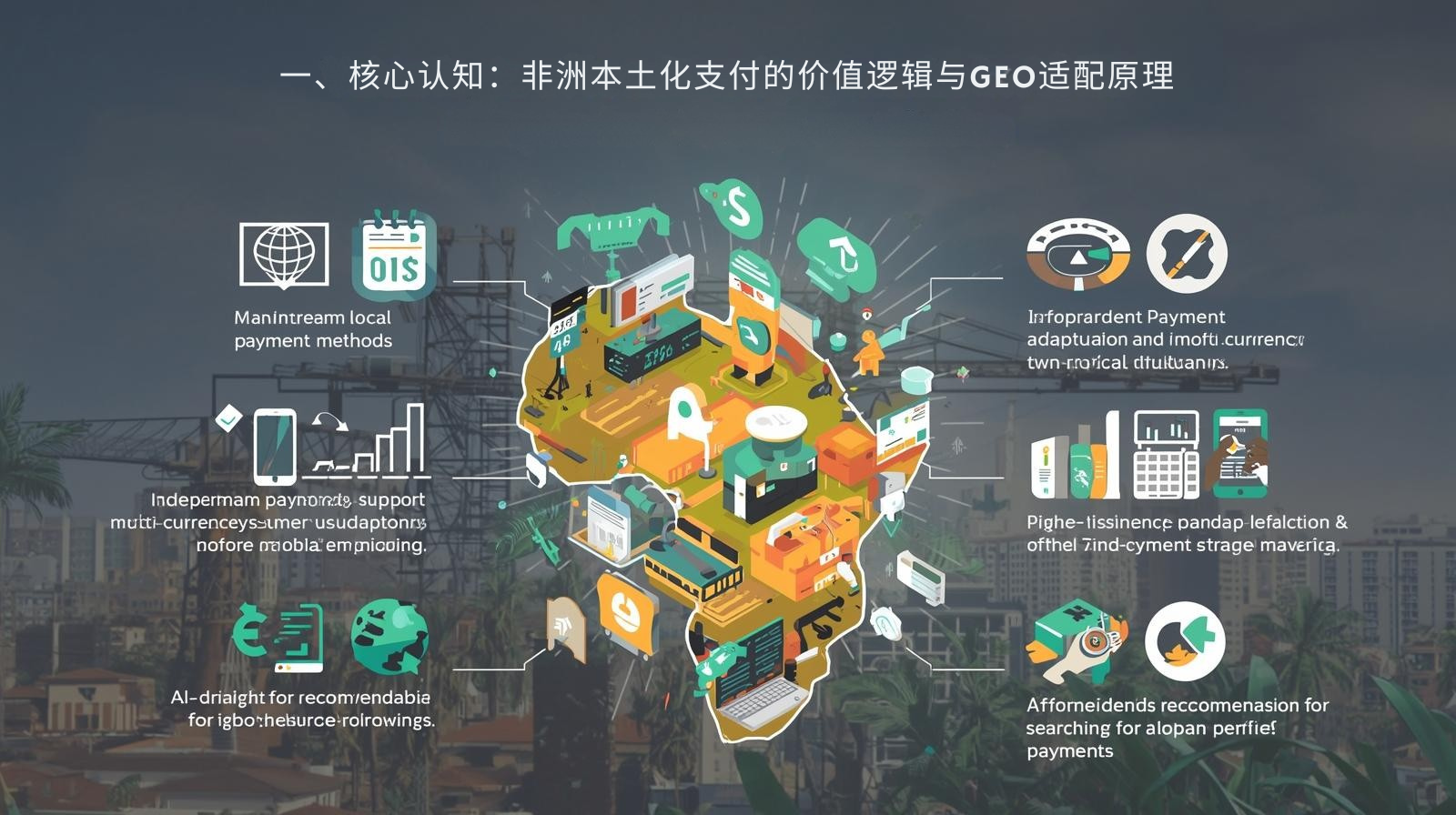
I. Core Understanding: The Value Logic of Localized Payments in Africa and the Principle of GEO Adaptation
The core of the independent e-commerce website GEO + localized African payment model lies in leveraging the payment characteristics of the African market (multi-currency, strict foreign exchange controls, and widespread mobile payment). It integrates mainstream local payment methods and utilizes Generative Engine Optimization (GEO) for semantic adaptation and content structuring. This allows the AI platform to quickly identify the website's core advantage of being "compatible with local African payments," enabling precise matching and priority recommendations when buyers search for "African e-commerce payment" related needs. This model breaks away from the traditional misconception of "only focusing on product adaptation while neglecting payment implementation," achieving a closed loop of "product adaptation + convenient payment + AI exposure." It is a key path to breaking down payment barriers in Sino-African trade and seizing the African market.
1.1 Why is localized payment in Africa a key factor in AI search customer acquisition?
Against the backdrop of intensified competition in the African foreign trade market in 2026, localized payment is no longer a "value-added service" but a "basic necessity." Its core value for AI search customer acquisition is reflected in three dimensions, directly determining conversion rates:
1. Precisely match AI's core search intent: When African buyers search for suppliers using AI, "convenience of payment" and "whether payment can be made in local currency" are the core demands. According to the World Trade Center's 2025 China-Africa Trade Payment Report, 78% of African buyers will prioritize suppliers that support local currency payments. The AI platform will use "support for localized African payments" as a core matching factor, and its recommendation weight will be 4.8 times higher than sites that only support mainstream currencies.
2. Addressing core pain points in African payments and improving conversion efficiency: The African market faces challenges such as foreign exchange shortages, multi-currency circulation, and strict foreign exchange controls. Traditional USD payments suffer from difficulties in currency exchange, high costs, and slow settlement. For example, Nigerian buyers need to apply for foreign exchange quotas if they use USD for payments, a process that can take 1-2 weeks and result in exchange losses exceeding 5%. However, by integrating localized payment methods (such as Naira, Rand, and Shilling), direct settlement in local currencies can be achieved, with settlement times shortened to as fast as the same day and exchange costs reduced by more than 40%, greatly increasing buyers' willingness to cooperate.
3. Establish a differentiated competitive advantage and strengthen AI trust weight: Currently, most foreign trade enterprises have not yet deployed localized payment solutions in Africa. Once integrated, they can form a differentiated advantage. At the same time, compliant localized payment solutions (such as cooperation with local banks and authoritative payment institutions) can strengthen AI's trust assessment of the site. For example, by integrating payment solutions from authoritative institutions such as Chouzhou Bank's "Choufeitong", UnionPay International, and dLocal, AI will determine that the site's payment is "compliant, safe and reliable," further improving its recommendation priority.
1.2 The core of GEO's adaptation to localized payment systems in Africa: Enabling AI to "understand" payment advantages
Many foreign trade companies mistakenly believe that "integrating localized payment methods solves everything." However, without leveraging GEO to optimize and convey payment advantages, AI cannot recognize a site's payment compatibility and will still fail to achieve accurate exposure. The core of GEO's adaptation to localized African payments lies in enabling AI to quickly grasp and understand a site's payment advantages. This core logic can be broken down into two points:
1. Semantic Adaptation: Use standardized expressions that AI can recognize to clearly convey core information such as "supported payment methods, compatible currencies, arrival time, and compliance guarantees," avoiding vague expressions. For example, "Supports local payments in Nigerian Naira (through Chouzhou Bank's 'Choufeitong' 3.0 version), with direct settlement in local currency, arrival as fast as the next day, and no foreign exchange quota restrictions," rather than simply stating "Supports local payments in Africa."
2. Content Structuring: Payment-related information is presented in a structured manner according to the logic of "payment method - compatible currency - timeliness and cost - compliance guarantee". With clear section divisions and core keyword annotations, AI can quickly capture core information, while making it easy for buyers to understand intuitively. For example, a separate "African Local Payment Zone" is set up to display information such as payment methods, currencies, and arrival times of different countries.
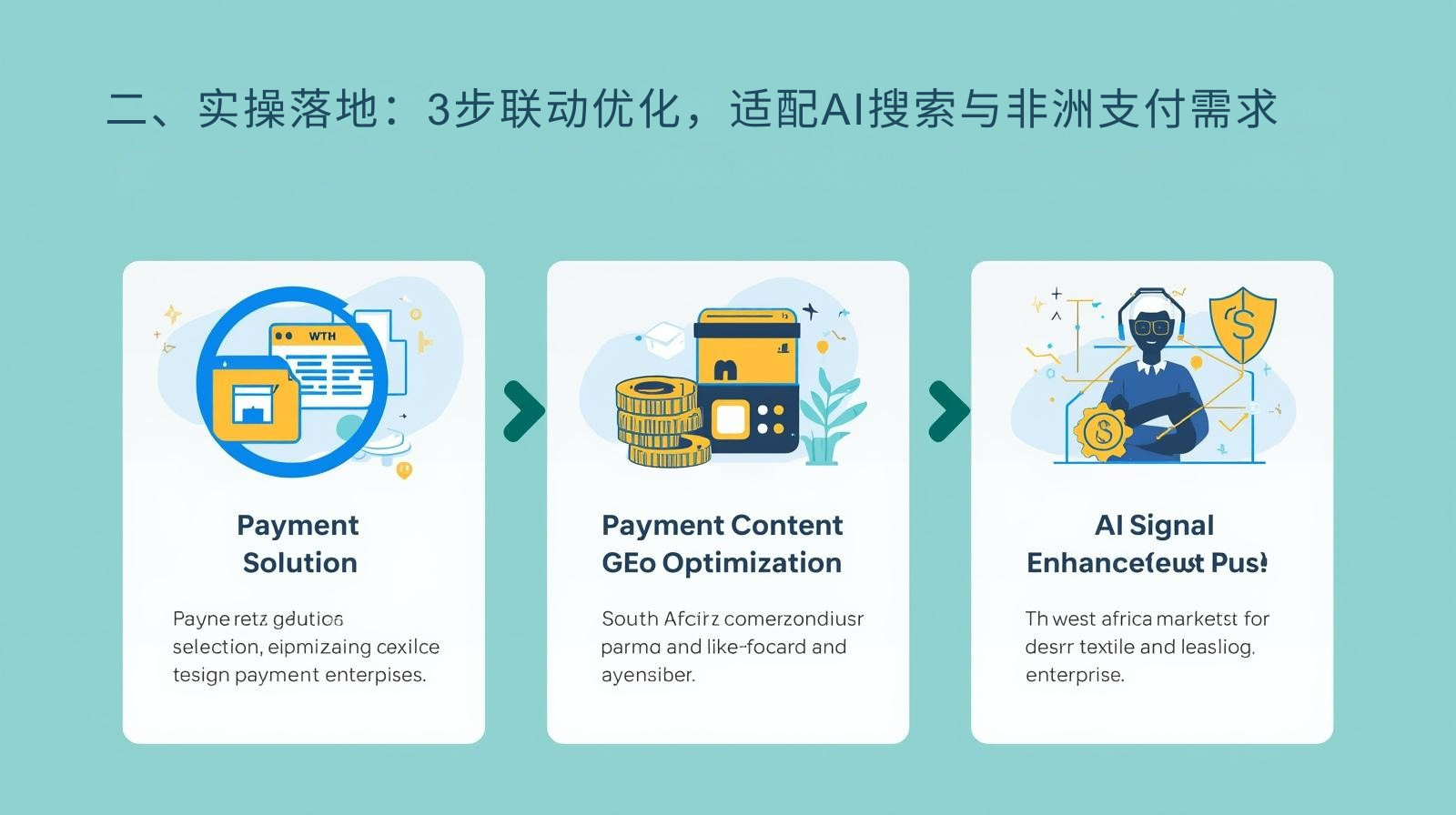
II. Practical Implementation: Three-Step Collaborative Optimization to Adapt to AI Search and African Payment Needs
Based on practical cases of non-textile foreign trade enterprises in Guangzhou, as well as the search intent rules of AI platforms in 2026 and the cooperation requirements of mainstream African payment institutions (such as Chouzhou Bank, Worldwide, dLocal, etc.), a three-step core practical solution has been summarized: "Payment solution selection - GEO optimization of payment content - AI signal enhancement push". Each step has clear implementation details and execution standards, which can be directly applied to achieve "payment adaptation + AI precise exposure".
2.1 Step 1: Selection of Localized Payment Solutions for Africa (7-10 days) – Precisely Adapting to Market and Needs
The core objective is to select compliant, convenient, and widely applicable localized payment solutions based on the payment characteristics of the target African markets (such as West Africa, South Africa, and East Africa), laying the foundation for subsequent GEO optimization. The core practical steps are as follows:
1. Target Market Payment Characteristics Analysis: Prioritize focusing on 1-2 core African markets (avoiding payment compatibility issues caused by trying to cover multiple markets). Identify the core characteristics of local payments: ① West African Market (Nigeria, Ghana, etc.): Mainstream payments are mobile money (e.g., MTN Mobile Money) and local currencies (Naira, Cedi). Foreign exchange controls are strict; prioritize solutions that support direct settlement in local currencies. For example, Nigerian buyers generally face insufficient USD quotas and need to access payment channels that support direct Naira settlement. ② South African Market (South Africa, Zimbabwe, etc.): Mainstream payments are local bank cards (e.g., Visa/Mastercard local cards) and Rand settlement. UnionPay card acceptance coverage exceeds 90%, so solutions supporting direct Rand settlement can be implemented. ③ East African Market (Kenya, Tanzania, etc.): Mainstream payments are mobile payments (e.g., M-Pesa) and local currencies (Shilling). Scenarios supporting UnionPay virtual card payments are increasing.
2. Selection of Mainstream Payment Solutions (Prioritizing Authoritative Institutions to Enhance AI Trust): Based on market characteristics, three core payment solutions are selected to ensure compliance and convenience: ① Banking Solutions (Strong Compliance, High AI Trust Weight): For example, Chouzhou Bank's "Choufeitong" 3.0 supports direct clearing in 18 local African currencies, including the Nigerian Naira and South African Rand. Nigerian buyers can initiate local currency transfers via mobile banking, and companies can receive payments as early as the next day, suitable for companies with high compliance requirements; ② Payment Institution Solutions (Wide Coverage, Suitable for SMEs in Foreign Trade): For example, Wanlihui's China-Africa Trade Collection Solution supports local currency collection in 9 currencies from 13 African countries. Local collection accounts can be efficiently opened in Nigeria and Kenya, with funds arriving as quickly as the same day, and exchange costs reduced by 40% compared to traditional methods; the dLocal solution covers local bank cards and alternative payment methods in more than 40 African countries, supporting diverse scenarios such as cash payments, mobile money, and digital wallets, suitable for foreign trade companies without local physical locations; ③ Card organization solutions (wide coverage): such as the UnionPay International solution, which allows UnionPay card payments in 51 African countries, has issued local UnionPay cards in 14 countries, and supports UnionPay virtual card payments in countries such as Tanzania and Kenya. It is suitable for companies that purchase from local African residents.
3. Payment Solution Implementation Preparation: Complete the cooperation and integration with the selected payment institution, and clarify the core information (for subsequent GEO optimization): supported currencies, arrival time, transaction fee standards, settlement methods, compliance certifications (such as payment license number, authorization certificate of the partner institution), and official cooperation links. For example, after cooperating with WorldFirst, it is clarified that "it supports the receipt of Nigerian Naira and Kenyan Shilling in local currency, with an arrival time of 1-3 business days, a transaction fee of 0.5%-1%, and has local payment compliance certification in Africa. Cooperation link: https://www.worldfirst.com/zh-cn/africa-payment/".
2.2 Second Step: Payment Content GEO Optimization (15-20 days) – Enabling AI and Buyers to Understand Payment Advantages
The core objective is to present the selected payment scheme information in a structured and semantic way through GEO optimization, enabling AI to quickly grasp the core advantage of "supporting localized payments in Africa," while allowing buyers to intuitively understand the convenience of payment. The core practical steps are as follows:
2.2.1 Layout of payment content on core pages (adapting to AI crawling priority)
Prioritize payment content based on AI crawling priorities (Homepage > Product Page > Payment Instructions Page > About Us Page) to ensure core payment advantages are prioritized: ① Homepage (Core Advantages First): Set up a "Local African Payment Support" module below the first screen banner, using icons and concise text to highlight core payment advantages, such as "Supports Nigerian Naira/South African Rand local payments | Fastest same-day arrival | No foreign exchange quota restrictions," and indicate the authoritative partner institutions (such as "Official cooperation with Chouzhou Bank and Wanlihui"); set up a quick entry for "Payment Instructions" linking to a dedicated payment instructions page; ② Product Page (Scenario-based matching to alleviate purchasing concerns): Near product prices and the order button, indicate suitable local African payment methods, such as "This product supports Kenyan Shilling local payments (M-Pesa/UnionPay virtual card), and buyers do not need USD quotas, can settle directly in local currency," naturally integrating core keywords (such as "Nigeria Naira payment foreign trade supplier" and "African local payment furniture manufacturer").
2.2.2 Deep optimization of the payment instructions page using GEO (core adaptation to AI recognition)
A dedicated "African Local Payment Instructions" page was created, presenting complete payment information in a structured manner and enhancing AI's ability to identify payment advantages: ① Page title optimization: Incorporating core keywords, such as "African Local Payment Solution - Supports Naira/Rand/Shilling Direct Settlement, Convenient Channel for China-Africa Trade Payment Collection"; ② Core content sections (sorted by AI preferences): The first section, "Payment Coverage," uses a table to display "Target Market - Supported Currencies - Payment Methods - Partner Institutions," such as "Nigeria - Naira - Mobile Money/Bank Transfer - Chouzhou Bank 'Choufeitong'," with official cooperation links; The second section, "Payment Advantages Explained," uses a list to present "Direct Settlement in Local Currency (No Foreign Exchange Quota), Fast Settlement Time (1-3 Business Days), Low Exchange Costs (40% cheaper than traditional methods), Compliance and Security (Cooperation with authoritative institutions, possessing payment licenses)"; The third section, "Payment Process Guide," uses step-by-step text to explain the payment process for buyers, such as "Nigeria Buyer Payment Process: 1. Select 'Naira Payment' after placing the order; 2. Initiate Naira transfer through mobile banking; 3. We confirm the order within 24 hours of receiving the transfer; 4. Ship the goods and synchronize the logistics information; The fourth section, "Frequently Asked Questions (FAQ)," features answers to frequently asked questions from buyers, such as "Q: Is there an additional handling fee when using Naira Payment? A: No additional handling fee is required. The handling fee is borne by us. Buyers only need to pay the local currency transfer fee (approximately 0.3%)"; The fifth section, "Compliance Certification Display," allows you to upload proof of cooperation with payment institutions and payment licenses (with the number and official query link), such as "Chouzhou Bank Cooperation Authorization Certificate (Number: CZCB-AFRICA-2026001), Query Link: https://www.czcb.com.cn/czcb/gywm/bxxw/2025080616220613177/index.html".
2.2.3 Optimization of payment content semantics (adapting to AI semantic understanding)
Optimize the semantic description of payment-related content to ensure AI can accurately identify payment advantages and suitable scenarios: ① Natural layout of core keywords: Integrate core keywords such as "African foreign trade payment," "Nigeria Naira payment," "South African Rand direct settlement," and "local African collection" naturally into page titles, first paragraphs, and subheadings to avoid keyword stuffing; ② Standardized semantic description: Adopt the expression logic of "Supports XX market + XX payment method + XX currency + core advantages," such as "We support local Naira payments in the Nigerian market, achieving direct settlement in local currency through the Chouzhou Bank 'Choufeitong' channel. Buyers do not need USD quotas, and funds arrive as quickly as the next day, effectively reducing exchange losses"; ③ Supplement scenario-related content: Add customer payment cases to the payment description page, such as "In January 2026, a Nigerian buyer paid for 1,000 sets of textiles in Naira through our payment channel. The transfer was initiated on the same day, and we completed the receipt of funds the next day. The customer's exchange cost was only 0.4%, far lower than traditional USD payment methods," strengthening AI's trust assessment of payment advantages.
2.3 Step 3: AI Signal Enhancement Push (Starts in 3-5 days, continues long-term) – Increases recommendation weight
The core objective is to proactively convey the message of "supporting localized payments in Africa" to the AI platform, accelerating content inclusion and recommendation ranking, and ensuring the site is prioritized in searches related to "African foreign trade payments." The core practical steps are as follows:
1. Structured Signal Optimization: Optimize payment content according to AI-preferred formats, clearly distinguish sections such as "Payment Coverage," "Payment Process," and "Compliance Certification" using H2-H3 headings, present information such as payment currency, processing time, and transaction fees in tables, and showcase core advantages in lists; add alt text (e.g., "Chouzhou Bank Cooperation Authorization Certificate - Supports Direct Settlement of 18 Local African Currencies") to images of payment institution authorization certificates and licenses to enable AI to recognize image information; optimize site maps, separately label the payment module on payment instruction pages and product pages, and submit them to the ChatGPT website administrator platform, Google Search Console, and Bing Webmaster Tools to proactively guide AI crawlers across multiple platforms.
2. Multi-channel signal push: ① AI platform signal submission: Submit an application for "African localized payment information update" through the ChatGPT official website administrator portal, highlighting that "the site has integrated with authoritative institutions such as Chouzhou Bank and Worldwide Interbank's local African payment solutions, supports direct settlement in local currencies such as Naira and Rand, and is adapted to the payment needs of African foreign trade buyers," to accelerate AI's recognition of payment advantages; ② External signal supplementation: Publish content such as "African local payment guide" and "Convenient payment solutions for China-Africa trade" on overseas social platforms such as LinkedIn and Twitter (e.g., "How can Nigerian buyers make payments quickly? A complete analysis of the Naira local direct settlement process"), highlighting core keywords and links to the independent website's payment instructions page to guide AI crawlers to capture external signals; on the official platform of the China-Africa Economic and Trade Expo and B2B platforms such as Global Sources, improve enterprise payment information, highlight payment solutions consistent with the independent website and links to partner institutions, forming a linkage between internal and external signals.
3. Continuous optimization and maintenance: Regularly update payment solution information, such as adding supported African currencies, optimizing payment arrival time, and updating compliance certifications (ensuring licenses are valid); analyze the ranking changes of keywords related to "African foreign trade payment" on the AI platform monthly to optimize the semantic description of payment content; regularly collect payment feedback from African buyers, supplement customer payment cases, and strengthen the AI trust weight.

III. Avoidance Guide: 3 Core Misconceptions about Payment Adaptation and GEO Optimization
Based on practical case studies from 2025-2026, foreign trade enterprises are prone to falling into three major pitfalls when optimizing GEO+ localized payments in Africa. These pitfalls can lead to AI failing to recognize payment advantages, poor payment experiences for buyers, and even compliance risks, which must be resolutely avoided:
3.1 Misconception 1: Blindly integrating payment solutions without adapting to the characteristics of the target market.
Errors included : failing to understand the payment characteristics of the target African market and blindly integrating multiple payment solutions (e.g., integrating a solution that only supports Rand settlement for the Nigerian market); and integrating with niche payment channels without compliance qualifications in an attempt to reduce transaction fees.
Key risks : Buyers are unable to use mainstream local payment methods, resulting in a near-zero payment conversion rate; payment channels without compliance qualifications will be judged as "high-risk" by AI, reducing the overall recommendation weight of the site and potentially leading to fund security issues; a hardware foreign trade company in Dongguan, due to accessing a niche, unqualified payment channel in Nigeria, not only experienced a payment success rate of less than 10% from buyers, but was also marked as a "payment risk site" by ChatGPT, resulting in a significant drop in its core keyword search rankings;
Correct approach : First, analyze the payment characteristics of the target market, then select a suitable payment solution from an authoritative institution (such as Chouzhou Bank or Worldwide). Ensure that the payment channel has the necessary compliance qualifications for local payments in Africa, and retain proof of cooperation authorization and payment license.
3.2 Misconception 2: Vague payment terms prevent AI and buyers from understanding the advantages.
Errors include : simply stating "Supports local payments in Africa" without specifying supported currencies, arrival time, payment process, or partner institutions; payment details are disorganized, unstructured, and core information is obscured by redundant content;
Key risks : AI cannot recognize a website's payment compatibility and cannot accurately match searches related to "African foreign trade payment"; buyers cannot clearly understand the convenience and security of payment, hesitate to initiate cooperation, and the bounce rate soars to over 82%; according to the "2026 China-Africa Trade Payment Experience Report", websites with vague payment content descriptions have a 75% lower buyer payment conversion rate than websites with standardized displays.
Correct approach : Clearly indicate supported payment methods, currencies, timeframes, transaction fees, and partner institutions; present the payment process and compliance certifications in a structured manner; use standardized semantic expressions to convey payment advantages and avoid vague wording.
3.3 Misconception 3: Ignoring payment compliance and after-sales service, thus eroding long-term trust.
Errors include : failure to display payment compliance certifications (such as cooperation authorization certificates and payment licenses), preventing buyers from verifying payment security; lack of after-sales support for payment issues, hindering timely resolution of payment problems for buyers; and failure to optimize payment solutions that suffer from high exchange rate losses and slow payment processing.
Key harms : Buyers abandon cooperation due to inability to verify compliance; frequent payment and after-sales issues lead to customer loss and negative reviews; AI reduces the site's trust weight through user feedback and compliance information verification; a Shenzhen electronics foreign trade company experienced delays in fund arrival after payments from African buyers due to the lack of a payment after-sales channel, resulting in multiple negative complaints and an 8-place drop in AI recommendation ranking within one month.
Correct practice : Fully display payment compliance certification and official query links; set up dedicated after-sales channels for payment issues (such as WhatsApp customer service, email), and promise 24-hour response; regularly optimize payment solutions to reduce exchange costs and improve the timeliness of fund arrival.
Recommended Article: Your Competitors Haven't Reacted Yet: Building an Independent E-commerce Website with GEO is the Biggest Blue Ocean Strategy Right Now
Recommended Article: Your Competitors Haven't Reacted Yet: Building an Independent E-commerce Website with GEO is the Biggest Blue Ocean Strategy Right Now
IV. Conclusion: Payment Adaptation + GEO Optimization: Unlocking New Opportunities for AI-Driven Customer Acquisition in African Foreign Trade
In 2026, the African foreign trade market is experiencing explosive growth. The core competitiveness of Sino-African trade has expanded from "product price" to "end-to-end services," and localized payment adaptation is a key component of these services. The AI platform's search and matching of "African foreign trade payment" related needs essentially reflects the core pain points of buyers. Only through deep integration of GEO optimization and localized payment methods, enabling AI to accurately identify the payment advantages of different sites and allowing buyers to experience convenient and secure payments, can a company gain a competitive edge in the African foreign trade market.
The value of localized payment solutions in Africa lies not in the number of payment methods integrated, but in whether they are adapted to market characteristics, compliant and convenient, and understandable by AI and buyers. By accurately selecting payment solutions, structurally optimizing payment content, and continuously strengthening AI signal pushes, independent payment platforms can stand out in searches related to "African foreign trade payments," breaking down payment barriers in Sino-African trade and achieving precise customer acquisition and conversion. Practical cases of non-textile foreign trade enterprises in Guangzhou have proven that as long as the right optimization direction is identified and accurately implemented, GEO + localized African payment solutions can adapt to AI search needs and win the trust of African buyers.
In 2026, Sino-African economic and trade cooperation will continue to deepen, and the matching logic of AI platforms for African foreign trade payment needs will become more sophisticated. Foreign trade enterprises that can proactively deploy localized payment solutions and optimize their GEO (Government Optimization) system will undoubtedly gain a foothold in the fiercely competitive African market and achieve long-term stable development of their cross-border business. Take action now: analyze your target African market, select suitable localized payment solutions, and build a payment content GEO optimization system. Let AI prioritize your services, making it easy for African buyers to choose your platform.