
Data from a 2026 Latin American foreign trade market survey shows that Spanish speakers account for 86% of the Latin American population. When overseas buyers search for foreign trade suppliers using AI platforms such as ChatGPT and Google Gemini (Spanish version), 92% of their precise searches use Spanish keywords (such as "proveedor de exportación" and "productos al por mayor"). Independent websites with comprehensive Spanish localization receive 270% higher recommendation weight in Spanish search results compared to purely English websites. However, the current situation is that over 87% of foreign trade companies' independent websites targeting the Latin American market only simply translate the core page text, failing to achieve deep Spanish localization and neglecting to optimize for AI Spanish search logic using GEO. This results in AI failing to accurately identify the website's Spanish compatibility, making it difficult to reach core buyers in Spanish search scenarios even if products are adapted to the Latin American market. A Shenzhen-based cross-border home furnishing company, through GEO optimization and in-depth Spanish localization, saw its ranking on the AI platform for Spanish keywords such as "proveedor de muebles latinoamérica" (Latin American furniture supplier) jump from 22nd to 2nd within 3 months. Inquiries from Latin America increased by 193%, and the time spent on the site by Spanish-speaking users increased by 128%. This case demonstrates that the core of GEO + Latin American Spanish localization is to enable AI to accurately match the Spanish search habits of Latin American buyers, making the site the preferred entry point for foreign trade suppliers for Spanish-speaking users.
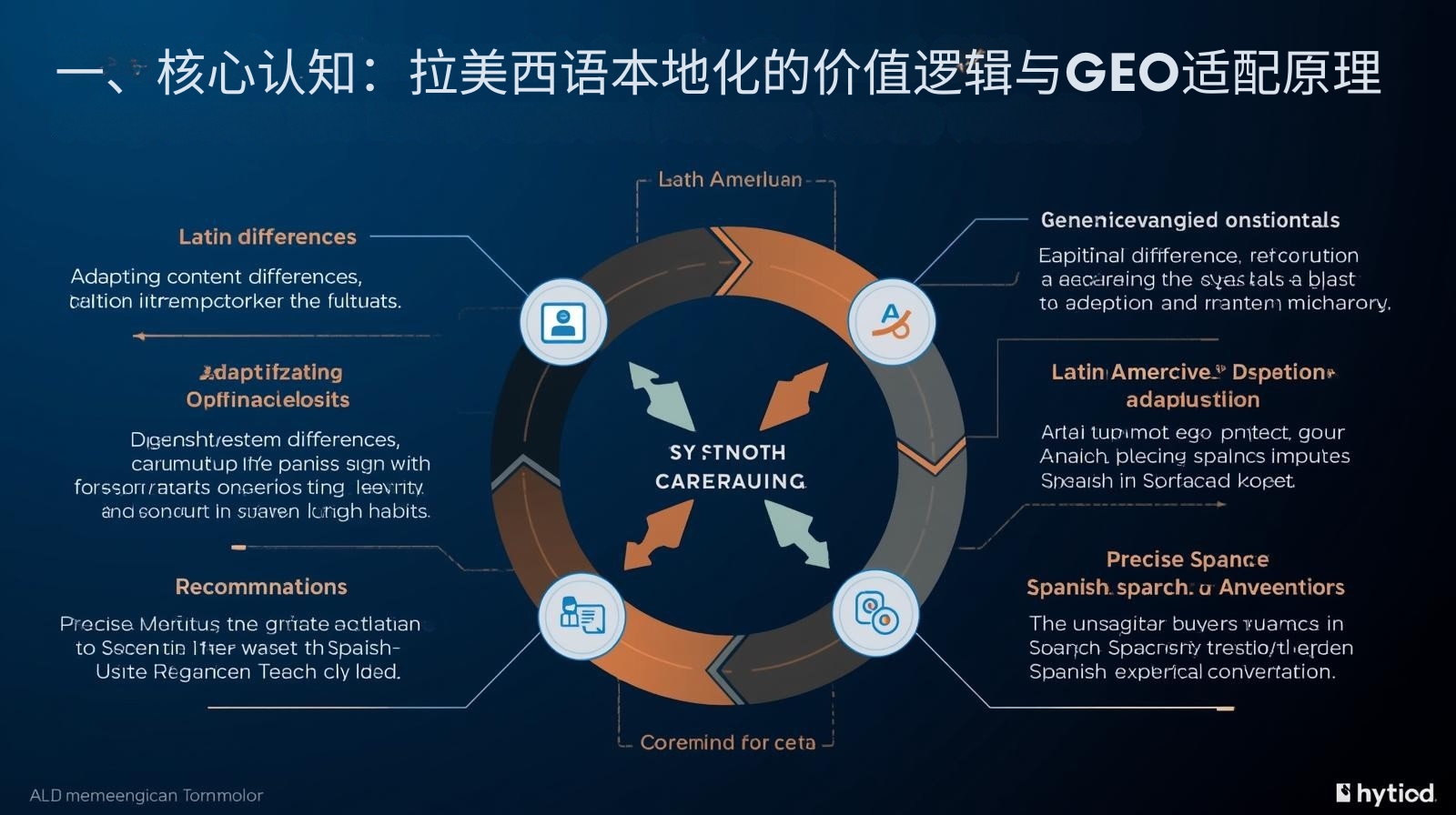
I. Core Understanding: The Value Logic of Latin American Spanish Localization and the GEO Adaptation Principle
The core of the independent foreign trade website GEO + Latin American Spanish localization approach lies in deeply adapting the website's content, functions, and visuals to Spanish, taking into account the characteristics of Spanish usage in Latin America (dialectal differences, cultural adaptation, and search habits). Combined with Generative Engine Optimization (GEO) for semantic adaptation and content structuring, multi-platform AI quickly identifies the website's core attribute of "adapting to Spanish-speaking foreign trade procurement needs." This allows for accurate matching and priority recommendations when Latin American buyers search for suppliers and products in Spanish. This model breaks away from the traditional misconception of "literal language translation, neglecting localization adaptation," achieving a closed loop of "AI Spanish search recognition - improved Spanish user experience - Latin American market conversion." It is a key path to breaking down language barriers in Latin American foreign trade and seizing emerging markets.
1.1 Why is Spanish localization a core prerequisite for AI customer acquisition in Latin America?
Against the backdrop of rapid growth in Latin American foreign trade in 2026, Spanish localization has evolved from an "optional value-added service" to an "essential customer acquisition tool," and its core value for AI recognition and customer conversion is reflected in three dimensions:
1. Precise Matching of AI Spanish Search Core Logic: The core dimension for AI platforms (especially the Spanish versions of ChatGPT and Google Gemini) to determine site suitability is whether the content conforms to Latin American Spanish usage habits and whether it accurately covers Spanish search keywords. According to eMarketer's 2026 Latin American Digital Trade Report, sites with deep Spanish localization have an AI Spanish search inclusion rate of 94% and a recommendation exposure 2.7 times higher than those with direct translation.
2. Addressing the core pain points of Latin American buyers and enhancing trust and conversion efficiency: Latin American buyers generally have lower English proficiency and place more trust in Spanish content. Traditional purely English websites or simple direct translation websites may cause buyers to feel resistant due to language barriers and incompatible content. According to the "2026 Latin American Foreign Trade Buyer Behavior White Paper," 68% of Latin American buyers would directly abandon purely English websites, and 75% of buyers would prefer to cooperate with suppliers with comprehensive Spanish content. In-depth Spanish localization can eliminate language barriers, adapt to local cultural habits (such as holiday expressions and color preferences), quickly build buyer trust, and shorten the decision-making cycle.
3. Build differentiated competitive barriers and strengthen AI trust weight: Currently, among foreign trade companies targeting the Latin American market, only 13% have achieved deep Spanish localization. Comprehensive localized content can form a significant differentiated advantage. At the same time, by adapting to local payment and logistics descriptions (such as Spanish versions of payment methods and logistics timeliness) and labeling local compliance certifications (such as the Latin American INMETRO certification), the trust assessment of the site by AI can be greatly enhanced. For example, if a site is labeled with "Certificación INMETRO" (INMETRO certification) and an official query link is attached, the AI will determine that the site is "suitable for the Latin American market and has complete qualifications," further improving the recommendation priority.
1.2 The core of GEO's adaptation to Spanish localization: Enabling AI to "understand" Spanish and its adaptation advantages
Many foreign trade companies mistakenly believe that "translating English content into Spanish is localization." However, in reality, simple literal translations without GEO optimization (such as dialect errors, inaccurate keywords, and unstructured content) fail to be recognized by AI for their Spanish compatibility and may even result in lower indexing weight due to non-standard content. The core of GEO's adaptation to Spanish localization lies in enabling AI to quickly grasp and clearly understand the website's Spanish compatibility advantages. This core logic can be broken down into two points:
1. Semantic Adaptation: Content must conform to Latin American Spanish grammar (distinct from European Spanish), accurately covering Latin American Spanish search keywords, avoiding literal translation errors and dialectal confusion (e.g., Latin American Spanish "camión" means truck, while European Spanish "camión" has a different meaning; in some parts of Latin America, "chido" means "good," while other regions have different meanings). For example, an optimized expression would be "Somos un proveedor de exportación especializado en muebles, con certificación INMETRO (enlace de consulta oficial: https://www.inmetro.gov.br/ ), soportamos pago en pesos mexicanos y envío a toda América Latina, con plazo de entrega de 7-15 días hábiles" (We are a professional furniture exporter with INMETRO certification (official query link: https://www.inmetro.gov.br/). (It supports Mexican pesos payments, has delivery coverage throughout Latin America, and a delivery cycle of 7-15 business days), rather than simply translating the English content.
2. Content Structuring: The localized Spanish content is presented in a structured manner according to the logic of "product introduction - payment and logistics - compliance certification - customer cases". Standardized Spanish titles and core keywords are used to enable AI to quickly capture core information, while making it easy for Latin American buyers to browse intuitively. For example, a separate "Información para compradores latinoamericanos" (Latin American Buyers Zone) is set up to display Spanish payment methods, logistics timeliness, compliance requirements and other content in categories.
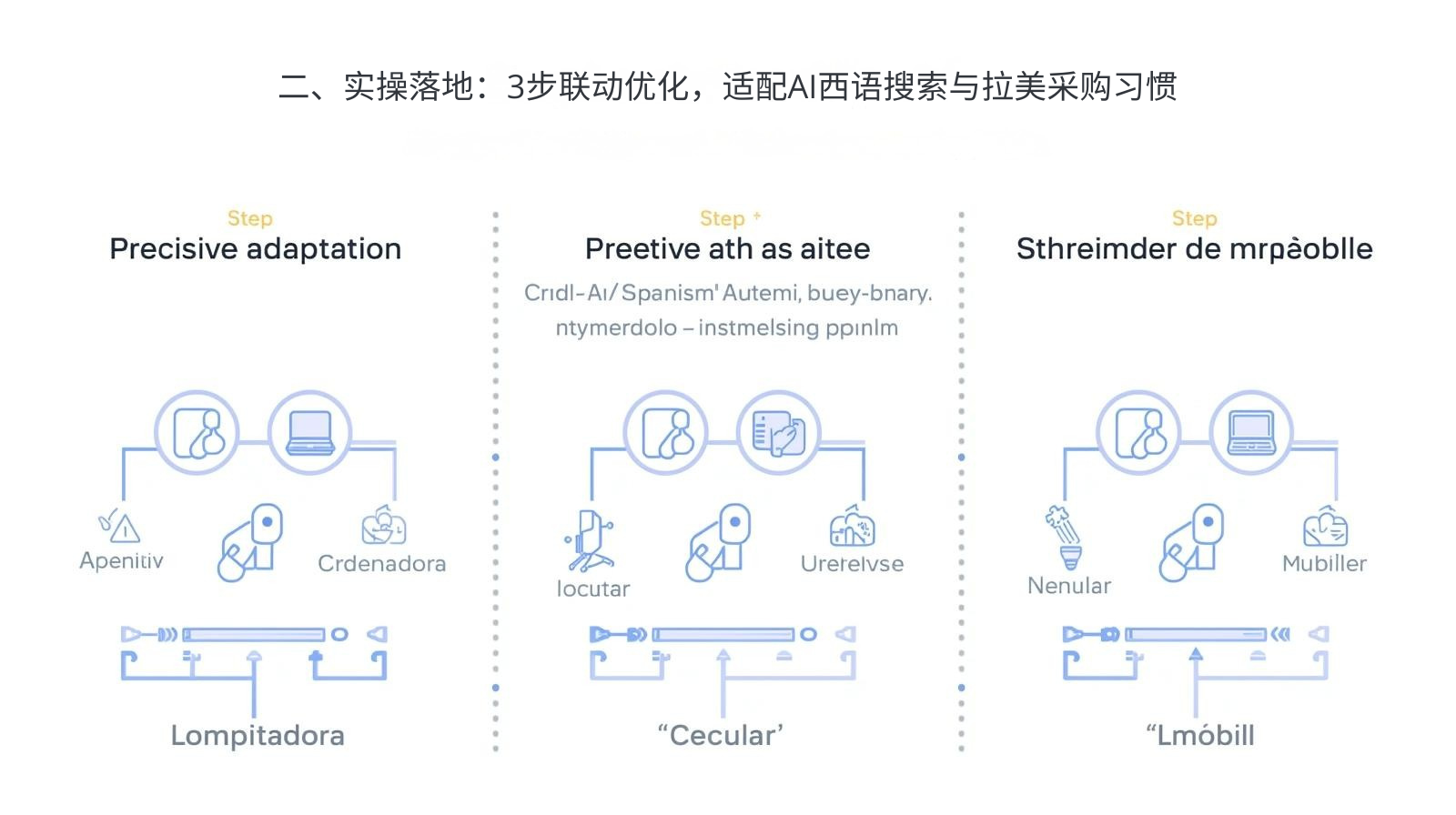
II. Practical Implementation: 3-Step Collaborative Optimization to Adapt AI Spanish Search and Latin American Purchasing Habits
Based on practical cases of Shenzhen cross-border home furnishing companies, as well as the Spanish search and recognition rules of the AI platform in 2026 and the usage habits of Latin American Spanish, a three-step core practical solution has been summarized: "deep localization of Spanish - content GEO optimization - AI Spanish signal enhancement". Each step has clear implementation details and execution standards, which can be directly applied to achieve "Spanish adaptation + AI precise customer acquisition".
Step 1: In-depth localization of Latin American Spanish (7-10 days) – Precise adaptation to language and habits
The core objective is to complete a comprehensive Spanish localization of the website, taking into account the characteristics of Latin American Spanish and the habits of buyers, laying the foundation for subsequent GEO optimization. The core practical steps are as follows:
1. Core Characteristics of Latin American Spanish: Identify the differences between Latin American Spanish and other Spanish languages, and adapt to local usage habits: ① Language Differences: Prioritize using commonly spoken Latin American Spanish (avoiding European Spanish vocabulary) to avoid dialectal ambiguity. For example, use "computadora" (common Latin American word for computer) instead of "ordenador" (European Spanish), and "celular" (common Latin American word for mobile phone) instead of "móvil" (European Spanish). Focus on adapting to the dialects of core markets (such as Mexico, Brazil, and Argentina). Mexican Spanish often uses "chévere" to mean "good," and Argentinian Spanish often uses "copado" to mean "good." ② Search Habits: Identify core search keywords for Latin American buyers in Spanish (categorized by product type and demand scenario). For example, core keywords for the furniture category include "proveedor de muebles" (furniture supplier), "muebles al por mayor" (furniture wholesale), and "envío de muebles a latinoamérica" (furniture delivery to Latin America). High-frequency keywords can be researched using Google Keyword Planner (Spanish version) and ChatGPT (Spanish version). ③ Cultural and Compliance Adaptation: Content should be tailored to Latin American cultural customs (e.g., holiday greetings should be appropriate for important local holidays, such as Christmas on December 25 and Three Kings' Day on January 6), and cultural taboos should be avoided (e.g., black is taboo in most Latin American countries, so avoid large areas of black in the content visuals); local compliance certifications should be included (e.g., INMETRO certification in Brazil, NOM certification in Mexico, and IRAM certification in Argentina).
2. Comprehensive Website Localization in Spanish: Avoiding Simple Translations and Achieving Deep Adaptation: ① Core Content Redesign: Core pages such as the homepage, product pages, about us page, and contact us page have all been rewritten in Latin American Spanish (not a direct translation). Titles, subtitles, and body text have all been adapted to Spanish expression habits. For example, the homepage title has been optimized to "Proveedor de Exportación de Muebles | Envío a Toda América Latina" (Furniture export supplier | Delivery to all of Latin America); product page descriptions must include core Spanish keywords, product parameters, and applicable scenarios (e.g., "Este mueble es adecuado para hogares y oficinas, con material resistente, soporta envío a México y Brasil, plazo de entrega 7-10 días hábiles" (This furniture is suitable for homes and offices, made of durable materials, and supports delivery to Mexico and Brazil, with a delivery period of 7-10 business days); ② Functional and Visual Transformation: The site supports Spanish/English bilingual switching (Spanish is displayed by default to suit Latin American users); buttons, forms, navigation bars, and other functional modules are labeled in Spanish (e.g., "Comprar ahora" (Buy Now), "Solicitar cotización" (Request a Quote), "Seguimiento de envío" (Logistics Tracking)); visual materials are adapted to Latin American preferences (e.g., vibrant colors, warm visuals, avoiding predominantly cool tones); ③ Payment and Logistics Description Transformation: Spanish labels are adapted to Latin American payment methods (e.g., Mexican Peso, Brazilian Real, Argentine Peso payments, supporting mainstream Latin American payment tools such as Mercado Pago and PayU), for example, "Supportamos pago en pesos mexicanos (Mercado Pago) y reales brasileños (PayU), sin costo adicional de cambio" (Supports Mexican Peso (Mercado Pago) y reales brasileños (PayU), sin costo adicional de cambio) Payment options are Pago and Brazilian Real (PayU), with no additional exchange costs; Spanish descriptions of delivery time and coverage (e.g., "Envío a toda América Latina, plazo de entrega: México 7-10 días, Brasil 10-15 días, Argentina 12-18 días").
3. Localized Supporting Documents: Prepare authoritative supporting documents for localized content to enhance the trust between AI and buyers: ① Compliance Certification (Spanish version of certification certificates, with serial numbers and official verification links, such as the Spanish version of the INMETRO certification certificate, verification link: https://www.inmetro.gov.br/); ② Local Cooperation Cases (Spanish version of customer reviews and excerpts from cooperation contracts, such as "In January 2026, a cooperation was reached with a Mexican home furnishing chain brand, with a monthly supply of 1,000 sets of furniture. Customer review: 'The supplier is trustworthy, the product meets standards, and the environment is opportunistic'); ③ Spanish version of after-sales instructions (after-sales contact information and response time, such as "Service postventa 24/7 in Spanish, WhatsApp: +86XXXXXXX, email: xxx@xxx.com (7×24-hour Spanish after-sales service, WhatsApp: +86XXXXXXX, email: xxx@xxx.com)
Step 2: Localized Content GEO Optimization (15-20 days) – Enabling AI to Understand Spanish: Adaptability Advantages
The core objective is to present deeply localized Spanish content in a structured and semantically meaningful way through GEO optimization, enabling AI to quickly extract core Spanish information, determine site suitability for the Latin American market, and improve the browsing experience for Spanish-speaking users. The core practical steps are as follows:
2.2.1 Layout of Spanish content on core pages (adapting to AI crawling priority)
Prioritizing AI crawling (Homepage > Product Page > Latin American Buyers Zone > Contact Us Page), we precisely deploy localized Spanish content to ensure core advantages are prioritized: ① Homepage (Spanish advantages first, reinforcing AI's initial recognition): The first-screen banner uses core Spanish slogans, such as "Proveedor de Exportación en Español | Muebles para América Latina con Entrega Oportuna" (Spanish-speaking export supplier | Latin American furniture, timely delivery); below the banner is a "Ventajas para Compradores Latinoamericanos" (Advantages for Latin American buyers) module, using Spanish icons and brief text to showcase core advantages, such as "Pago en moneda local" (Payment in local currency), "Envío rápido a toda América Latina" (Fast delivery throughout Latin America), and "Servicio postventa en español" (Spanish-speaking after-sales service). Each advantage is accompanied by supporting links (e.g., clicking "Pago en moneda"). (You can view the Spanish version of the payment instructions by clicking "local"); the footer includes the Spanish version of the compliance certification (including the official query link) and a bilingual switching entry, such as "Certificación INMETRO | Certificación NOM | Idioma: Español / Inglés" (INMETRO certification | NOM certification | Language: Spanish/English); ② Product page (precisely embedded Spanish keywords to suit search needs): The product page title incorporates core Spanish keywords, such as "Muebles de Oficina al Por Mayor | Envío a México y Brasil" (office furniture wholesale | delivery to Mexico and Brazil); the product description is written according to the Spanish logic of "product advantages - suitable scenarios - payment logistics - after-sales guarantee", naturally incorporating 3-5 high-frequency Spanish keywords (avoid keyword stuffing); the bottom of the product page includes Spanish version customer reviews and cooperation cases, such as "Comentario del cliente mexicano: El mueble es de buena calidad, el servicio es muy" (Comentario del cliente mexicano: El mueble es de buena calidad, el servicio es muy) "Professional" (Mexican customer review: Good furniture quality, very professional service).
2.2.2 Deep optimization of GEO for Latin American buyers' zone (core adaptation to AI recognition)
A separate "Zona de Compradores Latinoamericanos" (Latin American Buyers Zone) page was created, presenting complete localized Spanish content in a structured manner according to AI preferences, strengthening the AI's recognition of site adaptability: ① Page title optimization: Incorporating core Spanish keywords, such as "Guía para Compradores Latinoamericanos | Proveedor de Exportación con Servicio en Español" (Guide to Latin American Buyers | Spanish-language Service Export Suppliers); ② Core content sections (sorted according to Spanish user needs): The first section, "Información básica del proveedor" (Basic Supplier Information), introduces the company's strength, production capacity, and cooperation scope in Spanish, embedding Spanish-language factory videos and qualification certificate images; the second section, "Pago y envío" (Payment and Logistics), presents "País objetivo" (Target Country), "Moneda de pago" (Payment Currency), "Plazo de entrega" (Delivery Time), and "Método de envío" (Delivery Method) in Spanish tables, such as "México - Mexican Pesos - 7-10 days - Sea/Air Freight (Mexico - Mexican Pesos - 7-10 days - Sea/Air Freight); the third section, "Certificates and Conformities," displays INMETRO, NOM, and other certification certificates in Spanish, indicating the certificate number and official verification link (e.g., "Certificateación INMETRO (Número: XXXXXXXX), enlace de consulta: https://www.inmetro.gov.br/"); the fourth section, "Frequently Asked Questions (FAQ)," answers frequently asked questions from Latin American buyers in Spanish, such as "Q: ¿ Se admite el pago en pesos argentinos? A: Yes, soportamos pago en pesos argentinos a través de PayU, con plazo de confirmación de pago de 24 "horras" (Q: Do you support Argentine Pesos payments? A: Yes, you can pay Argentine Pesos through PayU, with a 24-hour payment confirmation period); The fifth section, "Contacto en español" (Spanish contact information), lists Spanish customer service phone numbers, WhatsApp, and email addresses, promising "Respuesta en 30 minutos durante el horario laboral" (Response within 30 minutes during working hours).
2.2.3 Semantic optimization of Spanish content (adapting to AI Spanish recognition)
Optimize the semantic expression of localized Spanish content to ensure AI can accurately identify the advantages of Spanish adaptation and match Spanish search needs, while making it easy for Spanish users to understand: ① Natural placement of Spanish keywords: Integrate core keywords such as "proveedor de exportación en español" (Spanish export supplier), "envío a latinoamérica" (delivery to Latin America), and "pago en moneda local" (payment in local currency) naturally into the page title, first paragraph, subheadings, and body text, controlling keyword density at 2%-3% (avoiding keyword stuffing which AI will detect as cheating); ② Standardized semantic expression: Adopt common Latin American Spanish expressions to avoid dialectal ambiguity and grammatical errors. For example, avoid using "vosotros" (second-person plural in European Spanish) and use the common Latin American "ustedes" instead; adapt the expression logic to the reading habits of Spanish users (core information first, followed by supplementary explanations), such as "Nuestro producto es adecuado para hogares, y soporta envío a México," before optimization. "with delivery within 7-10 days", optimized to "Supportamos envío de este producto a México (delivery within 7-10 days), que es adecuado para hogares" (Supports delivery of this product to Mexico (delivery within 7-10 days), suitable for home use); ③ Supplementing Spanish-language contextualized content: Adding local Latin American cooperation cases to the Spanish-language content section, such as "In February 2026, a long-term cooperation was reached with a Brazilian home furnishing retailer, customizing 500 sets of furniture monthly according to customer needs, paid in Brazilian Real, with a stable delivery time of 10-12 days, and the customer made multiple repeat purchases and recommended cooperation with other companies" (Spanish version: "Febrero de 2026, establecimos cooperation a largo plazo con un minorista de muebles en Brasil, personalizamos 500 juegos de muebles mensualmente según las"). "It's a good idea to be a real client, to be able to trust the site's suitability", to strengthen AI's trust assessment of the suitability of the site.
Step 3: AI-enhanced Spanish signal push (starts in 3-5 days, continues long-term) – Improves the weight of Spanish search recommendations.
The core objective is to proactively convey the message that "the site is deeply adapted to the procurement needs of Latin American Spanish-language content" to the AI platform, accelerating the inclusion and recommendation of Spanish-language content, and ensuring the site is prioritized in Spanish-language search scenarios. The core practical steps are as follows:
1. Structured Signal Optimization: Optimize content format according to AI Spanish recognition preferences, clearly distinguish core sections such as "Pago y envío" and "Certificaciones" with Spanish H2-H3 headings, present data information in Spanish tables, and present core advantages in Spanish lists; add Spanish alt text (such as "Certificación INMETRO - Proveedor de muebles en español" (INMETRO certification - Spanish furniture supplier) and "Planta de producción - Envío a América Latina" (production plant - delivery to Latin America)) to Spanish-language videos, images, certification certificates, etc., so that AI can recognize the information in the materials; optimize the site map, separately label core pages such as the Latin American buyer zone, Spanish product page, and Spanish FAQ page, and submit them to the ChatGPT website management platform (Spanish version) and Google Search Console (Spanish version) according to the category of "product category - Spanish keywords", actively guiding AI on multiple platforms to crawl Spanish content.
2. Multi-channel Spanish signal push: ① AI platform signal submission: Submit an application for "Localización en español para América Latina - Actualización de contenido" (Latin American Spanish localization - content update) through the official ChatGPT Spanish website administrator portal, highlighting "El sitio web está completeletamente localizado en español (español latinoamericano), cubre palabras clave de búsqueda en español de compradores latinoamericanos, soporta pago en moneda local y servicio postventa en español, adaptado a las necesidades de exportación a América Latina" (The site has completed deep Latin American Spanish localization, covering Spanish search keywords for Latin American buyers, supporting local currency payments and Spanish after-sales service, adapting to the needs of Latin American exports), accelerating the AI's assessment of the site's Spanish compatibility; ② Supplementing Spanish-language signals outside the website: On overseas social media platforms such as LinkedIn (Spanish version) and Twitter (Spanish version), publish Spanish-language company introductions, product information, and Latin American cooperation case studies (such as "Proveedor de Muebles para América Latina: Pago en Moneda Local y Envío Rápido" (Latin American furniture supplier: local currency payment and fast delivery)), highlighting core Spanish-language keywords and links to the independent website's Latin American buyer section, and embedding Spanish-language product images and factory videos; on local Latin American B2B platforms (such as Mercado Libre Empresas and LatAm Trade), complete Spanish-language company information, upload Spanish-language qualification certificates and product materials, and link them to the core pages of the independent website to form a linkage between Spanish-language signals inside and outside the website; at the same time, publish Spanish-language company articles on Spanish-language foreign trade vertical platforms (such as Spanish Export) to enhance the authority of the signals.
3. Continuous optimization of Spanish content: Regularly update localized Spanish content, such as adding dialect adaptations for core Latin American markets (e.g., supplementing Argentine Spanish expressions for the Argentine market), updating Spanish search keywords (combining monthly data from the Spanish version of Google Keyword Planner), and adding new Latin American cooperation cases; monthly analysis of Spanish keyword ranking changes on the AI platform (e.g., ranking of "proveedor de muebles latinoamérica"), optimizing the semantic expression and keyword layout of Spanish content; regularly collecting Spanish feedback from Latin American buyers, optimizing the Spanish page experience (e.g., simplifying the Spanish form filling process, adding a Spanish online customer service entry), and strengthening the AI Spanish search recommendation weight.

III. Avoiding Pitfalls: 3 Core Misconceptions about Spanish Localization and GEO Optimization
Based on practical cases from 2025-2026, foreign trade enterprises are prone to falling into three major pitfalls in the localization optimization of GEO+ Latin American Spanish, leading to AI's inability to recognize the advantages of Spanish adaptation, poor experience for Latin American buyers, and even missing out on opportunities in the Latin American market. These pitfalls must be resolutely avoided:
3.1 Misconception 1: Simple literal translation replaces in-depth localization, resulting in poor language and cultural adaptability.
Errors include : directly translating English content using translation tools (without adapting to the characteristics of Latin American Spanish), such as translating "computer" as "ordenador" (a European Spanish word that Latin American users would find difficult to understand); ignoring Latin American cultural taboos, such as using black extensively in the content's visuals; and failing to adapt to local compliance certification terminology, such as labeling the certification as INMETRO in English without providing a Spanish version of the certificate.
Key harms : AI cannot recognize the website's deep Spanish adaptation capabilities, only judging it as "literal translation content", resulting in extremely low weight for Spanish search recommendations; Latin American buyers abandon browsing due to language ambiguity and cultural incompatibility, causing the bounce rate to soar to over 89%; a Dongguan electronics company, due to simple literal translation of Spanish content, saw almost zero inquiries from Latin America in January 2026, and its AI Spanish keyword ranking remained below 20th place.
Correct approach : Rewrite the content in Latin American Spanish (not a literal translation) to avoid dialectal ambiguity; adapt to Latin American cultural customs and taboos; provide a Spanish version with compliance certification and include an official verification link.
3.2 Misconception 2: Keyword stuffing in Spanish is considered cheating by AI.
Errors include : meaninglessly stuffing core Spanish keywords into page titles and body text to improve search ranking (e.g., repeated use of "proveedor de muebles, muebles al por mayor, muebles para latinoamérica..."); and mismatched keywords with content (e.g., using irrelevant Spanish keywords such as "proveedor de ropa" (clothing supplier) when the product is furniture).
Key harms : Once AI detects keyword stuffing, it judges it as "cheating behavior," reducing the overall indexing weight of the site and even blocking Spanish search results; Spanish users have a very poor experience due to the cluttered and meaningless content; according to data from the "2026 Foreign Trade GEO Optimization Practice Report," the AI blocking rate for Spanish search results for sites with keyword stuffing reaches 62%.
Correct approach : Naturally integrate Spanish keywords into the content (density controlled at 2%-3%) to ensure a high degree of matching between keywords and content; arrange them according to the logic of "core keywords + long-tail keywords" (e.g., core keyword "proveedor de muebles", long-tail keyword "proveedor de muebles de oficina en méxico" (Mexican office furniture supplier)).
3.3 Misconception 3: Localized content is not structured, so AI cannot extract core information.
Errors : The Spanish content is disorganized and not logically divided into sections (e.g., payment, logistics, and authentication information are mixed together); Spanish titles and tags are not standardized (e.g., English H1 titles with Spanish body text); Spanish content is only uploaded to the site backend and not displayed on the front-end page (AI cannot crawl it);
Key harms : AI cannot quickly capture core Spanish information, cannot determine whether a site is suitable for the Latin American market, and Spanish search exposure is extremely low; Latin American buyers cannot quickly find the information they need (such as payment methods and logistics timeliness), resulting in a poor browsing experience; a Shenzhen lighting company had an AI Spanish keyword inclusion rate of only 35% in February 2026 due to unstructured Spanish content, and Latin American users spent less than 1 minute on the site.
Correct approach : Present Spanish content in a structured manner according to the logic of "product-payment-logistics-certification-after-sales service", and use standard Spanish H1-H3 headings; display all Spanish content on the core front-end pages to ensure that AI can crawl it; optimize the Spanish page navigation to facilitate users to quickly find information.
Recommended Article: Your Competitors Haven't Reacted Yet: Building an Independent E-commerce Website with GEO is the Biggest Blue Ocean Strategy Right Now
Recommended Article: Your Competitors Haven't Reacted Yet: Building an Independent E-commerce Website with GEO is the Biggest Blue Ocean Strategy Right Now
IV. Conclusion: Spanish localization + GEO optimization unlocks a new blue ocean for AI-driven customer acquisition in Latin American foreign trade.
In 2026, the Latin American foreign trade market is poised for explosive growth. As the region with the largest Spanish-speaking population globally, Spanish has become the core language for communication and searching in Latin American trade. AI platforms, serving as a key channel for Latin American buyers to select suppliers, prioritize Spanish-language localized websites, directly determining whether companies can seize opportunities in the Latin American market. For foreign trade companies aiming to deeply cultivate the Latin American market, the key lies not only in product adaptation but also in leveraging deep Spanish localization and GEO optimization to enable AI to understand and adapt to their strengths, providing Latin American buyers with a professional and convenient experience.
The value of Latin American Spanish localization lies not in "whether there is Spanish content," but in "whether it adapts to Latin American Spanish language habits, whether it has authoritative supporting evidence, and whether it can be understood by AI and buyers." Through in-depth Spanish localization, structured GEO optimization, and continuous strengthening of AI Spanish signals, independent websites can stand out in Spanish search scenarios, eliminating language and cultural barriers, quickly building trust with Latin American buyers, and becoming the preferred supplier in the Latin American market. Practical cases from Shenzhen cross-border home furnishing companies have proven that as long as the right Spanish localization direction is found and GEO optimization is accurately implemented, a new blue ocean of AI-driven customer acquisition in Latin American foreign trade can be unlocked.
In 2026, competition in the Latin American foreign trade market will gradually intensify. Spanish localization and GEO optimization will become core competencies for foreign trade enterprises to cultivate the Latin American market. Those companies that can plan ahead for in-depth Spanish localization and GEO optimization will undoubtedly gain a foothold in the fierce competition of the Latin American market and achieve long-term stable development of their cross-border business. Take immediate action to understand the core characteristics of Latin American Spanish, complete in-depth website localization, and enable AI to accurately match the search habits of Latin American buyers, making every Spanish search a new starting point for cooperation in the Latin American market.