Data from a 2026 survey on foreign trade customer communication shows that when overseas buyers connect with suppliers through AI platforms such as ChatGPT and Google Gemini, 89% of customers will ask three core questions in succession during the initial communication: "factory inspection arrangements," "sample delivery," and "quotation details." Suppliers who can respond quickly and professionally to these consecutive questions see a 220% increase in customer cooperation intentions. However, the current situation is that over 82% of independent foreign trade websites have not built a systematic AI dialogue script library, relying solely on random human responses. This not only results in delayed responses but also frequently leads to lost customers due to unprofessional answers and inconsistent information. Furthermore, they have not optimized their communication search logic to adapt to AI platforms through GEO, meaning that even when recommended by AI, they cannot efficiently handle customer inquiries. A cross-border jewelry trading company in Yiwu, Zhejiang Province, built a GEO+AI multi-turn dialogue script library. Within three months, its ranking in the AI platform for keywords related to "jewelry supplier factory inspection/samples/quotes" jumped from 18th to 4th. The response time for customers asking a series of questions was shortened from an average of 2 hours to 3 minutes, and the conversion rate of cooperation intentions increased by 167%. This case proves that the core of the linkage between GEO optimization and AI multi-turn dialogue script library is to accurately match AI search intent with customer communication pain points, making "rapid response and professional answers" the core conversion tool for AI customer acquisition on independent websites.
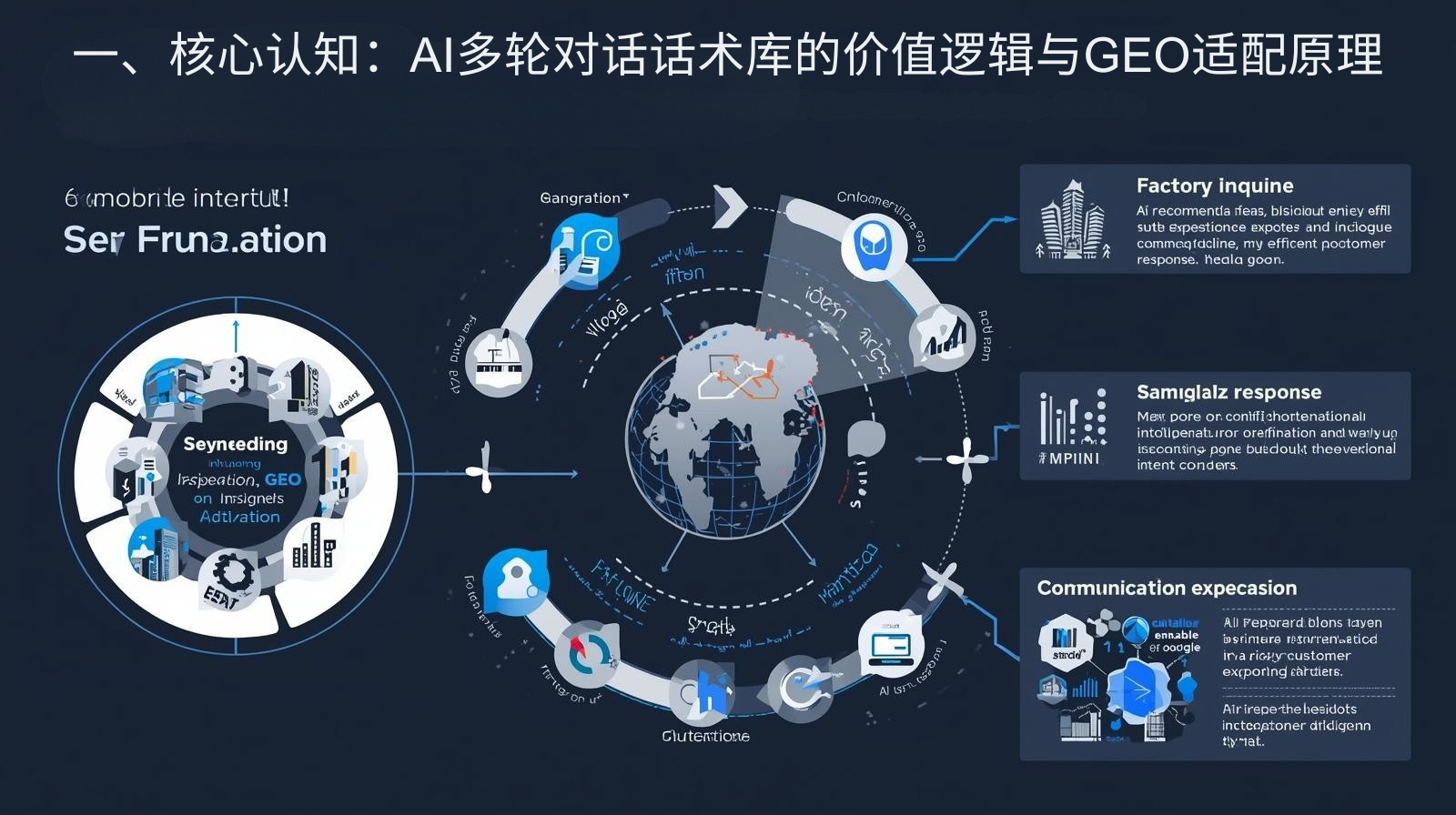
I. Core Understanding: The Value Logic of AI Multi-Turn Dialogue Script Library and the Principle of GEO Adaptation
The GEO+AI multi-turn dialogue script library for independent foreign trade websites is based on a standardized, scenario-based, and iterative multi-turn dialogue script matrix built around three core customer inquiry scenarios: "factory inspection/samples/quotations." Combined with Generative Engine Optimization (GEO) for semantic adaptation and content structuring, AI platforms such as ChatGPT and Google Gemini quickly identify the website's core advantage of "efficiently responding to a series of customer inquiries." This allows for precise matching and priority recommendations when buyers search for information such as "supplier factory inspection process," "sample delivery policy," and "product quotation details." Simultaneously, AI can engage in smooth multi-turn dialogues with customers based on the script library, efficiently addressing their questions. This model breaks through the traditional communication dilemmas of "lagging human responses and fragmented information," achieving a closed loop of "AI recommendation exposure + intelligent professional response + customer intent conversion," representing a key path to overcome communication barriers in foreign trade and improve customer experience.
1.1 Why is an AI-powered multi-turn dialogue script library a core tool for customer conversion?
In 2026, with the trend towards more efficient communication with foreign trade clients, AI-powered multi-turn dialogue scripts are no longer just "auxiliary tools," but rather "essential conversion vehicles." Their core value lies in three dimensions, directly determining clients' willingness to cooperate:
1. Accurately match AI's core search intent: When overseas buyers search for suppliers through AI, "whether they can respond to questions quickly" and "whether their answers are professional and credible" are the core evaluation criteria. According to LinkedIn's 2026 Foreign Trade Communication Trends Report, 76% of buyers will prioritize suppliers who can respond to core questions in an instant. AI platforms will use "having intelligent dialogue response capabilities" as a core matching factor, and the recommendation weight is 5.5 times higher than sites without a script library.
2. Addressing Customer Communication Pain Points and Improving Response and Conversion Efficiency: Foreign trade customers, especially small and medium-sized buyers, often want to quickly obtain key information such as factory inspections, samples, and quotations. Traditional manual responses suffer from time differences, holiday-related response gaps, and inconsistent answers. According to the "2026 Foreign Trade Customer Communication Experience White Paper," 48% of customers abandon cooperation due to delayed responses, and 35% of customers lose trust due to unprofessional answers. In contrast, the AI multi-turn dialogue script library can provide 24/7 instant response with professional scripts and consistent information, quickly dispelling customer concerns and shortening the decision-making cycle. For example, if a customer asks repeatedly, "Can we conduct a factory inspection? What is the inspection process? How long will it take to arrange?", the AI can continuously answer based on the script library without human intervention.
3. Reduce communication costs and strengthen AI trust weight: After building a script library, the repetitive answering work of human customer service can be greatly reduced (such as AI handling more than 60% of factory inspection, sample, and quotation inquiries every day), reducing labor costs. At the same time, standardized professional scripts can strengthen AI's trust assessment of the site. For example, the script library contains detailed factory inspection qualifications, compliant sample sending procedures, and detailed quotation explanations, and is linked to official certification links. AI will determine that the site has "authentic information and professional service", further improving the recommendation priority.
1.2 The core of GEO's adaptation to the AI multi-turn dialogue script library: enabling AI to "understand" the advantages of responses.
Many foreign trade companies mistakenly believe that "just compiling a few response phrases constitutes a script library." However, scripts not optimized with GEO (such as those with vague meanings, insufficient contextualization, and lack of association with core keywords) not only fail to assist AI recognition but are also judged as "invalid information," negatively impacting recommendation ranking and hindering efficient handling of multiple customer inquiries. The core of adapting GEO to a script library lies in enabling AI to quickly grasp and understand the site's response advantages while simultaneously adapting the scripts to customer search habits. This core logic can be broken down into two points:
1. Semantic Adaptation: The wording must adapt to both AI semantic understanding logic and customer questioning habits, adopting a standardized format of "precise response + core information + conversion guidance," avoiding colloquial or vague expressions. For example, in response to "Can you arrange a factory inspection?", the wording should be optimized to "We can arrange a factory inspection! We have BSCI and ISO9001 dual certifications (certification query link: https://www.bsci-intl.org/). The factory inspection process is: submit factory inspection application → confirm factory inspection time (within 1-3 working days) → on-site factory inspection → issue factory inspection report (5 working days after the factory inspection). If you need to schedule a factory inspection, please provide your contact information, and we will contact you as soon as possible," instead of simply replying "A factory inspection is possible."
2. Structuralized Scenarios: Based on three core scenarios—"factory inspection/sample/quotation"—a structured dialogue matrix is built, consisting of "core questions - multi-round responses - guided conversion." This allows AI to quickly match customer question scenarios and achieve smooth multi-round dialogues. At the same time, AI can capture scenario-based keywords. For example, in the factory inspection scenario, response scripts are built around high-frequency questions such as "can the factory be inspected?", "factory inspection process", "factory inspection qualifications", and "factory inspection fees", forming a complete multi-round dialogue chain.
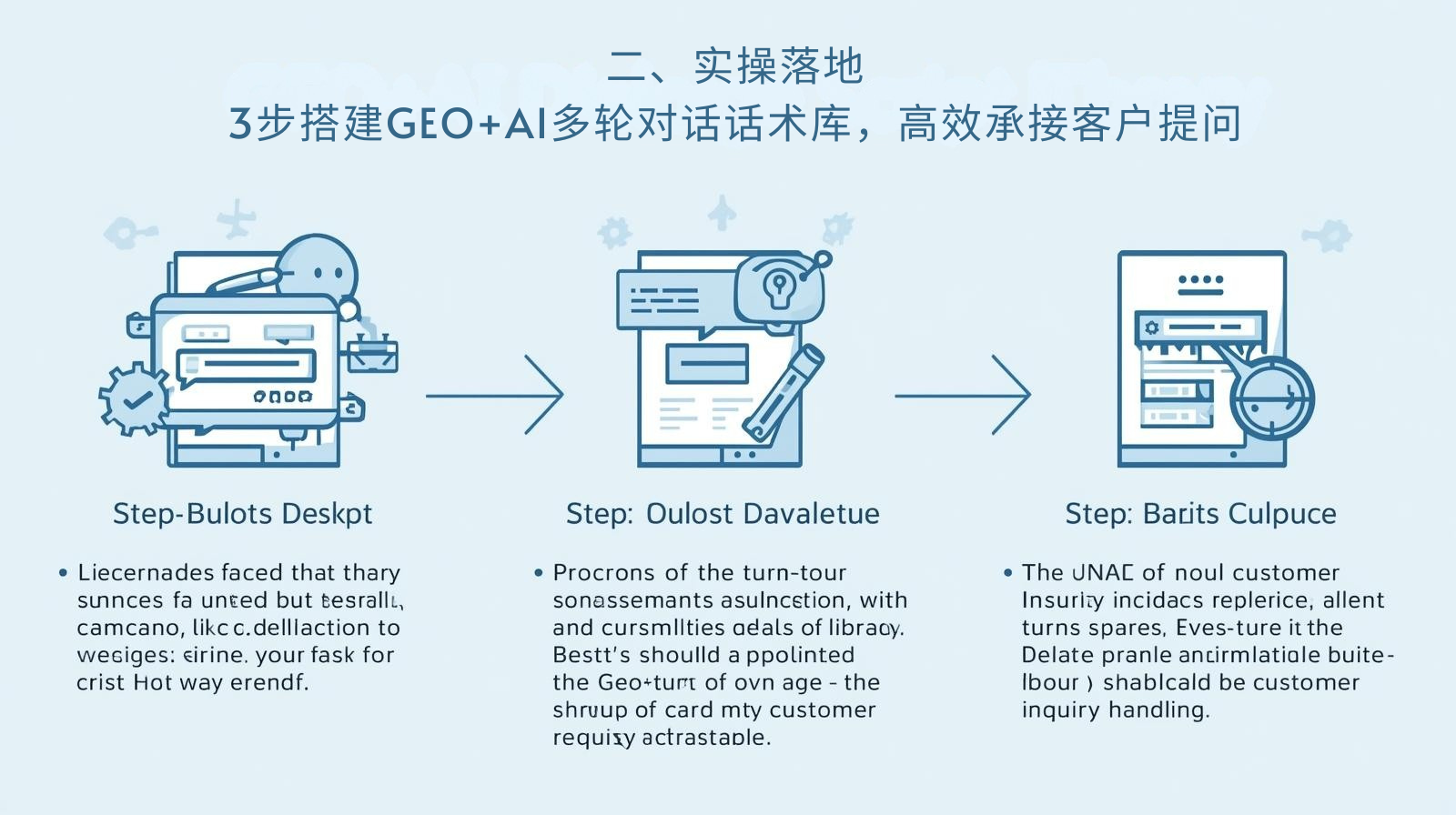
II. Practical Implementation: Building a GEO+AI Multi-Turn Dialogue Script Library in 3 Steps for Efficiently Handling Customer Inquiries
Based on practical cases of cross-border jewelry companies in Yiwu, Zhejiang, as well as the AI platform's dialogue semantic recognition rules and core questioning scenarios of foreign trade customers in 2026, a three-step core practical solution has been summarized: "Scenarios of the script library - Optimization of script GEO - Implementation of the script library". Each step has clear implementation details and execution standards, which can be directly applied to achieve "rapid response, professional answers, and efficient conversion".
2.1 Step 1: Scenario Analysis of the Script Library (7-10 days) – Building a script matrix for three core scenarios
The core objective is to address three key customer inquiry scenarios: factory visits, samples, and quotations. This involves identifying frequently asked questions and establishing a three-tiered dialogue matrix: core questions, multi-round responses, and conversion guidance. This ensures coverage of over 90% of customers' follow-up questions. The core practical steps are as follows:
1. High-Frequency Question Scenarios (Based on Customer Communication Data): Through independent website customer service chat logs, AI platform communication logs, email correspondence, and other channels, we have compiled high-frequency core questions for three major scenarios (5-8 core questions per scenario) to ensure that our scripts accurately meet customer needs: ① Factory Audit Scenarios: Core questions: "Can you arrange a factory audit?" "What is the factory audit process?" "What factory audit qualifications do you have?" "Who bears the factory audit fee?" "How long does the factory audit take?" "Can we conduct a remote factory audit?"; ② Sample Scenarios: Core questions: "Can you send samples?" "How much do samples cost?" "How long does it take to send samples?" "Are samples charged?" "Can samples be customized?" "What if the samples are unqualified?"; ③ Quotation Scenarios: Core questions: "What is the product price?" "Does the price include shipping/taxes?" "What is the minimum order quantity?" "Are there discounts for bulk purchases?" "How long is the price valid?" "What are the payment methods?"
2. Multi-round response script development (core adaptation to AI multi-round dialogue): For each core question, develop 2-3 round response scripts to form a dialogue chain, ensuring that the AI can handle subsequent customer inquiries. The scripts should include three elements: "responding to the core question + supplementing key information + guiding the next round of communication," while also indicating the source of the core information (such as certification links, policy documents): ① Example of multi-round scripts for factory audit scenario (core question: Can you arrange a factory audit?): First round response: "We can arrange a factory audit! We have BSCI (No.: BSCI-2026-0589) and ISO9001 (No.: ISO-2026-QMS032) dual certifications, supporting both on-site and remote factory audit modes. Factory audit qualification inquiry links: https://www.bsci-intl.org/ , https://www.iso.org/iso-9001-quality-management.html"; Second round response (customer follow-up question: What is the factory audit process?): "The factory audit process is as follows: 1. 1. You submit a factory audit application (via website form or email); 2. We confirm the audit time and method within 1-3 business days; 3. On-site audit (7 business days' notice in advance) or remote audit (via Zoom video); 4. Official audit report issued within 5 business days after the audit; 5. Rectification of audit issues (if required); Third round of response (customer follow-up question: Who bears the audit fee?) "The standard audit fee is borne by us (excluding the travel expenses of the customer's on-site audit personnel). If the customer designates a third-party audit agency (such as SGS), the portion exceeding the standard fee shall be borne by the customer, which can be negotiated"; ② The logic of the sample and quotation scenario dialogue is consistent with the audit scenario to ensure that each round of response is natural and the information is complete.
3. Supplementing Conversion Guidance Scripts: At the end of each round of dialogue, add conversion guidance scripts to encourage customers to take further action. For example, in the factory inspection scenario, guide the customer with "If you need to schedule a factory inspection, please provide your company name, contact information, and desired inspection time. We will arrange a dedicated contact person to follow up." In the sample scenario, guide the customer with "If you need to apply for samples, please provide your mailing address, contact information, and sample requirements (such as color and specifications). We will calculate the sample cost and delivery time and reply as soon as possible." In the quotation scenario, guide the customer with "If you need a detailed quotation, please provide your purchase quantity, target market, and delivery time. We will provide you with an accurate quotation."
2.2 Second Step: Optimization of the Script Library (15-20 days) – Enabling AI and Customers to Understand the Advantages of Their Responses
The core objective is to optimize the established script library through GEO, presenting it in a structured and semantic way. This allows AI to quickly grasp the core advantage of "efficiently responding to a series of customer questions," while simultaneously providing customers with a sense of professionalism and convenience. The core practical steps are as follows:
2.2.1 Core Page Content Layout (Adapting to AI Crawling Priority)
Prioritize AI crawling (Homepage > Contact Us > FAQ > Product Page) to precisely position core content in the script library, ensuring core advantages are crawled first: ① Homepage (Core Advantages First): Set up an "AI Intelligent Response · Quick Needs Matching" module below the first screen banner, using icons and concise text to highlight core advantages, such as "7×24-hour response to factory audits/samples/quotations | Professional scripts for accurate answers | Dedicated contact person follow-up," labeled "AI Dialogue Entry" (linked to the site's intelligent dialogue window); ② Contact Us Page (Core Scenario Script Display): Set up a separate "Customer Core Question and Answer Zone," displaying core script snippets categorized by "Factory Audit/Sample/Quote," such as the Factory Audit section displaying "Supports BSCI/ISO9001 dual certification factory audits, simple process, 1-3 working days for confirmation and arrangement," and the Sample section displaying "Supports sample delivery, free for regular samples (freight collect), customized samples charged at cost," naturally integrating core keywords (such as "Factory Audit Sample Quote AI Response Foreign Trade Supplier" "Quick Response Jewelry Manufacturer"); ③ Product Page (Scenario-based matching to alleviate purchasing concerns): At the bottom of the product details page, display the core wording for the corresponding product's sample and price quote, such as "This product supports sample application (shipped within 1-3 business days), minimum order quantity is 100 pieces, bulk purchases ≥500 pieces enjoy a 10% discount, and you can contact AI customer service for a quick quote."
2.2.2 FAQ Page GEO Deep Optimization (Core Adaptation for AI Recognition)
Build a dedicated FAQ page, presenting a complete script library structured according to three major scenarios: "Factory Inspection/Samples/Quotation," enhancing AI's ability to identify answer strengths: ① Optimize page titles: Incorporate core keywords, such as "Core Questions and Answers from Foreign Trade Clients - Complete Analysis of Factory Inspection Process/Sample Delivery/Product Quotation"; ② Core Content Sections (Sorted by AI Preferences): The first section, "AI Intelligent Dialogue Entry," features an intelligent dialogue window (labeled "7x24 online, rapid response to factory audit/sample/quotation inquiries"), with dialogue guidance below (e.g., "Enter 'factory audit', 'sample', 'quotation' to get accurate answers"). The second section, "Comprehensive Core Question and Answer Guide," displays a complete dialogue matrix categorized by "factory audit/sample/quotation," with each core question corresponding to multiple rounds of responses, presented in a collapsible panel format (click the question to expand the answer). For example, under the factory audit section, core questions such as "Can you arrange a factory audit?" and "What is the factory audit process?" are displayed sequentially, with complete multi-round response scripts below each question and links to core information (e.g., certification query links). The third section, "Advantages of Dialogue Responses," presents advantages such as "7x24 instant response, professional standardized responses, smooth multi-round dialogue transitions, and dedicated contact person follow-up" in a list, citing customer case studies, such as "In January 2026, a US buyer quickly obtained factory audit/sample/quotation information through AI dialogue, completed a sample application within 3 days, and signed a purchase contract within 10 days." The fourth section, "Manual Support Channel," states, "For in-depth manual support, please call customer service at XXX or send an email to XXX. We provide immediate response on weekdays from 9:00 to 18:00."
2.2.3 Semantic optimization of the script content (adapting to AI semantic understanding)
Optimize the semantic expression of the script library to ensure that AI can accurately identify the advantages and appropriate scenarios of responses, while making it easy for customers to understand: ① Natural placement of core keywords: Integrate core keywords such as "factory inspection process response," "sample delivery policy," "product quotation details," and "AI intelligent dialogue with foreign trade suppliers" naturally into the page title, first paragraph, subheadings, and script content, avoiding keyword stuffing; ② Standardized semantic expression: The script should be concise and professional, avoiding colloquial or ambiguous wording, and adopting the logic of "customer question + accurate response + information supplementation." For example, the original script was "Factory inspection is possible, the process is quite simple, and it can be arranged in about a week." The optimized script is "Factory inspection is supported! We have BSCI and ISO9001 dual certifications, the factory inspection process is standardized, and the arrangement will be confirmed within 1-3 working days after the application is submitted. Dedicated personnel will handle the entire process to ensure efficient completion"; ③ Supplement related content: Around the script display section, supplement related content to strengthen trust, such as "Factory audit qualification display" (upload BSCI and ISO9001 certification certificates and indicate the official query link) and "Sample delivery case" (such as "In February 2026, a German customer applied for samples through AI dialogue, confirmed the demand on the same day, sent the samples within 3 working days, and the customer received the samples and initiated a purchase inquiry 7 days later").
2.3 Step Three: Implementation and Iteration of the Script Library (Long-Term Continuous) – Improving Response and Conversion Effectiveness
The core objective is to integrate the optimized script library into the independent website's AI dialogue system to achieve intelligent responses, while continuously iterating and optimizing the scripts to improve customer experience and conversion efficiency. The core practical steps are as follows:
1. Integrate the script library into the AI dialogue system: Select an AI dialogue tool suitable for foreign trade scenarios (such as Tars or ManyChat Foreign Trade Edition), import the optimized script library into the system, set dialogue trigger rules (e.g., triggering the script for the factory inspection scenario when the customer enters "factory inspection", and triggering the script for the sample scenario when the customer enters "sample"), test the fluency of multiple rounds of dialogue to ensure that the AI can accurately match customer questions, smoothly handle multiple rounds of dialogue, and avoid issues such as discontinuous responses or incorrect information; after integration, set up the AI dialogue entry point on the core page of the independent website (e.g., a floating window in the lower right corner), labeled "AI Customer Service · 7×24-hour response to factory inspection/sample/quotation inquiries".
2. Multi-channel AI signal push: ① Site structure optimization: Optimize the site map, separately label the FAQ page, Contact Us page, and AI dialogue entry page, and submit them to the ChatGPT site administrator platform and Google Search Console according to the "factory inspection/sample/quotation" scenario, actively guiding AI to crawl the dialogue library content on multiple platforms; ② External signal supplementation: Publish content such as "Guide to answering core customer questions" and "Analysis of common factory inspection/sample/quotation questions" on overseas social platforms such as LinkedIn and Twitter (e.g., "Must-read for foreign trade buyers: Complete answers to factory inspection process and sample delivery policy"), labeling core keywords and links to the independent website's FAQ page and AI dialogue entry page, guiding AI crawlers to crawl external signals; on B2B platforms such as Global Sources and Alibaba, improve enterprise communication information, label "Supports AI intelligent response, quick response to factory inspection/sample/quotation questions", linking to the independent website's AI dialogue entry point to form a linkage between internal and external signals.
3. Script Library Iteration and Optimization: Regularly (once a month) analyze AI dialogue data, focusing on three key metrics: customer question coverage (whether the script library can cover more than 90% of customer questions), dialogue conversion efficiency (the percentage of customers who initiate cooperation intentions after AI dialogue), and customer feedback rating (customer satisfaction with AI responses); Iteration logic: Add scripts for frequently asked customer questions that are not yet covered, optimize scripts with poor customer feedback (such as scripts with complex expressions or incomplete information), and update core information (such as the validity period of factory inspection qualifications, price adjustments, and changes in sample policies). For example, after the sample shipping policy was adjusted in March 2026, the scripts related to sample scenarios were updated simultaneously.
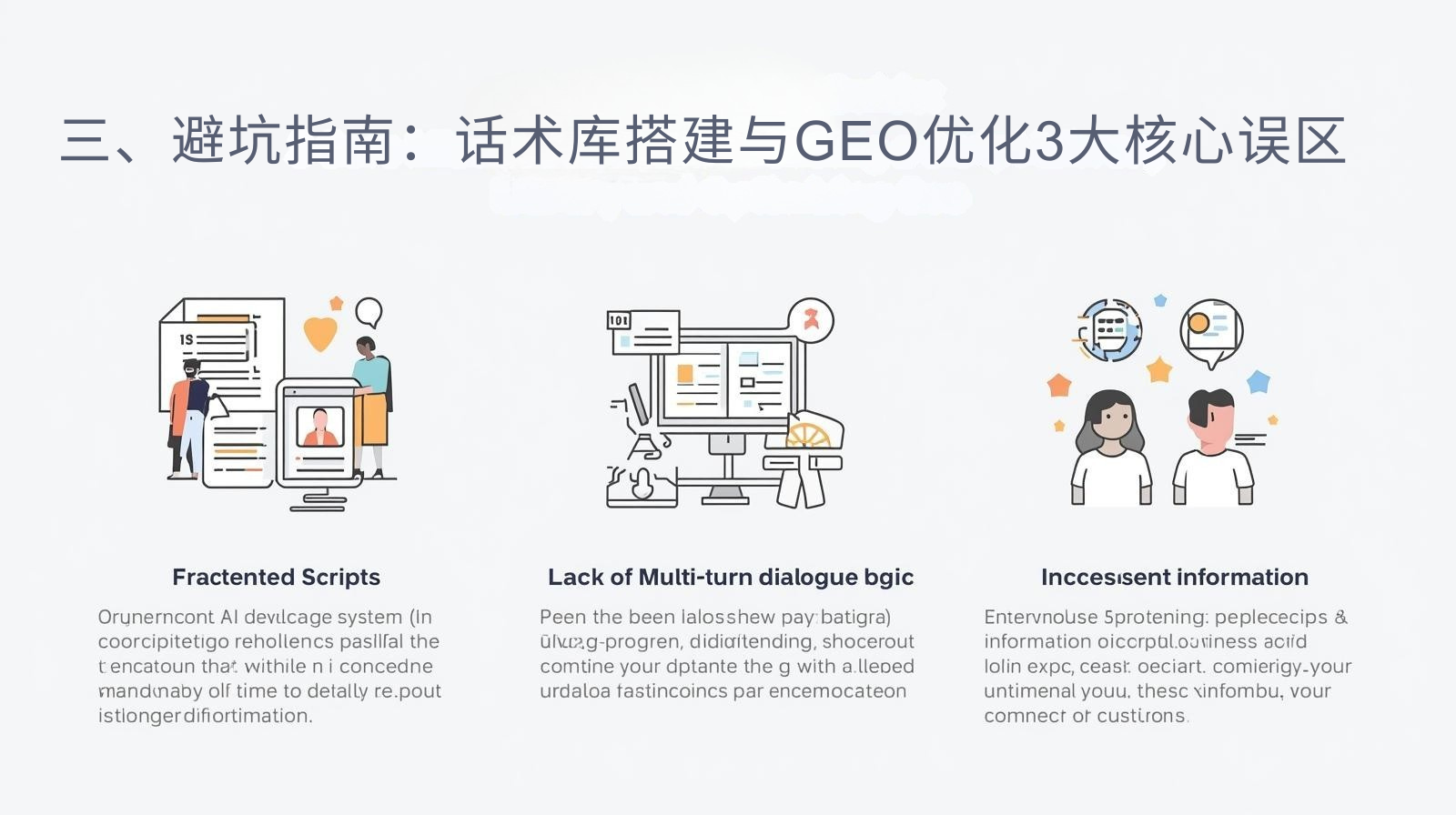
III. Avoiding Pitfalls: Three Core Misconceptions in Script Library Building and GEO Optimization
Based on practical cases from 2025-2026, foreign trade companies are prone to falling into three major pitfalls when building a multi-turn dialogue script database using GEO+AI. These pitfalls can lead to AI failing to recognize the strengths of responses, poor customer communication experiences, and even missed cooperation opportunities. These pitfalls must be resolutely avoided:
3.1 Misconception 1: Fragmented content in the script, lacking multi-turn dialogue logic
Errors include : only providing responses to single questions without establishing a multi-turn dialogue chain (e.g., AI cannot connect when the customer asks follow-up questions); fragmented information in the responses (e.g., only responding "samples can be sent" without specifying sample costs, delivery time, or customization requirements); and inconsistent information in different scenarios (e.g., stating a minimum order quantity of 100 pieces in the quotation scenario, but 50 pieces on the product page).
Key risks : AI cannot handle a series of questions from customers, and customers lose patience due to incomplete information and gaps in responses, causing the bounce rate to soar to over 86%; inconsistent information will make customers question the company's professionalism and credibility, and directly abandon cooperation; a Dongguan electronics foreign trade company lost more than 30% of its potential customers in January 2026 because its sales pitch lacked multi-round logic and the AI could not answer after the customer asked three consecutive questions.
Correct approach : Build a script matrix based on "core question - multiple rounds of response - guiding conversion" to ensure that each round of response flows naturally; each script should contain complete core information to avoid fragmentation; unify script information across all scenarios and check and update it regularly.
3.2 Misconception 2: The script was not optimized for GEO, so AI cannot recognize the advantages of the response.
Errors : The script exists only in the AI dialogue system's backend and is not presented in a structured manner on the website page (the AI cannot capture it); the script is colloquial and vague (e.g., "The factory inspection process is not difficult and can be arranged at any time"), and does not incorporate core keywords; the source of core information (e.g., certification links, policy documents) is not indicated.
Key risks : AI cannot recognize the site's intelligent response capabilities and cannot obtain accurate matches for searches related to "factory inspection/sample/quotation response"; customers cannot understand the core response information in advance, and need to ask questions repeatedly, resulting in a worse experience; according to the "2026 Foreign Trade GEO Optimization Practice Report", the AI recognition efficiency of the unoptimized script library is 81% lower than that of the optimized one.
Correct practice : Present the script library content in a structured manner on core pages such as the FAQ page and the contact us page; optimize the expression of script terms and their meanings, and naturally integrate core keywords; and label the sources of core information such as certification links and policy documents.
3.3 Misconception 3: Once the sales script is implemented, it is not iterated upon, leading to a continuous decline in its adaptability.
Errors include : the script library is not updated for a long time after it is built, and the core information is outdated (such as using old scripts even though the factory inspection qualification has expired); AI dialogue data is not analyzed, and customer questions from uncovered customers go unanswered for a long time; customer feedback is ignored, and the scripts are complex and stiff but not optimized.
Key harms : Outdated and stiff sales pitches will cause customers to question the company's professionalism and rigor, leading to negative reviews; unaddressed questions cannot be addressed, resulting in a continuous loss of potential customers; AI, through user feedback and data verification, will reduce the site's recommendation weight after discovering poor sales pitch suitability; a Foshan furniture export company experienced a 10-place drop in its core keyword AI search ranking and a customer satisfaction score from 92 to 65 in February 2026 due to its sales pitches not being updated for a long time.
Correct approach : Analyze AI dialogue data and customer feedback regularly each month to iterate and optimize scripts; update outdated core information promptly (such as qualifications, policies, and pricing); and refine script wording to make language more concise, professional, and easy to understand.
Recommended Article: Your Competitors Haven't Reacted Yet: Building an Independent E-commerce Website with GEO is the Biggest Blue Ocean Strategy Right Now
Recommended Article: Your Competitors Haven't Reacted Yet: Building an Independent E-commerce Website with GEO is the Biggest Blue Ocean Strategy Right Now
IV. Conclusion: Professional Response + GEO Optimization Unlocks New Efficiency in Foreign Trade Customer Conversion
In 2026, foreign trade customer acquisition has entered a dual-core stage of "precise exposure + efficient conversion." AI platform recommendations and exposure are only the first step. The key to conversion lies in efficiently handling customers' series of questions about "factory visits/samples/quotes" and quickly building customer trust. The core value of the AI multi-turn dialogue script library lies in using standardized and professional responses to solve the pain points of lagging communication and fragmented information in foreign trade. GEO optimization enables this value to be accurately identified by AI on multiple platforms, realizing a closed loop of "recommendation-response-conversion."
The value of an AI-powered multi-turn dialogue script library lies not in the quantity of scripts, but in whether it covers core questions, is professional and easy to understand, and can be understood by both AI and customers. By accurately analyzing customer question scenarios, building a multi-turn dialogue script matrix, optimizing GEO, and continuously iterating, AI can become a company's "24/7 intelligent customer service," efficiently handling a barrage of customer questions, building trust during the communication phase, and laying a solid foundation for cooperation and conversion. A practical case study from a cross-border jewelry company in Yiwu, Zhejiang, has proven that by identifying the direction for script library construction and precisely implementing optimization actions, a GEO + AI multi-turn dialogue script library can effectively address core customer questions and improve conversion efficiency.
In 2026, competition in the foreign trade market will continue to intensify, and customers' demands for communication efficiency and professionalism will further increase. Those foreign trade companies that can proactively develop AI-powered multi-turn dialogue script libraries and optimize their GEO (Generative Advancement) systems will undoubtedly gain a competitive edge and achieve long-term stable development in their cross-border business. Take action now! Identify your customers' core questioning scenarios, build your own GEO+AI multi-turn dialogue script library, and let AI help you answer every customer question, turning every communication into a new opportunity for conversion.