Data from the 2026 Global Foreign Trade Supply Chain Survey shows that when overseas buyers use AI platforms such as ChatGPT and Google Gemini to screen suppliers, 86% of their precise procurement needs target "integrated manufacturing and trading full-chain suppliers." Integrated manufacturing and trading companies with clearly demonstrated advantages receive a 235% higher recommendation weight from AI platforms compared to pure trading companies. However, the current situation is that over 84% of integrated manufacturing and trading foreign trade companies fail to systematically showcase their core advantages on their independent websites, only mentioning their production and trading capabilities in a scattered manner. Furthermore, they haven't optimized their AI recognition logic using GEO, making it difficult for AI to accurately identify their full-chain supplier status. Even with comprehensive capabilities in production, R&D, and trading, they struggle to stand out in precise search scenarios. A Ningbo-based cross-border home appliance manufacturing and trading company leveraged GEO to systematically showcase its integrated manufacturing and trading advantages. Within three months, its ranking on the AI platform for keywords such as "full-chain home appliance supplier" and "integrated manufacturing and trading home appliance manufacturer" jumped from 20th to 3rd place. High-quality inquiries increased by 172%, and the average customer cooperation cycle was shortened by 28 days. This case demonstrates that the core of GEO's integrated manufacturing and trading advantages is enabling AI to clearly identify a company's full-chain capabilities—from R&D to production, quality control, logistics, and after-sales service—making it a preferred full-chain partner for buyers.
I. Core Understanding: The Value Logic of Integrated Industry and Trade and the Principle of GEO Adaptation
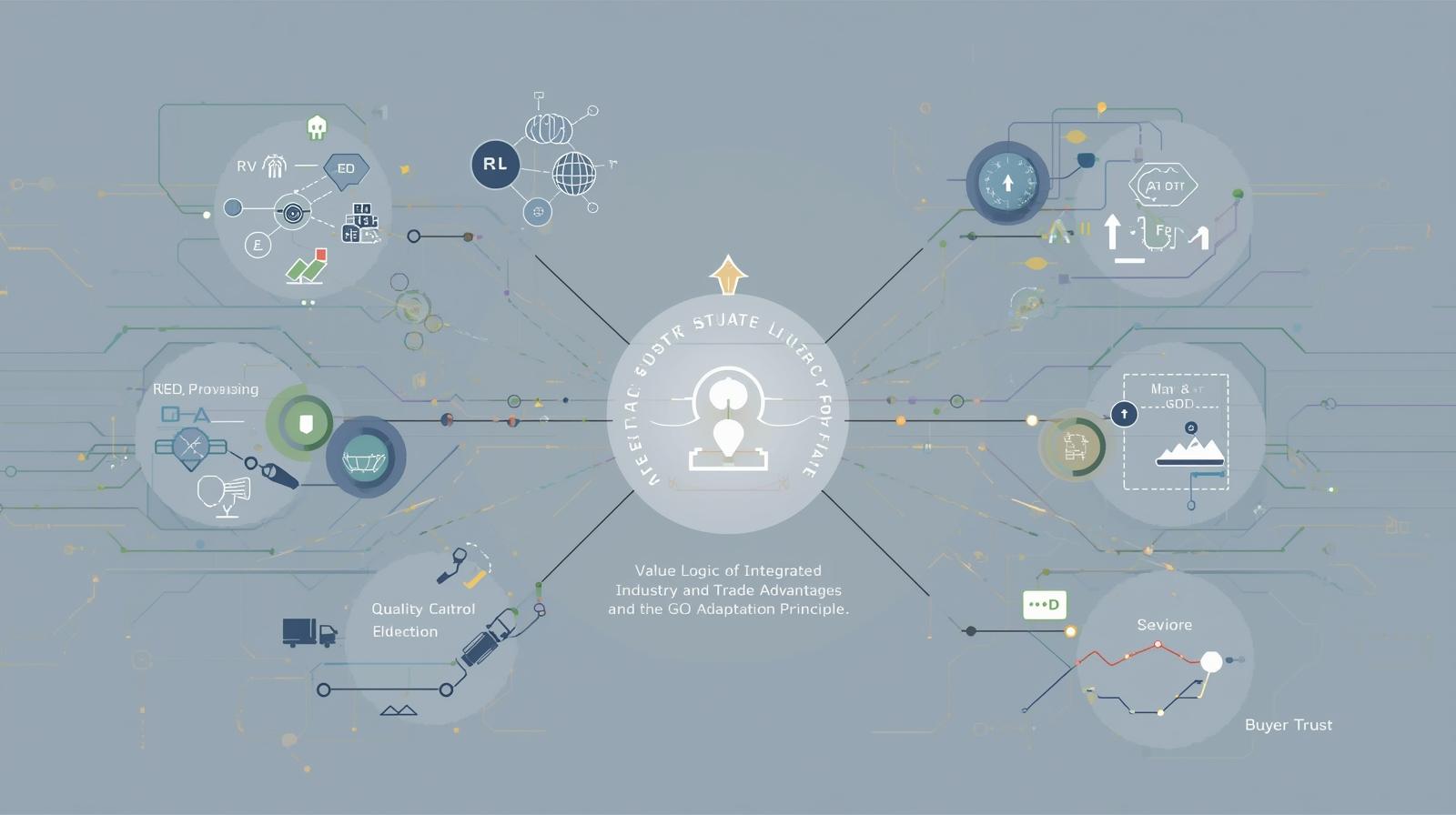
The core of the GEO+ integrated manufacturing and trading advantage showcase on independent foreign trade websites revolves around a company's full-chain capabilities in "R&D, production, quality control, logistics, and after-sales service." It identifies and prioritizes differentiated core advantages, combining semantic adaptation and content structuring through Generative Engine Optimization (GEO). This allows multi-platform AI to quickly capture and identify the company's "full-chain supplier" identity, enabling precise matching and priority recommendations when buyers search for "full-chain supplier" or "integrated manufacturing and trading manufacturer." This model breaks away from the traditional misconception of "emphasizing products while neglecting capabilities," transforming the company's implicit full-chain capabilities into explicit advantages that are identifiable by AI and perceptible to buyers. It achieves a closed loop of "accurate AI identification - buyer trust building - efficient conversion," representing a key path to overcome competition in the foreign trade supply chain and build core barriers to entry.
1.1 Why is the advantage of integrated industry and trade the core of AI's identification of full-chain suppliers?
In the context of the trend towards flattening foreign trade supply chains in 2026, integrated industry and trade has become a core criterion for buyers to select suppliers. Its value for AI identification and customer conversion is reflected in three core dimensions:
1. Precise Matching of AI Core Recognition Dimensions: The core dimension for the AI platform to determine "full-chain suppliers" is whether the enterprise has full-chain capabilities of "R&D-production-quality control-logistics-after-sales service". According to Statista's 2026 survey data on foreign trade suppliers, enterprises with complete integrated industrial and trade capabilities have a 91% pass rate in the AI platform's "full-chain supplier" identity recognition, and their recommended exposure is 2.3 times higher than that of pure traders.
2. Addressing core pain points for buyers and enhancing trust and conversion rates: Overseas buyers, especially medium and large-sized buyers, tend to prefer integrated industrial and trading suppliers. Their core pain points are "unstable supply, weak customization capabilities, lack of quality control, and uncontrollable delivery times." Integrated industrial and trading companies can achieve on-demand customization and stable supply through their own factories, ensure product quality through end-to-end quality control, and shorten delivery times through their own logistics channels. According to the "2026 White Paper on Foreign Trade Buyer Demands," buyers who choose integrated industrial and trading suppliers have a 78% higher satisfaction rate and a 52% higher repurchase rate compared to those who choose pure trading companies.
3. Build differentiated competitive barriers and strengthen AI trust weight: In the current foreign trade market, pure trading companies face fierce competition due to homogeneity, while integrated industrial and trading enterprises have a natural differentiated advantage in terms of their full-chain capabilities. At the same time, by showcasing authoritative certifications such as production qualifications, R&D patents, and quality control systems, AI can significantly enhance its trust assessment of enterprises. For example, by showing ISO9001 production quality management system certification, videos of production in their own factories, and R&D patent certificates, AI will determine that the enterprise has "genuine capabilities and complete qualifications," further increasing its recommendation priority.
1.2 The core of GEO's adaptation to the advantages of integrated industry and trade: enabling AI to "understand" the entire supply chain capabilities.
Many integrated manufacturing and trading companies mistakenly believe that "posting a few factory pictures and mentioning integration of manufacturing and trading on a website is enough to showcase their advantages." However, without GEO-optimized content (such as fragmented information, semantic ambiguity, and lack of authoritative supporting evidence), AI cannot recognize their end-to-end capabilities and they will still be classified as ordinary suppliers. The core of adapting GEO to advantage display lies in enabling AI to quickly capture and clearly understand a company's end-to-end capabilities. This core logic can be broken down into two points:
1. Semantic Adaptation: Use AI-recognizable standardized expressions to clearly convey information such as "full-chain capability coverage, core advantages and highlights, and authoritative qualification certifications," avoiding vague and colloquial expressions. For example, "We are an integrated home appliance manufacturing and trading company integrating R&D, production, quality control, logistics, and after-sales service. We have a 10,000㎡ self-owned factory (annual production of 5 million units), a 20-person R&D team (with 32 utility model patents), and an ISO9001 quality control system. We support on-demand customization, 7-day rapid sampling, and 48-hour delivery. Our logistics cover more than 200 countries worldwide (cooperating with authoritative logistics providers such as 4PX Express and TransWorld Logistics)," rather than simply stating "We are an integrated manufacturing and trading manufacturer."
2. Structuralized Content: The advantages of integrated industry and trade are presented in a structured manner according to the logic of "R&D capabilities - production capabilities - quality control capabilities - logistics capabilities - after-sales capabilities". The credibility of the information is enhanced by clear division of sections and authoritative supporting materials (certificates, videos, data), which enables AI to quickly capture the core capabilities of each link, while making it convenient for buyers to understand intuitively.
II. Practical Implementation: Three-Step Collaborative Optimization to Make AI Recognize You as a Full-Chain Supplier
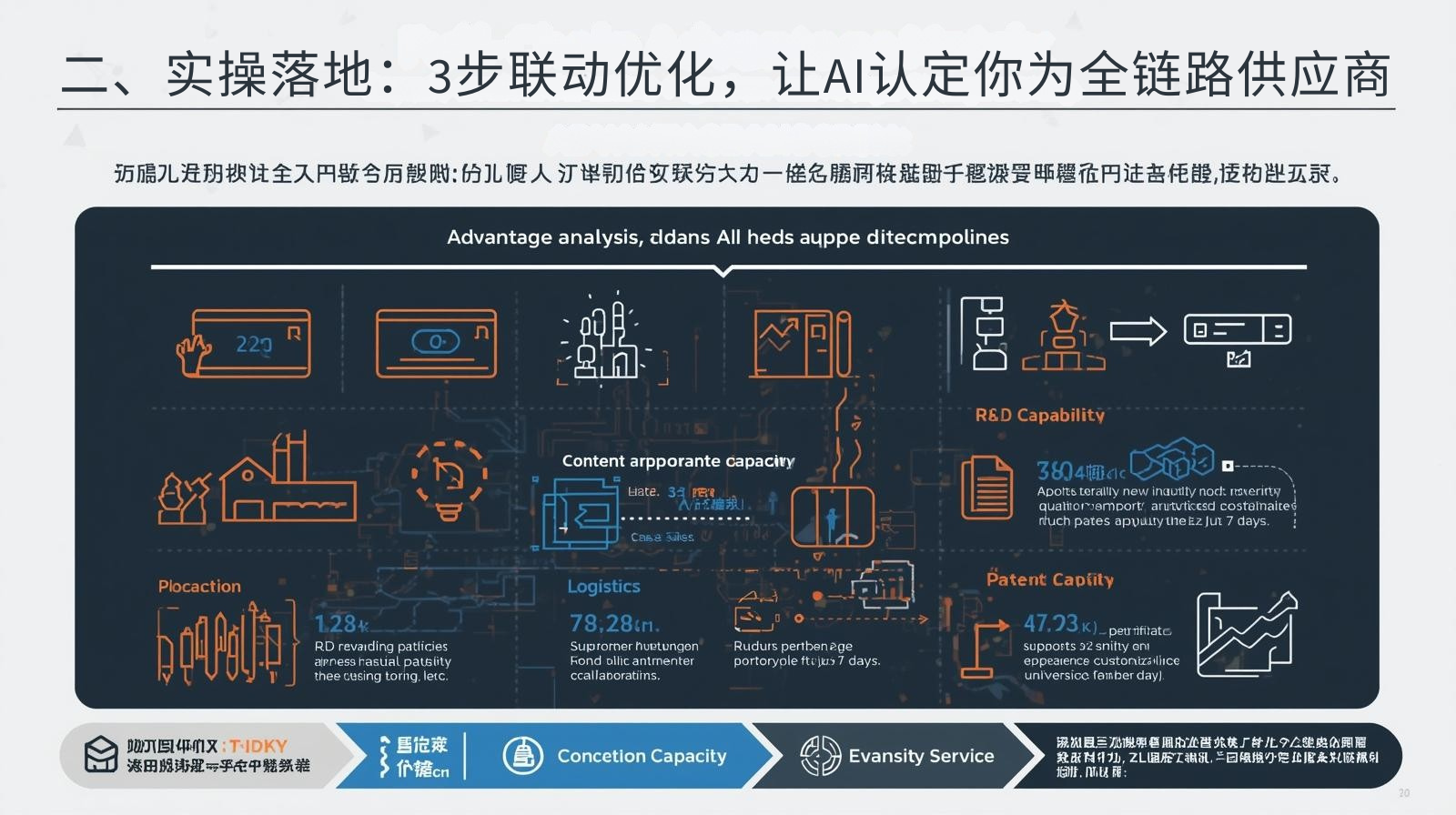
Based on practical cases of Ningbo cross-border home appliance companies, as well as the 2026 AI platform's "full-chain supplier" identification rules and the core demands of foreign trade buyers, a three-step core practical solution has been summarized: "advantage analysis - content GEO optimization - AI signal enhancement". Each step has clear implementation details and execution standards, which can be directly applied to achieve "AI accurate identification + efficient conversion".
2.1 Step 1: Identifying the Core Advantages of Integrated Industry and Trade (7-10 days) – Building a Full-Chain Advantage Matrix
The core objective is to identify the company's differentiated core advantages across the entire value chain, from R&D to production, quality control, logistics, and after-sales service. This involves extracting key information that can be demonstrated, corroborated, and recognized by AI, laying the foundation for subsequent GEO optimization. The core practical steps are as follows:
1. Full-chain advantage analysis (3-5 core advantages extracted from each dimension): Based on the company's actual capabilities, advantages are analyzed according to five core dimensions, ensuring that each advantage is supported by authoritative evidence (certificates, data, case studies): ① R&D capability advantage: R&D team configuration (number of people, qualifications), patent reserves (quantity, type, patent number), customized R&D capability (prototype timeliness, customization scope), technical cooperation resources (such as cooperation with universities and research institutions), for example, "A 20-person R&D team (including 5 senior engineers) has 32 utility model patents (patent number: ZL20252XXXXXXX, etc.), supports product function and appearance customization, and rapid prototyping takes only 7 days"; ② Production Capacity Advantages: ① Own factory scale (area, capacity), production line configuration (automation level, number of production lines), delivery cycle (delivery time for regular orders, response capability for urgent orders), production qualifications (ISO9001, BSCI, etc. certifications), for example, "10,000㎡ own factory, annual capacity of 5 million units, 3 automated production lines (automation rate up to 85%), regular order delivery time 48 hours, urgent order response 24 hours, possessing ISO9001 production quality management system certification (certificate number: ISO-2026-QMS058)"; ② Quality Control Capacity Advantages: Quality control process (incoming material inspection, production inspection, finished product inspection), testing equipment (type, accuracy), pass rate data (first-pass yield rate of finished products), quality control certifications (such as RoHS, CE certification), for example, "Established a three-level quality control system of 'incoming material-production-finished product,' equipped with 20 precision testing devices, the first-pass yield rate of finished products reaches 99.2%, and products have passed RoHS and CE certifications (certification query link: https://www.rohsdirective.com/)"; ③ Logistics Capability Advantages: Logistics partner resources (names of authoritative logistics providers), delivery range (countries/regions covered), logistics timeliness (timeliness in different regions), logistics services (door-to-door, customs clearance assistance), for example, "Deep cooperation with authoritative logistics providers such as 4PX Express and TransWorld, logistics coverage of 200+ countries worldwide, delivery time of 7-15 days in Europe and America, delivery time of 3-7 days in Southeast Asia, supporting door-to-door delivery and customs clearance assistance"; ⑤ After-sales Capability Advantages: After-sales response timeliness, after-sales coverage, after-sales methods (online + offline), warranty period, for example, "7×24-hour after-sales response, after-sales coverage of 180+ countries worldwide, supporting online (email, WhatsApp) and offline (overseas after-sales network) services, product warranty of 2 years".
2. Compilation of Supporting Materials for Advantages: Authoritative supporting materials will be prepared for each core advantage, used for subsequent content presentation and GEO optimization, enhancing AI's credibility with buyers: ① Qualification Certificates (R&D patent certificates, production certification certificates, quality control certification certificates, etc., with certificate numbers and official verification links); ② Physical and Scenario Materials (factory photos, production line videos, R&D team photos, quality control testing process videos, etc.); ③ Data and Case Studies (production capacity data, pass rate data, customized cooperation cases, stable supply cases, etc., such as "From January to February 2026, we stably supplied 100,000 home appliances to a US buyer with zero quality complaints and a 100% on-time delivery rate").
3. Extracting Differentiated Advantages: From the identified advantages, extract 2-3 core differentiated advantages (core capabilities that distinguish them from competitors), such as "Supporting small-batch customization (minimum order quantity 50 pieces) + 48-hour fast delivery" and "Having its own R&D team, capable of undertaking complex functional customization projects," as core highlights to strengthen AI recognition and memorability.
2.2 Step Two: Optimization of Key Content (GEO) (15-20 days) – Enabling AI and Buyers to Understand End-to-End Capabilities
The core objective is to present the identified advantages and supporting materials across the entire supply chain in a structured and semantically meaningful way through GEO optimization. This allows AI to quickly extract core information, identify suppliers across the entire supply chain, and enable buyers to intuitively perceive the company's strength. The core practical steps are as follows:
2.2.1 Core Page Advantage Layout (Adapting to AI Crawling Priority)
Prioritizing AI crawling (Homepage > About Us > Production Strength > Product Page), we precisely position our competitive advantages to ensure they are prioritized for crawling: ① Homepage (Core advantages first, reinforcing AI's initial recognition): The first-screen banner highlights differentiated core advantages, such as "Integrated Home Appliance Manufacturing and Trading Supplier | Customized R&D + Own Factory + 48-Hour Delivery"; a "Full-Chain Capabilities" module is set below the banner, using icons, concise text, and data to showcase five dimensions of core advantages, such as "R&D: 32 patents, 7-day prototyping" and "Production: 10,000㎡ factory, 5 million unit capacity," with authoritative supporting documentation for each advantage (e.g., clicking "Production" allows viewing factory videos); the footer displays core certifications (including official query links), such as "ISO9001 Certification | BSCI Certification | RoHS Certification"; ② About Us Page (Systematic Display of Full-Chain Advantages): The page title is optimized to "XX Home Appliance | Integrated Manufacturing and Trading Supplier - "One-stop service for R&D, production, quality control, logistics, and after-sales service"; the main text is organized according to the logic of "R&D capability - production capability - quality control capability - logistics capability - after-sales capability", and details the advantages in sections. Each section includes "advantage description + data support + supporting materials". For example, the production capability section states "10,000㎡ of self-owned factory, located in Ningbo Yuyao Industrial Park, equipped with 3 automated production lines (automation rate of 85%), annual production capacity of 5 million units, regular order delivery time of 48 hours, urgent order response within 24 hours, and ISO9001 production quality management system certification (certificate number: ISO-2026-QMS058, query link: https://www.iso.org/iso-9001-quality-management.html)", and also embeds real factory photos and production line videos.
2.2.2 Optimization of the advantages of the production strength page and product page (accurate identification of core adaptation)
The production capabilities page and product page are core pages for AI to verify a company's end-to-end capabilities and require key optimization: ① Production Capabilities Page: Build a separate "Production Capabilities Special Page" with a title incorporating core keywords, such as "Own Factory | Home Appliance Production Capabilities - Integrated Manufacturing and Trading End-to-End Supplier"; the page content should include "Factory Overview (Area, Capacity, Address), Production Line Configuration (Automated Equipment, Production Process), Quality Control and Testing (Three-Level Quality Control Process, Testing Equipment), Cooperation Cases (Stable Supplier Cases)," embedding a panoramic view of the factory and quality control and testing videos, and indicating "Supports on-site visits, factory tours can be scheduled"; ② Product Page (Integrating Advantages into Contexts to Alleviate Procurement Concerns): The "Product Advantages" module on each product details page incorporates corresponding integrated manufacturing and trading advantages. For example, customized products are labeled "Supports Function/Appearance Customization (In-house R&D Team, 7-Day Prototype)", while regular products are labeled "Made in-house Factory, 48-Hour Fast Delivery, 99.2% First-Time Pass Rate". The bottom of the product page displays "Full-Chain Service Commitment: R&D Customization - Production Supply - Quality Control Assurance - Logistics and Distribution - After-Sales Follow-up," naturally integrating core keywords (such as "Integrated Manufacturing and Trading Full-Chain Supplier" and "In-house Appliance Manufacturer").
2.2.3 Optimization of semantic advantages (adapting to AI semantic understanding)
Optimize the semantic description of the advantages showcase to ensure AI can accurately identify the entire supply chain capabilities while making it easy for buyers to understand: ① Natural placement of core keywords: Integrate core keywords such as "integrated industrial and trade full-chain supplier," "own factory manufacturer," "integrated R&D and production supplier," and "customized R&D + production supply" naturally into the page title, first paragraph, subheadings, and advantage descriptions, avoiding keyword stuffing; ② Standardized semantic description: Adopt the expression logic of "capability dimension + core advantages + data support + authoritative evidence," such as "R&D capabilities: Possess a professional R&D team of 20 people (including 5 senior engineers), and have obtained a total of 32 utility model patents (patent number: ZL20252XXXXXXX, etc.), supporting product function and appearance customization, rapid prototyping in just 7 days, and R&D strength can be verified through the patent search link (https://www.cnipa.gov.cn/)"; ③ Supplement with scenario-based content: Add customer cooperation cases to the advantages display section, such as "In January 2026, we reached a customized cooperation with a well-known German home appliance brand. We relied on our own R&D team to complete the product function optimization and realized mass production through our own factory. The first batch of 1,000 products was shipped within 48 hours. The customer highly recognized the delivery time and product quality." This strengthens the trust assessment of AI in the entire chain capability.
2.3 Step 3: AI Signal Enhancement Push (Starts in 3-5 days, continues long-term) – Enhancing the weight of identity verification across the entire process.
The core objective is to proactively convey the key message of "integrated industrial and trading full-chain supplier" to the AI platform, accelerate content inclusion and identity verification, and prioritize the site's display in "full-chain supplier" related searches. The core practical steps are as follows:
1. Structured Signal Optimization: Optimize content based on AI-preferred formats, clearly distinguishing core sections such as "R&D Capabilities" and "Production Capabilities" using H2-H3 headings, presenting data such as production capacity and timeliness in tables, and showcasing core advantages in lists; add alt text to materials such as factory videos and qualification certificates (e.g., "10,000㎡ Home Appliance Factory - Integrated Industrial and Trading Supplier" and "ISO9001 Production Certification Certificate - Home Appliance Manufacturer") to enable AI to recognize material information; optimize site maps, separately labeling core pages such as the About Us page, Production Strength page, and Product page, and submitting them to the ChatGPT website administrator platform, Google Search Console, and Bing Webmaster Tools according to the capability dimensions of "R&D - Production - Quality Control - Logistics - After-sales" to proactively guide AI crawling across multiple platforms.
2. Multi-channel signal push: ① AI platform signal submission: Submit an application for "Integrated Industry and Trade Full-Chain Advantage Information Update" through the ChatGPT official website administrator portal, highlighting that "the site's enterprises possess full-chain capabilities in R&D, production, quality control, logistics, and after-sales service, own their own factories, professional R&D teams, and authoritative certifications, and are integrated industry and trade full-chain suppliers, suitable for overseas buyers' one-stop procurement needs," accelerating AI's identification of the full-chain identity; ② External signal supplementation: On overseas social media platforms such as LinkedIn and Twitter, publish content such as "Introduction to the full-chain capability of integrated manufacturing and trading" and "How buyers select full-chain suppliers" (e.g., "Must-Read for Home Appliance Buyers: Selection Criteria and Cooperation Advantages of Full-Chain Suppliers"), marking core keywords and links to the independent website's About Us page and production strength page, embedding factory videos and qualification certificate images, and guiding AI crawlers to crawl external signals; on B2B platforms such as Global Sources and Made-in-China, improve company information, mark the identity of "integrated manufacturing and trading full-chain supplier", upload materials such as factory real-life scenes and qualification certificates, and link them to the core pages of the independent website to form a linkage between internal and external signals; at the same time, publish the company's full-chain capability introduction on industry vertical platforms (such as the official website of Home Appliance Magazine in the home appliance industry) to enhance the authority of the signal.
3. Continuous optimization of competitive content: Regularly update the content showcasing competitive advantages, such as adding R&D patents, expanding factory scale, increasing production capacity, and adding authoritative certifications, and promptly synchronize them to all core pages of the site; analyze the ranking changes of keywords related to "full-chain supplier" on the AI platform every month and optimize the semantic description of competitive content; regularly collect feedback from buyers and supplement the competitive information that buyers care about (such as small-batch customization capabilities and urgent order response capabilities), and strengthen the weight of AI identity recognition.
III. Avoiding Pitfalls: Three Core Misconceptions in Advantage Presentation and GEO Optimization
Based on practical case studies from 2025-2026, integrated industrial and trading companies are prone to falling into three major pitfalls when optimizing their GEO+ advantage presentation. These pitfalls can lead to AI failing to recognize their full-chain identity, buyers being unable to perceive their core strengths, and even missing out on cooperation opportunities. These pitfalls must be resolutely avoided:
3.1 Misconception 1: Fragmented presentation of advantages, lacking a complete value chain logic
Errors include : only showing advantages in a single dimension in a scattered manner (e.g., only showing factory pictures without mentioning R&D and quality control capabilities); lack of logical connection between the advantages (e.g., R&D capabilities and production capabilities are displayed separately, failing to reflect end-to-end synergy); inconsistent advantage information across different pages (e.g., the homepage states an annual production capacity of 5 million, while the production strength page states 3 million).
Key risks : AI cannot identify a company's full-chain capabilities, only determining that it has single production or trading capabilities, and cannot obtain "full-chain supplier" status; buyers cannot fully understand the company's strength, hesitate to cooperate, and the bounce rate soars to over 87%; a Foshan hardware and trade company failed to obtain "full-chain supplier" status from AI in January 2026 due to fragmented display of its advantages, resulting in the loss of 40% of high-quality inquiries;
Correct approach : Showcase advantages according to the entire chain logic of "R&D-production-quality control-logistics-after-sales service" to ensure that advantages in all dimensions are synergistic and related; unify the advantage information on all pages and check and update it regularly; and mark each advantage with data support and authoritative evidence.
3.2 Misconception 2: Lack of supporting evidence for superior content leads to distrust between AI and buyers.
Errors include : verbally stating advantages (e.g., "We have strong R&D capabilities and strict quality control") without providing authoritative supporting evidence such as qualification certificates, data, or videos; lacking official verification links for supporting materials (e.g., only posting images of certification certificates without indicating certificate numbers and verification channels); and falsely exaggerating advantages (e.g., claiming to have a "10,000㎡ factory" when there is no factory of their own).
Key harms : AI cannot verify the authenticity of advantages, reducing the trust weight of enterprises, and may even judge it as "false information", affecting the overall recommendation ranking; buyers abandon cooperation because they cannot verify strength, resulting in negative reviews; according to the "2026 Foreign Trade GEO Optimization Pitfall Avoidance Report", the trust level of customers is 83% lower for advantages without authoritative verification than for those with verification.
Correct practice : Each core advantage should be accompanied by supporting materials such as qualification certificates, data, and videos, with official verification links provided; false or exaggerated advantages must be resolutely avoided, and all information presented must be true and verifiable.
3.3 Misconception 3: Without GEO semantic optimization, AI cannot recognize core capabilities.
Errors include : using colloquial or vague statements about advantages (e.g., "Our factory is large and has high production capacity"), and failing to incorporate core keywords; presenting advantages in an unstructured manner, with core information obscured by redundant content; uploading advantage materials only to the site backend and not displaying them on the front-end (which AI cannot capture);
Key harms : AI cannot capture core competitive advantages, cannot identify the identity of a "full-chain supplier," and cannot obtain accurate search exposure; buyers cannot quickly grasp core competitive advantages, resulting in a poor browsing experience; a Shenzhen electronics and trade company experienced a 13-place drop in its core keyword ranking on the AI platform and a significant decline in inquiries in February 2026 due to vague descriptions of its competitive advantages.
Correct approach : Optimize the description of advantages, using standardized and professional language, and naturally integrating core keywords; present the advantages in a structured manner according to the entire chain logic, highlighting core information; comprehensively display advantages and supporting materials on the core front-end pages to ensure that AI can crawl them.
Recommended Article: Your Competitors Haven't Reacted Yet: Building an Independent E-commerce Website with GEO is the Biggest Blue Ocean Strategy Right Now
Recommended Article: Your Competitors Haven't Reacted Yet: Building an Independent E-commerce Website with GEO is the Biggest Blue Ocean Strategy Right Now
IV. Conclusion: End-to-end advantages + GEO optimization make us the preferred end-to-end supplier for AI and buyers.
In 2026, competition in the foreign trade supply chain has entered a new stage of "competition on full-chain capabilities." Buyers' core needs have shifted from "single-product procurement" to "one-stop full-chain cooperation." AI platforms, as a core channel for buyers to screen suppliers, directly determine a company's exposure quality and cooperation opportunities by identifying "full-chain suppliers." The core competitiveness of integrated industrial and trading companies lies not only in possessing full-chain capabilities but also in enabling AI and buyers to clearly perceive these capabilities.
The value of showcasing the advantages of integrated industry and trade lies not in the quantity of content displayed, but in whether it covers the entire supply chain, provides supporting evidence, and is understandable to AI and buyers. By accurately identifying advantages across the entire supply chain, optimizing the content structured, and continuously strengthening AI signal pushes, AI can quickly recognize a company as a "full-chain supplier," building trust with buyers during the search phase and making them a preferred partner. Practical cases of Ningbo cross-border home appliance companies have proven that by identifying the right direction for showcasing advantages and accurately implementing GEO optimization, companies can break through competitive barriers through integrated industry and trade advantages, achieving precise exposure and efficient conversion.
In 2026, the demand for end-to-end cooperation in the foreign trade market will continue to rise. AI platforms will further refine their identification logic for "end-to-end suppliers." Those companies that can systematically showcase their integrated industrial and trade advantages and optimize their GEO (Government-Operated Enterprise) model in advance will undoubtedly gain a competitive edge and achieve long-term stable development in their cross-border business. Take action now! Identify your core end-to-end advantages, build a systematic advantage demonstration system, let AI recognize your end-to-end supplier status, and make every search a new starting point for high-quality cooperation.