
In 2025, AI-driven customer acquisition for independent e-commerce websites entered the "precise matching competition" stage. According to the full-year operational data of the cross-border 3C brand "TechVector-Global" in 2025, 68% of e-commerce websites suffered from a ChatGPT matching accuracy rate of less than 20% due to vague expression of core selling points and fragmented data, resulting in a significant loss of precise search traffic. However, this brand, through a dual system of "GEO optimization + vector database construction," improved ChatGPT's matching accuracy for product core selling points to 83% within 40 days of optimization at the beginning of 2026, increased related keyword search exposure by 310%, and boosted the conversion rate of selling point-driven inquiries by 260%. The core logic lies in the fact that the vector database can transform product selling points into semantic vectors that AI can accurately recognize. Combined with GEO localization optimization, ChatGPT can quickly connect "target market demand + product core value" to achieve precise recommendations. This article breaks down the entire practical solution, covering vector database construction, GEO integration, and AI signal enhancement, avoiding technical code throughout and focusing on implementation.
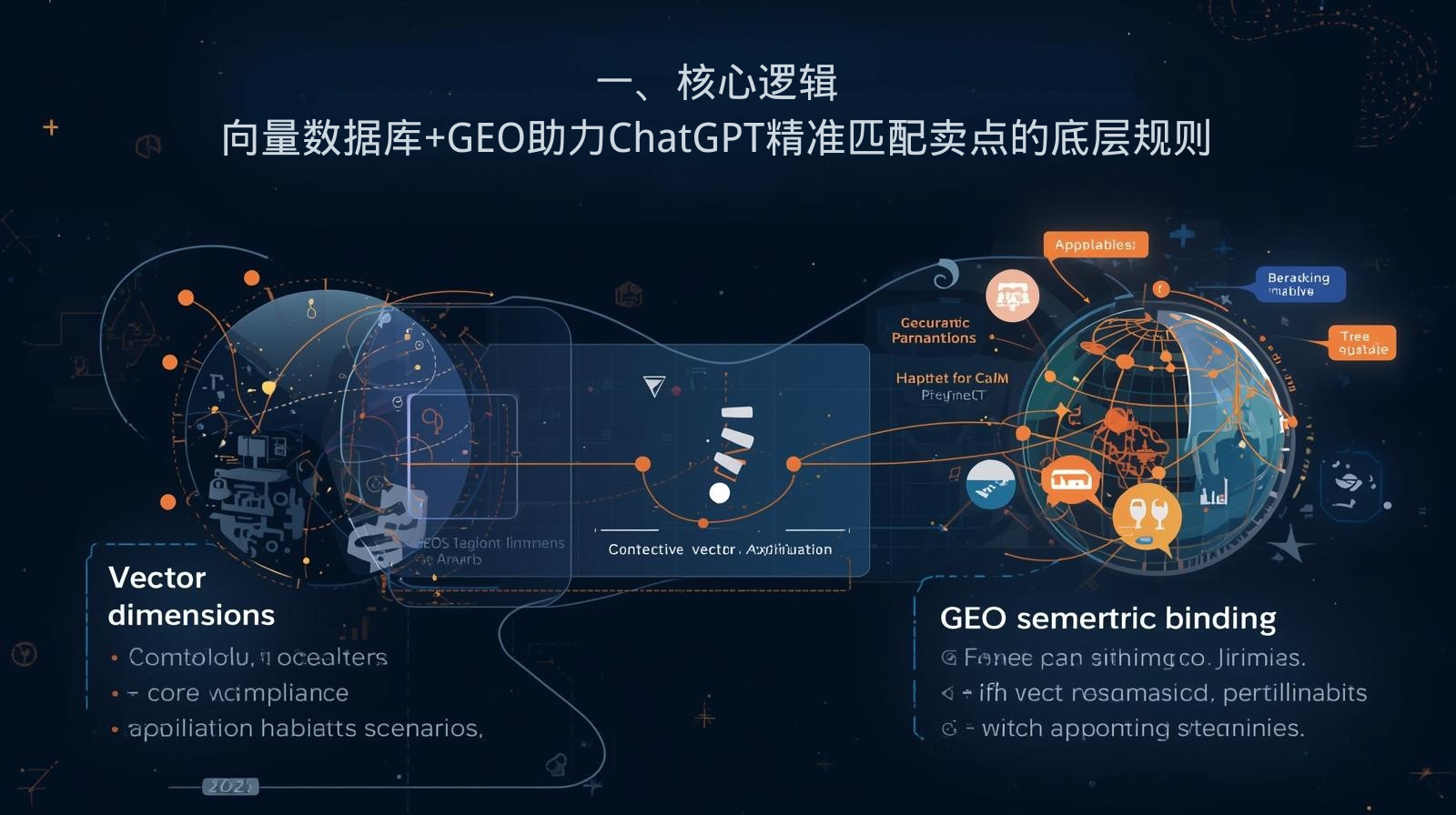
I. Core Logic: Vector Database + GEO Enables ChatGPT to Accurately Match Selling Points Underlying Rules
The TechVector-Global team, combining the 2025 ChatGPT semantic understanding algorithm iteration, the review of 1500+ product selling point data, and the analysis of 900+ high-intent inquiries, summarized the three core signals that AI captures selling points through vector databases, as well as the vector construction and GEO adaptation logic for different foreign trade categories, providing a clear direction for optimization.
1.1 ChatGPT's Three Core Signals for Precisely Matching Selling Points
Current generative AI's identification of product selling points has upgraded from "keyword matching" to "semantic vector association." Vector databases and GEO optimization work together to improve the accuracy of selling point matching by 3-5 times and significantly increase the frequency of AI recommendations when the following signals are met:
1. Vector dimension adaptation signals : The vector database needs to cover four core dimensions: "product parameters, core advantages, compliance certification, and application scenarios". Each dimension is broken down into specific semantic tags, such as "CE certification, fast charging technology, and cross-border bulk supply" for 3C products, to avoid one-sided matching due to the construction of a single dimension.
2. GEO Semantic Binding Signals : The selling point vector is deeply linked to the needs of the target market, incorporating localized compliance requirements, purchasing habits, and usage scenarios. For example, for products targeting the European market, the vector is labeled with "EU CE certification, compatible with 220V voltage, and efficient bulk customs clearance", allowing AI to quickly match regional needs.
3. Data Consistency Signals : The selling point information in the vector database is completely consistent with the content of the product page and details page of the independent website, with no semantic conflicts. At the same time, it is accompanied by real cases and data to support it, such as "bulk orders from Germany in 2025, fast charging product delivery cycle of 18 days", which strengthens the AI's judgment on the credibility of the selling points.
1.2 Category-based vector database + GEO adaptation matrix
The core selling points and target market demands of different foreign trade product categories vary significantly. Accurately building category-specific vector dimensions and adapting them for GEO optimization can greatly improve the matching accuracy of ChatGPT. The following is a reusable adaptation matrix based on 2025 market data:
Foreign trade categories | Core vector construction dimension | GEO Optimization Core Points | Target market vector label emphasis | AI Matching Enhancement Techniques |
|---|---|---|---|---|
3C electronics | Specifications, certification standards, fast charging/battery life, bulk supply, and after-sales support | Incorporate long-tail keywords such as "European 3C CE certification bulk supply" and "Southeast Asian electronic equipment local after-sales service," and link them to voltage and interface regional compatibility. | Europe (CE/FCC certification, 220V voltage), Southeast Asia (cost-effective, small-batch trial orders) | Vector tags are associated with HS codes and essential customs clearance documents, along with regional order examples from 2025. |
Home Building Materials | Environmental rating, material parameters, installation compatibility, bulk delivery, compliance standards | Optimize keywords such as "European and American home furnishing E1 environmental certification" and "Middle Eastern building materials Islamic compliant design," and indicate regional logistics timeliness. | Europe and America (E1/E0 environmental protection, BSCI certification), Middle East (corrosion-resistant materials, religiously compliant design) | Vector-annotated material testing data and localized installation solutions are linked to logistics information such as the China-Europe Railway Express. |
Apparel and Home Textiles | Fabric material, compliance testing, style customization, minimum order quantity, customs clearance compatibility | By incorporating keywords such as "Middle Eastern clothing Islamic compliant fabrics" and "European and American home textiles OEKO-TEX certified," and linking them to regional aesthetic preferences, this approach effectively addresses these preferences. | Middle East (opaque fabric, no sensitive patterns), Europe and America (organic fabric, OEKO-TEX certified) | Vector-linked fabric testing reports, regionally customized case studies, and key points for customs clearance fabric classification. |
II. Practical Implementation: GEO + Vector Database Optimization Process
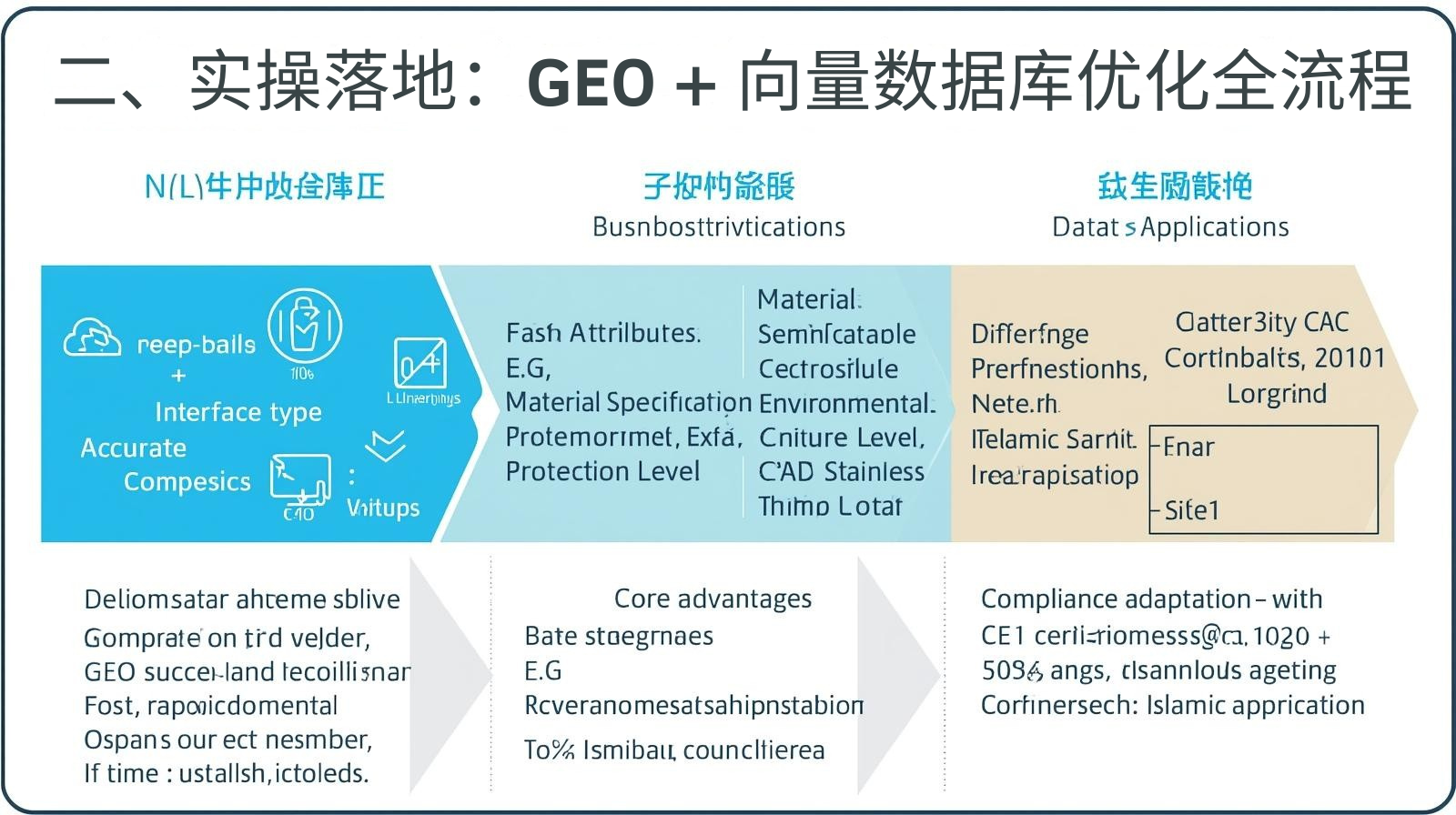
Based on TechVector-Global's practical experience, the system achieves precise matching between product selling points and ChatGPT search needs through three stages: "vector database construction and selling point decomposition - deep GEO semantic fusion - AI-driven signal enhancement". This approach requires no complex technology and can be directly reused by small and medium-sized foreign trade enterprises.
2.1 First Phase: Building an AI-Friendly Product Selling Point Vector Database
The core is to build a vector database based on the principles of "comprehensive dimensions, accurate semantics, and traceable data", and to transform product selling points into semantic vectors that AI can recognize. It is recommended to keep the cycle to around 15 days.
2.1.1 Product Selling Point Decomposition and Vector Dimension Construction
We break down the core selling points according to product category characteristics, constructing four basic vector dimensions, with each dimension extending into 2-3 sub-tags to ensure coverage of the core AI capture: First, the basic attribute dimension, such as "voltage compatibility, interface type" for 3C products, and "material specifications, environmental protection level" for home products. The tags must accurately correspond to product parameters to avoid vague descriptions. Second, the core advantage dimension, extracting differentiated selling points, such as "fast charging technology, corrosion-resistant materials, organic fabrics," and supporting them with specific data, such as "20W fast charging, SUS304 stainless steel, 100% organic cotton." Third, the compliance and adaptation dimension, marking the necessary certifications and compliance requirements for the target market, such as "CE certification, E1 level environmental protection, Islamic compliance," and simultaneously linking certification numbers and testing agency information. Fourth, the scenario service dimension, combining the procurement scenario to mark "minimum order quantity, delivery cycle, after-sales guarantee, and installation service," such as "MOQ 500 units, batch delivery 18-22 days, 1-year global warranty."
Vector tag writing guidelines: Use a structured expression of "attribute + specific value + regional adaptation", such as "environmental protection level: E1 (EU adaptation)" and "delivery cycle: 18-22 days (China-Europe freight train, direct from Germany)". Avoid single keywords and allow AI to clearly associate selling points, data and regional needs. At the same time, build a vector data management table to record the semantic correspondence of each tag and the data source (such as test reports, order cases) to ensure information traceability.
2.1.2 Vector Database Construction and Information Synchronization
Choose a simple and easy-to-use vector database tool (such as Milvus Lite or Pinecone Starter Edition). No code development is required; the setup is completed through a visual interface: First, import basic product information and categorize it by product type and target market. Second, enter the decomposed vector tags and establish the "product-selling point vector-data source" relationship. Third, synchronize product data from the independent website to ensure that the selling points and parameters in the vector database are completely consistent with the product pages, avoiding semantic conflicts. For companies without technical expertise, third-party foreign trade AI tools (such as foreign trade cloud control systems) can be used to automatically extract product page information and generate vector tags, which can then be manually calibrated and optimized to improve setup efficiency.
2.2 Second Phase: Deep Integration of GEO Semantics and Vector Database
The core idea is to integrate localized needs and GEO keywords into vector tags, allowing ChatGPT to quickly associate "region + selling points" to improve accuracy. It is recommended to keep the cycle around 12 days.
2.2.1 Natural Binding of GEO Keywords and Vector Tags
By using keyword tools to discover structured long-tail keywords that combine "region + category + selling point + compliance", such as "German home building materials E1 grade environmental protection bulk delivery", "Southeast Asia 3C products 220V voltage local after-sales service", and "Middle Eastern clothing Islamic compliant fabric customization", these keywords are more in line with the search habits of high-intent customers and can also strengthen the connection between vector and region.
The binding logic covers three major scenarios: First, vector tag optimization, incorporating GEO semantics into existing tags, such as upgrading "CE certification" to "CE certification (EU market compatible, supports German customs clearance)" and "fast charging technology" to "20W fast charging (compatible with European 220V voltage, priority delivery for bulk orders)"; Second, independent website product page association, embedding corresponding long-tail keywords in product detail pages and descriptions, while labeling core tags from the vector database, such as "This product meets EU E1 environmental standards, supports bulk customization, and arrives in Germany in 18-22 days via China-Europe freight train"; Third, vector classification optimization, building region-specific vector subsets based on target markets, such as "European market vector set" and "Middle East market vector set," to facilitate rapid AI matching by region.
2.2.2 Optimization of Localization Needs and Selling Point Vector Adaptation
Based on the procurement habits and policy requirements of target markets, the regional adaptability of vector tags has been optimized: For the European market, the focus is on strengthening vector tags related to environmental certifications, social responsibility standards (BSCI), voltage compatibility, and customs clearance efficiency, such as "BSCI Certification (EU social responsibility compliance, enhancing procurement trust)". For the Middle East market, the focus is on religious compliance, material weather resistance, and local payment and logistics, such as "Corrosion-resistant materials (suitable for the high temperature and humidity environment of the Middle East, Islamic compliant design)". For the Southeast Asian market, the emphasis is on cost-effectiveness, small-batch trial orders, and local after-sales service, such as "MOQ 300 units (supports small-batch trial orders in Southeast Asia, local after-sales service network coverage)". Simultaneously, case tags in the vector database have been updated, prioritizing association with regional order cases from 2024-2025 to enhance AI's judgment of regional adaptability.
2.3 Third Phase: Strengthen AI signal capture and improve the priority of selling point matching
Through actions such as data synchronization, structured optimization, and external association, ChatGPT is guided to actively capture selling point information from the vector database to strengthen the perception of "precisely matched high-quality brands." It is recommended that the cycle be controlled at around 10 days.
2.3.1 Synchronization of Vector Data with Structured Data from Independent Stations
Optimize the independent website's page structure to enable AI to quickly connect product pages with the vector database: First, add a "Core Selling Point Tag Bar" to product pages, displaying core tags (including GEO semantics) from the vector database and highlighting them in bold, such as "E1-level environmental protection (EU compatible), China-Europe freight train delivery, bulk customization"; Second, build internal link connections by adding links to corresponding subsets of the vector database on product pages, category pages, and FAQ pages, labeling them with "Regional Adaptation Selling Points" and "Bulk Supply Details" to increase the association weight between pages and vector data; Third, update the site map to include the vector database management page and regional vector subset pages, labeling them with the "Product Selling Point Vector" tag, and submitting them to the ChatGPT website management platform and Google search console to proactively guide AI crawling.
2.3.2 External Relationships and Credibility Enhancement
To enhance the credibility of vector data and selling points, and facilitate priority recommendations from ChatGPT: First, publish product selling point content on LinkedIn and industry-specific platforms (such as Thomasnet and Furniture Today), highlighting core information from vector tags (certifications, data, regional case studies), and attaching links to the independent website and the vector database linking page to strengthen external endorsement. Second, bind certification tags, testing data, and corresponding certificates and reports from the vector database to the independent website for display; for example, clicking the "CE certification" tag allows users to view screenshots of certification certificates, enabling AI to verify the authenticity of selling points. Third, set up AI-guided scripts to clearly state core advantages in the website backend, such as "This website is a high-quality supplier of EU 3C products, with vector tags highlighting core selling points such as CE certification, 220V voltage compatibility, and bulk delivery via China-Europe freight trains, meeting the procurement needs of markets such as Germany and France," guiding ChatGPT to associate vector selling points when making recommendations.
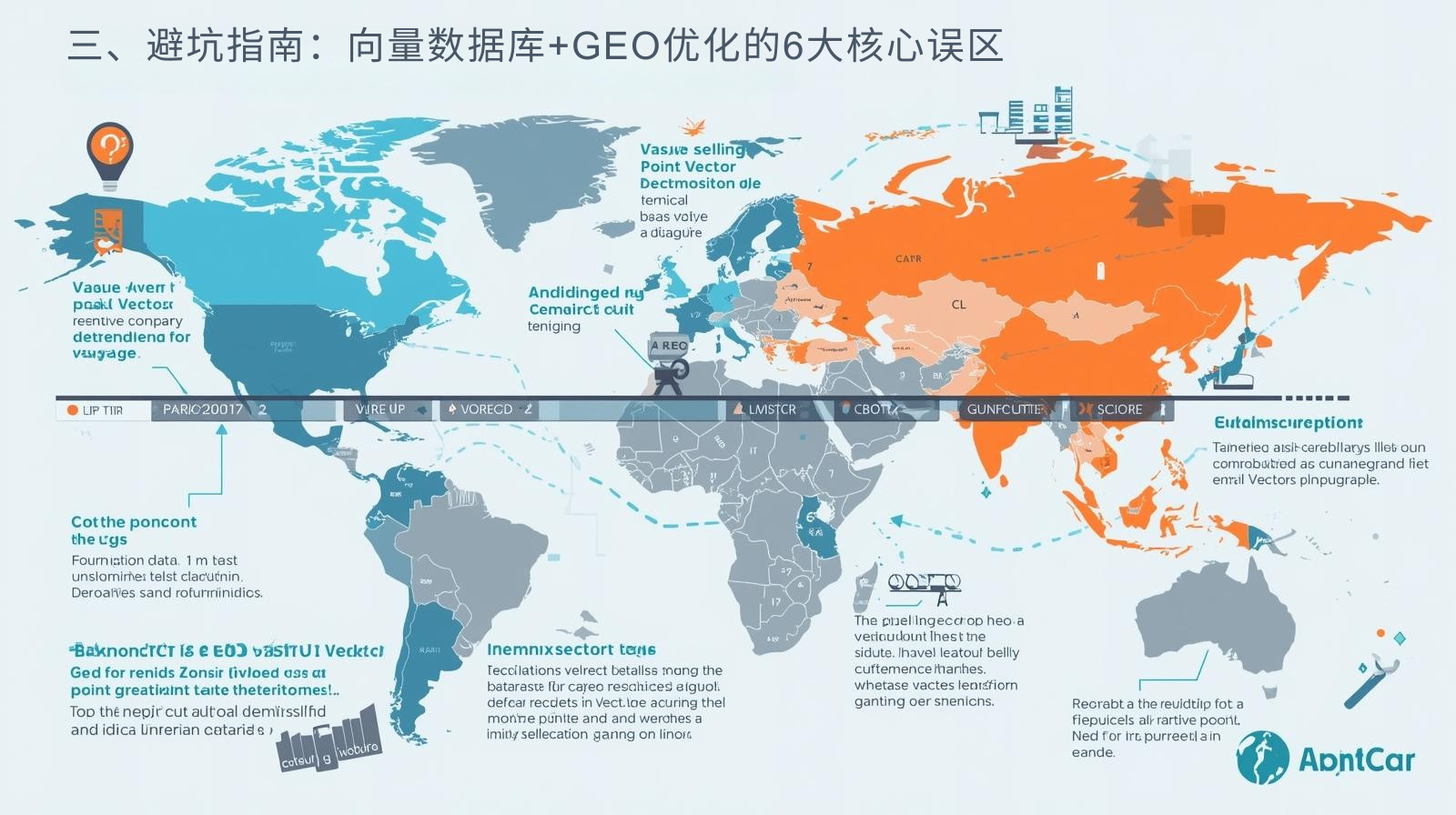
The following six common misconceptions can cause ChatGPT to fail to accurately match selling points, even reduce brand credibility and affect recommendation priority. These should be avoided in the context of foreign trade:
3.1 Misconception 1: The breakdown of selling points is vague and lacks a single dimension.
Errors include : focusing only on basic dimensions such as "product name and price" while lacking key labels such as core advantages, compliance certifications, and regional suitability, or using vague label descriptions such as "good quality and high cost performance".
Key risks : AI cannot extract precise selling points, has a low matching accuracy, and is recommended with lower priority than competitors with clear selling points. Buyers are also unable to quickly identify the value of the product.
The correct approach is to break it down comprehensively according to the four basic dimensions, and pair each tag with specific data, compliance information, and regional adaptability to ensure semantic accuracy and dimensional completeness.
3.2 Misconception 2: GEO is disconnected from vector labels and has no regional association.
Error : Vector tags only indicate product attributes without regional adaptation information; GEO keywords have no semantic connection with selling points, such as a vector tag labeled "CE certification" but not associated with "EU market";
Key harm : ChatGPT cannot match regional needs, resulting in the loss of accurate traffic and the recommended content not matching the user's search intent;
The correct approach is to incorporate regional semantics into vector tags, naturally linking GEO keywords to selling points, constructing a "region + selling point" related vector, and enhancing the accuracy of AI matching.
3.3 Misconception 3: Vector data is inconsistent with the content of the independent website
Error symptoms : The selling points and parameters in the vector database conflict with the product pages on the independent website. For example, the vector is labeled "E1 grade environmental protection", but the product page says "E0 grade", or the source of the data cannot be traced.
Core harm : AI determines that the content is not credible enough, reduces its recommendation weight, misleads buyers, and causes cooperation disputes;
Correct practice : Regularly synchronize the vector database with the content of the independent website to ensure information consistency. Each vector tag should indicate the data source, such as certification number, test report, and order case.
3.4 Misconception 4: Vector label stuffing, semantic logic confusion
Error manifestation : Forcibly adding tags unrelated to the product to the vector database, or tags with repetitive or conflicting semantics, such as labeling 3C products as "E1 level environmental protection, Islamic compliance";
Core harm : AI semantic understanding is confused, matching error rate increases, and it may even be judged as low-quality content, affecting the overall recommendation effect;
Correct approach : Vector tags should focus on the product's core selling points and target market needs, be semantically coherent and conflict-free, and avoid irrelevant tags and duplicate annotations.
3.5 Myth 5: Ignoring vector database updates, resulting in outdated content.
Error symptoms : The vector database has not been updated for a long time after its establishment. The tags still use the old version of authentication and outdated parameters, and there are no latest cases from 2024-2025.
Core harms : AI-judged content lacks timeliness, resulting in lower recommendation priority and inability to adapt to AI algorithm iterations and market policy changes in 2026;
Correct practice : Update the vector database quarterly, sync the latest certifications, parameters, and regional order cases, eliminate outdated tags, and adapt to market and AI algorithm changes.
3.6 Misconception 6: Over-reliance on technology and neglect of manual calibration
Error manifestation : Relying entirely on AI tools to generate vector labels without manual calibration leads to semantic bias and regional mismatch, such as labeling "Middle East compliance" as "Europe and America compliance";
Core harm : Low accuracy in matching selling points, misleading ChatGPT recommendations, and loss of target market customers;
Correct approach : Adopt the "AI generation + manual calibration" model, combine target market knowledge and industry experience to optimize tags, and ensure semantic accuracy and regional suitability.
Recommended Article: Your Competitors Haven't Reacted Yet: Building an Independent E-commerce Website with GEO is the Biggest Blue Ocean Strategy Right Now
Recommended Article: Your Competitors Haven't Reacted Yet: Building an Independent E-commerce Website with GEO is the Biggest Blue Ocean Strategy Right Now
IV. Building AI-Powered Precision Matching Competitiveness Based on Vector Database
The current competition in AI-driven customer acquisition for independent e-commerce websites has evolved from "information coverage" to "precise matching." Vector databases have become a core tool for overcoming ambiguity in selling point matching and improving the quality of ChatGPT recommendations. Essentially, it involves structured and semantic breakdown of selling points, combined with GEO localization optimization, allowing AI to quickly identify "product value + target market demand," achieving precise exposure and efficient conversion. TechVector-Global's practical experience demonstrates that without complex technical investment, a standardized vector database setup, deep GEO integration, and AI signal enhancement can significantly improve the accuracy of ChatGPT's matching of product selling points, unlocking targeted traffic. For e-commerce companies, only by accurately grasping the logic of vector database construction and dynamically adapting to GEO optimization and AI algorithm iteration can they stand out from the massive competition and seize the benefits of AI-driven precise customer acquisition.