
Foreign trade website mobile optimization and user experience improvement methods

  • Independent website marketing and promotion
  • Independent website industry application
  • Foreign trade stations
Posted by 广州品店科技有限公司 On Aug 23 2025

Mobile traffic is increasing year by year in the global foreign trade business. According to Google Analytics , mobile device traffic now exceeds 50% of visits to international B2B and B2C websites. Therefore, mobile optimization and user experience design are crucial for foreign trade websites , directly impacting customer retention, conversions, and brand trust.

1. Improve page loading speed

Mobile users are extremely sensitive to website loading speed. Studies have shown that if a page load time exceeds 3 seconds, the user bounce rate increases significantly. When optimizing your website for mobile devices, you can adopt the following strategies:

  • Image and media optimization : Use WebP format images, reasonably compress the size, and ensure fast loading at different resolutions.

  • Static resource caching : Use Next.js or other technologies to cache static files, reduce server requests, and improve response speed.

  • Lazy Loading : Use lazy loading for non-first screen content to increase the loading speed of the first screen.

According to W3C recommendations, optimizing page performance not only improves user experience, but also increases search engine crawling efficiency, thereby enhancing natural search rankings.

2. Responsive design and multi-device adaptation

Mobile devices have various sizes and screen ratios, so foreign trade websites should adopt a responsive layout:

  • Flexible grid system : Use CSS Grid or Flex layout to make page elements adaptively arranged on different screens.

  • Breakpoint optimization : Set breakpoints for commonly used mobile devices to ensure that images, text, and buttons are clearly visible on different devices.

  • Touch-friendly interaction : Buttons and links should be large enough and reasonably spaced to avoid accidental touches and improve operational convenience.

According to the recommendations of the International Trade Centre (ITC) , responsive website design can ensure that global customers have a consistent experience when accessing the website on different devices, thus enhancing brand credibility.

3. Mobile interaction and navigation optimization

User experience depends not only on page speed, but also on interaction design and information structure:

  • Simplify the navigation structure : Use simple designs such as hamburger menus and bottom navigation bars to reduce the time users spend looking for information.

  • Quick form and CTA optimization : Contact forms and inquiry buttons should be concise and clear, reduce input fields, and increase submission rates.

  • Scrolling and gesture optimization : Avoid complex scrolling effects and animations to ensure smooth sliding and enhance the smoothness of operation.

Google Search Central points out that websites with good mobile user experience not only reduce bounce rates but also improve search engine rankings.
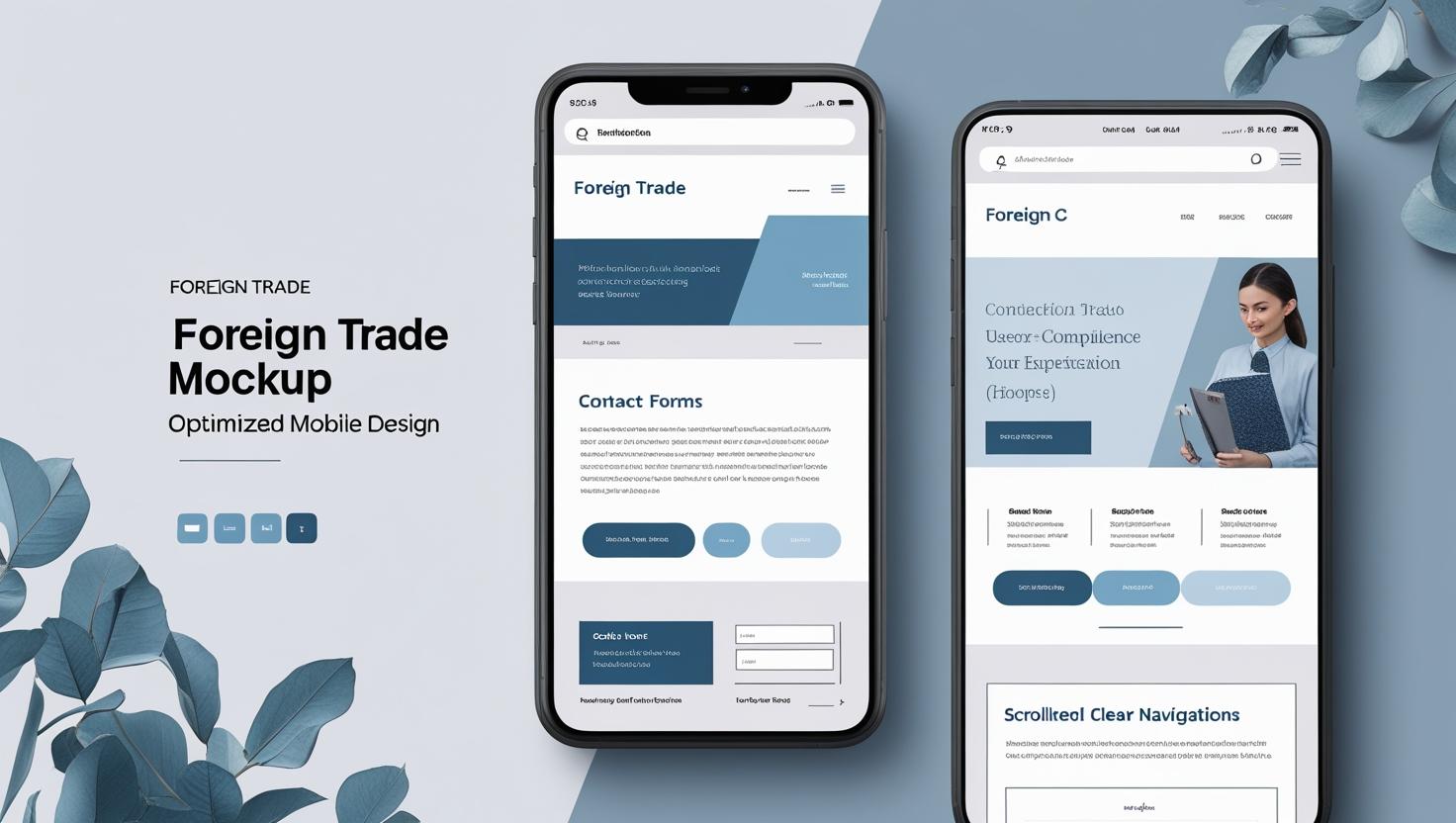
Foreign trade website construction: A website with good mobile user experience not only reduces bounce rate but also improves search engine rankings

4. Mobile SEO optimization and content display

Mobile optimization should also be combined with SEO strategies to increase website exposure and traffic conversion:

  • Structured data : Use Schema to mark up product, contact, and company information to help search engines understand your site’s content.

  • The content is concise and easy to read : paragraphs are short, headings are clear, and important information is placed on the first screen, making it easy to quickly obtain key information.

  • Multilingualism and internationalization : Foreign trade website construction is combined with i18n solutions to provide multilingual pages for users in different countries and expand potential customer coverage.

According to Moz research, combining mobile optimization with SEO strategies can effectively improve website rankings on search engines such as Google and Baidu.

Summarize

Mobile optimization is crucial for successful website development for international trade. From page loading speed, responsive design, interactive optimization, to mobile SEO strategies, businesses can improve user experience and conversion efficiency through scientific methods. Using the Pinshop website building platform, businesses can easily achieve high-performance mobile optimization, responsive layouts, and SEO-friendly page construction, making your international trade website more efficient and competitive in the global market.

Pinshop website building platform CTA :
Use the Pinshop website building platform now to optimize your foreign trade website building mobile experience , increase access speed and user conversion, and let global customers easily reach your products!

Pinshop foreign trade website building service

Recommended article: Analysis of the advantages of React+Next.js technology in building foreign trade websites

特色博客
Pintui Technology: GEO one-stop solution for independent foreign trade station

Pintui Technology: GEO one-stop solution for independent foreign trade station

This article introduces the GEO (Generative Engine Optimization) one-stop solution for the independent foreign trade station of Pintui Technology. It focuses on AI capture and trust rules and provides fully closed-loop implementation services from the four modules of structured website building, content system, technology adaptation, and data operation. It also clarifies the 30-60 day standardized implementation process and combines the latest AI rules and authoritative external links in March 2026 to help the independent foreign trade station appear stably in ChatGPT search results and achieve sustainable AI customer acquisition.

GEO Structured Layout for Independent Foreign Trade Websites: AI's Favorite Page Structure

GEO Structured Layout for Independent Foreign Trade Websites: AI's Favorite Page Structure

This article focuses on the core of GEO (Geometric Orientation) for independent e-commerce websites in 2026—structured layout—clearly pointing out that the key to AI crawling and recommendation lies in page structure rather than visual effects. The article details AI-friendly structures for four core pages: homepage, product pages, company introduction pages, and compliance pages, providing directly replicable layout templates. Based on the latest official rules from Google, OpenAI, Semrush, and others in 2026, it summarizes six golden rules of structured layout and a three-step implementation method, accompanied by authoritative and verifiable backlinks throughout, helping e-commerce companies quickly build AI-favored page structures and increase their exposure and recommendation probability on ChatGPT.

GEO for independent e-commerce websites is not about optimizing the website, but about optimizing AI cognition.

GEO for independent e-commerce websites is not about optimizing the website, but about optimizing AI cognition.

This article revolves around the core concept that "GEO for independent foreign trade websites is not about optimizing the website, but about optimizing AI cognition." It combines the latest industry data from March 2026 (China Daily GEO Analysis Report, "GEO Generation Search Optimization White Paper," NetEase News GEO Evaluation), practical foreign trade case studies, and authoritative backlinks (OpenAI, Google, Semrush, etc.). Divided into four core chapters (including sub-headings): "GEO Core Cognition," "Four Dimensions of AI Cognition Optimization," "3 Steps to Practical Implementation," and "6 Pitfall Avoidance Guidelines," this article delves into the underlying logic of GEO optimization for AI cognition. It breaks down directly implementable cognition optimization methods and practical processes, avoiding common pitfalls, adhering to long sentence formatting requirements, avoiding complex technical descriptions, and seamlessly integrating all backlinks into the text. Balancing professionalism and practicality, this article helps foreign trade companies avoid the misconception of "website optimization" and achieve precise customer acquisition for independent websites through optimizing ChatGPT cognition.

Why do 90% of independent e-commerce websites fail to see results despite implementing GEO (Geometric Orientation)?

Why do 90% of independent e-commerce websites fail to see results despite implementing GEO (Geometric Orientation)?

This article revolves around the core question, "Why do 90% of independent foreign trade websites fail to see results despite implementing GEO?" It combines the latest industry data from March 2026 (Jiemian News GEO Ineffective White Paper, China Academy of Information and Communications Technology GEO Report, Gartner Research Report), practical foreign trade case studies, and authoritative, verifiable backlinks (OpenAI, Google, Semrush, etc.). Divided into four core chapters (including subheadings): "The Core Truth Behind GEO Ineffectiveness," "4 Core Reasons for Ineffectiveness," "4-Step Rectification Plan," and "5 Common Pitfalls to Avoid," this article delves into the underlying logic behind the ineffectiveness of 90% of GEO campaigns. Paired with real-world case studies, it provides directly implementable rectification solutions, breaks down common pitfalls, and adheres to a concise, well-structured format. Avoiding complex technical descriptions, all backlinks are seamlessly integrated into the text, balancing professionalism and practicality. This helps foreign trade companies accurately identify the root causes of GEO ineffectiveness, avoid internal conflicts, and ensure GEO truly functions effectively for precise customer acquisition via ChatGPT. It also provides standardized article summaries, meta descriptions, and specified slugs, and concludes with a natural recommendation of a product store website building service.

How long does it take for an independent e-commerce website doing GEO (Google Originator) to be found on ChatGPT?

How long does it take for an independent e-commerce website doing GEO (Google Originator) to be found on ChatGPT?

This article focuses on the core question, "How long does it take for an independent foreign trade website to be found in ChatGPT after implementing GEO?" It combines the latest industry data from March 2026 (Gartner forecast report, China Academy of Information and Communications Technology GEO report, and Jiemian News practical guide), foreign trade case studies, and authoritative backlinks (OpenAI, Google, Semrush, etc.). Divided into four core chapters (including sub-headings): "Effective Time for Different Base Sites," "Core Influencing Factors," "Practical Acceleration Solutions," and "Effect Verification and Pitfall Avoidance," this article provides an in-depth analysis of the effectiveness of GEO optimization. It breaks down the effective timeframes at three levels, identifies four core influencing factors, outlines five directly implementable acceleration measures, provides a three-step effect verification method, and addresses four common pitfalls. Adhering to long sentence formatting requirements, it avoids complex technical descriptions, seamlessly integrating all backlinks into the text. Balancing professionalism and practicality, this article helps foreign trade companies clearly understand the effective timeframe for GEO, quickly achieve visibility in ChatGPT searches, and seize the AI-driven customer acquisition opportunities. It also provides standardized article summaries, meta descriptions, and specified slugs, and concludes with a natural recommendation of a product store website building service.

React-based standalone website and social media integration: A high-efficiency traffic conversion solution driven by automated SEO.

React-based standalone website and social media integration: A high-efficiency traffic conversion solution driven by automated SEO.

This article focuses on the core pain point of "high investment and low conversion" in social media traffic acquisition for foreign trade enterprises, providing a full-process solution for linking React independent websites with social media (Facebook/LinkedIn/Instagram). It breaks down the collaborative logic of React website performance optimization (compressing redirect loading time, cross-device adaptation), social media-website content consistency (unified topics, value extension), and automated SEO keyword interoperability (two-way empowerment, traffic feedback). Combined with a real-world case study of a cross-border e-commerce brand achieving a 50% increase in social media traffic conversion, it shares cost optimization techniques, implementation steps, and effectiveness verification methods. This helps enterprises break down the disconnect between social media and independent websites, efficiently converting social media traffic into inquiries while simultaneously boosting the organic ranking of independent websites, achieving synergistic growth across both channels.