

Technical SEO Checklist: 15 Key Points You Should Check Every Quarter – A Comprehensive Guide to Building Websites for Foreign Trade

  • Independent website industry application
  • Independent website operation strategy
  • Foreign trade stations
  • Foreign trade website
Posted by 广州品店科技有限公司 On Jan 13 2026

Transportation radius: Determine the logistics plan based on the destination port demurrage rate. If the destination port demurrage rate is higher than the average (7).png

1. Budget Crawling: Don't let the spider get lost. Budget crawling is the first hurdle in building a foreign trade website; wasting time on it will make everything else pointless.

  1. Use Search Console to capture statistics and view the daily request volume; a sudden drop should trigger an alert.
  2. Check robots.txt to see if new product categories are mistakenly blocked, especially seasonal new product pages;
  3. Merging 301 chains reduces redirection levels and saves spider time;
  4. Submit the revised report to the filing system of the China Academy of Information and Communications Technology to gain authoritative backlinks.

2. Index Coverage: Removing useless pages from the database will cause index bloat and dilute the relevance of the topic. Quarterly cleanup is a must.

  1. Export the GSC coverage report and filter for pages that are indexed but not clicked > 90 days ago;
  2. Add a 404 error to expired promotional pages; if the return code is correct (404), submit for deletion.
  3. Add canonical labels to pages with duplicate parameters and concentrate the weight on the main version;
  4. Review monthly to ensure that the ratio of indexed pages to valid pages is ≥85%.
Judging Scale by Quantity: Validating the Pattern Using the MOQ Curve (7).png

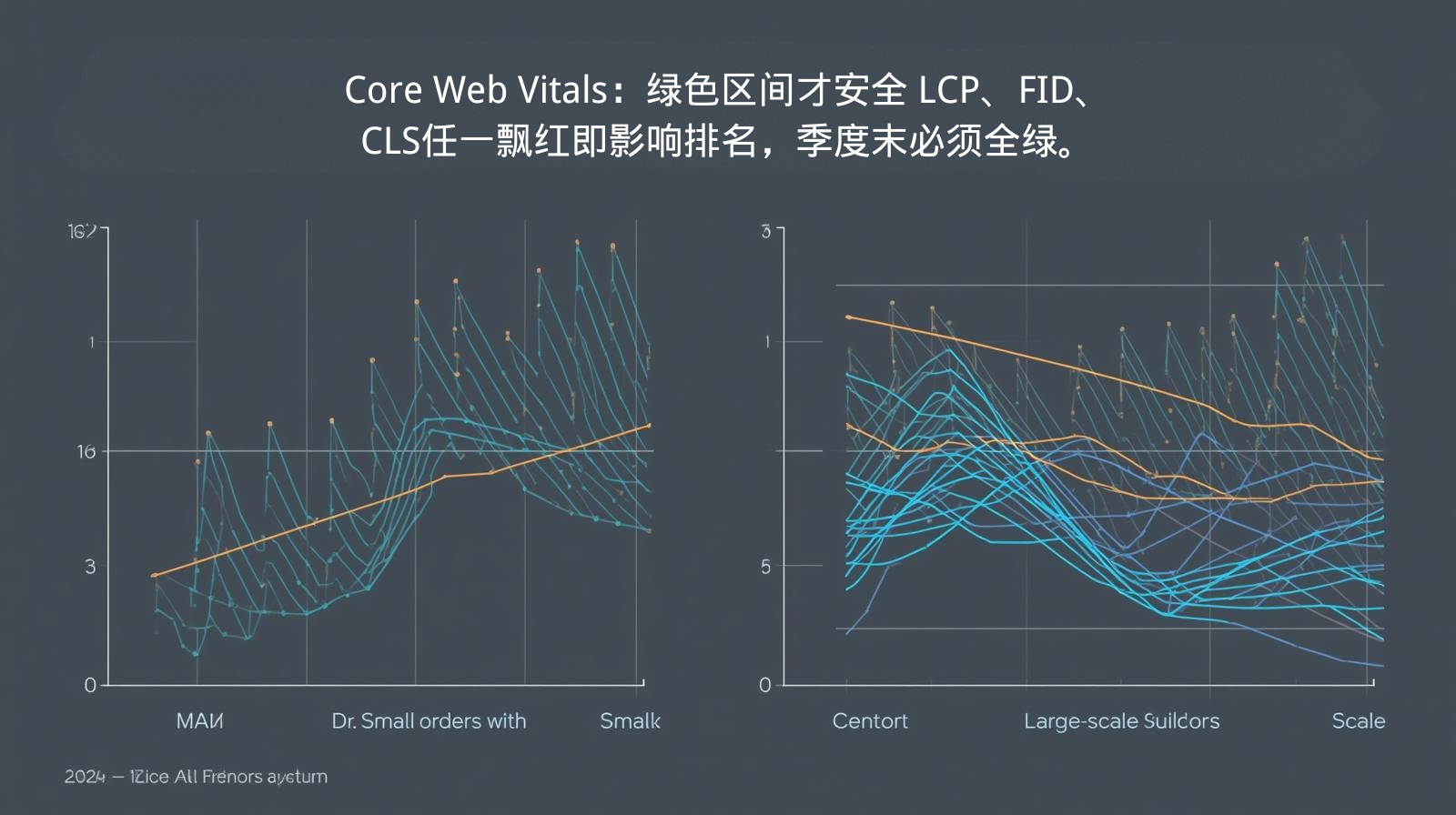
3. Core Web Vitals: Only the green zone is safe. If any of the LCP, FID, or CLS turns red, it will affect the ranking. All zones must be green by the end of the quarter.

  1. Use CrUX to view real user data, don't just trust lab results;
  2. Image size > 150KB: Compress immediately and convert to WebP;
  3. Third-party chat scripts can be placed in Web Workers so that the main thread is not occupied.
  4. Submit the optimization results to the Shenzhen Cross-Border E-commerce Association's monthly technical journal to build brand backlinks.

IV. Mobile-first: The thumb experience determines orders. Mobile traffic accounts for 70%+ of foreign trade website building. Thumb experience = wallet.

  1. Check that the spacing between touch elements is less than 48px to avoid accidental touches;
  2. Use CSS clamp() to achieve fluid layout without horizontal scrolling;
  3. Add a tooltip arrow to the horizontal scrolling of the table to reduce the risk of scrolling out of the page;
  4. Verify using Baidu's mobile landing page testing tool; if the score is below 90, immediately roll back.

5. Structured Data: Enable algorithms to instantly understand page products, FAQs, and videos. All of these require a schema; otherwise, rich media displays will be missed.

  1. Adding availability to the out-of-stock field in the Product Schema improves click-through rate (CTR) for shopping results.
  2. FAQPage only marks visible content; hiding questions and answers will result in penalties.
  3. Validate page by page using the Rich Results Test, and correct any errors immediately.
  4. Upload the tagged cases to the China E-Commerce Association's Trusted Product Database to increase authoritative citations.

VI. HTTPS and HSTS: Security is Key. HTTP pages are now being warned about in newer versions of Chrome, and conversion rates are plummeting.

  1. The entire site should be redirected to HTTPS using 301 redirects, and the certificate should be at least TLS 1.2.
  2. Add HSTS header, max-age=31536000;
  3. When submitting the HSTS Preload List, the browser will use encryption by default.
  4. If the certificate chain is below grade A according to SSL Labs testing, update it immediately.

VII. XML Map and IndexNow: New content is indexed instantly, and the sitemap structure is updated quarterly, with new categories pinned to the top.

  1. Dynamic maps are automatically split into URLs under 50,000 to avoid exceeding the maximum size.
  2. New pages will be pushed to IndexNow, shortening the indexing time to the hour;
  3. Only display 200 pages of maps; remove all 404 errors and redirects.
  4. Add the map URL to robots.txt to guide the spider to crawl it first.

8. Internal Links: If the internal links that dictate the flow of page authority break down, even the best deep pages won't be crawled.

  1. Use two-level categories in the footer navigation to avoid diluting the content with too many links;
  2. Adding breadcrumbs to the top of the article page improves deeper crawling;
  3. Use the "Related Cases" section to maintain contextual relevance;
  4. Run Screaming Frog every quarter and immediately add Orphan Page to your inbox.

9. External Links: Quarterly Check-up to Prevent Negative SEO. Bad links are worse than no links at all, and need to be audited regularly.

  1. Ahrefs exports the latest backlinks, and rejects them if DR < 10 and Spam > 50%;
  2. For a sudden surge in gambling/adult anchor text, reject it entirely with Disavow;
  3. The rejected file was simultaneously uploaded to the Baidu Resource Platform, synchronizing across both platforms.
  4. Submit the cleanup report to the Security Center of the China Academy of Information and Communications Technology to increase brand exposure.

10. Rendering method: Server-side priority CSR rendering requires secondary fetching, which wastes budget.

  1. Use SSR or SSG for the homepage and category pages to ensure that the HTML is crawled and indexed immediately.
  2. Use CSR only on interactive modules to reduce blank screens;
  3. Use Lighthouse to view the "crawlable content" and ensure that the key text is displayed on the first screen;
  4. Real spider test: site:domain + keyword, see if the first paragraph is highlighted.

11. 404 Page Experience: Retaining Dead Link Traffic 404 is not the end, but a secondary conversion entry point.

  1. Add a search box and best-selling products to reduce bounce rates;
  2. The return code must be 404; do not try to fool people with 200.
  3. Use Analytics to track 404 events and clean up the entry chain weekly;
  4. By documenting the repair process in the company Wiki, new employees can get started in 30 minutes.

12. Pagination parameters: canonical+viewall list pagination is often indexed, leading to duplicates.

  1. Provides a viewall page to display the entire list at once;
  2. Add a canonical label to each page pointing to the viewall to centralize page weight;
  3. If the product volume is large, use rel=next/prev, but Google has abandoned this method and only Baidu recognizes it.
  4. Ensure that viewall loads in less than 3 seconds to avoid CWV turning red.

13. Video Indexing: Double protection with tagging and Sitemap. Quarterly checks to see if videos are indexed to prevent content from sinking.

  1. Use Google Video Inspector to check the capture status;
  2. Each video should be accompanied by a 1280×720 thumbnail to avoid black screens;
  3. Add a video:video node to the XML map and submit it to the Search Console;
  4. Upload video examples to the official website of the Shenzhen Cross-border E-commerce Association to obtain authoritative local backlinks.

14. Internationalization: During the quarterly Hreflang inspection, multilingual websites often missed updating Hreflang, resulting in misaligned rankings.

  1. Check the language code and country code; do not use cn-zh.
  2. Each page header includes all language versions, forming a closed loop;
  3. Reporting errors using Screaming Frog Hreflang revealed them and was immediately corrected.
  4. Submit the correction log to the China E-Commerce Association to continuously accumulate brand citations.

15. Backup and Recovery: The Last Line of Defense for Technical SEO. A server crash can cause a page to return 5xx errors, and the ranking can vanish instantly.

  1. Automatically back up the database and static files daily, retaining 30-day versions;
  2. Using CDN edge rules, if the origin server goes down, it will automatically return to the cached page.
  3. If the uptime is less than 99.9%, an immediate SMS alert will be sent, and the system will recover within 10 minutes.
  4. Incorporate disaster recovery plans into the emergency standards library of the China Academy of Information and Communications Technology to enhance industry influence.

The 15-item CTA check at the end may seem complicated, but it can actually be completed with a single click using the system. Pinshop has packaged its quarterly health check into a "Technical SEO Panel": it automatically scans from CWV and Hreflang to SSL, and immediately pushes remediation solutions for any anomalies. Visit pintreel.com now to launch your foreign trade website with its built-in quarterly health check in just 30 minutes and eliminate your technical debt.

Personal business card.png

特色博客
Pintui Technology: GEO one-stop solution for independent foreign trade station

Pintui Technology: GEO one-stop solution for independent foreign trade station

This article introduces the GEO (Generative Engine Optimization) one-stop solution for the independent foreign trade station of Pintui Technology. It focuses on AI capture and trust rules and provides fully closed-loop implementation services from the four modules of structured website building, content system, technology adaptation, and data operation. It also clarifies the 30-60 day standardized implementation process and combines the latest AI rules and authoritative external links in March 2026 to help the independent foreign trade station appear stably in ChatGPT search results and achieve sustainable AI customer acquisition.

GEO Structured Layout for Independent Foreign Trade Websites: AI&#39;s Favorite Page Structure

GEO Structured Layout for Independent Foreign Trade Websites: AI&#39;s Favorite Page Structure

This article focuses on the core of GEO (Geometric Orientation) for independent e-commerce websites in 2026—structured layout—clearly pointing out that the key to AI crawling and recommendation lies in page structure rather than visual effects. The article details AI-friendly structures for four core pages: homepage, product pages, company introduction pages, and compliance pages, providing directly replicable layout templates. Based on the latest official rules from Google, OpenAI, Semrush, and others in 2026, it summarizes six golden rules of structured layout and a three-step implementation method, accompanied by authoritative and verifiable backlinks throughout, helping e-commerce companies quickly build AI-favored page structures and increase their exposure and recommendation probability on ChatGPT.

GEO for independent e-commerce websites is not about optimizing the website, but about optimizing AI cognition.

GEO for independent e-commerce websites is not about optimizing the website, but about optimizing AI cognition.

This article revolves around the core concept that &quot;GEO for independent foreign trade websites is not about optimizing the website, but about optimizing AI cognition.&quot; It combines the latest industry data from March 2026 (China Daily GEO Analysis Report, &quot;GEO Generation Search Optimization White Paper,&quot; NetEase News GEO Evaluation), practical foreign trade case studies, and authoritative backlinks (OpenAI, Google, Semrush, etc.). Divided into four core chapters (including sub-headings): &quot;GEO Core Cognition,&quot; &quot;Four Dimensions of AI Cognition Optimization,&quot; &quot;3 Steps to Practical Implementation,&quot; and &quot;6 Pitfall Avoidance Guidelines,&quot; this article delves into the underlying logic of GEO optimization for AI cognition. It breaks down directly implementable cognition optimization methods and practical processes, avoiding common pitfalls, adhering to long sentence formatting requirements, avoiding complex technical descriptions, and seamlessly integrating all backlinks into the text. Balancing professionalism and practicality, this article helps foreign trade companies avoid the misconception of &quot;website optimization&quot; and achieve precise customer acquisition for independent websites through optimizing ChatGPT cognition.

Why do 90% of independent e-commerce websites fail to see results despite implementing GEO (Geometric Orientation)?

Why do 90% of independent e-commerce websites fail to see results despite implementing GEO (Geometric Orientation)?

This article revolves around the core question, &quot;Why do 90% of independent foreign trade websites fail to see results despite implementing GEO?&quot; It combines the latest industry data from March 2026 (Jiemian News GEO Ineffective White Paper, China Academy of Information and Communications Technology GEO Report, Gartner Research Report), practical foreign trade case studies, and authoritative, verifiable backlinks (OpenAI, Google, Semrush, etc.). Divided into four core chapters (including subheadings): &quot;The Core Truth Behind GEO Ineffectiveness,&quot; &quot;4 Core Reasons for Ineffectiveness,&quot; &quot;4-Step Rectification Plan,&quot; and &quot;5 Common Pitfalls to Avoid,&quot; this article delves into the underlying logic behind the ineffectiveness of 90% of GEO campaigns. Paired with real-world case studies, it provides directly implementable rectification solutions, breaks down common pitfalls, and adheres to a concise, well-structured format. Avoiding complex technical descriptions, all backlinks are seamlessly integrated into the text, balancing professionalism and practicality. This helps foreign trade companies accurately identify the root causes of GEO ineffectiveness, avoid internal conflicts, and ensure GEO truly functions effectively for precise customer acquisition via ChatGPT. It also provides standardized article summaries, meta descriptions, and specified slugs, and concludes with a natural recommendation of a product store website building service.

How long does it take for an independent e-commerce website doing GEO (Google Originator) to be found on ChatGPT?

How long does it take for an independent e-commerce website doing GEO (Google Originator) to be found on ChatGPT?

This article focuses on the core question, &quot;How long does it take for an independent foreign trade website to be found in ChatGPT after implementing GEO?&quot; It combines the latest industry data from March 2026 (Gartner forecast report, China Academy of Information and Communications Technology GEO report, and Jiemian News practical guide), foreign trade case studies, and authoritative backlinks (OpenAI, Google, Semrush, etc.). Divided into four core chapters (including sub-headings): &quot;Effective Time for Different Base Sites,&quot; &quot;Core Influencing Factors,&quot; &quot;Practical Acceleration Solutions,&quot; and &quot;Effect Verification and Pitfall Avoidance,&quot; this article provides an in-depth analysis of the effectiveness of GEO optimization. It breaks down the effective timeframes at three levels, identifies four core influencing factors, outlines five directly implementable acceleration measures, provides a three-step effect verification method, and addresses four common pitfalls. Adhering to long sentence formatting requirements, it avoids complex technical descriptions, seamlessly integrating all backlinks into the text. Balancing professionalism and practicality, this article helps foreign trade companies clearly understand the effective timeframe for GEO, quickly achieve visibility in ChatGPT searches, and seize the AI-driven customer acquisition opportunities. It also provides standardized article summaries, meta descriptions, and specified slugs, and concludes with a natural recommendation of a product store website building service.

React-based standalone website and social media integration: A high-efficiency traffic conversion solution driven by automated SEO.

React-based standalone website and social media integration: A high-efficiency traffic conversion solution driven by automated SEO.

This article focuses on the core pain point of &quot;high investment and low conversion&quot; in social media traffic acquisition for foreign trade enterprises, providing a full-process solution for linking React independent websites with social media (Facebook/LinkedIn/Instagram). It breaks down the collaborative logic of React website performance optimization (compressing redirect loading time, cross-device adaptation), social media-website content consistency (unified topics, value extension), and automated SEO keyword interoperability (two-way empowerment, traffic feedback). Combined with a real-world case study of a cross-border e-commerce brand achieving a 50% increase in social media traffic conversion, it shares cost optimization techniques, implementation steps, and effectiveness verification methods. This helps enterprises break down the disconnect between social media and independent websites, efficiently converting social media traffic into inquiries while simultaneously boosting the organic ranking of independent websites, achieving synergistic growth across both channels.