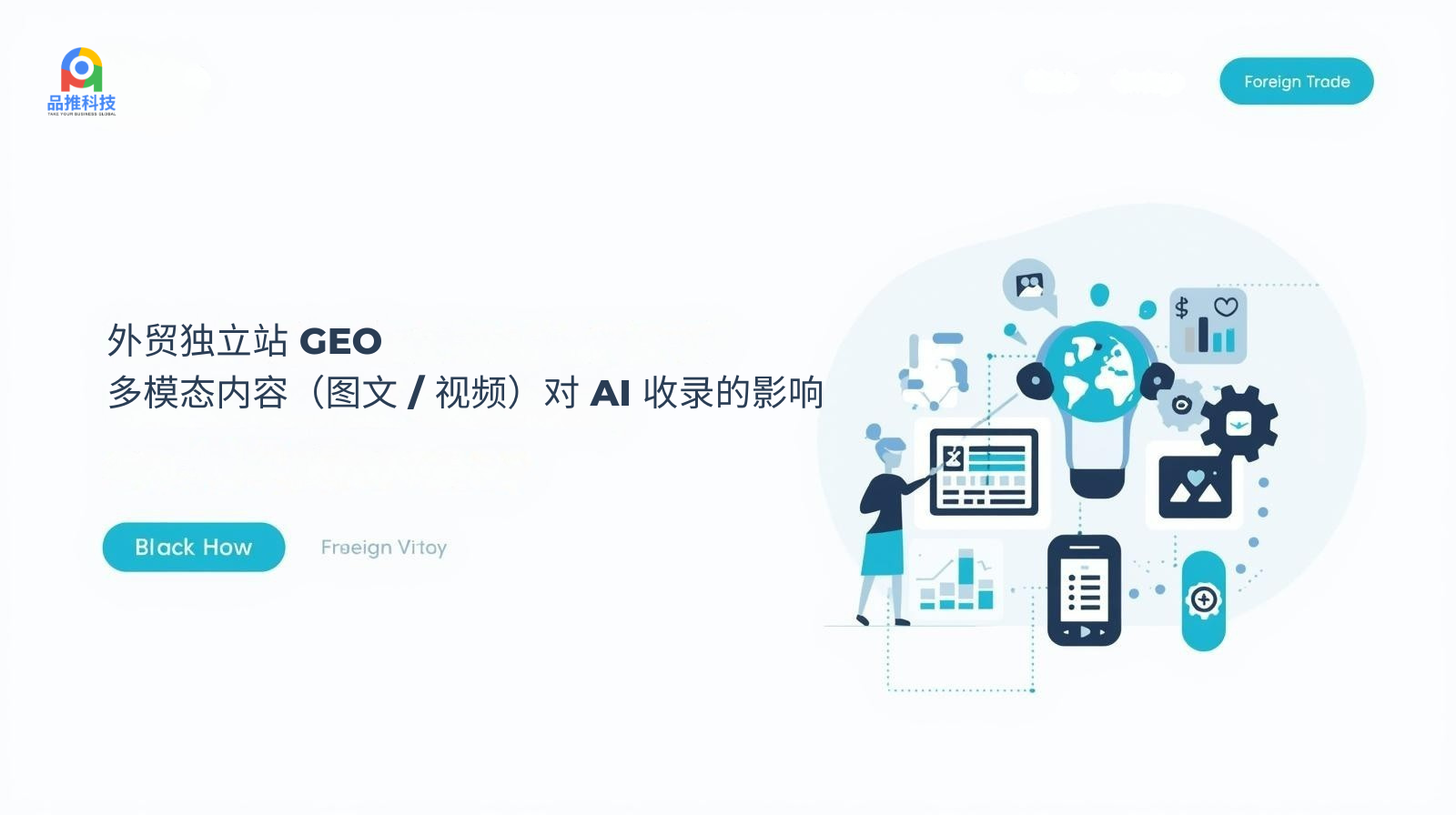

In the era of AI search dominated by GEO (Generative Engine Optimization), single text content is no longer able to meet the inclusion preferences of large AI models. Most foreign trade companies are in trouble: they only rely on text to pile up product information, but ignore the value of multi-modal content such as graphics, text, and video. This results in insufficient site content richness, low AI collection efficiency, and weak recommendation weight. Even if the text is of high quality, it is difficult to stand out among a large number of sites.
The core breaking logic is: the core of AI large model collection is "comprehensive understanding of site value". Multi-modal content is presented through the multi-dimensional "text + visual + auditory", which can help AI more accurately identify the core of the content and determine user value, thereby improving the collection priority and recommendation weight. Based on the practical experience of more than 1,200 foreign trade independent websites, combined with authoritative standards such as Google's multi-modal content collection guide and Google AI video indexing best practices (non-competing product external links, only for professional reference), Pintui Technology launched the "Foreign Trade Independent Station Multi-modal Content GEO Optimization Guide". The guide takes an average of 2 months to build. Through standardization of graphics and text, scene-based video, and multi-modal collaborative optimization, AI can efficiently collect site content and achieve a triple improvement of "collection rate + recommended traffic + conversion efficiency".
Multi-modal content GEO for foreign trade independent stations: strategic guide
|
Key considerations
|
Pintui Technology Strategic Policy
|
|---|---|
|
AI inclusion dilemma
|
The choice of single text content or multi-modal content combination depends on the richness of the content, the strength of visual support, and the efficiency of user understanding.
|
|
Text-Visual-Scene Triangle
|
In order to achieve efficient AI collection, it is necessary to balance text accuracy, visual authenticity, and scene adaptability to avoid invalid presentations of "just a pile of text without supporting evidence" and "only material without logic"
|
|
AI large model adaptation requirements
|
Multimodal content needs to have standardized tags, scene-based associations, and parsable semantics to facilitate AI extraction of text + visual core information and determine the match between content value and user needs.
|
|
Our comprehensive service portfolio
|
Services cover GEO-friendly graphic and text production , scene-based video content creation and multi-modal content collaborative optimization
|
|
Technical advisory role
|
Assist enterprises to decode AI multi-modal collection logic, formulate customized content plans based on product characteristics and target markets, and provide professional advice on graphic and text specifications, video scenes, and collaborative presentation
|
|
Accelerate the implementation of optimization
|
Through standardized templates and intelligent tools, combined with a 2-month construction cycle, we can achieve rapid transformation from content sorting to multi-modal implementation, avoiding lengthy trials and errors.
|
|
Result: verifiable inclusion data
|
Provide optimization results that can be comprehensively analyzed from the dimensions of AI multi-modal inclusion rate, visual content recognition accuracy, and multi-modal recommendation traffic proportion, providing high-confidence reference for decision-making
|
|
The result: a low-risk growth path
|
Provide a mature path from content diagnosis, material production, standard annotation to collaborative optimization, eliminating unexpected problems related to multi-modal content, AI inclusion rules, and user experience
|
Pintui Technology has successfully helped customers in various industries such as machinery, home furnishing, and electronics achieve multi-modal content optimization. Through GEO adaptation, customers have achieved an average increase of 50%+ in AI multi-modal inclusion rates, a 70%+ increase in recommended traffic, and a 65%+ increase in user stay time. In 2026, when AI attaches great importance to multi-dimensional value, creating AI-friendly multi-modal content is the core key for independent foreign trade stations to break through the collection bottleneck.
Why trust this guide? Actual data + authoritative verification
Most multi-modal content suggestions on the market stay at the level of "material stacking", and this guide is derived from the actual experience of Pintui Technology's 1,200+ independent foreign trade stations and the in-depth decoding of the AI multi-modal collection mechanism - we not only track the multi-modal recognition rules of large models such as Google and Bing, but also verify the effectiveness of each strategy through optimization testing of 300,000+ multi-modal content:
-
Optimize product graphics and production videos for machinery companies, standardize tags and semantic associations, increase AI multi-modal inclusion rate from 45% to 92% within 3 months, and core product page recommendation traffic increase by 2.3 times;
-
Create scenario-based usage videos and graphic tutorials for home furnishing companies to strengthen user demand matching, increase the inquiry conversion rate by 40%, and increase the proportion of high-intention customers by 58%;
-
Realizing multi-modal content collaboration for electronics companies, text + graphics + video form a semantic closed loop, and the AI content value score increased from 42 points to 86 points (out of 100).
Our solution strictly follows the multi-modal collection rules of AI large models, and combines the characteristics of foreign trade B2B procurement decision-making to ensure the triple goals of "AI can analyze + users can understand + value can be perceived", and completely get rid of the formalist trap of "multi-modality for the sake of multi-modality".
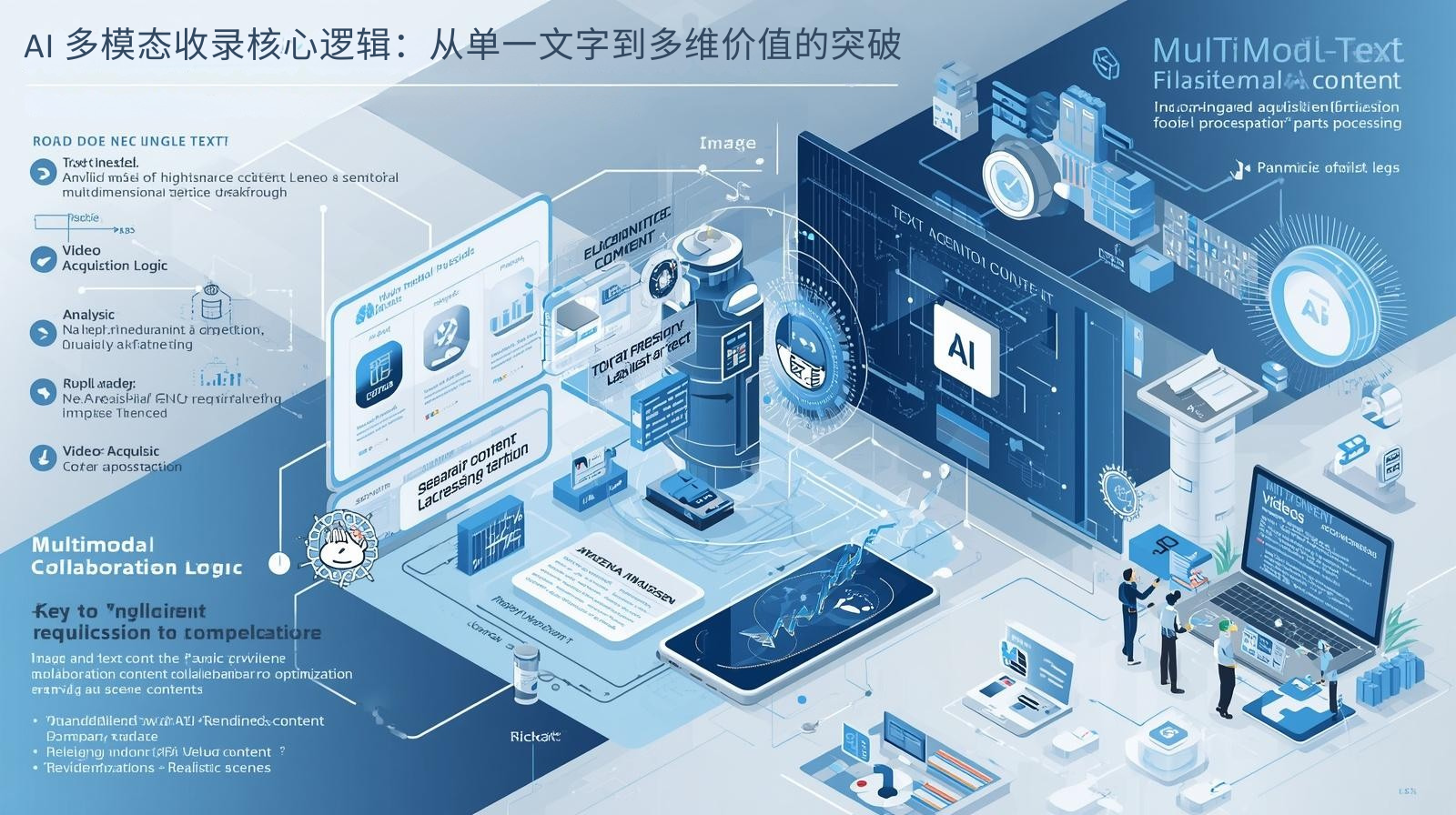
AI multi-modal collection core logic: breakthrough from single text to multi-dimensional value
(1) How does AI collect multi-modal content? Parse rather than simply crawl
When the AI large model processes multi-modal content, it does not just capture the material itself, but extracts core value through the triple action of "text analysis + visual recognition + semantic association":
-
Image and text collection logic : AI will simultaneously analyze the image content (such as product details, scene elements) and text descriptions (such as alt text, legends), and determine the correlation between the two - pictures without alt text and legends that have nothing to do with the content will be judged as "low-value materials" and cannot increase the inclusion weight.
-
Video collection logic : AI extracts core information (such as product functions, application scenarios, advantages and highlights) through video title, description, subtitles, and key frame recognition. Videos without subtitles and vague descriptions are difficult to accurately analyze by AI and have a low priority for collection.
-
Multi-modal collaborative logic : When text, graphics, and videos are presented together around the same semantic theme (such as "Aerospace Parts Processing Application of High-Precision CNC Machine Tools"), AI will determine that the content is rich and valuable, and will give it a higher inclusion weight and recommendation priority.
The key to implementation : Use Pintui Technology’s multi-modal content collaborative optimization services to ensure that text, graphics, and videos have consistent semantics and scene correlation, and improve the value judgment of AI collection.
(2) Graphic content: "Basic evidence" included in AI must meet "standards + correlation"
Graphics and text are the core foundation of multi-modal content. AI-friendly graphics and text must meet the three major requirements of "label specifications, content correlation, and realistic scenes":
-
Label standardization :
-
Add precise alt text to the image (such as "Real photos of aviation parts processed by high-precision CNC machine tools") to avoid meaningless names such as "img001.jpg".
-
The legend contains core semantic vocabulary (such as "using five-axis linkage technology, the processing accuracy can reach ±0.05mm") to supplement key information that cannot be conveyed by pictures.
-
-
Strongly related content :
-
The theme of the graphics and text is consistent with the semantics of the page where it is located. For example, the graphics and text on the product page focus on "product parameters + application scenarios", and the graphics and text on the case page focus on "cooperation results + on-site actual shooting".
-
Avoid stacking irrelevant pictures (such as inserting landscape pictures that have nothing to do with the industry on the product page), otherwise it will distract the AI from identifying the core content.
-
-
Scene authenticity :
-
Prioritize the use of actual product pictures, production site pictures, and customer application pictures, and avoid overly beautified composite pictures.
-
Key graphics and texts are paired with data support (such as "Comparison Chart of Customer Production Capacity Improvement" paired with a text description of "Monthly Production Capacity Increased from 1,000 to 1,800 Pieces") to enhance credibility.
-
Key to implementation : Use Pintui Technology’s GEO-friendly graphic and text production services to standardize the association of graphic and text tags with content to improve AI recognition and collection efficiency.
(3) Video content: The "value bonus items" included in AI must meet the requirements of "scenario + analysis"
Video has become the core basis for AI to determine high-value content because of its more intuitive information transmission. Scenario-based videos need to meet the three major requirements of "clear theme, clear analysis, and adaptation needs":
-
Theme sceneization :
-
Focusing on the core demand scenarios of foreign trade B2B users, such as product function demonstration ("CNC machine tool high-precision processing operation demonstration"), customer case display ("European auto parts enterprise cooperation live video"), problem solutions ("CNC equipment common troubleshooting tutorial").
-
The length of the video is adapted to the scenario, with 3-5 minutes for function demonstrations and 5-8 minutes for case presentations to avoid lengthy and unfocused content.
-
-
Clarification of analysis :
-
Add multi-language subtitles (English + languages of the target market are preferred). The subtitles contain core semantic vocabulary and data (such as "Processing error is controlled within ±0.03mm").
-
The video title and description contain "core words + scene words + regional words" (such as "high-precision CNC machine tools + aerospace parts processing + German market"), which facilitates AI to quickly identify the topic.
-
-
Adapt to multiple terminals :
-
The video format supports mainstream players (MP4 is preferred), the resolution is no less than 1080P, and the loading speed is ≤5 seconds;
-
Provide video thumbnails that contain core scene elements (such as product body + application scenarios) to increase users' willingness to click.
-
Key to implementation : Use Pintui Technology’s scenario-based video content creation services to create scenario-based videos that are easy to parse with AI and easy for users to understand.
(4) Multi-modal collaboration: The "weight amplifier" included in AI must satisfy "logic + closed loop"
The collection effect of a single image, text or video is limited, and multi-modal collaboration needs to build a semantic closed loop of "text + image + video":
-
Page-level collaboration :
-
Product page: core text introduction + product details pictures + function demonstration video to present product value in an all-round way.
-
Case page: Cooperation background text + on-site pictures and texts + customer testimony video to strengthen the credibility of the case.
-
Tutorial page: step-by-step text + operation guide graphic + practical demonstration video to reduce the user’s understanding cost.
-
-
Semantic level collaboration :
-
Different modal content revolves around the same core semantic cluster (such as "environmental-friendly home + small apartment + European certification") to avoid topic dispersion.
-
Video subtitles, graphic annotations and core text echo each other, repeat core information (such as product advantages, key data), and strengthen AI semantic recognition.
-
-
Technical level collaboration :
-
Add structured data tags (such as ImageObject tags, VideoObject tags) to multimodal content, follow Schema.org standard.
-
Optimize the layout of internal links to realize mutual jumps between content in different modalities (such as text links to related videos, video pages associated with supporting images and text), and improve page relevance.
-
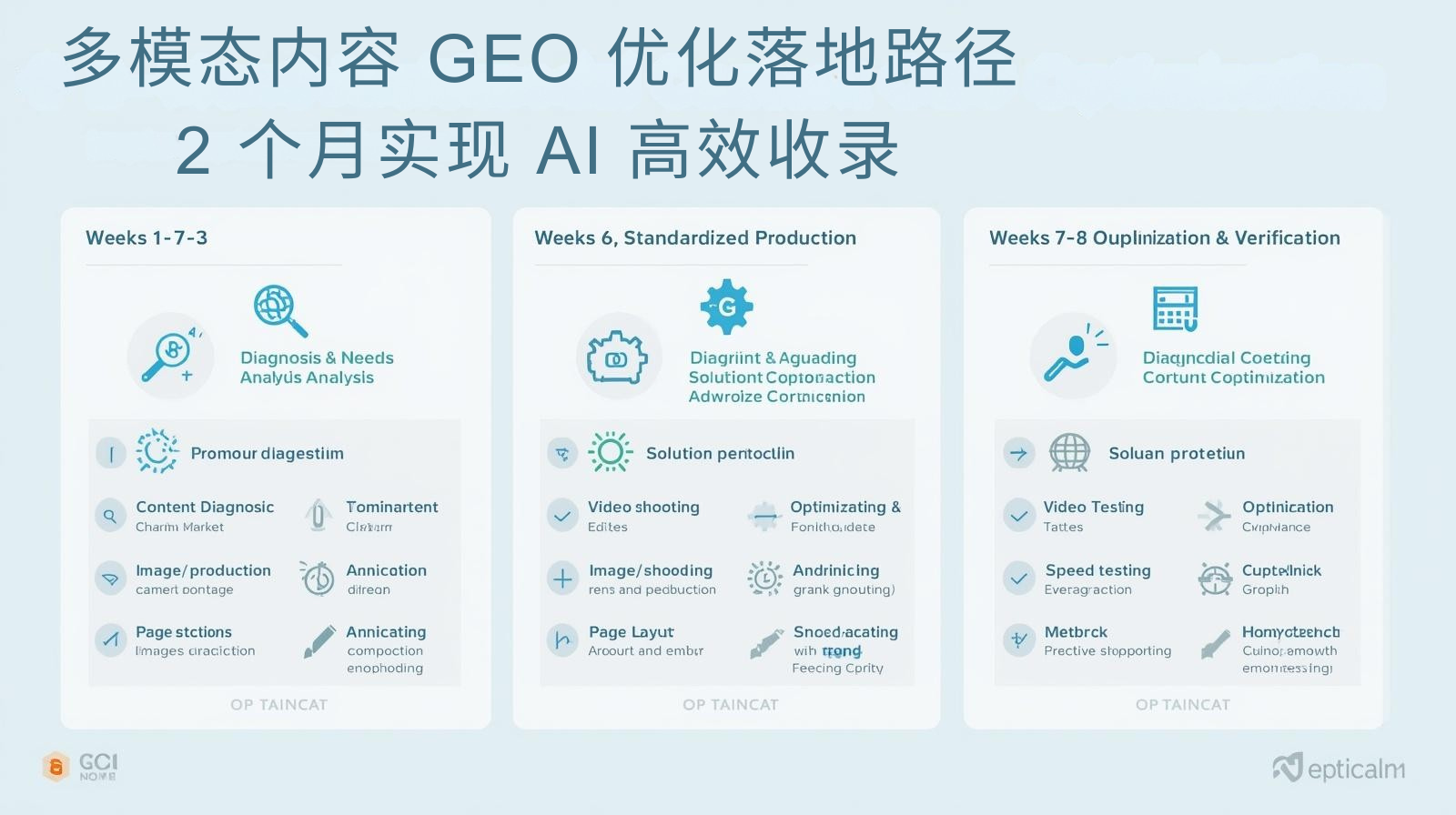
Multi-modal content GEO optimization landing path: 2 months to achieve efficient AI collection
Weeks 1-3: Multimodal Content Diagnosis and Requirements Analysis
-
Decode the multi-modal preferences of the target market (for example, the European and American markets focus on technology demonstration videos, and the Southeast Asian market focuses on product photos and texts).
-
Use Pintui Technology's multi-modal content diagnosis tool to detect the label standardization, scene relevance, and AI resolution of existing content.
-
Develop a customized plan to clarify core actions and priorities such as graphic and text production, video shooting, and collaborative presentation.
Weeks 4-6: Standardized production of multimodal content
-
Produce core graphics and text (product details, scene applications, data comparison) according to GEO-friendly standards, and complete standardized annotation of alt text and legends.
-
Shoot/edit 3-5 core scene videos (function demonstration, case display, tutorial explanation), add multi-language subtitles and standard descriptions.
-
Add structured data tags to all multi-modal content to ensure accurate analysis by AI.
Weeks 7-8: Multi-modal collaborative optimization and effect verification
-
Optimize the page layout to achieve logical presentation and internal linking of text, graphics, and videos.
-
Test multi-modal content loading speed and multi-terminal adaptability to ensure barrier-free AI crawling and user browsing.
-
Monitor indicators such as AI multi-modal inclusion rate, visual content recognition accuracy, and proportion of recommended traffic, and perform fine-tuning and optimization to ensure expected results are achieved.
Practical case: How can machinery companies improve AI collection efficiency through multi-modal content?
Customer background
A medium-sized domestic machinery manufacturing enterprise specializing in CNC machining equipment. The site only relies on text to introduce products, without standardized graphic and video content. The AI inclusion rate is less than 40%. The core product page recommendation traffic accounts for a low proportion. Users stay for only 35 seconds, and the average monthly accurate inquiry is only 9.
Pintui Technology Solution (construction period 2 months)
-
Multi-modal content diagnosis : It is found that the site has problems such as missing images and text, no video material, abstract text information, etc., making it difficult for AI to fully understand the value of the product.
-
GEO-friendly graphics production produces 20 sets of core graphics (product appearance, core components, processing site, data comparison), and adds precise alt text (such as "Real photos of the core components of the five-axis CNC machining center") and legends (such as "Using a spindle imported from Germany, the speed can reach 12,000 rpm").
-
Scenario-based video creation and shooting of 3 core videos ("CNC equipment high-precision processing demonstration", "European customer cooperation on-site witness" and "Equipment operation and maintenance tutorial"), adding English subtitles and standard descriptions, including the core semantics of "CNC processing + high precision + European market".
-
Multi-modal collaborative optimization optimizes the product page layout, logically connects text introduction + graphic display + video demonstration; adds structured data tags to images, texts and videos; builds internal link associations, links text paragraphs to related videos, and associates supporting images and texts to video pages.
-
Effect verification and fine-tuning : Monitor the collected data, and optimize the semantic density of video subtitles and the layout of internal links in graphics and text based on AI feedback after one month.
results and value
Three months after the optimization was implemented, the customer achieved:
-
Inclusion indicators: AI multi-modal inclusion rate increased from 38% to 95%, and visual content recognition accuracy reached 98%.
-
Traffic indicators: The proportion of AI recommended traffic increased from 11% to 52%, the total traffic increased by 190%, and the average user stay time extended from 35 seconds to 88 seconds.
-
Conversion indicators: The monthly average number of precise inquiries increased from 9 to 26, the inquiry conversion rate increased from 1.7% to 3.6%, and the proportion of high-intention customers increased by 60%.
How to evaluate the professional capabilities of multi-modal content GEO optimization service providers?
The core of choosing a service provider is to evaluate its "AI multi-modal collection mechanism decoding capabilities, content production experience, and practical implementation effects" rather than simply price:
-
Decoding capabilities of the collection mechanism : Service providers need to be able to interpret the recognition rules of images, texts and videos by AI large models, rather than just provide material production, and be able to accurately locate the shortcomings of multi-modal collection.
-
Content production experience : Possessing multi-modal content production cases in the foreign trade industry, able to combine product features and market demand to produce AI-friendly content that users love to see, rather than applying universal templates.
-
Technical tool support : It has self-developed multi-modal content diagnosis, tag generation, and structured configuration tools, which can accurately locate problems and efficiently implement optimization.
-
Actual effect verification : It is required to provide quantitative comparative data (such as inclusion rate, recommended traffic, user stay time) "before and after optimization" and reject empty success stories.

Frequently Asked Questions (FAQ)
-
What is the average construction period for multi-modal content GEO optimization?
The average construction period is 2 months, which can be adjusted according to the volume of content: it takes about 1.5 months for multi-modal optimization of the core page, and about 2-2.5 months for multi-modal upgrade of the entire site. Pintui Technology ensures efficient delivery through standardized processes.
-
Can small and medium-sized enterprises carry out multi-modal optimization with limited budgets?
Can. Pintui Technology provides a lightweight solution, giving priority to core product pages and case pages, and producing 3-5 sets of core graphics and 1-2 key videos. The investment cost is as low as tens of thousands of yuan to achieve AI inclusion and adaptation of core content; it also supports phased optimization to reduce financial pressure.
-
There is a wealth of existing multi-modal content, why is the AI collection effect so poor?
The core reason may be that the tags are not standardized, the semantics are not relevant, and the format is incompatible. It is recommended to use Pintui Technology’s multi-modal content diagnosis tool to evaluate gaps and optimize tags, semantics and formats in a targeted manner.
-
How to verify whether multi-modal optimization improves AI collection efficiency?
Core monitoring indicators include: AI multi-modal inclusion rate, image/text/video recognition accuracy, multi-modal recommended traffic proportion, user residence time, page bounce rate, and detailed data reports are provided every month to clearly demonstrate the optimization effect.
Recommended related articles: Your peers haven’t reacted yet: using GEO to build an independent foreign trade station is the biggest blue ocean strategy at the moment.
Recommended related articles: Your peers haven’t reacted yet: using GEO to build an independent foreign trade station is the biggest blue ocean strategy at the moment.
For foreign trade independent websites in the AI era, multi-modal content has become the core competitiveness of AI collection and recommendation. Single text content is difficult to satisfy AI's determination of "comprehensive value". Only through multi-modal presentation of "standardized graphics and text + scene video + logical collaboration" can it help AI deeply understand the value of the site and obtain higher inclusion weight and recommended traffic.
The multi-modal content GEO optimization solution created by Pintui Technology based on 1,200+ practical experiences provides enterprises with a full-process service of "diagnosis-production-collaboration-optimization" with an efficient construction cycle of 2 months, helping enterprises to get rid of single text dependence and achieve dual breakthroughs in AI collection and conversion through multi-modal content.
Contact Pintui Technology customer service immediately and provide your site status, product type and target market. Our GEO optimization consultant will provide you with an exclusive report titled "GEO Customized Optimization Plan for Multi-modal Content of Foreign Trade Independent Stations" within 2 hours, so that your multi-modal content can be efficiently included by AI and seize the traffic high ground!