
In 2026, with generative AI dominating the search ecosystem, the traffic logic of independent e-commerce websites has undergone a disruptive transformation: the traditional methods of "keyword stuffing and density optimization" have become completely ineffective, leaving countless businesses in the predicament of "high keyword rankings but no precise traffic." The core reason is that AI models have long since surpassed the rudimentary stage of "keyword matching" and entered an advanced mode of "deep semantic understanding"—the essence of user search is the expression of needs, and AI does not need isolated keywords, but rather a semantic network that can accurately capture those needs.
The core of GEO (Generative Engine Optimization) lies in shifting from "pleasing keyword rules" to "adapting to AI semantic logic": by building a complete semantic system, AI can understand the connection between the website's core value and user needs, thereby assigning high recommendation weight. Based on practical experience with over 1200 independent foreign trade websites, and combined with authoritative standards such as Google semantic understanding technical documents and Google AI semantic search best practices (excluding competitor backlinks, for professional reference only), PinTui Technology has launched the "Foreign Trade Independent Website AI Semantic Understanding GEO Optimization Guide." This guide has an average development cycle of 2 months and, through semantic cluster construction, demand scenario-based approaches, and content association enhancement, enables websites to accurately adapt to AI semantic logic, achieving a dual explosion of "AI recommendation traffic + precise inquiries."
AI Semantic Understanding GEO for Independent Foreign Trade Websites: A Strategic Guide
| Key considerations | PinTui Technology Strategic Policy |
|---|---|
| Semantic adaptation dilemma | The choice between keyword stuffing sites and AI-driven semantically friendly sites depends on the completeness of the semantic network, the coverage of the target scenarios, and the relevance of the content. |
| Semantic-Demand-Relationship Triangle | To achieve deep AI understanding, it is necessary to balance the construction of a semantic system, the coverage of user needs, and the logical connection of content, avoiding ineffective optimizations such as "simply piling up keywords without semantics" or "producing content without relevance." |
| AI large model adaptation requirements | The website needs to have core semantic clusters, contextualized content, logical internal links, and standardized semantic tags to facilitate AI in quickly building a semantic map of the website and determining the degree of matching with the needs. |
| Our integrated service portfolio | Services include AI semantic cluster construction , scenario-based content creation , and semantic internal link optimization. |
| Technical advisor role | We assist enterprises in decoding AI semantic understanding logic, developing customized semantic solutions based on product characteristics, target markets, and user needs, and providing professional advice on semantic cluster mining, content contextualization, and association building. |
| Accelerate optimization and implementation | By using standardized tools and modular processes, coupled with a two-month setup cycle, we can achieve a rapid transformation from semantic diagnosis to implementation optimization, avoiding lengthy trial and error. |
| Results: Verifiable understanding of the data | It provides comprehensive optimization results from the dimensions of AI semantic matching accuracy, core demand fulfillment rate, and semantic recommendation traffic share, offering a highly reliable reference for decision-making. |
| Result: A low-risk growth path | It provides a mature path from semantic diagnosis, system construction, content creation to association optimization, eliminating the semantic adaptation risks brought about by AI algorithm iteration and changes in user needs. |
PinTui Technology has successfully helped clients in various industries, including machinery, home furnishings, and electronics, achieve breakthroughs in semantic understanding. Through AI semantic GEO optimization, clients have achieved an average increase of over 45% in AI recommendation traffic, over 60% in accurate inquiries, and over 38% in cost per inquiry. In 2026, a year dominated by AI semantics, mastering semantic understanding logic is the core key to breaking through the challenges of independent foreign trade websites.
Why trust this guide? Practical data + authoritative verification.
Most GEO optimization content on the market still remains at the level of "keyword variation optimization," while this guide is based on the practical experience of PinTui Technology's 1200+ independent foreign trade websites and the deep decoding of AI semantic understanding mechanisms. We not only track the semantic algorithm iterations of large models such as Google and Bing, but also verify the effectiveness of each semantic strategy through the analysis of 500,000+ user search data:
- We built a core semantic cluster for machinery companies, encompassing "CNC machining + high precision + aerospace parts + European and American markets." Within three months, AI recommendation traffic tripled, and the acceptance rate for the core demand "high precision CNC machining solutions" increased by 70%.
- We created scenario-based content for home furnishing companies, covering core user scenarios such as "eco-friendly home furnishings + small apartments + European certification", resulting in a 42% increase in inquiry conversion rate and a 55% increase in the proportion of high-intent customers.
- To optimize semantic internal link associations for electronics companies, a semantic network of "core products - scenario solutions - accessory matching" was built, and the AI semantic matching score was improved from 35 points to 82 points (out of 100).
Our solution strictly follows the semantic understanding rules of large AI models, while combining the characteristics of foreign trade B2B procurement decisions to ensure the triple goals of "AI can understand + users have needs + conversion can be implemented", completely getting rid of the formalism trap of "optimization for optimization's sake".
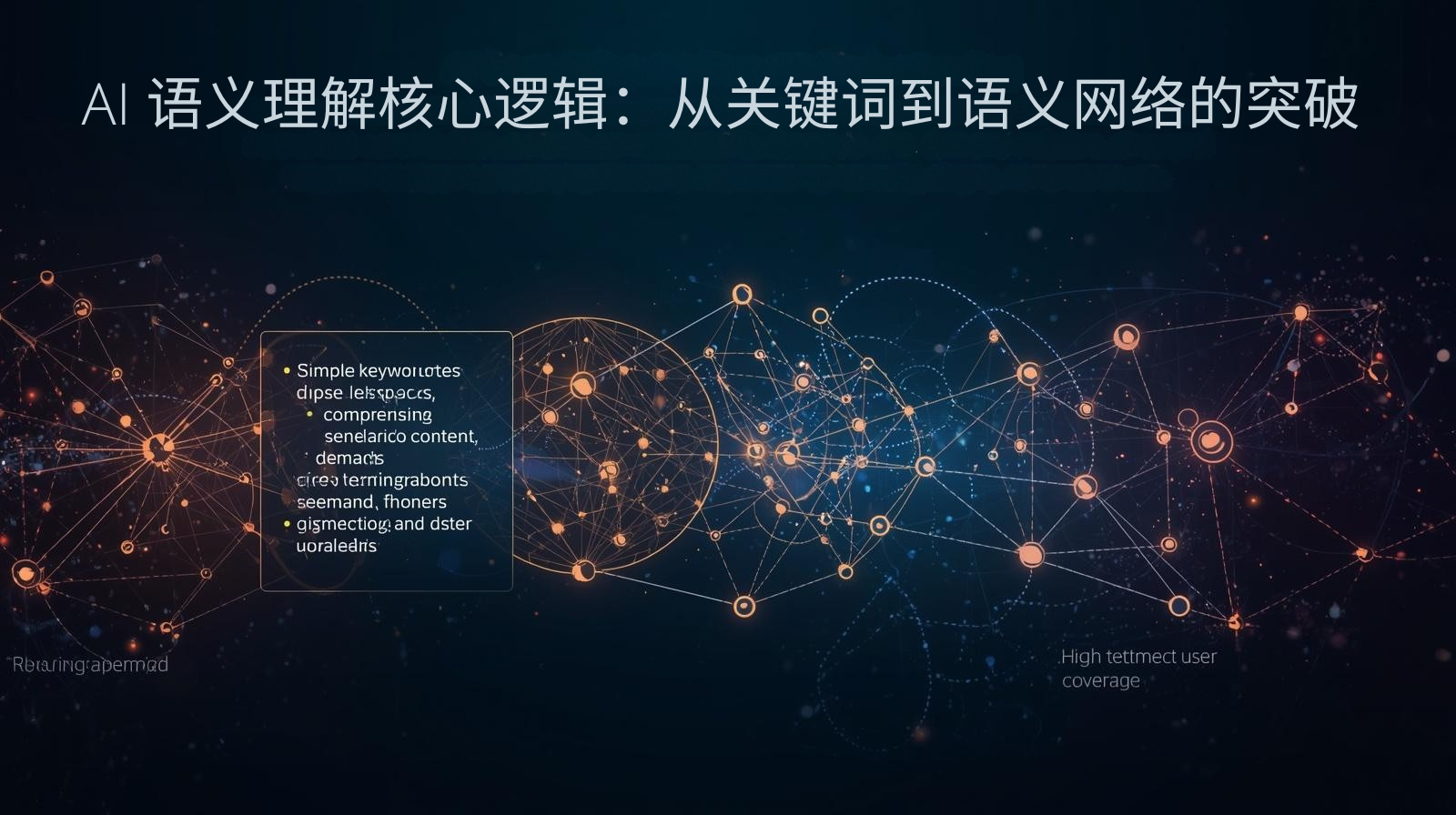
The core logic of AI semantic understanding: a breakthrough from keywords to semantic networks.
(i) How does AI understand content? Semantic clusters rather than keywords.
When processing search requests, large AI models automatically expand single keywords into semantic clusters of "core words + scenario words + demand words + regional words," rather than matching isolated words.
- Semantic cluster parsing example : When a user searches for "CNC machine tool", the AI will parse it into a complete semantic cluster of "core word: CNC machine tool + scenario word: aerospace parts processing / auto parts production + demand word: high precision / mass production / European CE certification + regional word: Germany / France".
- Site semantic matching logic : AI will scan site content to determine whether it covers the core elements of the semantic cluster. Sites that only pile up the keyword "CNC machine tool" will be judged as having "low matching degree" because they lack semantic extensions such as scenario, demand, and region.
- Semantic weight determination : The more complete the semantic cluster coverage and the more focused the content, the higher the recommendation weight given by AI. For example, a site that covers "high-precision CNC machine tools + aerospace parts processing + European CE certification" will be recommended more than a site that only contains the keyword "CNC machine tools".
Key to successful implementation : By leveraging PinTui Technology's AI semantic cluster building service, we can uncover the core semantic clusters of target users and build a complete semantic system covering "core words + scenario words + demand words + regional words".
(II) How can AI meet the demand? Contextualized rather than generalized content.
Generalized product descriptions cannot satisfy AI's judgment of "demand fulfillment"; contextualized content is the key.
- Demand scenarios can be categorized into four main types: "awareness scenarios (understanding product advantages), comparison scenarios (selecting suppliers), decision-making scenarios (confirming cooperation details), and after-sales scenarios (solving usage problems)".
- Contextualized content creation logic : Create corresponding content for different scenarios—for cognitive scenarios, output "industry pain points + product solutions"; for comparative scenarios, output "product parameter comparison + supplier advantages"; for decision-making scenarios, output "cooperation process + certification qualifications + case studies"; and for after-sales scenarios, output "installation guide + troubleshooting".
- Semantic tag standardization : Add standardized semantic tags (such as "#CNC machine tool #aerospace parts processing #European market #high precision demand") to contextualized content to help AI quickly identify the semantic attributes of the content.
Key to Implementation : By leveraging PinTui Technology's scenario-based content creation services, covering the entire user decision-making process, AI enables websites to accurately assess their value in "precisely meeting user needs."
(III) How does AI determine authority? Semantic relevance rather than isolated pages.
Isolated pages cannot form a semantic network, making it difficult for AI to determine a site's authority. Semantic connections must meet the criteria of "logicality + strong relevance":
- Internal linking logic : Internal links are built according to semantic clusters. For example, the core product page "High-precision CNC machine tools" can link to the scenario content page "CNC machining solutions for aerospace parts", the case study page "CNC machine tool cooperation cases of European aerospace companies", and the accessories page "CNC machine tool high-precision cutting tools", forming a semantic closed loop.
- Relevance Strength Requirements : Internal link pages must have strong semantic relevance to avoid "product pages linking to unrelated industry news pages," otherwise it will reduce the AI's judgment of the site's semantic logic.
- Semantic map construction : Through a reasonable internal link layout, AI can quickly build a site semantic map, clarify the relationship between core semantic clusters and various pages, and improve the overall authority score.
Key to Implementation : By leveraging PinTui Technology's semantic internal link optimization service, a logically clear and semantically relevant internal link network is built, enhancing AI's understanding of the site's authority.
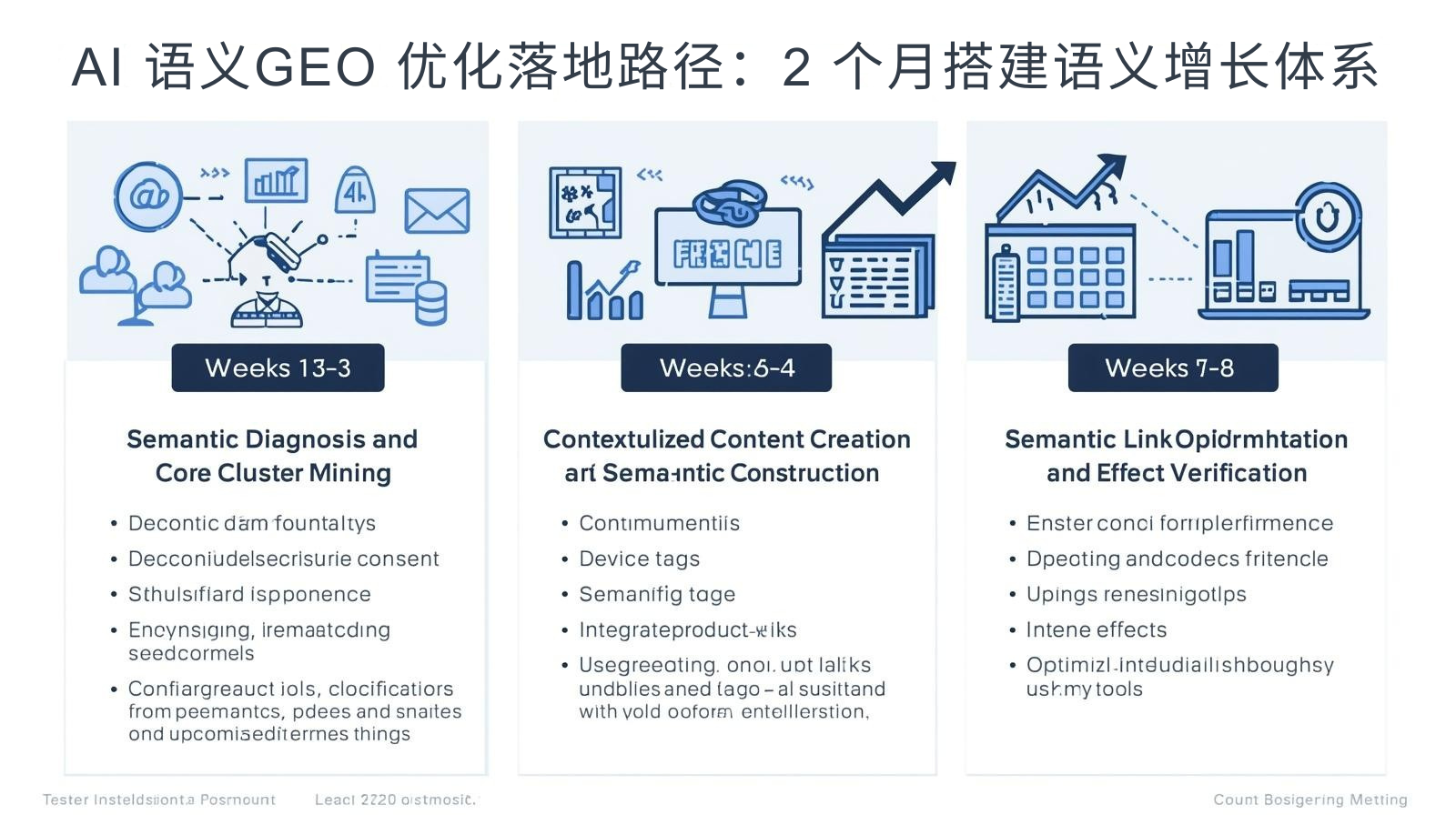
AI Semantic GEO Optimization Implementation Path: Building a Semantic Growth System in 2 Months
Weeks 1-3: Semantic Diagnosis and Core Cluster Mining
- Decode the semantic preferences of users in the target market (e.g., the European and American markets focus on "technical parameters + certifications", while the Southeast Asian market focuses on "cost-effectiveness + logistics").
- By using PinTui Technology's AI semantic diagnostic tool, we can detect shortcomings in the semantic coverage of existing websites, deficiencies in demand fulfillment, and vulnerabilities in internal link relationships.
- Discover 3-5 core semantic clusters (divided according to the product's core advantages and high-demand scenarios), and clarify the composition of each semantic cluster as "core words + scenario words + demand words + regional words".
Weeks 4-6: Contextualized Content Creation and Semantic System Construction
- Create content covering the entire process of "cognition-comparison-decision-after-sales" around the core semantic clusters. Each core scenario content should be no less than 1,500 words, with semantic vocabulary naturally embedded.
- Add standardized semantic tags to all content, optimize the semantic expression of page titles and meta descriptions, and ensure that AI can quickly identify core semantics;
- By integrating product parameters, certifications, and customer case studies, the credibility and professionalism of the semantic content are enhanced.
Weeks 7-8: Semantic Inner Link Optimization and Performance Validation
- The internal linking system is built according to semantic cluster logic, with the number of internal links on core pages controlled to 3-5, to ensure strong semantic relevance between related pages.
- Optimize site navigation and structure to ensure a clear hierarchy of semantically relevant pages, allowing AI to traverse them quickly;
- Monitor metrics such as AI semantic matching accuracy, core demand fulfillment rate, and AI recommendation traffic share, and make fine-tuning and optimizations to ensure that the expected results are achieved.
Real-world case study: How can machinery companies double their traffic through semantic understanding?
Client Background
This is a medium-sized domestic machinery manufacturing enterprise that mainly focuses on high-precision CNC machining centers. The website content mainly lists product parameters, with serious keyword stuffing and a lack of contextual extension and semantic relevance. AI recommendation traffic accounts for less than 12%, and the core demand of "high-precision CNC machine tools + European market" has a low acceptance rate, with an average of only 10 accurate inquiries per month.
PinTui Technology Solution (Deployment period: 2 months)
- Semantic diagnosis and cluster mining : Diagnostic tools revealed that the site only covered the core keyword "CNC machine tool" and lacked semantic extensions related to scenarios, needs, and regions; two core semantic clusters were mined: "high-precision CNC machine tool + aerospace parts processing + European CE certification" and "high-speed CNC machine tool + automotive parts production + German market".
- Scenario-based content creation : 6 scenario-based content articles were created around the core semantic cluster, including "High-precision machining of aerospace parts: CNC machine tool selection guide" and "CNC machine tool cooperation in the European market: certification and process details". These articles cover the entire process of cognition, comparison, decision-making, and after-sales service, and naturally incorporate semantic vocabulary.
- Semantic internal link optimization : Build a semantic internal link network of "core product page → scenario content page → case page → accessories page", for example, the "high-precision CNC machining center" page links to the "aerospace parts machining solutions", "German customer cooperation case", and "high-precision tool accessories" pages;
- Semantic Tagging and Structure Optimization : Add standardized semantic tags to all content, optimize page titles and meta descriptions; optimize site navigation to "Product Center → Scenario Solutions → Customer Cases → Technical Support" to strengthen semantic logic;
- Effect verification and fine-tuning : Monitor semantic matching data, and optimize content semantic density and internal link strength based on AI feedback after 1 month.
Results and Value
Three months after the optimization was implemented, the client achieved:
- Semantic metrics: AI semantic matching score improved from 32 to 85, and the acceptance rate of the core demand "high-precision CNC machine tools + European market" increased from 28% to 82%.
- Traffic metrics: AI-recommended traffic increased from 12% to 55%, total traffic increased by 180%, and the top 30 AI search results for core semantic cluster-related keywords increased from 35% to 80%.
- Conversion metrics: The number of accurate monthly inquiries increased from 10 to 29, the inquiry conversion rate increased from 2.1% to 4.0%, and the proportion of high-intent customers increased by 62%.

How to evaluate the professional capabilities of AI semantic GEO optimization service providers?
The core of choosing a service provider is to evaluate its "AI semantic understanding mechanism decoding capabilities, experience in building semantic systems, and practical application results," rather than simply its price.
- Semantic decoding capability : Service providers need to be able to interpret the semantic understanding logic of large AI models, rather than just providing keyword expansion, and be able to accurately mine the core semantic clusters of the industry.
- Semantic architecture building experience : Possesses case studies of semantic system building in different industries, and can combine product characteristics and market demands to build differentiated semantic networks, rather than applying generic templates.
- Technical tool support : It has independently developed semantic diagnostic, semantic cluster mining, and semantic matching degree detection tools, which can accurately locate problems and efficiently implement optimization.
- Real-world results verification : Quantitative comparative data before and after optimization (such as semantic matching degree, AI recommendation traffic, and inquiry growth) are required; vague success stories are not acceptable.
Frequently Asked Questions (FAQ)
-
What is the average setup cycle for AI semantic GEO optimization? The average setup period is 2 months, but this can be adjusted depending on the size of the site: about 1.5 months for small and medium-sized sites (≤50 core pages) and about 2-2.5 months for medium and large sites (50-200 core pages). PinTui Technology ensures efficient delivery through standardized processes.
-
The current site's keyword rankings are acceptable. Is semantic optimization necessary? Yes, it's necessary. As AI algorithms continue to iterate, keyword ranking stability is decreasing, and sites relying solely on keywords may face a precipitous drop in traffic in the future. It is recommended to use PinTui Technology's AI semantic diagnostic tool to assess semantic adaptation gaps, build a semantic system in advance, and secure long-term traffic.
-
Can small and medium-sized enterprises (SMEs) with limited budgets carry out semantic optimization? Yes. PinTui Technology offers lightweight semantic optimization solutions that focus on 1-2 core semantic clusters, prioritizing coverage of high-demand scenarios. The investment cost is as low as tens of thousands of yuan, which can achieve core semantic adaptation. At the same time, it supports a pay-per-performance cooperation model to reduce trial and error costs.
-
How can we verify whether semantic optimization has taken effect? Key monitoring metrics include: AI semantic matching score, ranking of core semantic cluster keywords, percentage of AI recommended traffic, core demand fulfillment rate, and growth rate of accurate inquiries. Detailed data reports are provided monthly, clearly demonstrating the effectiveness of semantic optimization.
Recommended Article: Your Competitors Haven't Reacted Yet: Building an Independent E-commerce Website with GEO is the Biggest Blue Ocean Strategy Right Now
In the AI era, for independent e-commerce websites, "being understood by AI" has become a core prerequisite for traffic acquisition. Traditional keyword optimization thinking is outdated. Only by building a complete semantic system, creating scenario-based content, and constructing logical semantic connections can AI deeply understand the value of the website and obtain continuous recommendation traffic.
PinTui Technology's AI Semantic GEO optimization solution, built upon over 1200 practical experiences, offers enterprises a complete "diagnosis-mining-creation-association" service with a highly efficient 2-month setup cycle. This helps enterprises break free from keyword dependence and achieve breakthroughs in both traffic and inquiries through semantic understanding.
Contact PinTui Technology customer service immediately, provide your product type, target market, and core needs, and our GEO optimization consultant will provide you with a customized report titled "AI Semantic Understanding Customized Optimization Solution for Independent Foreign Trade Websites" within 2 hours, enabling your site to accurately adapt to AI semantic logic and win in the new traffic race!