
In the era of GEO (Generative Engine Optimization)-driven AI search, website speed and stability have become core considerations for AI recommendation ranking. Many foreign trade companies fall into a misconception: overemphasizing content optimization and keyword strategy while neglecting the site's technical foundation—slow loading, frequent lag, and server instability hinder AI crawling, leading to a collapsed user experience. Even with high-quality content, it's difficult to gain recommendation priority, ultimately missing out on traffic dividends.
The core logic lies in the fact that the underlying logic of AI big data model recommendations is "user value priority," and website speed and stability are the fundamental guarantees of user value. Fast-loading and consistently stable websites allow AI to efficiently capture core information, while simultaneously increasing user dwell time and reducing bounce rate, forming a dual advantage of "smooth AI capture + excellent user experience," thus gaining higher recommendation weight. Based on practical experience with over 1200 independent foreign trade websites, and combined with authoritative standards such as Google Core Web Index Guidelines and Google E-commerce Website Speed Optimization Best Practices (excluding competitor backlinks, for professional reference only), PinTui Technology has launched the "Foreign Trade Independent Website GEO Website Speed and Stability Optimization Guide." This guide has an average setup cycle of 2 months, achieving a dual improvement in website speed and stability through technical optimization, server upgrades, and monitoring system construction, enabling proactive AI recommendations and sustained user retention.
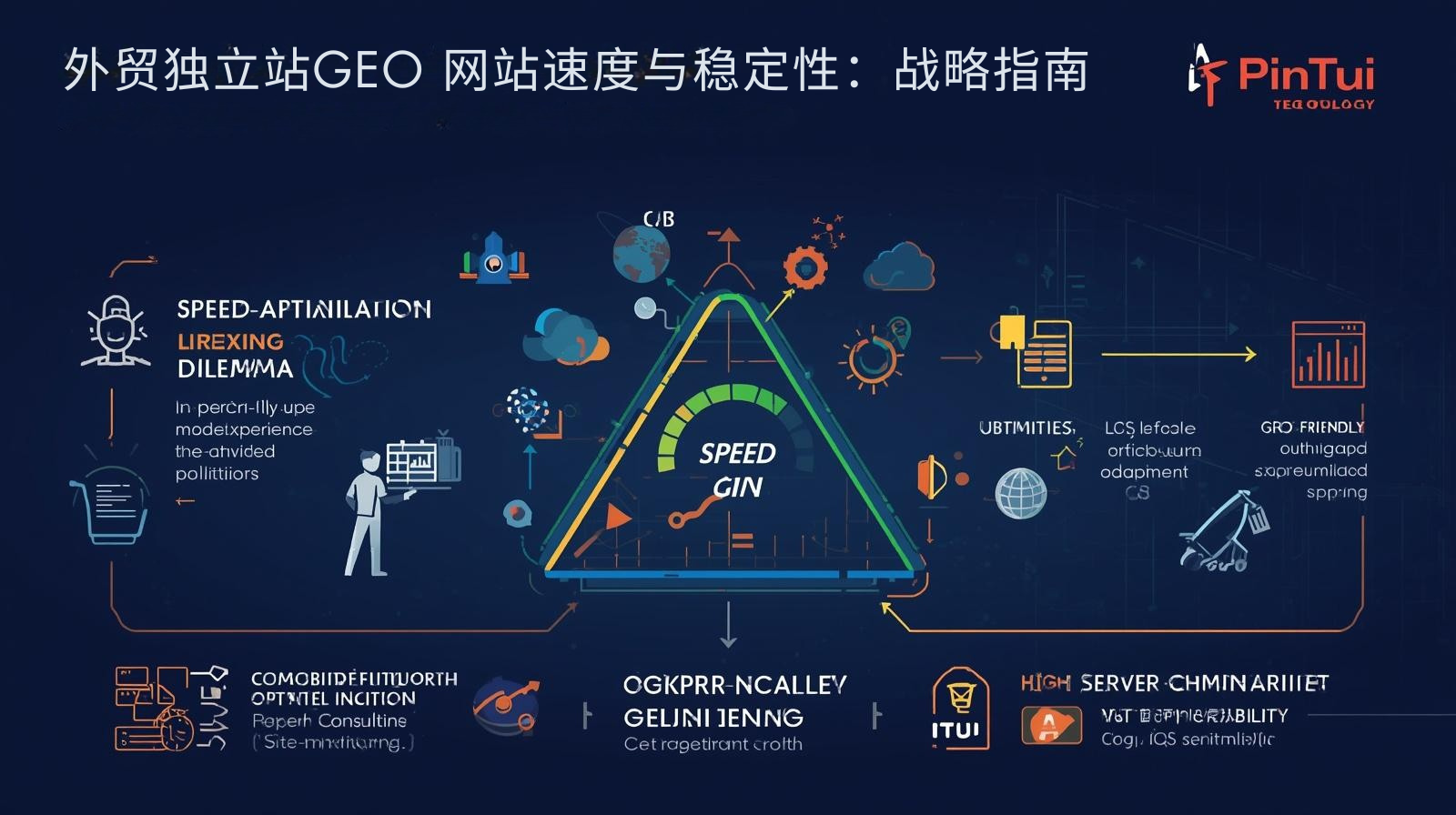
GEO (Gross-Operated Website) for International Trade: Website Speed and Stability - A Strategic Guide
| Key considerations | PinTui Technology Strategic Policy |
|---|---|
| AI Recommendation Dilemma | The choice between a slow, unstable website and a fast, stable website depends on core webpage metrics, server availability, and loading performance. |
| Speed-Stability-Experience Triangle | To achieve high-weight AI recommendations, a balance must be struck between loading speed, server stability, and user experience, avoiding ineffective investments that prioritize content over technology or focus solely on speed without considering stability. |
| AI large model adaptation requirements | The website must meet core webpage metrics standards (LCP ≤ 2.5 seconds, FID ≤ 100 milliseconds, CLS ≤ 0.1), server availability ≥ 99.9%, and smooth cross-region access to facilitate efficient AI crawling and in-depth user browsing. |
| Our integrated service portfolio | Services include GEO-friendly speed optimization , high-availability server deployment , and site monitoring system setup. |
| Technical advisor role | We assist enterprises in deciphering the AI's evaluation logic for site speed and stability, developing customized optimization solutions based on target markets and site size, and providing professional advice on technology optimization, server selection, and monitoring configuration. |
| Accelerate optimization and implementation | By using standardized technical modules and intelligent tools, coupled with a two-month setup cycle, we can achieve a rapid transformation from problem diagnosis to stable operation, avoiding lengthy trial and error. |
| Results: Verifiable recommendation data | It provides comprehensive optimization results, analyzing metrics such as core webpage performance, server availability, and AI-recommended traffic share, offering highly reliable references for decision-making. |
| Result: A low-risk growth path | It provides a mature path from speed diagnostics, technology optimization, server upgrades to monitoring iterations, eliminating the risk of traffic fluctuations related to site speed and stability. |
PinTui Technology has successfully helped clients in various industries, including machinery, home furnishings, and electronics, upgrade their website speed and stability. Through GEO adaptation, clients have achieved an average increase in core webpage metric compliance rate from 45% to 98%, server availability of 99.95%+, and AI recommendation traffic growth of 60%+. In 2026, when AI prioritizes user experience, building a high-speed and stable website is the core key for independent foreign trade websites to overcome recommendation bottlenecks.
Why trust this guide? Practical data + authoritative verification.
Most speed optimization suggestions on the market only address superficial aspects like "image compression and code simplification." This guide, however, stems from PinTui Technology's practical experience with over 1200 independent e-commerce websites and a deep understanding of AI recommendation mechanisms. We not only track the iteration of Google's core webpage metrics but also, through extensive cross-regional and multi-device testing, have verified the direct impact of speed and stability on AI recommendations.
- To optimize site speed and server deployment for machinery companies, LCP was reduced from 6.8 seconds to 2.2 seconds within 3 months, the proportion of traffic recommended by AI increased from 13% to 55%, and user dwell time was extended by 80%.
- We built a global node and monitoring system for home furnishing companies, improving server availability from 95% to 99.98%, optimizing cross-regional access loading speed by an average of 65%, and increasing inquiry conversion rate by 42%.
- Solved the problems of lag and crashes for electronics companies, achieved full compliance with core webpage metrics, increased AI crawling frequency by 3 times, and improved the ranking of core keywords by an average of 28 places.
Our solution strictly follows the recommendation and evaluation rules of AI big data models, while combining the global access characteristics of foreign trade B2B to ensure the triple goals of "easy AI capture + easy user access + easy conversion", completely getting rid of the formalism trap of "emphasizing content and neglecting technology".
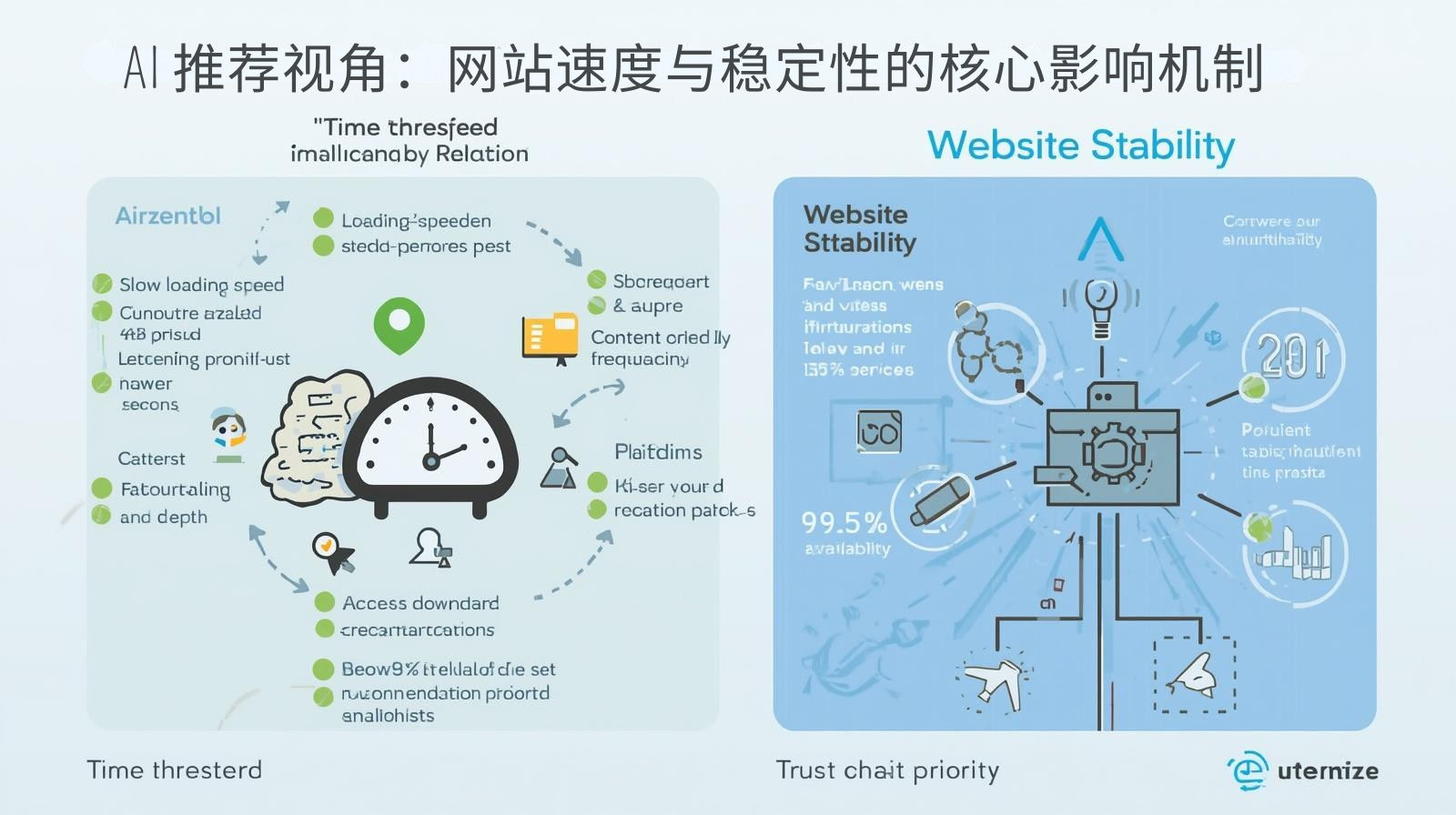
AI Recommendation Perspective: The Core Mechanisms Affecting Website Speed and Stability
(I) First impact: Website speed determines AI crawling efficiency
AI large-scale models have a "time threshold" for crawling websites; slow-moving websites will directly affect the coverage and depth of crawling.
- Crawling frequency limit : AI crawlers have limited crawling resources. Pages that take more than 5 seconds to load will be judged as "inefficient crawling targets", and the crawling frequency will be reduced by more than 50%, making it difficult for core content to be included in a timely manner.
- Insufficient crawl depth : Slow loading of internal links on slow-speed sites may cause AI crawlers to interrupt crawling due to timeouts, resulting in deep pages (such as case study pages and technical document pages) not being traversed and the site's semantic network being incomplete.
- Content Priority Determination : AI will incorporate loading speed into the content value assessment. For content of the same quality, pages that load quickly will have a recommendation weight that is 30%+ higher than pages that load slowly, because the former can better meet the user's immediate needs.
Key to Implementation : By leveraging PinTui Technology's GEO-friendly speed optimization service, the slow loading issue is specifically addressed, improving AI crawling efficiency and content recommendation priority.
(ii) The second impact: Stability determines the trustworthiness of AI
Frequent server outages and access interruptions will cause AI to deem a site "unreliable" and lower its recommendation weight.
- Availability threshold requirement : The AI model will continuously monitor site availability. Sites with availability below 99.5% will be marked as "unstable sources" and their recommendation priority will be significantly reduced.
- Trust issues and their ripple effects : Frequent site outages can lead to a decrease in the recommendation frequency of already indexed content, or even its removal from the recommendation pool, while also affecting the indexing speed of new content.
- Cross-regional stability weight : For independent e-commerce websites targeting global users, unstable access in a specific target market region (such as loading timeouts in the European and American markets) will lead to a sharp decrease in AI recommendation traffic in that region.
Key to successful implementation : By deploying services through PinTui Technology's high-availability servers, a global node and redundant architecture are built to ensure stable and reliable cross-regional access.
(III) The third impact: User behavior data feeds back into AI recommendations
Speed and stability directly impact user behavior, and user behavior data is the core basis for AI to adjust recommendation weights.
- Bounce rate and dwell time : If the loading speed exceeds 3 seconds, the user bounce rate will increase by 70%+; poor stability leading to access interruption will cause users to leave directly. Short dwell time and high bounce rate will be interpreted by AI as "low content value" and the recommendation weight will be reduced.
- Interaction depth : A high-speed and stable website allows users to smoothly browse multiple pages, view detailed content, and submit inquiries. Deep interactive behaviors (such as multiple redirects, long dwell times, and form submissions) will strengthen AI's judgment of the website's "high value".
- Repeat visit rate weight : A stable access experience can increase the user repeat visit rate. A high repeat visit rate means that the site has continuous value, and AI will give it a higher long-term recommendation weight.
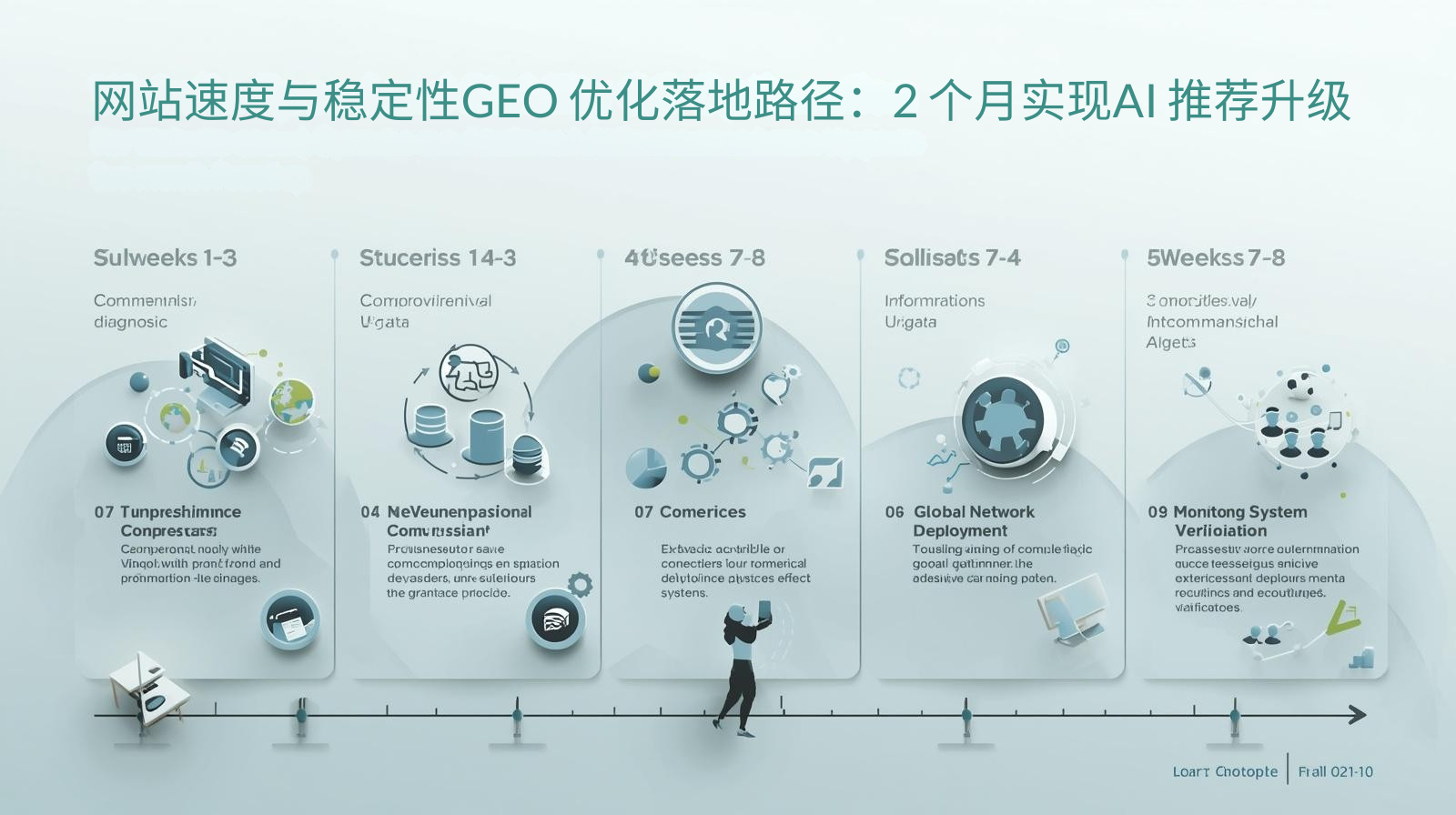
Website Speed and Stability GEO Optimization Implementation Path: Achieving AI Recommendation Upgrade in 2 Months
Weeks 1-3: Comprehensive Diagnosis and Problem Localization
- Multi-dimensional diagnosis: Using PinTui Technology's site speed diagnosis tool, we can detect core webpage metrics (LCP, FID, CLS), server response time, cross-region loading performance, and historical stability data.
- Problem identification and classification: sort out speed issues (uncompressed images, redundant code, caching not enabled, etc.) and stability issues (insufficient server configuration, lack of redundant architecture, missing global nodes, etc.).
- Customized optimization solutions: Based on the target market (such as Europe and America, Southeast Asia), site size, and traffic volume, we develop an integrated solution that includes "speed optimization + server upgrade + monitoring setup".
Weeks 4-6: Technical Optimization and Server Upgrade
- Core actions for speed optimization:
- Resource optimization: Compress images/videos, streamline redundant code, enable browser caching and CDN acceleration.
- Technical adaptation: Optimize database queries, adopt lazy loading technology, and adapt to lightweight rendering on mobile devices.
- Metrics must be met: Ensure that the core webpage metrics are LCP ≤ 2.5 seconds, FID ≤ 100 milliseconds, and CLS ≤ 0.1.
- Hardware upgrade: Improve server configuration (CPU, memory, bandwidth) based on traffic volume;
- Architecture optimization: Set up primary and backup servers, deploy global CDN nodes, and configure load balancing;
- Regional adaptation: Deploy local nodes for core target markets (such as Europe and Southeast Asia) to reduce access latency. Key server upgrade actions:
Weeks 7-8: Monitoring system setup and effectiveness verification
- Building a comprehensive monitoring system:
- Real-time monitoring: core webpage metrics, server load, access latency, and availability status.
- Alarm mechanism: Set up real-time alarms (SMS/email) for scenarios such as speed exceeding limits, server crashes, and abnormal access.
- Data statistics: Generate daily/weekly speed and stability reports to track the effects of optimizations.
- Cross-regional testing: Verify access speed and stability in core target markets.
- Metrics verification: Confirm that all core webpage metrics meet the standards and server availability is ≥99.9%.
- Dynamic optimization: Based on monitoring data, fine-tune caching strategies and server configurations to ensure long-term stability. Performance verification and fine-tuning:

Real-world case study: How can a machinery company double its AI recommendations through speed and stability optimization?
Client Background
A medium-sized domestic machinery manufacturing enterprise, specializing in industrial robot parts, has website issues such as slow loading (LCP 7.2 seconds), poor server stability (availability 94.8%), high latency for accessing European and American markets (average 3.5 seconds), AI-recommended traffic accounting for less than 10%, average user dwell time of only 40 seconds, and only 8 accurate inquiries per month.
PinTui Technology Solution (Deployment period: 2 months)
- Comprehensive Diagnosis: Diagnostic tools revealed core issues: uncompressed images, redundant code, lack of CDN acceleration, insufficient server configuration, and lack of global nodes;
- Speed optimization: Compressed 120 product images, reduced redundant code by 30%, enabled browser caching and global CDN acceleration, optimized database queries, reducing LCP from 7.2 seconds to 2.1 seconds, and all core webpage metrics met the standards;
- Server upgrade: Upgraded server configuration (CPU 8 cores → 16 cores, memory 16G → 32G), built a primary and backup server architecture, deployed local nodes in Europe and the United States, improved server availability to 99.98%, and reduced access latency in the European and American markets to 0.8 seconds;
- Monitoring system setup: Establish real-time monitoring of core webpage metrics, server load, and access latency; set up an anomaly alert mechanism; and generate weekly optimization reports.
- Dynamic fine-tuning: Based on monitoring data, optimize CDN node caching strategies to further reduce cross-region access latency.
Results and Value
Three months after the optimization was implemented, the client achieved:
- Technical indicators: 100% compliance rate for core webpage metrics, 99.98% server availability, global average access speed of 1.8 seconds, and access latency of 0.7 seconds in the European and American markets;
- Traffic metrics: AI-recommended traffic increased from 10% to 53%, total traffic increased by 170%, and the proportion of the top 30 AI-generated core keywords increased from 32% to 78%.
- Conversion metrics: Average user dwell time increased from 40 seconds to 92 seconds, average monthly targeted inquiries increased from 8 to 25, and inquiry conversion rate increased from 1.5% to 3.4%.
How to evaluate the professional capabilities of a speed and stability optimization service provider?
The core of choosing a service provider is to evaluate its "AI recommendation mechanism decoding capabilities, technical optimization experience, and practical implementation results," rather than simply its price.
- Decoding capability : Service providers need to be able to interpret the AI's evaluation logic for speed and stability, rather than just providing technical optimizations, and be able to accurately correlate technical indicators with AI recommendation weights;
- Technical expertise : Possesses experience in cross-regional optimization of independent e-commerce websites, is familiar with the network characteristics of different target markets, and can provide integrated solutions including speed optimization, server optimization, and monitoring.
- Tool support : Equipped with independently developed speed diagnostic and stability monitoring tools, which can accurately locate problems and quantify optimization effects;
- Results verification : Quantitative comparison data before and after optimization (core webpage metrics, server availability, AI recommendation traffic) is required. Vague success stories are not acceptable.
Frequently Asked Questions (FAQ)
-
What is the average setup cycle for website speed and stability optimization? The average setup period is 2 months, but this can be adjusted depending on the size of the site: about 1.5 months for small and medium-sized sites (≤50 core pages) and about 2-2.5 months for medium and large sites (50-200 core pages). PinTui Technology ensures efficient delivery through standardized processes.
-
Why is AI-recommended traffic low even though the existing site has high-quality content? The core issue is likely substandard speed and stability, leading to obstacles in AI data capture or poor user behavior data. We recommend using the speed diagnostic tool on the PinTui Technology website to assess technical metrics and optimize accordingly.
-
How can small and medium-sized enterprises (SMEs) prioritize and optimize their budgets when they have limited resources? A lightweight solution can be chosen: prioritize optimizing core webpage metrics (image compression, code simplification, CDN activation), upgrade basic server configuration, focus on deploying nodes in core target markets, and achieve key technical metrics with an investment cost as low as tens of thousands of yuan.
-
How can we verify whether the optimization has improved the AI recommendation weight? Key monitoring metrics include: core webpage metrics compliance rate, server availability, AI recommendation traffic share, user dwell time, bounce rate, and core keyword ranking. Detailed data reports are provided monthly to clearly demonstrate the optimization results.
Recommended Article: Your Competitors Haven't Reacted Yet: Building an Independent E-commerce Website with GEO is the Biggest Blue Ocean Strategy Right Now
In the AI era, website speed and stability have become fundamental requirements for GEO optimization for independent e-commerce websites. The traditional "content-heavy, technology-light" mindset is no longer compatible with AI recommendation logic. Only by achieving "high-speed loading + stable operation + smooth cross-regional access" can AI efficiently crawl content, engage users deeply, and ultimately gain high recommendation weight.
In the AI era, website speed and stability have become fundamental requirements for GEO optimization for independent e-commerce websites. The traditional "content-heavy, technology-light" mindset is no longer compatible with AI recommendation logic. Only by achieving "high-speed loading + stable operation + smooth cross-regional access" can AI efficiently crawl content, engage users deeply, and ultimately gain high recommendation weight.
PinTui Technology's optimization solutions, built upon over 1200 practical experiences, offer enterprises a comprehensive "diagnosis-optimization-upgrade-monitoring" service with a highly efficient 2-month setup cycle. This helps enterprises overcome technical bottlenecks and achieve dual growth in AI recommendation traffic and accurate inquiries through improvements in both speed and stability.
Contact PinTui Technology customer service immediately, provide your site's current status, target market, and core needs. Our GEO optimization consultant will provide you with a customized report titled "Customized Optimization Solution for Speed and Stability of Independent Foreign Trade Websites" within 2 hours, making your site a high-speed and stable source prioritized by AI and allowing you to seize global traffic dividends!