
I. Misconceptions about affiliate marketing sites: Commercial pages ≠ spam pages. Search engines dislike "worthless pure commissions," not all commercial content.
- The real targets are missing information, fabricated comparisons, and clickbait.
- Providing real reviews and data, even commercial pages can rank in the Top 3;
- A background in foreign trade website building gives you access to first-hand supply chain information, making it inherently more authoritative.
- Use information value to offset business intentions and achieve a win-win situation.
II. Content Three-Layer Model: Information → Comparison → Decision. Each layer provides users with different value, reducing bounce rate.
- Information layer: popularizes pain points, provides neutral definitions, and does not include affiliate links;
- Comparison layer: Cross-product evaluation with price trend charts added;
- Decision-making level: Provide exclusive coupons and operational steps, and place affiliate CTAs;
- The three layers are connected by "Read More" anchor text, with weight flowing to the decision page.
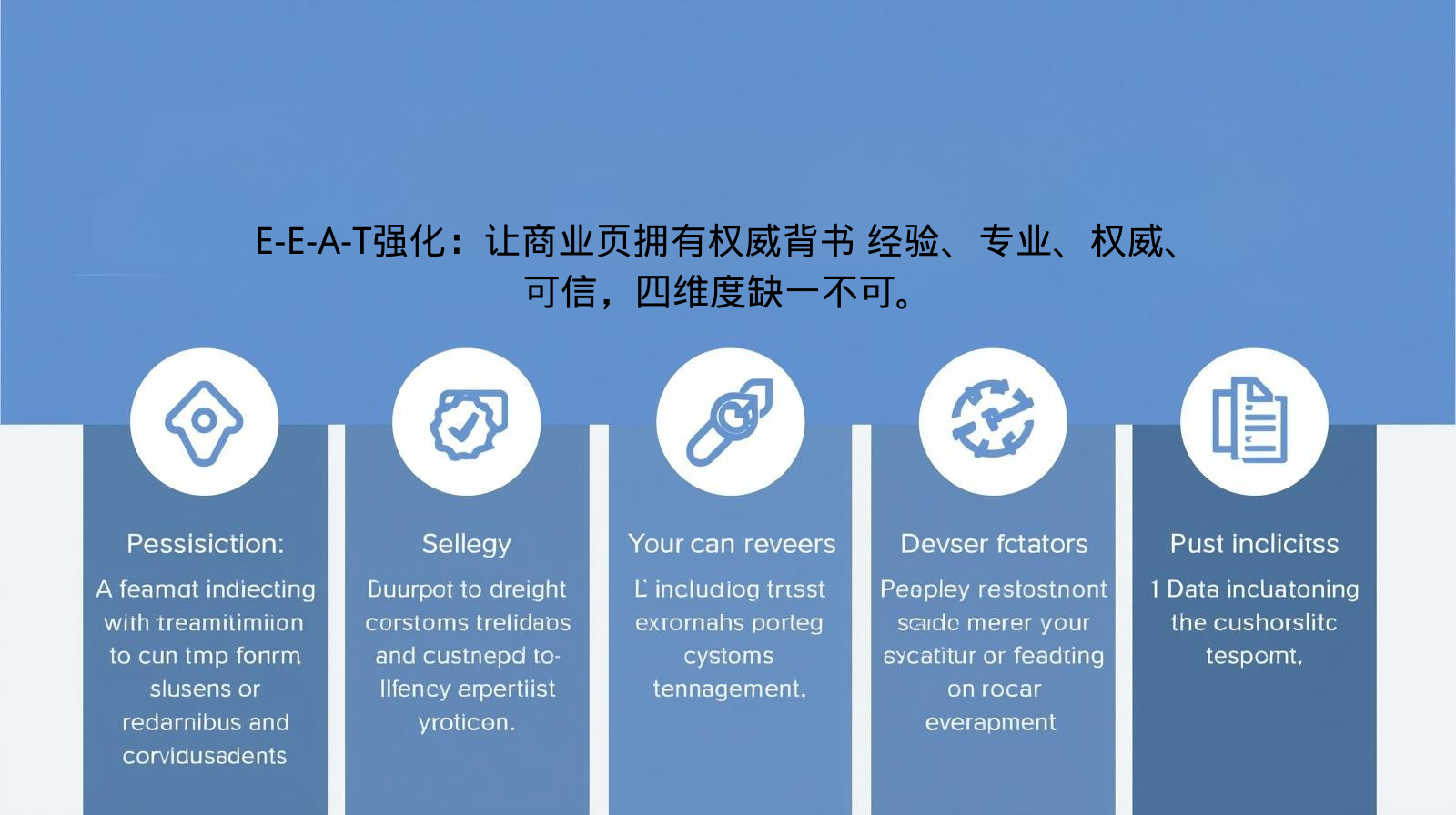
III. EEAT Enhancement: Ensuring that business pages possess authoritative endorsement experience, professionalism, authority, and credibility—all four dimensions are indispensable.
- The author's name and LinkedIn link showcase 5 years of practical experience in building websites for foreign trade.
- Introducing customs export data increases objectivity and persuasiveness;
- Upload the evaluation process to the Trusted Cloud Case Library of the China Academy of Information and Communications Technology to obtain a .gov backlink;
- We update the data quarterly to keep it "fresh".
IV. Semantic Network: Covering relevant entities and avoiding keyword stuffing. Google BERT focuses on context; the more comprehensive the entity coverage, the more stable the ranking.
- Use the Natural Language API to extract entities such as "commission rate" and "cookie duration";
- Integrate naturally into the first 20 words of the paragraph to enhance relevance to the theme;
- Synonyms are used for emphasis to help machines identify key points;
If an entity is missing, write a new paragraph, maintaining a coverage rate of >45%.
5. Core Web Vitals: Speed determines dwell time. Commercial pages often display a large number of ads, which lowers LCP (Local Value Packet). A balance needs to be struck between revenue and user experience.
- No more than one alliance banner on the first screen; the rest should be placed in a collapsed section.
- Use WebP + lazy loading to ensure LCP < 2.5 seconds;
- Third-party scripts can be used in Web Workers to reduce main thread blocking.
- Use Chrome CrUX to view real user data; red flags will be immediately rolled back.
6. Internal Links: Directing traffic to high-commission pages and related article components is a free yet highly effective way to improve page ranking.
- The information page links to the comparison page, with the anchor text "In-depth evaluation";
- The comparison page links to the decision page, using "Latest Price" as the anchor text;
- Add a "Popular Reviews" section at the bottom of each article, keeping the total to 6 articles.
- Use Screaming Frog to check orphan pages and add them to the list.
VII. User Signals: Let Comments and Votes Speak for You. The comment section is free UGC, which can increase the frequency of page updates.
- The questionnaire concludes by asking "What do you care about most?" to gather new assessment angles.
- Use the Schema's Review tag to enhance the star rating display;
- Publicly responding to negative comments demonstrates brand responsibility;
- Post screenshots of highly-rated comments on social media to attract repeat visits.
8. External Link Strategy: Exchanging evaluation data for industry-referenced data reports is more persuasive than "asking for links".
- I created a line chart of the quarterly commission changes and published it on my personal blog;
- Submit your work to Reddit r/affiliatemarketing to attract organic citations from peers;
- Upload the complete report to the research section of the Shenzhen Cross-border E-commerce Association to obtain authoritative local backlinks.
- Use Ahrefs to track anchor text and ensure it includes "Foreign Trade Website Building" to reinforce the theme.
9. Monetization Balance: Information pages can also subtly embed non-commercial content and appropriately place soft ads to improve the overall RPM.
- The information page features a "Related Tools" module, with their own foreign trade website building service being the primary focus;
- Use a neutral tone, such as "We also offer..." to avoid being suggestive;
- Adding nofollow to a link informs search engines of the business relationship;
- Track click events; retain clicks with a click rate greater than 5%, and replace clicks with a click rate lower than 5%.
10. Monitoring and Iteration: Update quarterly reviews with data rather than intuition, retain high-RPM pages, and eliminate inefficient content.
- Use Google Analytics to identify pages with high RPM and high page dwell time, and mark them as benchmarks;
- Copy its structure to the new assessment to maintain consistent standards;
- Rewrite the title and conclusion of the low RPM page and compare the results after 30 days.
- Incorporate positive results into the case library of the China E-Commerce Association to continuously build brand authority.
The concluding CTA emphasizes that balancing commercial content and user experience requires a modular and quickly testable website building system. Pinshop has packaged "comment components + schema + speed optimization" into an affiliate marketing template, allowing for one-click deployment. Visit pintreel.com now to launch your first foreign trade affiliate website in 30 minutes, ensuring your content retains users and generates continuous commissions.