
In 2026, amidst the AI-driven wave of customer acquisition in foreign trade, over 45% of foreign trade companies held 1-2 "dormant websites"—sites that once had stable traffic but were gradually forgotten by search engines and AI platforms due to long-term lack of updates, outdated content, and outdated technology, becoming "zombie sites." Even more regrettably, while 61.8% of overseas buyers relied on AI platforms like ChatGPT and Google Gemini to screen suppliers, these dormant websites missed out on massive amounts of targeted traffic because they couldn't be effectively crawled and recommended by AI. One Shenzhen-based hardware foreign trade company's website, after two years of dormancy, was reactivated and optimized through GEO. Within three months, its AI recommendation rate soared from 3% to 52%, its ChatGPT search keyword ranking entered the top 3, and its targeted inquiries increased by an average of 118% per month. This case proves that dormant websites are not "useless"; through a scientific GEO activation strategy, their existing value can be awakened, they can regain their place on AI platform search rankings, and they can reap the benefits of foreign trade traffic at a low cost.
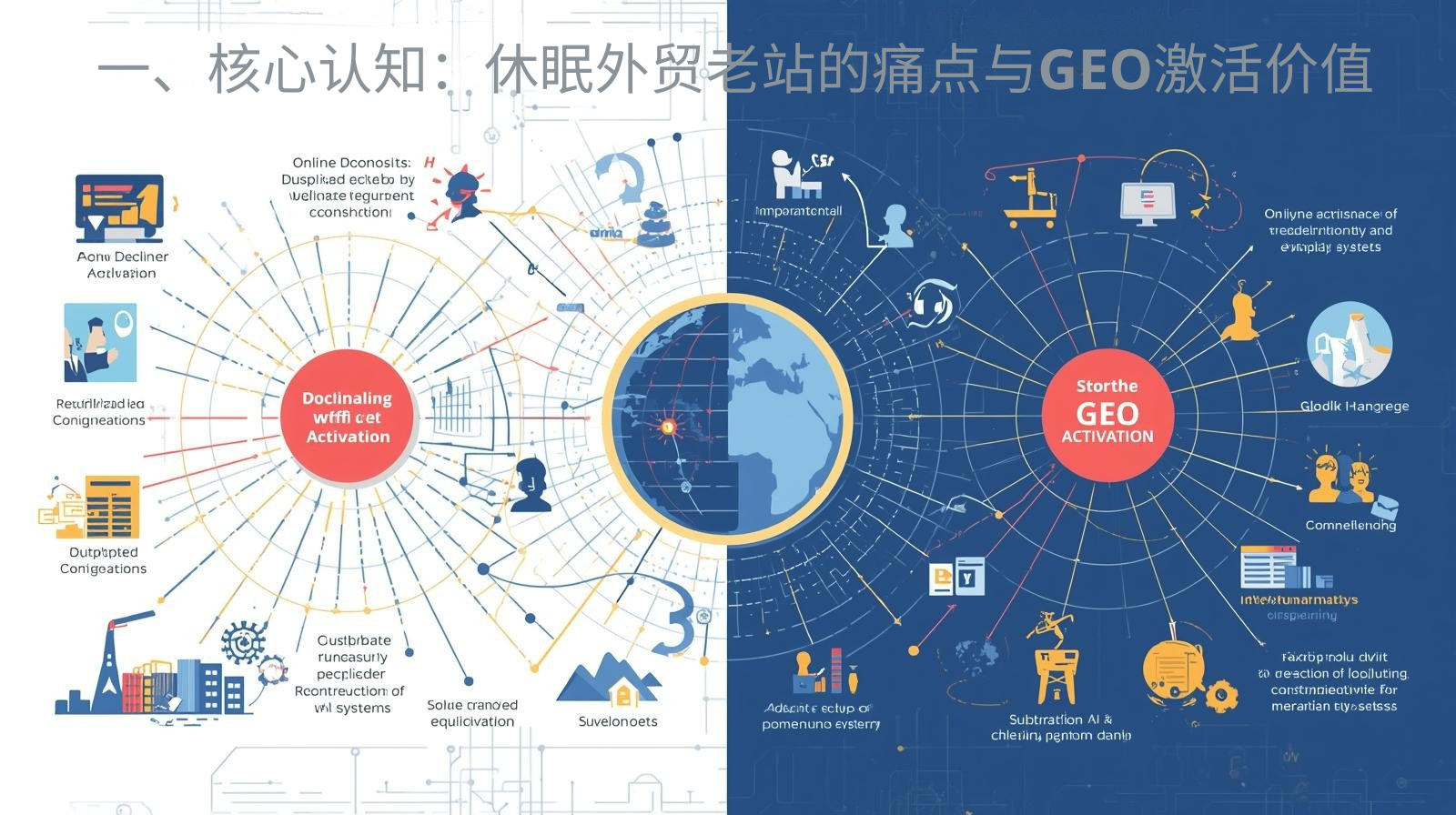
I. Core Understanding: The Pain Points and GEO Activation Value of Dormant Foreign Trade Websites
Dormant independent e-commerce websites typically refer to sites that haven't updated their core content for more than six consecutive months, have outdated technical configurations, continuously declining traffic, and almost no inquiries. The core problem for these sites isn't "lack of historical authority," but rather the depletion of their historical authority, a disconnect between their content and AI crawling rules, and a loss of trust signals, preventing them from entering the AI platform's core recommendation pool. GEO (Generative Engine Optimization) activation is precisely the core method for adapting to AI crawling logic, fixing site weaknesses, and reconstructing the value system, allowing older sites to regain AI recognition. Its value far exceeds the cold start of a newly created site.
1.1 Three Core Pain Points of Dormant Websites (AI Perspective)
From the perspective of AI platform crawling and recommendation logic, the core pain points of dormant websites failing to gain exposure are concentrated in three aspects, which are also the core targets of GEO activation:
1. Outdated content: The old site's content is mostly product parameters and industry information from several years ago, which is seriously out of touch with the current scenario-based needs of overseas buyers (such as small-batch purchases, compliance certifications, and localized services). Furthermore, it is not organized according to the "problem-solution" paradigm preferred by AI, and cannot match the AI's semantic understanding logic. At the same time, the lack of updates over a long period of time has led AI to judge the site as "low-activity and lacking in value," thus reducing its crawling and recommendation priority.
2. Outdated Technology: Most dormant websites still use outdated technical architectures, with core content relying on JavaScript client-side rendering (CSR), which makes it difficult for AI crawlers to effectively capture key information; slow page loading speed (LCP far exceeds the optimal standard of 1.5 seconds), poor mobile adaptation, which does not meet the user experience evaluation requirements of AI platforms; and even problems such as robots.txt configuration errors and too many dead links, which directly block the AI crawling channel.
3. Lack of trust: The compliance certifications of older websites (such as CE and REACH) may have expired, customer case studies, third-party endorsements and other information may not be updated in a timely manner, and there is a lack of verifiable trust signals (such as certification numbers and official query links), which cannot meet the EEAT principle (professionalism, experience, authority and credibility) of AI recommendation, and even if it is crawled, it is difficult to get recommended.
1.2 The core value of GEO activation: Low-cost reactivation of traffic to old websites
Compared to newly established independent foreign trade websites, reactivating dormant websites through GEO has core advantages of "low cost, high return, and quick results," and its value is mainly reflected in three dimensions:
1. Reuse historical weight to shorten the startup cycle: Old websites usually have accumulated a certain domain age, historical backlinks and core keyword ranking foundation. These historical weights will not completely disappear. They can be quickly awakened through GEO activation, shortening the cycle for the site to enter the AI recommendation pool by 60% compared to a newly built site. Significant traffic growth can be achieved in 3 months.
2. Lower optimization costs and higher ROI: GEO activation does not require investment in basic costs such as domain registration and website building. It only requires optimization of content, technology, and trust signals, and the overall cost is 75% lower than that of building a new website. Its conversion rate can reach 15.2%, which is 3 times that of traditional SEO. The long-term ROI is as high as 500%-2025%, which is far higher than the cold start investment of building a new website.
3. Quickly seize the blue ocean of AI and avoid the red ocean of competition: Most foreign trade companies have not yet paid attention to the revitalization of dormant websites. The AI search competition in related tracks is low. Old websites can quickly seize core keywords with "high demand and low competition" through GEO optimization and stand out in the search rankings of AI platforms such as ChatGPT.
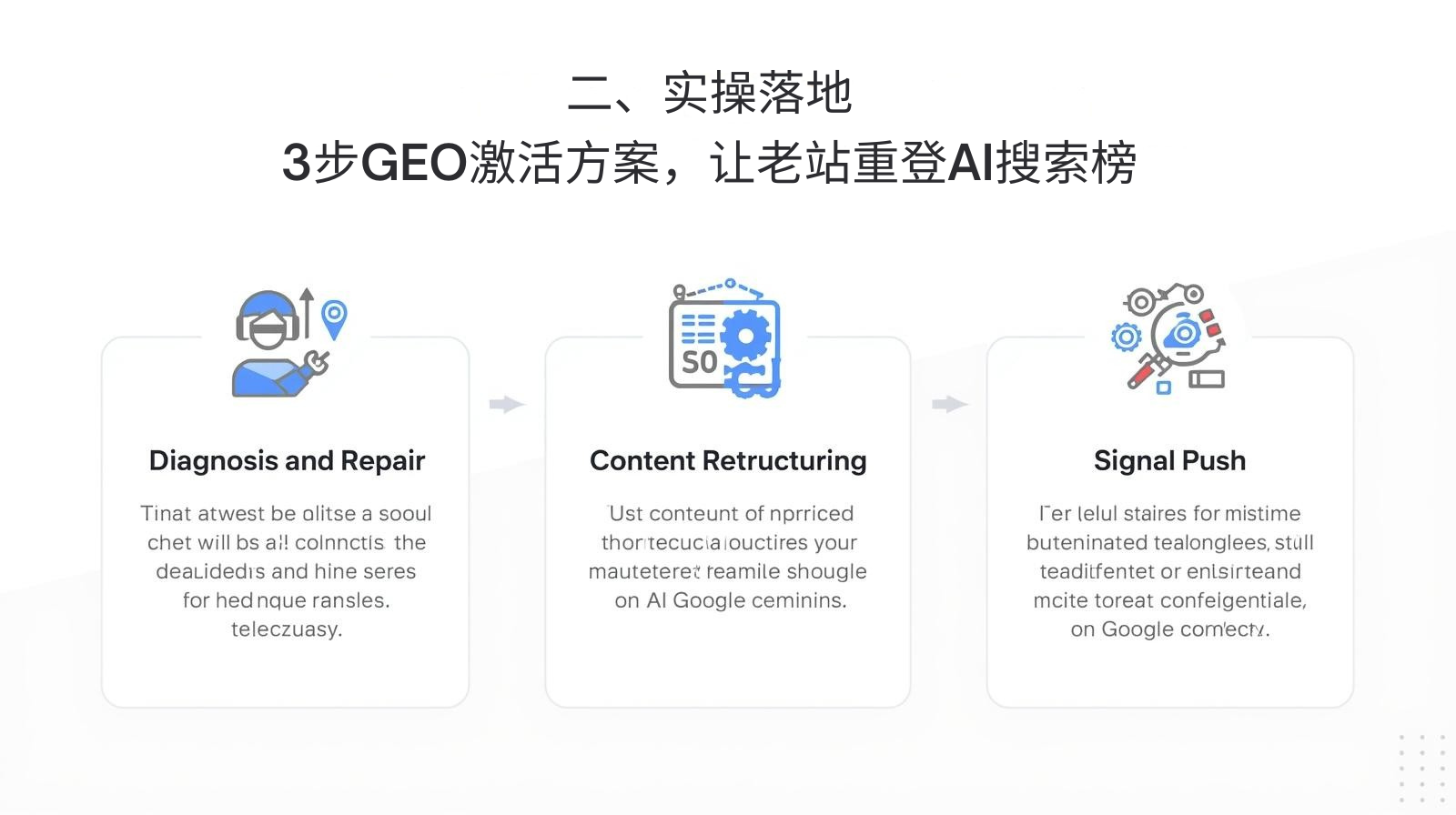
II. Practical Implementation: A 3-Step GEO Activation Solution to Help an Old Website Reclaim its Place on the AI Search Ranking
Based on the activation case of Shenzhen hardware foreign trade old website, and the AI platform crawling rules in 2026 (such as ChatGPT priority indexing standard and Google Core Web Vitals requirements), a three-step GEO activation solution of "diagnosis and repair - content reconstruction - signal push" is summarized. Each step has clear practical steps and key points for implementation, which can be directly applied to wake up dormant old websites.
2.1 Step 1: Comprehensive diagnosis + technical repair, to restore AI capture channels (7-10 days)
The core objective is to identify and address technical vulnerabilities and content issues on the old website, fix obstacles to AI crawling, and lay the foundation for subsequent optimizations. The core practical steps are as follows:
1. Three Core Diagnostic Methods: ① AI Crawling Diagnosis: Using tools such as MarketMuse and Google Search Console, we check the crawling status, indexing, and number of dead links of the old site on platforms such as ChatGPT and Google Gemini, focusing on whether core content has been identified by AI crawlers (such as hidden JavaScript content, robots.txt blocking issues); ② Technical Performance Diagnosis: We test page loading speed (LCP, FID, INP, three core indicators) and mobile compatibility, ensuring that the mobile performance score is ≥90 points, LCP is ≤1.5 seconds, and meets the user experience requirements of the AI platform; ③ Content and Trust Diagnosis: We review the existing content of the old site, marking outdated, redundant, and disconnected content; we verify the validity period of compliance certifications and the authenticity of customer cases, and pinpoint the core issues of missing trust signals.
2. Technical Obstacle Fixes: ① Crawling Permission Fixes: Optimized robots.txt configuration to ensure that crawlers from core AI platforms such as ChatGPT and Google Gemini are not blocked; changed core content of client-side rendering (CSR) to static generation (SSG) or server-side rendering (SSR) to prevent AI crawlers from being unable to crawl; cleaned up dead links on the site and submitted a list of dead links to major AI platforms and search engines to reduce invalid crawls; ② Performance Optimization: Compressed images and code, configured CDN acceleration to ensure that AI crawler request response time is <200ms, and improved crawling priority; optimized mobile adaptation, fixed issues such as page glitches and unclickable buttons, and improved AI's evaluation of the site experience; ③ Basic Configuration Updates: Updated basic configurations such as site registration information, contact information, and domain name resolution to ensure normal site access; optimized the site map, categorizing pages by "product category + region + language" to facilitate AI crawlers in recognizing the site structure.
2.2 Second step: Content reconstruction + trust enhancement, adapting to AI recommendation logic (15-20 days)
The core objective is to restructure the old site's content system, strengthen trust signals, ensure content accurately matches AI semantic understanding logic and the EEAT principle, and improve AI recommendation weight. The core practical steps are as follows:
2.2.1 Content Restructuring: From "Outdated Information" to "AI-Selected Content"
We discarded outdated content from the old site and restructured the core content according to the AI-preferred logic of "scenario-based + structured + question-and-answer". Key actions included: ① Content filtering and cleaning: deleting expired product information, industry news, event announcements, etc.; retaining valuable historical content (such as classic customer cases and core product introductions) and optimizing and upgrading it; ② Scenario-based content creation: creating "problem-solution" content around high-frequency scenarios for buyers in target markets (Europe, America, Southeast Asia, etc.), such as "EU compliant hardware accessories small-batch procurement solution" and "Southeast Asian cross-border e-commerce hardware drop shipping service"; core pages (product pages, service pages) were structured according to "scenario pain points - core advantages - technical parameters - compliance certifications - case evidence", presenting key information using lists and tables to improve AI crawling efficiency; ③ Question-and-answer content supplementation: mining high-frequency procurement questions from AI platforms such as ChatGPT (such as "Which hardware accessories are REACH compliant in the EU?" "What is the MOQ for hardware parts in Southeast Asia?"). Asia?"), build a FAQ section on the old site, create high-quality Q&A content, and increase the probability of AI citation; ④ Natural keyword layout: lay out GEO keywords around "core words + regional long-tail words + scenario words" (such as "EU hardware accessories supplier" "US UL certified hardware parts"), and control the keyword coverage rate in the natural range of 2%-8% to avoid keyword stuffing.
2.2.2 Trust Reinforcement: Satisfying the EEAT Principle of AI Recommendation
By supplementing and optimizing authoritative trust signals, the established website gains dual recognition from AI and users. Key actions include: ① Updating and displaying compliance certifications: Updating expired compliance certifications (CE, REACH, UL, etc.) and displaying them in a structured manner on product pages and the homepage, clearly indicating the certification number, issuing body, and official query link (e.g., ECHA official website query link: https://echa.europa.eu/), facilitating verification by AI and users; ② Optimizing customer cases and third-party endorsements: Selecting 3-5 of the latest core customer cases (prioritizing multinational corporations and industry benchmark clients), showcasing the client's logo, cooperation scenarios, and core achievements, such as "Cooperated with a German automotive enterprise to provide 1000 sets of hardware accessories, reducing production costs by 22%"; supplementing with third-party testing reports (e.g., SGS reports, indicating report numbers and query links), industry honors, etc., to strengthen authority; ③ Service Guarantee Commitment: Clearly indicate overseas warehouse layout, logistics timeliness (e.g., "direct shipping from German overseas warehouse, delivery within the EU in 3-5 days"), after-sales response timeliness (24-hour multilingual customer service response), and technical support services (remote installation guidance, on-site debugging) to eliminate users' procurement concerns.
2.3 Third step: Signal push + dynamic iteration, stabilize AI search ranking (starting in 3-5 days, long-term continuous)
The core objective is to proactively send site activation signals to the AI platform, accelerating content indexing and recommendation, while ensuring stable rankings through continuous iteration. The core practical steps are as follows:
1. Multi-platform signal submission: ① Submission of optimized site map: Submit the updated site map (labeled by category) to ChatGPT webmaster platform, Google Gemini search resource platform, Google Search Console, etc., to proactively guide AI crawlers to crawl; ② Content update signal transmission: Submit content update requests through the official AI platform portal to inform the platform that the site has completed comprehensive optimization, accelerating the improvement of indexing and recommendation weight; ③ Supplementing external signals: Publish links to the core content of the optimized old site (such as scenario-based solutions, the latest customer cases) on overseas social platforms such as LinkedIn and Twitter to guide AI crawlers to crawl, while enhancing the site's external trust endorsement.
2. Dynamic Monitoring and Iteration: ① Core Metric Monitoring: Monitor three core metrics daily—AI Recommendation Rate (the percentage of times a site is recommended by AI out of total exposures, target ≥ 50%), Core Keyword AI Ranking (core keyword ranking on platforms such as ChatGPT, target top 5), and GEO-SQL Conversion Rate (the percentage of AI traffic converted into accurate inquiries, target ≥ 12%); generate a monitoring report weekly and conduct optimization reviews monthly; ② Continuous Content Updates: Update 1-2 scenario-based blog posts or FAQ content weekly to maintain site activity, allowing AI to determine that the site "continuously outputs value" and stabilize recommendation weight; ③ Rule Adaptation and Adjustment: Keep up with updates to AI platform crawling rules (such as changes in ChatGPT priority indexing standards), and simultaneously optimize site content and technical configuration to ensure that older sites always adapt to AI recommendation logic.
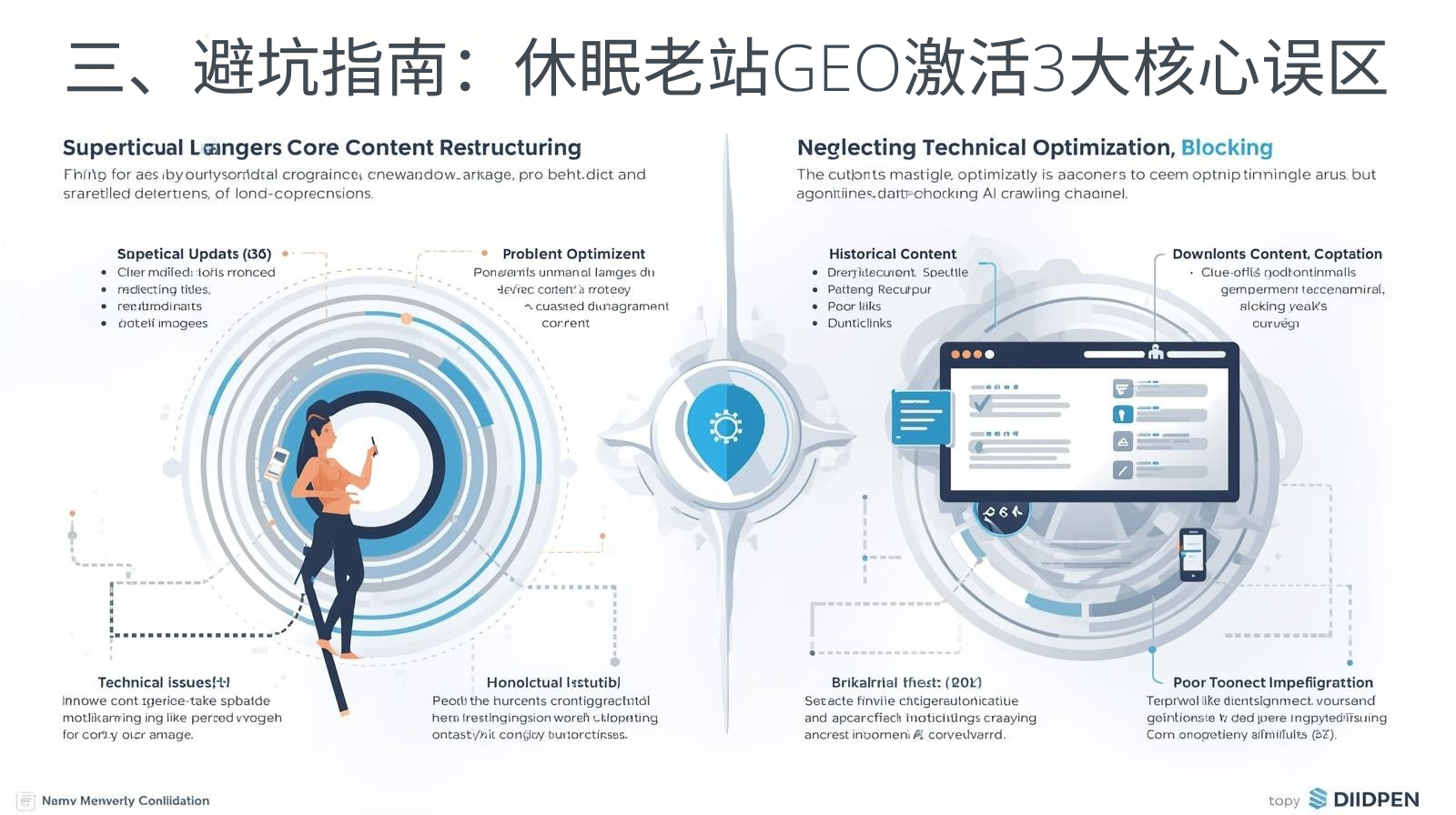
III. Avoiding Pitfalls: 3 Core Misconceptions about Activating Dormant Old Websites with GEO
Based on practical case studies from 2025-2026, dormant power stations are prone to falling into three major pitfalls during the GEO activation process, leading to activation failure or significantly reduced effectiveness. These pitfalls must be strictly avoided:
3.1 Misconception 1: Only making superficial updates and ignoring the core content restructuring
Errors include : simply modifying page titles, replacing a few images, and deleting a small amount of expired content on the old site without reconstructing the core content in a contextualized way; or directly copying content from the new site without optimizing it based on the old site's historical ranking and target market needs.
Core harm : The content still cannot match the AI semantic understanding logic and user needs. The AI will judge the site as "not improved in value" and will not be able to enter the core recommendation pool. After activation, there is no significant increase in traffic. A certain old furniture site in Foshan made only superficial updates. Two months after activation, the AI recommendation rate was still less than 8%, and the number of accurate inquiries was almost zero.
Correct approach : Reconstruct the core content system of the old site based on the scenario-based needs of the target market, create "problem-solution" style content, and ensure that the content has high value and AI adaptability; retain and optimize valuable historical content of the old site, and reuse historical weight.
3.2 Misconception 2: Ignoring technical optimization and blocking AI crawling channels
Errors include : focusing solely on content updates while neglecting the technical vulnerabilities of older sites, such as core content still relying on JavaScript rendering, slow page loading speeds, poor mobile compatibility, and unresolved dead links; or blindly modifying robots.txt configurations, causing AI crawlers to be unable to access the site.
Key risks : Even with optimized content, AI crawlers cannot effectively capture core information, and the site still cannot gain exposure; poor technical performance will reduce the AI's evaluation of the site's experience, and even if it is crawled, it will be difficult to get recommended; a certain old electronics website in Dongguan was not crawled and indexed by ChatGPT within a month after its content was updated because it did not optimize its technology.
Correct approach : Prioritize completing technical fixes to ensure core content can be crawled by AI, page performance meets standards, and mobile adaptation is good; regularly check technical configurations to avoid crawling obstacles.
3.3 Misconception 3: Generalization of trust signals fails to satisfy the EEAT principle
Errors include : using only general statements such as "reliable quality" and "CE certification" without providing verifiable information such as certification numbers, official query links, and detailed customer case studies; or using expired compliance certifications or fabricated customer case studies in an attempt to deceive customers.
Key risks : AI will determine that the information on a website is not credible enough and refuse to include it in the core recommendation list; once users find that the information is unverifiable or expired, they will completely lose trust and will not make inquiries even if they see the website through AI; in 2025, a certain long-established cross-border medical website was marked as a "non-compliant supplier" by the AI platform for using expired FDA certification and permanently lost AI search traffic.
Correct approach : Update and display genuine, verifiable trust signals, fully labeling compliance certification numbers, official query links, and customer case details; reject fictitious endorsements, and use authentic information to meet the EEAT principle of AI recommendations to build long-term trust.
Recommended Article: Your Competitors Haven't Reacted Yet: Building an Independent E-commerce Website with GEO is the Biggest Blue Ocean Strategy Right Now
Recommended Article: Your Competitors Haven't Reacted Yet: Building an Independent E-commerce Website with GEO is the Biggest Blue Ocean Strategy Right Now
IV. Conclusion: Dormant old websites hold hidden benefits from AI-driven foreign trade traffic.
In 2026, the competition for AI search traffic in foreign trade has entered the "existing stock mining" stage. Dormant websites are no longer a "burden" but a "traffic goldmine" with hidden dividends. Compared to the cold start difficulties of new websites, established websites, with their advantages such as historical authority and domain foundation, can quickly climb the AI platform search rankings and acquire accurate traffic and inquiries at low cost through a scientific GEO activation strategy.
The core of revitalizing dormant websites through GEO (Government-Operated-Operated) technology lies not in "large-scale transformation," but in "precise repair and value reconstruction." This involves three steps: technical repair to unlock AI capture channels, content reconstruction to match user needs with AI logic, and signal pushes to accelerate recommendation weight enhancement. The revitalization of a dormant website in Shenzhen's hardware and foreign trade sector has proven that, with the right direction and precise implementation, dormant websites can be reborn and become a core engine for foreign trade business growth.
In 2026, the AI traffic dividend for foreign trade will continue to be released. If you have a dormant independent foreign trade website, you might as well take immediate action and use the "diagnosis and repair - content reconstruction - signal push" 3-step GEO activation solution to bring your old website back to the top of the AI search rankings, seize the opportunity in the fierce market competition, and achieve leapfrog growth in cross-border business.