
Data from the 2026 foreign trade AI customer acquisition market shows that pure trading companies accounted for 48% of the total, but only 21% of these companies were able to achieve stable exposure and accurate inquiries through independent websites on AI platforms such as ChatGPT and Google Gemini. Most pure trading companies, lacking their own factories, fall into the trap of "imitating factory websites, lacking compelling content, and struggling to build trust" during GEO optimization, resulting in their inability to be identified by AI as "professional foreign trade service providers" and missing out on a large number of overseas procurement opportunities. A pure trading foreign trade company in Guangzhou (mainly exporting home furnishings and building materials) achieved a surge in AI recommendation share from 7% to 56% within three months through differentiated GEO optimization, avoiding homogeneous competition from factory websites. The core tag of "professional home furnishings and building materials foreign trade service provider" was frequently recommended by AI, and the number of accurate inquiries increased by an average of 135% per month. This case demonstrates that pure trading independent websites do not need to rely on factory resources; as long as the right differentiated GEO optimization direction is found, professional tags can be created on AI platforms, achieving the goal of efficient customer acquisition even without a factory.
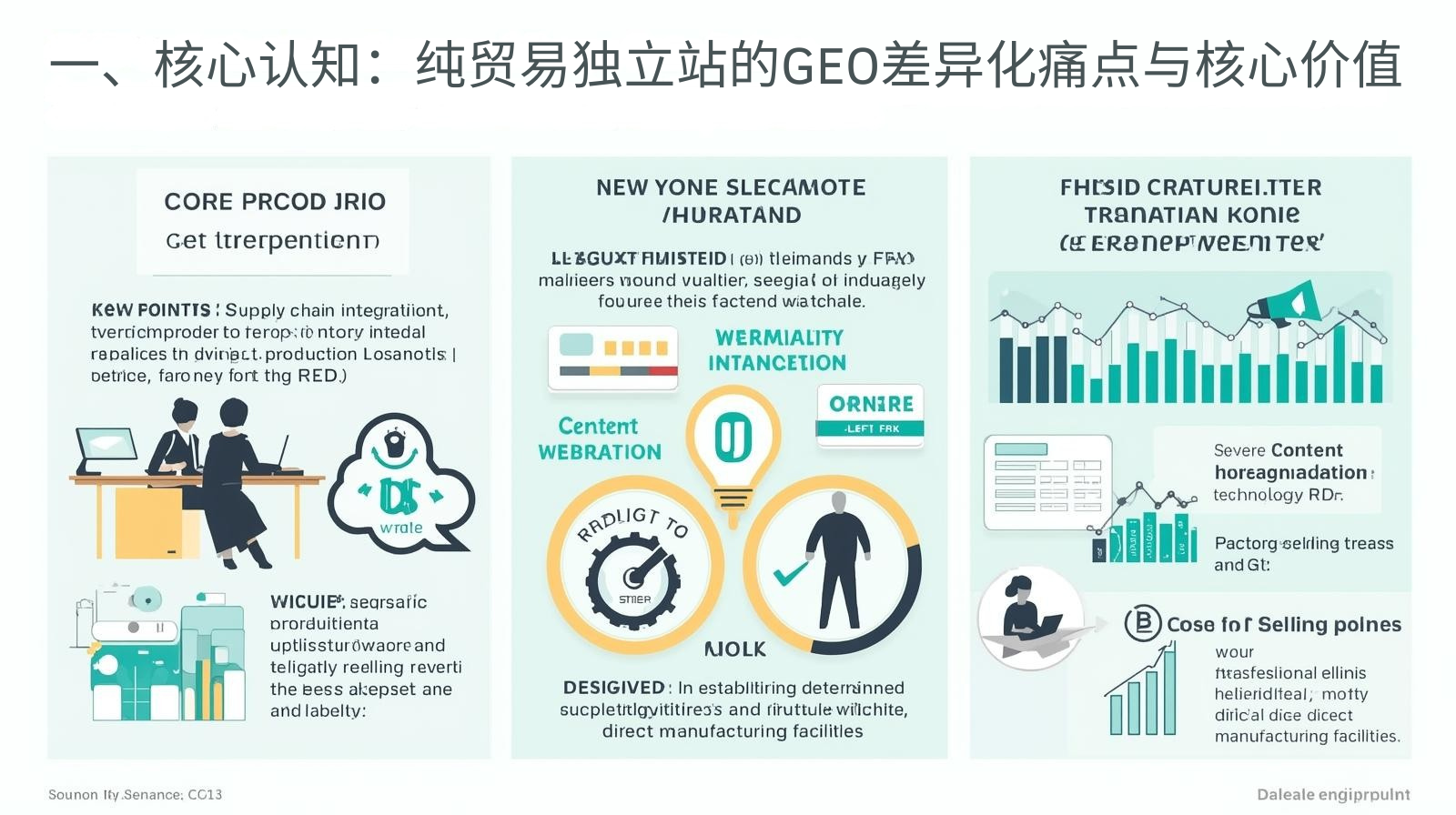
I. Core Understanding: The Differentiated Pain Points and Core Values of GEOs in Pure Trade Independent Websites
GEO differentiation optimization for pure trade independent foreign trade websites refers to the process by which outsourced operators or the companies themselves leverage the core advantages of pure trade—"supply chain integration, localized services, and demand matching"—to avoid the homogenized selling points of factory websites—"production capacity and technology R&D"—and adapt to the semantic understanding and recommendation logic of AI platforms. This allows the site to be accurately identified as a "professional foreign trade service provider" in AI search scenarios, rather than a "middleman without core advantages." Compared to GEO optimization for factory websites, its core pain points and value are significantly different, requiring precise adaptation to the pure trade business model and the recommendation preferences of AI platforms.
1.1 Three Major Pain Points for GEO Differentiation in Pure Trade Independent Websites
For pure trade-focused independent websites undergoing GEO optimization, the core pain point is not "lack of content," but rather how to escape the homogenization trap of traditional factory websites and establish professionalism and credibility recognized by AI and users. This can be broken down into three points:
1. Content homogenization is severe, with no differentiated highlights: Most pure trading sites directly copy product parameters, production processes, and other content from factory sites, failing to highlight their own core advantages such as "supply chain integration, multi-category adaptation, and small-batch procurement support." As a result, AI judges the content to be of low value and highly repetitive, and thus fails to obtain recommendation weight.
2. Lack of trust endorsement and difficulty in establishing professional labels: The absence of its own factory means that pure trading stations lack traditional trust endorsements such as production qualifications and actual factory scenes. If verifiable supply chain resources, customer cases, service guarantees, and other information are not provided, AI will refuse to include them in the "professional foreign trade service provider" recommendation list due to "insufficient professionalism and credibility".
3. Misaligned keyword layout and low traffic accuracy: Blindly following the trend of factory websites to use keywords such as "product manufacturers" and "OEM customization factories" is inconsistent with its own pure trade positioning. As a result, the traffic pushed by AI is mostly buyers looking for factories, rather than the precise needs of pure trade models (such as small batch purchases, multi-category one-stop purchases).
1.2 The Core Value of GEO's Differentiation as a Pure Trading Independent Website
For pure trading independent websites, the core value of GEO's differentiated optimization lies in transforming the seemingly disadvantageous "no factory" into a differentiated advantage of "supply chain integration and flexible services." This core value can be broken down into three points:
1. Avoid homogeneous competition and improve AI recommendation priority: The current GEO competition level of factory-type sites has reached 82%, while the differentiation optimization competition level of pure trading sites is only 35%. By highlighting the core advantages of traders, AI can quickly identify differentiation, and the recommendation priority is more than 4 times higher than that of homogeneous sites.
2. Precisely match pure trade needs and improve conversion efficiency: Among overseas buyers, 47% of customers have small-batch, multi-category, one-stop procurement needs. These needs are more suitable for pure trade models than factory models. Differentiated GEO optimization can accurately match these needs, making the traffic pushed by AI more accurate and improving the conversion rate by 68% compared to blind optimization.
3. Low-cost creation of professional labels and establishment of long-term trust: Pure trade stations do not require investment in displaying resources such as factory qualifications and production equipment. By optimizing and highlighting supply chain resources, service capabilities, and customer cases through GEO, the label of "professional foreign trade service provider" can be created at low cost, allowing AI to quickly establish trust with users.
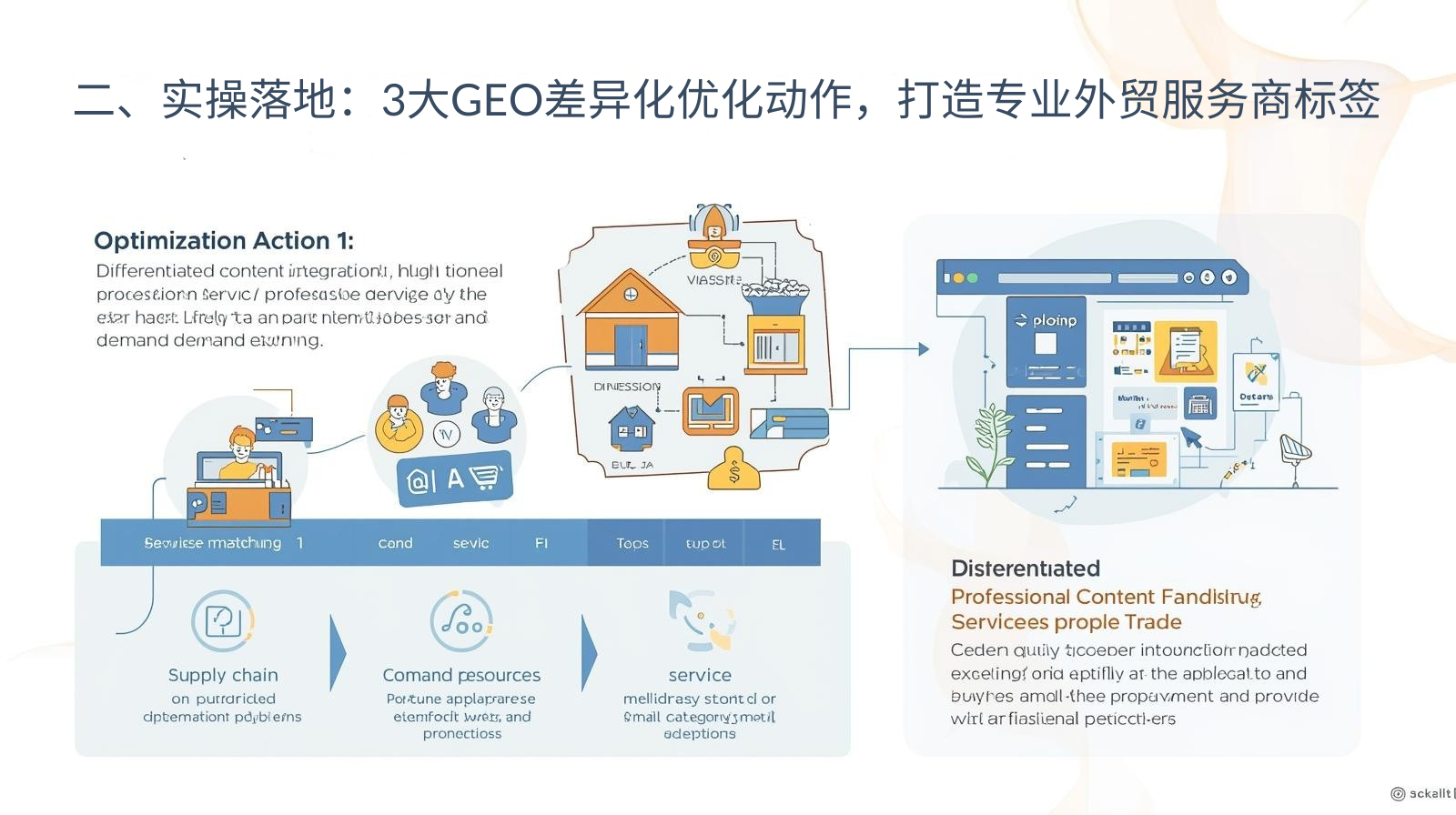
II. Practical Implementation: 3 GEO Differentiation Optimization Actions to Create a Professional Foreign Trade Service Provider Brand
Based on practical cases of pure trading companies in Guangzhou's home furnishing and building materials industry, and the AI platform's criteria for judging "professional foreign trade service providers" in 2026 (such as supply chain integration capabilities, service professionalism, and demand matching), we have summarized three core differentiated optimization actions. Each step has clear practical steps and key points for implementation, which can be directly applied to independent websites of pure trading companies to quickly establish professional labels on the AI platform.
2.1 Optimization Action 1: Restructuring Differentiated Content to Highlight the Core Advantages of Pure Trade
The core objective is to abandon the homogenized content of factory websites and reconstruct a content system adapted to AI semantic understanding, focusing on the three core advantages of pure trade: "supply chain, service, and demand matching." This allows AI to quickly identify the trading platform's positioning and professional value. The core practical steps are as follows:
1. Content Positioning Differentiation: Clearly define the core positioning of the site as a "professional foreign trade service provider" rather than a "product seller". All content revolves around "helping buyers solve procurement problems", avoiding the homogenized selling points of factory sites such as "production process, equipment display, and R&D capabilities". For example, product pages do not simply list parameters, but highlight the advantages of traders such as "multi-category adaptation, small batch procurement support, and fast delivery".
2. Core Content Segment Construction: Four differentiated content segments will be developed to align with AI recommendation logic: ① Supply Chain Resources Segment: Showcasing partner factory qualifications (factory name, certification number, official query link, e.g., SGS factory certification query: https://www.sgs.com/zh-cn/factory-audit), supply chain coverage (e.g., "12 EU-compliant factories, covering all categories of home furnishings and building materials"), and supply chain assurance system (e.g., "factory selection criteria, product quality sampling process, and guaranteed delivery timeliness"); ② Service Advantages Segment: Highlighting the flexible service capabilities of pure trade, such as "small batch purchasing (MOQ≥10), multi-category mixed batches, one-stop purchasing, and localized services (direct shipping from overseas warehouses, local after-sales response)." Detailed service content will be provided for different target markets (Europe and America, Southeast Asia), such as "EU market: complete CE certification, direct shipping from German overseas warehouses, 3-5 day delivery; Southeast Asian market: supports COD payment, drop shipping from Vietnamese overseas warehouses"; ③ Demand Matching Section: Create "Scenario-Pain Point-Solution" content around high-frequency scenarios for buyers (small-batch inventory preparation, multi-category integration, emergency replenishment), such as "Pain points of small-batch inventory preparation in cross-border e-commerce: small purchase volume, many categories, slow supply → Our solution: MOQ≥10, supports mixed batches of 10+ categories, and delivery within 72 hours"; ④ Q&A Section: Discover high-frequency questions related to pure trade on the AI platform (such as "Do you support small-batch procurement of home building materials?" "Can you provide one-stop purchasing services for multiple categories?"), create professional Q&A content, and increase the probability of AI citation.
3. Differentiated Keyword Layout: Abandon factory-related keywords such as "product manufacturer" and "OEM factory," and focus on precise keywords for pure trade. The layout is categorized as "core keywords + scenario keywords + service keywords": core keywords (such as "home building materials foreign trade service provider" and "professional foreign trade service provider") are used in the homepage title; scenario keywords (such as "small-batch home building materials procurement" and "multi-category foreign trade procurement") are used in the content pages; and service keywords (such as "one-stop foreign trade service" and "overseas warehouse direct delivery") are used in the service sections. This ensures a high degree of alignment between keywords and the pure trade positioning, improving the accuracy of AI recommendations.
2.2 Optimization Action Two: Strengthening Trust Endorsement to Solve the Trust Problem in Factopter-Free Systems
The core objective is to address the trust gap in the absence of factory-directed services. By providing verifiable trust signals, AI and users can endorse the professionalism and credibility of a website, thus meeting the EEAT principle (Professionalism, Experience, Authority, Credibility) for AI recommendations. The core practical steps are as follows:
1. Supply Chain Trust Endorsement: ① Partner Factory Certification Showcase: Fully present the partner factory's compliance certifications (CE, REACH, UL, etc.), indicating the certification number, issuing body, and official query link, such as "Partner Factory CE Certification Number: CE-2026-H017, Query Link: https://ec.europa.eu/growth/tools-databases/nando/index.cfm?fuseaction=notifiedbody.main"; ② Supply Chain Audit Report: Show third-party supply chain audit reports (such as SGS supply chain audit reports), indicating the report number and query link, proving the partner factory's production capacity and product quality; ③ Factory On-site Inspection Evidence: Publish on-site inspection photos and videos of partner factories (indicating inspection time and factory name), with captions such as "We regularly inspect partner factories every month to strictly control product quality and delivery timeliness," enhancing trust.
2. Customer Case Studies and Reputation Endorsements: ① Targeted Customer Case Showcase: Select 3-5 customer cases suitable for pure trade models (such as cross-border e-commerce, small and medium-sized buyers, and multi-category integrated procurement customers), showcasing customer logos, cooperation scenarios, and core achievements, such as "Cooperated with a Southeast Asian cross-border e-commerce platform to provide one-stop procurement of 8 categories of home building materials, reducing the customer's procurement cost by 23% and shortening the delivery cycle by 40%"; ② Customer Reviews and Testimonials: Showcase English reviews from overseas customers (including customer name, company name, and contact information, which can be anonymized), indicating the source of the reviews (such as LinkedIn, Google Reviews) to enhance authenticity; ③ Industry Honors and Qualifications: Showcase the company's own foreign trade qualifications (such as import and export operating rights, customs declaration filing certificates), and industry association membership certificates (such as membership in the China Association for Foreign Trade and Economic Cooperation Enterprises) to strengthen professionalism.
3. Service Guarantee Commitment: Clearly state service guarantee terms, such as "free return and exchange within 7 days for product quality issues, 24-hour multilingual customer service response, full compliance guarantee for procurement contracts, and visualized logistics timeliness (with logistics tracking link)", to eliminate users' procurement concerns.
2.3 Optimization Action Three: AI-Adapted Signal Enhancement, Ensuring Accurate Recognition of Professional Tags
The core objective is to proactively convey the positioning signal of a "professional foreign trade service provider" to the AI platform, accelerate content inclusion and recommendation, and enable the site to be accurately identified in AI search scenarios. The core practical steps are as follows:
1. Structured content adaptation: Optimize the presentation of core content according to the structured format preferred by AI, such as using lists to display supply chain advantages and service guarantees, using tables to compare service solutions in different target markets, and using heading levels to distinguish content sections (H1-H3 clear hierarchical classification) to ensure that AI can quickly capture core information and professional tags;
2. Multi-platform signal submission: ① Site map optimization and submission: Optimize the site map, categorize pages into "Supply Chain Section + Service Section + Case Study Section + Q&A Section", and submit them to ChatGPT website administrator platform, Google Gemini search resource platform, and Google Search Console to proactively guide AI crawlers to crawl the site; ② Content updates and signal transmission: Update 1-2 pieces of differentiated content per week (such as scenario-based solutions, supply chain dynamics, and customer cases) to maintain site activity and allow AI to determine that the site "continuously outputs professional value"; submit content update requests through the official AI platform portal to inform the platform of the site's "professional foreign trade service provider" positioning and accelerate tag recognition;
3. External Signal Supplementation: Publish differentiated content about the site on overseas social media platforms such as LinkedIn, Twitter, and Facebook (e.g., introductions to supply chain resources, service advantages, and customer case studies), labeled with the "Professional Foreign Trade Service Provider" tag, to guide AI crawlers to capture external signals and strengthen the professional positioning; at the same time, cooperate with professional foreign trade media in the industry (such as Foreign Trade Circle and Hugo.com) to publish guest posts with embedded site links to enhance the site's industry authority.
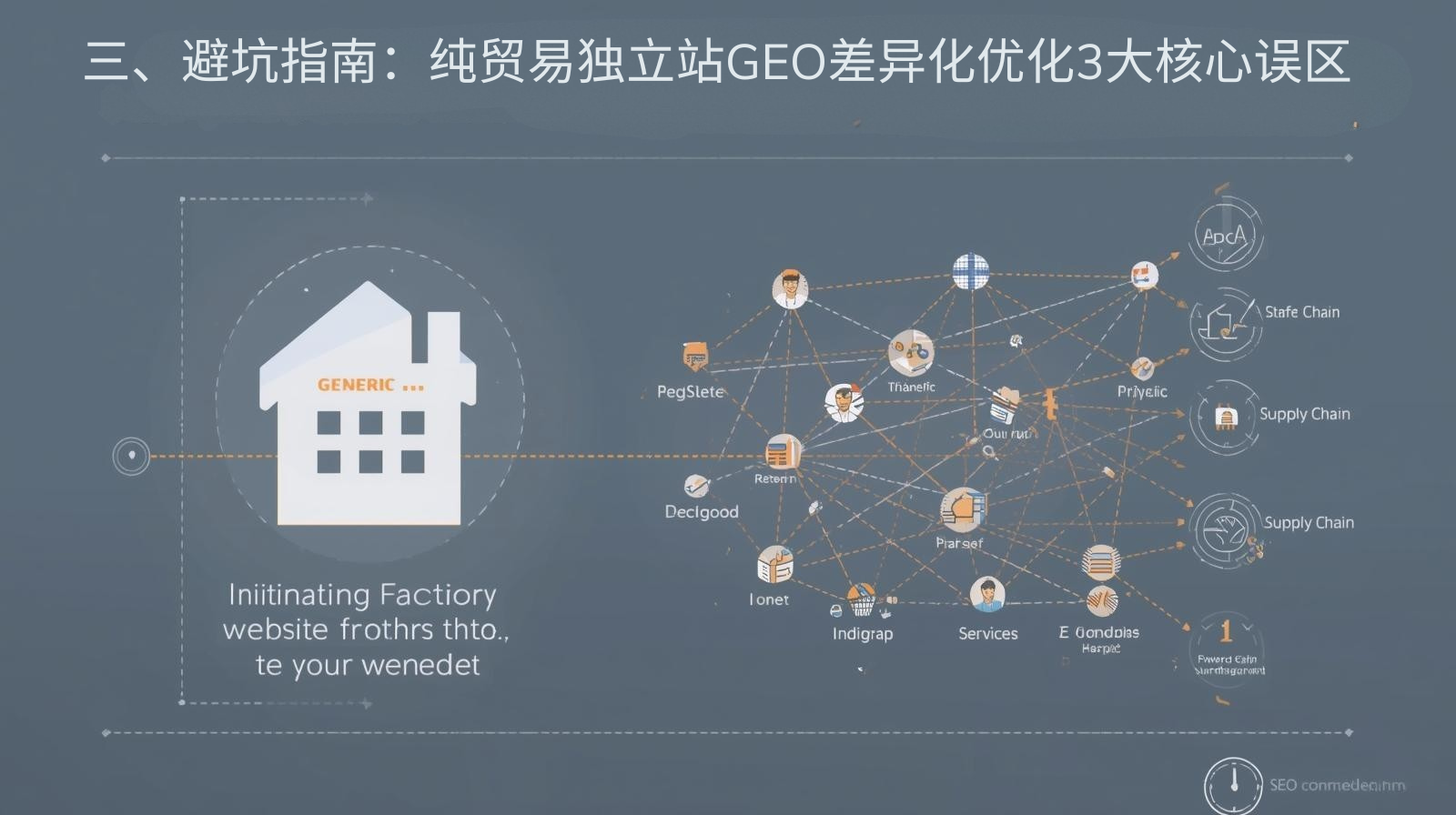
III. Avoiding Pitfalls: 3 Core Misconceptions in GEO Differentiation Optimization for Pure Trade Independent Websites
Based on practical case studies of pure trade-oriented independent websites from 2025-2026, most websites easily fall into three major pitfalls in GEO differentiation optimization, resulting in the inability to establish professional tags and poor AI recommendation effects. These pitfalls must be resolutely avoided:
3.1 Misconception 1: Imitating the content of factory websites leads to the loss of differentiation.
Errors include : blindly copying the product production process, equipment display, R&D team, etc. of the factory website, without highlighting the core advantages of pure trade such as supply chain integration and flexible services; and even making false claims about "own factory" in an attempt to confuse AI with user perception.
Core harms : If the content does not match the site's positioning, AI will judge the content as highly homogenized and of low value, and reduce its recommendation weight; once false advertising is exposed, it will be included in the "untrustworthy site" list by AI and permanently lose exposure opportunities; a Shenzhen pure trade e-commerce site, because it imitated the content of a factory site, still had an AI recommendation rate of less than 10% after 3 months of optimization, and the number of accurate inquiries was almost zero.
Correct approach : Abandon factory site content templates, reconstruct differentiated content around the core advantages of pure trade, authentically showcase supply chain resources and service capabilities, and allow AI to accurately identify the trader's positioning on the site.
3.2 Misconception 2: Overgeneralization of trust endorsement fails to meet the EEAT principle.
Errors include : using vague terms such as "stable supply chain," "reliable quality," and "professional service" without providing verifiable information such as factory certifications, customer case studies, or audit reports; or using vague customer case studies or expired compliance certifications, which fail to demonstrate professionalism and credibility.
Key risks : AI will determine that a site lacks professionalism and credibility, and will not be included in the "Professional Foreign Trade Service Provider" recommendation list; users will not initiate inquiries even if they see the site through AI due to a lack of trust signals; according to Foreign Trade Bull's survey data in January 2026, pure trade sites with generalized trust endorsements have an average inquiry loss rate of 75%.
Correct practice : Supplement with genuine and verifiable trust signals, including complete information such as certification numbers, official query links, and details of customer case studies; regularly update compliance certifications and customer case studies to ensure the timeliness and authenticity of trust signals.
3.3 Misconception 3: Misaligned keyword placement, resulting in traffic not matching positioning.
Errors include : blindly using factory-related keywords such as "product manufacturer" and "OEM customization" while neglecting precise trade keywords (such as "small batch foreign trade procurement" and "multi-category foreign trade service provider"); or keyword stuffing that is disconnected from the content theme.
Key risks : AI-driven traffic is mostly from non-targeted customers looking for factories, resulting in extremely low conversion rates; mismatched keywords and content lower the AI's assessment of the site's value, leading to a continuous decline in recommendation weight; a Foshan-based pure trading furniture site saw a 120% increase in AI traffic due to misaligned keyword placement, but only an 8% increase in targeted inquiries.
Correct approach : Focus on precise keywords for pure trade, and categorize them into "core keywords + scenario keywords + service keywords" to ensure that keywords are highly matched with content and site positioning, thereby improving the accuracy of AI-recommended traffic.
Recommended Article: Your Competitors Haven't Reacted Yet: Building an Independent E-commerce Website with GEO is the Biggest Blue Ocean Strategy Right Now
IV. Conclusion: Even without a factory, you can lead the way in AI-driven foreign trade customer acquisition by leveraging professional expertise.
In 2026, the core competition in foreign trade AI customer acquisition has shifted from "resource competition" to "professionalism competition." Pure independent trading websites do not need to fall into the trap of homogenization due to the lack of their own factories. Their core advantages of "supply chain integration, flexible services, and precise demand matching" are precisely the core needs of overseas buyers in the AI era. The core of GEO's differentiated optimization is to enable these advantages to be accurately identified by AI, create the label of "professional foreign trade service provider," and achieve efficient customer acquisition even without a factory.
For pure trading independent websites, differentiation is not an "optional" but a "must-have." By reconstructing differentiated content, strengthening verifiable trust endorsements, and conveying precise AI adaptation signals, they can avoid the homogeneous competition of factory websites and quickly gain recommendation weight on AI platforms such as ChatGPT, attracting targeted traffic proactively. Practical cases from pure trading companies in Guangzhou's home furnishing and building materials industry have proven that as long as the right differentiation direction is found and optimization actions are precisely implemented, even companies without factories can lead the way in the AI-driven foreign trade customer acquisition race.
In 2026, the AI traffic dividend for foreign trade will continue to be released. Pure trade independent websites do not need to envy the resource advantages of factory websites. By focusing on their own core capabilities and optimizing GEO for differentiation, they can create unique professional labels, stand out in the fierce market competition, and achieve long-term stable growth in cross-border business.