The global industrial metaverse market experienced explosive growth in 2026. According to industry research data, overseas procurement demand for industrial metaverse equipment and accessories surged by 187% year-on-year. Among them, 65% of overseas buyers used AI platforms such as ChatGPT and Google Gemini to screen suppliers, and the monthly AI query volume for core search terms such as "metaverse equipment foreign trade" and "industrial metaverse accessory suppliers" increased by an average of 92%. Under this trend, the industrial metaverse accessory foreign trade sector has formed a brand-new blue ocean of AI search. However, only 17% of relevant independent foreign trade websites have carried out targeted GEO optimization. Most websites have missed out on massive amounts of precise traffic due to issues such as neglecting AI semantic understanding logic, content being out of touch with the context, and lacking compliance information. A Shenzhen-based industrial metaverse interactive equipment parts company, through systematic GEO optimization to adapt to AI search demands, saw its AI recommendation share for core keywords such as "industrial metaverse sensor foreign trade" and "metaverse workshop equipment parts supplier" surge from 8% to 59% within three months. The number of accurate inquiries also increased by an average of 132% per month. This case demonstrates that for independent industrial metaverse parts foreign trade websites, only by seizing the high ground in AI platform search through professional GEO optimization can they quickly establish a competitive advantage in a blue ocean market.
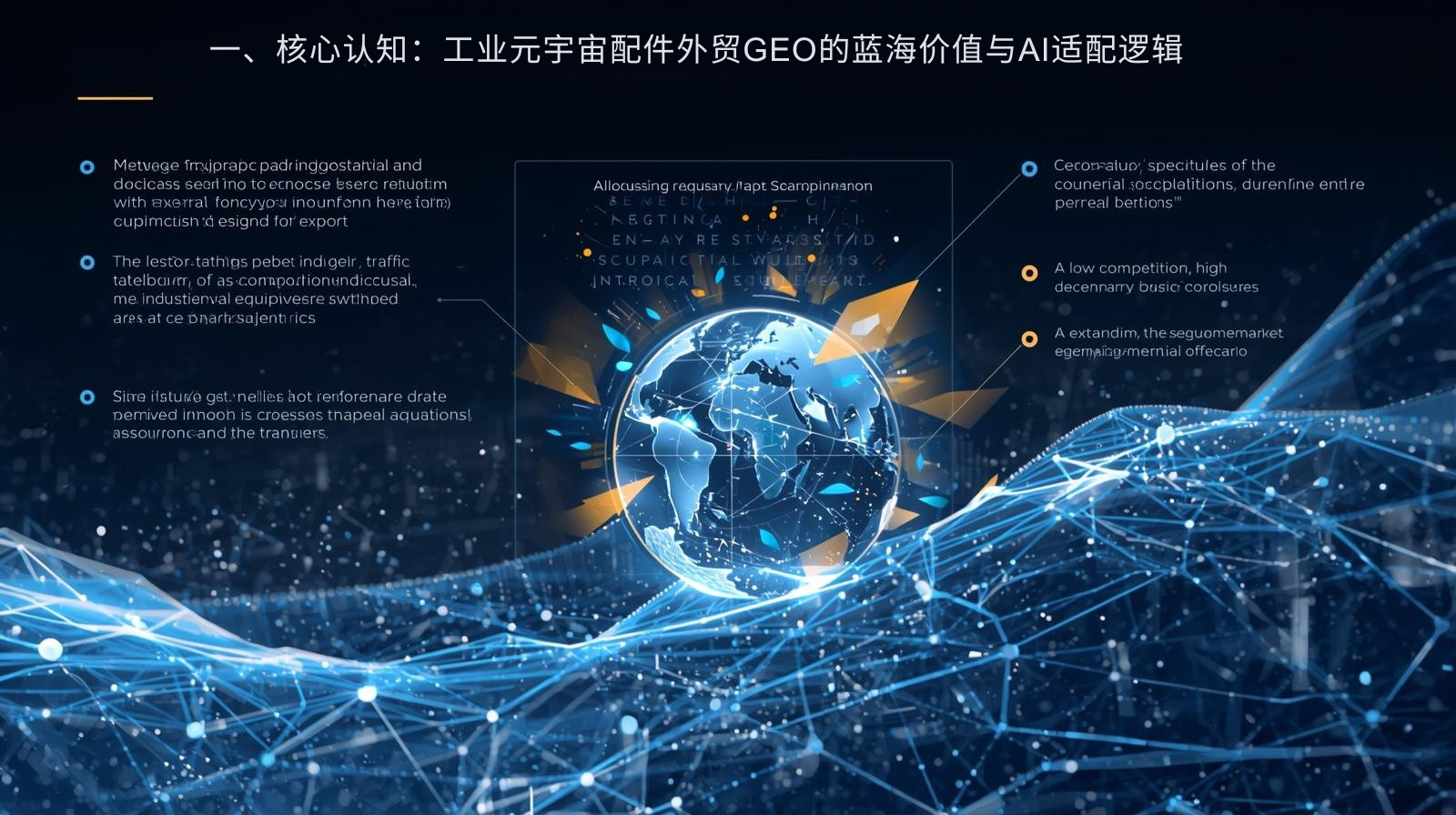
I. Core Understanding: The Blue Ocean Value and AI Adaptation Logic of Industrial Metaverse Parts Export GEOs
GEO optimization for industrial metaverse components in foreign trade refers to optimizing the core of a generative engine to adapt to the semantic understanding, demand mining, and content recommendation logic of AI platforms in the industrial metaverse scenario. This allows independent entities to gain priority display in AI search scenarios related to "metaverse equipment foreign trade," essentially a core means of seizing traffic in a blue ocean market during the AI era. Compared with traditional category GEO optimization, its core value and adaptation logic have significant industry specificities, requiring precise matching of the technical attributes of the industrial metaverse, the compliance requirements of foreign trade scenarios, and the recommendation rules of AI platforms.
1.1 The core value of GEO in a blue ocean market: Early planning and securing incremental traffic.
Currently, the export market for industrial metaverse components is still in a period of high growth potential. The core value of GEO optimization is concentrated in three dimensions, which are also its core advantages that distinguish it from mature product categories:
1. Low competition and high precision, lower traffic acquisition cost: Compared with the traditional industrial parts track, the AI search competition of industrial metaverse parts is only 23% of the former, and the search users are mostly precise groups such as purchasing managers of overseas manufacturing companies and metaverse technology integrators. Through GEO optimization, AI recommendation weight can be obtained quickly, and the traffic acquisition cost is 67% lower than that of mature categories.
2. Adapt to AI demand mining logic and expand potential customers: The procurement demand of industrial metaverse components is characterized by "strong technical attributes, obvious scenario-based, and high demand exploration". Overseas buyers often ask AI questions in long sentences in natural language (such as "What are the compliant suppliers of interactive sensors that are adapted to the automotive metaverse workshop?"). GEO optimization can accurately match such AI question-and-answer scenarios, reach buyers who have not yet formed a clear procurement goal but have potential needs, and expand the boundaries of customer acquisition.
3. Establish early brand awareness and build competitive barriers: Currently, most industrial component export companies have not paid attention to the deployment of AI platforms. By optimizing GEO in advance to seize the high ground of AI recommendations, they can establish brand awareness as an "industry benchmark" in the minds of overseas buyers. When the competition intensifies, they will form traffic and brand barriers that are difficult to surpass.
1.2 Core AI Adaptation Logic of Industrial Metaverse Components Foreign Trade GEO
The AI platform's recommendation of industrial metaverse component content follows a three-dimensional logic of "semantic matching + value verification + compliance review," which is also the core target of GEO optimization. It must simultaneously meet the requirements of technical scenario adaptation, foreign trade compliance requirements, and AI crawling preferences.
1. Semantic matching: AI prioritizes content that accurately matches the needs of industrial metaverse scenarios. It needs to deeply understand the technical requirements of core scenarios such as "metaverse workshop", "digital twin equipment" and "industrial metaverse interactive terminal" to avoid simply piling up keywords without considering the actual application scenario.
2. Value Verification: Industrial metaverse components have high technical barriers, and AI tends to recommend content with professionalism and credibility. It is necessary to prove the technical feasibility and adaptability of the product through information such as technical parameters, application cases, and third-party testing reports, and meet the EEAT principle (professionalism, experience, authority, credibility) recommended by AI.
3. Compliance audit: Overseas industrial procurement has stringent compliance requirements, especially in core markets such as the EU and the US. AI will prioritize recommending sites with complete compliance certifications. It is necessary to sort out compliance requirements such as REACH, CE, and UL in advance and display them in a structured manner to avoid affecting the recommendation weight due to missing compliance information.
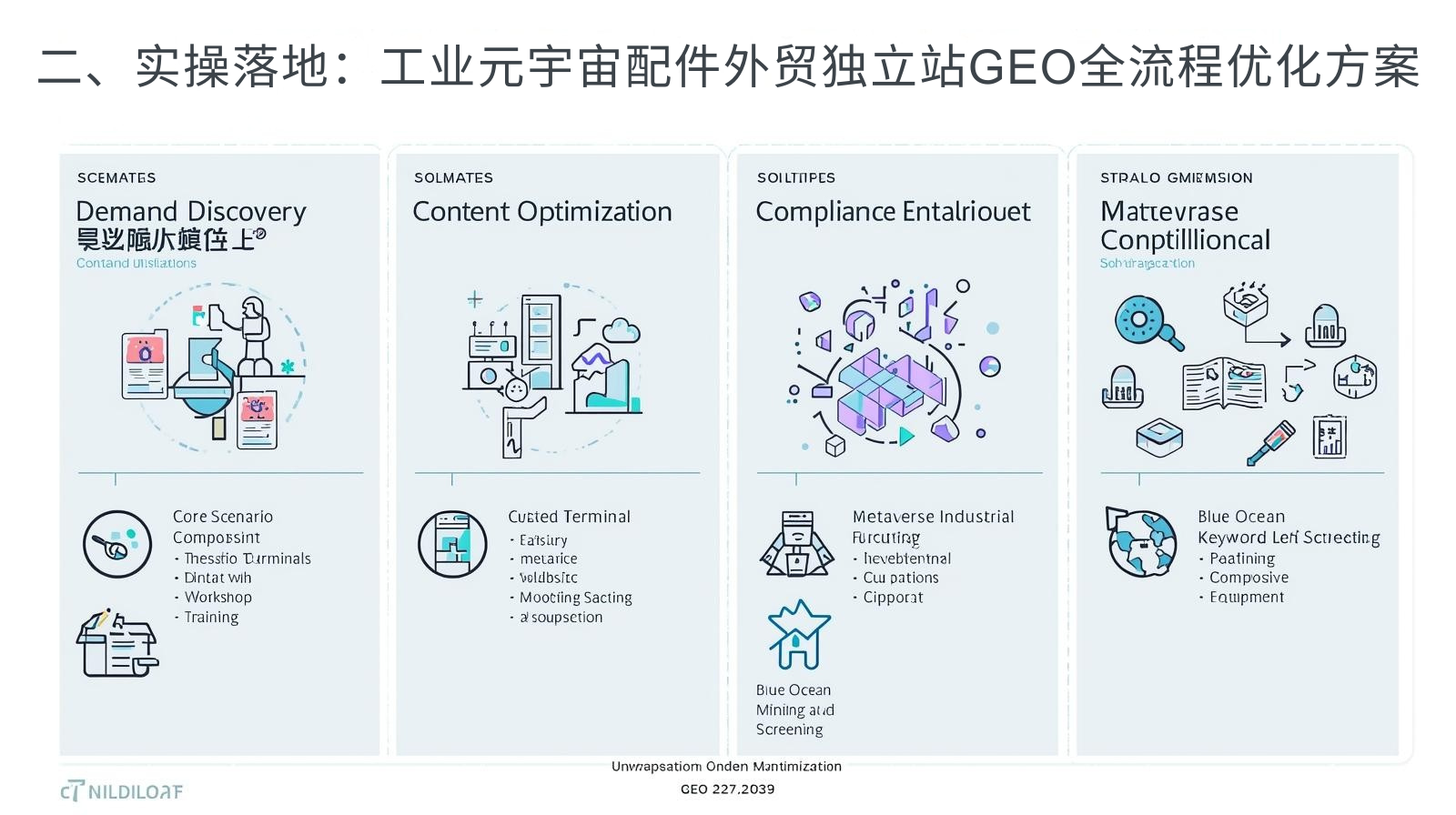
II. Practical Implementation: GEO Full-Process Optimization Solution for Industrial Metaverse Parts Export Independent Website
Based on practical cases of Shenzhen industrial metaverse component enterprises, as well as the technical attributes and foreign trade compliance requirements of the industrial metaverse scenario, a four-stage GEO optimization solution of "demand mining - content optimization - compliance enhancement - signal submission" is summarized. Each stage has clear practical steps and key points for implementation, which can be directly applied to achieve a breakthrough in AI search traffic.
2.1 Phase 1: AI Search Demand Mining (7-10 days) – Precisely Identifying Blue Ocean Keywords
The core objective is to uncover the high-frequency search demands and core keywords of overseas buyers of industrial metaverse components on AI platforms, laying the foundation for subsequent content optimization. The core practical steps are as follows:
1. Core Scenario Requirements Breakdown: Based on the core application scenarios of the industrial metaverse, we break down the procurement needs of overseas buyers, focusing on four key scenarios: ① Industrial metaverse interactive terminal accessories (such as sensors, controllers, and display modules); ② Digital twin workshop equipment accessories (such as data acquisition modules and modeling and scanning accessories); ③ Metaverse industrial training equipment accessories (such as VR/AR adapter components and motion capture accessories); ④ Metaverse factory security equipment accessories (such as intelligent monitoring adapter modules and early warning sensor accessories). For each scenario, we extract the core concerns of buyers, such as technical parameter compatibility, industry compliance requirements, installation and commissioning services, and after-sales support.
2. Blue Ocean Keyword Mining and Screening: Precise keywords are mined through three main channels: ① AI Tool Mining: High-frequency procurement questions in target markets (Europe, America, Southeast Asia) are generated using ChatGPT and Google Gemini, such as "Which sensors are suitable for metaverse industrial workshops?" and "EU compliant metaverse device accessories suppliers"; ② Keyword Tool Validation: The search popularity and competition of keywords are verified using Ahrefs and Google Keyword Planner to screen for "high-demand, low-competition" blue ocean keywords; ③ Competitive Analysis Supplement: The GEO optimized keywords of 3-5 benchmark companies in the same industry are analyzed to uncover scenario-specific long-tail keywords that they do not cover (such as "automotive metaverse workshop sensor accessories" and "small-batch metaverse device parts procurement").
3. Keyword Classification and Layout: The mined keywords are classified into "core keywords + scenario-based long-tail keywords + compliance keywords". Core keywords (such as "industrial metaverse parts supplier" and "metaverse equipment foreign trade") are placed in the homepage title and core banner; scenario-based long-tail keywords (such as "digital twin workshop data acquisition module") are placed in product category pages and content pages; compliance keywords (such as "REACH compliant metaverse accessories" and "CE certified industrial metaverse parts") are placed in the compliance section of product pages and qualification certification pages, forming a comprehensive keyword layout system.
2.2 Second Phase: Contextualized Content Optimization (15-20 days) – Adapting to AI Semantic Understanding Logic
The core objective is to restructure the content of independent websites, ensuring that the content accurately matches the AI semantic understanding logic and the needs of industrial metaverse scenarios, thereby improving the weight of AI recommendations. The core practical steps are as follows:
2.2.1 Restructuring of Page Content Structure
Abandoning the traditional parameter listing format, the core page content is restructured according to the logic of "scenario pain points - technical solutions - product advantages - case studies," ensuring that AI can quickly grasp core information and users can see value at a glance. For example, for the scenario of "automotive metaverse workshop sensor parts," the content can be designed as follows: ① Scenario pain points: "Automotive metaverse workshops face challenges such as inaccurate data collection and poor device compatibility, affecting production efficiency"; ② Technical solutions: "Our sensors support high-precision data collection (error ≤0.01mm), are compatible with mainstream metaverse workshop systems, and provide one-stop installation and commissioning services"; ③ Product advantages: "CE/REACH compliant, supports small-batch customization, and provides a 24-month after-sales warranty"; ④ Case studies: "Cooperated with a German automotive metaverse enterprise to provide 500 sets of sensors, reducing equipment failure rate by 28%." At the same time, technical parameters and core advantages are presented in lists and tables to improve AI's grasping efficiency.
2.2.2 Supplementing and Strengthening Technical Content
Industrial metaverse accessories are highly technical, requiring supplementary professional technical content to enhance AI's assessment of the site's professionalism. Key actions include: ① Technical blog creation: Creating blog content around frequently asked technical questions, such as "How to choose sensors for industrial metaverse workshops" and "REACH compliance guidelines for metaverse device accessories," incorporating relevant keywords to increase AI's citation probability; ② Product technical manual optimization: Providing bilingual (Chinese and English) technical manuals that detail product technical parameters, suitable scenarios, installation steps, and solutions to common problems, which can be directly used by AI for recommendations; ③ FAQ section construction: Building a multilingual FAQ section to address frequent technical and procurement questions from overseas buyers, such as "Does your product support customization for digital twin workshops?" and "What is the delivery time for EU market orders?".
2.3 Phase Three: Compliance and Trust Endorsement Enhancement (10-15 days) – Improving AI Recommendation Priority
The core objective is to improve the compliance information and trust endorsement content of independent websites to meet the authority and credibility requirements of AI recommendations. The core practical steps are as follows:
1. Structured Display of Foreign Trade Compliance Information: Comprehensive presentation of compliance certification information tailored to the compliance requirements of core target markets, with a focus on: ① EU Market: REACH certification (SVHC test results, certification number, and official query link must be included, such as the ECHA official website query link: https://echa.europa.eu/), CE certification (applicable directives and certification number must be included); ② US Market: UL certification, FDA certification (if medical-grade industrial metaverse components are involved); ③ Southeast Asian Market: SNI certification, TISI certification; Additionally, a compliance declaration will be prominently displayed on the product page, stating that the product complies with the regulatory requirements of the target market, such as "Our industrial metaverse sensors fully comply with EU REACH regulation (SVHC content < 0.1%), and the certification number is REACH-2026-E012, which can be queried on the official website of ECHA".
2. Enhanced Trust Endorsement Content: Strengthening trust between AI and users through multi-dimensional trust endorsements. Core actions include: ① Customer Case Studies: Selecting 3-5 core overseas customer cases (prioritizing benchmark companies in the industrial metaverse field), showcasing customer logos, cooperation scenarios, and core achievements, such as "Cooperated with a French aerospace metaverse enterprise to provide 300 sets of data acquisition modules, shortening project cycle by 32%"; ② Supplementary Third-Party Endorsements: Showcasing third-party testing reports (such as SGS testing reports, with report numbers and query links), industry honors, media reports, etc.; ③ Service Guarantee Commitments: Clearly indicating overseas warehouse layout (such as overseas warehouses in Germany and the United States), logistics timeliness (such as 3-5 day delivery to the EU market), after-sales response timeliness (24-hour multilingual customer service response), and technical support services (such as remote installation guidance and on-site debugging services).
2.4 Fourth Stage: AI-Focused Signal Submission (3-5 days) – Accelerating Content Inclusion and Recommendation
The core objective is to proactively send crawling signals to the AI platform to accelerate the indexing and recommendation of content from independent websites. The core practical steps are as follows:
1. Sitemap Optimization and Submission: Optimize the sitemap of the independent website, and label the pages according to "scenario category + product category + language version" (such as "en/eu/industrial-metaverse-sensors" "zh/southeast-asia/metaverse-device-parts") to ensure that the AI crawler can quickly identify the site structure and core content; submit it to ChatGPT webmaster platform and Google Gemini search resource platform respectively to accelerate content inclusion.
2. Crawling permissions and technology configuration: Check the site's robots.txt file to ensure that crawlers from core AI platforms such as ChatGPT and Google Gemini are not blocked, and avoid relying on JavaScript to load core content (AI crawlers are more efficient at crawling plain text content); optimize page loading speed to ensure that loading time on both mobile and PC is controlled within 3 seconds to improve the experience for both AI and users.
3. Content Update Signal Transmission: After synchronously updating and optimizing the content, submit a content update application through the official entry of the AI platform, and at the same time publish the content link on overseas social platforms such as LinkedIn and Twitter to guide the AI crawler to crawl and accelerate the improvement of recommendation weight.
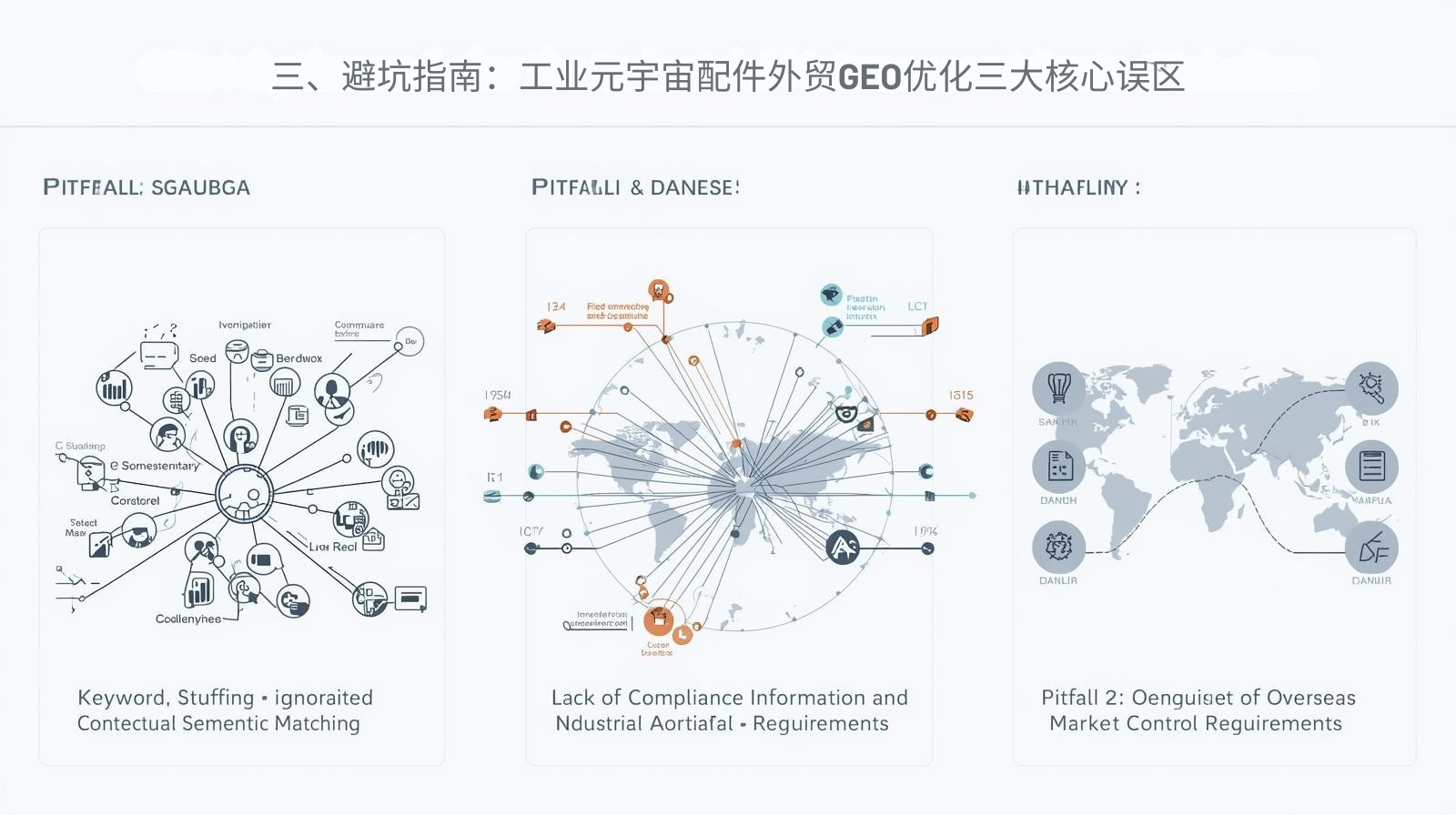
III. Avoiding Pitfalls: Three Core Misconceptions in GEO Optimization for Industrial Metaverse Components in Foreign Trade
Based on practical case studies from 2025-2026, independent e-commerce websites specializing in industrial components often fall into three common pitfalls when optimizing their GEO (Getting Things Done) metrics. These pitfalls can significantly reduce optimization effectiveness and even cause websites to miss out on emerging traffic opportunities. These pitfalls must be resolutely avoided:
3.1 Misconception 1: Keyword stuffing, neglecting contextual semantic matching
Errors include : blindly piling up core terms such as "industrial metaverse" and "metaverse equipment foreign trade," with content detached from actual application scenarios. For example, product pages only repeatedly label "industrial metaverse parts" without mentioning the applicable industry scenarios, technical parameters, and compliance requirements; or directly copying the content of general industrial parts without optimizing it in conjunction with the technical attributes of industrial metaverse.
Key harm : AI will determine that the content does not match the user's contextual needs well, reduce the recommendation weight, and even if a small amount of exposure is obtained, most of it will be non-precise traffic, with an extremely low inquiry conversion rate; a Dongguan industrial parts company, due to keyword stuffing, saw its AI exposure increase by only 23% after 2 months of optimization, and the number of precise inquiries was almost zero.
The correct approach is to integrate keywords naturally into contextualized content, focusing on the core application scenarios of the industrial metaverse, to ensure that the content addresses users' actual purchasing needs; and to focus on semantic matching rather than keyword stuffing to enhance AI's value assessment of the content.
3.2 Misconception 2: Lack of compliance information and neglect of overseas market control requirements
Errors include : failing to take overseas compliance requirements of Industrial Universe components seriously, only labeling them with general terms such as "reliable quality," and failing to provide REACH, CE, or other compliance certification numbers, test reports, and official query links; or confusing compliance requirements of different markets, such as directly applying EU REACH certification information to the US market.
Key risks : Overseas industrial procurement has stringent compliance requirements. AI may determine that the information on a website is not credible enough and refuse to include it in the core recommendation list. Even if users see a website through AI, they may abandon inquiries due to the lack of compliance information, and may even face risks such as customs penalties. In 2025, a cross-border electronic component company was marked as a "non-compliant supplier" by the AI platform for failing to meet EU REACH compliance requirements, and permanently lost AI traffic in the European market.
Correct approach : For core target markets, compile complete compliance requirements and present verifiable information such as compliance certification numbers, test reports, and official query links in a structured manner; differentiate compliance differences between different markets to avoid information confusion; establish a dynamic compliance information update mechanism to track updates to compliance requirements such as the SVHC list in a timely manner.
3.3 Misconception 3: Focusing solely on content optimization while neglecting conversion path design
Errors : Overemphasis on content optimization and AI exposure while neglecting conversion path design, such as hiding the inquiry entry too deeply (requiring more than 4 clicks to find), setting only a single email entry (without specifying response time), and lacking professional customer service support related to industrial metaverse technology, resulting in users wanting to inquire but not being able to find a channel or being afraid to inquire.
Core harm : Even if a large amount of accurate AI traffic is obtained through GEO optimization, traffic will be lost due to unclear conversion paths and insufficient customer service professionalism, making it difficult to improve the inquiry conversion rate; according to the survey data of Foreign Trade Bull in January 2026, the average inquiry loss rate of industrial metaverse parts websites with unreasonable conversion paths reached 72%.
Correct practice : Set up prominent multi-channel inquiry entry points (WhatsApp, online customer service, dedicated consultation email) on core pages (product pages, homepage, technical blog pages), and label them with "24-hour multilingual technical customer service response" and "Inquiries will receive a free Industrial Metaverse accessory adaptation solution"; equip them with professional customer service staff familiar with Industrial Metaverse technology who can accurately answer users' technical questions and purchasing concerns.
Recommended Article: Your Competitors Haven't Reacted Yet: Building an Independent E-commerce Website with GEO is the Biggest Blue Ocean Strategy Right Now
Recommended Article: Your Competitors Haven't Reacted Yet: Building an Independent E-commerce Website with GEO is the Biggest Blue Ocean Strategy Right Now
IV. Conclusion: In a blue ocean market, GEO optimization is the key to seizing the initiative.
In 2026, the blue ocean dividend of the industrial component parts foreign trade sector is accelerating its release. AI platforms have become a core channel for overseas buyers to screen suppliers. The ability to seize the high ground in AI search through GEO optimization directly determines a company's competitive position in the sector. Unlike the traditional industrial component sector, industrial component parts foreign trade GEO optimization must adapt to the semantic understanding logic of AI platforms while taking into account the industry's technical attributes and overseas compliance requirements. Only through systematic, scenario-based, and compliant optimization can accurate traffic and inquiries be quickly obtained.
For industrial Yuan Universe parts and components export companies, now is the perfect time to implement GEO optimization—the market has low competition, low traffic costs, and high precision. Through a four-stage optimization plan—"demand mining, content optimization, compliance enhancement, and signal submission"—they can quickly achieve breakthroughs in AI search traffic and establish early brand awareness and competitive barriers. Real-world case studies from Shenzhen-based industrial Yuan Universe parts and components companies have proven that as long as the right optimization direction is identified and implemented precisely, they can continuously achieve accurate exposure in the "Yuan Universe Equipment Export" search scenario on the AI platform, truly transforming blue ocean traffic into growth momentum for their businesses.
In 2026, the competition in the industrial metaverse foreign trade has begun. Only by making early arrangements for GEO optimization and seizing the blue ocean of AI search can one stand out in the fierce market competition, become the preferred industrial metaverse parts supplier for overseas buyers, and achieve leapfrog growth in cross-border business.