
Data from 2026 on AI-powered search customer acquisition in foreign trade shows that when overseas buyers search for suppliers through AI platforms such as ChatGPT and Google Gemini, only 32% of their queries explicitly mention their purchasing needs (e.g., "purchase 1000 sets of photovoltaic modules"). The remaining 68% of searches are vague, scenario-based questions (e.g., "how to solve the corrosion problem of outdoor furniture in Southeast Asia"). These searches, which conceal unspoken purchasing needs, represent the core customer acquisition opportunities for independent foreign trade websites. Unfortunately, over 70% of GEO optimization for these websites remains at the "keyword matching" level, failing to analyze the deeper intent behind AI searches, resulting in the loss of a large number of potential customers. A Shenzhen-based home furnishing export company, through a deep integration of GEO optimization and AI search intent, accurately uncovered customers' unspoken purchasing pain points and needs. Within three months, the accuracy of AI recommendations improved by 189%, and inquiries converted from implicit needs accounted for 65% of the total, with overall inquiries increasing by an average of 142% per month. This case demonstrates that the core of GEO optimization is not "matching keywords," but "analyzing search intent." Only by understanding customers' unspoken needs can independent platforms accurately reach potential buyers through AI search.
I. Core Understanding: The Value Logic of AI Search Intent Analysis and the Principle of GEO Adaptation
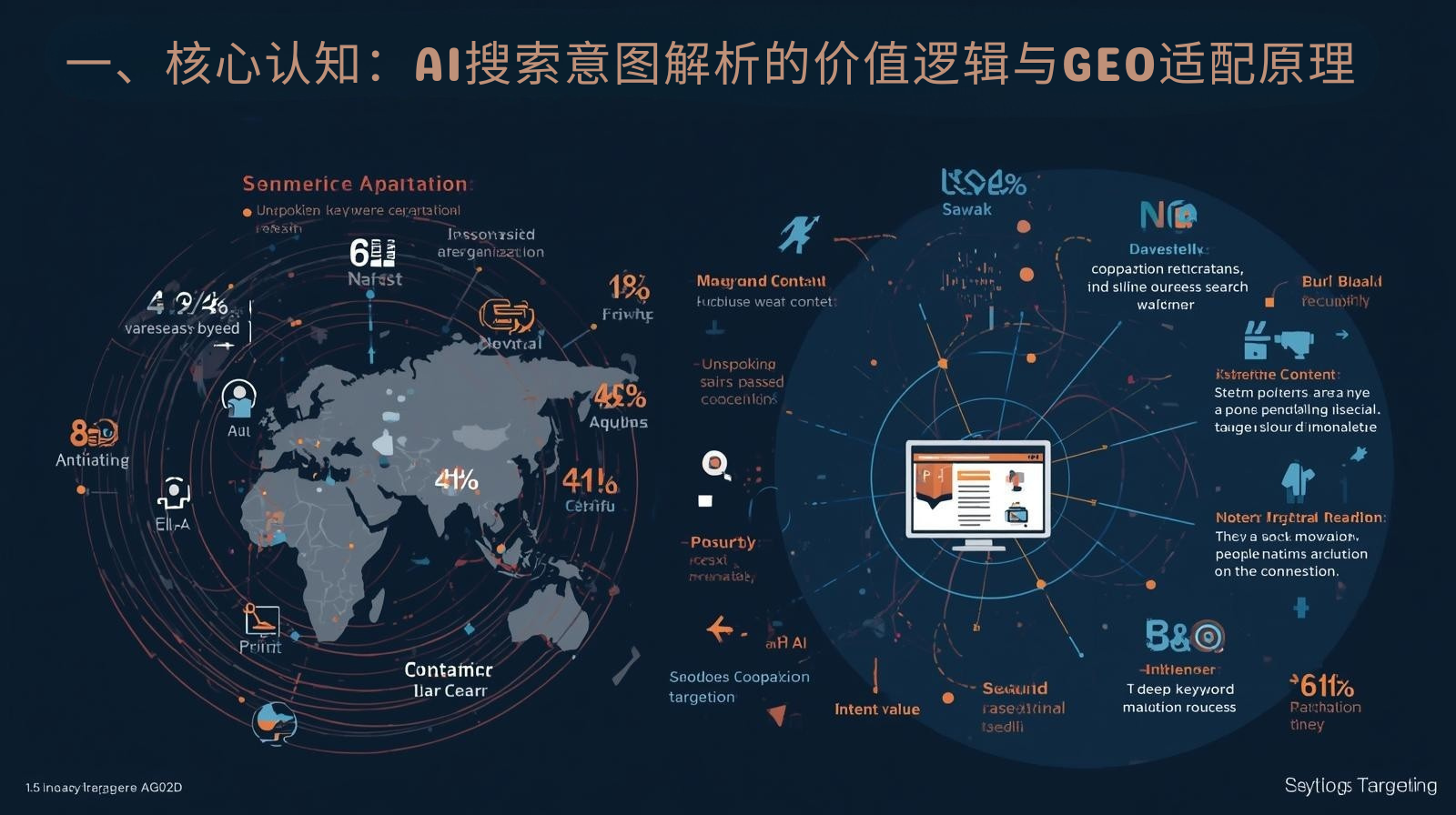
The core of GEO+AI search intent analysis for independent e-commerce websites lies in leveraging the semantic adaptation capabilities of Generative Engine Optimization (GEO) combined with the intent recognition logic of an AI platform to dissect the deep-seated needs behind overseas buyers' search behavior—including unspoken procurement pain points, potential cooperation expectations, and requests for scenario-based solutions. This implicit need is then matched with structured content, allowing the independent website to accurately target customers' core demands through AI search recommendations. This model breaks away from the traditional shallow matching of "keywords-content," achieving a deep connection between "intent-value," which is the core competitiveness for customer acquisition in the AI era for independent e-commerce websites.
1.1 Why uncover unspoken procurement needs? (2026 Trend Adaptation)
Against the backdrop of upgraded foreign trade procurement demands in 2026, uncovering customers' unspoken needs is far more valuable than simply meeting explicit demands, and this is primarily reflected in three dimensions:
1. Avoid red ocean competition and seize the first-mover advantage: The search competition for explicit procurement needs (such as "bulk purchase of XX products") is as high as 85%, while the competition for implicit needs (such as "solution to product XX problem") is only 27%. By analyzing intent and connecting with implicit needs, you can quickly obtain AI recommendation weight and seize potential customers before your competitors react.
2. Improve conversion efficiency and build deep trust: When buyers raise implicit needs, they are often in the demand exploration stage and have not yet formed a clear supplier preference. At this time, solving their pain points and matching their potential needs through professional content can quickly build professional trust and increase the conversion rate by more than 3 times compared to connecting with explicit needs.
3. Expand customer acquisition boundaries and tap into incremental markets: Many buyers do not directly search for purchasing keywords due to unclear needs (such as "not sure which product specifications are suitable for their own scenario"). Instead, they seek scenario-based solutions through AI. Analyzing these search intentions can reach incremental customers that traditional keyword optimization cannot cover.
1.2 Core Logic of AI Search Intent Parsing (Key to GEO Adaptation)
AI platforms like ChatGPT analyze buyers' search intent by following a three-dimensional logic of "semantic decomposition - scenario matching - demand prediction." This is also the core adaptation direction for GEO optimization, requiring precise alignment with each layer of logic to uncover implicit needs.
1. Semantic decomposition: AI will break down the core keywords, scenario words, and pain point words in the search query, rather than simply matching the literal meaning. For example, "Southeast Asian outdoor furniture anti-corrosion solution" will be broken down into "region (Southeast Asia) + category (outdoor furniture) + pain point (anti-corrosion) + demand type (solution)".
2. Scenario matching: AI will combine the buyer's region, industry, and procurement scenario to match their potential needs. For example, when searching for "anti-corrosion solutions", Southeast Asian buyers may implicitly need "adaptation to high temperature and humidity environments" and "low-cost anti-corrosion", while European and American buyers may implicitly need "environmentally friendly anti-corrosion materials" and "compliance certification".
3. Demand Prediction: Based on common industry needs and search history, AI will predict the deeper needs of buyers that are not explicitly stated. For example, buyers who search for "photovoltaic module installation guide" may have potential purchasing needs such as "small batch purchase", "installation team docking" and "after-sales maintenance".
II. Practical Implementation: A 3-Step GEO+AI Intent Analysis Solution to Uncover Hidden Procurement Needs
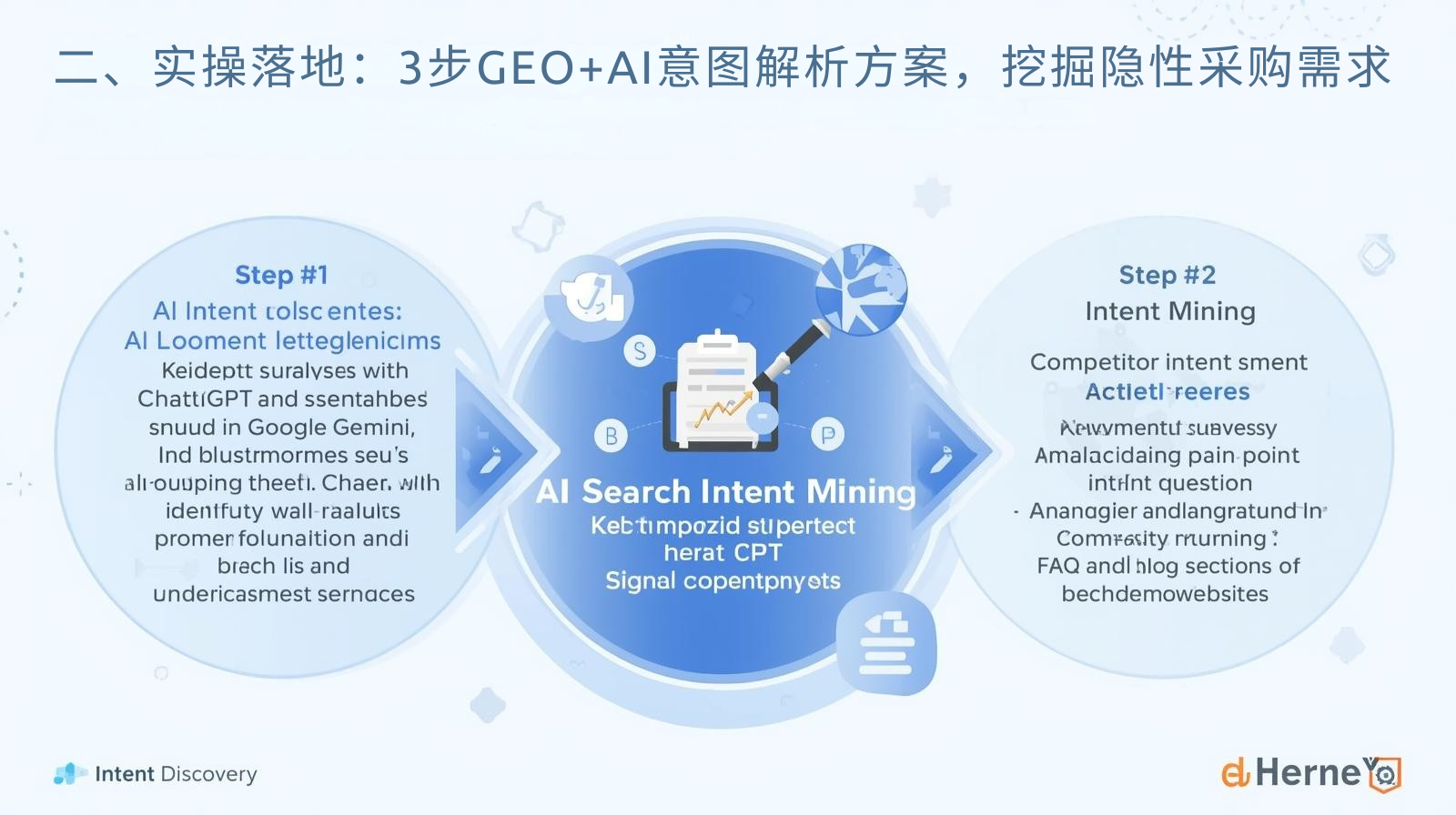
Based on practical cases of Shenzhen home furnishing export companies and AI semantic understanding rules in 2026 (such as ChatGPT intent recognition algorithm and Google BERT semantic model), we have summarized a three-step core solution: "intent mining - content adaptation - signal enhancement". Each step has clear practical steps and key points for implementation, which can be directly applied to accurately capture customers' unspoken purchasing needs.
2.1 Step 1: AI Search Intent Mining (7-10 days) – Accurately Capturing Latent Demand Signals
The core objective is to systematically uncover the AI search intent of buyers in the target market, distinguish between explicit and implicit needs, and identify implicit needs with high conversion potential. The core practical steps are as follows:
1. Multi-channel intent collection: Collect search intent through three core channels to ensure comprehensive coverage: ① Direct survey through AI platforms: Input core product keywords + regional keywords into ChatGPT and Google Gemini to generate high-frequency search questions from buyers (e.g., inputting "outdoor furniture Southeast Asia" to obtain implicit needs such as "how to solve the problem of mold on outdoor furniture in Southeast Asia during the rainy season"); ② In-depth analysis using keyword tools: Use Ahrefs and Semrush's "Question Search Report" to filter long-tail question keywords in target markets (Europe, America, Southeast Asia, etc.) and label intent types such as "pain point", "solution", and "question" (e.g., "what to do about low power generation efficiency of photovoltaic modules in winter" is a pain point implicit need); ③ Competitor intent reverse deduction: Analyze the GEO optimization content of 3-5 benchmark independent websites of peers, especially the FAQ and blog sections, to reverse deduce the implicit needs they cover (e.g., the peer blog "Complete Guide to EU Toy Compliance Certification" corresponds to the implicit need of "toy procurement compliance").
2. Intent Classification and Prioritization: Collected search intents are classified into "explicit needs + implicit needs," and implicit needs are then prioritized based on "pain point intensity + conversion potential." The core focus is on three types of high-value implicit needs: ① Pain point solution-oriented (e.g., "how to reduce logistics costs for small-batch purchases"); ② Scenario-adaptive-oriented (e.g., "small home furnishing products suitable for cross-border e-commerce live streaming"); ③ Compliance guarantee-oriented (e.g., "FDA certification process for electronic products in the US market"). The ranking criteria consider two dimensions: AI search popularity (monthly search volume ≥ 500) and demand relevance (matching degree with core products/services ≥ 80%).
3. Building a keyword library for implicit needs: A keyword library is built around high-priority implicit needs, consisting of "pain point words + scenario words + solution words." For example, for the implicit need of "anti-corrosion of Southeast Asian outdoor furniture," keywords include "anti-corrosion solutions for Southeast Asian outdoor furniture," "solutions for mold growth on outdoor furniture during the rainy season," and "anti-corrosion materials for furniture in high-humidity environments." Simultaneously, the core implicit need corresponding to each keyword is labeled (e.g., "reducing logistics costs" corresponds to the implicit need of "small-batch purchasing"), laying the foundation for subsequent content adaptation.
2.2 Step Two: GEO Content Adaptation (15-20 days) – Matching Implicit Needs with Professional Content
The core objective is to restructure the independent website's GEO-optimized content system based on uncovered implicit needs, enabling content to both accurately identify intent through AI and precisely address unspoken customer demands. The core practical steps are as follows:
2.2.1 Content Structure Restructuring: From "Product Promotion" to "Needs Resolution"
Abandoning traditional product parameter listings, we restructure core content according to the logic of "pain point presentation - latent need discovery - solution - product adaptation," ensuring that each piece of content precisely addresses a specific latent need. For example, regarding the latent need of "corrosion prevention for Southeast Asian outdoor furniture," the content structure could be designed as follows: ① Pain point presentation: "Southeast Asia's rainy season brings high temperatures and humidity, making outdoor furniture prone to mold and corrosion, leading to frequent replacements and increased procurement costs"; ② Latent need discovery: "Buyers not only need corrosion-resistant furniture but also low-cost products that are suitable for the local climate and require minimal maintenance, potentially implying a need for small-batch purchases and rapid delivery"; ③ Solution: "Using imported corrosion-resistant wood and high-temperature carbonization technology, the corrosion and mold resistance lasts for over 5 years, supporting small-batch purchases with an MOQ ≥ 50, direct shipping from Vietnam overseas warehouse, delivery in 3-5 days"; ④ Product adaptation: "Recommended: XX series outdoor tables and chairs, certified by Southeast Asia SNI, suitable for local courtyards, guesthouses, and other scenarios"; Simultaneously, we present core advantages in a list and compare product adaptation solutions for different scenarios in a table, improving AI-driven data collection efficiency.
2.2.2 Core Content Module Optimization: Full Coverage of Implicit Needs Scenarios
We will focus on optimizing three core sections to ensure full coverage of implicit needs: ① Blog Section: We will create in-depth articles around each type of high-value implicit need (such as "Southeast Asian Outdoor Furniture Anti-corrosion Guide: From Material Selection to Maintenance Techniques"), incorporating keywords related to implicit needs and naturally integrating product solutions; ② FAQ Section: We will build a FAQ section categorized by "Region + Category + Pain Point," creating professional answers to frequently asked questions about implicit needs (such as "Q: How to reduce logistics costs for small-batch purchases of photovoltaic modules? A: We support warehousing in EU and Southeast Asian overseas warehouses. Small-batch orders can be shipped directly from local overseas warehouses, reducing logistics costs by 40% and delivering within 3-5 days"); ③ Product Page Section: We will add a "Scenario Pain Point Adaptation" module to product introductions, clearly indicating the implicit needs that the product can solve (such as "Adapted for cross-border e-commerce small-batch warehousing: MOQ≥10, supports mixed batches, and provides product listing material packages").
2.2.3 Semantic Adaptation Optimization: Enabling AI to Accurately Recognize Intent
Optimize the semantic expression of content to ensure that AI can accurately deconstruct search intent and match content: ① Naturally integrate intent keywords: Naturally integrate implicit demand keywords (pain point words, scenario words, solution words) into the title, first paragraph, and subheadings to avoid piling up keywords; ② Use AI-preferred expression logic: Adopt the expression style of "Buyers may encounter XX problems in XX scenario and need XX solutions" to adapt to the AI's intent prediction logic; ③ Supplement semantically related content: Supplement the article with extended content related to implicit needs (such as compliance requirements, industry trends, procurement skills) to enhance AI's recognition of content intent.
2.3 Step 3: AI Intent Signal Strengthening (Starts in 3-5 days, continues long-term) – Enabling AI to prioritize recommending relevant content.
The core objective is to proactively signal to the AI platform that "content accurately matches implicit needs," accelerating content inclusion and recommendation, and giving independent websites priority display when customers search for implicit needs. The core practical steps are as follows:
1. Structured Signal Optimization: Optimize content according to the structured format preferred by AI, such as using H2-H3 headings to distinguish sections such as "Pain Points", "Solutions", and "Product Adaptation", and using tags to mark core intent keywords (such as "#Southeast Asian Outdoor Furniture Anticorrosion#Small Batch Procurement") to facilitate AI's quick identification of the core intent of the content;
2. Multi-platform signal submission: ① Site map update and submission: Mark the optimized implicit demand-related content (blog, FAQ, product page) separately in the site map and submit it to ChatGPT webmaster platform, Google Gemini search resource platform, and Google Search Console to actively guide AI crawler to crawl; ② Content update signal transmission: Submit content update requests through the official AI platform portal, highlighting "Content focuses on solutions to buyers' implicit needs, adapted to XX scenario search intent" to accelerate AI indexing;
3. Supplementing with External Intent Signals: Publish content on overseas social media platforms such as LinkedIn and Twitter that provides solutions to implicit needs (e.g., "Tips for Cost Control in Small-Batch Foreign Trade Procurement"), tagging core intent keywords and links to the independent website to guide AI crawlers to capture external signals and strengthen the relevance between the content and implicit needs; simultaneously, answer buyers' questions about implicit needs in industry forums (such as Foreign Trade Circle and Alibaba Forum), embedding links to the independent website content to enhance the content's authority.
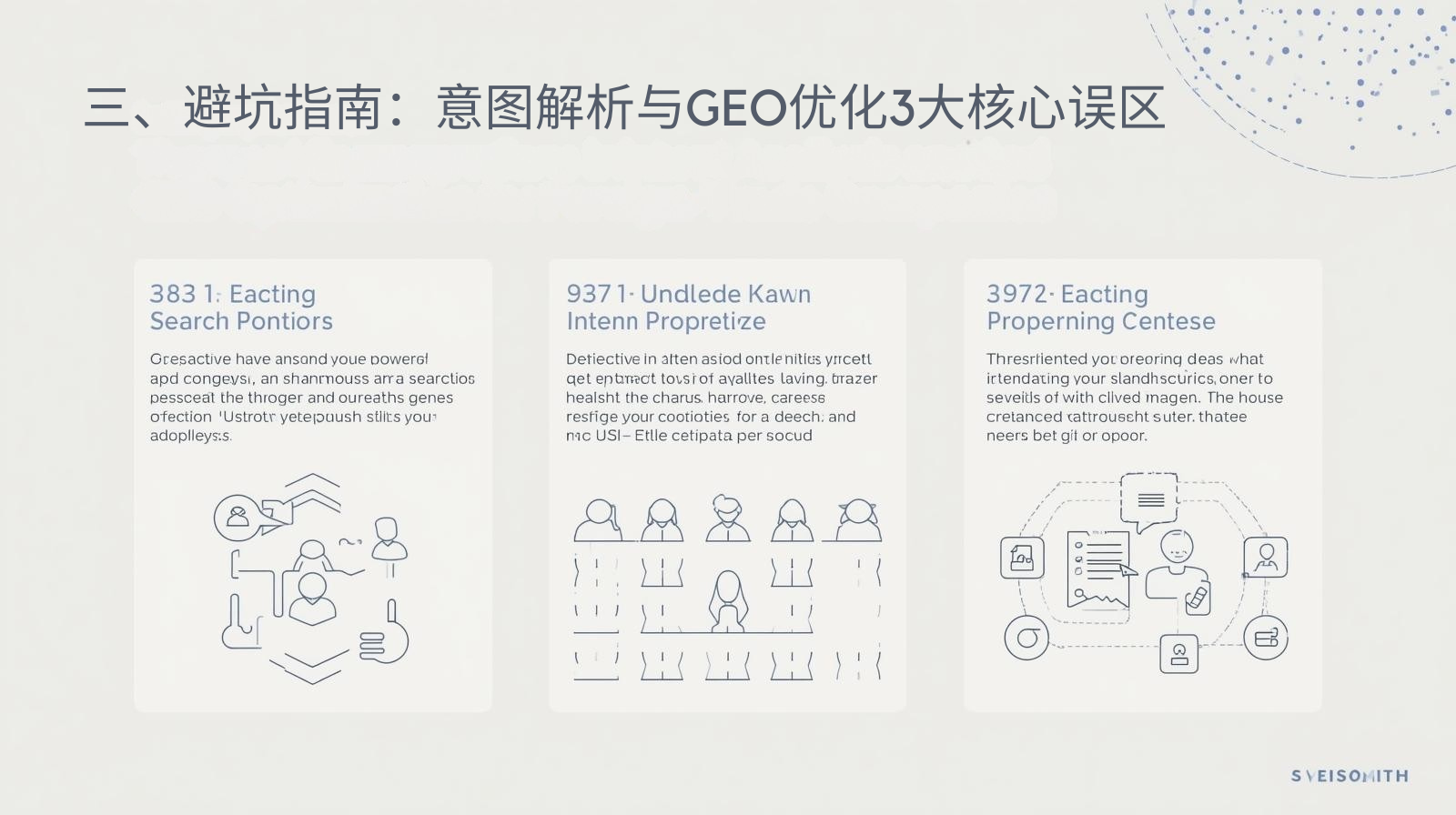
III. Avoiding Pitfalls: Three Core Misconceptions in Intent Analysis and GEO Optimization
Based on practical case studies from 2025-2026, foreign trade enterprises are prone to falling into three major pitfalls when optimizing GEO+AI search intent analysis, leading to an inability to accurately uncover hidden needs and poor AI recommendation results. These pitfalls must be resolutely avoided:
3.1 Misconception 1: Matching only keywords without analyzing deeper intent
Errors include : blindly piling up explicit keywords such as "procurement" and "supplier" without considering the semantic breakdown and intent analysis of the search query; and creating content solely around keywords without addressing the implicit pain points and needs of the buyers.
Key harm : When content is disconnected from the core needs of customers, AI will judge the content as low value and reduce its recommendation weight; even if exposure is gained, it is mostly non-precise traffic, and the number of inquiries converted from implicit needs is almost zero; a Foshan electronics foreign trade company neglected intent analysis, and after 3 months of optimization, its AI traffic increased by 110%, but the number of inquiries converted from implicit needs accounted for only 5%.
The correct approach : First, break down the search intent and uncover the implicit needs, then create content around that intent; avoid keyword stuffing and ensure that the content accurately addresses the client's unspoken needs.
3.2 Misconception 2: Inaccurate identification of latent needs, resulting in detachment from the target market.
Errors include : failing to consider the geographical characteristics, industry needs, and purchasing habits of the target market, and blindly exploring hidden needs; for example, pushing "low-cost anti-corrosion solutions" to European and American buyers while ignoring their core hidden needs for environmentally friendly materials and compliance certifications.
Key harms : Content fails to match the true needs of target customers, and AI recommendations have low accuracy; customers cannot obtain value after seeing the content, and the bounce rate soars to over 80%; according to data from Foreign Trade Bull's January 2026 survey, intention optimization that deviates from the target market has a conversion efficiency 73% lower than accurate optimization.
The correct approach is to accurately identify suitable implicit needs by combining the geographical characteristics, compliance requirements, and procurement habits of the target market; for example, the European and American markets focus on implicit needs such as "compliance certification" and "environmentally friendly materials", while the Southeast Asian market focuses on implicit needs such as "low cost", "small batches" and "fast delivery".
3.3 Misconception 3: Content only provides solutions without incorporating conversion guidance.
Errors : The content focuses solely on solving customer pain points and uncovering latent needs, without naturally integrating product compatibility information and conversion guidance; or the conversion guidance is too abrupt and disconnected from the content theme.
Key harm : Customers recognize the value of the content, but cannot clearly connect it to products and services, and implicit needs cannot be converted into inquiries; rigid conversion guidance will reduce customer trust and even cause resentment; a hardware foreign trade company in Dongguan saw a 200% increase in the number of reads of implicit need content due to a lack of conversion guidance, but the number of inquiries only increased by 12%.
Correct approach : Naturally integrate product compatibility information after the solution content, and add soft conversion guidance at the end of the article and between paragraphs (such as "To obtain a customized solution and quote tailored to your scenario, click the WhatsApp button on the right to connect immediately, and receive 24-hour professional consultation"). The conversion guidance should be highly consistent with the content theme to avoid hard-sell tactics.
Recommended Article: Your Competitors Haven't Reacted Yet: Building an Independent E-commerce Website with GEO is the Biggest Blue Ocean Strategy Right Now
Recommended Article: Your Competitors Haven't Reacted Yet: Building an Independent E-commerce Website with GEO is the Biggest Blue Ocean Strategy Right Now
IV. Conclusion: Understanding unspoken needs is the key to customer acquisition in the AI era of foreign trade.
In 2026, foreign trade AI search customer acquisition has entered a new era of "intent competition," moving beyond the "traffic war." Unspoken purchasing needs from customers represent the most valuable customer acquisition opportunities. The combination of GEO optimization and AI search intent analysis breaks the limitations of traditional keyword optimization, enabling independent websites to accurately reach potential buyers with vague needs and undecided suppliers, achieving a shift from "passively waiting for inquiries" to "proactively uncovering needs."
For independent e-commerce websites, intent analysis is not "extra work," but rather the core essence of GEO optimization. Only by uncovering implicit needs through multiple channels, reconstructing a demand-oriented content system, and strengthening AI intent matching signals can an independent website stand out in AI search and accurately capture every unspoken purchasing need. Practical cases from Shenzhen home furnishing export companies have proven that as long as the right direction for intent analysis is found and optimization actions are precisely implemented, implicit needs can be transformed into a continuous stream of precise inquiries.
In 2026, the core of competition in foreign trade AI customer acquisition will be the ability to "understand customers." Those foreign trade companies that can accurately analyze AI search intent and uncover implicit purchasing needs will undoubtedly gain a competitive edge in the fierce market competition and achieve leapfrog growth in their cross-border business. Take immediate action to optimize GEO+AI search intent analysis, understand the unspoken needs of customers, and turn every AI search into a new opportunity to acquire customers.