
Data on foreign trade customer acquisition in 2026 shows that online trade shows have become a core channel for foreign trade companies to reach overseas buyers, with the number of companies participating in online trade shows increasing by 123% year-on-year. However, only 27% of these companies were able to convert trade show traffic into long-term, stable inquiries. Most companies are caught in the dilemma of "exposure during the trade show, but no trace after the trade show ends." The core reason is that they have not effectively linked trade show information with GEO optimization, resulting in trade show resources not being continuously captured by AI platforms such as ChatGPT, thus missing the opportunity to reach buyers long-term after the trade show. A machinery foreign trade company in Ningbo, through GEO optimization and deep integration with online exhibitions, systematically accumulated information such as exhibition exhibits, case studies, and industry insights on its independent website. Within 3 months, the amount of data crawled by the AI platform increased by 210%, and the proportion of AI recommendations for exhibition-related core keywords (such as "parts suppliers for the 2026 Hannover Messe in Germany") soared from 9% to 62%. The post-exhibition inquiry retention rate increased by 89%. This case proves that the integration of GEO and online exhibitions is not simply about piling up information, but about continuously amplifying the value of exhibitions through the AI platform to achieve long-term reach to buyers.
I. Core Understanding: The Value Logic and AI Adaptation Principles of GEO Integration with Online Exhibitions
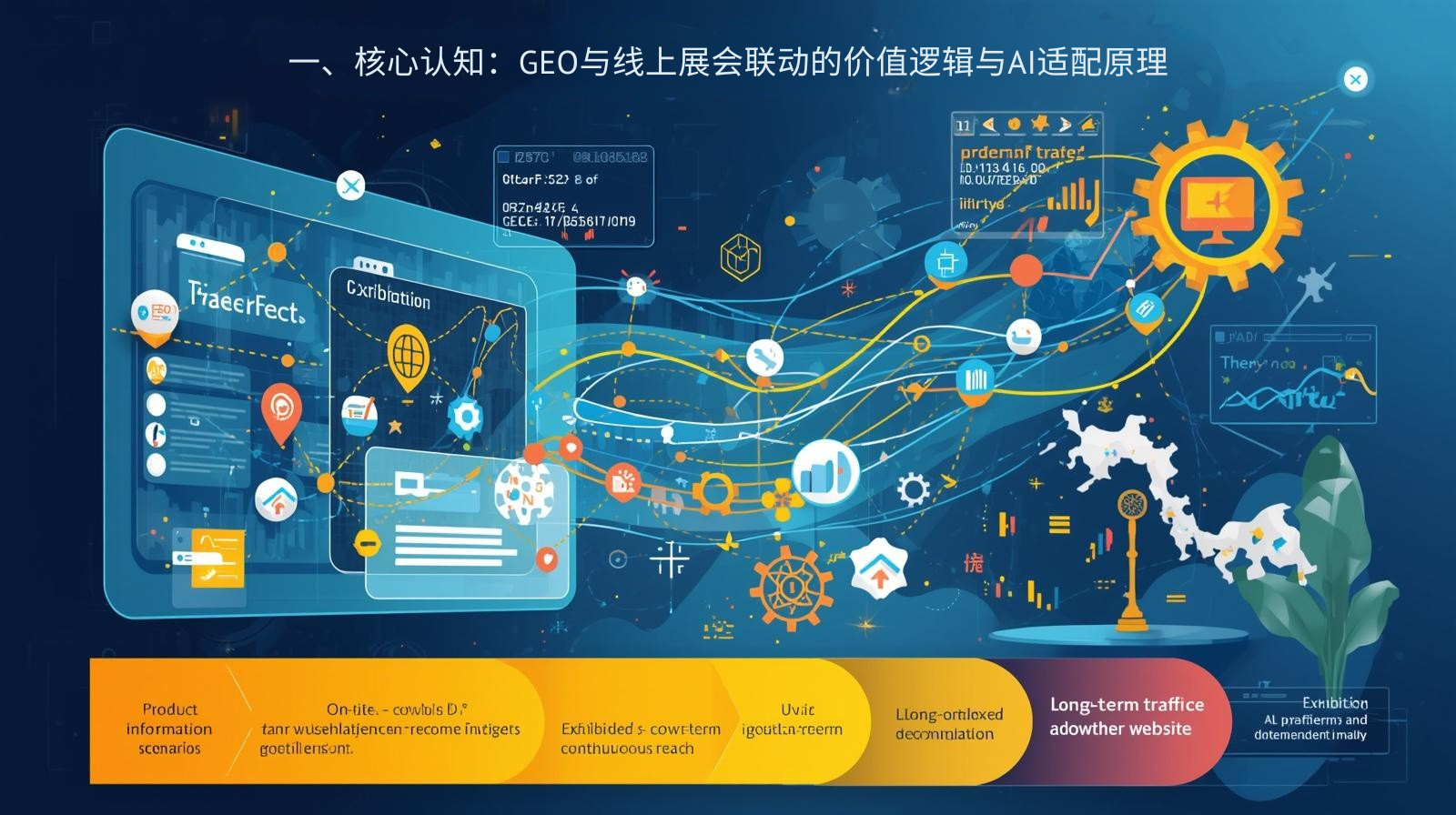
The core of the collaboration between independent foreign trade websites and online exhibitions lies in the structured accumulation and optimization of key resources from online exhibitions, such as exhibit information, matchmaking scenarios, customer needs, and industry insights, through GEO optimization (generative engine optimization). This ensures the independent website is precisely adapted to the AI platform's crawling and recommendation logic, giving it priority display rights when buyers search for exhibition-related information via AI, thus achieving long-term continuity of exhibition value. This collaborative model not only addresses the pain points of traditional online exhibitions—"short timeliness and shallow traceability"—but also enhances the professionalism and scenario adaptability of GEO-optimized content, forming a closed loop of "exhibition traffic generation - on-site accumulation - AI crawling - long-term reach."
1.1 The Three Core Values of the Collaborative Model (Adapted for Foreign Trade Customer Acquisition in 2026)
In 2026, with AI driving customer acquisition in foreign trade, the value of GEO's integration with online exhibitions far exceeds that of single-channel operations, primarily reflected in three dimensions:
1. Break through the time constraints of exhibitions and achieve long-term reach: The exposure period of traditional online exhibitions is usually only 3-7 days. However, exhibition information optimized and accumulated through GEO can be continuously captured and recommended by the AI platform, extending the exposure period to 6-12 months, so that buyers who have not been connected in time can still be reached after the exhibition ends.
2. Enhance content professionalism and improve AI recommendation weight: Online exhibitions bring together core industry resources and precise needs. Transforming this information (such as product technical parameters, industry pain point solutions, and on-site matchmaking cases) into GEO-optimized content can significantly improve the industry professionalism of independent websites, which is in line with the EEAT principle (professionalism, experience, authority, credibility) of AI recommendations. The recommendation weight is more than 4 times higher than that of ordinary content.
3. Accurately match post-exhibition search demand and improve conversion efficiency: After the exhibition, a large number of buyers will use the AI platform to search for exhibition-related suppliers (such as "photovoltaic module suppliers exhibiting at a certain exhibition" or "high-quality service providers of the 2026 Southeast Asia Electronics Show"). The optimized independent website can accurately match these high-intent search demands, improving traffic accuracy by 75% and conversion efficiency by 68% compared to ordinary optimization.
1.2 Core Principles of AI Adaptation in Linkage Mode
AI platforms like ChatGPT capture and recommend exhibition-related content based on a three-dimensional logic of "scene matching + value verification + information structuring," which is also the core target for GEO's collaborative optimization with online exhibitions.
1. Scene matching: AI prioritizes content that closely matches the search scenarios of buyers. Exhibition-related searches (such as "exhibition product price quotes" and "exhibition matchmaking cases") are themselves high-intent scenarios. Integrating this kind of scenario-based information into the independent website can accurately match the semantic understanding logic of AI.
2. Value Validation: AI tends to recommend content with real-world endorsements. Information such as the exhibitor's qualifications, on-site connection records, and real photos of exhibits at online exhibitions are all natural endorsements of trust. By optimizing and strengthening the verifiability of this information through GEO (such as marking the official certification link of the exhibition and the exhibitor's number), the value assessment of content by AI can be significantly improved.
3. Information Structuring: AI is more than 3 times more efficient at capturing structured content than plain text. Organizing exhibition information into a structure of "exhibit information - case studies - industry insights - exhibit qualifications" and presenting core information with clear headings, lists, and tables can accelerate AI's capture and indexing.
II. Practical Implementation: A 3-Step Collaborative Optimization Solution Enables AI to Continuously Capture Exhibition Information
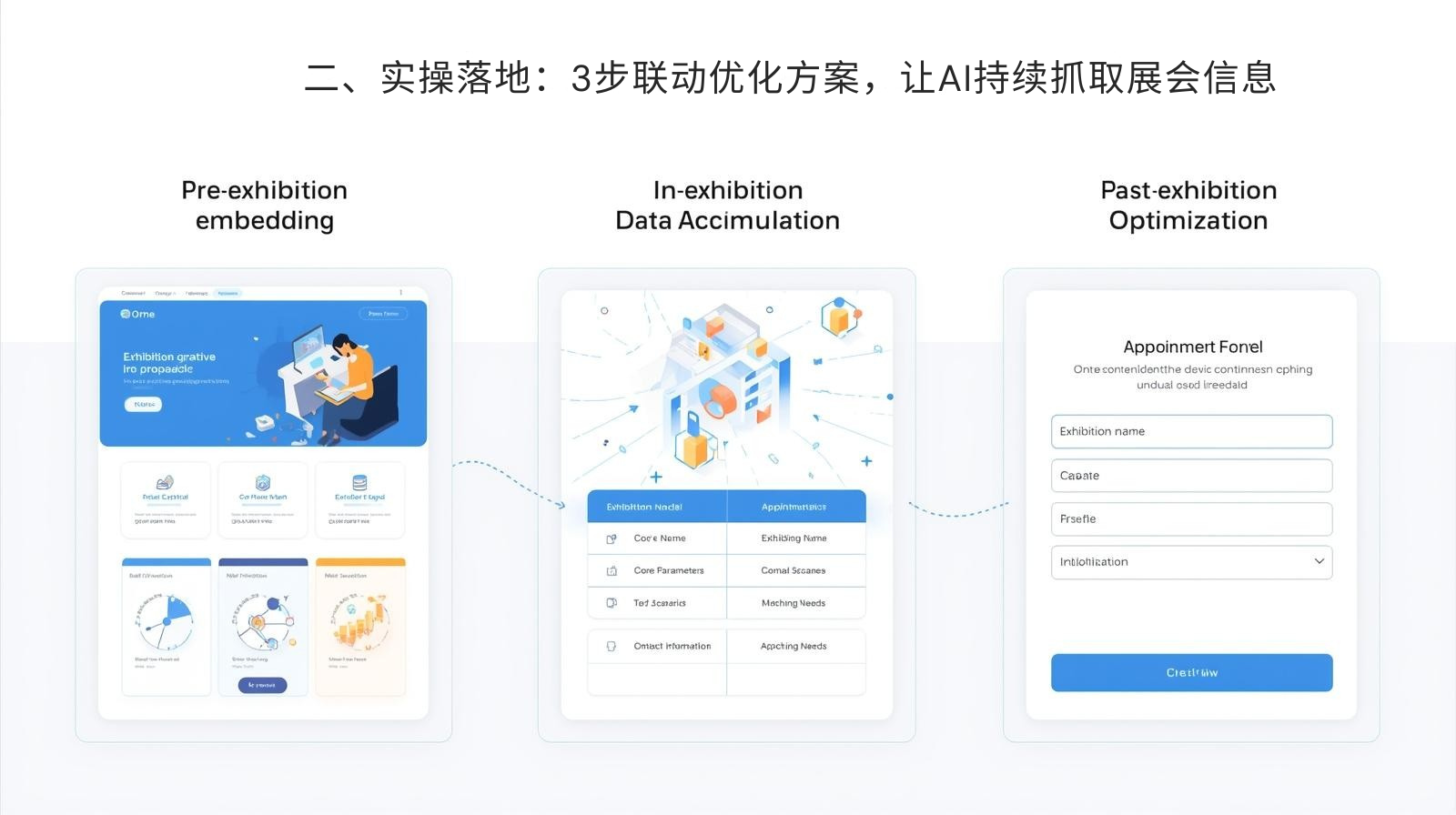
Based on practical cases of Ningbo machinery foreign trade enterprises and the AI platform crawling rules in 2026 (such as ChatGPT priority indexing standard and Google Core Web Vitals requirements), a three-step linkage optimization solution of "pre-exhibition embedding - in-exhibition accumulation - post-exhibition optimization" is summarized. Each step has clear practical steps and key points for implementation, which can be directly applied to achieve long-term AI reach of exhibition information.
2.1 Step 1: Pre-exhibition planning (7-10 days before the exhibition) – Building a GEO-compatible exhibition content framework
The core objective is to build an AI-optimized framework for exhibition content on an independent website in advance, clarify the information accumulation path for the exhibition, and prepare for content updates during the exhibition. The core practical steps are as follows:
1. Core Content Section Construction: A "Exhibition Special" entry will be set up on the homepage of the independent website, divided into four core sections: ① Exhibitor Information Section: Includes the exhibitor name (e.g., "2026 Hannover Messe"), exhibition dates, booth number, official exhibition link (e.g., Hannover Messe official link: https://www.hannovermesse.de/), and a list of exhibits. Present the exhibit names, core parameters, and applicable scenarios in a table to ensure structured information; ② Appointment and Matching Section: A dedicated appointment form will be provided, marked "Priority for On-site Matching" and "Free Technical Manual for Exhibitors Upon Appointment." The form will only retain four core information items: "Name, Company, Contact Information, and Matching Needs," lowering the barrier for users to fill out; ③ Industry Insights Section: Create 1-2 professional blog posts around the core theme of the exhibition (e.g., "2026 Intelligent Trends in the Machinery Industry"), incorporating relevant keywords (e.g., "2026 Hannover Messe Intelligent Trends in Machinery") to enhance AI's initial understanding of the exhibition theme; ④ FAQ section: Prepare frequently asked questions from buyers in advance (such as "When will you participate in the 2026 Hannover Messe?" "What are the core products you will display at the exhibition?"), create Q&A content, and adapt it to AI search scenarios.
2. GEO Keyword Layout: Based on the exhibition's relevant needs, a keyword library of "exhibition terms + product terms + scenario terms" will be built. Core terms (such as "machinery suppliers at the 2026 Hannover Messe" and "machinery parts manufacturers exhibiting at the exhibition") will be placed in the exhibition's special page title and homepage; scenario terms (such as "machinery parts matching at the exhibition" and "Hannover Messe exhibit price quotes") will be placed in the corresponding content sections; and product terms (such as "intelligent machinery parts") will be combined with exhibition terms and placed in the product descriptions, naturally integrated into the copywriting, avoiding keyword stuffing.
3. Technical Adaptation and Optimization: Ensure the loading speed of the exhibition's special page (LCP≤1.5 seconds) and mobile adaptability (score≥90 points) meet the user experience requirements of the AI platform; optimize the site map, separately mark the exhibition's special page, and submit it to the ChatGPT webmaster platform and Google Search Console to guide the AI crawler to familiarize itself with the page structure in advance.
2.2 Second Step: Accumulating Experience During the Exhibition (During the Exhibition) – Real-time Updates of High-Value Exhibition Information
The core objective is to continuously upload high-value information from the exhibition (on-site matchmaking cases, exhibit photos, industry exchange insights) to an independent website in real time, providing high-quality content for GEO optimization. The core practical steps are as follows:
2.2.1 Daily Information Updates: Maintaining Content Activity
After each day's exhibition, update 2-3 key pieces of information: ① On-site product photos: Publish photos and videos of exhibits taken at the exhibition (labeling the shooting time and booth number), with captions explaining the core advantages of the exhibits and on-site business matching (e.g., "Our intelligent mechanical parts were highly concerned at the exhibition, and 23 potential customers conducted on-site consultations on the same day"); ② Business matching case studies: Select 1-2 high-quality on-site business matching cases, remove customer privacy information, and showcase the business matching scenario, customer needs, and initial cooperation intentions, such as "Cooperated with a German automotive enterprise on-site to discuss the customization needs of intelligent mechanical parts, and the customer will send a formal inquiry after the exhibition"; ③ Industry insights supplement: Record key industry exchanges during the exhibition (e.g., the latest technology trends, changes in buyer needs), and supplement them to the industry insights section of the exhibition's special feature to enhance the professionalism of the content.
2.2.2 Strengthening Trust Signals: Enhancing Trust Between AI and Users
Real-time supplementation of verifiable trust signals: ① Exhibition qualification demonstration: Upload the official exhibition certificate and on-site check-in record (with exhibition number and query link) to prove the authenticity of the exhibition; ② Customer evaluation collection: Collect buyer evaluations on-site (with customer name and company name, which can be anonymized) and update them to the exhibition page in real time, such as "A customer from France commented: 'The product quality and technical support are very professional, and we look forward to further cooperation'"; ③ Media coverage supplementation: If industry media report on the exhibition, promptly collect the report links and screenshots to strengthen the authority of the content.
2.3 Step 3: Post-Exhibition Optimization (15-20 days after the exhibition ends) – Deep GEO optimization to accelerate AI crawling
The core objective is to perform deep GEO optimization on the content accumulated during the exhibition, adapt it to AI recommendation logic, and ensure that exhibition information can be continuously captured and recommended. The core practical steps are as follows:
1. In-depth Content Optimization: ① Integrate High-Quality Content: Integrate matchmaking cases, industry insights, and customer reviews from the exhibition into 1-2 in-depth feature articles (e.g., "Hannover Messe 2026 Retrospective: Explosive Demand for Intelligent Procurement in the Machinery Industry, These Matchmaking Cases Are Worth Noting") to enhance the completeness and professionalism of the content; ② Optimize Content Structure: Adjust the content of the exhibition's special page according to the logic of "core highlights presented first + modular presentation," using H2-H3 titles to distinguish sections, using lists to present core advantages, and using tables to compare exhibit parameters to improve AI crawling efficiency; ③ Supplement Long-Tail Keywords: Supplement long-tail keywords based on the search needs of buyers after the exhibition (e.g., "Hannover Messe 2026 Machinery Parts Matchmaking Cases" and "Post-Exhibition Machinery Intelligent Product Quotations"), naturally integrating them into the content copy.
2. AI-Driven Signal Push: ① Site Map Update and Submission: Update the site map, highlighting the optimized special pages and in-depth articles after the exhibition, and resubmit them to the ChatGPT website management platform and Google Gemini search resource platform to inform the AI platform that the content has been updated; ② External Signal Supplementation: Publish links to the exhibition special pages and core content (such as in-depth review articles and high-quality matchmaking cases) on overseas social media platforms such as LinkedIn and Twitter, marking the exhibition name and core keywords to guide the AI crawler to crawl external signals; ③ Content Update Signal Transmission: Submit content update requests through the official AI platform portal, highlighting "Exhibition special content optimization completed, including high-value content such as exhibition information and matchmaking cases" to accelerate AI indexing.
3. Conversion path optimization: Naturally embed conversion guidance into the optimized content after the exhibition, such as adding "To obtain the complete technical manual of the exhibits or exclusive quotation, click the WhatsApp button on the right to connect immediately, and we will respond within 24 hours" at the end of the in-depth review article; and marking "Similar needs can be directly consulted, and we will prioritize the exhibition liaison team to follow up" in the case study section, thus shortening the conversion path.
2.4 Long-term monitoring and iteration (continuous long-term monitoring after the exhibition)
The core objective is to continuously monitor the AI-driven capture and conversion effects of exhibition information, adjust and optimize strategies in a timely manner, and ensure long-term reach. The core operational steps are as follows: ① Core indicator monitoring: Monitor four core indicators daily—AI capture volume (the number of times exhibition-related content is captured by AI), AI recommendation rate (the proportion of exhibition-related keywords recommended by AI), exhibition-specific page visits, and exhibition-related inquiries; ② Continuous content updates: Update exhibition-specific content monthly (such as supplementing subsequent cooperation cases and extending industry trend analysis) to maintain content activity and allow AI to determine that the site "continuously outputs exhibition-related value"; ③ Rule adaptation and adjustment: Keep up with the AI platform's capture rule updates in a timely manner, and simultaneously optimize the structure and expression of exhibition-specific content to ensure that it always adapts to the AI recommendation logic.
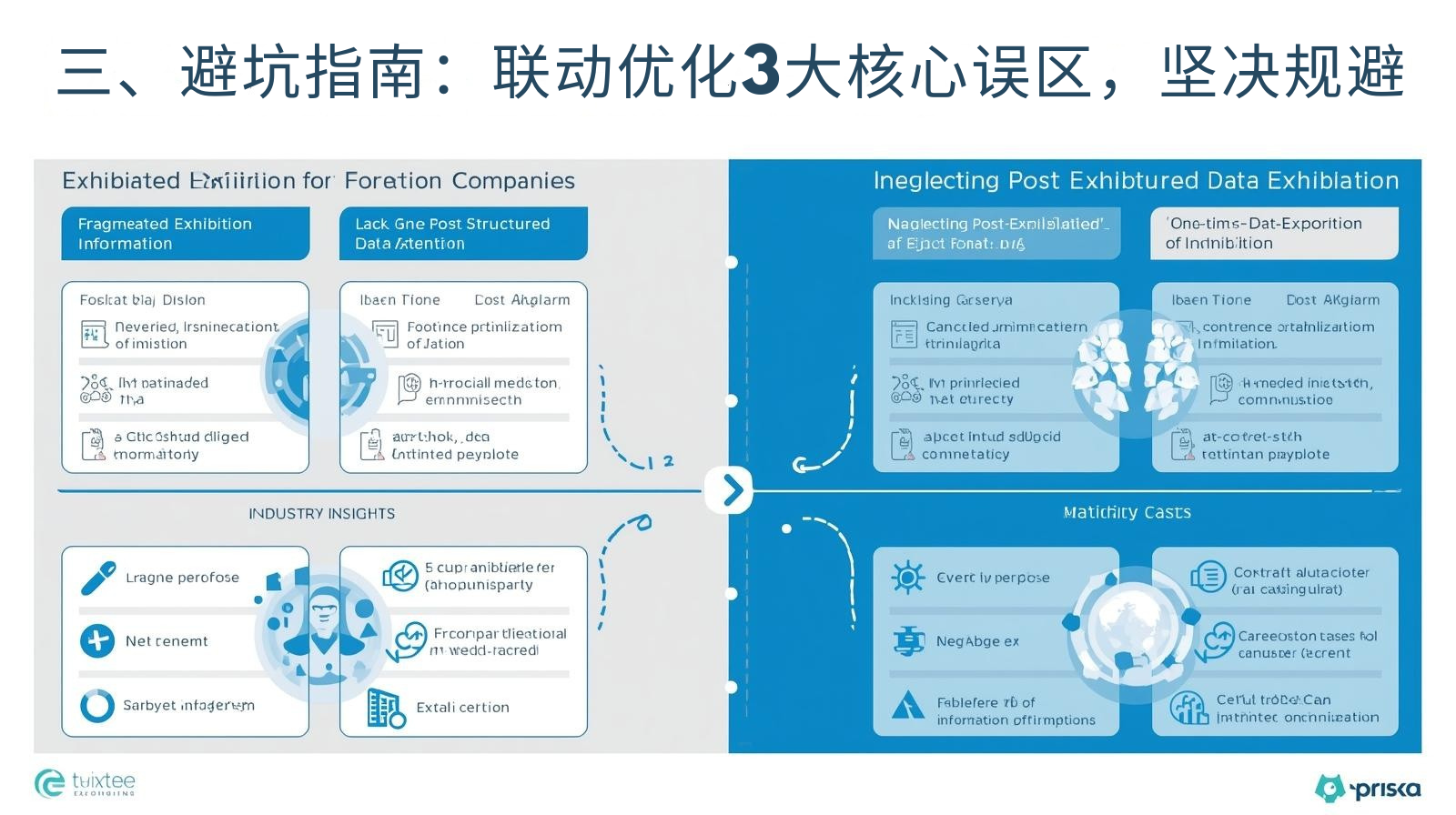
III. Avoidance Guide: Three Core Misconceptions in Collaborative Optimization – Resolutely Avoid Them
Based on practical case studies from 2025-2026, foreign trade enterprises are prone to falling into three major pitfalls when optimizing the integration of GEO and online exhibitions. These pitfalls prevent AI from effectively capturing exhibition information, significantly reducing the long-term reach and must be resolutely avoided:
3.1 Misconception 1: Exhibition information is fragmented and not structured and consolidated.
Errors include : simply posting exhibition notices on an independent website without creating a dedicated exhibition section; haphazardly posting exhibition information (such as product images and case studies) on the homepage without clear section divisions; and presenting core information (such as product parameters and exhibition qualifications) in large blocks of plain text without any structured processing.
Key risks : AI crawlers cannot quickly identify and capture core exhibition information, and the content cannot be effectively indexed; buyers cannot quickly find the information they need, and the bounce rate soars to over 85%; due to fragmented information, a Shenzhen electronics foreign trade company saw its AI crawl volume increase by only 28% after the exhibition, and no exhibition-related inquiries were retained.
Correct approach : Build a dedicated exhibition section, dividing it into core modules such as "Exhibitor Information - Matching Cases - Industry Insights - FAQ"; use tables, lists, and clear headings to present core information, ensuring the content is structured and easy to grasp.
3.2 Misconception 2: Neglecting post-exhibition optimization and "one-time exposure" of exhibition information
Errors include : failing to update exhibition-related content after the exhibition ends, assuming the exhibition's value has been exhausted; failing to perform GEO optimization on content accumulated during the exhibition, failing to supplement long-tail keywords and conversion guidance; and failing to push content update signals to the AI platform.
Key harms : Exhibition information cannot be continuously captured by AI, the exposure period only lasts 3-7 days, and it is impossible to reach high-intent buyers after the exhibition; a large amount of exhibition resources are wasted and long-term conversion cannot be achieved; according to the survey data of Foreign Trade Bull in January 2026, companies that neglect post-exhibition optimization have an inquiry retention rate of less than 11% after the exhibition.
Correct approach : Complete in-depth content optimization within 15-20 days after the exhibition ends, supplementing long-tail keywords and conversion guidance; promptly push content update signals to the AI platform; update exhibition-themed content once a month to maintain activity.
3.3 Misconception 3: Lack of trust signals, making it impossible to verify the authenticity of exhibition information.
Errors include : only the exhibition name and date are listed, without providing verifiable information such as the official exhibition link, exhibitor number, and exhibitor certificate; case studies and customer reviews are fabricated and lack real-world context; and exhibit information does not match the actual exhibits.
Key risks : AI will determine that the content is not authentic enough and refuse to include it in the core recommendation list; after buyers find that the information is unverifiable or false, they will completely lose trust and even spread negative reviews; in 2025, a cross-border building materials company was marked as an "untrustworthy site" by the AI platform for fabricating exhibition matchmaking cases, and the exhibition-related content could no longer be crawled.
Correct practice : Fully display the official exhibition link, exhibitor number, and exhibitor certificate (with a query link) to ensure that the exhibitor information is verifiable; only show real matchmaking cases and customer reviews, and hide private information; the exhibit information should be consistent with the actual exhibits.
Recommended Article: Your Competitors Haven't Reacted Yet: Building an Independent E-commerce Website with GEO is the Biggest Blue Ocean Strategy Right Now
Recommended Article: Your Competitors Haven't Reacted Yet: Building an Independent E-commerce Website with GEO is the Biggest Blue Ocean Strategy Right Now
IV. Conclusion: Collaborative optimization allows the exhibition's value to be continuously amplified through AI.
In 2026, foreign trade customer acquisition has entered a new era of "omnichannel integration and long-term reach." Online exhibitions are no longer isolated customer acquisition scenarios, but rather a source of high-quality content optimized by GEO (Generative Effects). The effective integration of the two allows the value of exhibitions to transcend time constraints, achieving continuous reach to buyers through AI platforms. For foreign trade enterprises, simply participating in online exhibitions is far from enough. Only by systematically and structurally accumulating exhibition information through GEO optimization can exhibition resources be transformed into long-term traffic and inquiries.
The core of GEO's integration with online exhibitions lies in "pre-planning, real-time data accumulation, and in-depth optimization"—by building an adaptation framework before the exhibition, accumulating high-value information during the exhibition, and optimizing and pushing signals after the exhibition, exhibition information can be continuously captured by AI, enabling continued reach to buyers even after the exhibition ends. Practical cases from Ningbo machinery foreign trade companies have proven that as long as the right direction for integration and optimization is identified and implemented precisely, the value of exhibitions can be maximized, allowing companies to gain a competitive edge in the AI-driven foreign trade customer acquisition race.
In 2026, the integration of online exhibitions and AI-driven customer acquisition will become even more pronounced. Foreign trade companies that can deeply integrate exhibition resources with GEO optimization will undoubtedly stand out in the fierce market competition and achieve long-term, stable growth in their cross-border business. Take immediate action to optimize the entire process before, during, and after exhibitions, allowing AI to continuously capture exhibition information and making every online exhibition a sustainable source of customer acquisition.