According to the "Rich Media Marketing Trends Report for Independent Foreign Trade Websites" released by iResearch in February 2026, foreign trade websites featuring 3D product modeling displays have a 74% higher probability of being crawled by AI platforms such as ChatGPT and Google SGE. Buyer search clicks are 5.9 times higher than websites using only 2D images. Websites that achieve AI-recognizable 3D content through GEO optimization see an additional 38% increase in inquiry conversion rates. Real-world data also shows that only 29% of foreign trade websites have mastered the "3D content AI crawling and adaptation" technique. Most websites' 3D modeling, lacking GEO optimization, becomes "ineffective rich media" that cannot be recognized by AI, failing to realize the core value of three-dimensional display. For independent foreign trade websites, the core significance of GEO + 3D product modeling is to allow three-dimensional content to be accurately crawled and interpreted by AI, improving search appeal through more intuitive product displays and shortening the buyer's decision-making cycle.

I. Core Understanding: The Underlying Logic of AI Capturing 3D Content and Key Optimization Techniques for GEO
AI platforms have long since moved beyond the rudimentary stage of simply recognizing images/videos when it comes to capturing 3D product content. They've entered a deeper stage of analysis, enabling "analysis, correlation, and interactivity." Generative AI, especially platforms like ChatGPT, prioritizes capturing 3D content that combines rich media value, product information, and brand relevance. Many e-commerce websites fall into the misconception that "3D modeling equals increased attractiveness," simply uploading 3D model files without optimizing them with GEO (Google Engine) to embed AI-recognizable signals or linking them to core product information. This results in 3D content failing to be captured by AI, ultimately becoming mere "visual decoration." Understanding the underlying logic of AI capture is crucial to ensuring that GEO optimization transforms 3D modeling into a "bonus" for AI search, rather than a "wasteful investment."
1.1 Three Core Dimensions of AI Capture of 3D Content (Latest Mechanism in 2026)
Based on OpenAI's "Rich Media Content Capture and Interpretation Specifications" released in February 2026 and practical verification in the foreign trade industry, AI prioritizes capturing and recommending the following three types of 3D product content:
1. Recognizable: The 3D model must use an AI-compatible format (such as GLB, GLTF) and include standardized descriptive information (product name, core parameters, and applicable scenarios). It should also use structured tags to allow AI to clearly parse the core information of the model, rather than simply recognizing it as an "unknown 3D file".
2. Value Relevance: 3D content must be strongly related to the core information of the product (price, MOQ, compliance certification, customization services). For example, 3D models can show product customization details and material characteristics, and be associated with corresponding text descriptions, so that AI can determine that the content has the value of "assisting in purchasing decisions".
3. Interaction Adaptability: 3D models that support basic interactive operations (such as 360° rotation, zooming in and out) are given higher priority by AI. This type of content can improve the buyer's experience and allow AI to recognize the "high usability" of the content, referencing the 3D content interaction standards of the Sketchfab platform.
1.2 The core differences between GEO+3D modeling and ordinary 3D display
Ordinary 3D displays only satisfy "visual intuitiveness," while GEO+3D modeling focuses on "AI-driven capture and search value." The core differences lie in three points: First, signal output: GEO optimization embeds AI-recognizable structured markers and core information-related signals into 3D content, enabling AI to analyze the model's value—a feature absent in ordinary 3D displays. Second, content logic: GEO+3D modeling deeply integrates 3D displays with buyers' pain points (such as "intuitively viewing product details without needing to send samples for confirmation"), while ordinary 3D displays simply showcase the product's appearance. Third, search adaptation: GEO optimization associates 3D content with core search keywords (such as "3D viewing of women's clothing export customization details"), improving AI search matching accuracy, whereas ordinary 3D displays are disconnected from search logic. As Hugo.com's 2026 Foreign Trade Rich Media Special Interpretation states, "In the AI era, the core of 3D displays is to make 3D content a 'searchable, interpretable, and convertible' marketing asset."
1.3 Frequently Asked Questions about 3D Modeling and GEO Optimization for Foreign Trade Websites
Based on practical case studies from 2026, the following four common misconceptions can prevent 3D content from being crawled by AI or from generating search appeal, and must be resolutely avoided: First, incompatible 3D model formats, using formats that AI cannot recognize (such as MAX, MA), or failing to convert to standard formats like GLB/GLTF; second, lack of structured markup, with 3D content lacking any AI-recognizable signals, only able to be identified as a file and unable to parse core information; third, 3D content disconnected from product information, only showcasing the appearance without linking to core procurement information such as price, MOQ, and customization, resulting in insufficient value; and fourth, slow model loading, with excessively large file sizes (over 10MB), causing slow loading for overseas buyers and impacting AI crawling efficiency.

II. Practical Implementation: 4-Step GEO+3D Modeling Optimization to Enable AI to Capture 3D Content
This solution is specifically designed for AI-driven 3D content capture and adaptation for independent e-commerce websites. All operations are aligned with the 2026 AI rich media judgment mechanism and GEO optimization logic. It covers the entire process from 3D modeling specifications to AI-recognizable implementation, and can be implemented directly without complex technologies. The core goal is to enable AI to accurately capture 3D product models, thereby improving search appeal and inquiry conversion.
2.1 Step 1: Core Specifications for 3D Product Modeling (Adapting to AI Crawling Basics)
Core objective: To output a 3D model that is "AI compatible, meets detail standards, and has optimized size," laying the foundation for subsequent GEO optimization and avoiding the inability to capture due to problems with the model itself.
2.1.1 Core Operation Actions
1. Model Format and Parameter Specifications: ① Format Selection: Prioritize AI-compatible GLB or GLTF formats (refer to Khronos Group's 3D format standards, link: https://www.khronos.org/gltf/), and avoid using formats such as MAX and MA that are only recognized by modeling software; ② Detail Optimization: Core details of the model (such as product materials, interfaces, and customized parts) must be clearly presented, and the polygon count should be controlled within 100,000 (no more than 200,000 for complex products) to ensure both display effect and avoid excessively large file size; ③ Material Labeling: Add standardized material descriptions to the model (such as "food-grade stainless steel" and "100% cotton fabric") and associate them with corresponding text descriptions to facilitate AI's analysis of material characteristics;
2. File size optimization: Using the compression function of 3D modeling tools (such as Blender, link: https://www.blender.org/), the model file size is controlled to within 5MB (the maximum size of a single model is no more than 10MB). Specific operations include simplifying non-core polygons and compressing texture images (the resolution is controlled to within 2048×2048), while retaining the basic interactive functions of the model (360° rotation, zoom in and out).
3. Model Preview Image Configuration: Generate 3-5 high-definition preview images for each 3D model (multi-angle display). The preview image file name incorporates core keywords (such as "women-dress-3d-preview-custom"), and adds ALT text descriptions (such as "European and American women's clothing 3D display with customizable neckline details") to facilitate AI to associate and retrieve 3D models through preview images.
2.2 Second Step: GEO Optimization and Integration, Enabling AI to Recognize the Core Value of 3D Content
Core objective: Through standardized GEO optimization, embed AI-recognizable signals into 3D content, link core product information with search keywords, and enable AI to accurately analyze the value of 3D content.
2.2.1 Core Operation Actions
1. Configure 3D Content Structured Tag: Using the Rank Math optimization plugin (link: https://rankmath.com/), configure dedicated structured tags for product pages containing 3D models. The entire process is described in text: ① Core Tag: Configure the "ProductModel" structured tag for the 3D model (refer to the rich media tag standard of Schema.org, link: https://schema.org/ProductModel), annotating the model name, format, core parameters, interactive functions, and associated product ID; ② Association Tag: Associate the 3D content with the core product information (price, MOQ, compliance certification, customized services) through sub-tags such as "offers" and "certifications", for example, annotating "MOQ50, quoted at USD12/piece, with EU REACH certification (certificate number: XXX, query link: https://ec.europa.eu/chemicals/reach_en)";
2. Keyword and Content Relevance: ① Keyword Layout: Naturally integrate core keywords (such as "3D View of Export Product Details" and "3D Display of Customized Export Products") into the description text of the 3D model, product page titles, and paragraph content. Keyword density should be controlled at 2%-3% to avoid keyword stuffing. ② Value Description: Add precise value descriptions to the 3D content, such as "Through 360° 3D display, you can intuitively view product interface details, confirm customization needs without sending samples, and shorten the procurement decision-making cycle," allowing AI to identify the core value of the content to buyers.
3. Optimize the interaction entry point: Set up a 3D model interaction entry point (such as the "Click to view 3D model" button) in a prominent position on the product page. The entry text incorporates keywords, and "interaction instructions" (such as "Supports rotation and zoom to view product details") are added to facilitate the operation of buyers and allow AI to recognize the interactive value of the content.
2.3 Step 3: Integrating 3D content with site content to enhance the relevance of AI search
Core objective: To deeply integrate 3D content with the site's core content (product descriptions, case studies, blog posts) to form a content system of "3D display + value interpretation + pain point solutions," thereby improving AI search matching accuracy.
2.3.1 Core Operation Actions
1. Product page content integration: In the product description, 3D display is deeply linked to the pain points of buyers. For example, "To address the pain point that foreign trade buyers cannot view products in person, this page provides a 3D stereoscopic display (click to interact), which can clearly show the welding details and material texture of the product. It also supports customized modifications (such as color and size). The minimum order quantity is 50, and the delivery time is 15 days." The 3D interactive entry point is linked multiple times in the description.
2. Contextualized Content Creation for Blog Pages: Publish contextualized blog posts related to 3D content, such as "New Trends in Foreign Trade Procurement in 2026: How Can 3D Product Displays Replace Sample Confirmation? (Brand Case Study)". The content incorporates screenshots of 3D model displays, interactive operation guides, and industry data (such as "According to the Global Sources 2026 report (link: https://www.globalources.com/), 3D displays can reduce sample shipping costs by 62%), and links to 3D content on product pages;
3. Internal and External Link Optimization: ① Internal Links: Establish precise internal links between the 3D product page and relevant case study pages, blog pages, and compliance pages. For example, link the 3D product page to "Sample Shipping Cost Optimization Case Study" to allow AI to clearly identify content levels; ② External Links: Publish 3D content (including preview images and core value descriptions) to high-authority foreign trade platforms (such as Made-in-China.com 3D Showroom, link: https://www.made-in-china.com/) and industry communities (LinkedIn Foreign Trade Procurement Group), indicating the brand source and website link to strengthen AI's recognition of the authority of 3D content.
2.4 Step Four: Performance Monitoring and Optimization to Enhance the Attractiveness of 3D Content Search
Core objective: To monitor the AI-driven capture of 3D content, interaction data, and search conversion rates in real time, optimize and adjust accordingly to address issues, and continuously improve the search appeal of 3D content.
2.4.1 Core Operation Actions
1. Core Performance Monitoring: ① Crawling Monitoring: Use the "Rich Media Crawling" module of Google Search Console (link: https://search.google.com/search-console) to check if the 3D content is crawled by AI. If not, check for issues with formatting and structured markup; ② Search Monitoring: Enter "3D + core keyword + brand name" (e.g., "3D Women's Clothing Foreign Trade Custom Brand XXX") in ChatGPT to check if the site's 3D content can be retrieved; ③ Interaction and Conversion Monitoring: Monitor the interaction rate (clicks, dwell time) of 3D content using Hotjar (link: https://www.hotjar.com/), and monitor the inquiry conversion rate of 3D product pages using Google Analytics;
2. Issue Optimization and Adjustment: ① If 3D content is not captured, first check if the format is GLB/GLTF and if the structured markup is configured correctly, then re-optimize and submit to the AI platform; ② If the interaction rate is low, optimize the display position of the 3D interaction entry, add clearer interaction instructions, and simplify the interaction operation (such as defaulting to loading the 360° rotation function); ③ If the conversion rate is low, strengthen the connection between 3D content and purchasing decisions, such as adding guiding words next to the 3D display such as "Confirming the order based on the 3D display can reduce the sample fee by 50%";
3. Continuous Iteration and Optimization: Based on buyer feedback and AI crawling trends, we regularly update the 3D model (such as adding customized detail displays and optimizing material rendering), while also updating the associated text descriptions and keywords to ensure that the 3D content always adapts to the AI crawling logic and buyer needs.
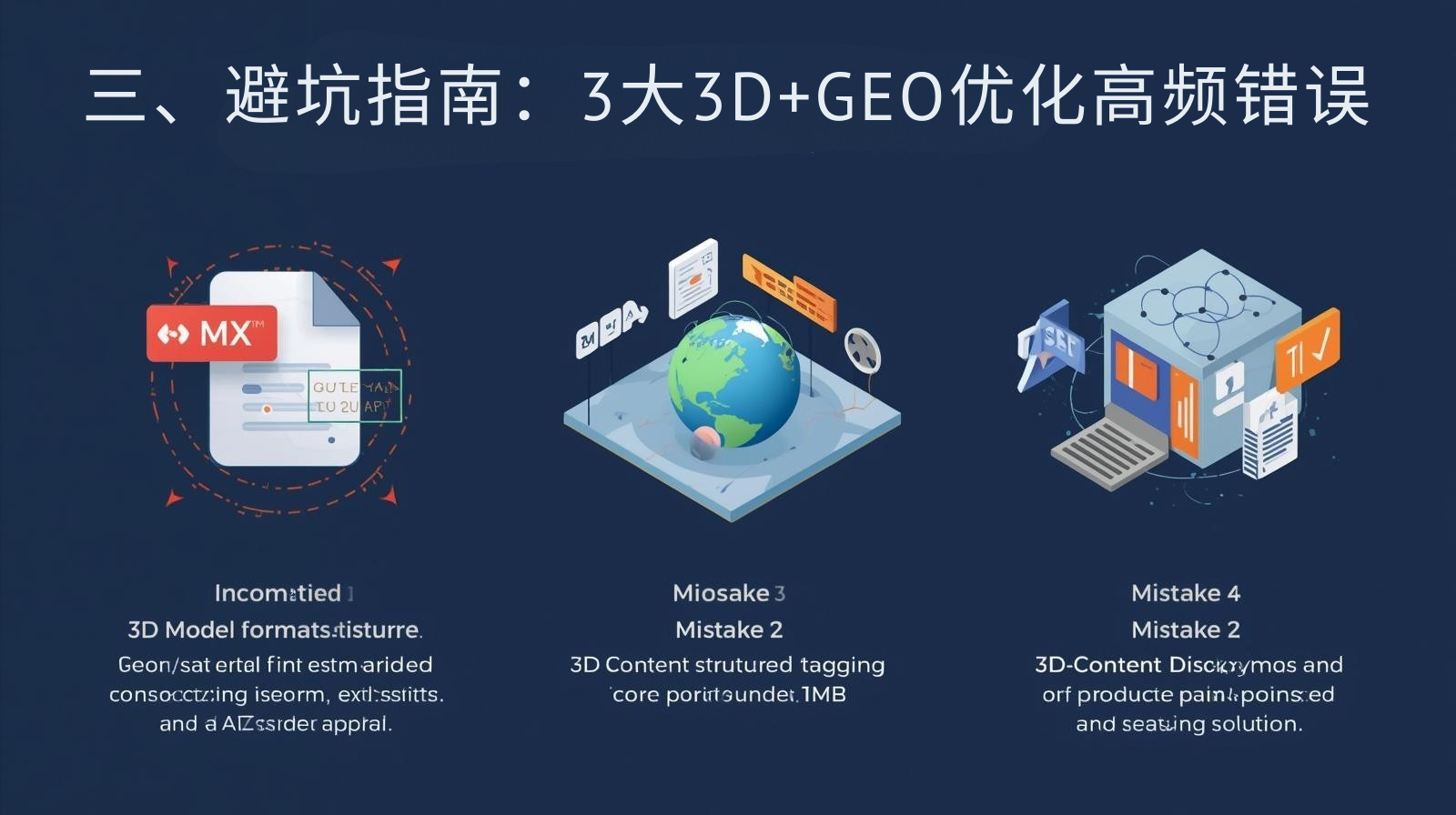
III. Pitfall Avoidance Guide: 3 Frequently Occurring Errors in 3D+GEO Optimization (Must Read)
Based on practical case studies of independent e-commerce websites in 2026, the following three mistakes will directly prevent 3D content from being crawled by AI or from being attractive in search results, and must be resolutely avoided:
3.1 Error 1: 3D model format incompatibility, AI cannot recognize it.
Error : Uploading 3D models in non-AI compatible formats such as MAX and MA without converting them to the GLB/GLTF standard format, or having excessively large model file sizes (over 20MB), causing AI to be unable to capture or parse them;
Core harm : 3D content becomes "visual decoration" and cannot be captured by AI and included in search recommendations, the initial investment in modeling is wasted, and it also affects page loading speed;
Correct approach : Use GLB/GLTF format uniformly, compress the model file size to less than 10MB, and ensure that AI can recognize and capture it.
3.2 Error 2: Lack of structured labeling prevents AI from parsing core value.
Error : Only a 3D model was uploaded without any structured tags or association with core information such as product price, MOQ, and compliance. The AI can only identify it as an "unknown 3D file" and cannot analyze its value.
Core harm : 3D content cannot be recommended by AI search, and buyers cannot find the site when searching through AI, thus losing the core advantage of rich media marketing;
Correct approach : Configure ProductModel structured markup to deeply associate 3D content with core product information and compliance certifications, allowing AI to clearly analyze the value of the content.
3.3 Error 3: The 3D content is disconnected from the pain points of procurement and has no practical value.
Error : The 3D model only shows the product's appearance and does not present the details that buyers care about (such as materials, interfaces, and customized parts), nor does it associate it with corresponding solutions. The content has no practical value.
Core harm : Even if AI captures 3D content, its recommendation weight will be reduced due to insufficient value, and buyers will quickly leave after interaction, making it impossible to drive inquiry conversion.
Correct approach : Focus on the buyer's pain points (such as inability to view samples in person or concerns about discrepancies in customization details), optimize the detailed display of 3D models, and associate them with corresponding solutions and value descriptions.
Recommended Article: Your Competitors Haven't Reacted Yet: Building an Independent E-commerce Website with GEO is the Biggest Blue Ocean Strategy Right Now
Recommended Article: Your Competitors Haven't Reacted Yet: Building an Independent E-commerce Website with GEO is the Biggest Blue Ocean Strategy Right Now
IV. Conclusion: 3D+GEO – Building Core Competitiveness for Foreign Trade Search in the AI Era
In 2026, the search competition for independent e-commerce websites has entered the era of "rich media value competition." Simple 2D image displays can no longer meet the needs of AI crawling and buyers. The combination of GEO and 3D product modeling allows AI to accurately capture three-dimensional content and enhances buyer trust through intuitive display, becoming a core competitive advantage for acquiring customers in foreign trade. Its core logic is not simply about adding 3D technology, but about using GEO optimization to transform 3D content into a "searchable, interpretable, and convertible" marketing asset, achieving a dual improvement in AI search appeal and inquiry conversion rates.
To maximize the effects of 3D+GEO optimization, a smooth, stable, and rich media-capable independent website is the core platform. Many foreign trade websites suffer from weak foundational features, resulting in slow 3D model loading and choppy page interactions. Even with GEO signal optimization, they fail to retain buyers and negatively impact AI crawling efficiency. PinDian Technology, with over ten years of experience in foreign trade website building and serving over 7000 clients, utilizes React technology to build websites. This not only ensures a smoother browsing experience (overseas loading speed ≤2 seconds, adaptable to multiple devices) but also fundamentally adapts to the display and crawling needs of 3D rich media content—built-in 3D model loading optimization module, standardized structured tag configuration entry, and global CDN acceleration ensure smooth overseas access, allowing 3D content to be displayed efficiently without additional technical adaptation. Simultaneously, PinDian website building can assist companies in streamlining 3D modeling standards and optimizing GEO signal integration. Combined with the 4-step practical solution outlined in this article, your foreign trade website can quickly achieve "AI-crawled 3D content and doubled search appeal." If your foreign trade website is facing difficulties such as "3D content cannot be captured by AI, loading is slow, and search results are not attractive enough", you might as well choose PinDian Technology. With professional website building services and precise GEO optimization, you can seize the rich media marketing opportunity in the AI era.