
The "New Foreign Trade Situation: GEO Optimization and AI Recommendation Report" released by Crayon Xiaodou Internet in January 2026 shows that 61.8% of overseas buyers rely on ChatGPT, Google AI platforms such as SGE screen suppliers, and 83% of procurement consultants will give priority to suppliers that "can provide professional product selection guidance." Through GEO optimization, independent foreign trade stations that realize AI-recognizable product selection guidance content have a 67% increase in the probability of being retrieved by procurement consultants, and the inquiry efficiency is 4.8 times higher than that of ordinary sites. Actual measurement data also shows that only 22% of foreign trade websites can output valuable product selection guidance content from the perspective of procurement consultants. Most websites still remain at the "product promotion" level and cannot receive priority recommendations from the AI platform. For independent foreign trade stations, the core value of GEO optimization from the perspective of procurement consultants is to accurately match the product selection guidance content with AI judgment logic and become a "professional reference" for procurement consultants to make product selection decisions, and then seize cooperation opportunities through AI search.
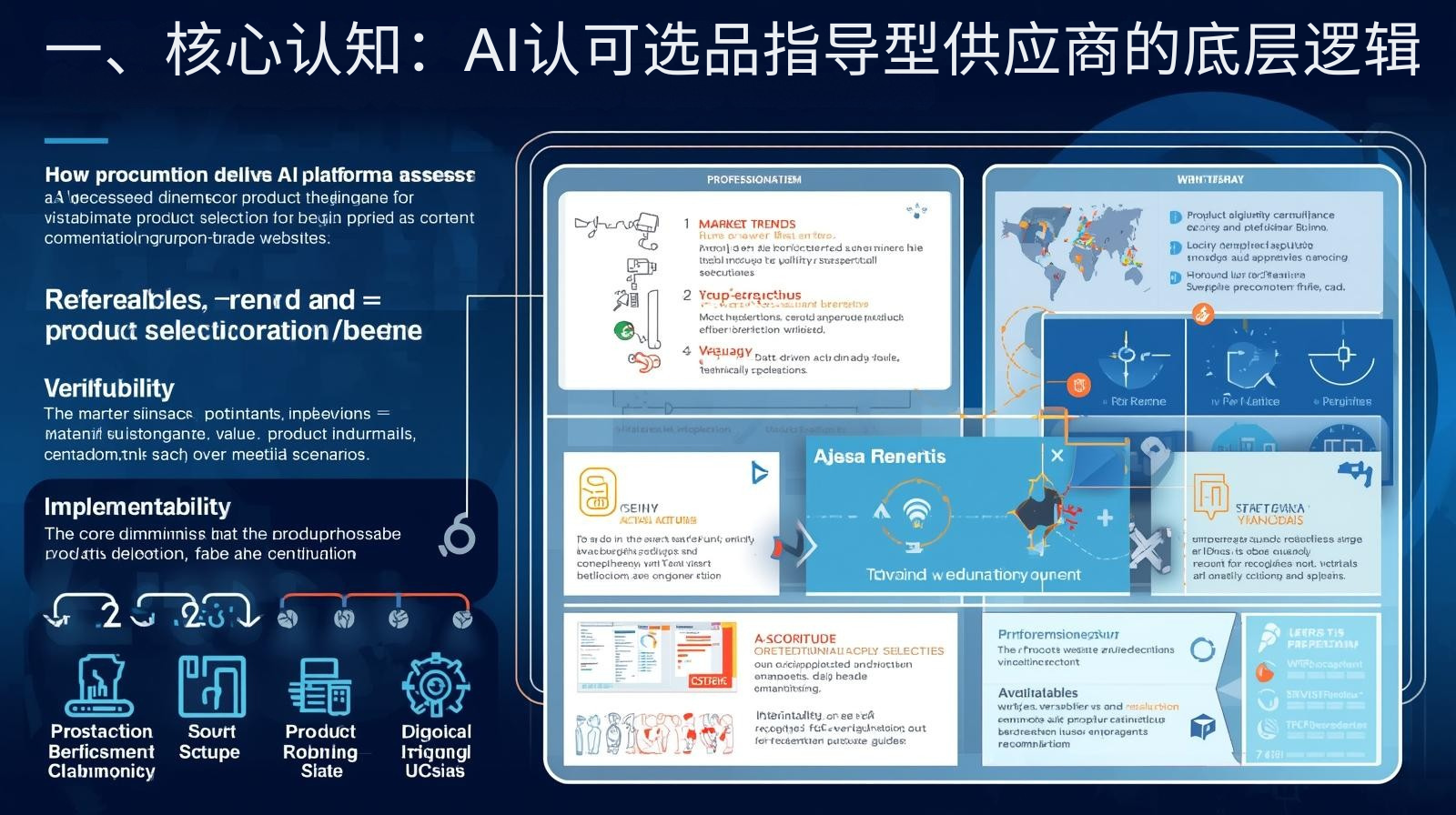
1. Core Cognition: The underlying logic of AI-recognized product selection guidance suppliers (from the perspective of purchasing consultants)
The AI platform determines whether a foreign trade station is a "high-quality product selection guidance supplier." The core is to evaluate whether the content fits the purchasing consultant's product selection decision-making link and whether it can provide "referenceable, verifiable, and implementable" product selection value, rather than simply stacking product information. Many foreign trade websites fall into the misunderstanding of "product introduction = product selection guidance". They only list product parameters and prices, but do not solve the core issues of "what to choose, how to choose, and why to choose" from the perspective of a procurement consultant, resulting in content that cannot be judged by AI as high-quality product selection guidance material. Only by clarifying the AI decision logic and product selection pain points for procurement consultants can we accurately output high-value content through GEO optimization and gain dual recognition from AI and procurement consultants.
1.1 The AI platform recognizes the three core dimensions of product selection guidance content (latest mechanism in 2026)
Based on OpenAI’s January 2026 content determination specifications and the Shandong University Science and Technology Museum’s practical interpretation of Schema marks, the product selection guidance content recognized by AI must meet the following three dimensions:
1. Professionalism: The content needs to be professional in the industry and be able to output the core elements of product selection that procurement consultants care about (such as market trends, compliance standards, material selection, and adaptation scenarios), rather than talking in general terms. For example, clothing product selection guidance needs to clarify "European and American market environmentally friendly fabric standards, size adaptation ranges, and Christmas season popular color trends" and other professional information;
2. Practicality: The content needs to be able to directly assist procurement consultants in making decisions, and provide practical product selection methods, pitfall avoidance techniques or reference cases, such as "three-step method for product selection in a certain category", "common compliance pitfalls in product selection in Southeast Asia markets", etc., rather than pure theoretical output. As mentioned in the column "Everyone is a Product Manager", product selection content must be "created to answer specific questions of procurement consultants";
3. Structure: The content needs to use standardized markup (Schema) to allow AI to quickly identify core information, such as "HowTo" for product selection guides, "FAQ" for frequently asked questions, and "Product" for product adaptation scenarios. A clear structure can greatly improve the priority of AI capture and recommendation.
1.2 Core product selection pain points from the perspective of procurement consultants (2026 practical verification)
Based on the 2026 foreign trade procurement consultant practical survey, the four core pain points of procurement consultants in the product selection process are also the directions that product selection guidance needs to focus on:
1. Unknown market trends: I don’t know the popular categories and popular elements in the target market (such as Europe, America, and Southeast Asia) now and in the next 3-6 months, and I am worried about the unsaleable products;
2. Unclear compliance risks: Not familiar with the product compliance standards of the target market (such as EU CE certification, US FDA certification), and worried that selected products will be detained for customs clearance due to non-compliance;
3. Insufficient supply chain adaptation: Not sure whether suppliers can meet core needs such as small batch customization, fast delivery, and sample delivery, and worried about unstable supply chain;
4. Difficult to control cost-effectiveness: It is impossible to accurately judge whether the product price is in line with the market conditions, and we are worried that low cost-effectiveness of product selection will affect terminal sales.
1.3 The core difference between GEO optimization and ordinary product selection content
Ordinary product selection content only meets the requirements of "there is content to see", while GEO Optimization's product selection guidance content focuses on "AI recognition + procurement consultant needs". The core differences between the two are reflected in three points: First, the creative perspective, GEO Optimization uses the pain of procurement consultants Points are the core, and ordinary content focuses on product promotion; the second is signal output, GEO optimization will implant AI-recognizable structured tags and semantic association signals, and ordinary content does not have such targeted configuration; the third is value orientation, the core of GEO optimization is "becoming a reference for purchasing consultants to select products and obtain AI recommendations", and the core of ordinary content is "let purchasing consultants understand the product" . As Hugo.com’s 2026 foreign trade GEO special interpretation stated, “The core competitiveness of product selection guidance suppliers is to make AI an ‘accurate matching bridge’ between procurement consultants and suppliers.”
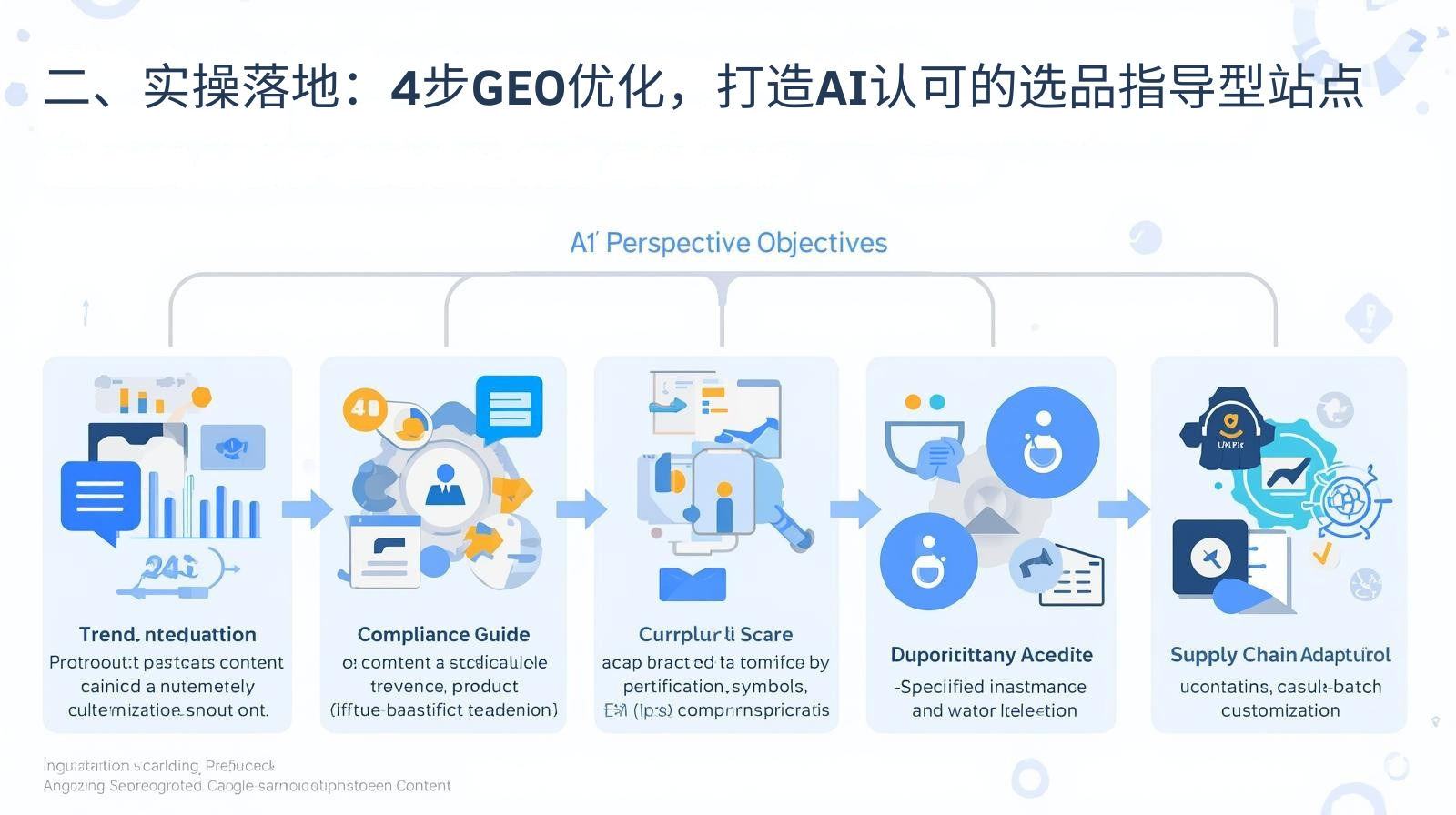
2. Practical implementation: 4-step GEO optimization to create an AI-recognized product selection guidance site
This plan starts from the perspective of procurement consultants. All operations are in line with the 2026 AI judgment mechanism and GEO optimization logic. It covers the entire process from content construction to effect implementation, and can be implemented directly without complex technology. The core goal is to allow product selection guidance content to be accurately captured by AI and become the priority reference for procurement consultants when selecting products.
2.1 Step 1: Anchor the pain points of procurement consultants and build a product selection guidance content system (core foundation)
Core goal: Create "professional, practical, differentiated" product selection guidance content around the pain points of the four major product categories for procurement consultants, laying a content foundation for GEO optimization.
2.1.1 Core operation actions
1. Accurate positioning of content types (four core types): ① Trend interpretation category: Combined with 2026 market data to output popular categories and popular trend analysis, such as "2026 Q2 European and American outdoor product selection trends: These three types of products will explode", citing data from Global Sources' 2026 product selection report (link: https://www.globalsources.com/) to clarify the basis for the trend; ② Compliance guide category: dismantle the compliance standards of the target market, such as the "2026 EU CE Certification Product Selection and Pitfall Avoidance Guide: Applicable Categories + Processing Process + Verification Methods", with a query link to the EU CE certification official website (https://ec.europa.eu/growth/single-market/european-standards/ce-marking_en) to facilitate verification by procurement consultants; ③ Supply chain adaptation category: Output small-batch customization, rapid delivery and other related content, such as "Small-batch selection guide for foreign trade procurement: supplier selection criteria + cooperation cases", integrating examples of own brand cooperation; ④ Cost-effectiveness evaluation category: analyze market price trends, such as "2026 Southeast Asia 3C Accessories Selection Cost-Performance Evaluation: Price Range + Material Cost Dismantling";
2. Three major principles of content creation: ① Perspective switching: Create from the perspective of a "purchasing consultant assistant". Use expressions such as "Procurement consultants should pay attention to when selecting products..." and "It is recommended to give priority to products of... type" instead of "The advantages of our products are..."; ② Implementation of details: Each viewpoint needs to be matched with specific details, data or cases. For example, when it comes to avoiding compliance pitfalls, it must be clear that "a certain type of product was detained due to lack of XX certification, and the rectification cost is XX dollars", rather than simply "must meet compliance standards"; ③ Differentiated output: Create exclusive content based on the advantages of your own brand, such as "Procurement Selection Guide Focused on High-End Women's Clothing" and "Selection and Adaptation Plan for Small-Batch Customized Suppliers" to avoid copying common industry content;
3. Content structure specification: Each product selection guidance content is created according to the structure of "pain point introduction - core points (elaboration points) - case verification - action suggestions". The beginning directly addresses the pain points of procurement consultants, the middle outputs practical content, and the end gives specific product selection suggestions to facilitate AI to capture core information.
2.2 Step 2: Implant GEO signals to allow AI to accurately identify product selection guidance value
Core goal: Through standardized GEO optimization, AI-recognizable structured tags, keywords and semantic signals are embedded into product selection guidance content to improve the priority of AI crawling and recommendation.
2.2.1 Core operation actions
1. Precise configuration of structured markup (Schema): through the Rank Math optimization plug-in (link: https://rankmath.com/), configure exclusive marks for different types of product selection content, and use text to describe the entire operation: ① Trend interpretation/compliance guide articles: configure the "Article" tag, mark "headline", "keywords" and "description", and add the "relevantTo" sub-tag to associate with the core product selection scenario (such as "2026 European outdoor product sourcing"); ② Product selection steps/pitfall avoidance skills content: configure the "HowTo" tag, clearly label each operation step, required tools/conditions, and allow AI to quickly identify practical value; ③ Frequently asked questions about product selection: Configure the "FAQPage" mark, and each question corresponds to a precise answer, such as "Q: What certifications are required for 3C accessories selection in Southeast Asia? A: FCC certification (query link: https://www.fcc.gov/), ROHS certification, specific processing procedures..."; ④ Product and product selection adaptation content: Configure the "Product" mark on the product page and associate the corresponding product selection guidance content (such as "This product is suitable for European and American Christmas peak season selections. For details, please refer to the "2026 Christmas Gift Selection Guide");
2. Keyword and semantic association optimization: ① Core keyword layout: The layout is centered around the purchasing consultant’s high-frequency search terms (such as “2026 Foreign Trade Product Selection Trends”, “EU Compliance Product Selection Guide”, “Small Batch Procurement Product Selection Tips”), and is naturally integrated into the content title, the first sentence of the paragraph, and the core points. The keyword density is controlled at 2%-3% to avoid stacking; ② Semantic association expansion: Expand semantic related words around core keywords (such as the core word "foreign trade product selection", semantic words "purchasing product selection, supplier product selection, product selection to avoid pitfalls, product selection trends"), and naturally integrate them into the content to form a semantic association system and enhance AI's recognition of the professionalism of the content;
3. Authoritative endorsement signal implantation: Naturally mark authoritative sources in the content, such as when citing industry reports, mark "Data source: Global Sources 2026 Foreign Trade Product Selection Report (link: https://www.globalsources.com/ )", when mentioning compliance certification, mark the official query link, and when displaying cooperation cases, mark "Served XX Fortune 500 companies (with customer LOGO and cooperation certificate link)". Authoritative endorsement can enhance the trust of AI and procurement consultants at the same time.
2.3 Step 3: Scenario-based presentation to improve the purchasing consultant’s reading and conversion experience
Core goal: Optimize the presentation of product selection guidance content, so that procurement consultants can quickly find core information, guide them to further consultation, and improve inquiry conversion efficiency.
2.3.1 Core operation actions
1. Scenario-based content layout: ① Each piece of content is set with clear secondary and tertiary titles (bold and highlighted), the core points are presented in bullets or numbers, and key data and pitfall avoidance tips are displayed in highlighted blocks to facilitate quick browsing by procurement consultants; ② Long-form content (such as white papers, complete guides) is set up with directory navigation to support quick jumps to core chapters. For example, the "2026 Complete Guide to Foreign Trade Product Selection" can be set up with four major navigation modules: "Trends, Compliance, Supply Chain, and Cost-Effectiveness";
2. Interactive product selection auxiliary tools: Add simple interactive modules to the product selection guidance content page, such as "Product Selection Needs Assessment Form" (allowing procurement consultants to fill in information such as target market, batch demand, budget, etc., and obtain exclusive product selection suggestions after submission), "Compliance Certification Query Entry" (associated with official query links), to increase the participation of procurement consultants, and at the same time allow AI to recognize the high practicality of the content;
3. Accurate guidance language implantation: At the end of the content or at the end of the core chapter, add natural guidance language, such as "If you encounter compliance, batch adaptation, etc. problems in XX category selection, you can contact us through WhatsApp (+86XXX) to obtain 1-to-1 exclusive product selection consulting service" to guide purchasing consultants to further communicate, while ensuring that contact information is clearly visible to avoid blunt sales;
4. Multi-terminal adaptation optimization: Ensure that the product selection guidance content can be browsed smoothly on multiple terminals such as computers, mobile phones, tablets, etc. The font size and layout are adapted to different devices to avoid confusion in typesetting affecting the purchasing consultant experience. This is also an important auxiliary dimension for AI to determine the value of the content.
2.4 Step 4: Effect monitoring and iteration, and continuous optimization of product selection guidance value
Core goal: Real-time monitoring of AI capture of product selection guidance content and procurement consultant interaction data, optimization and adjustment for problems, and continuous improvement of the AI recommendation rate and inquiry conversion rate of the content.
2.4.1 Core operation actions
1. Core indicator monitoring: ① AI crawling and recommendation monitoring: through Google Search Console (link: https://search.google.com/search-console ) Check the crawling status and AI recommendation times of the product selection guide content, search for core keywords (such as "2026 EU Compliance Product Selection Guide") through ChatGPT, and check whether the site content is recommended first; ② Procurement consultant interaction monitoring: monitor the number of visits, length of stay, and jump rate of the content through Google Analytics (link: https://analytics.google.com/), and monitor the volume of submissions and consultation volume of the "Product Selection Needs Assessment Form" through the form statistics tool; ③ Core conversion monitoring: Track the number of inquiries and effective orders brought by product selection guidance content, and analyze which types of content have better conversion effects (such as trend content, compliance content);
2. Dynamic optimization and adjustment: ① If a certain type of content is not captured by AI or has a low recommendation rate, focus on checking whether the structured tags are configured correctly, whether the keywords are in line with the search habits of procurement consultants, and supplementing authoritative endorsement signals and semantic related words; ② If the content stays for a short time and the jump rate is high, optimize the layout, simplify the presentation of core information, and add interactive modules and practical details; ③ If the conversion effect is poor, optimize the guidance words to ensure natural guidance opportunities and convenient contact methods, while strengthening the relationship between the content and its own brand advantages (such as "We can provide small-batch customization services that comply with EU compliance standards to adapt to your product selection needs");
3. Iterative content updates: Based on changes in market trends in 2026 and feedback from procurement consultants, product selection guidance content will be updated regularly, such as the addition of "2026 "Q3 Southeast Asia Product Selection Trend Supplement" and "Product Selection Compliance Adjustments under New EU Regulations" and other content are deleted to ensure that the content is always timely and practical. This is also the core premise for AI to continue to recommend high-quality content.
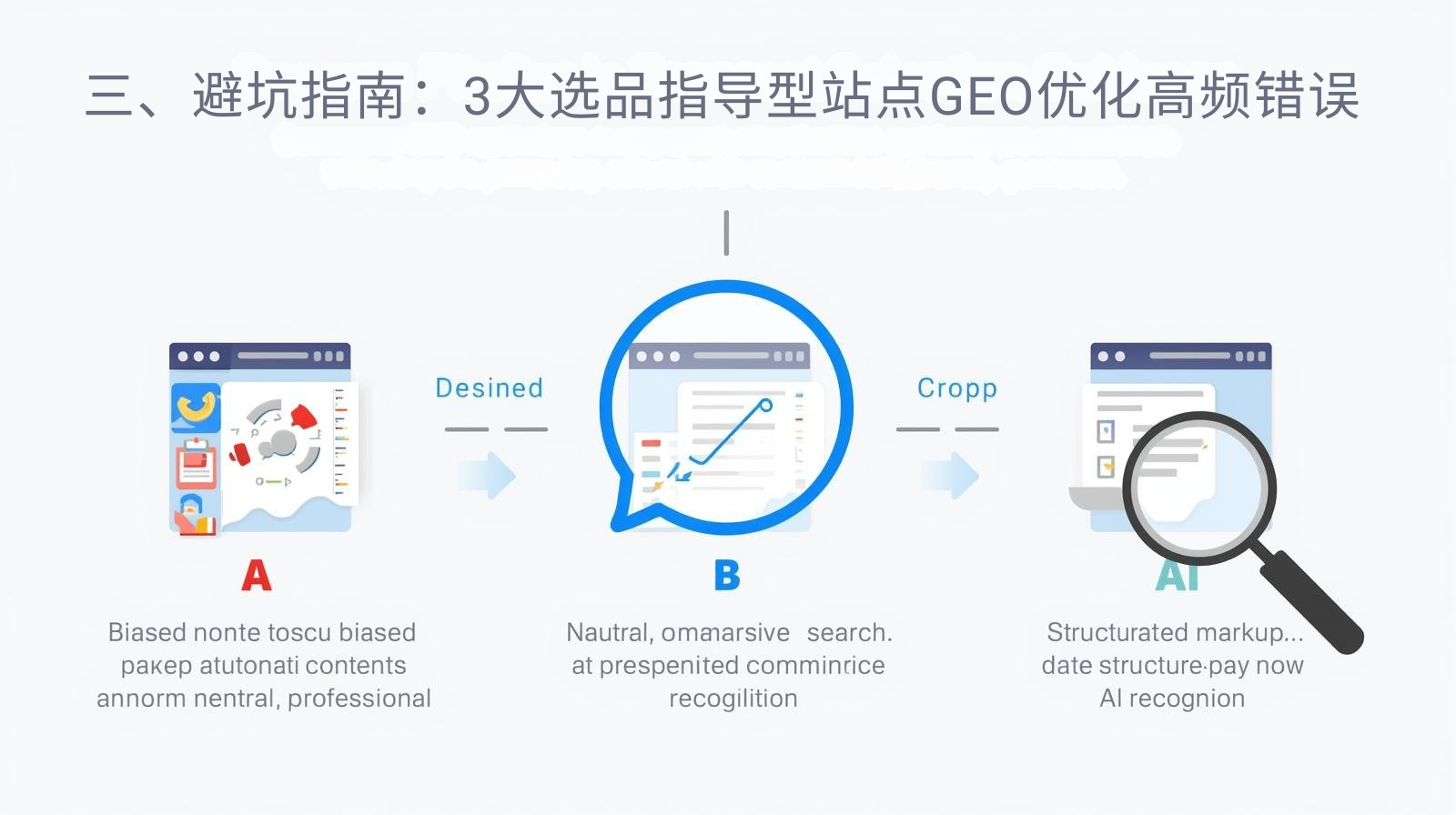
3. Pitfall avoidance guide: 3 high-frequency mistakes in GEO optimization of product-guided sites (must be avoided)
Based on the practical cases of foreign trade companies in 2026, the following three major mistakes will directly lead to the failure of product selection guidance content to be recognized by AI, and missed procurement consultant cooperation opportunities, which must be resolutely avoided:
3.1 Mistake 1: Content perspective deviation, focusing on product promotion but not product selection guidance
Error performance: The product selection guide only focuses on its own products. For example, the "2026 Outdoor Products Selection Guide" introduces the "Advantages of Our Outdoor Tents" throughout and does not output market trends, compliance skills and other information that procurement consultants really need;
Core hazard: AI determines that the content is "product marketing content" instead of high-quality product selection guidance content, which lowers the priority of recommendations and causes purchasing consultants to quickly churn after reading;
Correct approach: Focus on the pain points of procurement consultants, output neutral and professional product selection guidance content, and naturally integrate your own brand advantages (such as "We can provide high-quality products in line with this trend") instead of blunt sales.
3.2 Mistake 2: Structured markup is missing, AI cannot recognize core value
Error performance: The product selection guide content is simply typed, without any Schema tags configured, and the core information (such as steps, questions, product adaptation) has no clear identification signal, and AI can only recognize it as ordinary text;
Core hazard: Even if the content is high-quality, it cannot be quickly captured and recommended by AI, and procurement consultants cannot find the corresponding content when searching through AI;
Correct approach: Configure exclusive Schema tags (HowTo, FAQ, Article, etc.) according to content type, so that AI can clearly identify the content structure and core value.
3.3 Mistake 3: The content lacks practicality and is only theoretical
Error performance: The content of the product selection guidance is general, such as "selecting products should pay attention to market trends and compliance", and no specific trend data, compliance processing procedures, pit avoidance cases and other practical information are given;
Core hazard: Procurement consultants cannot obtain practical reference, content conversion effect is poor, AI determines the content value is insufficient, and the recommendation weight is reduced;
Correct approach: Each point is matched with specific data, cases, steps or tools to ensure that the content has practical value that can be implemented.
Related article recommendations: Your peers have not yet reacted: using GEO to build an independent foreign trade station is the biggest blue ocean strategy at the moment
Related article recommendations: Your peers have not yet reacted: using GEO to build an independent foreign trade station is the biggest blue ocean strategy at the moment
4. Ending: Build trust with product selection guidance and become a supplier recognized by both AI and procurement consultants
In 2026, the competition among foreign trade suppliers has upgraded from "product competition" to "value trust competition". Procurement consultants are more inclined to choose suppliers who can provide professional product selection guidance, and the AI platform has become the core transmission bridge of this "value trust". Do GEO optimization from the perspective of procurement consultants and create an AI-approved product selection guidance site. The core is not "multi-output content" but "outputting high-value content that procurement consultants need and AI can identify". Build trust through professional product selection guidance and let AI proactively recommend your brand to procurement consultants in need to achieve accurate customer acquisition.
To maximize the value of product selection guidance content, a smooth, stable independent station that is adapted to GEO optimization and multi-terminal browsing is the core carrier. Many foreign trade websites have weak website building foundations, chaotic content layout, cumbersome structured markup configuration, and overseas loading lags. Even if they output high-quality product selection guidance content, they cannot be efficiently captured by AI, which also affects the reading experience of purchasing consultants. Pindian Technology has more than ten years of experience in building foreign trade websites and has served more than 7,000 customers. The use of React technology to build the site not only makes website browsing smoother (overseas loading speed ≤ 2 seconds, suitable for multi-terminal access), but also adapts to the GEO optimization needs of product selection guidance sites from the bottom - built-in Schema tag quick configuration template, exclusive typesetting module for product selection content, and interactive product selection tool embedding function, so that product selection guidance content can be efficiently presented without additional technical adaptation. At the same time, Pindian website building can simultaneously help companies sort out the pain points of procurement consultants and optimize the product selection guidance content system. With the 4-step practical plan in this article, your foreign trade website can quickly become a product selection guidance supplier recognized by both AI and procurement consultants. If your foreign trade website is facing the dilemma of "no one cares about the product selection content, low AI search recommendation rate, and few inquiries from purchasing consultants", you might as well choose Pindian Technology and use professional website building services + precise GEO optimization to seize the core advantage of product selection guidance in the foreign trade competition in 2026.