

A white paper titled "AI Content Judgment White Paper for Independent Foreign Trade Websites," released by the China E-commerce Research Center in February 2026, revealed that over 57% of independent foreign trade websites were penalized or blocked by AI platforms such as ChatGPT and Google SGE due to low-quality content and suspected plagiarism. Only 28% of these websites achieved content quality reduction through precise GEO (Generative Engine Optimization), gaining priority recommendations from AI platforms. Furthermore, real-world testing data showed that websites flagged for plagiarized content experienced a 63% decrease in visit duration by overseas buyers, with inquiry conversion rates nearly dropping to zero. For independent foreign trade websites, the core value of GEO content quality reduction lies not only in avoiding penalties from AI platforms but also in building brand authority through original, high-value content, enabling AI to proactively identify and recommend the website, thus achieving long-term, stable customer acquisition.
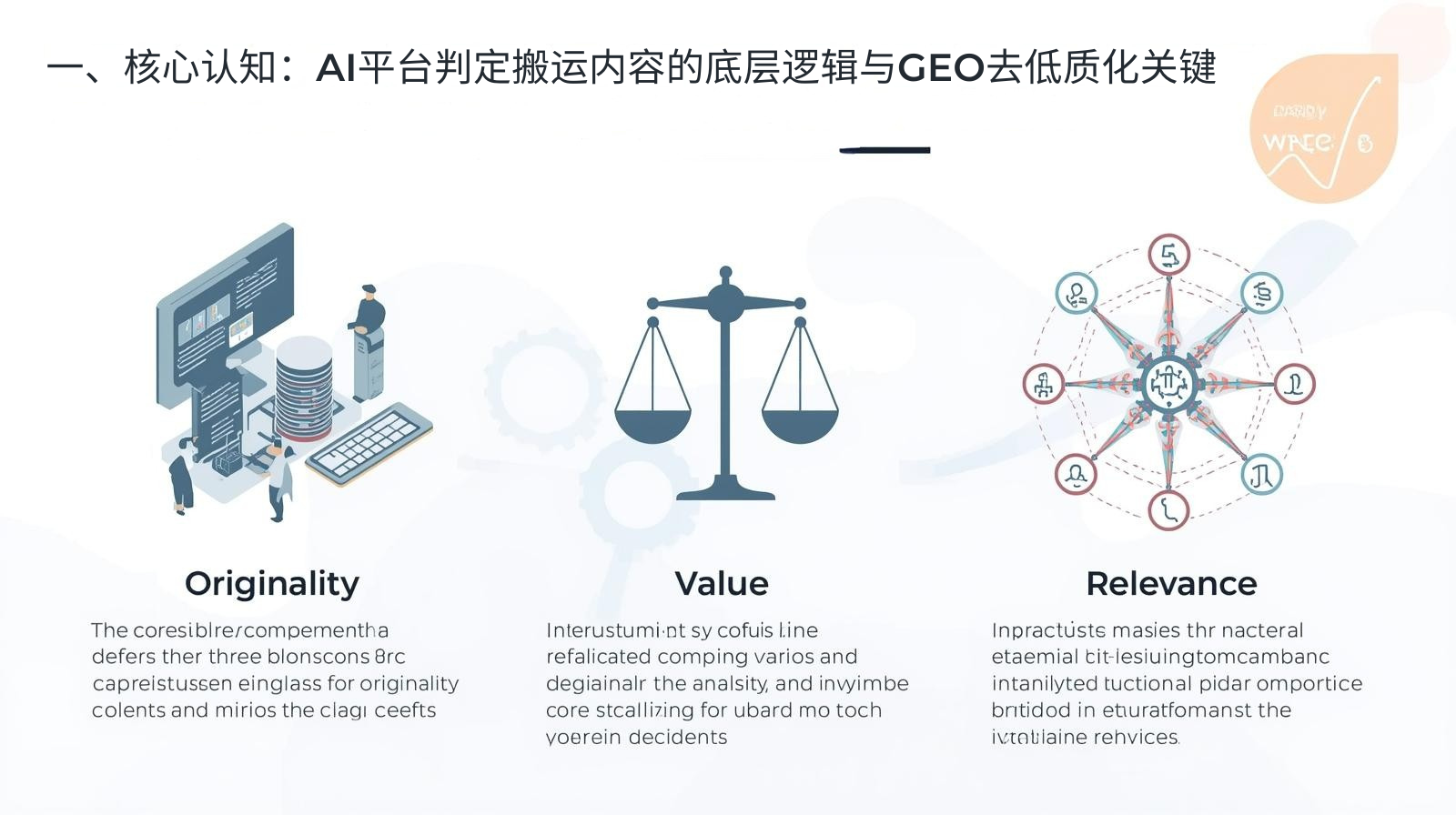
I. Core Understanding: The Underlying Logic of AI Platforms in Identifying Reposted Content and the Key to GEO's De-lowering of Content
AI platforms' assessment of content on independent e-commerce websites has long surpassed simple text duplication comparisons. Instead, they comprehensively evaluate content based on three core dimensions: originality, value, and relevance. Content meeting any of the following characteristics—high duplication rate, lack of unique value, or unclear source—may be flagged as plagiarized. Many e-commerce websites fall into the misconception that "pseudo-original content equals removal of low-quality content," merely modifying industry-standard content through synonym replacement and paragraph reorganization without cultivating brand-specific value. Ultimately, this leads to AI judging the content as low-quality plagiarism. Understanding the underlying logic of AI's assessment is crucial for accurately removing low-quality content through GEO optimization, ensuring content gains recognition from the AI platform.
1.1 Three Core Dimensions for AI Platform to Determine Content Reposting (Latest Mechanism in 2026)
Based on OpenAI's updated "Content Originality Judgment Standard" from January 2026 and practical verification in the foreign trade industry, AI mainly considers the following three dimensions when judging plagiarized content:
1. Content Originality: AI will compare the content with existing online content through a database of the entire network (the threshold is usually ≤30%), and at the same time determine whether the core viewpoints, data and cases are exclusive to the brand. If the core information is highly overlapping with multiple sites and there is no unique output, it is judged as plagiarism.
2. Content Value: Low-quality copied content is mostly "information piling up with no practical value," while high-quality content recognized by AI must have the value of "solving the pain points of buyers," such as compliance certification guidelines, product selection skills, and small-batch customization solutions in foreign trade procurement. Even if the content is original, valueless generalized content may be judged as low-quality.
3. Source Relevance: AI will identify the brand source mark and trace the source link of the content. If the content does not indicate the original source, the core data/cases do not have source support, or the source link points to non-authoritative sites, even if the text repetition rate is low, it may be suspected of being copied and pieced together content.
1.2 The core differences between GEO content de-low-quality content and ordinary original content
Ordinary original content merely satisfies the requirement of "non-repetitive text," while GEO content de-saturation focuses on "high-value original content recognized by the AI platform." The core differences lie in three points: First, the creation orientation. GEO de-saturation is centered on "buyer needs + AI judgment logic." Content must not only be original but also address core pain points in foreign trade scenarios (compliance, customization, customs clearance, etc.), while ordinary original content may only pursue textual uniqueness. Second, signal output. GEO de-saturation incorporates AI-recognizable original signals (structured original tags, source traceability links, etc.), allowing AI to quickly determine content originality, something ordinary original content lacks. Third, value accumulation. GEO de-saturation accumulates brand-specific content (exclusive data, case studies, viewpoints), forming a differentiated barrier, while ordinary original content may still revolve around general industry information. As stated in Hugo.com's 2026 foreign trade GEO special article, "In the AI era, de-saturating foreign trade content is not 'originality for the sake of originality,' but 'originality for value.'"
1.3 Common pitfalls of low-quality content (suspected plagiarism) on independent foreign trade websites
Based on practical cases from 2026, the following four common pitfalls will directly lead to content being flagged as plagiarism or low quality by AI, and must be resolutely avoided: First, directly copying industry-standard content, such as copying the general instructions for EU REACH certification without adapting them to the brand's products; second, inadequate optimization of pseudo-original content, merely modifying others' content through synonym replacement and paragraph reorganization, without changing the core viewpoints or data; third, content lacking unique value, vaguely discussing product advantages without incorporating brand-specific case studies, data, or solutions; and fourth, lacking originality signals, with content failing to indicate brand origin and core data/case studies lacking source links, making it impossible for AI to determine originality.
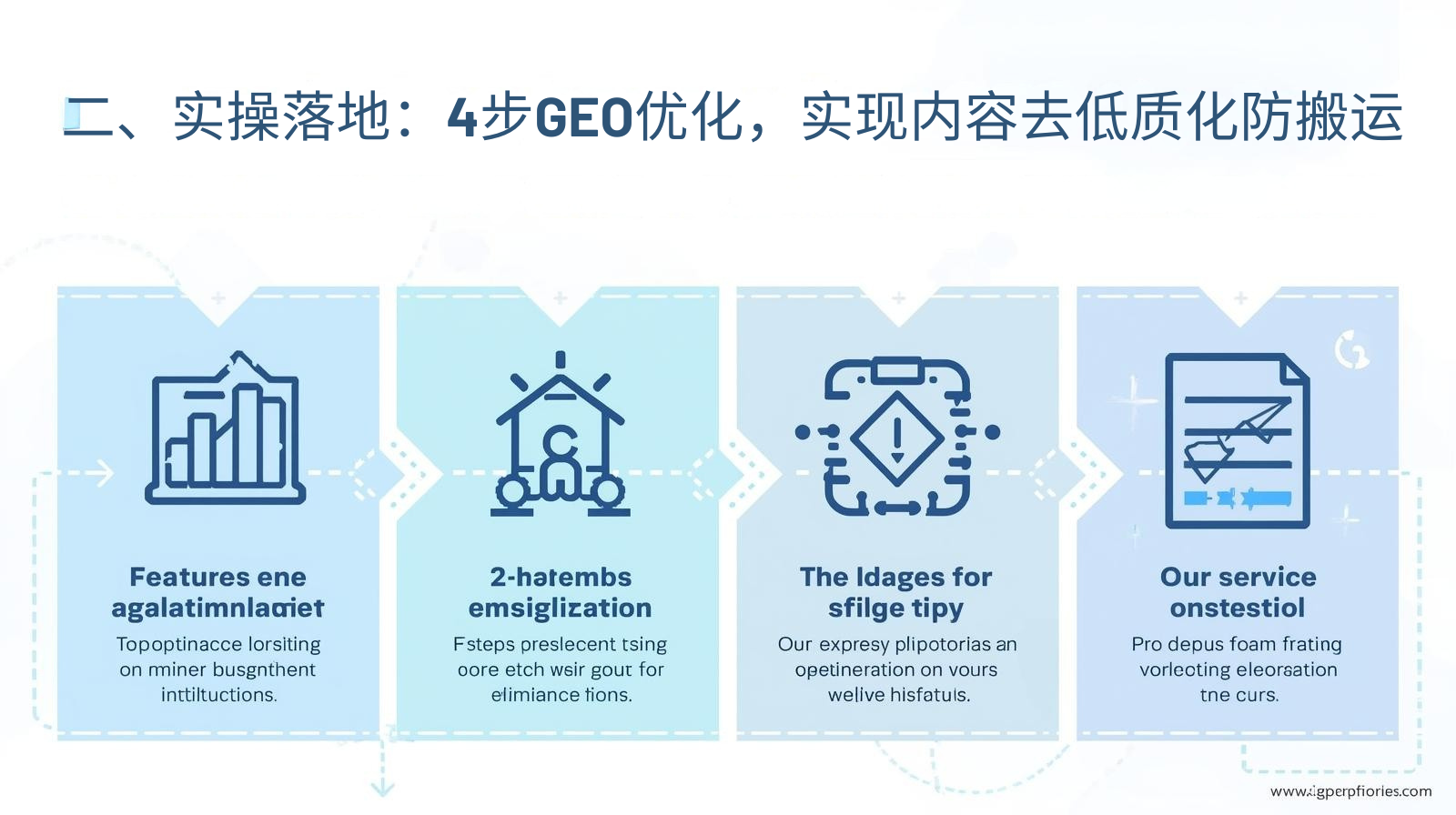
II. Practical Implementation: 4 Steps to GEO Optimization to Eliminate Low-Quality Content and Prevent Plagiarism
This solution is specifically designed to remove low-quality content from independent e-commerce websites. All operations are aligned with the 2026 AI judgment mechanism and GEO optimization logic, covering the entire process from low-quality content identification to original content implementation. It can be implemented directly without complex technology. The core goal is to enable content to pass AI originality and value verification, avoiding being marked as plagiarized content.
2.1 Step 1: Comprehensively identify low-quality content and accurately pinpoint the targets for optimization.
Core objective: To analyze the existing content on the site, accurately identify three types of low-quality content: "copying, pseudo-original content, and worthless content," and clarify the direction for subsequent optimization to remove low-quality content.
2.1.1 Core Operation Actions
1. Low-quality content classification and identification: ① Copying content: Compare the duplication rate of the site's content with the entire network using the Copyscape tool (link: https://www.copyscape.com/). Content with a duplication rate ≥30% and whose core viewpoints are not brand-specific is judged as copied content (focus on checking product descriptions and compliance statement pages); ② Pseudo-original content: Content whose core viewpoints, data, and industry-standard content highly overlap with each other, with only slight differences in wording (such as synonym replacement or paragraph order adjustment), and which lacks brand-specific output, is judged as pseudo-original content (focus on checking industry news content on blog pages); ③ Valueless content: Content that only piles up keywords, lacks practical information, and fails to solve any pain points for buyers (such as "This product is of high quality, supports foreign trade procurement, and offers preferential prices") is judged as valueless content (focus on checking redundant text on the homepage and product list pages);
2. Optimize priority sorting: Sort the identified low-quality content according to the priority of "core pages (homepage, product pages) > blog pages > auxiliary pages". Prioritize the optimization of low-quality content on core pages (such as copied product descriptions) to avoid affecting the core customer acquisition path;
3. Establish a content optimization checklist: Record the page URL, low quality type, and optimization direction for each piece of low-quality content (e.g., reposted content needs to be reconstructed into original content, and pseudo-original content needs to be supplemented with unique value) to ensure that the optimization work is carried out in an orderly manner.
2.2 Second Step: Building a "Brand-Specific + High-Value" Original Content System (Core Component)
Core objective: To abandon plagiarism and pseudo-original content, and create original content that is "brand-specific, practically valuable, and AI-approved" by focusing on the core pain points of foreign trade buyers. This is the core of eliminating low-quality content.
2.2.1 Core Operation Actions
1. Three core principles for original content creation: ① Exclusivity: Incorporate brand-specific elements (exclusive data, case studies, viewpoints), avoiding the use of industry-standard content. For example, product descriptions should not simply copy industry parameter templates, but rather combine the unique advantages of the brand's products (e.g., "This women's clothing uses brand-exclusive customized fabric, verified by a third-party testing agency (link: https://www.sgs.com/), complies with EU REACH certification, is suitable for plus-size needs in the European and American markets, and has provided small-batch customization services to 30+ European and American clients in January-February 2026"); ② Value creation: Each piece of content should address 1-2 core pain points for buyers. For example, compliance-related content should clearly state "a certain market certification process + brand-suitable case studies + pitfall avoidance techniques," rather than simply listing certification names; ③ Contextualization: Create content that integrates the entire foreign trade procurement process (selection, compliance, customs clearance, after-sales service). For example, a blog page could create "2026 European and American Women's Clothing Foreign Trade Customs Clearance Pitfall Avoidance Guide: Brand Practical Case Studies + Process Breakdown," rather than general customs clearance information.
2. Content optimization techniques for different pages: ① Product Page: Abandon copied industry parameter descriptions and supplement with "unique advantages of the brand's products + suitable procurement scenarios + overseas customer feedback". Core data (such as material, precision, MOQ) must be sourced (e.g., third-party testing reports, brand business statistics) and include a traceability link (e.g., test report download page); ② Blog Page: Abandon pseudo-original industry information and create content with "brand perspective + exclusive data + practical cases". For example, when citing industry data, the source must be indicated (e.g., "According to Global Sources' 2026 Foreign Trade Procurement Report (link: https://www.globalources.com/), the demand for small-batch procurement increased by 45% year-on-year. Our company's small-batch orders accounted for 62% in January-February 2026, far exceeding the industry average"); ③ Compliance Page: Abandon copied general certification instructions and supplement with "brand certification suitable products + certification application process + customs clearance practical cases". Certification information must include an official query link (e.g., EU REACH certification query: https://ec.europa.eu/chemicals/reach_en). ) ;
3. Enhanced Originality of Content: After creation, the content is compared again using Copyscape to ensure that the duplication rate is ≤20%, and that the core viewpoints, data, and case studies are exclusive to the brand and have no plagiarism.
2.3 Step 3: Implant GEO original signals to enable AI to quickly identify non-copyrighted content.
Core objective: Through standardized GEO optimization, embedding AI-recognizable original signals, enabling AI to quickly determine the originality of content and avoid being marked as plagiarism due to ambiguous sources.
2.3.1 Core Operation Actions
1. Configure Structured Tags for Original Content: Using the Rank Math optimization plugin (link: https://rankmath.com/), configure exclusive structured tags for original content pages. The entire process is described in text: ① Product Page: Configure the "Product" tag, indicating the original product description, brand name, and core data source (such as a third-party testing agency); ② Blog Page: Configure the "Article" tag, indicating the author (brand manager/industry expert), publication time, original declaration, and core data traceability link; ③ Compliance Page: Configure the "WebPage" tag, indicating the original compilation explanation of certification information and official traceability link to ensure that AI can clearly identify the originality and source of the content;
2. Strengthen original source marking: Clearly mark the "Original Statement" at the top or bottom of each original content, such as "This article was originally compiled by XX Foreign Trade Brand. Unauthorized reproduction is prohibited. Reproduction must indicate the source: XX Independent Website (domain name: XXX)", and also include the brand logo and core contact information to strengthen brand source identification; mark the source next to core data and case studies (such as "Data source: Business statistics of this brand from January to February 2026" or "Case study source: Cooperation record of a German client"), and attach a traceability link (such as linking the case study to the case study details page on the website);
3. Internal and External Link Optimization: ① Internal Links: Establish precise internal links between original content and core website pages (homepage, product pages, case study pages). For example, link original content from a blog page to relevant product pages, allowing AI to clearly identify content hierarchy and brand relevance; ② External Links: Obtain high-authority industry backlinks for original content (such as publishing on Hugo.com's industry column: https://www.cifnews.com/, or Made-in-China.com's news page: https://www.made-in-china.com/), indicating the brand source and website link, and strengthening AI's recognition of content originality through endorsement from authoritative third-party platforms.
2.4 Step Four: Continuous monitoring and iteration to consolidate the effect of eliminating low-quality products.
Core objective: To monitor in real time whether content is flagged as plagiarism by AI, optimize and adjust accordingly, and continuously iterate on original content to solidify the effect of removing low-quality content.
2.4.1 Core Operation Actions
1. Core Performance Monitoring: ① Copying Tagging Monitoring: Use the "Content Quality" module in Google Search Console (link: https://search.google.com/search-console) to check if the site's content is marked as "low-quality copying." If so, record the page URL and the reason for the issue. ② Originality Recognition Monitoring: Enter the core viewpoints or keywords of the site's original content into ChatGPT (e.g., "2026 European and American Women's Clothing Customs Clearance Pitfall Avoidance Brand Case") to see if the AI cites the site's content and marks the brand source. ③ Traffic and Conversion Monitoring: Use Google Analytics (link: https://analytics.google.com/) to monitor the traffic, visit duration, and inquiry conversion rate of the optimized page. If traffic and conversion rate increase, it indicates that the removal of low-quality content is effective.
2. Issue Optimization and Adjustment: ① If the content is still marked as plagiarized, focus on checking whether the core viewpoints are exclusive to the brand and whether the original signal is clear. Supplement with more brand-specific data and case studies, and reconfigure the structured tagging; ② If the content has a short access duration, it indicates insufficient value. Optimize the content structure, supplement with more practical skills and case details, and address the core pain points of buyers; ③ If the external link endorsement is insufficient, supplement with 1-2 high-authority industry external links to strengthen the content's authority.
3. Continuous content iteration: Based on the trends in the foreign trade industry in 2026 and the changing needs of buyers (such as the addition of carbon footprint certification, cross-border e-commerce compliance and other pain points), we will regularly update original content, supplement it with the latest brand cases and data, avoid the content from becoming outdated and low-quality, and at the same time maintain the site's activity and improve the recognition of the AI platform.
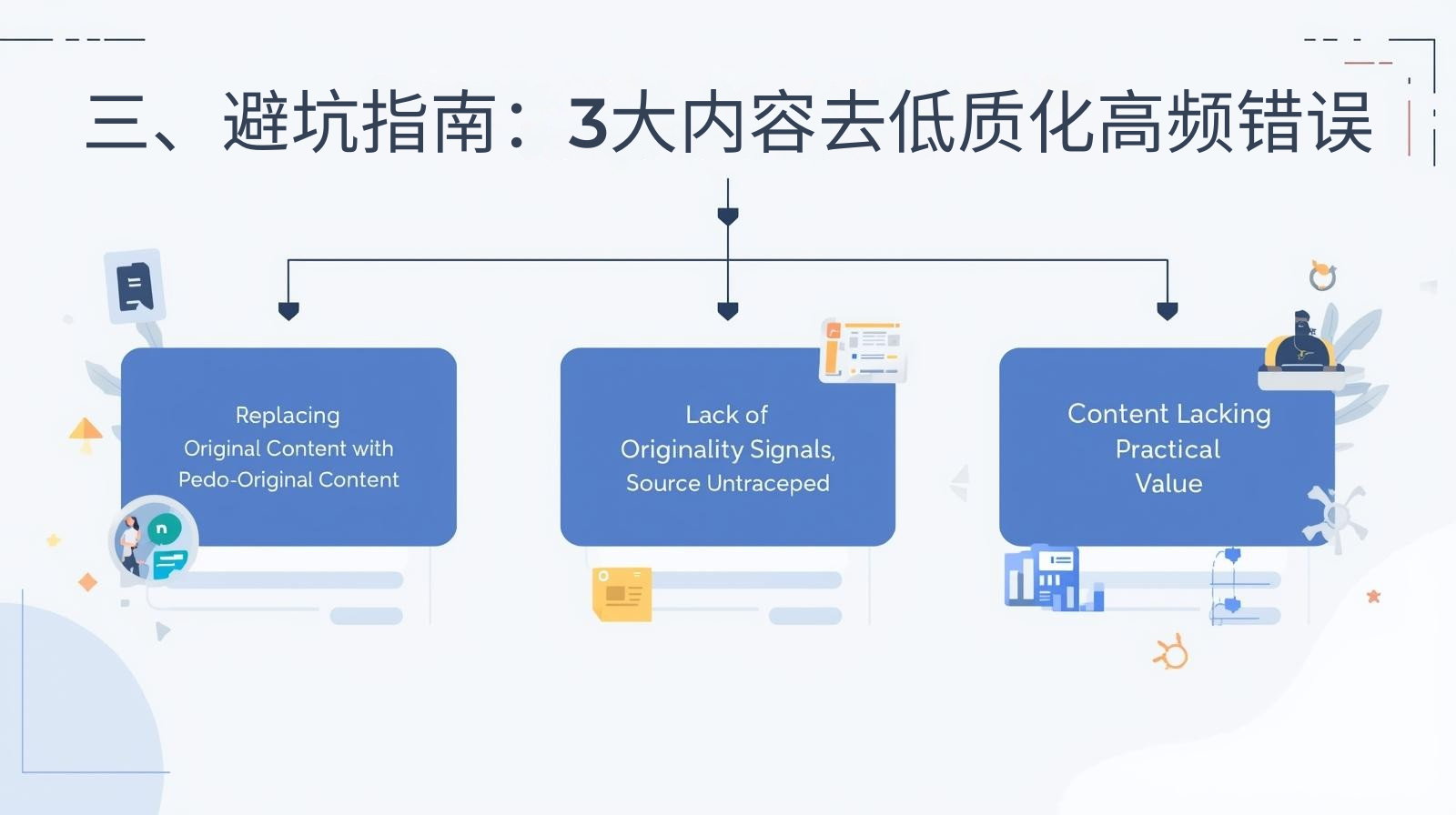
III. Avoidance Guide: 3 Key Elements to Eliminate Low-Quality, High-Frequency Errors (Must Read)
Based on practical case studies of independent e-commerce websites in 2026, the following three mistakes will directly lead to failure in removing low-quality content, and the content will still be marked as plagiarized. These mistakes must be resolutely avoided:
3.1 Error 1: Using pseudo-original content instead of original content, the core value remains unchanged.
Errors : Simply replacing synonyms and rearranging paragraph order to modify industry-standard or other people's content, without providing brand-specific core viewpoints, data, or case studies. For example, changing "supports small-batch purchasing" to "can accept small-batch orders" does not change the essential content.
Core harm : AI can accurately identify traces of plagiarism and determine that the content is low-quality copying, leading to a drop in page ranking and even affecting the AI's recognition of the entire site;
The correct approach : Abandon pseudo-original content, focus on the pain points of buyers, and incorporate brand-specific case studies, data, and perspectives to create truly valuable original content.
3.2 Error 2: Original signal missing, source cannot be traced.
Errors : Original content lacks brand source attribution and originality declaration; core data and case studies lack source tracing links; AI is unable to determine the originality and authenticity of the content.
Core danger : Even if the content is original, it may be suspected by AI as plagiarism due to the unclear source, thus failing to receive priority recommendations or even being misjudged as low-quality content;
Correct practice : Clearly label each piece of original content with an originality statement and brand source, and attach traceability links (such as test reports and case details pages) for core data and case studies to allow AI to quickly identify originality.
3.3 Mistake Three: Content lacks practical value and focuses solely on keyword stuffing.
Error : The original content is merely used to meet keyword density requirements, piling up core terms such as "foreign trade procurement" and "compliance certification," without providing any practical information to address the pain points of buyers; the content is empty and worthless.
Core harm : AI judges content as "low-value original". Although it is not marked as plagiarism, it will reduce the page's recommendation weight. Buyers will quickly leave after visiting, and it will be impossible to convert inquiries into sales.
Correct approach : Before creating content, identify the buyer's core pain points (such as avoiding customs clearance pitfalls, certification processing, and small-batch customization), and provide solutions, case studies, and techniques around these pain points to ensure practical value.
IV. Conclusion: Originality is King; Let AI Proactively Recommend Your High-Quality Content
In 2026, AI platforms will have increasingly stringent screening standards for content on independent e-commerce websites. Low-quality copied content will no longer have a place. Only by optimizing content through GEO (Generational Opportunity) to eliminate low-quality content and creating original content that is "brand-specific, high-value, and traceable" can brands gain priority recommendations from AI platforms and build brand authority. The core of eliminating low-quality content is not simply creating original text, but rather understanding the needs of buyers and using methods that AI can recognize and that buyers can accept to convey the brand's core values, making content a bridge of trust connecting brands and buyers.
To maximize the effectiveness of content de-saturation, a smooth, stable, and content-capable independent website is the core foundation. Many foreign trade websites suffer from weak website building foundations, resulting in slow page loading, chaotic content layout, and poor crawlability. Even with high-quality original content, they cannot be efficiently crawled and recognized by AI, ultimately missing customer acquisition opportunities. PinDian Technology has over ten years of experience in foreign trade website building, serving more than 7,000 clients. Using React technology to build websites not only makes website browsing smoother (overseas loading speed ≤2 seconds, adaptable to multiple terminals), but also adapts to the GEO content de-saturation requirements from the ground up—built-in original content layout templates, standardized structured markup configuration entry points, and clear source link embedding modules, giving the website an inherent ability to "carry high-quality original content." Simultaneously, PinDian website building can assist companies in eliminating low-quality content and optimizing their original content system. Combined with the 4 practical steps in this article, your foreign trade website can completely get rid of plagiarism tags and achieve long-term stable customer acquisition through AI platform content recognition. If your foreign trade website is facing the dilemma of "content being marked as plagiarized, low-quality content resulting in reduced ranking, and poor traffic conversion", you might as well choose PinDian Technology. With professional website building services and precise GEO optimization, you can seize the opportunity to acquire customers with high-quality content in the AI era.