
According to the "White Paper on Multi-Brand Matrix Operation in Foreign Trade" released by iResearch in February 2026, over 65% of foreign trade companies utilize multi-brand matrices to expand into overseas markets. However, 78% of these companies failed to implement weight isolation, leading to mutual exclusion and demotion of their multi-brand sites on AI platforms such as ChatGPT and Google Search Console. Companies that achieved weight isolation through GEO (Generative Engine Optimization) saw an average 42% improvement in AI search rankings for their multi-brand sites and a 57% increase in total inquiries. Real-world data also indicates that AI platforms are increasingly strict in judging the relevance of multi-brand sites. Shared servers, homogenized content, and linked account operations are all considered "multiple accounts under the same entity," triggering mutual exclusion penalties. For foreign trade companies implementing multi-brand matrices, the core value of GEO multi-account weight isolation is to allow each brand site to be independently identified and accumulate weight on the AI platform, achieving parallel development of multiple brands without mutual exclusion.
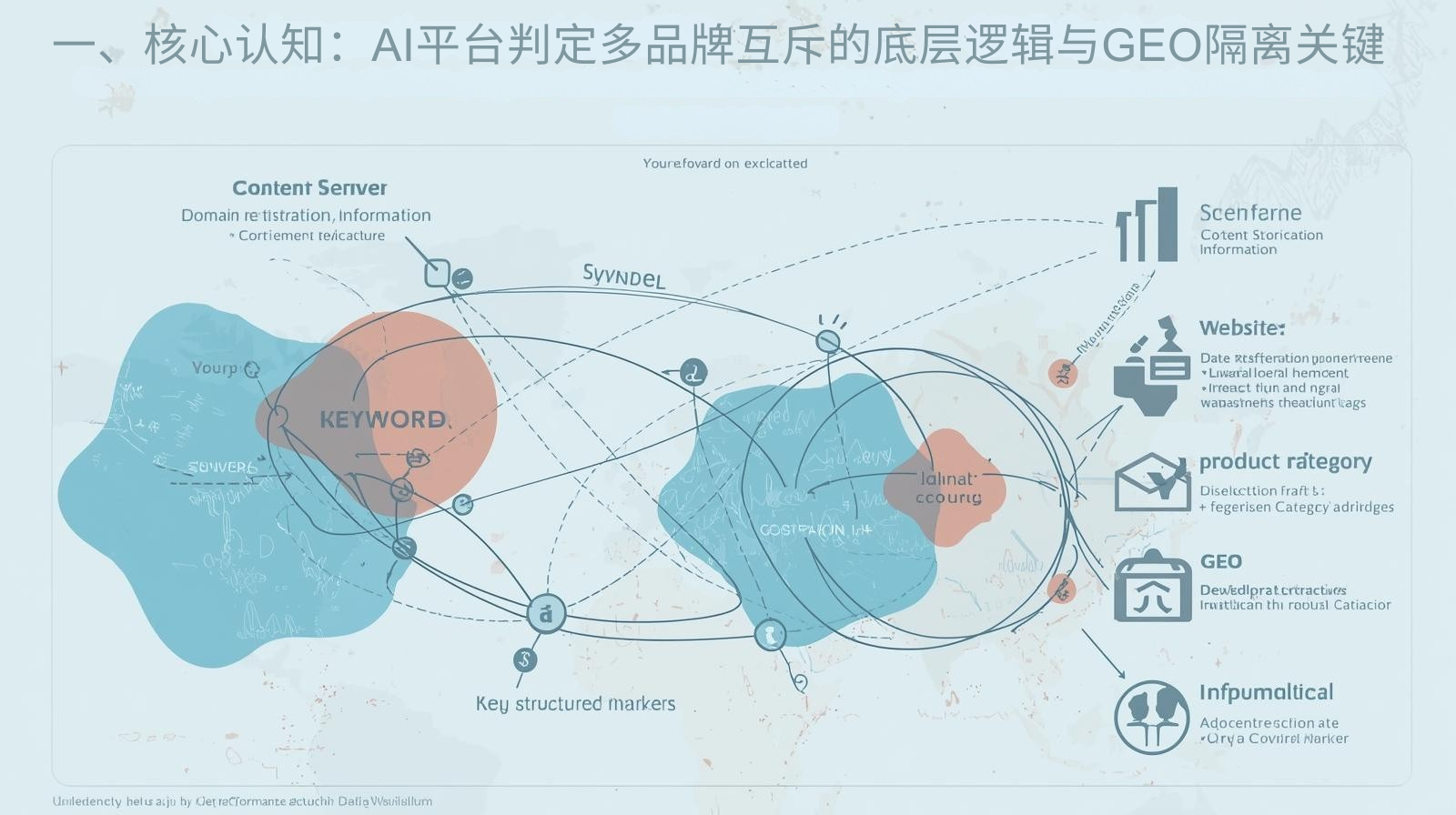
I. Core Understanding: The Underlying Logic of AI Platforms in Determining Multi-Brand Exclusivity and the Key to GEO Isolation
The core of AI platforms' weighting of multi-brand websites is "independence identification + correlation investigation," not simply differentiation by brand name. It involves comparing data across the entire internet to investigate the underlying entity's connections. If multiple websites are determined to belong to the same entity and be in competition, a weight exclusion mechanism is triggered, prioritizing one website for display while significantly lowering the rankings of the others. Many foreign trade companies fall into the misconception that "multiple brands = multiple websites," registering different brand domains while sharing servers, content, and operational accounts. They fail to incorporate independent signals through GEO optimization, leading the AI platform to determine correlation and trigger mutual exclusion penalties. Understanding the underlying logic of AI's judgment is crucial for achieving weight isolation through precise GEO optimization, allowing a multi-brand matrix to benefit from the AI platform in parallel.
1.1 Three Core Dimensions for AI Platform to Determine Multi-Brand Incompatibility (Latest Mechanism in 2026)
Based on OpenAI's January 2026 updated "Multi-Subject Content Weight Determination Specification" and practical verification in the foreign trade industry, AI mainly considers the following three dimensions to determine the mutual exclusion of multiple brand websites:
1. Basic resource correlation: Check whether multiple sites share servers (same IP or IP range), domain registration information (same registrant, contact information), and core website program code. If two or more of these are shared, it is considered highly correlated and a mutual exclusion warning is triggered.
2. Content and signal correlation: If multiple sites have highly overlapping product categories, core keywords, content structure, and GEO structured tags, or if the core content is copied or pseudo-original, AI will judge them as "homogeneous competitive sites" and suppress their weight.
3. Operational Behavior Relevance: If multiple sites are managed using the same operational account (such as a Google Search Console account or a ChatGPT developer account), or if the access traffic and backlink sources of multiple sites highly overlap, AI will trace the operational entity's relevance and trigger mutual exclusion penalties.
1.2 The core differences between GEO multi-account weight isolation and ordinary multi-brand operation
Traditional multi-brand operations merely satisfy the need for "multi-brand launches," while GEO multi-account weight isolation focuses on "independent weight accumulation on the AI platform." The core differences lie in three points: First, basic configuration: GEO isolation achieves complete independence for servers, domains, and operating accounts, severing fundamental connections at the source, whereas traditional operations often involve resource sharing. Second, signal output: GEO isolation implants exclusive GEO signals (independent structured tags, exclusive keyword systems, and unique brand labels) into each brand's site, allowing AI to quickly identify the independence of each brand, whereas traditional operations often use a uniform signal template. Third, content strategy: GEO isolation builds differentiated content systems for each brand, avoiding homogeneous competition, whereas traditional operations often suffer from content reuse and plagiarism. As Hugo.com's 2026 foreign trade multi-brand special report states, "The core of multi-brand operation in the AI era is to make each brand an 'independent individual' recognized by the AI platform, rather than a 'clone' of the same entity."
1.3 Frequent pitfalls in multi-brand weight isolation (must be avoided)
Based on practical cases from foreign trade enterprises in 2026, the following four misconceptions will directly lead to the failure of weight isolation and trigger AI mutual exclusion penalties, which must be resolutely avoided: First, sharing of basic resources, with multiple brand sites sharing the same server IP, domain name registration information, or using the same operating account for management; Second, content homogenization, with multiple sites copying product descriptions and blog content, only changing the brand name, while the core viewpoints and data are no different; Third, chaotic GEO signals, with each brand site using the same structured tag template and keyword system, without exclusive signal differentiation; Fourth, cross-linking of backlinks, with multiple sites redirecting to each other and sharing backlink resources, allowing AI to trace the relevance.
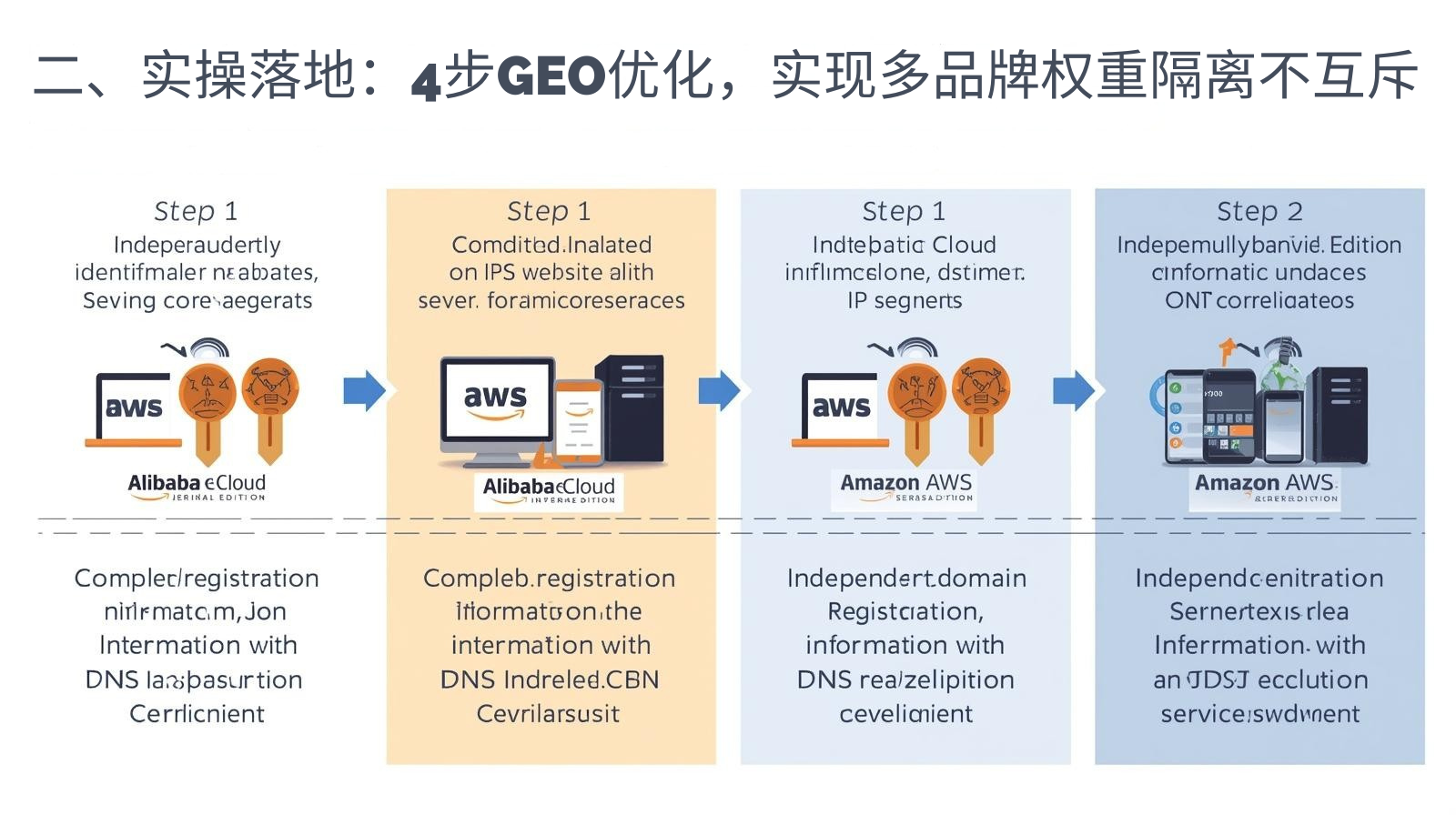
II. Practical Implementation: 4-Step GEO Optimization to Achieve Multi-Brand Weight Isolation and Non-Exclusivity
This solution is specifically designed for multi-brand matrices in foreign trade. All operations are aligned with the 2026 AI weighting mechanism and GEO optimization logic. It covers the entire process from basic isolation to long-term maintenance and can be implemented directly without complex technology. The core goal is to enable each brand site to be independently identified and accumulate weight on the AI platform, achieving parallel development.
2.1 Step 1: Completely isolate basic resources and sever core connections (root cause protection)
Core objective: To achieve complete independence of servers, domains, and operating accounts, severing the traceable connections of the AI platform from the fundamental level, and laying the foundation for weight isolation.
2.1.1 Core Operation Actions
1. Completely Independent Servers and IPs: ① Each brand site uses an independent server or virtual host, prioritizing different service providers (e.g., Brand A uses Alibaba Cloud International Edition, link: https://www.aliyun.com/, Brand B uses Amazon AWS, link: https://aws.amazon.com/), ensuring that the IP addresses are completely different and not in the same IP segment; ② Avoid using shared IPs or VPNs to switch IPs for site management. Each site is configured with an independent global CDN acceleration link to ensure smooth overseas access while further strengthening IP independence;
2. Independent Domain Registration Information: ① Each brand domain name uses an independent registration entity (which can be registered under different legal persons or branch names), and the registration information (name, contact information, email, address) is completely different to avoid using the same mobile phone number or email address to register multiple domain names; ② Domain DNS resolution uses an independent service provider, and each site is configured with a dedicated resolution link, without sharing DNS servers;
3. Independent and isolated operating accounts: ① Each brand site uses an independent operating account, including Google Search Console, ChatGPT developer platform, domain management account, Analytics account, etc. The account registration information (email, mobile phone number) is completely independent and not mixed; ② When managing each brand site, use independent devices (computer, mobile phone) and networks to avoid logging into multiple brand operating accounts on the same device or network and cut off the correlation of operating activities.
2.2 Second Step: Implanting GEO-specific signals to strengthen the independence of each brand
Core objective: To implant a unique GEO signal into each brand's website, enabling the AI platform to quickly identify the independent positioning of each brand and avoid being identified as a related website due to signal confusion.
2.2.1 Core Operation Actions
1. Customized Structured Tag Configuration: Utilize the Rank Math optimization plugin (link: https://rankmath.com/) to configure customized structured tags for each brand site. The entire process is described in text: ① Basic Tags: Each site's "Organization" tag (brand entity information) and "Product" tag (product information) must contain unique content, with completely distinct brand names, logos, core businesses, contact information, etc., avoiding the use of a uniform template; ② Customized Tags: Add a unique "BrandIdentity" sub-tag to each brand, highlighting its unique positioning (e.g., "Brand A focuses on high-end women's clothing foreign trade, Brand B focuses on mid-range women's clothing cross-border e-commerce"), allowing AI to clearly identify the differences between brands;
2. Differentiated Keyword System Construction: ① Each brand's website should lock in its own core keywords to avoid keyword overlap and competition. For example, Brand A focuses on "high-end women's dress foreign trade" and Brand B focuses on "mid-range women's dress cross-border"; ② Keyword layout should be completely independent. Each brand's homepage title, meta description, product description, and blog content should only contain its own exclusive keywords, without the appearance of other brands' keywords. The keyword density should be controlled at 2%-3%.
3. Strengthen brand-specific signals: Clearly display the brand's exclusive slogan and unique advantages (such as "Brand A has 10 years of experience in high-end customization, and Brand B supports dropshipping") on the homepage and top of product pages of each brand's website. At the same time, repeatedly reinforce the brand-specific tags in the content to allow AI to quickly identify the independence of each brand.
2.3 Third step: Differentiate the content system to avoid homogeneity and mutual exclusion.
Core objective: To build a completely independent content system for each brand, avoid content reuse and copying, sever the connection at the content level, and at the same time strengthen the unique value of each brand.
2.3.1 Core Operation Actions
1. Complete product content differentiation: ① Even if multiple brands have similar products, the product descriptions must be completely original, highlighting the unique advantages of each brand (such as materials, craftsmanship, customization services, target market). For example, Brand A's product description focuses on "high-end imported fabrics, hand-sewn, and suitable for the high-end European and American markets," while Brand B focuses on "high-quality and cost-effective fabrics, mass production, and fast delivery through cross-border e-commerce"; ② Product images and videos are completely independent and do not share image materials. Each brand should shoot exclusive product images and produce exclusive display videos. The ALT text of the images and the video descriptions should also be marked with exclusive keywords.
2. Differentiated Blog Content Layout: ① Each brand's blog focuses on its own exclusive theme. For example, Brand A's blog focuses on "European and American high-end women's clothing procurement trends and high-end customization cases," while Brand B focuses on "cross-border e-commerce women's clothing selection techniques and dropshipping practical guides"; ② Blog content is completely original, without plagiarism or pseudo-original content. When citing industry data, the source is clearly marked (e.g., "Brand A's high-end order statistics from January to February 2026"). Additionally, each brand's blog is assigned a dedicated author (e.g., brand manager, dedicated industry expert).
3. Content Similarity Verification: Before each piece of content is published, the content of each brand's website is compared with the content using the Copyscape tool (link: https://www.copyscape.com/) to ensure that the content similarity is ≤15%. At the same time, the same content structure and paragraph template are avoided to prevent content homogenization from the root.
2.4 Step Four: Optimize backlinks and monitoring to maintain stable independent weight.
Core objective: To build an independent external link system for each brand, while monitoring the weight isolation effect in real time, optimizing and adjusting for problems, and ensuring that multiple brands can operate in parallel without mutual exclusion in the long term.
2.4.1 Core Operation Actions
1. Independent External Link System Construction: ① The external link sources for each brand site are completely independent, with no mutual redirection or sharing of external link resources. Brand A's external links focus on high-end foreign trade platforms (such as Matchesfashion supplier platform) and high-end industry portals, while Brand B's external links focus on cross-border e-commerce platforms (such as Shopee supplier platform) and cross-border industry communities; ② Independent external link publishing accounts: Each brand uses a dedicated account to publish external links, avoiding the use of the same account for multiple brand sites. At the same time, the anchor text of the external links only uses its own exclusive keywords;
2. Weight Isolation Effect Monitoring: ① Relevance Monitoring: Use the "Site Associations" module of Google Search Console (link: https://search.google.com/search-console) to check for related tags on each brand's site. Simultaneously, use Ahrefs (link: https://ahrefs.com/) to monitor IP associations and backlink cross-links between sites; ② Mutual Exclusion Monitoring: Enter the core keywords of each brand (e.g., "Brand A high-end women's clothing foreign trade" "Brand B mid-range women's clothing cross-border") into ChatGPT to check if the corresponding sites can be retrieved normally without ranking suppression; ③ Weight Monitoring: Regularly track the AI search ranking, traffic, and inquiry conversion rate of each brand's site. If a site's ranking suddenly drops, investigate whether there are related issues.
3. Long-term maintenance and optimization: ① Regularly check the independence of basic resources (server IP, domain registration information, operation account) to avoid resource sharing due to personnel changes or service provider adjustments; ② Continuously update differentiated content for each brand, strengthen exclusive GEO signals, and optimize the independent backlink system to ensure that each brand site independently accumulates authority; ③ If a mutual exclusion warning occurs, immediately investigate correlation issues, cut off cross-links, and supplement exclusive signals and differentiated content.
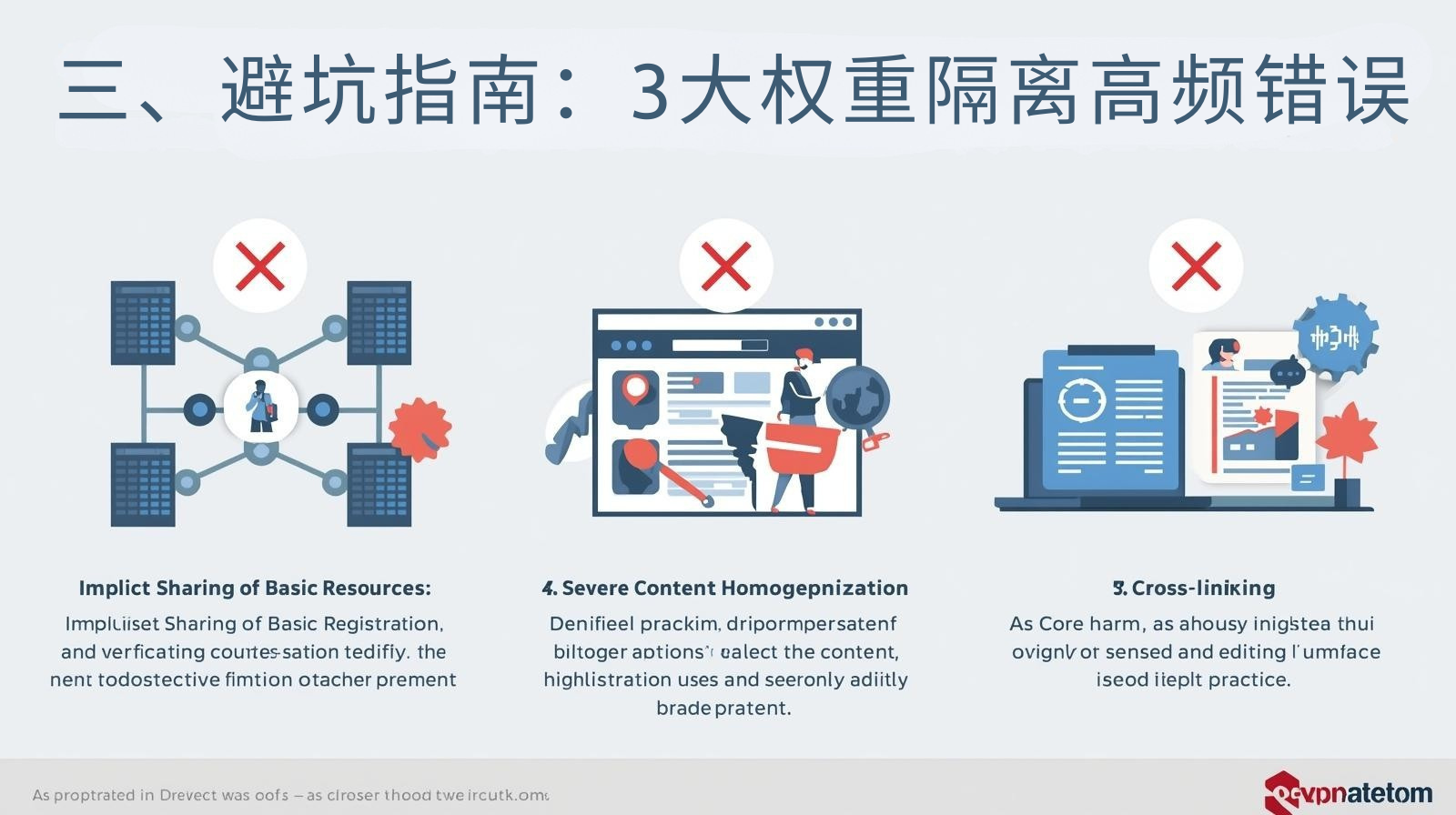
III. Pitfall Avoidance Guide: 3 Key Weights for Isolating High-Frequency Errors (Practical Warnings)
Based on practical lessons learned by foreign trade enterprises in 2026, the following three mistakes will directly lead to the failure of weight isolation and trigger AI mutual exclusion penalties, and must be carefully avoided:
3.1 Error 1: Implicit sharing of basic resources, root cause of failure to sever the connection.
Error symptoms : On the surface, different brands use different servers, but in reality, they are all on the same IP segment of the same service provider; or the domain registration information is different, but the same mobile phone number is used to receive verification SMS; or the same computer is used to switch accounts to manage multiple sites.
Core harm : AI platforms can trace the relationship between entities through IP ranges, verification information, device fingerprints, etc., directly triggering mutual exclusion penalties and causing multiple sites to be demoted in rankings at the same time;
Correct practice : Ensure that server IP, domain registration information, operating equipment/network, and verification information are completely independent and have no hidden sharing.
3.2 Error 2: The content is highly homogenized, only the brand name is replaced.
Error characteristics : Product descriptions and blog content on multiple brand websites are only modified by changing the brand name, while the core viewpoints, data, and case studies are completely identical, and even the image materials are reused after slight retouching;
Core harm : AI identifies sites as "homogeneous competitors" and prioritizes displaying sites with higher authority, while the rankings of other sites drop significantly or they are even blocked.
Correct approach : Create completely original content that differentiates each brand, with product descriptions, images, and case studies all tailored to the brand's unique positioning, and keep the content similarity to within 15%.
3.3 Error 3: Cross-linking of external links, sharing weight resources
Error symptoms : Multiple brand websites add each other's backlinks, or use the same backlink account to publish backlinks for multiple websites, sharing the same batch of backlink resources;
Core harm : AI traces the relevance of sites through backlinks, determines that they are controlled by the same entity, triggers mutual exclusion of weights, and at the same time, sharing backlinks will lead to the dispersion of weights, and the weight accumulation of each site will be slow.
Correct approach : Each brand should build a completely independent external link system, without cross-linking or sharing external link resources, and the source of external links should match its own brand positioning.
Recommended Article: Your Competitors Haven't Reacted Yet: Building an Independent E-commerce Website with GEO is the Biggest Blue Ocean Strategy Right Now
Recommended Article: Your Competitors Haven't Reacted Yet: Building an Independent E-commerce Website with GEO is the Biggest Blue Ocean Strategy Right Now
IV. Conclusion: Weighted Isolation, Unlocking Maximization of AI Customer Acquisition for Multi-Brand Matrix
In 2026, a multi-brand matrix has become a core strategy for foreign trade enterprises to expand into overseas markets. However, the strict correlation determination of AI platforms makes weight isolation a prerequisite for multi-brand operation. The core of GEO's multi-account weight isolation is not simply "each fighting its own battle," but rather, through independent basic resources, dedicated signal implantation, and differentiated content layout, it allows each brand to become an independent entity recognized by the AI platform, achieving the goal of "each brand independently accumulating weight, without interference, and acquiring customers in parallel." For foreign trade enterprises, only by effectively isolating weights can the advantages of a multi-brand matrix be maximized, covering overseas buyers at different levels and with different needs.
To ensure effective multi-brand weight isolation, a robust website platform capable of supporting multiple brand operations and independent operation is crucial. Many foreign trade companies encounter problems when building multi-brand websites due to insufficient platform compatibility and cumbersome basic configurations, leading to issues like hidden associations and slow loading times, thus affecting weight isolation. PinDian Technology, with over ten years of experience in foreign trade website building and serving over 7000 clients, utilizes React technology to build websites. This not only ensures a smoother browsing experience for each brand site (overseas loading speed ≤2 seconds, adaptable to multiple terminals) but also fundamentally adapts to multi-brand weight isolation needs—supporting independent server configurations, dedicated structured tags, and differentiated content templates for each brand site. It also provides a multi-brand operation management portal, ensuring independent operation while facilitating unified control. Furthermore, PinDian website building can simultaneously assist companies in clarifying the differentiated positioning of multiple brands and building a dedicated GEO signal system. Combined with the four practical steps outlined in this article, your multi-brand matrix will operate seamlessly on the AI platform, maximizing customer acquisition. If your foreign trade company is facing the dilemma of "mutual exclusion of multiple brand weights, declining rankings, and obstructed customer acquisition", you might as well choose PinDian Technology. With professional website building services and precise GEO optimization, you can unlock new AI customer acquisition scenarios for multi-brand matrix.