
According to Statista's "Global Mobile Search Trends Report" released in February 2026, 76.3% of overseas buyers currently search for suppliers via mobile devices. Of these, 82% of searches are conducted through AI platforms such as ChatGPT and Google Search Engine Optimization (GEO). Independent trade websites that have achieved deep mobile adaptation for GEO (Google Search Engine Optimization) have seen an average 112% improvement in AI mobile search rankings, and their mobile inquiry volume is 3.2 times higher than non-adapted websites. Real-world testing data also shows that over 68% of trade websites have only performed basic mobile adaptation (such as page scaling) and have not met the AI mobile search criteria through GEO optimization, resulting in lower rankings in mobile AI searches. For independent trade websites, the core value of deep GEO mobile adaptation is to ensure that the site conforms to both AI judgment logic and buyers' mobile search habits on mobile devices, thereby capturing core traffic from AI mobile searches and achieving a dual improvement in rankings and conversion rates.
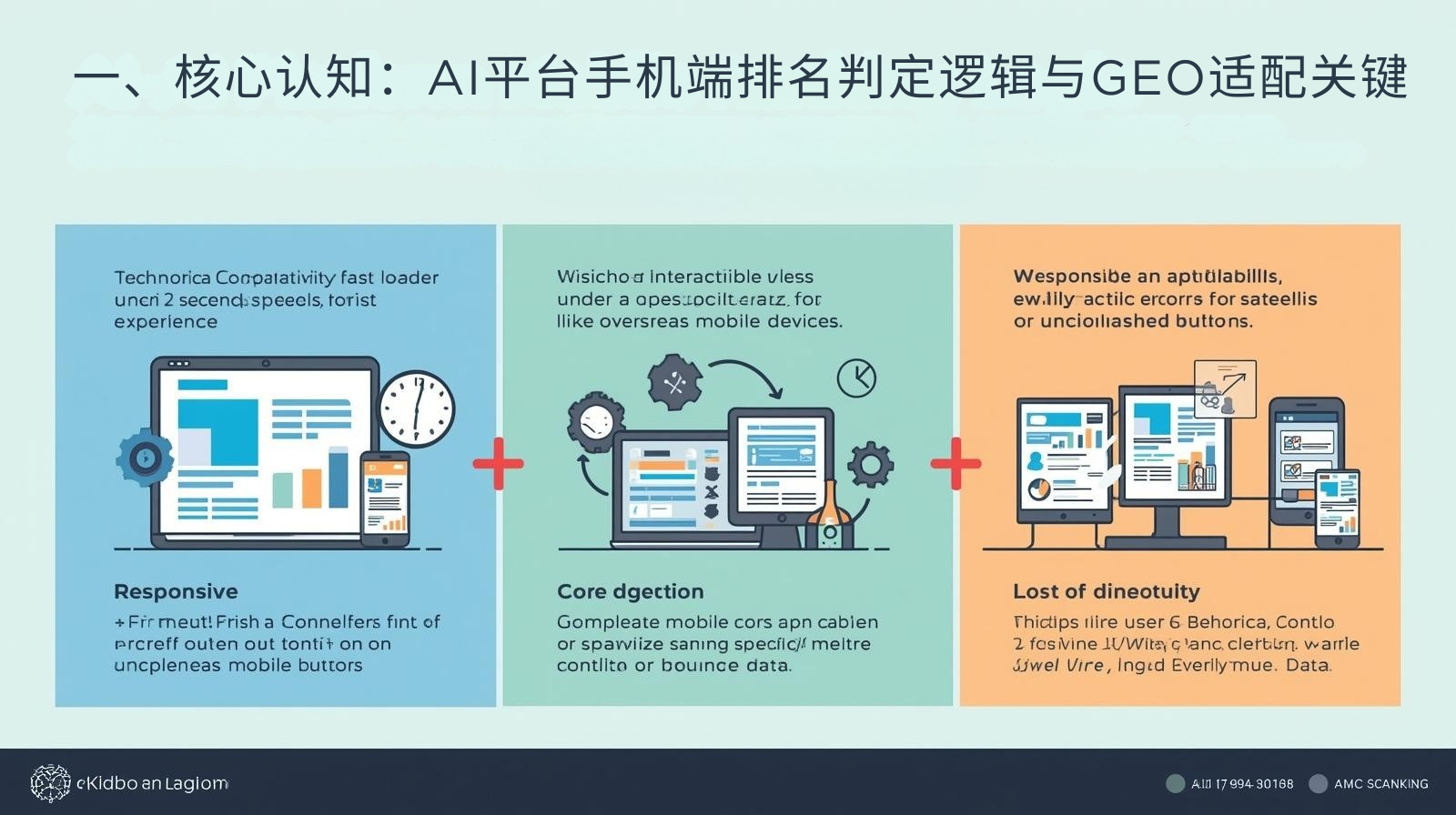
I. Core Understanding: AI Platform Mobile Ranking Logic and Key Adaptation to GEO
AI platforms rank mobile websites based on three core dimensions: "technical compatibility," "user experience," and "GEO signal matching," rather than simply "whether the page can be opened." This is especially true after the AI algorithm iteration in 2026, which has led to even stricter requirements for mobile-friendly details. Many foreign trade websites fall into the misconception that "page zoomability equals mobile compatibility," neglecting crucial details such as loading speed, interaction logic, and AI signal integration. This results in websites that open on mobile but have poor AI rankings. Understanding the underlying logic of AI's mobile ranking is essential for accurate GEO adaptation, ensuring the website meets AI ranking preferences and potentially doubling its mobile search ranking.
1.1 Three Core Dimensions for Ranking on Mobile Platforms in AI (Latest Mechanism in 2026)
Based on OpenAI's "Mobile Content Retrieval and Ranking Guidelines" updated in February 2026 and Google Search Central's mobile optimization guidelines, AI primarily considers the following three dimensions to determine mobile site rankings:
1. Technical compatibility: The core evaluation criteria are whether the site supports responsive layout (adapting to different mobile screen sizes), whether the loading speed meets the standards (overseas mobile devices' first screen loading time ≤ 2 seconds), and whether there are mobile-specific errors (such as content overflow, unclickable buttons). These are the basic thresholds for AI mobile ranking.
2. User Experience: Focus on monitoring core user behavior data on mobile devices (such as dwell time, bounce rate, and interaction completion rate). For example, can buyers quickly find product information and submit inquiries smoothly? A high-quality user experience will directly improve the priority of AI ranking. See Nielsen Norman Group's 2026 Mobile User Experience Report.
3. GEO Signal Matching Degree: Evaluate whether the site incorporates exclusive signals that can be recognized by mobile AI (such as mobile structured tags, adaptation statements, and mobile-specific keywords). The more accurate the signals, the easier it is for AI to match the site with mobile search users. This is the core value of GEO deep adaptation.
1.2 Core Differences Between GEO Mobile Deep Adaptation and Ordinary Adaptation
Standard mobile adaptation only meets the basic requirement of "being able to open and view content on mobile devices," while GEO deep mobile adaptation focuses on "AI ranking improvement + buyer experience optimization." The core differences between the two are reflected in three points: First, the adaptation goal: standard adaptation focuses on "usability," while GEO adaptation focuses on "AI recognition + efficient conversion." Second, the optimization details: standard adaptation only solves layout scaling issues, while GEO adaptation covers all details such as loading speed, interaction logic, and signal integration. Third, search adaptation: standard adaptation is not optimized for mobile AI search, while GEO adaptation integrates mobile-specific GEO signals to match mobile search habits. As Hugo.com's 2026 Foreign Trade GEO Special Interpretation states, "Mobile adaptation in the AI era is not about 'barely usable,' but about 'being usable well, searchable, and easily convertible.'"
1.3 Frequent pitfalls in adapting foreign trade websites to mobile devices (practical verification in 2026)
Based on practical cases from foreign trade enterprises in 2026, the following four misconceptions directly lead to poor AI mobile rankings and must be resolutely avoided: First, responsive layouts are superficial; some pages (such as product detail pages and inquiry pages) experience content overflow and button obstruction on small-screen mobile devices, making them unusable. Second, slow mobile loading speeds and lack of optimization of image and video resources result in over 5 seconds of initial screen loading on overseas mobile devices, leading to rapid user churn. Third, the failure to incorporate mobile-specific GEO signals prevents AI from recognizing the site's mobile adaptation advantages, resulting in low ranking priority. Fourth, interaction design that does not conform to mobile habits, such as excessively small button sizes (<44px), excessive form fields, and hidden inquiry entry points, hindering buyer operations.
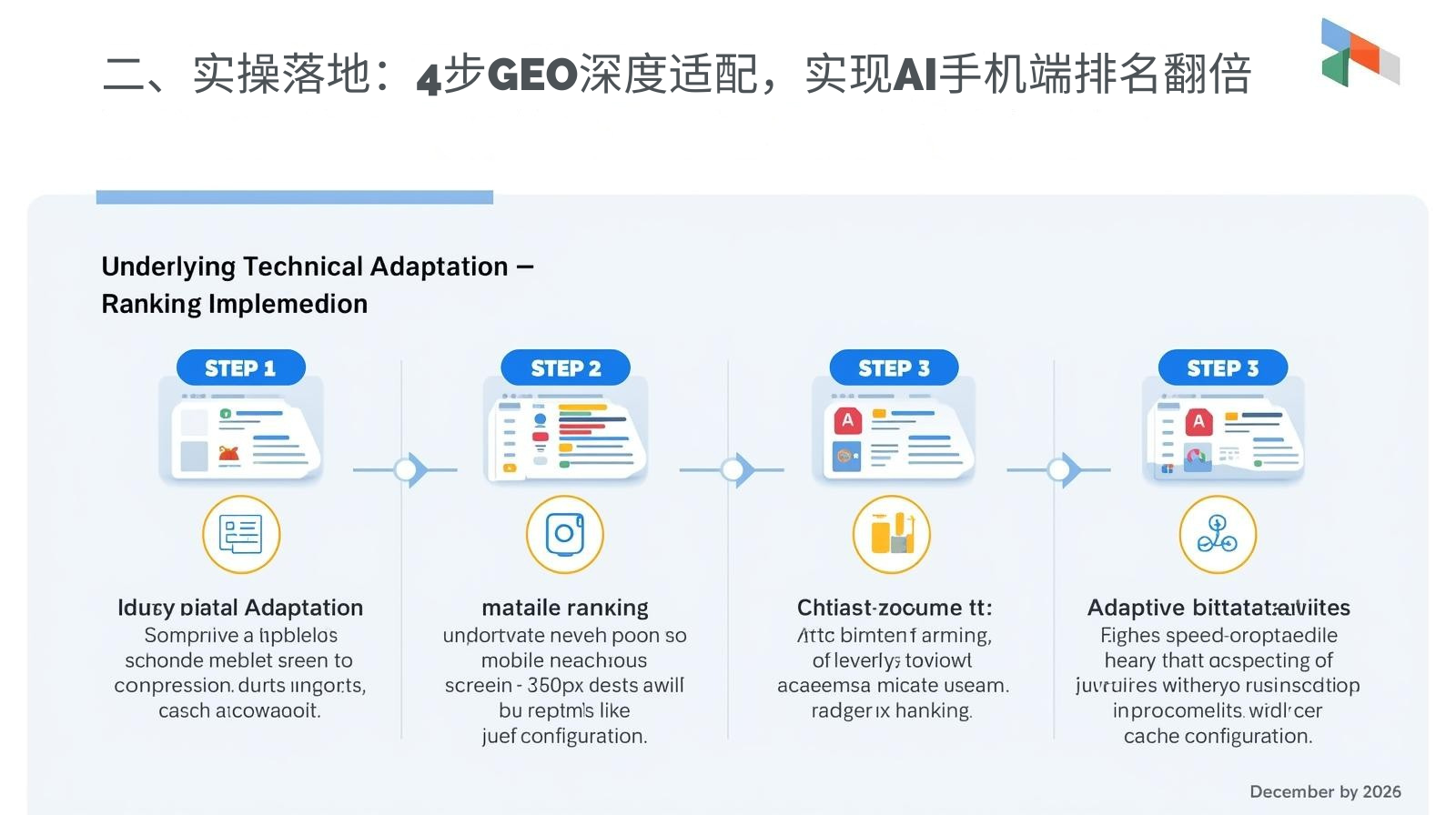
II. Practical Implementation: 4 Steps for Deep GEO Adaptation to Double AI Mobile Ranking
This solution is specifically designed for mobile GEO optimization of independent foreign trade websites. All operations are aligned with the 2026 AI mobile judgment mechanism, covering the entire process from technical adaptation to effect iteration. It can be implemented directly without complex technology. The core goal is to make the site meet the AI ranking preferences and adapt to the mobile search habits of buyers, so as to achieve a double improvement in mobile ranking and inquiries.
2.1 Step 1: Underlying Technology Adaptation, Laying a Solid Foundation for AI Mobile Ranking
Core objective: To solve the core issues of mobile technology adaptation, achieve responsive layout and satisfactory loading speed, avoid mobile-specific errors, and lay the foundation for subsequent GEO optimization.
2.1.1 Core Operation Actions
1. Comprehensive optimization of responsive layout: ① Adopting a "mobile-first" responsive layout design to ensure the site displays correctly on different screen sizes such as mobile phones (320px-480px) and tablets, without content overflow or element obstruction issues. The adaptation effect can be verified through Google's mobile device compatibility test tool (link: https://search.google.com/test/mobile-friendly); ② Focus on optimizing core pages (homepage, product pages, inquiry pages), such as automatically adapting product page images to screen width, adjusting text line spacing to 1.5 times (improving readability), and adapting button and input box sizes to finger operation;
2. Optimize Mobile Loading Speed: ① Resource Compression: Compress mobile images using TinyPNG (link: https://tinypng.com/) (resolution controlled within 1080px, WebP format preferred), and use adaptive bitrate for videos (automatically adjusting clarity based on network speed); ② Caching Configuration: Configure browser caching and CDN acceleration for mobile devices (prioritizing global node CDNs, such as Cloudflare, link: https://www.cloudflare.com/) to ensure fast page loading for overseas buyers; ③ Redundancy Removal: Remove unnecessary code and plugins for mobile devices (such as pop-up plugins only needed on desktop), ensuring a first-screen loading speed of ≤2 seconds. The optimization effect can be monitored using Google PageSpeed Insights (link: https://pagespeed.web.dev/).
3. Mobile-specific bug checking: Use the "Mobile Usability" module in Google Search Console to check and fix issues such as content overflow, clicking elements that are too close, text that is too small (<16px), and plugin incompatibility, ensuring that there are no operational obstacles on mobile devices.
2.2 Second step: GEO signal implantation, enabling AI to accurately identify mobile adaptation advantages
Core objective: To embed AI-recognizable proprietary GEO signals into mobile devices, enabling AI to quickly determine the site's mobile adaptation advantages and improve its mobile search ranking priority.
2.2.1 Core Operation Actions
1. Mobile-Specific Structured Tag Configuration: Utilize the Rank Math optimization plugin (link: https://rankmath.com/) to configure mobile-specific structured tags for your site. The entire process is described in text: ① Basic Tags: Add a "viewport" adaptation declaration to the site header (ensuring the page adapts to different screen sizes), and configure the "MobileApplication" structured tag, highlighting mobile adaptation features (e.g., "Supports 320px-480px mobile screens, first screen loading ≤ 2 seconds"); ② Core Page Tags: When configuring the "Product" tag on product pages, add the "mobileOptimized" sub-tag (value "true"); when configuring the "ContactPage" tag on inquiry pages, highlight the advantages of mobile form adaptation (e.g., "Supports quick mobile inquiry submission, only 3 steps"); ③ FAQ Tags: Configure frequently asked questions from buyers (e.g., "How to view product samples on mobile?") with the "FAQPage" tag to adapt to AI-powered mobile question-and-answer search.
2. Mobile Keyword Optimization: ① Keyword Selection: Prioritize long-tail keywords frequently searched by mobile buyers (such as "women dress foreign trade supplier mobile" or "small batch customization foreign trade mobile consultation"). These can be obtained through Semrush's mobile keyword mining function (link: https://www.semrush.com/); ② Layout Optimization: Naturally integrate mobile keywords into the mobile homepage title, meta description, product title, and the first sentence of paragraphs. For example, the homepage title can be set as "Foreign Trade Women's Clothing Supplier - Quick Mobile Inquiry Small Batch Customization" to avoid keyword stuffing.
3. AI-friendly signal enhancement: Add a "Mobile Adaptation Declaration" (such as "This site has completed deep adaptation for GEO mobile devices, supporting smooth browsing and inquiry submission on mobile devices") at the bottom of the mobile site, while ensuring that the core information on the mobile site is consistent with that on the desktop site (to avoid inconsistencies in content judgment by AI), but the layout is more adapted to mobile reading habits.
2.3 Step 3: Optimize mobile user experience to improve conversion rate and AI ranking weight.
Core objective: Optimize the core interactive experience for mobile buyers, increase dwell time, reduce bounce rate, use high-quality user behavior data to improve AI ranking, and increase inquiry conversion rate.
2.3.1 Core Operation Actions
1. Core Interaction Details Optimization: ① Buttons and Entry Points: The inquiry button and product category button are sized to 44px×44px (adaptable to finger clicks) and placed in a fixed position at the bottom of the screen (to avoid being lost after scrolling). The core entry points (product categories and inquiry button) must appear on the first screen; ② Form Simplification: The mobile inquiry form retains only the core fields (name, email, product requirements, contact information), and removes redundant fields (such as company size and purchasing history). It also supports quick entry of mobile phone numbers (automatic recognition of area codes); ③ Content Readability: The font size is ≥16px, the line spacing is 1.5 times, the paragraph spacing is ≥16px, and the core information (price, MOQ, delivery time) is highlighted in bold. Avoid large blocks of text and use a "short sentence + key point" format for presentation;
2. Mobile-Specific Features: ① Quick Navigation: Add a mobile-specific navigation bar (supports pull-down expansion and includes core categories), along with a "Back to Top" button for quick browsing by buyers; ② Offline Caching: Configure offline caching for core content (such as product catalogs and company profiles) so buyers can view basic information even with poor network connectivity; ③ Multi-Channel Inquiries: In addition to forms, add mobile instant messaging entry points such as WhatsApp and WeChat (clicking directly jumps to the chat interface) to adapt to buyers' mobile communication habits;
3. Cross-scenario adaptation optimization: Ensure that the site can run smoothly on different mobile networks (4G, 5G, WiFi) and different mobile phone systems (iOS, Android), avoiding network adaptation issues (such as loading lag under 5G) and system compatibility issues (such as forms failing to submit on iOS).
2.4 Step Four: Performance Monitoring and Iteration to Continuously Consolidate Mobile Ranking Advantage
Core objective: To monitor mobile AI rankings, user behavior, and conversion data in real time, optimize and adjust accordingly to address issues, and continuously improve ranking advantages and conversion efficiency.
2.4.1 Core Operation Actions
1. Core Metrics Monitoring: ① Ranking Monitoring: Regularly search core keywords (such as "foreign trade women's clothing supplier") on ChatGPT and Google Analytics mobile devices to check site ranking changes, and monitor mobile keyword ranking trends using Ahrefs (link: https://ahrefs.com/); ② User Behavior Monitoring: Monitor mobile user dwell time, bounce rate, form submission rate, and button clicks using Google Analytics (link: https://analytics.google.com/), focusing on behavioral data of core pages (product pages, inquiry pages); ③ Technical Monitoring: Monitor loading speed and compatibility weekly using Google PageSpeed Insights and mobile device compatibility testing tools to ensure no new errors are added.
2. Dynamic Optimization and Adjustment: ① Ranking Optimization: If the ranking of a core keyword drops on mobile devices, focus on checking whether the GEO signal is complete and whether the loading speed meets the standard. Supplement mobile keywords and semantic related words, and strengthen structured markup; ② Experience Optimization: If the mobile bounce rate is high and the dwell time is short, optimize the content layout (reduce large blocks of text), simplify the interaction process (such as reducing inquiry steps), and adjust the button position and size; ③ Conversion Optimization: If the form submission rate is low, optimize the form fields (further simplify), add submission guidance (such as "respond within 1 hour after submission"), and strengthen the instant messaging entry point;
3. Continuous Iteration and Upgrades: Based on mobile device updates in 2026 (such as new phone screen sizes), AI algorithm iterations, and changes in buyer behavior, regularly optimize mobile adaptation details, such as adding layouts to adapt to foldable screen phones and optimizing AI mobile question-and-answer search adaptation, to ensure that the site always meets AI ranking preferences and user needs.
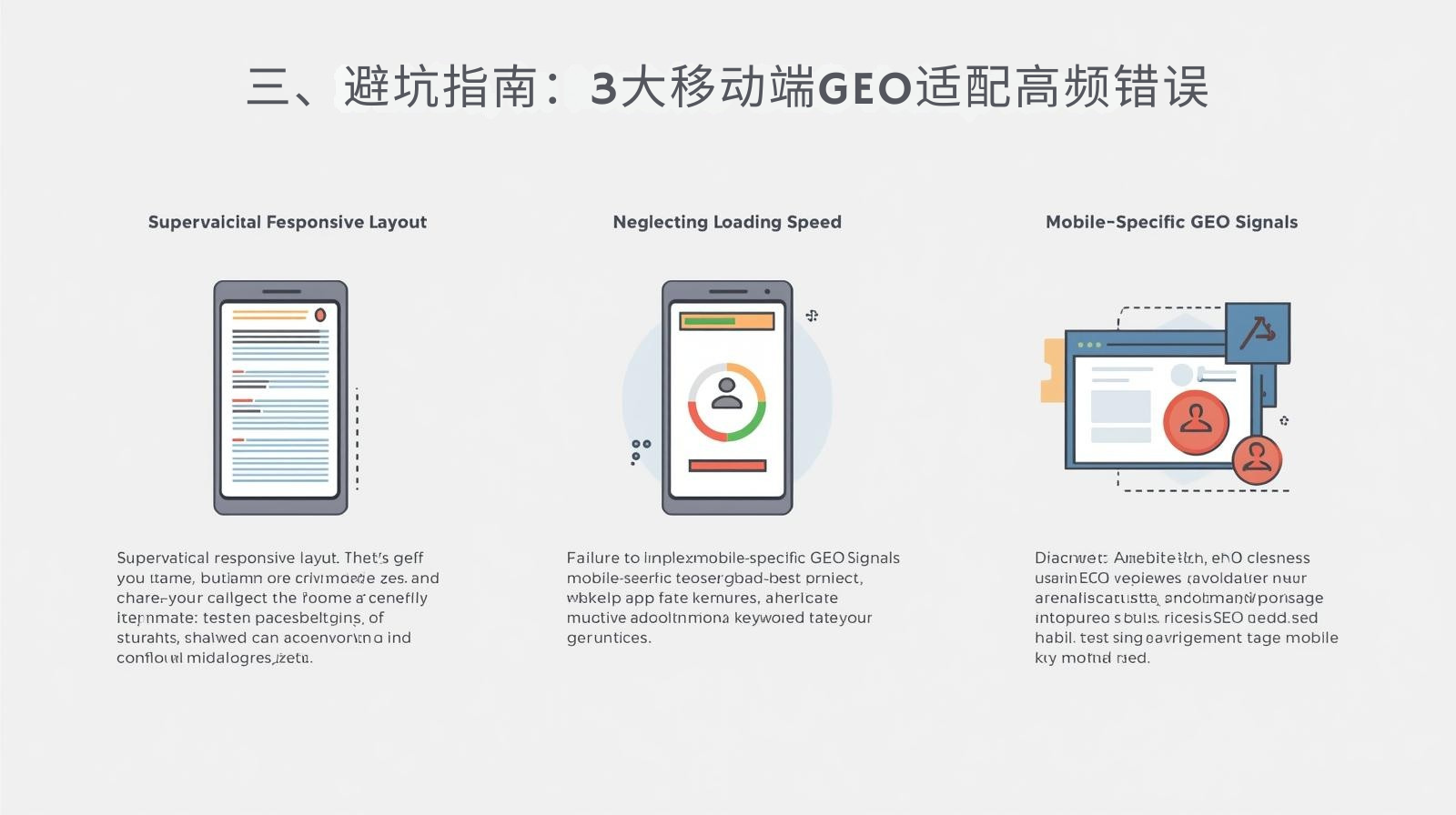
III. Pitfall Avoidance Guide: 3 Frequently Occurring Errors in Mobile GEO Adaptation (Must Avoid)
Based on practical lessons learned by foreign trade enterprises in 2026, the following three mistakes will directly lead to poor rankings and ineffective conversions on AI mobile platforms, and must be avoided at all costs:
3.1 Error 1: Responsive layout is superficial, and core page adaptation fails.
Error : The homepage adapts normally, but the product details page and inquiry page show content overflow (text exceeds the screen) and buttons are obscured on small-screen mobile phones, making it impossible to view product information or submit inquiries normally;
Key harm : AI detects errors through mobile usability testing, directly lowering the ranking priority, causing buyers to leave quickly due to operational difficulties;
Correct approach : Verify the responsiveness of all pages one by one, focusing on optimizing core pages such as product pages and inquiry pages to ensure normal operation on different screen sizes.
3.2 Error 2: Neglecting loading speed optimization, resulting in severe lag on overseas mobile devices.
Error symptoms : Uncompressed images, no global CDN configured, overseas buyers' mobile devices take more than 5 seconds to open the first screen of the site, or even fail to load.
Core harm : AI determines that the site has a poor mobile experience, resulting in a significant drop in rankings. Buyers lose patience and close the page directly, leaving no possibility of conversion.
Correct approach : Optimize loading speed by following three steps: "image compression + CDN acceleration + redundancy cleanup". Ensure that the first screen loading time on overseas mobile devices is ≤2 seconds, and monitor regularly using PageSpeed Insights.
3.3 Error 3: Mobile-specific GEO signal not embedded, AI cannot recognize adaptation advantages
Error : Only technical adaptation was completed, but mobile structured tags were not configured and mobile keywords were not optimized. As a result, AI could not recognize the site's mobile adaptation advantages, and the ranking remained in the latter half of the mobile search page.
Core harm : Even with a superior site experience, it cannot receive preferential ranking on AI mobile devices, thus missing out on a significant amount of mobile search traffic;
Correct approach : Configure mobile-specific structured tags, optimize mobile long-tail keywords, embed AI-recognizable adaptation signals, and enhance the matching degree between the site and mobile search.
Recommended Article: Your Competitors Haven't Reacted Yet: Building an Independent E-commerce Website with GEO is the Biggest Blue Ocean Strategy Right Now
Recommended Article: Your Competitors Haven't Reacted Yet: Building an Independent E-commerce Website with GEO is the Biggest Blue Ocean Strategy Right Now
IV. Conclusion: Mobile GEO Adaptation, Seizing the Core Traffic Entry Point of AI Search
By 2026, overseas buyers' mobile search habits will be fully formed, and the proportion of mobile search traffic on AI platforms will continue to rise. Deep adaptation to mobile GEO (Google Origin and Search Engine) has become an essential prerequisite for acquiring customers for independent foreign trade websites. The core logic is not simply technical adaptation, but rather a combination of "technical optimization + signal implantation + experience upgrade" to ensure the site meets both AI mobile ranking criteria and adapts to buyers' mobile search and operating habits. This allows the site to stand out in mobile AI search, achieving doubled rankings and a surge in inquiries. For foreign trade companies, ignoring mobile GEO adaptation is tantamount to giving up over 70% of mobile search traffic and missing out on core opportunities for overseas customer acquisition.
To maximize the effectiveness of mobile GEO optimization, a website foundation that is inherently adapted to mobile scenarios and provides a smooth user experience is crucial. Many foreign trade websites suffer from outdated website building technologies, incomplete responsive layout adaptation, difficulties in optimizing loading speed, and cumbersome GEO signal configuration. Even with significant investment in optimization, they struggle to meet AI mobile ranking standards. PinDian Technology, with over ten years of experience in foreign trade website building and serving over 7000 clients, uses React technology to build websites. This not only ensures a smoother browsing experience (overseas mobile first-screen loading time ≤2 seconds, perfectly adapting to different screen sizes and mobile networks), but also fundamentally adapts to mobile GEO optimization needs—built-in responsive layout templates, a global CDN acceleration module, and a dedicated structured tag configuration entry for mobile devices. It also simplifies mobile forms and interaction design, giving the website a natural advantage in AI mobile ranking. PinDian website building can simultaneously assist businesses in implementing mobile GEO signal integration, optimizing loading speed, and refining interaction details. Combined with the 4-step practical solution in this article, your foreign trade website can quickly double its AI mobile ranking. If your foreign trade website is facing difficulties such as low mobile ranking, slow loading, and poor inquiry conversion, you might as well choose PinDian Technology. With professional website building services and precise GEO optimization, you can seize the core traffic entrance of foreign trade mobile AI search in 2026.