
According to the "AI Search Marketing White Paper for Peak Season in Foreign Trade" released by Global Sources in February 2026, independent foreign trade websites that completed their peak season keyword layout 3-6 months in advance using GEO+AI saw an average 53% increase in search rankings on AI platforms such as ChatGPT and Google SGE during the peak season, and inquiries increased by 68% compared to websites that only made temporary layouts during the peak season. Real-world data also showed that over 72% of foreign trade companies still relied on "following the trend of keyword layout after the peak season arrives," resulting in missing the best customer acquisition window. In contrast, companies that accurately predicted keyword popularity using AI and combined it with GEO optimization doubled their conversion efficiency during the peak season. For independent foreign trade websites, the core value of GEO+AI search popularity prediction is to accurately capture the signals of rising keyword popularity during the peak season, complete content and signal optimization in advance, seize core positions in AI search during the peak period of procurement demand, and maximize customer acquisition during the peak season.
I. Core Understanding: The Underlying Logic of AI Search Popularity Prediction and Key Strategies for GEO Deployment
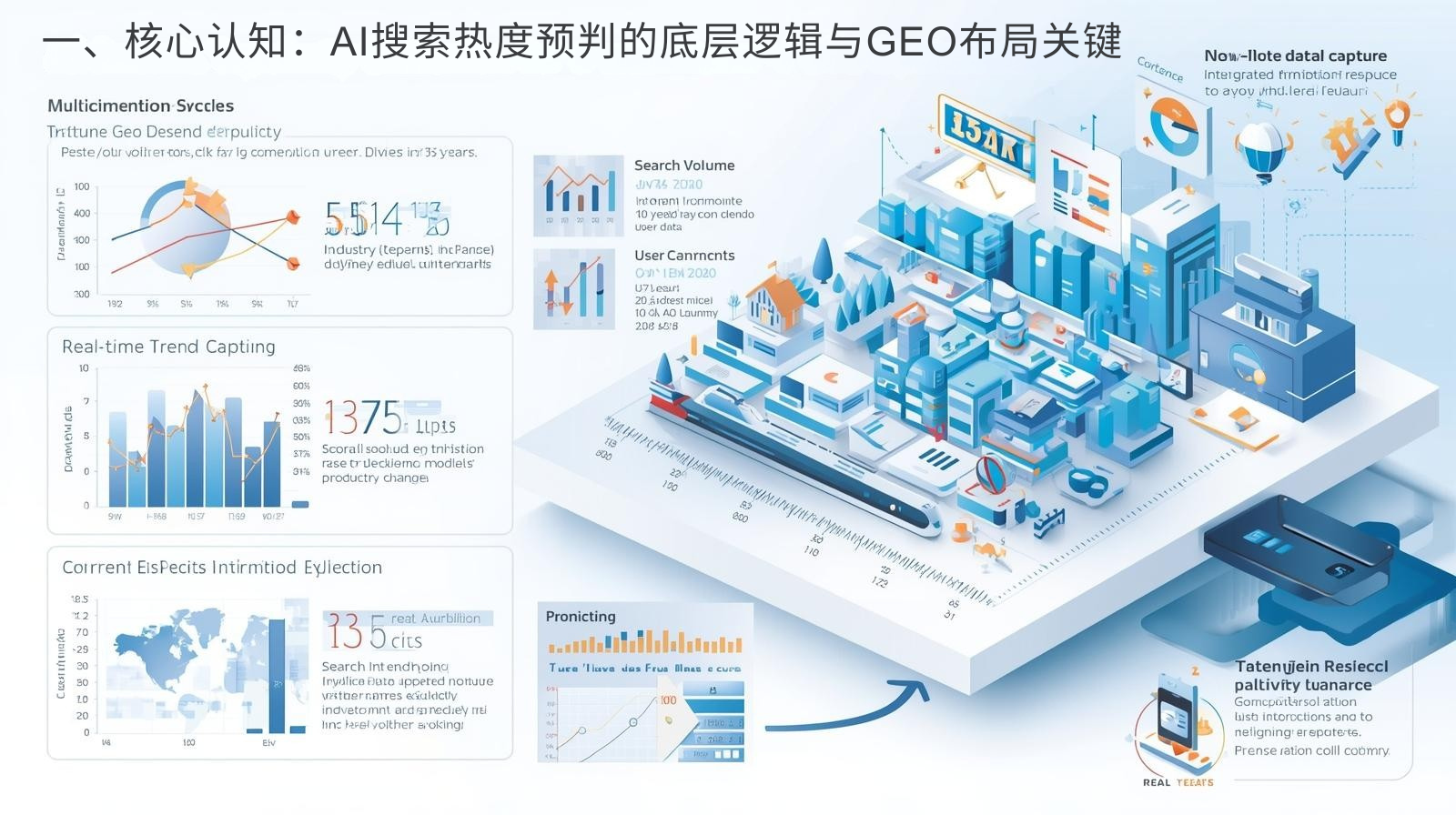
AI platforms predict keyword search popularity not simply by relying on historical data, but based on the core logic of "multi-dimensional data modeling + real-time trend capture + user demand prediction." This allows them to identify potential keywords poised to surge during peak seasons. Many foreign trade companies fall into the misconception that "historical popularity equals prediction," relying solely on last year's peak season keyword strategy while ignoring variables such as market trends, policy changes, and purchasing habits in 2026. This results in keywords that are out of sync with the current peak season's demand. Understanding the underlying logic of AI-driven popularity prediction is crucial for accurately capturing predicted popularity through GEO optimization, allowing keywords to accumulate weight in advance, and quickly seizing a search advantage when the peak season arrives.
1.1 Three Core Dimensions of AI Search Popularity Prediction (Latest Mechanism in 2026)
Based on OpenAI's February 2026 updated "Search Popularity Prediction Algorithm Specification" and practical verification in the foreign trade industry, AI prediction of keyword popularity during peak foreign trade seasons mainly refers to the following three dimensions:
1. Multi-dimensional historical data accumulation: AI will integrate keyword search volume, click volume, and conversion data for the same period in the past 3-5 years (such as the Q3 European and American Christmas peak season and the Q1 spring shopping season), and combine them with the popularity growth curve of the first two quarters of the year to predict the peak popularity and outbreak time of the peak season.
2. Real-time trend dynamic capture: AI will capture industry exhibition information (such as the Canton Fair and the Frankfurt Home Textiles Fair), target market policies (such as new EU regulations and tariff adjustments), and global consumption trends (such as demand for environmentally friendly materials and the trend of small-batch customization) in real time. These variables will directly affect the popularity of keywords during the peak season.
3. Semantic analysis of user needs: By analyzing recent AI dialogue records, search intent, and inquiry content of buyers, AI will predict the core pain points of peak season needs and identify related potential keywords (such as the newly added keywords "carbon-neutral product foreign trade" for the peak season in Europe and the United States in 2026).
1.2 The core differences between GEO+AI predictive layout and ordinary keyword layout
Traditional keyword strategy often involves "following trends and implementing strategies 1-2 months before the peak season," while GEO+AI predictive strategy focuses on "locking in potential keywords in advance and accumulating long-term authority." The core differences lie in three points: First, timing. GEO predictive strategy starts 3-6 months in advance, allowing sufficient time for AI to capture and accumulate keyword authority, while traditional strategy misses this window. Second, keyword selection. GEO predictive strategy uses AI to capture keywords that are "not yet explosive but have great potential," while traditional strategy often chooses popular keywords that are "explosive but highly competitive." Third, optimization logic. GEO predictive strategy incorporates AI-adaptive signals (structured tagging, semantic association), allowing keywords to deeply match the AI search logic, while traditional strategy simply piles up keywords. As Hugo.com's 2026 Foreign Trade Peak Season Marketing Special Interpretation states, "In the AI era, acquiring customers during the foreign trade peak season wins through prediction and succeeds through early planning."
1.3 Common Pitfalls in Keyword Prediction and Strategies for Peak Season
Based on practical cases of foreign trade enterprises in 2026, the following four misconceptions will directly lead to ineffective predictions and failed strategies, and must be resolutely avoided: First, blindly relying on historical data without adjusting keywords according to market trends and policy changes in 2026, resulting in no search results for the targeted keywords; Second, focusing only on popular broad keywords while ignoring long-tail potential keywords (such as "small batch customization of Christmas decorations for Europe and America"), leading to fierce competition; Third, failing to perform GEO optimization after prediction, simply stuffing keywords into content, which cannot be efficiently captured by AI; Fourth, launching the strategy too late, starting only one month before the peak season, so that the keywords have not accumulated enough weight and cannot enter the first page of search results.
II. Practical Implementation: 4-Step GEO+AI Optimization for Early Peak Season Keyword Planning
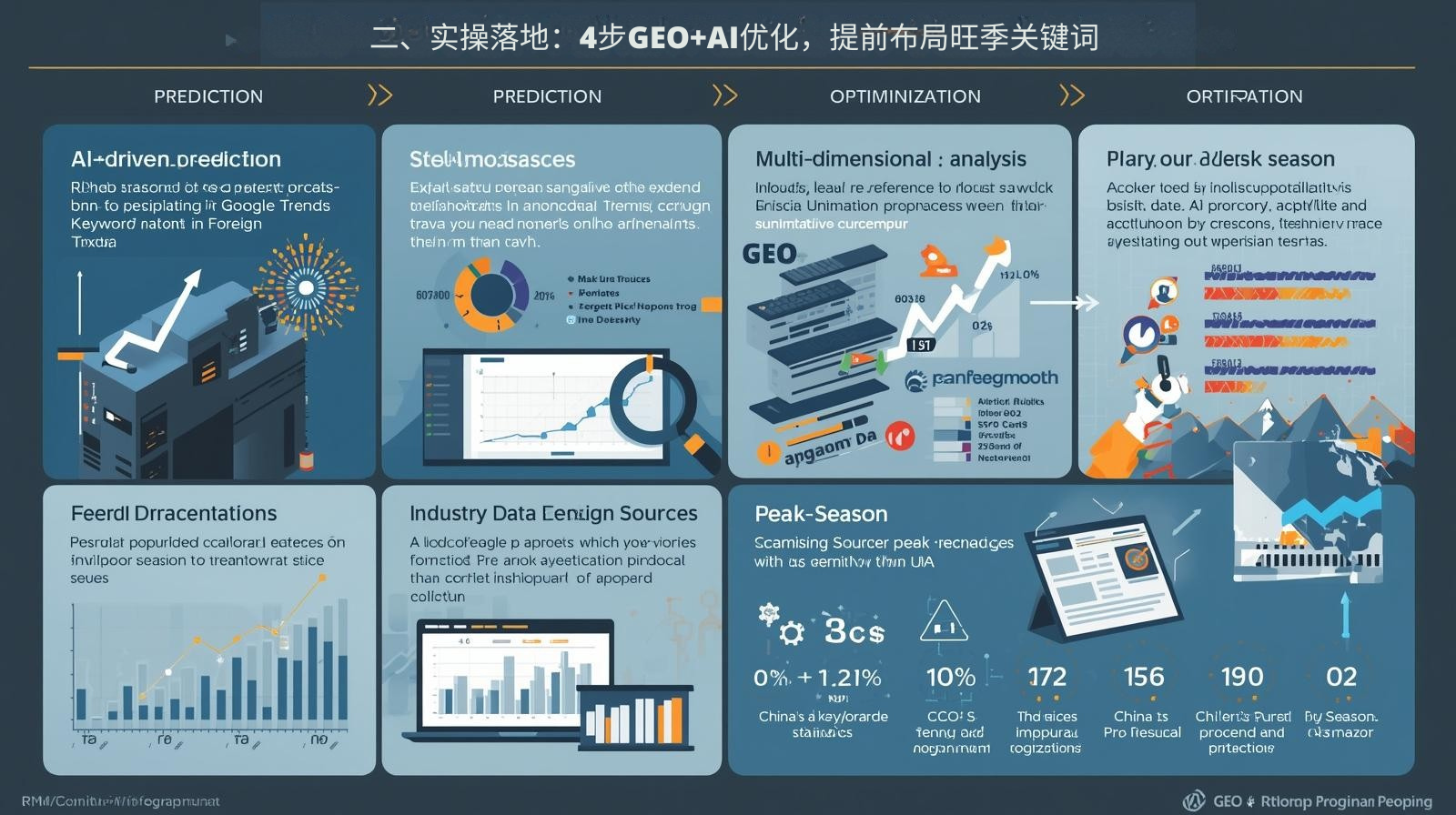
This solution is specifically designed for early keyword planning during the peak season of foreign trade. All operations are aligned with the 2026 AI popularity prediction mechanism and GEO optimization logic, covering the entire process from popularity prediction to peak season iteration. It can be implemented directly without complex technology. The core objective is to identify potential keywords in advance, accumulate weight through GEO optimization, and seize the core position in AI search during the peak season.
2.1 Step 1: AI-driven prediction of peak season keyword popularity (core premise)
Core objective: To accurately predict potential keywords for the 2026 peak season for foreign trade (such as the Christmas season and the spring purchasing season) by leveraging AI tools and multidimensional data, and to identify the timing of the surge in popularity and core demand.
2.1.1 Core Operation Actions
1. Multi-dimensional data tools for prediction: ① Basic popularity tools: Filter historical popularity curves of peak season keywords over the past 3-5 years using Google Trends (link: https://trends.google.com/), focusing on keywords with "increasing popularity year by year and earlier peak periods"; ② AI prediction tools: Use Semrush AI keyword prediction function (link: https://www.semrush.com/) and ChatGPT plugins (such as Keyword Insights), inputting core product categories (such as "women dress" and "industrial parts") and peak season cycles (such as "2026 Q4 Christmas") to generate a list of potential keywords, while obtaining predictions of the peak time (such as "starting to heat up in September 2026, reaching its peak in November"); ③ Industry data references: Refer to Global Sources' 2026 Peak Season Sourcing Trends Report (link: https://www.globalources.com/) and China's foreign trade export statistics (link: https://www.mofcom.gov.cn/). Capture potential keywords driven by policies and the market (such as category keywords related to tariff reductions);
2. Keyword Classification and Screening (Focusing on Potential and Conversion): ① Core Classification: Divided into three categories based on "popularity potential + conversion intention"—high-potential, high-conversion keywords (e.g., "2026 Christmas decorations small batch customization for Europe and America"), high-potential, low-competition keywords (e.g., "carbon-neutral Christmas gift foreign trade supplier"), and long-tail, precise keywords (e.g., "German Christmas lighting compliance certification fast delivery"); ② Screening Criteria: Prioritize keywords with "monthly search volume growth rate ≥ 20%, competition level ≤ 0.6, and high match with the product's core selling points," and avoid broad keywords with "high competition but low conversion intention" (e.g., only "Christmas gift");
3. Marking of Popularity Explosion Points: Mark each predicted keyword with "preheating period, warming period, peak period, and decline period". For example, for keywords related to the Christmas peak season in Europe and the United States in 2026, the preheating period is July-August, the warming period is September-October, the peak period is November, and the decline period is late December, providing a basis for subsequent phased deployment.
2.2 Second step: GEO optimization and implantation, allowing predicted keywords to accumulate weight in advance.
Core objective: Integrate predicted keywords into the core pages of the site, and use GEO optimization to embed AI-recognizable signals, so that keywords can be captured by AI in advance and accumulate weight, laying the foundation for a surge in popularity during the peak season.
2.2.1 Core Operation Actions
1. Precise Keyword Layout (Page-Specific Adaptation): ① Homepage: Incorporate 2-3 core predictive keywords into the title and meta description (e.g., "2026 European and American Women's Christmas Small Batch Customization Foreign Trade Supplier"). Naturally embed keywords in the homepage banner and key selling point areas, avoiding keyword stuffing; ② Product Page: Incorporate 1-2 long-tail predictive keywords into each product title and description. For example, for the Christmas lighting product page, the title can be set as "2026 German Christmas Lighting Compliance Certification Fast Delivery Foreign Trade Customization". The description should elaborate on the product's applicable scenarios and advantages around the keywords (e.g., "Suitable for European and American Christmas peak season procurement needs, with EU CE certification, supports small batch customization, 15-day fast delivery"); ③ Blog Page: Create a peak season-themed blog in advance (e.g., "2026 European and American Christmas Procurement Peak Season: Gift Selection Guide + Compliance Key Points"). Naturally incorporate various predictive keywords into the article, while also using industry data and practical cases to enhance value;
2. GEO Structured Tag Configuration: Using the Rank Math optimization plugin (link: https://rankmath.com/), configure exclusive structured tags for each page, with the entire process described in text: ① Product Page: Configure the "Product" tag, integrating the predicted keywords into the "name", "description", and "keywords" sub-tags, while also linking information such as product MOQ, price, and compliance certifications, allowing AI to clearly identify the relevance between keywords and products; ② Blog Page: Configure the "Article" tag, annotating "headline", "keywords", and "description" to highlight the peak season theme and predicted keywords, while adding the "relevantTo" sub-tag to associate with the peak season scenario (e.g., "Christmas purchasing season 2026"); ③ Homepage: Configure the "WebSite" tag, annotating the core predicted keywords to strengthen the overall relevance between the site and peak season keywords;
3. Semantic association optimization: Expand semantic related words around the predicted keywords (such as the core word "Christmas decorations", semantic words "Christmas ornaments, Christmas decorations, holiday decorations"), and naturally integrate semantic words into the content to form an association system of "core words + semantic words", which improves the AI's recognition of keyword layout, while avoiding the demotion caused by keyword stuffing.
2.3 Third step: Phased content layout to accommodate different periods of popularity.
Core objective: To create tailored content in stages based on the peak popularity of keywords, ensuring that the content accurately meets the search needs of buyers during the pre-heating, warming, and peak periods, and continuously accumulates ranking authority.
2.3.1 Core Operation Actions
1. Warm-up period (3-6 months before peak season): Create content such as "trend interpretation + product selection guide". For example, in July and August, which is the warm-up period for the Christmas peak season, you can publish "2026 European and American Christmas Purchasing Trend Forecast: These 3 types of products will become bestsellers". The content should incorporate high-potential, low-competition prediction keywords and embed the brand's product adaptation advantages. The core goal is to let AI initially grasp the keywords and establish the connection between the site and the peak season theme; ② Page optimization: Complete the keyword layout and GEO tag configuration of the homepage and core product pages to ensure that the basic weight begins to accumulate;
2. Warm-up Period (1-3 months before peak season): Create content featuring "practical details + case studies," such as during the Christmas peak season warm-up period in September-October, publishing articles like "2026 Christmas Gift Foreign Trade Customs Clearance Practical Guide: Avoiding Pitfalls + Case Analysis" and "European and American Christmas Small Batch Procurement Case: 30-Day Fast Delivery Record." The content should prominently incorporate high-potential, high-conversion predictive keywords, while strengthening internal link connections (blog page links to product pages). The core objective is to increase keyword weight and attract inquiries from buyers during the pre-heating period; ② Interaction Optimization: Add modules such as "Peak Season Stocking Reminder" and "Small Batch Customization Channel" to product pages, incorporating predictive keywords to improve user experience and conversion intention;
3. Peak Period (Peak Season Month): Create "Emergency Guide + Promotion" content, such as "2026 Christmas Peak Season Inventory Emergency Plan: What to Do If Inventory is Insufficient?" during the November Christmas peak season. The content incorporates long-tail precise predictive keywords, while optimizing site loading speed and simplifying the inquiry process. The core goal is to handle the surge in search demand and maximize the conversion of inquiries; ② Signal Strengthening: Update GEO structured tags and add sub-tags such as "Peak Season Promotion" and "Fast Delivery" to improve the priority of AI search matching.
2.4 Fourth Step: Real-time monitoring and iteration to dynamically optimize the layout effect
Core objective: To track and predict changes in keyword popularity and ranking in real time, adjust strategies promptly to address deviations, and ensure that core keywords remain competitive in search results during peak seasons.
2.4.1 Core Operation Actions
1. Core Metric Monitoring: ① Popularity Monitoring: Track the search volume changes of predicted keywords in real time using Google Trends and Semrush. If the popularity of a keyword surges earlier or later than expected, adjust the content layout rhythm accordingly. ② Ranking Monitoring: Regularly search predicted keywords in ChatGPT and Google SGE to check the site's ranking. Simultaneously, monitor keyword weight changes using Ahrefs (link: https://ahrefs.com/). ③ Conversion Monitoring: Monitor the traffic, visit duration, and inquiry conversion rate brought by each predicted keyword using Google Analytics (link: https://analytics.google.com/) to identify high-conversion keywords for focused optimization.
2. Dynamic Optimization and Adjustment: ① Keyword Optimization: If the predicted popularity of a keyword does not meet expectations, supplement related semantic words and content details to strengthen the GEO signal; if a long-tail keyword has good conversion results, increase the layout of that keyword on product pages and blog pages; ② Content Optimization: Based on buyer inquiry feedback, update the core selling points in the content (e.g., during peak season, buyers focus on delivery cycles, so information such as "10-day fast delivery" can be emphasized in the content); ③ Weight Enhancement: Obtain high-weight industry backlinks for high-potential keywords (e.g., publish to Hugo.com industry column: https://www.cifnews.com/) to improve keyword ranking stability;
3. Peak Season Review and Consolidation: After the peak season ends, review the accuracy of the predicted popularity of each keyword, its ranking, and conversion effect, and consolidate the experience of keyword layout in the 2026 peak season to provide data support for the prediction and layout of the next year.
III. Avoidance Guide: Common Mistakes in Predicting and Implementing Keyword Strategies for the 3 Peak Seasons
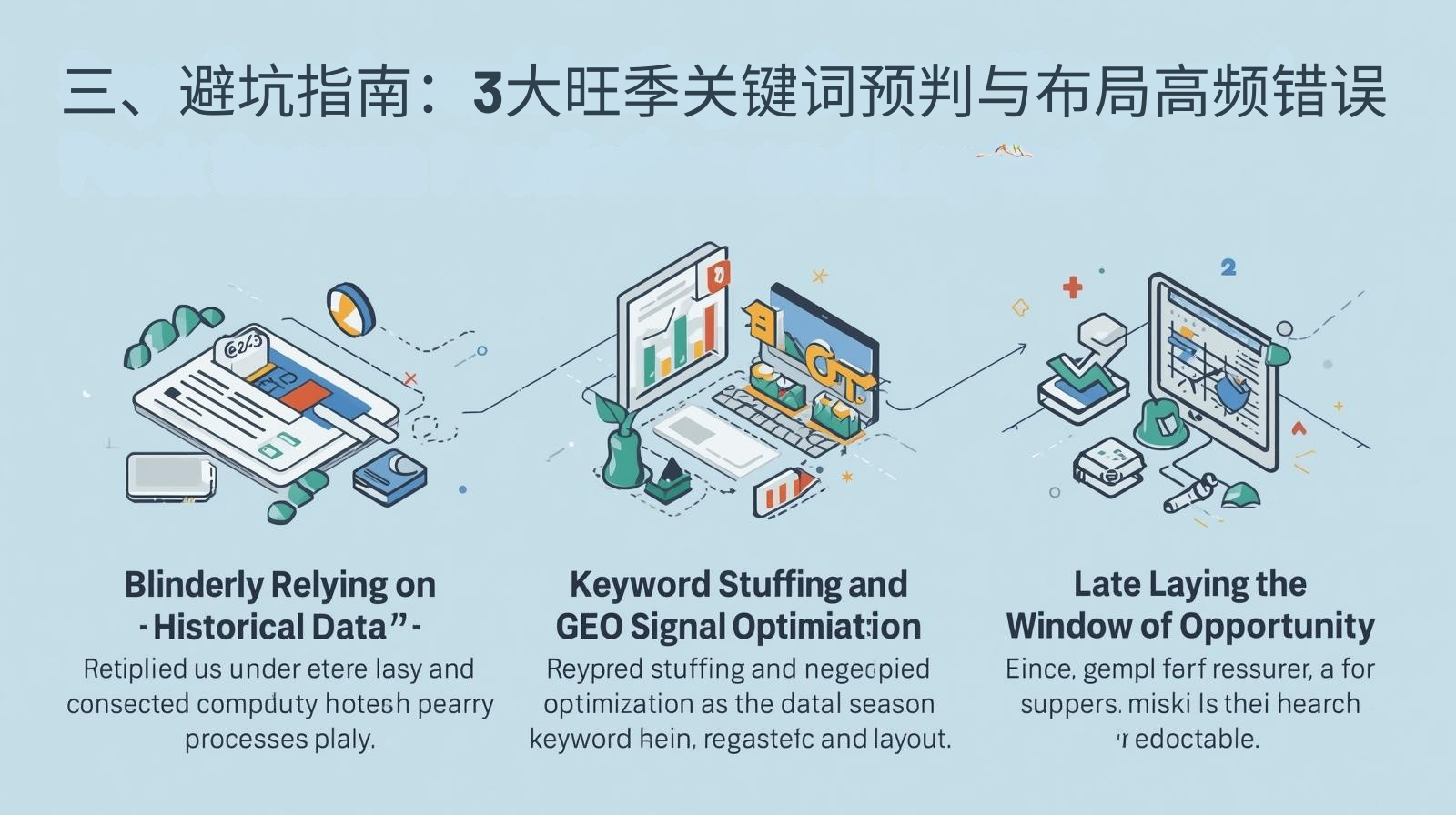
Based on practical lessons learned by foreign trade enterprises in 2026, the following three mistakes can directly lead to ineffective predictions and failed strategies, and must be carefully avoided:
3.1 Mistake 1: Blindly relying on historical data and ignoring market variables in 2026
Error : Simply copying the keyword strategy for the 2025 peak season without adjusting the keywords to take into account the target market policies (such as the EU's new carbon footprint regulations) and consumption trends (such as the demand for environmentally friendly materials) in 2026, resulting in the keywords being out of touch with the procurement needs of that year;
Core harm : During peak season, core keywords have no search volume, the site cannot obtain AI search traffic, and all the investment in advance is wasted;
The correct approach is to combine AI-powered predictive tools with industry trends and policy data for 2026 to select potential keywords that align with market demands that year, rather than blindly copying historical data.
3.2 Error 2: Keyword stuffing, neglecting GEO signal optimization
Errors include : blindly piling up predicted keywords on the page (e.g., repeating "Christmas decorations" more than 3 times in the product title), failing to configure GEO structured tags, and failing to optimize semantic association;
Core harm : AI determines that the content is low-quality keyword stuffing, triggering a penalty in search rankings. Even if the keyword becomes popular, the site will not be able to achieve a good ranking.
Correct approach : Naturally place keywords in the core position of the page, configure exclusive GEO structured tags, and pair them with semantic related words to improve AI recognition.
3.3 Mistake 3: Late timing of deployment, missing the window of opportunity for weight accumulation
Error : Keyword strategy was only started one month before the peak season, without allowing enough time for AI to crawl and accumulate weight. When the peak season hit, the keyword ranking was still in the latter half of the search page.
Core harm : Missing the best customer acquisition window during the peak season, watching competitors seize core traffic through early planning, while your own inquiry volume is very small;
Correct approach : Start forecasting and planning 3-6 months in advance, and gradually optimize in stages: warm-up period, warm-up period, and peak period, allowing sufficient time for keywords to accumulate weight.
Recommended Article: Your Competitors Haven't Reacted Yet: Building an Independent E-commerce Website with GEO is the Biggest Blue Ocean Strategy Right Now
Recommended Article: Your Competitors Haven't Reacted Yet: Building an Independent E-commerce Website with GEO is the Biggest Blue Ocean Strategy Right Now
IV. Conclusion: Anticipating needs and taking proactive measures to unlock new heights in AI-driven customer acquisition during peak foreign trade seasons.
In 2026, the AI search competition during the peak season for foreign trade has entered an era of "predictive victory," where simply following trends is no longer sufficient to meet customer acquisition needs. The core of GEO+AI search popularity prediction is not "betting on the right keywords," but rather using AI to accurately capture market trends and user needs, combined with GEO optimization to accumulate authority in advance. This ensures the site appears in the core positions of AI search results at the very moment peak season procurement demand surges, achieving a closed loop of "demand arrives, traffic is acquired, and inquiries are converted." For foreign trade enterprises, pre-planning peak season keywords is not only about seizing search opportunities but also about building core competitiveness for customer acquisition during the peak season.
To maximize the effectiveness of keyword strategy during peak season, a smooth, stable, and GEO+AI-optimized independent website is the core platform. Many foreign trade companies, when planning ahead, suffer from weak website infrastructure, resulting in slow page loading, rigid keyword layout templates, and cumbersome GEO tag configurations. This hinders the efficient accumulation of keyword authority and leads to missed peak season opportunities. PinDian Technology, with over ten years of experience in foreign trade website building and serving over 7000 clients, uses React technology to build websites. This not only ensures a smoother browsing experience (overseas loading speed ≤2 seconds, adaptable to multiple devices) but also fundamentally adapts to the needs of early peak season keyword planning—featuring built-in AI-friendly keyword layout templates, standardized GEO structured tag configuration entry points, and phased content publishing tools. It also supports global CDN acceleration to ensure stable access during peak season traffic. PinDian website building can simultaneously assist companies in identifying predicted keywords for the 2026 peak season and building a phased layout system. Combined with the 4-step practical solution in this article, your foreign trade website will be fully prepared before the peak season arrives, allowing you to seize core AI search traffic. If your foreign trade company is facing difficulties such as "inaccurate prediction of peak season keywords, confusion about the timing of layout, and low customer acquisition efficiency", you might as well choose PinDian Technology. With professional website building services and precise GEO optimization, you can unlock a new level of AI customer acquisition in the 2026 foreign trade peak season.