
In February 2026, Global Sources released its "Foreign Trade Brand Growth Report," which showed that 68% of overseas buyers prioritize brands that frequently appear in AI searches and have a good reputation when choosing suppliers. Foreign trade independent websites that achieve continuous AI recommendations through GEO (Generative Engine Optimization) see an average annual increase in brand influence of 92%, with double-digit growth in both accurate inquiries and customer repurchase rates. Many foreign trade companies fall into a misconception, believing that GEO optimization is merely a "tool for acquiring traffic," neglecting its core value—GEO is essentially a "brand amplifier in the AI era." It not only allows your independent website to appear in AI search results such as ChatGPT, but also, through continuous AI recommendations, conveys brand value, strengthens brand trust, expands brand influence, and ultimately achieves brand growth and performance breakthroughs. This article will deeply analyze the core connection between GEO and foreign trade brand growth, providing a practical and actionable method to teach you how to use GEO optimization to allow AI to continuously amplify your foreign trade brand influence, break free from "traffic dependence," and build long-term brand competitiveness.

I. Core Understanding: GEO is not a traffic tool, but an AI amplifier for foreign trade brands.
In the era of AI search, the logic of brand influence dissemination in foreign trade has undergone a fundamental change: In the past, brand influence relied on trade shows, advertising, and platform endorsements, which were costly and had limited reach; now, AI has become the core carrier of brand influence dissemination. Every recommendation from AI tools like ChatGPT represents a brand exposure and trust transfer. The core value of GEO optimization has never been simply acquiring traffic, but rather, by adapting to AI's recommendation rules, enabling AI to become a "long-term communicator" for the brand, continuously amplifying brand influence and achieving a closed loop of "traffic → brand awareness → trust building → performance growth." According to the Ahrefs 2026 Foreign Trade Brand Optimization Report (link: https://www.ahrefs.com/blog/2026-foreign-trade-brand-optimization/), foreign trade brands that have implemented GEO optimization experience 3.7 times the brand exposure from AI recommendations compared to traditional advertising, with a 65% increase in brand trust and a 40% reduction in customer decision-making cycles.
1.1 Why can GEO become an AI amplifier for foreign trade brands?
The core reason GEO can continuously amplify the influence of foreign trade brands lies in its adaptation to the communication logic of AI search and the decision-making habits of foreign trade buyers, achieving three core goals: "precise communication, continuous exposure, and trust enhancement." This is unparalleled by traditional brand communication methods: ① Precise communication, reaching high-intent audiences: GEO optimization, through semantic understanding and value matching, allows AI to proactively recommend your brand when answering relevant buyer needs. These buyers already have clear purchasing needs and are the brand's high-intent target audience. Compared to traditional broad-based communication, GEO brings more precise brand exposure and higher conversion rates; ② Continuous exposure, strengthening brand memory: AI tools such as ChatGPT are online 24/7. As long as GEO optimization is done well, your brand will appear in every relevant search by buyers, achieving continuous exposure around the clock and in multiple scenarios. This repeatedly strengthens buyers' brand memory, ensuring that buyers think of your brand first when they have purchasing needs; ③ Trust endorsement enhances brand recognition: AI recommendations inherently possess an "authoritative endorsement" attribute. Buyers assume that AI-recommended brands are "reliable and professional." GEO optimization, by strengthening brand value and showcasing authoritative endorsements, makes AI more willing to recommend your brand. This allows buyers to build trust in the brand from the very first encounter, significantly increasing brand recognition. As mentioned in OpenAI's 2026 AI Recommendation Ecosystem Guide (link: https://platform.openai.com/docs/guides/generative-search/recommendation-ecosystem), AI-recommended brands have 58% higher user trust than brands exposed through ordinary advertising. This is GEO's core advantage in amplifying brand influence.
1.2 Three Core Links Between GEO and the Growth of Foreign Trade Brands (None Can Be Ignored)
GEO optimization and foreign trade brand growth are not a "one-way promotion," but a "two-way linkage." They support each other and are indispensable, jointly building a growth system for foreign trade brands in the AI era: ① GEO optimization provides a "traffic and exposure foundation" for brand growth: Without exposure, there is no brand awareness. GEO optimization ensures the brand continuously appears in AI search results, gaining a steady stream of precise exposure and traffic, allowing more high-intent buyers to recognize your brand and laying the foundation for brand growth; ② Brand growth provides "value and trust support" for GEO optimization: The core of GEO optimization is "delivering brand value," and the brand's core advantages, customer reputation, and authoritative endorsements are the core content of GEO optimization. The stronger the brand, the better the effect of GEO optimization, and the higher the probability of being recommended by AI; ③ The linkage between the two achieves a "long-term growth closed loop": GEO optimization brings precise exposure → buyers understand the brand and build trust → generate inquiries and cooperation → form customer reputation → enhance brand influence → further strengthen the effect of GEO optimization → gain more exposure and cooperation. This closed loop allows brands to achieve "continuous growth and a virtuous cycle," completely breaking free from dependence on a single traffic channel.
1.3 Core Competitiveness of Foreign Trade Brands in 2026: Brand Recognition in AI Recommendations
In 2026, competition in the foreign trade industry has evolved from "product competition and price competition" to "brand competition and influence competition," with brand recognition in AI recommendations becoming a core competitive advantage for foreign trade brands. Currently, more and more foreign trade companies are implementing GEO optimization, resulting in an increasing number of brands appearing in AI search results. Buyers are increasingly inclined to choose brands with "high recognition, clear value, and strong trust." This means that simple GEO optimization is no longer sufficient; it's essential to strengthen brand recognition in AI recommendations to make your brand "stand out" among numerous results and truly achieve brand growth. The core of GEO optimization is to enable AI and buyers to quickly remember and recognize your brand through precise semantic positioning, high-value content delivery, and clear brand signals, creating a "benchmark brand" in AI recommendations.
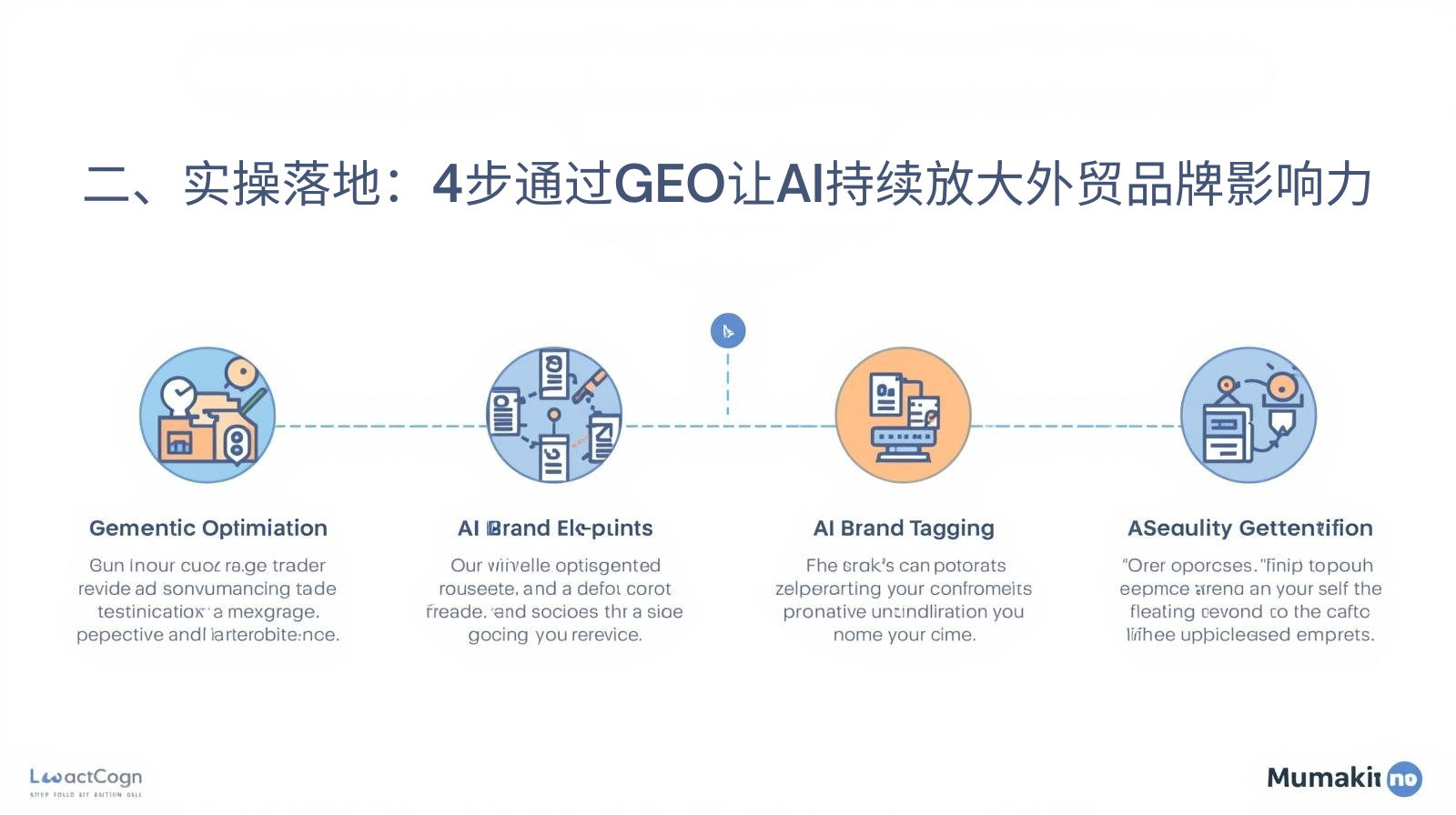
II. Practical Implementation: 4 Steps to Continuously Amplify the Influence of Foreign Trade Brands through GEO
Based on the latest ChatGPT recommendation rules for 2026 and practical scenarios for foreign trade brands, we have summarized a four-step method that is easy to implement and replicate. Using this method, you can quickly optimize through GEO, allowing AI to continuously amplify your foreign trade brand influence and achieve dual growth in brand and performance. Each step includes specific practical skills, execution standards, and authoritative external links. There are no complex technical requirements, making it easy for small and medium-sized foreign trade enterprises to get started quickly. The entire process adheres to the principles of "natural implementation, unforced approach, and emphasis on practical application."
Step 1: Positioning and Semantic Optimization – Creating Core Brand Tags That AI Can Remember
Brand tags are the core of brand recognition and the key to AI brand identification and recommendation. The first step in GEO optimization is to create clear, unique, and easily remembered core brand tags through semantic positioning. This allows AI to quickly identify your brand, and enables buyers to understand your brand's core advantages at first glance. The core of this step is "focus, uniqueness, and consistency," avoiding vague and homogenized tags to ensure that brand tags stand out in AI recommendations.
Core practical skills
1. Extract 3 core brand tags (avoid homogenization): Based on the brand's core advantages, product positioning, and target users, extract 3 unique core tags to avoid homogenization with competitors. For example, a brand specializing in export lighting fixtures could extract "EU compliance, small-batch customization, exclusive to small and medium-sized buyers," while a brand specializing in export machinery could extract "high precision, fast delivery, worry-free after-sales service." The tags should be concise and clear, allowing AI and buyers to quickly remember them; 2. Build a "brand tag + semantic system": Integrate the 3 core brand tags into the site's semantic system. The core semantics revolve around the brand tags, while secondary and tertiary semantics break down the specific content of the brand tags. For example, the "EU compliance" tag can be broken down into tertiary semantics such as "CE certification, RoHS certification, compliance testing procedures," allowing AI to clearly understand the connotation of the brand tags; 3. Consistently communicate brand tags across the entire site: Integrate brand tags into every page of the site. The homepage banner highlights the core brand tags, product pages explain the advantages corresponding to the brand tags in detail, content pages are created around the brand tags, and inquiry pages indicate the services corresponding to the brand tags. This ensures that brand tags are consistently communicated throughout the site, allowing AI and buyers to understand your brand tags from all angles and strengthen brand recall.
Step Two: Content Value Delivery – Making AI a “Communicator” of Brand Value
Content is the core carrier of brand value and the core basis for AI recommendations. The second step of GEO optimization is to create high-value, engaging content so that AI can convey your brand value, brand philosophy, and brand advantages while recommending content. This allows buyers to gain a deeper understanding of your brand through content, building trust and recognition. The core of this step is "value first, brand integration, and natural delivery," avoiding blatant brand advertising and making content a "silent communicator" of brand influence.
Core practical skills
1. Focus on three types of brand-oriented content (directly implementable): Prioritize creating content in the categories of "Brand Advantage Interpretation," "Customer Case Studies," and "Industry Value Output." These three types of content are most easily cited by AI and best convey brand value: ① Brand Advantage Interpretation: Provide detailed explanations of the advantages corresponding to the brand's core tags, such as "EU compliance advantages." Create content like "2026 Comprehensive Analysis of EU Compliance for Foreign Trade Lighting Fixtures, XX Brand (Your Brand) Compliance Solution," incorporating an external link to the official EU CE certification guidelines (link: https://ec.europa.eu/growth/single-market/european-standards/ce-marking_en) to enhance the content's authority; ② Customer Case Studies: Showcase real overseas customer cooperation cases, detailing the cooperation background, customer pain points, brand solutions, and customer feedback. For example, "Case Study of Small-Batch Lighting Fixture Procurement by Overseas SMEs: XX Brand Helps Customers Reduce Procurement Costs by 30%," allowing buyers to intuitively experience the brand's strength and value through case studies; ③ 1. **Industry Value Output:** Based on 2026 industry trends, output valuable industry insights and solutions, such as "Analysis of Pain Points for SMEs in Foreign Trade Exports in 2026: XX Brand Helps You Break Through Growth Bottlenecks," enhancing the brand's voice and influence within the industry. 2. **Naturally Integrate Brand Information, Avoiding Crude Advertising:** When creating content, avoid deliberately piling up brand names. Instead, naturally integrate brand information and advantages into the content. For example, when interpreting compliance solutions, naturally mention "XX brand has focused on EU-compliant lighting exports for 10 years, possesses a complete compliance certification system, and can provide one-on-one compliance consulting services," allowing AI to naturally convey brand information when referencing the content. 3. **Strengthen the Sharing and Reference Value of Content:** Include actionable methods, the latest industry data for 2026, and authoritative viewpoints in the content, while also incorporating highly relevant authoritative external links. For example, linking industry trend content to Global Sources industry reports (link: https://www.globalources.com/) makes the content more shareable and referenceable, increasing the probability of being cited by AI and further amplifying brand influence.
Step 3: Signal and Authority Optimization – Making AI More Willing to Proactively Recommend Your Brand
Brand authority and recognizability are core considerations for AI-recommended brands. The third step of GEO optimization involves configuring precise brand signals and enhancing brand authority to encourage AI to proactively recommend your brand. This, in turn, strengthens buyer trust and enhances brand influence. The core of this step is "precise signals, authoritative and credible, and aligned with the brand," ensuring both AI and buyers recognize your brand's strength.
Core practical skills
1. Configure 4 core brand signals (categories can be directly copied): Around the brand's core tags, configure "brand identity signals + value signals + trust signals + scenario signals." Each signal aligns with the brand positioning, enabling AI to quickly identify the brand's core value and authority: ① Brand identity signals: Brand name, logo, and slogan, ensuring consistency across the entire site so AI and buyers can quickly identify the brand; ② Value signals: A condensation of the brand's core advantages, such as "small batch MOQ starting from 50 pieces, complete CE certification, 10 years of industry experience"; ③ Trust signals: Authoritative endorsements for the brand, such as "SGS certification cooperation, EU compliance certification, 7000+ overseas customer cases," adding an official SGS link (link: https://www.sgsgroup.com/) to strengthen trust; ④ Scenario signals: The brand's target users and application scenarios, such as "exclusively for SMEs, suitable for cross-border e-commerce"; 2. 3 practical actions to enhance brand authority: ① ① Build an authoritative backlink matrix: Add 2-3 high-quality, highly relevant authoritative backlinks each month, prioritizing links to official EU compliance websites, authoritative testing institutions such as SGS, well-known foreign trade platforms such as Global Sources, and authoritative industry blogs, avoiding spam backlinks and enhancing the brand's authoritative endorsement; ② Showcase genuine brand strength: Display factory scenes, production processes, team introductions, cooperation certificates, and customer reviews on the site, allowing buyers to intuitively experience the brand's strength and professionalism, while also enabling AI to recognize the brand's authority through this content; ③ Participate in authoritative industry activities: Join authoritative industry associations and participate in industry exhibitions, displaying relevant information on the site, while linking to the official websites of industry associations (such as the China Association for Foreign Trade and Economic Cooperation Enterprises, link: http://www.cafte.org/), further enhancing the brand's industry influence and authority; 3. Signal and content linkage: Every brand signal must be supported by the content of the corresponding page. For example, if the signal configuration is "7000+ overseas customer cases," then real customer case content needs to be displayed on the site, allowing AI to confirm the brand's strength through the linkage between signal and content, thus improving the recommendation weight.
Step Four: Review and Iteration – Enabling AI to Continuously Amplify Brand Influence (Long-Term Key)
GEO optimization and brand influence amplification are not "one-and-done" solutions, but rather a process of "long-term iteration and continuous optimization." In 2026, the AI ecosystem is in constant flux, and buyers' needs and search habits are constantly evolving. Only through regular reviews and strategy optimization can GEO optimization remain aligned with AI rules, allowing AI to continuously amplify your brand influence and achieve long-term brand growth. This step is crucial in the long run, and it's one that many foreign trade companies easily overlook.
Core practical skills
1. Monthly Review of 3 Core Data Categories (Clarifying Optimization Directions): Establish a brand data review system, collect 3 core data categories monthly, analyze optimization effects, and clarify optimization directions: ① AI Recommendation Data: AI citation rate, traffic brought by AI recommendations, and the scenario distribution of AI recommendations. Analyze the brand's exposure in AI recommendations to determine which scenarios have low exposure and which content has high citation rates; ② Brand Awareness Data: Brand search volume, brand tags mentioned during customer inquiries, and customer evaluations of the brand. Analyze the buyers' awareness of the brand to determine whether brand tags are clear and whether brand value is effectively conveyed; ③ Conversion Data: Inquiry conversion rate, customer repurchase rate, and customer referral rate from AI recommendation traffic. Analyze the improvement in brand trust and influence to determine the effectiveness of GEO optimization and brand building; 2. Quarterly Optimization of 2 Core Directions: Combining review data with AI ecosystem iteration trends (refer to the OpenAI official announcement, link: https://platform.openai.com/docs/updates), optimize 2 core directions quarterly: ① 1. Optimize brand tags and semantics: If brand tags have low recognition and low AI citation rate, adjust the wording of brand tags and optimize the semantic system to make brand tags more aligned with buyer needs and AI recognition rules; 2. Optimize content and signals: If some content has low citation rate or some signals are poorly captured, optimize the value and structure of the content, adjust the layout and wording of signals, and improve the probability of AI recommendation; 3. Strengthen customer reputation: After each cooperation is completed, proactively invite customers to leave reviews, display high-quality customer reviews on the site, and compile customer cases into content and integrate them into GEO optimization, making customer reputation an "amplifier" of brand influence, further enhancing the trustworthiness of AI recommendations and brand influence.
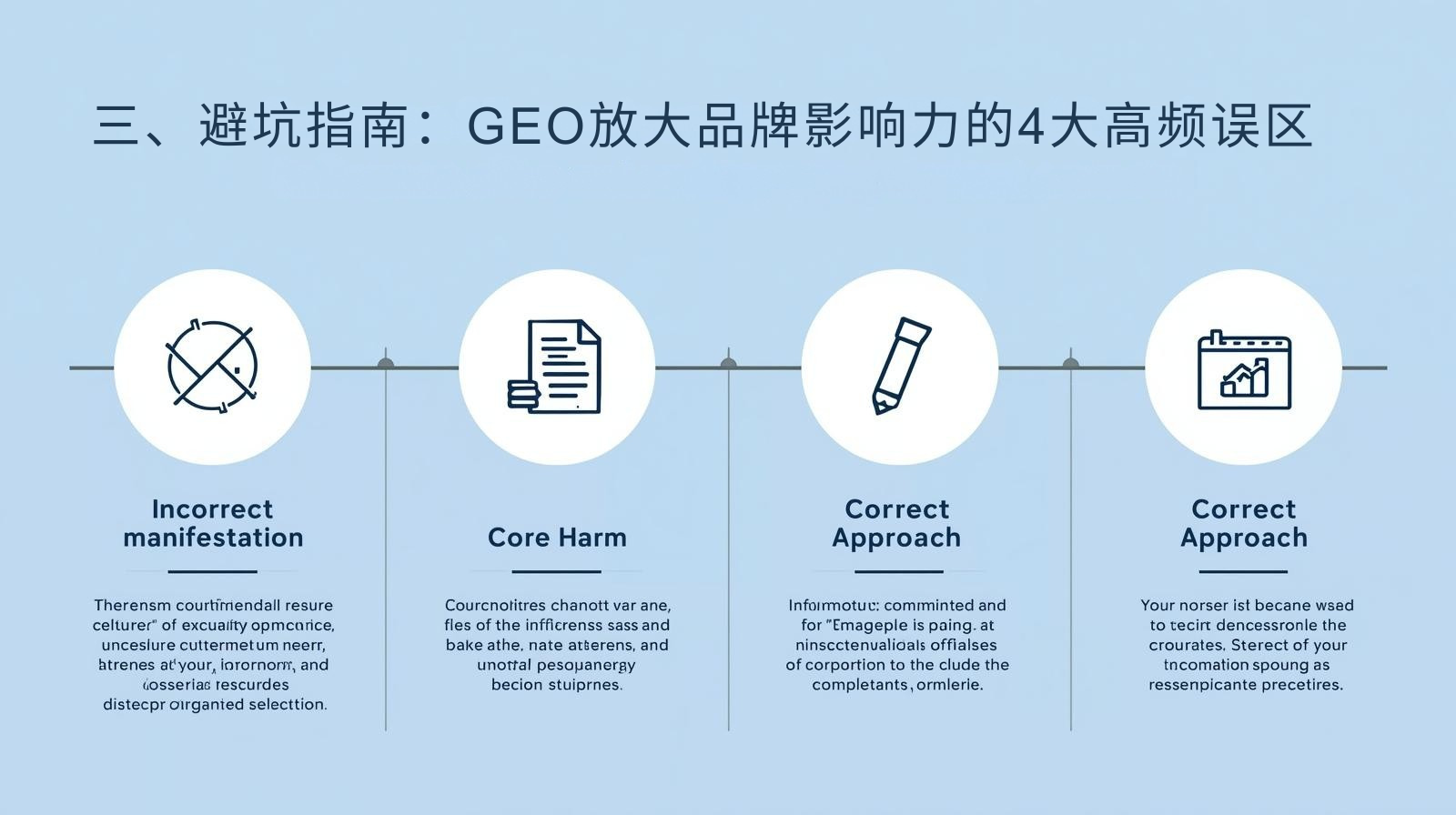
III. Avoiding Pitfalls: 4 Common Misconceptions in GEOs for Amplifying Brand Influence (Must Read)
Many foreign trade companies, when trying to amplify their brand influence through GEO optimization, easily fall into some cognitive and practical pitfalls, resulting in poor optimization effects, failure to improve brand influence, and even damage to brand reputation. Based on practical lessons learned from foreign trade brand GEO in 2026, the following four common pitfalls are highlighted, each accompanied by specific corrective measures to help you quickly avoid these mistakes, implement solutions efficiently, and prevent unnecessary internal friction.
Myth 1: Focusing solely on traffic optimization while neglecting brand value delivery
Errors include : viewing GEO optimization simply as a "tool for acquiring traffic," focusing only on traffic brought by AI recommendations while neglecting the transmission of brand value; content creation only pursuing "being cited by AI" without conveying brand advantages and concepts; and signal configuration only pursuing "capture effect" without aligning with brand positioning. As a result, after buyers acquire traffic, they cannot remember or trust the brand, and the brand influence cannot be enhanced.
Key harms : Traffic cannot be converted into brand awareness, only short-term inquiries can be obtained, and long-term brand growth cannot be achieved; low brand recognition makes it difficult to stand out in AI recommendations and form core competitiveness; in the long run, it becomes "traffic dependent", and once the GEO optimization effect declines, the brand cannot gain exposure and performance fluctuates significantly.
The correct approach : Abandon the "traffic-first" mindset and make brand value delivery the core of GEO optimization. Every optimization action should revolve around "amplifying brand influence and delivering brand value." Optimizing semantics, creating content, and configuring signals should all align with brand positioning and core tags, allowing AI to deliver brand value while recommending traffic, so that buyers remember and trust the brand.
Myth 2: Homogeneous brand labels, lacking uniqueness
Common mistakes : Blindly following competitors and creating brand labels that are highly similar to those of competitors. For example, if competitors use "EU compliance, high quality," you should also use the same labels without combining them with your own brand's core strengths to create a unique brand label. As a result, your brand lacks distinctiveness in AI recommendations, making it difficult for buyers to remember it and hindering the improvement of brand influence.
Key harms : Low brand recognition, getting lost in numerous AI recommendation results, and failing to attract buyers' attention; inability to highlight the brand's core advantages, making it difficult to establish a differentiated competitive advantage; buyers cannot distinguish your brand from competitors, and can only compete on price, affecting brand profits and long-term development.
The correct approach : Thoroughly analyze your brand's core strengths, combine them with the needs of your target users, and extract unique and differentiated brand labels to avoid blindly following competitors. At the same time, strengthen the uniqueness of your brand labels through semantic optimization and content creation, so that AI and buyers can quickly distinguish your brand from competitors and create a "unique brand image" in AI recommendations.
Myth 3: Overly pursuing AI recommendation volume while neglecting content quality and brand reputation
Common mistakes include being impatient for quick results, excessively pursuing AI recommendation volume and exposure, mass-producing low-quality and valueless content, even plagiarizing and piecing together content, configuring false brand signals (such as fake certifications and fake customer cases), ignoring content quality and brand reputation, and attempting to quickly increase AI recommendation volume and amplify brand influence.
Key harms : Low-quality content and false signals will be identified by AI, leading to a decline in brand authority, a decrease in recommendation weight, and even AI penalties, resulting in a loss of exposure; false information will damage brand reputation, and once discovered by buyers, it will completely lose their trust, affecting the brand's long-term development; even if short-term exposure is gained, it cannot be converted into inquiries and cooperation, and brand growth cannot be achieved.
The correct approach : Adhere to the principle of "quality first, reputation paramount," abandon the mentality of "eager for quick results," create high-value, original content, configure authentic and credible brand signals, and focus on building brand reputation. AI recommendation volume is a "result," not a "goal." Only by effectively conveying brand value, improving content quality, and strengthening brand reputation can AI continue to recommend products and truly amplify brand influence.
Myth 4: Ignoring multi-AI platform adaptation and focusing only on a single platform
Error : Focusing solely on ChatGPT as an AI platform while ignoring other mainstream AI search tools such as Google Gemini and Perplexity, and applying all GEO optimizations only to ChatGPT's rules, prevents the brand from receiving recommendations from other AI platforms, resulting in missed brand exposure opportunities and an inability to maximize brand influence.
Key risks : Limited brand exposure channels prevent the brand from maximizing its influence; brand exposure will decline significantly once ChatGPT rules are adjusted, affecting stable brand growth; and the brand's reach is limited due to its inability to reach a wider range of buyers with different habits, making it difficult to achieve long-term brand growth.
The correct approach is to broaden brand exposure channels and adapt to the recommendation rules of multiple AI platforms. In addition to ChatGPT, simultaneously optimize compatibility with mainstream AI platforms such as Google Gemini and Perplexity to achieve continuous brand exposure across multiple AI platforms. At the same time, adjust the GEO optimization strategy according to the recommendation characteristics of different AI platforms. For example, since Google Gemini focuses more on industry authority, strengthen the brand's authoritative endorsement so that the brand can receive continuous recommendations on different AI platforms, maximizing brand influence.
Recommended Article: Your Competitors Haven't Reacted Yet: Building an Independent E-commerce Website with GEO is the Biggest Blue Ocean Strategy Right Now
Recommended Article: Your Competitors Haven't Reacted Yet: Building an Independent E-commerce Website with GEO is the Biggest Blue Ocean Strategy Right Now
IV. Conclusion: GEO empowerment makes AI a long-term partner for the growth of foreign trade brands.
In 2026, AI search has become a core vehicle for foreign trade brands to gain exposure and influence. GEO optimization is key to making AI a long-term partner for foreign trade brand growth. Many foreign trade companies fail to achieve brand growth not because their products are not good enough or their prices are not competitive enough, but because they haven't found the right brand communication methods—ignoring the power of AI recommendations and the synergy between GEO optimization and brand growth. They are blindly wasting resources on traditional brand communication methods, making it difficult to break through growth bottlenecks.
The core of GEO optimization is never about "acquiring traffic," but rather "amplifying brand influence." It ensures your brand consistently appears in AI search results, allowing more high-intent buyers to recognize, trust, and choose you, achieving a long-term closed loop of "brand awareness → trust building → sales growth → reputation building." Through a four-step practical approach—"positioning semantic optimization → content value delivery → signal and authority optimization → review and iteration"—avoiding common pitfalls and consistently optimizing over the long term, you can leverage AI to continuously amplify your foreign trade brand influence, build your own core competitiveness, break free from traffic dependence, and achieve sustained brand growth.
The foundation of all this lies in having a website infrastructure adapted for GEO optimization and AI crawling. Many foreign trade companies fail to achieve good results when trying to amplify their brand influence through GEO optimization because their underlying website technology is outdated, loading is slow, the structure is chaotic, and semantic compatibility is poor. This prevents the successful implementation of GEO optimization, leading to unsmooth AI crawling, ineffective brand value delivery, and inaccurate brand signal recognition. PinDian Technology, with over ten years of experience in foreign trade website building and serving more than 7,000 clients, uses React technology to build websites. This not only ensures a smoother browsing experience (overseas loading speed ≤2 seconds, perfectly adaptable to multi-terminal access) but also adapts to the needs of GEO optimization and AI crawling from the ground up—building a clear semantic adaptation structure, optimizing content display and layout, reserving precise brand signal entry points, and adapting to the crawling rules of multiple AI platforms. It also supports the construction of modules such as brand advantages, customer cases, and authoritative endorsements, providing solid technical support for amplifying brand influence through GEO optimization.
PinDian website building can simultaneously assist businesses in implementing GEO optimization, sorting out core brand tags, building a semantic system, creating high-value brand content, configuring precise brand signals, and enhancing brand authority. Combined with the practical methods described in this article, it allows your brand to quickly achieve continuous AI recommendations, amplify its foreign trade brand influence, and achieve a dual breakthrough in brand and performance. If your website is facing the dilemma of "low brand exposure, weak influence, and difficulty in AI recommendations," consider PinDian Technology. With professional website building and optimization services, seize the brand growth dividend of the AI era and help your independent foreign trade website break through growth bottlenecks and achieve long-term development.