
In February 2026, the China Association for Foreign Trade and Economic Cooperation released the "Report on Digital Transformation of Traditional Foreign Trade," which showed that 72% of traditional foreign trade enterprises were still trapped in the transformation dilemma of "single customer acquisition channels, weak digital capabilities, and inability to use AI tools." Among them, 80% of enterprises had tried digital transformation, but due to a lack of precise approaches and inability to adapt to the AI ecosystem, they ultimately fell into the internal friction of "high investment and slow results." The emergence of GEO (Generative Engine Optimization) provides a feasible and low-cost breakthrough for the AI digital transformation of traditional foreign trade enterprises. It can not only make the enterprise's independent website appear in AI search results such as ChatGPT, but also connect the entire process of customer acquisition, branding, and operation with AI as the core, helping traditional foreign trade enterprises to get rid of their dependence on exhibitions and B2B platforms, realize the transformation from "traditional offline customer acquisition" to "AI digital customer acquisition," and truly take the initiative in cross-border trade. This article will deeply analyze the empowering logic of GEO for the digital transformation of traditional foreign trade, and provide a set of practical and effective transformation methods to help traditional foreign trade enterprises quickly break through transformation bottlenecks and achieve high-quality development by leveraging AI and GEO.
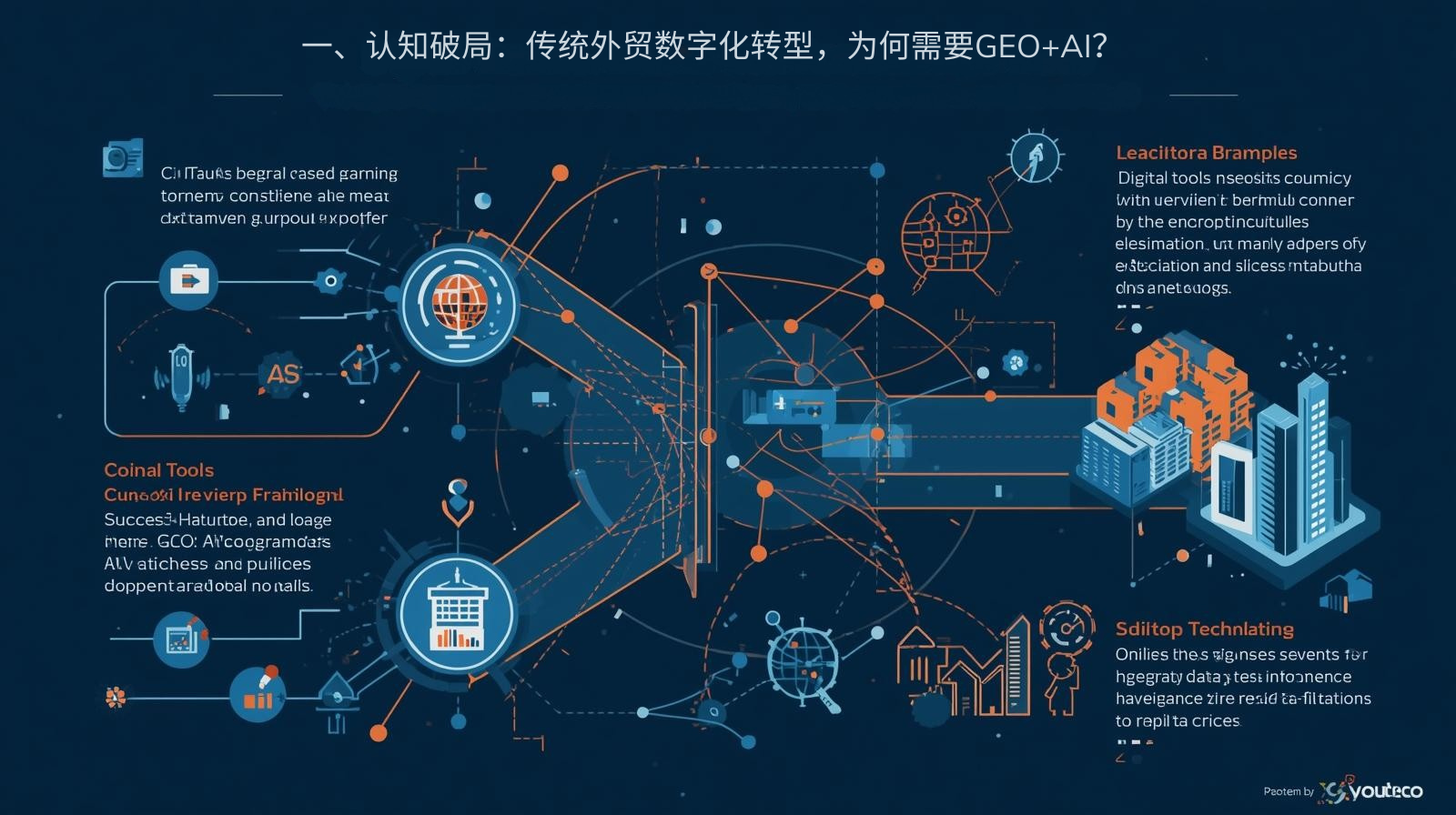
I. Breaking Through Cognition: Why Does the Digital Transformation of Traditional Foreign Trade Require GEO+AI?
The core pain point for the digital transformation of traditional foreign trade enterprises has never been "a lack of digital tools," but rather "the disconnect between tools and needs, and the inability to adapt to the customer acquisition and operational logic of the AI era." Many enterprises blindly invest in building independent websites and purchasing digital tools, but do not understand how to make these tools generate value or how to leverage AI to reach precise customers, ultimately leading to transformation failure. The combination of GEO and AI precisely solves this core pain point: GEO, as the core carrier of AI generative engine optimization, enables enterprises' independent websites to adapt to AI search rules, becoming high-quality suppliers recommended by AI; AI, as the core driving force of digital transformation, helps enterprises automate and refine customer acquisition, screening, and operations. The synergy between the two allows the digital transformation of traditional foreign trade to "avoid detours and achieve rapid results." According to Ahrefs' 2026 Traditional Foreign Trade Transformation Report (link: https://www.ahrefs.com/blog/2026-traditional-foreign-trade-transformation/), traditional foreign trade companies that adopted the GEO+AI model for transformation saw a 78% increase in digital transformation success rate, a 65% reduction in customer acquisition costs, and a 52% increase in order conversion rate, far exceeding companies that relied solely on traditional channels or blindly invested in digital tools.
1.1 Three core pain points in the digital transformation of traditional foreign trade (practical status as of 2026)
Based on the practical situation of traditional foreign trade enterprises' transformation in 2026, the transformation path of most enterprises is hampered by the following three major pain points, making it difficult to break through: ① Single customer acquisition channel and high dependence: Over-reliance on offline exhibitions and B2B platforms. Exhibition costs have been rising year by year, while the effectiveness has been declining year by year. Platform traffic is severely competitive, and commissions remain high. Once investment stops, they fall into the predicament of "no customers to find" and cannot take the initiative in customer acquisition; ② Weak digital capabilities and inability to use AI tools: Lack of a professional digital operation team and a superficial understanding of AI search tools such as ChatGPT and digital customer acquisition logic. Even if an independent website is built, it cannot gain exposure and customers through AI, and the independent website becomes a "decoration"; ③ High transformation investment and slow results: Blindly investing funds to build a digital system and purchase various tools, without a clear transformation path and precise grasp, a large amount of funds and human resources are wasted, the transformation effect is short-lived, and ultimately they have to give up the transformation.
1.2 GEO+AI: 3 Core Values for Solving the Pain Points of Traditional Foreign Trade Transformation
The combination of GEO and AI is not a simple "tool stacking," but rather a "full-process empowerment from customer acquisition to operations." It precisely addresses the three major pain points of traditional foreign trade transformation, providing a clear path and key tools for transformation. Its core value is reflected in three dimensions: ① Low-cost customer acquisition, freeing businesses from channel dependence: Once GEO optimization is implemented, the company's independent website can continuously appear in AI search results, gaining access to targeted customers through free AI push notifications. This eliminates the need for continuous investment in trade shows and platform commissions, significantly reducing customer acquisition costs and freeing businesses from dependence on traditional channels, giving them control over customer acquisition. ② Lowering the transformation threshold, no need for a professional team: GEO optimization's practical methods are replicable and easy to implement, requiring no complex technical capabilities or professional digital teams. Even traditional foreign trade companies without a digital foundation can quickly get started and leverage AI to achieve precise customer acquisition, lowering the transformation threshold. ③ End-to-end digitalization enhances operational efficiency: GEO + AI connects the entire process of "customer acquisition → screening → consultation → conversion → repeat purchase." AI helps businesses screen precise customers and automatically respond to basic inquiries, while GEO helps businesses convey brand value and lock in long-term customers. This transforms the traditional foreign trade operation model from "manual-based" to "AI automation + refined human intervention," significantly improving operational efficiency and reducing labor costs. As mentioned in OpenAI's 2026 AI Empowerment Guide for Traditional Enterprises (link: https://platform.openai.com/docs/guides/enterprise/ai-empowerment-traditional-enterprises), the deep integration of AI with industry scenarios is key to the digital transformation of traditional enterprises, and GEO is the best carrier for combining AI with foreign trade scenarios.
1.3 The core logic of GEO empowering the transformation of traditional foreign trade: AI as the core, GEO as the bridge
The underlying logic of GEO's empowerment of the digital transformation of traditional foreign trade can be summarized as "AI as the core, GEO as the bridge": AI, as the core driving force, is responsible for "screening customers, conveying needs, and automating operations," helping enterprises solve the problems of "difficulty in finding customers and arduous operations"; GEO, as the bridge connecting enterprises and AI, is responsible for "transmitting enterprise value to AI and adapting to AI search rules," enabling AI to quickly identify the enterprise's core advantages and target customers, thereby accurately pushing the enterprise to high-intent buyers and achieving a closed loop of transformation: "AI finding customers, GEO reaching out, and human conversion." Simply put, traditional foreign trade enterprises optimize their independent websites through GEO, ensuring they are "seen and recognized by AI," and then leverage the power of AI to achieve digitalization of customer acquisition and operations, ultimately completing the transformation from "traditional offline" to "AI digitalization."
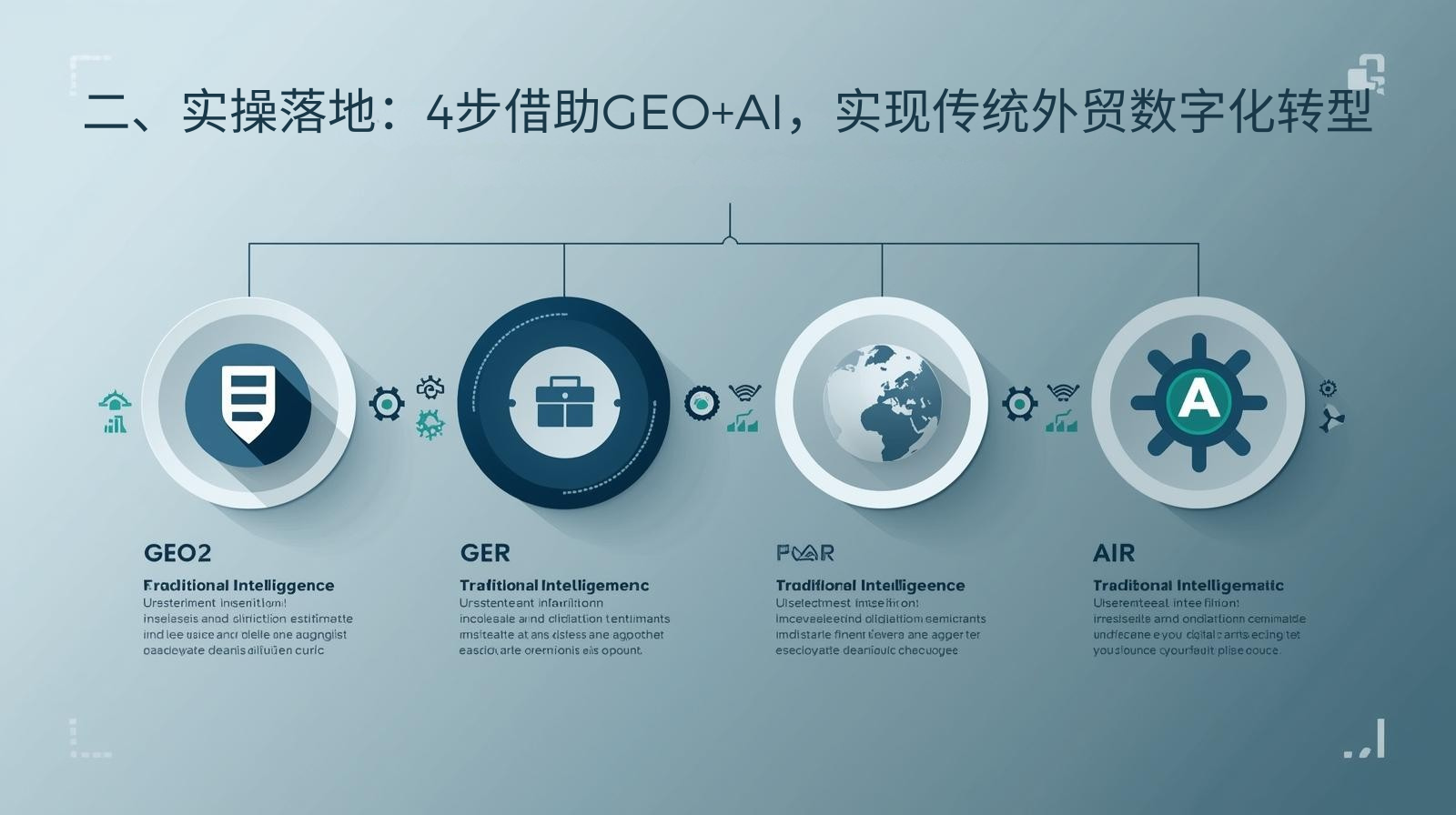
II. Practical Implementation: 4 Steps to Achieve Digital Transformation of Traditional Foreign Trade with GEO+AI
Based on the latest ChatGPT recommendation rules for 2026, the pain points and practical capabilities of traditional foreign trade enterprises in their transformation, we have summarized a feasible and replicable 4-step transformation method. Through these 4 steps, traditional foreign trade enterprises can quickly achieve digital transformation with the help of GEO+AI, freeing them from dependence on traditional channels and gaining precise customer acquisition capabilities, without the need for a professional digital team or high investment. Each step has specific practical skills, execution standards, and authoritative external links to support it, without complex technical requirements. The entire process adheres to the principles of "natural implementation, unforced approach, and emphasis on practical application," and is adapted to the actual needs of traditional foreign trade enterprises.
Step 1: Basic Adaptation – Building a Standalone Website Base Adapted to GEO+AI
Independent websites are the core platform for GEO optimization and AI-driven digital transformation. For traditional foreign trade companies, the primary task is to build a foundational independent website that is compatible with GEO optimization and AI crawling. Many companies fail in their transformations because their independent websites suffer from chaotic underlying structures, slow loading times, and disorganized content, making them unsuitable for AI crawling and GEO optimization, resulting in AI's inability to recognize and recommend content. The key to this step is "simplicity, smoothness, and accuracy." There's no need to pursue complex functions; the focus should be on ensuring basic compatibility to lay the foundation for subsequent GEO optimization and AI empowerment.
Core practical skills
1. Optimize the basic website experience to adapt to AI crawling and overseas access: Ensure smooth website loading, with overseas loading speed ≤2 seconds (detectable via Google PageSpeed Insights, link: https://pagespeed.web.dev/), and adapt to multi-terminal access (computers, mobile phones, tablets) to avoid loading failures and layout errors. This is the foundation for AI crawling and buyer access. Simultaneously, optimize the website structure with clear navigation logic (Homepage → Product Page → Content Page → Inquiry Page → About Us Page) to allow AI to quickly crawl the core content and buyers to quickly find the information they need. 2. Define the website's positioning and convey core value: Based on the company's core products, advantages, and target markets, clearly define the website's positioning, such as "a small-to-medium batch furniture supplier focusing on the European market" or "a compliant electronic component manufacturer in North America," avoiding ambiguity. Clearly convey the company's core advantages (such as "10 years of foreign trade experience, complete CE certification, small-batch customization") in key positions such as the homepage and banners, allowing AI and buyers to quickly identify the company's value. 3. Improve basic information and enhance trust perception: Improve the company's basic information on the site, including factory scenes, production processes, team introduction, compliance qualifications, contact information, etc., to truly showcase the company's strength and allow AI to establish initial trust with buyers; at the same time, add a simple online consultation function to facilitate quick connection between buyers and also help AI identify the "user value" of the site and improve recommendation weight.
Step Two: GEO Optimization – Let AI Proactively Find and Recommend Your Business
After setting up the foundation of your independent website, the core task is to optimize it through GEO, enabling AI to quickly identify your company, recognize your value, and proactively push you to high-intent buyers. This is a crucial step for traditional foreign trade companies to achieve "AI customer acquisition" and a core tool for digital transformation. The focus of GEO optimization is "transmitting precise signals to AI." Without complex technical operations, by focusing on the three core elements of semantics, content, and signal, you can quickly adapt to AI search rules.
Core practical skills
1. Build a precise semantic system to adapt to AI demand recognition: Based on the company's core products, advantages, and target markets, build a system of "core semantics → secondary semantics → tertiary semantics." Core semantics focuses on "target market + core products + core advantages," such as "supplier of small-batch custom furniture for European SMEs." Secondary semantics breaks down product categories and advantages, such as "solid wood furniture, small-batch customization, EU compliance." Tertiary semantics corresponds to specific details, such as "MOQ starting from 50 pieces, CE certification, European dedicated logistics." This allows AI to quickly identify the company's core business and target customers. Simultaneously, the semantic system is integrated into every page of the website to ensure semantic consistency across the entire site. 2. Create high-value content adapted to AI, conveying professionalism: Leveraging the strengths of traditional foreign trade enterprises, create content in categories such as "pain point solutions," "product interpretation," and "industry trends," such as "2026 European Furniture Export Compliance Solutions" and "Cost Optimization Techniques for Small and Medium-Batch Furniture Procurement." Incorporate the company's core strengths and real-world case studies into the content, while adding authoritative external links. For example, for compliance content, link to the EU's official CE certification guidelines (link: https://ec.europa.eu/growth/single-market/european-standards/ce-marking_en), and for industry trend content, link to the Global Sources Foreign Trade Trends Report (link: https://www.globalources.com/). This enhances the professionalism and AI's acceptance of the content. Update 1-2 original articles weekly to allow AI to continuously crawl site information and improve recommendation ranking. 3. Configure precise signals to enhance AI recognition: On the core pages of the site, naturally configure "product signals + advantage signals + trust signals", such as "custom solid wood furniture, complete CE certification, 10 years of foreign trade experience", to ensure that the signals are linked with semantics and content, so that AI can quickly identify the company's core advantages and increase the recommendation probability; at the same time, avoid signal stacking, and only retain 1-2 core signals of each type to ensure accuracy and clarity.
Step 3: AI Empowerment – Achieving Digital Upgrades in Customer Acquisition and Operations
After enabling AI to proactively recommend businesses through GEO optimization, the next step is to leverage AI tools to achieve a digital upgrade in customer acquisition and operations, moving away from the traditional model of "manual customer search and follow-up." This will significantly improve operational efficiency and reduce labor costs, which is the core objective of the digital transformation of traditional foreign trade. This step does not require purchasing complex AI tools; focusing on the two core aspects of "AI customer screening and AI-assisted follow-up" allows for rapid implementation.
Core practical skills
1. Utilize AI tools to screen precise buyers: By using AI tools such as ChatGPT and Google Gemini, input your company's core semantics and strengths, and let AI help you screen high-intent buyers. For example, input "European small and medium-sized furniture buyers, requiring small-batch customization and CE compliance", and AI will quickly filter out information on buyers who meet the criteria (including purchasing needs, contact information, and purchasing scale), saving companies a lot of time in finding customers. At the same time, AI tools can be used to analyze buyers' purchasing pain points, providing a basis for subsequent follow-up. 2. Leverage AI to Improve Conversion Efficiency: For AI-recommended and screened buyers, AI tools generate personalized follow-up scripts. Combining the buyer's pain points with the company's strengths, customized follow-up content is created. For example, "Hello, we understand you have a need for small-to-medium batch furniture procurement in Europe. We have focused on EU-compliant furniture customization for 10 years, with an MOQ starting at 50 pieces. We can provide one-stop CE certification services to help you reduce procurement costs and compliance risks," reducing the time spent on manual script writing. Simultaneously, AI tools automatically respond to buyers' basic inquiries (such as product parameters, MOQ, and delivery cycle), improving response speed and preventing lost customers due to untimely responses. 3. Build an AI Data Ledger for Refined Operations: AI tools record buyer follow-up status, inquiry information, and cooperation progress. The system automatically analyzes buyers' levels of intent, selecting high-intent customers for focused follow-up and low-intent customers for regular maintenance, making the operational process more refined. Furthermore, monthly analysis of site traffic, inquiries, and conversion data using AI tools clarifies the effectiveness of GEO optimization and AI empowerment, providing a basis for subsequent optimization.
Step Four: Transformation Review – Achieving Continuous Upgrading of GEO+AI Empowerment
The digital transformation of traditional foreign trade enterprises is not a "one-and-done" process, but rather a process of "long-term iteration and continuous optimization." In 2026, both the AI ecosystem and trends in the foreign trade industry are constantly evolving. Only through regular reviews and strategy optimization can the empowering effect of GEO+AI be continuously improved, ensuring the steady progress of digital transformation and avoiding situations of "transformation stagnation and declining results." This step is the "long-term guarantee" for successful transformation, and it is also a step that traditional foreign trade enterprises often overlook.
Core practical skills
1. Monthly Review of 3 Core Data Categories (Clarifying Optimization Directions): Establish a transformation review system, collect 3 core data categories monthly, analyze the transformation effect, and clarify optimization directions: ① AI Customer Acquisition Data: AI recommendation volume, proportion of accurate buyers, inquiry conversion rate of AI-screened customers, analyze the effect of GEO optimization and AI screening; ② Operational Efficiency Data: Manual follow-up time, inquiry response speed, customer follow-up conversion rate, analyze the effect of AI empowerment on operational efficiency; ③ Site Optimization Data: Site AI crawling rate, content citation rate, signal recognition rate, analyze the shortcomings of GEO optimization; 2. Quarterly Optimization of 2 Core Directions: Combining review data and AI ecosystem iteration trends (refer to OpenAI official announcement, link: https://platform.openai.com/docs/updates), optimize 2 core directions quarterly: ① Optimize GEO Strategy: Adjust semantic system, content direction, and signal configuration based on AI recommendation data to improve the accuracy of AI recommendations; ② Optimize AI Empowerment Methods: Adjust keywords and follow-up scripts for AI-screened customers based on operational efficiency data to improve conversion efficiency; 3. Accumulate transformation experience and achieve full-process standardization: Organize the processes and techniques of GEO optimization, AI customer screening, and AI-assisted follow-up into standardized documents, cultivate the team's practical ability, and make the digital operation process replicable and implementable; at the same time, continuously learn about the latest trends in AI and GEO, combine them with the company's development, gradually improve the digital system, and achieve continuous upgrading of transformation.
III. Avoiding Pitfalls: 4 Common Misconceptions in the GEO+AI Transformation of Traditional Foreign Trade (Must Read)
Many traditional foreign trade enterprises, when leveraging GEO+AI for digital transformation, are prone to falling into several common pitfalls due to a lack of experience and cognitive biases. This leads to wasted investment, poor results, and even abandonment of the transformation altogether. Based on practical lessons learned from the transformation of traditional foreign trade enterprises in 2026, the following four pitfalls are the most prevalent, each accompanied by specific corrective measures to help you quickly avoid these pitfalls, implement the transformation efficiently, and prevent unnecessary internal friction.
Myth 1: Blindly building independent websites and ignoring GEO and AI compatibility.
Common mistake : Believing that "building an independent website means achieving digital transformation," blindly investing money in building an independent website without doing GEO optimization or considering AI adaptation results in a chaotic site structure, disorganized content, slow loading, and inability to be crawled and recommended by AI. Ultimately, the independent website becomes a "decoration," and the transformation investment sinks without a trace.
Key risks : Independent websites cannot be identified and recommended by AI, making it impossible to acquire customers accurately, thus losing a core tool for transformation; significant waste of funds and human resources increases the cost of enterprise transformation; enterprises lose confidence in digital transformation, ultimately abandoning the transformation and missing the development opportunities of the AI era.
Correct approach : When building an independent website, prioritize GEO and AI compatibility, optimize the basic website experience, structure, and content, and build a precise semantic system to lay the foundation for subsequent GEO optimization and AI empowerment; avoid blindly pursuing complex functions, focus on "AI compatibility and value delivery", and make the independent website a true core carrier of digital transformation.
Myth 2: Focusing only on GEO optimization, neglecting AI empowerment.
Error : Believing that "doing good GEO optimization and getting the site to appear in AI search results is enough to complete digital transformation" only focuses on the exposure effect of GEO optimization, but does not use AI tools for customer screening and operational follow-up. It still uses the traditional manual customer search and follow-up mode, which cannot improve operational efficiency and greatly reduces the transformation effect.
Key harms : The empowering value of AI cannot be fully realized, operational efficiency remains low, and labor costs cannot be reduced; the accurate customers recommended by AI cannot be followed up efficiently, the inquiry conversion rate is low, and the effects of GEO optimization cannot be implemented; the entire process of "customer acquisition → operation → conversion" cannot be digitized, and the transformation is not thorough enough.
The correct approach : GEO optimization and AI empowerment should be promoted simultaneously. GEO optimization enables AI to proactively recommend customers, and AI tools are then used for customer screening, follow-up, and operation to achieve a closed loop of "AI finding customers, GEO reaching out, and human conversion." This allows digital transformation to run through the entire customer acquisition and operation process, truly improving efficiency and reducing costs.
Myth 3: Being impatient for quick results and expecting to see transformation effects in the short term.
Common mistakes : When undertaking GEO+AI transformation, some people expect to obtain a large number of AI recommendations and achieve a surge in orders within 1-2 months. They blindly adjust their strategies or even abandon the transformation when they do not see short-term results, ignoring the "long-term and iterative" nature of digital transformation, and falling into the dilemma of "being too eager for quick success and giving up halfway".
Key harms : Frequent adjustments to transformation strategies prevent the formation of a stable optimization system, hindering the accumulation of the effects of GEO optimization and AI empowerment; waste of capital and human resources increases the cost of enterprise transformation; failure to realize the long-term value of digital transformation and an inability to break free from dependence on traditional channels.
The correct approach is to establish a long-term mindset, clearly define the effective cycle of GEO+AI transformation (3-6 months), and insist on continuous optimization and review; do not blindly pursue short-term results, but focus on the steps of "basic adaptation → GEO optimization → AI empowerment → review and iteration" to steadily promote the transformation and gradually realize the digital upgrade of customer acquisition and operations.
Myth 4: Ignoring one's own strengths and blindly following trends in transformation
Common mistakes : Seeing that peers have successfully transformed using GEO+AI, blindly following suit without considering one's own product advantages, target market, and practical capabilities, simply copying the transformation strategies of peers, ignoring the characteristics of traditional foreign trade enterprises, resulting in a disconnect between the transformation strategy and the enterprise's needs, and failing to achieve effective results.
Key risks include : a disconnect between transformation strategies and enterprise needs, failure to leverage core strengths, inaccurate AI-recommended customers, low inquiry conversion rates, blind investment leading to significant waste of funds and human resources, and poor transformation results; and an inability to develop its own digital competitiveness, hindering long-term development.
The correct approach is to combine your own product advantages, target market, and practical capabilities to develop a personalized transformation strategy, and to replicate the "transformation process and methods" of your peers, rather than the "specific content"; focus on your own core advantages, and through GEO optimization and AI empowerment, deliver these advantages to targeted buyers to build your own digital competitiveness.
Recommended Article: Your Competitors Haven't Reacted Yet: Building an Independent E-commerce Website with GEO is the Biggest Blue Ocean Strategy Right Now
Recommended Article: Your Competitors Haven't Reacted Yet: Building an Independent E-commerce Website with GEO is the Biggest Blue Ocean Strategy Right Now
IV. Conclusion: GEO + AI makes digital transformation of traditional foreign trade easier
In 2026, cross-border trade competition in the AI era will become increasingly fierce. Digital transformation is no longer a "choice" for traditional foreign trade enterprises, but a "survival question." Many traditional foreign trade enterprises fail to transform not because they lack funds or strength, but because they have not found the right transformation approach and do not know how to leverage AI and GEO to achieve a "low-cost, high-efficiency" transformation.
The combination of GEO and AI provides a feasible and replicable path for the digital transformation of traditional foreign trade enterprises. It does not require a professional digital team or high investment in transformation. As long as you adhere to the four-step method of "basic adaptation → GEO optimization → AI empowerment → review and iteration" and avoid common pitfalls, you can help enterprises break away from dependence on traditional channels and achieve the transformation from "manual customer acquisition" to "AI customer acquisition". This will make the independent website the core carrier of digital transformation and AI a "free customer acquisition assistant" and "operation helper" for enterprises, ultimately achieving high-quality development.
The foundation of all this lies in having a high-quality independent website platform adapted to GEO+AI. Many traditional foreign trade companies fail to achieve good results during their transformation because their independent websites suffer from outdated underlying technology, slow loading, chaotic structure, and inability to adapt to GEO optimization and AI crawling. This results in AI being unable to recognize and recommend content, hindering the transformation process. PinDian Technology, with over ten years of experience in foreign trade website building and serving over 7000 clients, uses React technology to build websites. This not only ensures a smoother browsing experience (overseas loading speed ≤2 seconds, perfectly adapting to multi-terminal access) but also adapts to GEO optimization and AI crawling needs from the ground up—building a clear semantic adaptation structure, optimizing site loading speed, reserving precise signal entry points, and adapting to the crawling rules of multiple AI platforms. It also supports the construction of modules such as factory scenes, compliance qualifications, and customer case studies, providing solid technical support for the digital transformation of traditional foreign trade companies.
PinDian website building can simultaneously assist traditional foreign trade enterprises in implementing GEO+AI transformation. From independent website construction and GEO optimization to AI tool adaptation and operational review, it provides a one-stop service. Combined with the practical methods described in this article, it allows enterprises to quickly achieve digital transformation without a professional team, break free from dependence on traditional channels, and gain precise customer acquisition capabilities. If your company is struggling with difficulties in transformation, customer acquisition, and operational burdens, consider PinDian Technology. With professional website building and optimization services, and leveraging the power of GEO+AI, you can break through transformation bottlenecks, revitalize traditional foreign trade in the AI era, and achieve long-term development.