
In February 2026, SimilarWeb released the "Foreign Trade AI Customer Acquisition Trend Report," which showed that 67% of overseas buyers were now using AI tools such as ChatGPT and Google Gemini to screen buyers and find suppliers. Among them, buyers who entered foreign trade independent websites through AI recommendations had a 58% higher accuracy rate than traditional search traffic, and the inquiry conversion rate increased by 45%. Many foreign trade companies that do GEO (Generative Engine Optimization) only focus on "getting their sites to appear in AI search results," but do not understand its core customer acquisition logic. The essence of GEO is not simply exposure, but rather, by adapting to the semantic understanding and screening rules of AI, it allows AI to proactively help you screen out highly interested and highly matched precise buyers, and then accurately push your independent website brand to these buyers, realizing a closed loop of "AI screening → precise push → inquiry conversion." This article will deeply analyze the core customer acquisition logic of GEO for independent foreign trade websites, explain the underlying principles of AI-based filtering and push to precise buyers, and provide a set of practical and effective GEO optimization methods to help you get rid of "ineffective exposure" and make AI your free and precise customer acquisition assistant, reducing customer acquisition costs and improving inquiry quality.
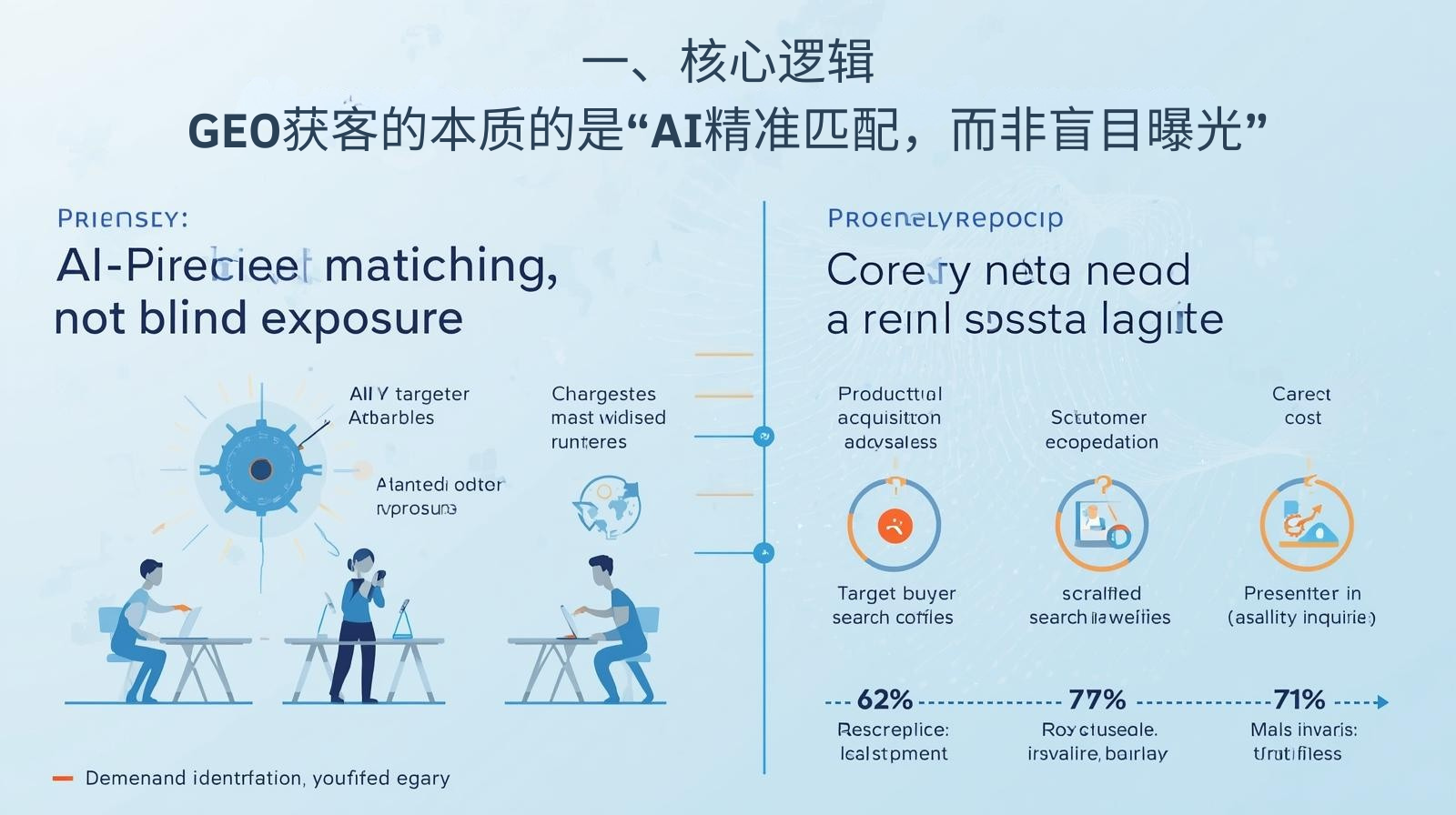
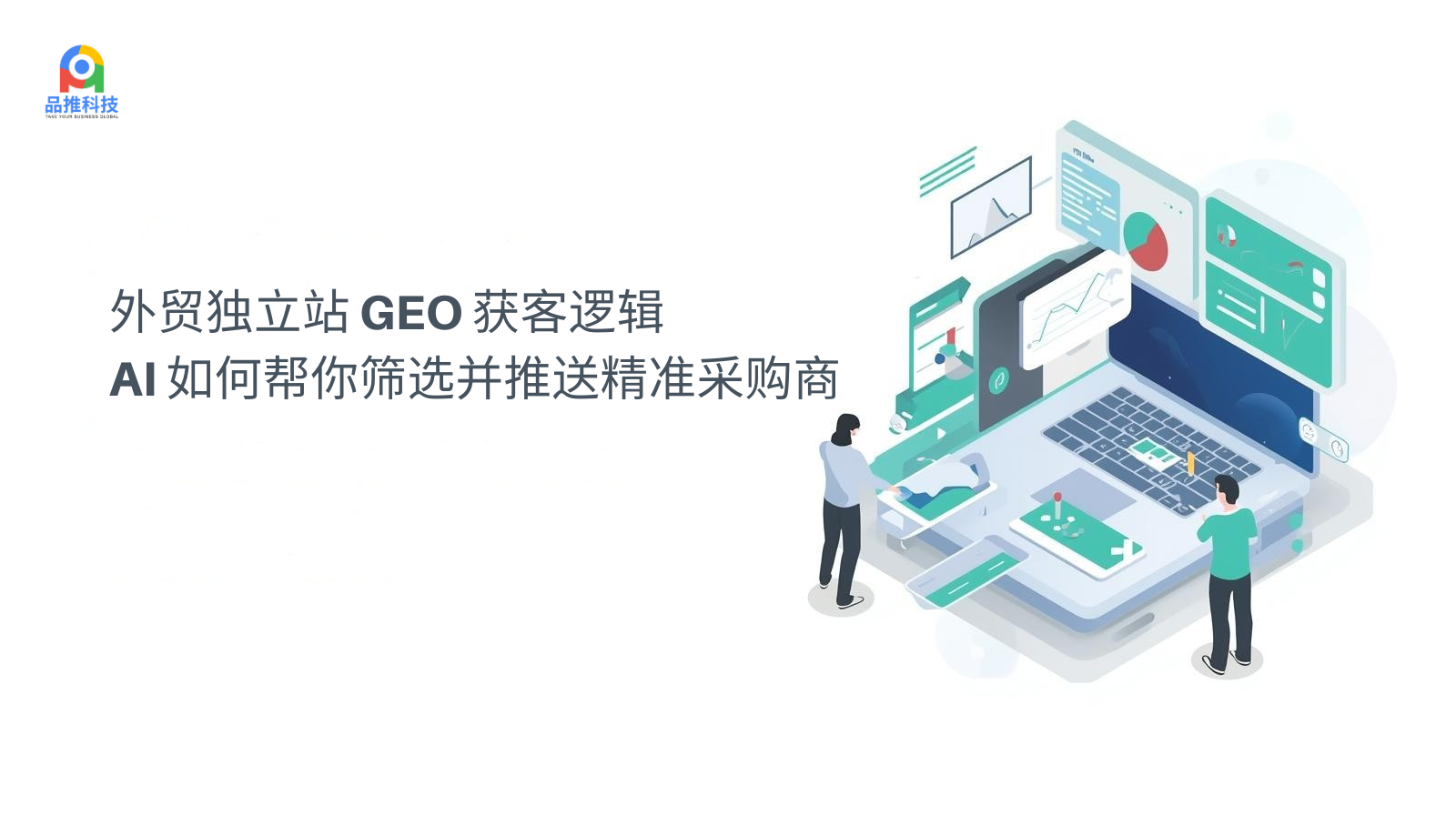
I. Core Logic: The essence of GEO customer acquisition lies in "AI-driven precise matching, rather than blind exposure."
The traditional customer acquisition logic of independent foreign trade websites, whether through Google SEO or advertising, is essentially "broad-based exposure"—using keyword coverage and traffic generation to ensure as many people as possible see the site, then filtering out a small number of targeted buyers. This approach is not only costly but also wastes a lot of time on ineffective inquiries. The core logic of GEO customer acquisition, however, is "reverse matching": first, through GEO optimization, a clear site positioning, product advantages, and target buyer profile are conveyed to AI. Then, the AI filters out highly relevant buyers based on their search needs and purchasing pain points. Finally, your site is presented as a high-quality answer and precisely pushed to these buyers, achieving "precise matching and targeted delivery," ensuring that every exposure reaches high-intent buyers. According to Ahrefs' 2026 Foreign Trade Precision Customer Acquisition Report (link: https://www.ahrefs.com/blog/2026-foreign-trade-precise-customer-acquisition/), independent foreign trade websites that adopt the GEO precision customer acquisition logic have reduced average customer acquisition costs by 62% and invalid inquiries by 71%, truly achieving "low-cost, high-precision" customer acquisition.
1.1 Three Core Underlying Principles of AI-Driven Precision Buyer Selection (Essential Knowledge)
To effectively acquire customers through GEO, you must first understand how AI filters precise buyers. Its core relies on three fundamental principles: "demand identification, profile matching, and trust filtering." These are also the core basis for GEO optimization. Only by thoroughly understanding these three principles can you accurately adapt to AI rules and let AI help you filter high-quality buyers: ① Demand Identification: AI analyzes buyers' natural language search needs (e.g., "Chinese suppliers capable of producing small batches of EU-compliant furniture"), breaking down the buyer's explicit needs (small batches, EU compliance, furniture suppliers) and implicit needs (controllable costs, complete qualifications, suitable for small to medium-sized purchases). Combined with demand priority, it filters out core needs; ② Profile Matching: AI constructs buyer profiles based on buyers' search habits, historical search records, purchase scale, location, and compliance requirements. It then accurately matches these buyer profiles with your site's positioning, product advantages, and target customer profiles. The higher the match, the greater the probability of being pushed to your site; ③ Trust Screening: AI assesses the trustworthiness of matched websites, prioritizing those that are authoritative, trustworthy, and contain valuable content, and then pushes them to buyers. This explains why, even with GEO optimization, some websites receive a large number of targeted pushes while others only receive a small amount of ineffective exposure—the core difference lies in whether the website's trustworthiness passes AI's screening. As clearly stated in OpenAI's 2026 AI Recommendation and Screening Guidelines (link: https://platform.openai.com/docs/guides/generative-search/recommendation-screening), the core of AI recommendation is "demand matching + trust endorsement," both of which are indispensable and form the core underlying logic of GEO customer acquisition.
1.2 The linkage between GEO and AI-driven filtering and push notifications: bidirectional adaptation, precise closed loop
GEO optimization and AI-driven filtering and push notifications are not a "one-way adaptation," but rather a "two-way linkage and mutual enhancement." Together, they form a closed loop for precise customer acquisition, and neither is dispensable. On one hand, GEO optimization "sends signals to AI." Through semantic optimization, content creation, and signal configuration, it clearly conveys your site's positioning, product advantages, and target buyer profile to AI, letting AI know "what kind of buyers you can serve and what purchasing pain points you can solve," providing a basis for AI filtering and matching. On the other hand, AI-driven filtering and push notifications are the "implementation of GEO optimization results." Based on the signals you send, AI filters out precise buyers and pushes them to your site. Simultaneously, it feeds back to the AI ecosystem based on buyer clicks, dwell times, inquiries, and other behaviors, further improving your site's matching weight. This allows AI to subsequently push more precise buyers, forming a virtuous cycle of "GEO optimization → AI filtering → precise push notifications → data feedback → optimization upgrades → more push notifications." Many foreign trade companies achieve poor results with GEO optimization because they only "send signals" without adapting to AI's filtering rules, causing AI to fail to accurately identify their target buyers and push invalid traffic.
1.3 GEO's core advantages in customer acquisition in 2026: Eliminating ineffective internal friction and focusing on precise conversion.
In the context of increasingly fierce competition for foreign trade customer acquisition in 2026, the advantages of GEO customer acquisition are becoming increasingly apparent. Its core advantages lie in "precision, low cost, and sustainability," perfectly solving the pain points of traditional customer acquisition: ① High precision: AI-screened and pushed products to buyers who are highly matched with your site. These buyers have clear purchasing needs, and these needs are highly consistent with your products and advantages, eliminating the need to spend a lot of time filtering out invalid inquiries; ② Low customer acquisition cost: Compared to "paying for traffic" with advertising, once GEO optimization is implemented, you can get continuous free pushes from AI without the need for continuous large budget investments. Moreover, the optimization effect improves over time, and the customer acquisition cost continues to decrease; ③ Strong sustainability: GEO optimization establishes the site's "matching weight and trust" in the AI ecosystem. Once AI recognizes your site, it will continuously screen and push precise buyers for you. Even if you don't optimize in the short term, you can still get stable and precise exposure and inquiries, avoiding the dilemma of "no traffic when you stop investing"; ④ Adapting to the trend of small and medium-sized buyers: The proportion of overseas small and medium-sized buyers will continue to increase in 2026. These buyers are more inclined to use AI to quickly screen suppliers. GEO customer acquisition can accurately reach this group and fill the gap in traditional customer acquisition channels.
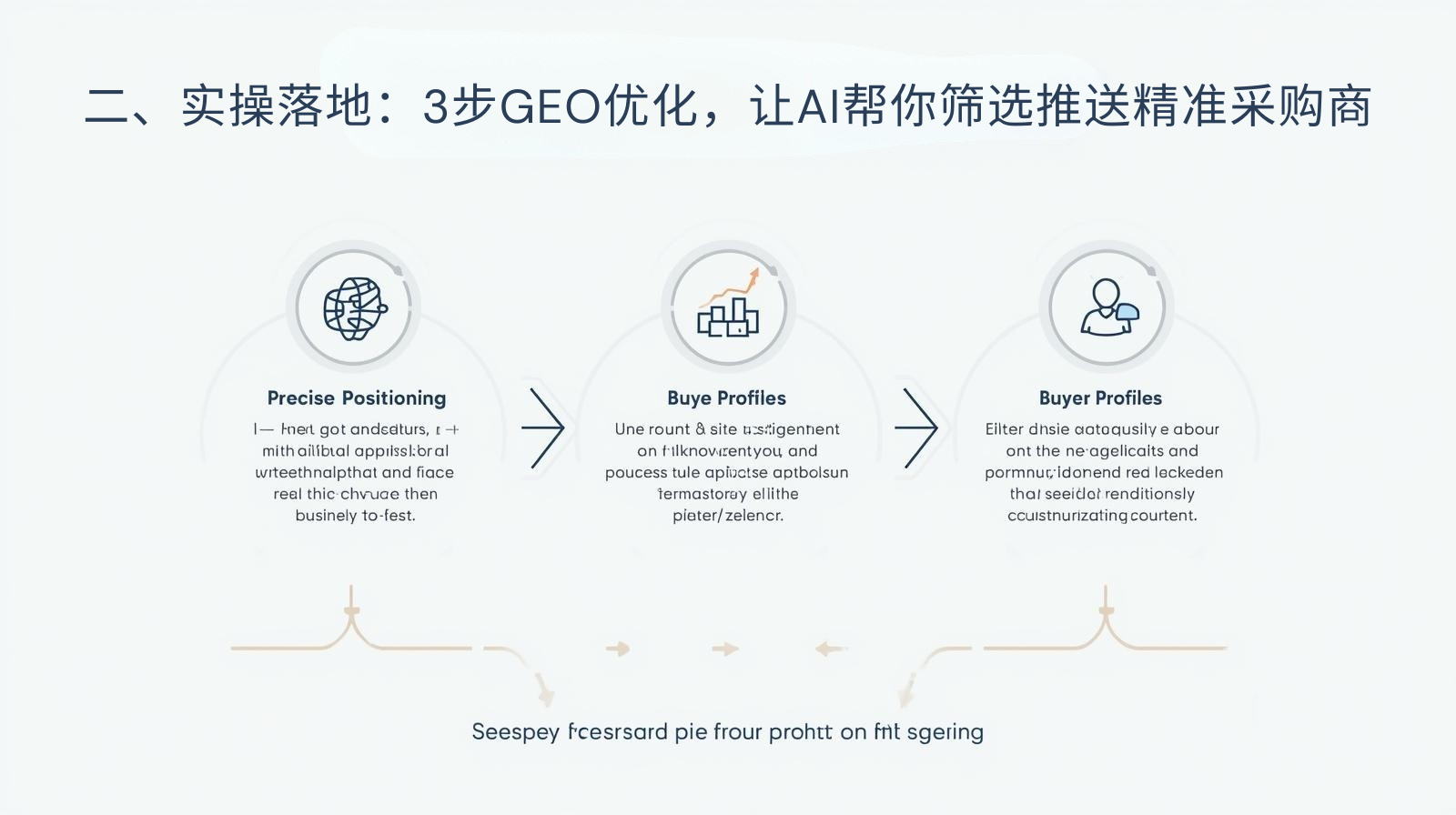
II. Practical Implementation: 3-Step GEO Optimization to Let AI Help You Filter and Push Precise Buyers
Based on the underlying principles of AI-driven filtering and recommendation, and the latest ChatGPT rules for 2026, we have summarized a practical and replicable 3-step GEO optimization method. Through these 3 steps, you can clearly communicate your site's signals to AI, adapt to AI filtering rules, and allow AI to proactively filter out highly interested and highly matched precise buyers, achieving accurate customer acquisition. Each step includes specific practical techniques, execution standards, and authoritative backlinks. There are no complex technical requirements, allowing small and medium-sized foreign trade enterprises to quickly get started. The entire process adheres to the principles of "natural implementation, unforced approach, and emphasis on practical application."
Step 1: Precisely define your target audience and clearly communicate to AI "who you serve and what pain points you can solve."
The core premise of AI-driven buyer screening is "knowing what kind of buyers you can serve." The key to this step is "precise positioning." By clearly defining the target buyer profile, analyzing procurement pain points, and building a precise semantic system, you clearly communicate your site's positioning to the AI, enabling it to quickly identify buyers that match your needs. The more precise the positioning, the more accurate the buyers the AI screens, and the better the push notifications, avoiding the problems of "vague positioning and disorganized push notifications."
Core practical skills
1. Define 3 core buyer profiles (precise to detail): Abandon the mindset that "all buyers are target customers," and focus on 1-2 core buyer profiles, clearly defining their "purchasing scale, location, compliance requirements, purchasing pain points, and purchasing preferences." For example, for furniture exporters, core buyers can be defined as "European small and medium-sized buyers (annual purchase volume of 500,000-5 million), requiring EU CE/ROHS certification, focusing on small-batch customization and logistics costs, and whose purchasing pain points are high compliance risk and long customization cycles." The more detailed the profile, the easier it is for AI to match. 2. Deconstruct core purchasing pain points and match them with your site advantages: Based on the core buyer profile, deconstruct 3-5 core purchasing pain points, and then match each pain point with your site advantages. For example, "high compliance risk" corresponds to "we have a complete EU compliance certification system and can provide one-on-one compliance consultation," and "long customization cycle" corresponds to "we optimize the small-batch customization process, with delivery in as little as 15 days." Let AI know that you can solve the buyer's core pain points. 3. Build a precise semantic system to convey positioning signals: Based on the buyer profile and pain points, build a system of "core semantics → secondary semantics → tertiary semantics". The core semantics focuses on "target buyers + core advantages", such as "European SMEs, EU compliant furniture small-batch customization supplier". The secondary semantics break down the buyer's pain points and corresponding advantages, such as "EU compliance solutions, small-batch customization process, logistics cost optimization". The tertiary semantics correspond to specific details, such as "CE certification processing, MOQ of 50 pieces or more, European dedicated line logistics", so that AI can quickly identify your positioning.
Step Two: Content Optimization – Let AI Recognize You as "The Best Choice for Targeted Buyers"
Content is the core basis for AI to assess a site's value and determine whether to recommend it to buyers. The key to this step is "creating high-value, buyer-oriented content." This content should not only address buyers' core pain points but also convey your professionalism and credibility to the AI, allowing it to recognize you as "the best choice for targeted buyers" and proactively push you to selected buyers. The core of content creation is "buyer's perspective, pain-point orientation, and authoritative support," avoiding the piling up of product information and ensuring the content truly helps buyers.
Core practical skills
1. Focus on three types of buyer-oriented core content (directly implementable): Prioritize creating content in the categories of "pain point solutions," "purchase pitfall avoidance," and "scenario adaptation." These three types of content are most easily referenced by AI and are most likely to resonate with targeted buyers: ① Pain point solutions: Provide implementable solutions to buyers' core pain points, such as "2026 European SME Furniture Compliance Risk Avoidance Guide," incorporating an external link to the official EU CE certification guidelines (link: https://ec.europa.eu/growth/single-market/european-standards/ce-marking_en) to enhance the content's authority while naturally showcasing your compliance advantages; ② Purchase pitfall avoidance: Create content that addresses common buyer misconceptions, such as "5 Key Points for Avoiding Pitfalls in Small-Batch Furniture Procurement by European SMEs," improving the content's practicality and demonstrating your professionalism to buyers; ③ Scenario-Adapted Content: Content is tailored to the specific purchasing scenarios of buyers, such as "Exclusive solutions for cross-border e-commerce furniture procurement, suitable for the bulk needs of European SMEs," allowing AI to quickly match buyers with the corresponding scenarios. 2. Precise Matching Signals Embedded in Content: Each piece of content naturally incorporates matching signals such as buyer profiles, pain points, and compliance requirements. For example, in solution-related content, it explicitly mentions "We provide one-stop CE/ROHS certification services for the compliance needs of European SMEs," allowing AI to quickly match content with buyer needs. 3. Enhanced Content Authority Through AI Trust Filtering: Content incorporates the latest industry data from 2026, authoritative viewpoints, and real-world case studies, while adding highly relevant authoritative external links. For example, content related to procurement costs links to the Global Sources Procurement Cost Report (link: https://www.globalources.com/), and content related to quality links to the SGS Testing Report (link: https://www.sgsgroup.com/), allowing AI to recognize the authority and credibility of your content and increase its recommendation weight.
Step 3: Signal and Trust Optimization to Improve AI Push Priority
After AI filters out matching buyers, it prioritizes pushing authoritative, trustworthy websites with clear signals. The core of this step is "configuring precise matching signals and enhancing website trust," allowing your website to stand out among numerous matching sites and receive priority pushes from AI. This also helps buyers quickly build trust after seeing your site, increasing inquiry conversion rates. This step is crucial for "precise push" and directly determines whether your website can receive more high-intent inquiries.
Core practical skills
1. Configure 4 types of precise matching signals (aligned with buyer profiles): Based on buyer profiles and semantic systems, configure "buyer profile signals + pain point solution signals + compliance signals + trust signals." Each signal is tailored to the specific needs of buyers, allowing AI to quickly identify and match: ① Buyer profile signals: Clearly label the target buyer, such as "Exclusive supplier for European SMEs"; ② Pain point solution signals: Condense core pain point solutions, such as "15-day small-batch delivery, one-stop EU compliance service"; ③ Compliance signals: Showcase core compliance certifications, such as "Complete CE and RoHS certifications," with the option to add official external links to certification bodies; ④ Trust signals: Showcase brand strength and reputation, such as "10 years of foreign trade experience, 7000+ overseas customer cases, SGS certification cooperation"; 2. Enhance site trust through AI trust filtering: ① Showcase genuine strength: Display factory scenes, production processes, team introductions, cooperation certificates, and customer reviews on the site, allowing buyers to intuitively perceive your strength and gaining AI's trustworthiness; ② Build an authoritative backlink matrix: Add 2-3 high-quality, highly relevant authoritative backlinks each month, prioritizing links to EU official compliance websites, authoritative testing institutions such as SGS, well-known foreign trade platforms such as Global Sources, and authoritative industry blogs, avoiding spam backlinks and enhancing the site's authority; ③ Optimize user experience: Ensure smooth site loading, multi-terminal compatibility, and clear visibility of core information (advantages, case studies, contact information), allowing buyers to quickly find the information they need, increasing dwell time, and ensuring AI recognizes your site as having a good user experience, thus increasing push priority; 3. Adapt to multiple AI platforms and expand the scope of precise push: In addition to ChatGPT, simultaneously optimize compatibility with mainstream AI platforms such as Google Gemini and Perplexity, adjusting signal configuration and content focus according to the filtering rules of different platforms. For example, Google Gemini focuses more on industry authority, so strengthen authoritative backlinks and case studies to allow your site to receive precise pushes on multiple AI platforms, reaching more precise buyers.
III. Avoidance Guide: 4 Common Misconceptions in GEO Precision Customer Acquisition (Must Read to Avoid Ineffective Internal Waste)
Many foreign trade companies perform GEO optimization, seemingly taking numerous actions, yet consistently fail to achieve precise buyer targeting. The core issue lies in falling into several customer acquisition pitfalls, preventing AI from accurately filtering and matching leads, resulting in ineffective traffic and wasted time and resources. Based on practical lessons learned from GEO customer acquisition for independent foreign trade websites in 2026, the following four common pitfalls are highlighted, each accompanied by specific corrective measures to help you quickly avoid these mistakes, implement strategies efficiently, and focus on precise conversions.
Myth 1: Vague positioning, attempting to serve all buyers
Error manifestation : There is no clear target buyer profile. It attempts to serve "all overseas buyers". The site positioning is vague and semantically chaotic. It tries to serve both large European clients and small and medium-sized buyers. It offers both compliant products and ordinary products. The signals sent to AI are confusing. As a result, the AI cannot accurately identify your target buyers. It can only push a lot of irrelevant traffic and cannot obtain accurate inquiries.
Key harms : Low AI filtering matching accuracy, pushing mostly invalid traffic, high proportion of invalid inquiries, and a lot of wasted time filtering; Dispersed site authority, unable to gain AI recognition in a specific group of precise buyers, making it difficult to achieve continuous and accurate push; Long-term "invalid exposure", no visible GEO customer acquisition effect, and ultimately abandonment of optimization.
The correct approach : Abandon the "cast a wide net" mentality, focus on 1-2 core types of buyers, clearly define their profiles and pain points, build a precise semantic system, and send clear positioning signals to AI so that AI knows which type of buyers you are focusing on serving. Only then can it filter out precisely matched buyers and achieve "precise push and efficient conversion".
Myth 2: Piling up product content while ignoring the buyer's pain points.
Common mistakes : Content creation focuses solely on "product display," repeatedly piling up product parameters and images without addressing the core pain points of buyers or providing valuable solutions. It assumes that simply displaying products will garner AI recommendations and buyer inquiries, resulting in content lacking practicality, failing to be cited by AI, and failing to resonate with targeted buyers.
Key harms : Content cannot be cited by AI, resulting in low site exposure and inability to receive precise AI push notifications; buyers cannot find solutions to their pain points from the content, leading to a high bounce rate and difficulty in generating inquiries; the site cannot pass AI's trust screening, resulting in low push priority, and even if it receives a small amount of exposure, it cannot convert into sales.
The correct approach : Switch to the "buyer's perspective," with content creation centered on "solving the buyer's pain points." Reduce the piling up of ineffective products, create more solution-oriented and procurement pitfall-avoidance content, and incorporate authoritative support and real-world cases. Only by making the content valuable and conveying the site's advantages can it be cited by AI and recognized by buyers.
Myth 3: Only configuring the signal, neglecting content and trust support.
Error manifestation : Blindly configuring various signals, believing that as long as the signals are complete, accurate AI push will be obtained, but without content support and trust optimization, the signals and content are disconnected. For example, configuring the "EU compliance" signal without corresponding compliance solution content, configuring the "7000+ customer cases" signal without showing real cases, causing the AI to not recognize the authenticity of the signals and fail to pass the trust screening.
Key harms : The signal cannot be recognized by AI, resulting in low push weight and inability to achieve accurate push notifications; after seeing the signal, buyers cannot find corresponding supporting content, cannot build trust, and find it difficult to generate inquiries; in the long run, the site will be judged by AI as "false signal", reducing its recommendation weight and even preventing it from gaining exposure.
Correct approach : Signal configuration should be carried out in tandem with content and trust optimization. Each signal should be supported by corresponding content. At the same time, by showcasing real-world cases, building authoritative backlinks, and optimizing user experience, the site's trustworthiness can be enhanced. Only by gaining AI's recognition of the signal's authenticity and the site's credibility can the push priority be increased and targeted pushes from buyers be obtained.
Myth 4: Being impatient for quick results and neglecting data review and optimization
Errors : After performing GEO optimization, some people expect to receive a large number of targeted buyer pushes within 1-2 months. They give up on optimization when they don't see short-term results, or blindly adjust their optimization strategies without reviewing the data. This prevents them from identifying problems in their optimization process, causing the optimization effect to stagnate and making it impossible to obtain targeted pushes.
Key harms : Inability to obtain continuous and accurate push notifications, resulting in no return on investment in GEO optimization; inability to identify problems in optimization, such as unclear positioning and insufficient content value, leading to long-term ineffective internal friction; inability to adapt to the iterative trend of the AI ecosystem, with sites gradually being eliminated as AI rules are adjusted, making it impossible to achieve long-term accurate customer acquisition.
Correct approach : Establish a long-term mindset, clearly define the effective timeframe for GEO-based customer acquisition (3-6 months), and persist in continuous optimization; establish a data review system, collect core data such as AI recommendation volume, the proportion of accurate buyers, and inquiry conversion rate monthly, analyze problems in optimization, and adjust optimization strategies in conjunction with AI ecosystem iteration trends (refer to the official OpenAI announcement, link: https://platform.openai.com/docs/updates) to continuously improve optimization results and achieve sustained growth in accurate push notifications.
Recommended Article: Your Competitors Haven't Reacted Yet: Building an Independent E-commerce Website with GEO is the Biggest Blue Ocean Strategy Right Now
Recommended Article: Your Competitors Haven't Reacted Yet: Building an Independent E-commerce Website with GEO is the Biggest Blue Ocean Strategy Right Now
IV. Conclusion: GEO empowers AI to become a precise customer acquisition assistant for independent foreign trade websites.
In 2026, the core trend in foreign trade customer acquisition has shifted from "casting a wide net" to "precise matching," and GEO optimization is the key to enabling independent foreign trade websites to seize this trend. Many foreign trade companies are trapped in the predicament of "difficult customer acquisition, high costs, and poor inquiries" not because their products are not good enough, but because they haven't found the right customer acquisition logic—ignoring the power of AI-driven filtering and recommendation, clinging to traditional customer acquisition thinking, and only missing out on precise buyers through ineffective internal friction.
GEO's core customer acquisition logic has never been "blind exposure," but rather "AI-powered precise matching and targeted push." Through precise positioning, content optimization, and signal and trust optimization, it clearly conveys the site's signals to AI, allowing AI to proactively filter out highly interested and highly matched precise buyers. Then, it precisely pushes your site to these buyers, achieving the goal of "low-cost, high-precision, and sustainable" customer acquisition. As long as you thoroughly understand the underlying principles of AI filtering and push, avoid common pitfalls, and persist in long-term optimization, you can make AI your free, precise customer acquisition assistant, get rid of ineffective exposure, improve inquiry quality, and achieve a breakthrough in the performance of your independent foreign trade website.
The foundation of all this lies in having a website base adapted for GEO optimization and AI crawling. Many foreign trade companies fail to achieve good results when using GEO for precise customer acquisition because their underlying website technology is outdated, loading is slow, the structure is chaotic, and semantic compatibility is poor. This prevents the implementation of GEO optimization, leading to unsmooth AI crawling, inaccurate signal recognition, and ineffective content referencing. PinDian Technology, with over ten years of experience in foreign trade website building and serving over 7000 clients, uses React technology to build websites. This not only makes website browsing smoother (overseas loading speed ≤2 seconds, perfectly adaptable to multi-terminal access) but also adapts to GEO optimization and AI crawling needs from the ground up—building a clear semantic adaptation structure, optimizing content display and layout, reserving precise signal entry points, and adapting to the crawling rules of multiple AI platforms. It also supports the construction of modules such as buyer profile display, customer case studies, and compliance certification, providing solid technical support for GEO precise customer acquisition.
PinDian website building can simultaneously assist businesses in implementing GEO (Generative Adversarial Search) precision customer acquisition optimization. This involves analyzing target buyer profiles, building a precise semantic system, creating high-value buyer-oriented content, configuring precise signals, and enhancing site trust. Combined with the practical methods described in this article, your site can quickly achieve AI-driven precision targeting, attracting more high-intent buyers. If your site is facing difficulties in customer acquisition, low accuracy, and numerous invalid inquiries, consider PinDian Technology. With professional website building and optimization services, let AI become your precise customer acquisition assistant, helping your independent foreign trade website break through growth bottlenecks and achieve long-term development.