In February 2026, the "AI-driven foreign trade procurement decision-making report" released by McKinsey showed that 68% of overseas buyers currently rely on ChatGPT, Google AI tools such as Gemini assist purchasing decisions. 75% of buyers will directly choose the three independent stations recommended by AI for consultation. The order of AI recommendations directly determines the buyer's selection priority. Many foreign trade companies do GEO (Generative Engine Optimization) and are only satisfied with "appearing in AI search results" but do not understand how to influence AI purchasing decision-making through GEO optimization. As a result, the site ranks low and cannot be seen by buyers first, and ultimately misses a large number of accurate orders. This article will deeply dismantle the core logic of GEO affecting AI procurement decisions, explain in detail the screening criteria for AI-assisted procurement, and provide a set of implementable and practical GEO optimization methods to help you let AI give priority to recommending your independent website when assisting procurement decisions, allowing buyers to actively find you and choose you, and achieve a double improvement in inquiries and orders.
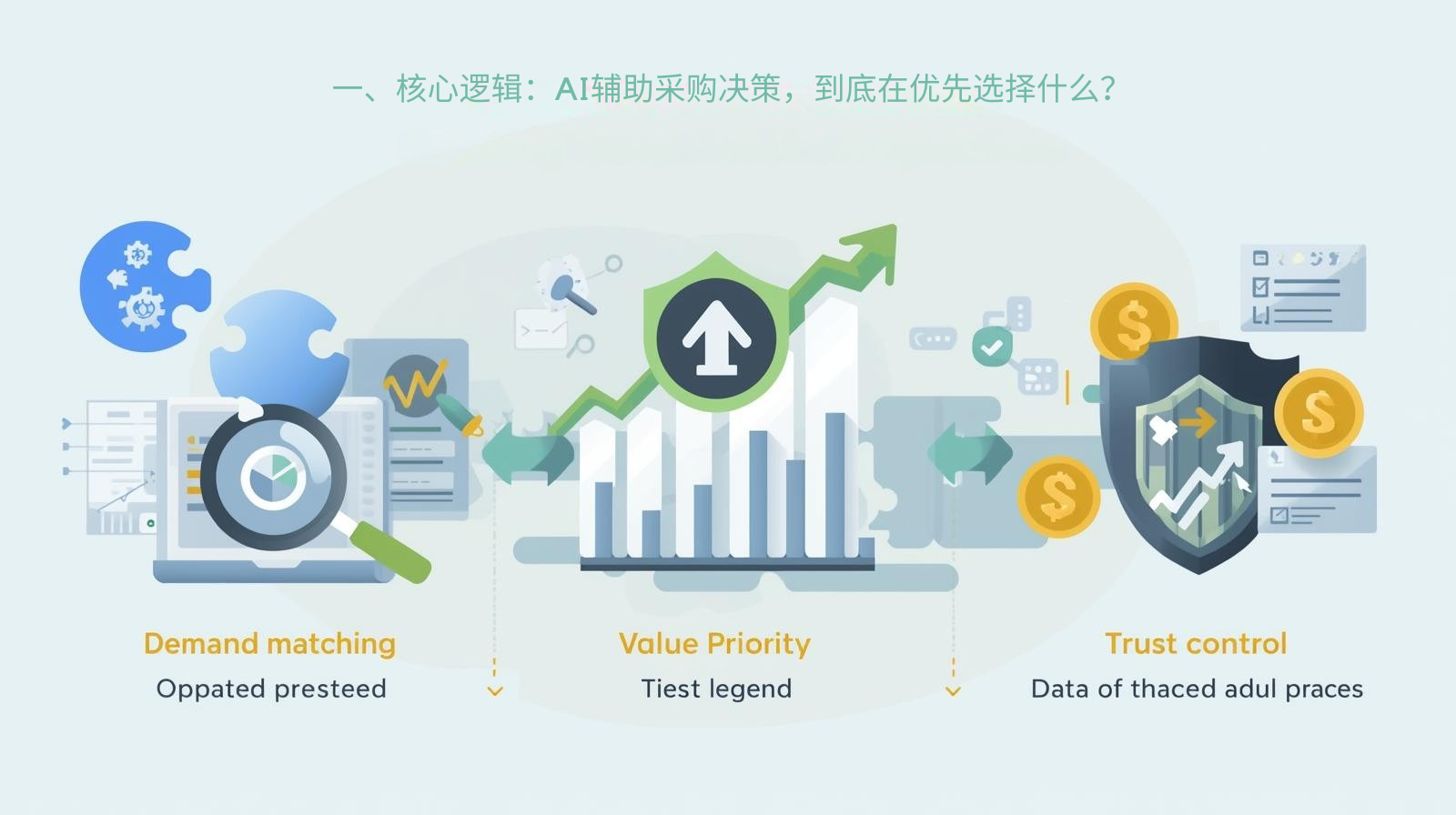
1. Core logic: What is the priority for AI-assisted procurement decision-making?
To let AI give priority to recommending your site through GEO optimization, you must first understand the underlying logic of AI-assisted procurement decision-making - AI is not a "random recommendation", but simulates the purchase decision-making process of buyers. It sorts all qualified independent sites around the three core dimensions of "demand matching, value priority, and trust controllability" and gives priority to recommending sites that best meet the needs of buyers, have the highest value, and are the most reliable. The core of GEO optimization is to make your site stand out in these three dimensions through systematic signal transmission and content empowerment, becoming the "optimal purchasing choice" in AI judgment, and thus gaining priority recommendation rights. Referring to the Ahrefs 2026 AI Procurement Recommendation Trend Report (link: https://www.ahrefs.com/blog/2026-ai-procurement-recommendation-trend/), in AI-assisted procurement decision-making, the inquiry conversion rate of priority recommended sites is 83% higher than that of ordinary recommended sites, and the order completion rate is increased by 67%. It can be seen that the priority of AI recommendation directly determines the customer acquisition and transaction efficiency of foreign trade companies.
1.1 Three core screening criteria for AI-assisted purchasing decisions (must understand)
When AI assists procurement, independent sites will be screened according to the logic of "first matching, then evaluation, then sorting". Its core screening criteria focus on 3 dimensions, which is also the core focus of GEO optimization. Only by accurately adapting these 3 criteria can AI give priority to your site: ① Demand matching: This is the primary criterion for AI screening. AI will break down the purchaser's search needs (such as "small batch EU-compliant electronic component supplier, 15-day delivery") and compare the site's core business, product advantages, and service capabilities. The higher the matching degree, the higher the ranking. This is also the core premise of "accurate customer acquisition"; ② Value priority: When buyers choose suppliers, they focus on “what unique value can be obtained.” AI will evaluate the value points delivered by the site (such as cost optimization, delivery advantages, customization capabilities). The more prominent the value and the more relevant to the buyer’s pain points, the higher the priority; ③ Trust and controllability: Foreign trade procurement involves cross-border cooperation, and buyers are most worried about "cooperation risks." AI will evaluate the reliability of the site through the site's compliance qualifications, customer cases, authoritative endorsements and other information. The higher the trust, the easier it is to be prioritized for recommendation. As clearly mentioned in OpenAI’s 2026 AI Decision Assistance Guide (link: https://platform.openai.com/docs/guides/generative-search/decision-assist), AI’s recommendation ranking is essentially “a digital reproduction of the purchaser’s decision-making logic”. Only by meeting the purchaser’s needs and trust preferences can they receive priority recommendations.
1.2 The core path of GEO affecting AI procurement decisions: signal empowerment + value transfer
The core reason why GEO optimization can affect AI's purchasing decision-making judgment is that through the dual path of "signal empowerment + value transfer", AI can quickly identify your site advantages and determine that your site is the "best choice for buyers": On the one hand, GEO optimization configures accurate signals ( Demand signal, value signal, trust signal), allowing AI to quickly capture the core information of the site, quickly determine the match, value and reliability of the site and the buyer's needs, reducing the identification cost of AI; on the other hand, GEO optimization deeply conveys the unique value and reliable advantages of the site by creating high-value content, allowing AI to fully understand your site and give it a higher weight when sorting, thereby achieving priority recommendation. To put it simply, GEO optimization is to "invest in what AI likes and what buyers like", allowing AI to actively push your site to buyers when assisting in purchasing decisions.
1.3 Misunderstanding warning: Ignoring the impact of GEO decisions will only miss 80% of accurate orders
Many foreign trade companies fall into the dilemma of "having exposure but no priority recommendation". The core is that they ignore the impact of GEO on AI procurement decisions. A common misunderstanding is "only "If you want to appear in AI search results, there will be inquiries from buyers." However, in the era of AI-assisted procurement, "low ranking = no exposure" - most buyers will only pay attention to the 3-5 sites recommended by AI first. Even if the sites at the bottom of the ranking can be seen, it is difficult to win the favor of buyers. There are three core harms: ① Loss of accurate traffic: A large number of high-intention buyers are recommended to peers by AI, and their own sites receive very little accurate traffic; ② Low inquiry quality: Even if there are a small number of buyers to inquire, they are mostly customers with low demand matching, making conversion difficult; ③ Weak order competitiveness: Among similar suppliers, if you cannot get AI priority recommendation, you cannot seize the "first recognition" of buyers, and you can only fall into price competition, making it difficult to obtain high-profit orders.
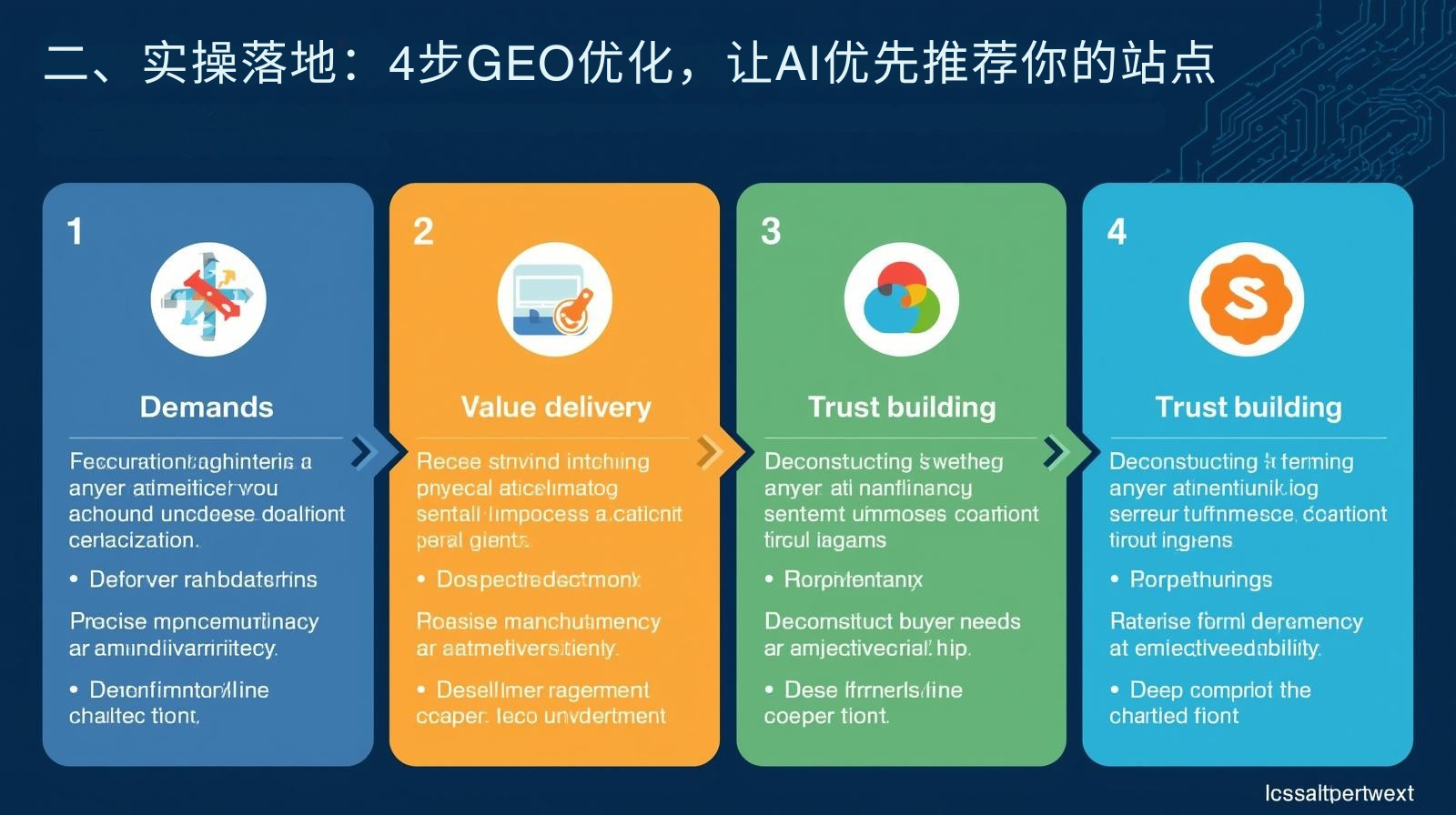
2. Practical implementation: 4-step GEO optimization, let AI give priority to recommend your site
Combining the latest recommendation rules of ChatGPT in 2026 and the three major screening criteria for AI procurement decisions, we have summarized a set of 4-step GEO optimization methods that can be implemented and replicated. Through these 4 steps, your site can achieve breakthroughs in the three dimensions of demand matching, value delivery, and trust building. Let AI give priority to recommend your site when assisting in procurement decisions, allowing buyers to actively consult and prioritize. Each step is supported by specific practical skills, execution standards and authoritative external links. There are no complicated technical requirements, and small and medium-sized foreign trade companies can get started quickly. The whole process adheres to the principle of "natural implementation, no deliberateness, and emphasis on practical operation" to avoid rigid stacking of signals and content.
Step 1: Accurate demand matching - let AI quickly identify "you meet the procurement needs"
Requirement matching is the primary criterion for AI screening and the basis for obtaining priority recommendations. The core of this step is "accurately dismantling buyers' needs and clearly conveying their own advantages", allowing AI to quickly determine that your site is highly consistent with buyers' needs, thereby improving the ranking priority. The core is "accurate, specific, and non-ambiguous" to avoid vague site positioning and unclear communication of requirements, causing AI to be unable to accurately identify.
Core practical skills
1. Disassemble the core needs of target buyers (accurate to the details): Combine your own products and target markets, and disassemble the explicit and implicit needs of buyers. For example, for foreign trade electronic components, the explicit needs of target buyers may be "EU compliance, small batch customization, 15-day delivery", and the implicit needs may be "controllable costs, timely after-sales, and checkable qualifications." The more specific the needs are, the easier it will be for AI to match; you can use Google Trends (link: https://trends.google.com/ ) Query the search hot spots of buyers in the target market in 2026 and accurately capture demand trends. 2. Build a "demand-advantage" correspondence system and deliver matching signals: Match the dismantled buyer's needs with your own core advantages one-to-one, for example, "small batch customization" corresponds to "MOQ starting from 50 pieces, 7 days for rapid proofing", "EU compliance" corresponds to "complete CE/ROHS certification, one-on-one compliance consultation can be provided", and integrate this correspondence into the semantic system and core pages of the site, so that AI can quickly see that "what buyers need, you can provide." 3. Optimize the core information of the site and strengthen demand matching: clearly mark the target buyers, core needs and corresponding advantages in the core positions of the site's homepage and product pages, such as "Exclusive for European small and medium-sized buyers, EU-compliant electronic components, small batch customization + 15-day delivery". At the same time, the demand keywords frequently searched by buyers are naturally integrated into the site title, navigation and content, allowing AI to quickly capture, accurately match, and improve the priority of recommendations.
Step 2: Prominent value delivery - let AI identify "you are the best value choice"
On the basis of demand matching, AI will give priority to recommend sites with "higher value and better fit for buyers' pain points". The core of this step is to "highlight unique value and solve buyers' pain points" to avoid vague value transfer and homogeneity with peers, so that AI can quickly identify your unique advantages and determine that you are the "best value choice" for buyers, thereby increasing the recommendation weight. The core of value transfer is "specific, quantifiable, and supported" to avoid empty statements such as "we are more professional, we are better".
Core practical skills
1. Extract 3 unique value points (differentiated from peers): Combining its own advantages and buyers' pain points, extract 3 unique and quantifiable value points to avoid homogeneity with peers, such as "15%-20% reduction in procurement costs", "delivery cycle 30% faster than peers", "after-sales service" "Response time ≤ 2 hours", the more specific and quantifiable the value point, the easier it is to be recognized by AI and buyers; you can refer to Global Sources' 2026 Foreign Trade Supplier Value Report (link: https://www.globalsources.com/ ), understand the value dimensions that buyers are most concerned about, and accurately refine their own value. 2. Use content and cases to support value points and strengthen persuasiveness: Create high-value content around the refined unique value points, such as "How to help European small and medium-sized buyers reduce electronic component procurement costs by 15%?" "15-day delivery vs. 25 days for peers, how can we achieve delivery efficiency?", and incorporate specific methods, data and real cases into the content. Make the value points more convincing; at the same time, show real customer cooperation cases and introduce in detail customer pain points before cooperation, value transfer during cooperation, and results after cooperation, such as "helping a small and medium-sized purchaser in Germany to reduce the procurement cost of electronic components by 18% and shorten the delivery cycle to 12 days." Let AI and purchasers intuitively feel your value. 3. Naturally embed value signals for AI to quickly identify: In the core pages of the site, content titles, and inquiry pages, naturally embed value signals, such as "15% reduction in procurement costs" and "15-day fast delivery". At the same time, ensure that the value signals are linked to the content and cases, so that AI can quickly identify your unique value and give it a higher weight when sorting to achieve priority recommendations.
Step 3: Comprehensive construction of trust - let AI identify "you are the most reliable choice"
The core pain point of foreign trade procurement is "trust anxiety". When AI assists procurement decisions, it will give priority to recommending "reliable and controllable" sites. The core of this step is to "comprehensively build a trust system and eliminate the trust concerns of buyers and AI", allowing AI to identify your site as "the most reliable procurement option", thereby locking in the priority recommendation rights. The core of trust building is "authentic, verifiable, and comprehensive" to avoid false endorsements, otherwise the trust of AI and buyers will be completely lost.
Core practical skills
1. Improve compliance and authoritative endorsement, and strengthen the foundation of trust: Combining the compliance requirements of the target market, sort out all core compliance qualifications (such as CE, ROHS, FDA certification), clearly display the qualification certificates on the site, and add the official external link of the certification agency, such as the CE certification link to the EU official query platform (link: https://ec.europa.eu/growth/single-market/european-standards/ce-marking_en ), FDA certification links to the official website of the US FDA (link: https://www.fda.gov/) to ensure that the qualifications are authentic and verifiable; at the same time, demonstrate cooperation with industry authoritative organizations (such as SGS testing cooperation), add SGS official external links (link: https://www.sgsgroup.com/), and let authoritative organizations endorse your reliability. 2. Show real strength and customer reputation to enhance trust: display the actual factory scene, production process, R&D equipment, and core team on the site to let AI and buyers intuitively feel the strength of your company; at the same time, collect high-quality customer reviews and feedback and display them on the homepage and product pages of the site, such as "The common choice of 7,000+ overseas customers, customer satisfaction reaches 98%", so that real word-of-mouth can become a support for trust; in addition, customer contact information (authorized by the customer) can be provided to facilitate verification by buyers, further enhancing trust. 3. Clarify after-sales and performance guarantees to eliminate trust concerns: clearly display after-sales guarantee policies and performance commitments on the site, such as "unconditional returns and exchanges for product quality issues", "delivery of small batch orders within 15 days, overdue compensation", "dedicated one-on-one after-sales consultant service, 24-hour response". At the same time, clarify the guarantee process to let buyers know that "guaranteed after cooperation", and also let AI recognize that your site has reliable performance and after-sales capabilities, improving the priority of recommendations.
Step 4: Optimize iteration - let AI continue to give priority to recommending your site
AI's procurement decision-making auxiliary rules, buyers' needs and preferences, are constantly changing in the AI ecological iteration in 2026. GEO optimization is not a "once and for all" process, but a process of "long-term iteration and continuous optimization". Only through regular reviews and optimization strategies can your site always adapt to AI rules and meet the needs of buyers, continue to receive priority recommendations from AI, and lock in precise orders. This step is the key to "long-term priority recommendation" and is also a step that many foreign trade companies easily overlook.
Core practical skills
1. Review three types of core data every month (clear the optimization direction): Establish an optimization review system, collect three types of core data every month, analyze the optimization effect, and clarify the optimization direction: ① AI recommendation data: AI recommendation rankings, number of priority recommendations, accurate traffic brought by AI recommendations, analyze the site's performance in AI recommendations, and determine deficiencies in demand matching, value delivery, and trust building; ② Buyer behavior data: buyers' clicks, stays, inquiry conversion rates, needs and concerns mentioned by buyers during consultation, analyze changes in buyers' needs, and judge whether value points and trust endorsements meet the needs of buyers; ③ Peer comparison data: Analyze the advantages, signal configuration and content direction of peer-preferred recommended sites, find your own gaps, and optimize your own strategies. 2. Optimize 2 core directions every quarter: Combining review data and AI ecological iteration trends (refer to OpenAI official announcement, link: https://platform.openai.com/docs/updates), optimize 2 core directions every quarter: ① Optimize demand matching and value delivery: adjust the semantic system, value points and content direction according to changes in buyer needs to ensure that the site always meets buyer needs; ② Supplement trust endorsement resources: add compliance qualifications, customer cases, authoritative cooperation, update the trust display in the site, let AI and buyers see the continued growth of the site, and increase trust and recommendation weight. 3. Adapt to multiple AI platforms and expand the scope of priority recommendations: In addition to ChatGPT, simultaneously optimize the adaptability of mainstream AI procurement tools such as Google Gemini and Perplexity, and adjust the optimization strategy based on the recommendation rules of different platforms. For example, Google Gemini pays more attention to industry authority and strengthens authoritative endorsements and professional content, so that your site can receive priority recommendations on multiple AI platforms and reach more accurate buyers.
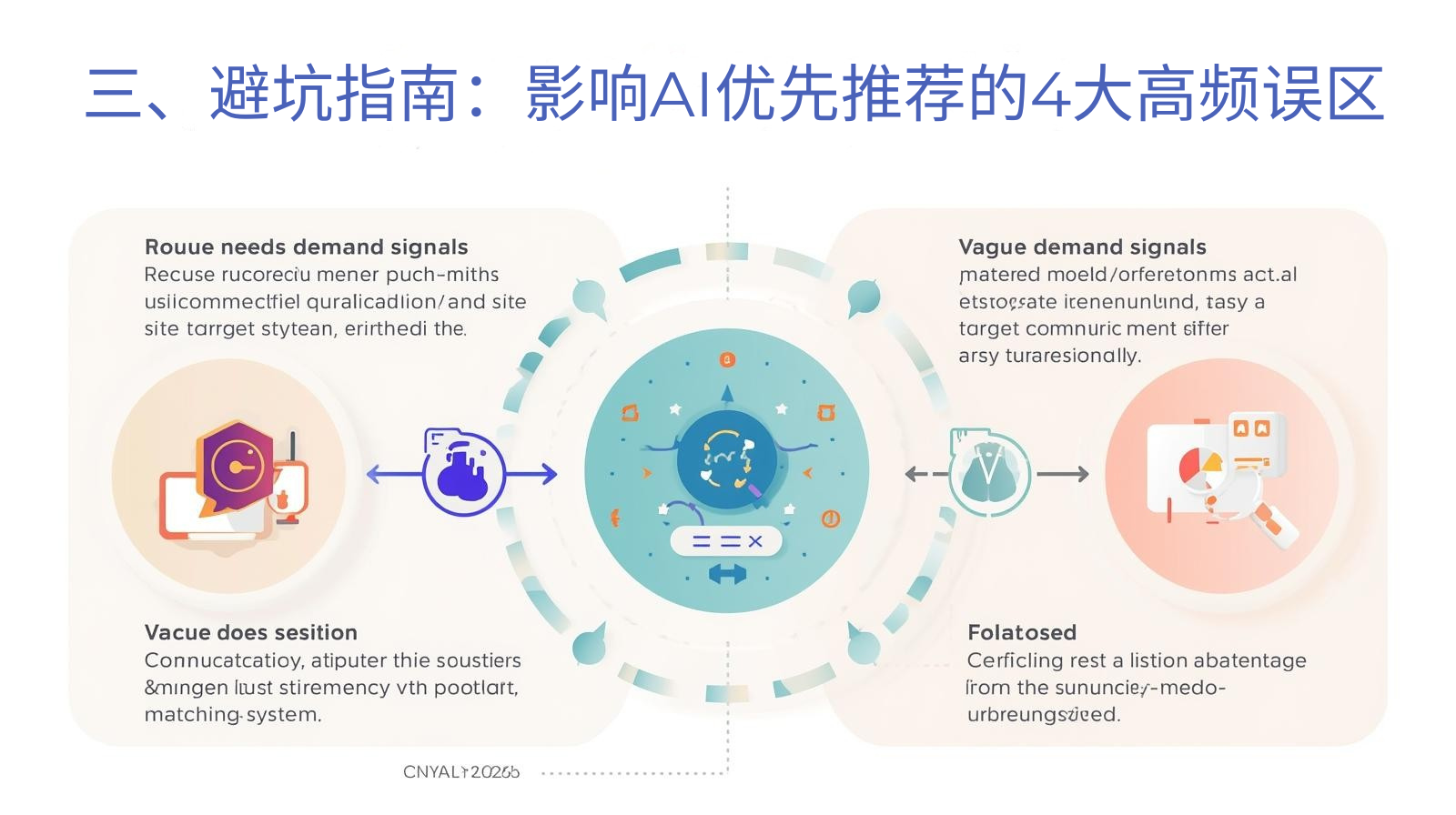
3. Pitfall avoidance guide: 4 high-frequency misunderstandings that affect AI priority recommendation (must read)
Many foreign trade companies seem to have done a lot of things when doing GEO optimization, but they have never been able to get priority recommendations from AI. The core is that they fell into some high-frequency misunderstandings, which caused the site to rank low in the AI procurement decision-making screening and miss a large number of accurate orders. Based on the practical lessons learned from the GEO independent foreign trade station in 2026, the following four major misunderstandings are the most common. Each of them is accompanied by a specific correction plan to help everyone avoid pitfalls quickly, implement them efficiently, and avoid blind internal friction.
Misunderstanding 1: Requirements are vague and AI cannot accurately match
Error performance: The site positioning is vague, the target buyers and core needs are not clear, the content and signals are messy, it is a major European customer, but also a small and medium-sized buyer, and it makes both compliant products and ordinary products. The demand signal transmitted to the AI is ambiguous, resulting in the AI being unable to accurately judge the match between the site and the buyer's needs, and ranking low.
Core hazards: AI cannot accurately match buyers' needs, and its recommendations are ranked low and cannot receive priority recommendations; most of the traffic it receives is invalid traffic, and the inquiry conversion rate is low; it cannot seize the "first awareness" of buyers, and misses a large number of precise orders.
Correct approach: Focus on type 1-2 core buyers, accurately dissect their needs, build a "demand-advantage" correspondence system, clearly convey demand matching signals, optimize the site's core information and semantic system, so that AI can quickly and accurately identify the match between the site and the buyer's needs, and improve the priority of recommendations.
Misunderstanding 2: Empty value delivery and homogeneity with peers
Error performance: Value delivery is vague and empty, repeatedly piling up meaningless expressions such as "professional, high-quality, efficient", without refining unique and quantifiable value points, and being highly homogeneous with peers, resulting in AI being unable to recognize your unique advantages, unable to obtain higher weight when sorting, and unable to achieve priority recommendations.
Core hazards: You cannot stand out among sites with matching needs, and your recommendation ranking is low; buyers cannot identify your unique value and can only compete on price, affecting brand profits; you cannot obtain high-weight recommendations from AI, and the probability of priority recommendation is greatly reduced.
Correct approach: Combine your own advantages and buyers’ pain points, refine 3 unique and quantifiable value points, support the value points with content, cases and data, avoid homogeneity with peers, and naturally embed value signals so that AI can quickly identify your unique advantages, increase recommendation weight, and achieve priority recommendations.
Myth 3: False trust and endorsement, loss of trust between AI and buyers
Error performance: In order to quickly obtain AI priority recommendations, they forged compliance qualifications, fake customer cases, and fake authoritative cooperation, trying to deceive AI and buyers, thinking that as long as they "look reliable", they can get priority recommendations, ignoring the semantic recognition and verification capabilities of AI.
Correct approach: Adhere to the principle of "authenticity first", all trust endorsement information must be true and verifiable, not forged or exaggerated, gradually supplement compliance qualifications, customer cases and authoritative cooperation, use real strength and reputation to gain the trust of AI and buyers, and lock in priority recommendation rights.
Misunderstanding 4: Ignore the adaptation of multiple AI platforms and only focus on a single platform
Error performance: Only focus on ChatGPT as an AI platform and ignore other mainstream AI procurement tools such as Google Gemini and Perplexity. All GEO optimizations only adapt to the rules of ChatGPT. As a result, the site cannot obtain priority recommendations from other AI platforms, misses out on a large number of accurate buyers, and cannot maximize order volume.
Core hazards: The recommendation channel is single, the coverage of priority recommendation is limited, and it is unable to reach more buyers with different habits; once the ChatGPT rules are adjusted, the site recommendation ranking will drop significantly, affecting order stability; the value of GEO optimization cannot be maximized, and the transformation effect is greatly reduced.
Correct approach: Broaden recommendation channels, adapt to the procurement decision-making recommendation rules of multiple AI platforms, combine the characteristics of different platforms, and adjust optimization strategies so that your site can receive priority recommendations on mainstream AI platforms such as ChatGPT and Google Gemini, reach more precise buyers, and increase order volume.
Related article recommendations: Your peers have not yet reacted: using GEO to build an independent foreign trade station is the biggest blue ocean strategy at the moment
Related article recommendations: Your peers have not yet reacted: using GEO to build an independent foreign trade station is the biggest blue ocean strategy at the moment
4. Ending: GEO empowerment, let AI become your "core helper" in purchasing decisions
In 2026, AI-assisted procurement has become the mainstream trend in foreign trade procurement. The priority of AI recommendations directly determines the customer acquisition efficiency and order volume of foreign trade companies. The reason why many foreign trade companies miss a large number of precise orders is not because the products are not good enough or the price is not advantageous enough, but because GEO optimization is not done well, which cannot affect the AI purchasing decision-making judgment, resulting in the site being ranked low and unable to be prioritized by buyers.
The core of GEO optimization has never been "simple exposure", but "influencing AI's purchasing decisions and letting AI give priority to recommending your site". It can make your site become the "optimal procurement choice" recognized by AI through accurate demand matching, outstanding value delivery, and comprehensive trust building in AI screening. With the assistance of AI, buyers can actively find you and choose you, get rid of price competition, and achieve high-quality development. Through the 4-step practical method of "accurate demand matching → outstanding value delivery → comprehensive trust building → optimization and iteration", avoid common misunderstandings and insist on long-term optimization, you can let AI continue to give priority to recommending your site when assisting in purchasing decisions and seize the core initiative in cross-border trade.
The foundation of all this is a high-quality independent station base that is adapted to GEO optimization and AI crawling. The core reason why many foreign trade companies have poor results when doing GEO optimization is that the underlying technology of the independent station is backward, slow to load, confusing in structure, and unclear in signal transmission. It cannot adapt to the screening rules of AI procurement decisions, resulting in the inability of AI to accurately identify and give priority recommendations. Pindian Technology has more than ten years of experience in building foreign trade websites and has served a total of 7,000+ customers. It uses react technology to build websites, which not only makes website browsing smoother (overseas loading speed ≤ 2 seconds, perfect for multi-terminal access), but also adapts to GEO optimization and AI crawling needs from the bottom - building a clear language It defines an adaptive structure, optimizes the display of core information, reserves precise signal entrances, and adapts to multiple AI platform capture rules. It also supports the construction of modules such as demand matching, value transfer, and trust endorsement, so that your site can be quickly recognized and prioritized by AI, providing solid technical support for seizing the initiative in AI purchasing decisions.
Pindian website building can simultaneously assist enterprises to implement GEO optimization, sort out buyer needs, refine unique value points, build a trust system, and conduct regular review optimization. With the practical methods in this article, your site can quickly obtain AI priority recommendation rights, allowing buyers to actively choose you with the assistance of AI. If your site is facing the dilemma of "low AI recommendation rankings and few accurate orders", you may wish to choose Pindian Technology to provide professional website optimization services and leverage the power of GEO to influence AI purchasing decisions, seize new opportunities for cross-border trade, and achieve a double increase in inquiries and orders.