
In February 2026, the "Foreign Trade GEO Optimization Practical Report" released by Semrush showed that 80% of foreign trade independent stations fell into "fragmentation" in GEO (Generative Engine Optimization) "Optimized, unsystematic, and difficult to copy" is a dilemma. Even if a lot of time and cost are invested, it is difficult to appear stably in AI search results such as ChatGPT. However, a site with a complete GEO system can not only allow AI to continue to actively recommend, but its optimization method can also be quickly copied to multiple categories and multiple sites to achieve batch customer acquisition. Many foreign trade companies' understanding of GEO is still at the level of "scattered content optimization and signal configuration". They mistakenly believe that as long as they do a certain link well, they can get AI recommendations, but they ignore that the core of GEO is "systematization" - it is not a single optimization action, but a set of "positioning, content, signal, authority, complexity" The complete methodology of "Disk" is replicable, implementable and iterable, which can help independent foreign trade stations get rid of the internal friction of "blind optimization" and realize the standardization and efficiency of AI generative engine optimization. This article will dismantle this replicable GEO system methodology in detail, so that foreign trade companies, regardless of size, can quickly get started and implement it to achieve results.

1. Cognitive Breakthrough: Why does GEO need to be systematic rather than piecemeal optimization?
In the era of AI search, GEO optimization of independent foreign trade sites is no longer a "single-point breakthrough" that can be effective. Scattered content creation and random signal configuration will only cause AI to be unable to accurately identify the site value, and the optimization effect will be short-lived and even waste a lot of resources. The core value of GEO systematization is to integrate scattered optimization actions into standardized and replicable processes, allowing AI to continuously and clearly understand the value of the site, while allowing enterprises to quickly reuse methods and implement them in batches, eliminating dependence on "professional optimizers." Referring to the Ahrefs 2026 foreign trade traffic optimization report (link: https://www.ahrefs.com/blog/2026-foreign-trade-traffic-optimization/), building a site with a complete GEO system, AI recommendation stability increased by 76%, optimization efficiency increased by 68%, and the optimization method can be quickly copied to new sites, significantly reducing customer acquisition costs.
1.1 Three fatal problems in fragmented GEO optimization (pain points in practical operation in 2026)
Based on the actual operation status of GEO independent foreign trade stations in 2026, the fragmented optimization methods of most enterprises have the following three major problems, resulting in poor optimization results and unsustainability: ① Fuzzy positioning, AI cannot identify core value: There is no clear site positioning and semantic orientation. Today, "EU compliance" is optimized, and tomorrow "small batch customization" is piled up. The content and signals are messy, and AI cannot clearly judge the core advantages and target users of the site. Even if it is occasionally recommended, it is difficult to obtain accurate traffic; ② Optimization has no logic and cannot form a closed loop: it only focuses on a single link, such as only producing content without configuring signals, or only configuring signals without improving authority. The optimization actions are out of touch and cannot form a closed loop of "positioning→content→signals→authority→recommendation". The optimization effect is difficult to sustain, and there may even be a situation where "the traffic declines after optimizing for a period of time"; ③ Without standardized methods, it is impossible to copy and iterate: optimization relies entirely on "feeling", without clear processes and standards. If you change a category or a site, you need to explore again. Past experience cannot be reused, and the optimization efficiency is low. It is also difficult to find problems and iteratively optimize, and you will fall into "blind internal friction" for a long time.
1.2 The core value of GEO systemization: replicable, implementable and iterable
The essence of GEO systematization is to formulate standardized processes, clear goals and implementable methods for every aspect of GEO optimization, forming a complete closed loop of "input → execution → output → review". Its core value is reflected in three dimensions, perfectly solving the pain points of fragmented optimization: ① Replicable: This methodology does not rely on personal experience. No matter what category of foreign trade independent station (lighting, furniture, electronics, machinery, etc.), regardless of whether it has a professional optimization foundation, it can be implemented according to standardized processes, and can even be quickly copied to multiple sites and categories to achieve bulk customer acquisition; ② Implementable: Abandon empty theories. Each link has specific operating steps, implementation standards and precautions. There are no complex technical requirements, and small and medium-sized foreign trade companies can get started quickly, avoiding "you can know it once you see it, but you can't do it once you do it"; ③ Iterable: The system includes a review and optimization link, which can quickly identify problems in the optimization process. It can adjust the optimization strategy in a timely manner based on the AI ecological iteration trend and site data, so that the GEO system can always adapt to the AI search rules and achieve continuous improvement of the optimization effect. As mentioned in the OpenAI 2026 AI Recommendation Ecosystem Guide (link: https://platform.openai.com/docs/guides/generative-search/recommendation-ecosystem), standardized and systematic site optimization is the core prerequisite for continuous AI recommendation and the key to improving optimization efficiency.
1.3 The core logic of the GEO system: Let AI "continue to understand, continue to trust, and continue to recommend"
The underlying logic of the GEO system is not to "cater to AI rules", but to "establish a trust relationship between AI and the site". Through systematic optimization, AI can continue to understand the core value of the site and continue to trust the authority of the site, thereby achieving continuous active recommendations. Its core logic can be summarized as follows: clarify the core positioning and semantic system of the site (let AI understand it) → create high-value content and configure accurate signals (let AI recognize it) → enhance the authority of the site and strengthen trust endorsement (let AI trust it) → review and optimize, adapt to AI iterations (let AI continue to recommend). This set of logic is interlocking, and each link lays the foundation for the next link, ensuring the stability and sustainability of the optimization effect, and completely getting rid of the "flash in the pan" of scattered optimization.
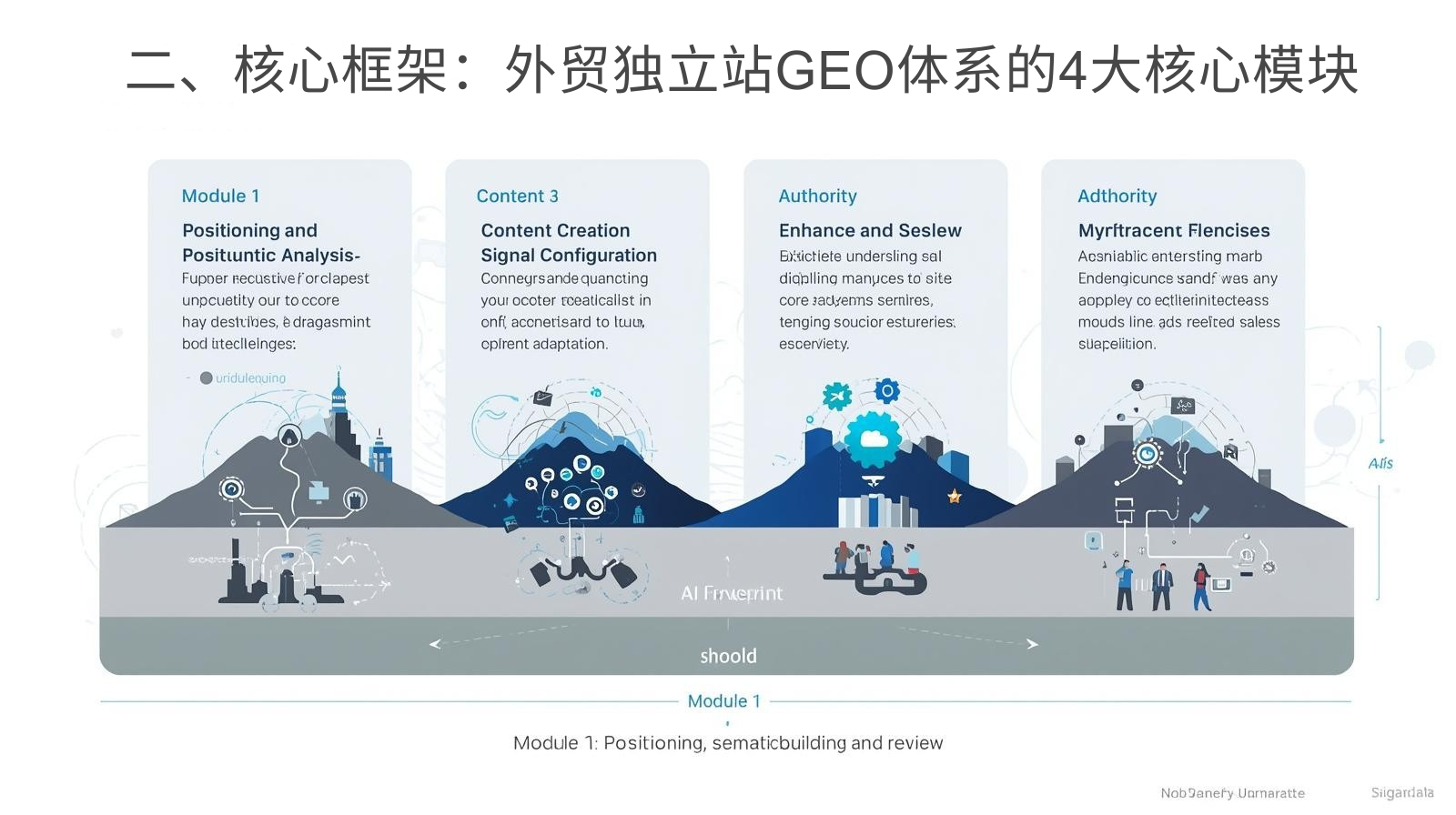
2. Core framework: 4 core modules of the GEO system of the independent foreign trade station (can be copied directly)
The core of the foreign trade independent station GEO system is composed of four major modules: "positioning semantic module, content creation module, signal configuration module, authority improvement and review module". The four major modules are interrelated and indispensable, and together form a complete set of replicable methodology. Each module has standardized operating procedures, execution standards and implementation techniques. There is no complicated technology in the whole process. It integrates authoritative and checkable external links and complies with the latest recommended rules of ChatGPT in 2026. No matter what category of foreign trade independent station it is, it can be directly copied and implemented to achieve the standardization of AI generative engine optimization.
Module 1: Positioning semantic module (basic core) - let AI quickly understand your site
The positioning semantic module is the foundation and core link of the GEO system. The core goal is to "clarify the core positioning of the site and build a clear semantic system" so that AI can quickly and accurately understand the core advantages, target users and value proposition of the site, laying the foundation for subsequent content creation and signal configuration. This module is the key to being replicable. Regardless of the category, it can be implemented according to the process of "clear positioning → building semantics → unified adaptation".
Standardized operation steps (can be copied directly)
1. Clarify the three core positionings (can be completed in one day): sort out the core products, core advantages and target users of the site, and clarify "category positioning + advantage positioning + user positioning". Combining the three to avoid vague positioning, such as the foreign trade lighting site, the category positioning is "foreign trade LED lamps", the advantage positioning is "EU compliance, small batch customization", and the user positioning is "overseas small and medium-sized buyers"; 2. Build a hierarchical semantic system (can be completed in 2-3 days): Build a hierarchical system of "core semantics → second-level semantics → third-level semantics" around three core positionings. Core semantics (1): a condensation of the site's core positioning, such as "EU compliant small batch LED lamps"; second-level semantics (2-3): dismantling of core advantages, such as "LED lamp compliance certification, small batch MOQ optimization, procurement cost control"; third-level semantics (each second-level semantics corresponds to 2-3): dismantling of specific scenarios and needs, such as "LED lamps CE certification process, MOQ" "50-piece minimum plan, logistics cost optimization techniques"; 3. Unified adaptation of the entire site's semantics (can be completed in 3-5 days): Integrate the semantic system into every page of the site. The homepage highlights the core semantics and advantageous positioning. The product pages fit the corresponding secondary and tertiary semantics. The content pages are created around the semantic system. The inquiry page is marked with core values to ensure the semantic unity of the entire site, allowing AI to quickly confirm the site's positioning through the entire site's content and avoid semantic disconnection.
Module 2: Content creation module (core carrier) - let AI actively reference your site
Content is the core carrier of the GEO system and the core basis for AI recommendations. The core goal is to "create content that is easy for AI to cite and valuable to users", so that the content can become a "bridge" for AI recommendation sites, while improving user trust and inquiry conversion rates. The methodology of this module can be directly copied. Regardless of the category, high-quality content can be created in batches according to the process of "determine direction → creation standards → update and maintenance".
Standardized operation steps (can be copied directly)
1. Determine the direction of three types of core content (can be directly reused): No matter what category, give priority to creating "question-and-answer content, solution-based content, and scenario-based content." These three types of content are most easily referenced by AI and can best solve user pain points, such as: question-and-answer type (questions commonly searched by users with AI, such as "2026 LE What certifications are required for D lamps to be exported to the EU? ”), solution-based (solutions to users’ core pain points, such as “An avoidance solution for small-batch procurement of LED lamps for overseas small and medium-sized buyers”), scenario-based content (fitting user procurement scenarios, such as “exclusive solution for small-batch customization of cross-border e-commerce LED lamps”); 2. Develop content creation standards (to ensure replicability): ① Content structure: directly address user pain points at the beginning → provide implementable methods and data support in the middle → naturally embed site value and links at the end; ② Content length: 800-1200 words for a single piece of content, with clear logic and progressive layers to avoid verbosity; ③ Authoritative support: Each piece of content is integrated with 1-2 authoritative external links. For example, compliance content links to the EU’s official CE certification guide (link: https://ec.europa.eu/growth/single-market/european-standards/ce-marking_en), and quality content links to SGS testing reports (link: https://www.sgsgroup.com/) to enhance content authority and AI recognition; ④ Semantic integration: Naturally integrated into the semantic system without deliberate stacking, ensuring a high match between content and site positioning; 3. Standardized update and maintenance: 1-2 original content is updated every week, with fixed update times (such as every Tuesday and Friday); core content is updated quarterly to supplement the latest industry data, compliance rules, and customer cases in 2026; a content ledger is established to record the AI citation rate, traffic, and inquiry conversion of each piece of content, providing a basis for subsequent review and optimization.
Module 3: Signal Configuration Module (Acceleration Engine) - Improve AI recommendation weight
The signal configuration module is the "acceleration engine" of the GEO system. Its core goal is to "configure accurate and semantic GEO signals" to help AI identify site value more quickly and accurately, increase AI recommendation weight, and allow sites to be actively recommended in more relevant scenarios. The configuration standards of this module can be copied directly, and all independent foreign trade stations can be implemented according to the process of "screening signals → laying out signals → linking content".
Standardized operation steps (can be copied directly)
1. Screen 4 types of core signals (can be reused directly): Regardless of the category, focus on the semantic system and screen the four types of core signals "brand signal + value signal + scene signal + trust signal". Only 1-2 signals of each type are retained to avoid stacking, such as: brand signal (site brand name + core positioning, such as "XX Brand EU Compliant Small Batch LED Lamps"), value signal (condensation of core advantages, such as "MOQ" 50 pieces minimum, complete with CE certification"), scenario signals (target user scenarios, such as "exclusive for small and medium-sized buyers, cross-border e-commerce adaptation"), trust signals (authoritative endorsement, such as "10 years of industry experience, SGS certification cooperation"); 2. Standardized signal layout: The four types of core signals are evenly laid out on the core pages of the site. The home page (navigation bar, banner, bottom) each has 1-2 core signals. The product page (title, top of the details page) layout corresponds to the scene and value signals. The core content page (beginning, end) layout corresponds to the semantic signals. This ensures that AI can quickly identify it when crawling, and avoids signals being concentrated on a certain page, which affects the user experience; 3. Signal and content linkage: Each signal must find support in the content of the corresponding page. For example, if the signal configuration is "CE certified complete", the corresponding product page or content page must introduce the process, advantages and processing methods of CE certification in detail, so that AI can confirm the professionalism of the site and improve the recommendation weight through the linkage of signals and content; 4. Signal iteration standards: Combined with AI ecological iteration trends every quarter (refer to OpenAI official announcement, link: https://platform.openai.com/docs/updates ), adjust the signal expression to ensure that the signal adapts to the AI semantic understanding rules. For example, in 2026, AI will pay more attention to scene-based expression, and the signal will be optimized to "CE certified LED lamps for small and medium-sized buyers, MOQ starting from 50 pieces."
Module 4: Authority improvement and review module (continuous guarantee) - let AI continue to recommend
The authority improvement and review module is the "continuous guarantee" of the GEO system. The core goal is to "enhance the authority of the site in the AI ecosystem, and at the same time, adjust strategies in a timely manner through review optimization to ensure continuous improvement of the optimization effect" and avoid stagnation in the optimization effect. This module is the key to the iteration and sustainability of the system and can be directly copied and implemented.
Standardized operating steps (can be copied directly)
1. Three standardized actions to improve authority: ① Build authoritative external links: 2-3 new high-quality authoritative external links will be added every month, giving priority to linking to EU official compliance websites, authoritative testing agencies such as SGS, and well-known foreign trade platforms such as Global Sources (link: https://www.globalsources.com/ ), industry authoritative blogs to avoid junk external links; ② Show real trust endorsement: on the homepage and about us page of the site, display real customer cases, cooperation certificates, factory strength, and customer reviews, such as uploading cooperation cases of 10+ overseas small and medium-sized buyers, SGS cooperation certificates, and real factory pictures to enhance the trust between AI and users; ③ Actively adapt to AI citations: Add a "content citation guide" to the site to clearly mark the originality and citation method of the content to facilitate crawling and citation by AI tools such as ChatGPT; submit core content to the OpenAI content library every quarter (link: https://platform.openai.com/docs/guides/generative-search/content-submission) to increase the probability of the site being recognized and recommended by AI; 2. Review and optimize the standardization process (once a month): ① Data collection: Collect five types of core data of the site: AI citation rate, AI recommended traffic, bounce rate, inquiry conversion rate, and signal capture status; ② Problem analysis: Compare standard data (industry average or past data) to analyze problems in the optimization process. For example, low AI citation rate may be due to insufficient content value; low inquiry conversion rate may be due to a mismatch between signals and user needs; ③ Strategy adjustment: According to the discovered problems, adjust the optimization strategy of the corresponding module. For example, if the content citation rate is low, optimize the content value and structure; if the signal capture is poor, adjust the signal layout and expression; ④ Iterative implementation: Apply the adjusted strategy to the optimization of the next month, forming a closed loop of "review → adjustment → implementation → review again" to ensure that the optimization effect continues to improve.
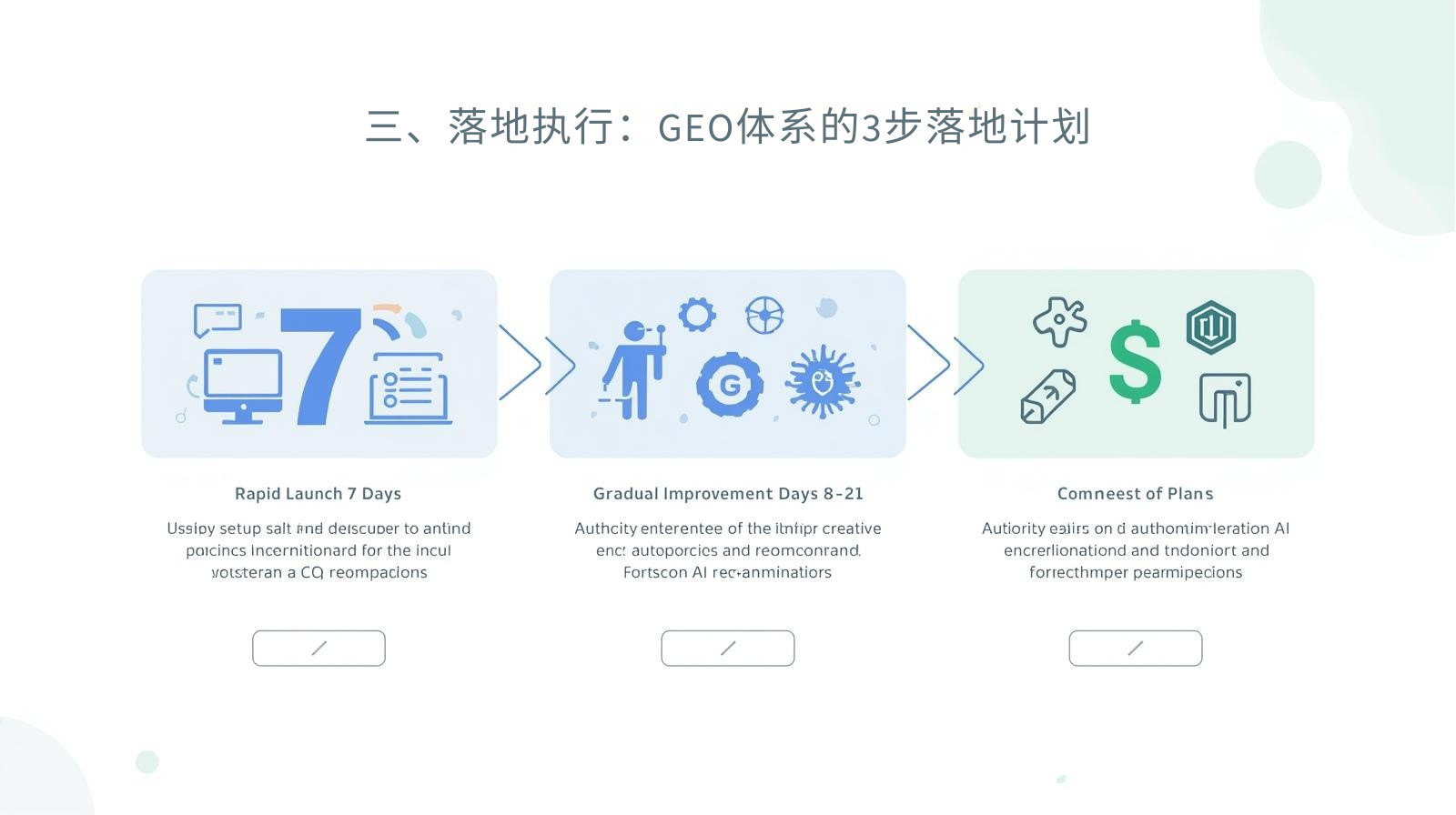
3. Implementation: 3-step implementation plan for GEO system (can be started in 7-30 days)
Many foreign trade companies worry that systematic optimization will be time-consuming, labor-intensive, and difficult to start. In fact, this GEO system can be implemented quickly in 7-30 days according to the three-step plan of "quick start → gradual improvement → review and iteration" without investing a lot of time and cost. Small and medium-sized foreign trade companies can also easily implement it. Each step has clear time nodes and execution standards, and can be copied directly.
Step 1: Quick start (7 days) - complete the basic construction and achieve preliminary AI recognition
Core goal: quickly complete the basic work of the positioning semantic module and signal configuration module, so that AI can initially identify the site value, laying the foundation for subsequent content creation and authority improvement. Execution content: On day 1, clarify the three core positionings of the site; on days 2-3, build a basic semantic system (core semantics + secondary semantics); on days 4-5, screen 4 types of core signals and complete the signal layout of the homepage and core product pages; on days 6-7, check the semantic unity of the entire site, adjust the compatibility between signals and semantics, and submit 1-2 core contents to the OpenAI content library to complete a quick start.
Second step: Gradual improvement (8-21 days) - complete the core modules and increase the probability of AI recommendation
Core goal: to complete the core work of the content creation module and the authority improvement module, improve the site's AI recognition and recommendation weight, and achieve preliminary AI active recommendations. Execution content: On days 8-14, according to content creation standards, create 7 high-quality original contents (3 Q&A-based articles, 2 solution-based articles, 2 scenario-based articles), integrate authoritative external links, and complete content updates; on days 15-21, build 3-4 authoritative external links, display core customer cases and cooperation certificates, improve site trust endorsement, and optimize the linkage between signals and content to ensure that each signal is supported by content.
The third step: review and iteration (22-30 days) - forming a closed loop to achieve continuous optimization
Core goal: Complete the first review optimization, discover problems, adjust strategies, form a complete optimization closed loop, ensure that the GEO system can continue to adapt to the AI ecosystem, and achieve continuous improvement in optimization effects. Execution content: On days 22-25, collect site core data and analyze problems in the optimization process (such as AI citation rate, traffic, inquiry conversion); on days 26-28, adjust the optimization strategy of the corresponding module (such as content, signals, external links) in response to the problems; on days 29-30, implement the adjusted strategy, improve the GEO system, start the next round of optimization cycle, and organize the optimization experience to form a replicable standardized document to lay the foundation for subsequent batch replication or multi-site optimization.
Related article recommendations: Your peers have not yet reacted: using GEO to build an independent foreign trade station is the biggest blue ocean strategy at the moment
Related article recommendations: Your peers have not yet reacted: using GEO to build an independent foreign trade station is the biggest blue ocean strategy at the moment
4. Pitfall avoidance guide: 4 high-frequency misunderstandings in the implementation of the GEO system (must read to avoid internal friction)
Although this GEO system can be copied and implemented, many foreign trade companies will still fall into some frequent misunderstandings during the implementation process, resulting in poor optimization results, waste of resources, and even affecting the site's AI recognition. Based on the practical lessons learned from the GEO system of independent foreign trade stations in 2026, the following four major misunderstandings are the most common. Each of them is accompanied by a specific correction plan to help everyone avoid pitfalls quickly and implement them efficiently.
Misunderstanding 1: Copying the system without adjusting it according to its own category
Error performance: Directly copying all the contents of this system, without combining the characteristics, core advantages and target users of its own category, adjusting the semantics, content and signals, such as a site for mechanical products, copying the semantics and content direction of the lighting site, resulting in a disconnect between the content and products, a mismatch between signals and needs, and the inability of AI to accurately identify the value of the site.
Core hazards: The site positioning is vague, the traffic recommended by AI is inaccurate, and the inquiry conversion rate is extremely low; the optimization actions are out of touch with its own category, unable to deliver core values, and the system implementation is a formality, unable to realize automatic AI recommendations; a lot of time and cost are wasted, and it falls into the dilemma of "blind copying and ineffective internal consumption".
Correct approach: Copy the "process and standards" of the system rather than the "specific content", adjust the semantic body based on the characteristics of your own category Department, content direction and signal configuration, for example, for a mechanical product site, the core semantics can be adjusted to "EU compliant small batch mechanical parts", the content direction focuses on "mechanical parts compliance, customization process, quality inspection", and the signal highlights "high precision, CE certification, small batch customization" to ensure that the system is highly compatible with its own category.
Misunderstanding 2: Ignoring original content and plagiarizing and patching together in batches
Error performance: In order to quickly complete the content update task, plagiarizing content from other sites in batches, or simply piecing together text, without paying attention to the originality and value of the content, or even directly translating content from foreign sites, resulting in content that lacks professionalism, cannot solve user pain points, and is judged as low-quality content by AI.
Core hazards: Low-quality and plagiarized content cannot be cited and recommended by AI, and may even reduce the AI authority of the site, causing the site to be included in the "low-quality site blacklist" by AI; users cannot gain value from the content, with high bounce rates and low inquiry conversion rates; long-term plagiarism will affect the site's brand reputation and make it difficult to achieve long-term development.
Correct approach: Strictly follow content creation standards, insist on original content output, combine your own industry experience and the latest trends in 2026, and create content that has unique value and can solve user pain points; even if you refer to the content of other sites, you must also carry out in-depth optimization, supplement your own experience and data, and integrate authoritative external links to ensure the originality and professionalism of the content.
Misunderstanding 3: Only do system construction, not review and iteration
Error performance: After completing the construction of the four major modules according to the system process, it is considered that the GEO optimization has been completed, and no longer performs review optimization, nor pays attention to the iterative trend of the AI ecosystem. It sticks to the old optimization strategy, resulting in the site being unable to adapt to changes in AI rules, and the optimization effect gradually declining.
Core hazards: The AI ecosystem is in continuous iteration, rules are constantly changing, and adhering to old strategies will lead to sites being gradually eliminated by AI, AI recommendation weights will decrease, and traffic will be lost; problems in the optimization process cannot be discovered, and the optimization effect is difficult to continuously improve, and even "optimize for a period of time, but the traffic will decline"; the system cannot achieve iterative upgrades, and gradually loses replicable and sustainable advantages.
Correct approach: Strictly implement the review optimization process, conduct a review once a month, and adjust the optimization strategy based on the AI ecological iteration trend every quarter; establish an AI rule monitoring mechanism, regularly pay attention to official announcements such as OpenAI, Semrush, etc., and timely adapt to changes in AI search rules to keep the GEO system alive and achieve continuous improvement in optimization effects.
Misunderstanding 4: Excessive pursuit of the number of external links and ignoring the quality of external links
Error performance: In the authority improvement module, excessive pursuit of the number of external links, batch construction of junk external links and irrelevant external links (such as entertainment and e-commerce external links unrelated to foreign trade and categories), believing that the more external links, the higher the authority of the site, ignoring the quality and relevance of external links.
Core hazards: Spam external links and irrelevant external links will be judged as illegal optimization by AI, resulting in a decrease in site authority, reduced recommendation weight, and even punishment by AI; a large number of irrelevant external links will distract the core value of the site, affect AI's recognition of site positioning, and lead to a decrease in recommendation accuracy; a lot of time and cost will be wasted, and the goal of increasing authority cannot be achieved.
Correct approach: Follow the principle of "quality first, quantity supplemented", add 2-3 new high-quality products every month Authoritative external links with high quality and high relevance should be given priority to authoritative websites related to foreign trade, categories and compliance to avoid spam external links and irrelevant external links; regularly check the quality of external links and delete invalid and illegal external links to ensure the authority and relevance of external links and truly improve the authority of the site.
5. Ending: GEO system, allowing foreign trade independent stations to optimize AI to say goodbye to internal consumption and acquire customers in batches
In 2026, the GEO optimization of independent foreign trade stations is no longer an era of "sporadic efforts", but an era of "system victory". The reason why many foreign trade companies are unable to achieve breakthroughs in AI search is not because they are not working hard enough, but because they have not found the right method. Scattered optimization actions will only lead to blind internal friction and short-lived results. Only a replicable, implementable, and iterable GEO system can allow independent foreign trade stations to get rid of internal friction, realize the standardization and efficiency of AI generative engine optimization, and allow AI tools such as ChatGPT to continue to actively recommend and obtain a steady stream of accurate traffic.
This GEO system abandons empty theories and focuses on practicality and replicability. It has four core modules, a three-step implementation plan, and four pitfall avoidance guides. No matter what category of foreign trade independent website you are, whether you have a professional optimization foundation or not, you can quickly get started and achieve results. It can even be quickly copied to multiple sites and categories to achieve batch customer acquisition. It not only helps you make your site appear stably in AI search results, but also allows you to take the initiative in cross-border customer acquisition in the AI era, get rid of dependence on a single traffic channel, and achieve double breakthroughs in inquiry and performance.
The foundation of all this is to have a site base that is adapted to the GEO system and AI crawling. The core reason why many foreign trade companies have poor results when implementing the GEO system is that the underlying technology of the site is backward, slow to load, confusing in structure, and has poor semantic adaptability. It cannot support the implementation of the four major modules. As a result, AI crawling is not smooth, the content cannot be cited, and the value of the site cannot be recognized. Pindian Technology has more than ten years of experience in building foreign trade websites and has served a total of 7,000+ customers. It uses react technology to build websites, which not only makes website browsing smoother (overseas loading speed ≤ 2 seconds, perfect for multi-terminal access), but also adapts to the GEO system and AI from the bottom Capture requirements - Build a clear semantic adaptation structure, optimize content display and layout, reserve precise signal entrances, adapt to multiple AI platform capture rules, and support the construction of modules such as compliant content display and customer case display to provide solid technical support for the implementation of the GEO system.
Pindian website building can simultaneously assist enterprises to implement this GEO system, sort out the core positioning of the site, build a semantic system, create high-quality content, configure accurate signals, and improve site authority. With the replicable methodology of this article, your site can quickly implement AI active recommendations, bid farewell to optimization of internal consumption, and achieve batch customer acquisition. If your site is facing the dilemma of "GEO optimization is fragmented, ineffective, and difficult to copy", you may wish to choose Pindian Technology to provide professional website optimization services, seize the cross-border traffic dividends in the AI era, and help independent foreign trade websites break through growth bottlenecks and achieve performance leaps.