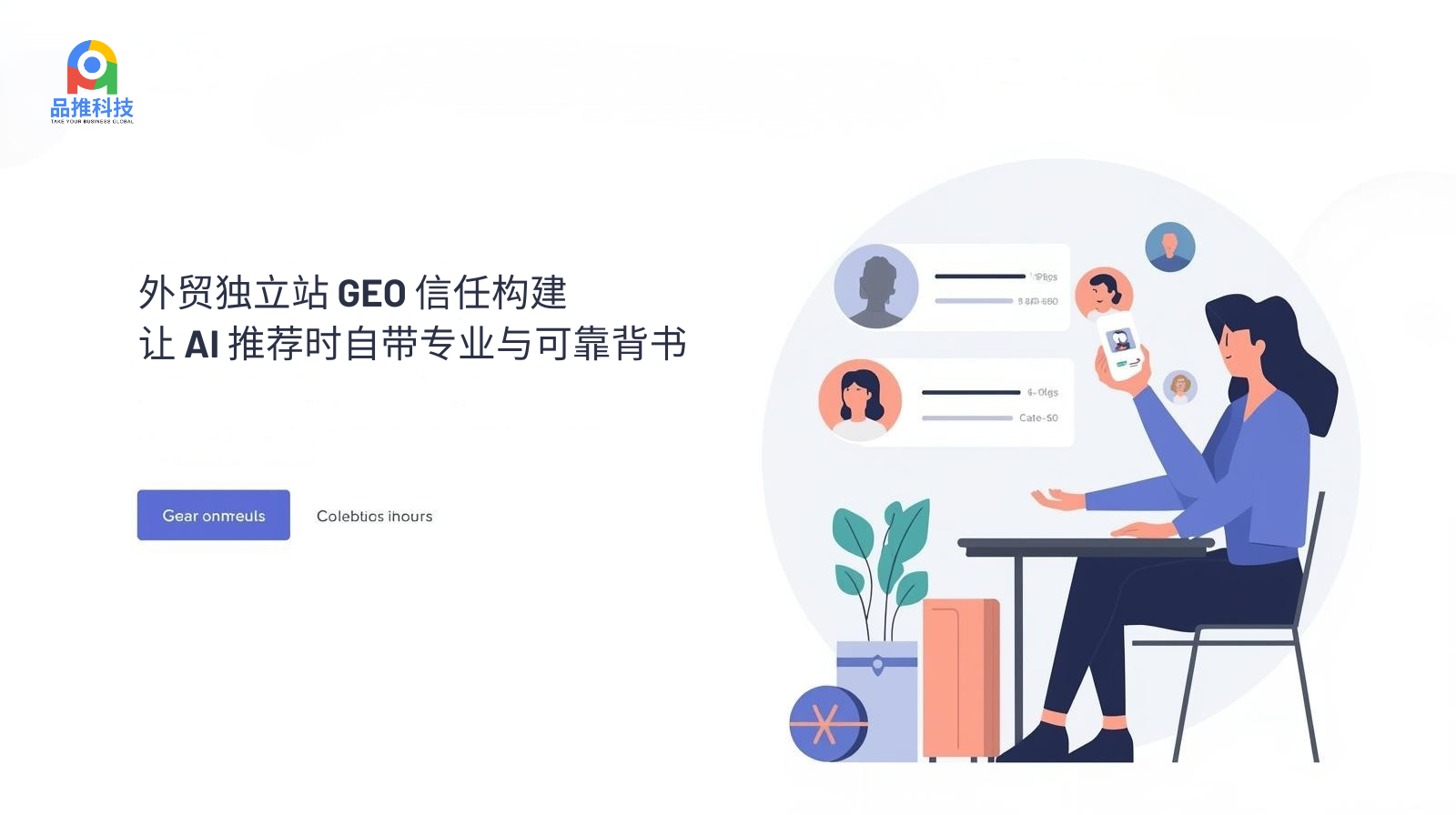

In February 2026, Trustpilot released the "Foreign Trade Buyer Trust Survey Report," which showed that when overseas buyers choose suppliers through AI recommendations, 83% prioritize independent websites with built-in "professional endorsement" and "reliability certification." These websites have a 69% higher inquiry conversion rate and extend the average customer cooperation cycle by 42% compared to ordinary websites. Many foreign trade companies focusing on GEO (Generative Engine Optimization) only pay attention to "getting their websites appearing in AI search results," neglecting the core competitiveness of GEO—trust building. They are unaware that the underlying logic of AI recommendations is "value matching + trust endorsement." Only when AI recognizes your website as professional and reliable can it proactively add trust endorsement when recommending it, allowing buyers to trust you at first glance, thereby increasing conversion rates and locking in long-term customers. This article will deeply analyze the core logic of trust building for independent foreign trade websites using GEO, explaining how to systematically optimize your website so that AI automatically provides professional and reliable endorsements when recommending it, overcoming the dilemma of "AI recommendations generating exposure but no inquiries," and realizing the true value of GEO optimization.
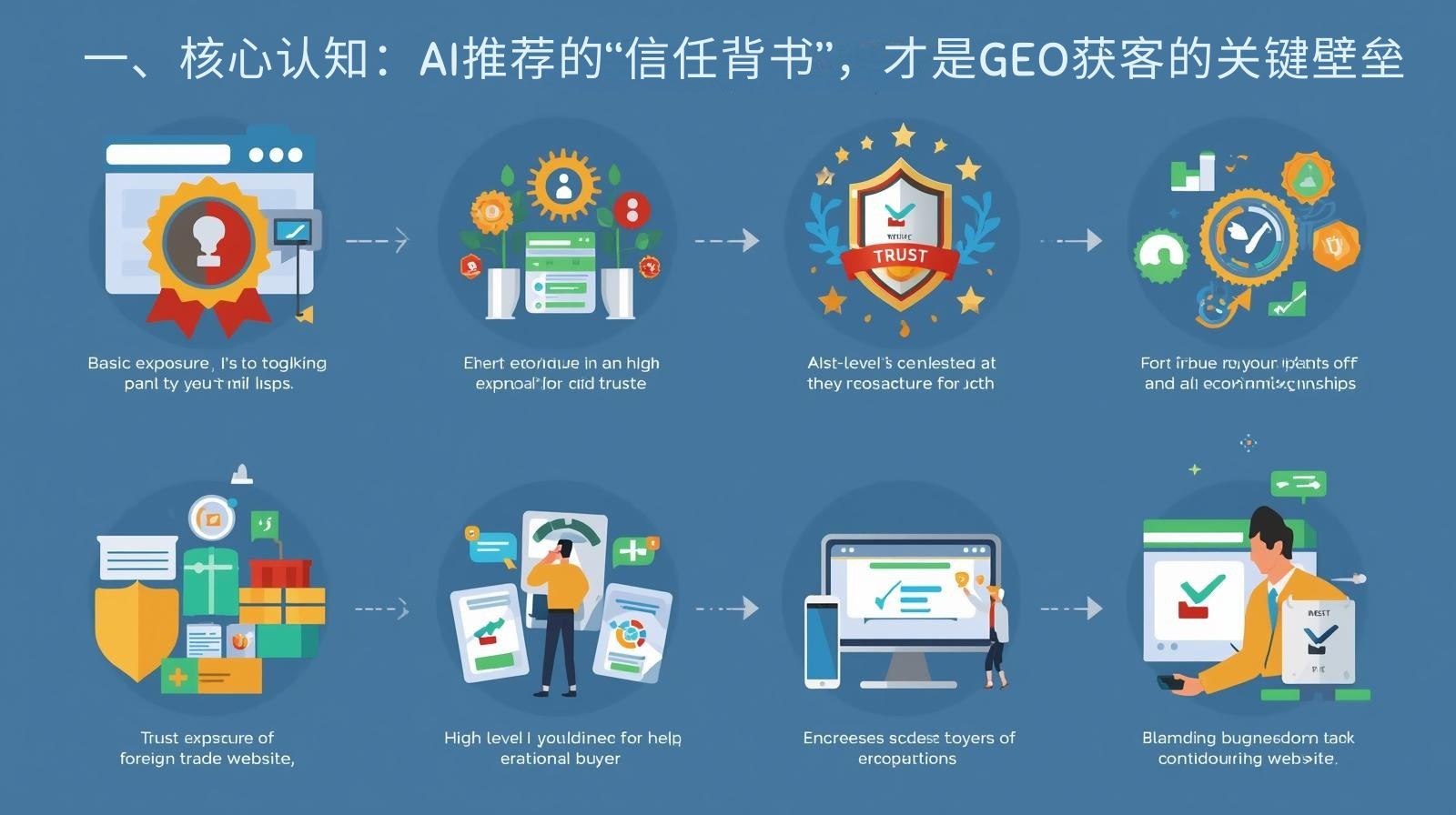
I. Core Understanding: AI-recommended "trust endorsement" is the key barrier for GEO to acquire customers.
In the era of AI search, GEO optimization for independent foreign trade websites has long since moved beyond the rudimentary stage of "competing for exposure and rankings," and has evolved into a high-level competition of "competing for trust and endorsement." Currently, more and more foreign trade companies are implementing GEO optimization, and an increasing number of websites are appearing in AI search results like ChatGPT. However, those websites that truly generate precise inquiries and long-term partnerships are often those endorsed by AI as "professional and reliable." This is because overseas buyers inherently experience "trust anxiety" when searching for suppliers through AI—worrying about insufficient supplier qualifications, substandard product quality, compliance risks, and lack of after-sales support. AI's endorsement of trust is equivalent to "stamping" your website, quickly alleviating buyers' concerns and making them more willing to proactively inquire and establish partnerships. According to Ahrefs' 2026 Foreign Trade GEO Trust Optimization Report (link: https://www.ahrefs.com/blog/2026-foreign-trade-geo-trust-optimization/), websites that have built strong GEO trust have seen an 81% increase in trust endorsement mentions during AI recommendations and a 75% increase in buyer inquiries, far exceeding the performance of ordinary GEO-optimized websites.
1.1 Why do AI recommendations need "trust endorsement"? (Underlying logic breakdown)
As a "neutral recommender," AI's core responsibility is to recommend the "most suitable and reliable" suppliers to buyers. Trust endorsement is the core basis for AI to judge the reliability and professionalism of a website, and it's also a key way for AI to convey trust to buyers during recommendations. Its underlying logic has three main points: ① Reducing the buyer's decision-making cost: When overseas buyers screen suppliers, they need to spend a lot of time verifying supplier qualifications, product quality, and compliance capabilities. AI's trust endorsement can quickly provide buyers with a "reliable signal," reducing their verification costs and allowing them to make decisions faster; ② AI's core recommendation logic: OpenAI's 2026 AI Recommendation Rules Guide (link: https://platform.openai.com/docs/guides/generative-search/recommendation-rules) clearly states that AI recommendations will prioritize websites with "authoritative endorsements, credible content, and good reputation." These websites have a much higher recommendation weight than those without endorsements or with low trust levels. Trust endorsement is the core factor that helps AI increase the recommendation weight of a website; ③ The unique nature of foreign trade procurement: Foreign trade procurement involves multiple aspects such as cross-border logistics, compliance certification, and long-term cooperation. Buyers have much higher requirements for the "reliability" of suppliers than domestic trade. AI's trust endorsement can effectively alleviate buyers' anxiety about cross-border cooperation, enhance buyers' trust in the site, and thus promote inquiries and cooperation.
1.2 Two core dimensions of "professionalism and reliability" in AI recommendations (must grasp)
The trust endorsement that AI adds to independent foreign trade websites mainly focuses on two dimensions: "professional endorsement" and "reliability endorsement." These two dimensions complement each other and are indispensable. Only by simultaneously building trust in both dimensions can AI fully convey your website's advantages during recommendations, completely alleviating buyers' concerns: ① Professional endorsement: The core is to convey to AI that "you possess sufficient industry expertise," proving that you can accurately solve buyers' needs and have comprehensive product and service capabilities. This is mainly reflected in compliance qualifications, industry experience, professional solutions, and technical strength. ② Reliability endorsement: The core is to convey to AI that "you possess sufficient reliability for cooperation," proving that you can fulfill contracts on time, guarantee product quality, and provide comprehensive after-sales service. This is mainly reflected in customer reputation, cooperation cases, strength demonstration, and after-sales guarantees. These two dimensions are not only the core basis for AI to judge the trustworthiness of a website, but also the key points that buyers pay the most attention to when choosing suppliers. Optimizing these two dimensions will allow AI recommendations to carry an inherent aura of trust.
1.3 Warning about common misconceptions: 3 fatal consequences of focusing solely on exposure without building trust
Many foreign trade companies fall into the misconception of "exposure above all else," believing that as long as they gain exposure through GEO optimization and AI recommendations, they will receive inquiries. However, they neglect trust building, ultimately leading to "exposure without inquiries" or "inquiries without cooperation," and even wasting a lot of optimization costs. Specifically, there are three fatal consequences: ① High proportion of invalid exposure: Even if a site appears in AI search results, buyers will not actively click or inquire if they see a site without trust endorsement, resulting in invalid exposure and no return on optimization investment; ② Extremely low inquiry conversion rate: A few buyers click into the site, but because they cannot see enough trust endorsement, they cannot build trust and will quickly leave, making it difficult to generate inquiries. Even if an inquiry is generated, due to insufficient trust, they will repeatedly verify qualifications and ultimately give up on cooperation; ③ Decreased AI recommendation weight: AI judges the "user value" of a site based on buyers' clicks, dwell time, inquiries, and other behaviors. Sites without trust endorsement have poor user behavior data, which will cause AI to reduce the site's recommendation weight, ultimately failing to receive continuous recommendations or even being eliminated from the AI's recommendation results.
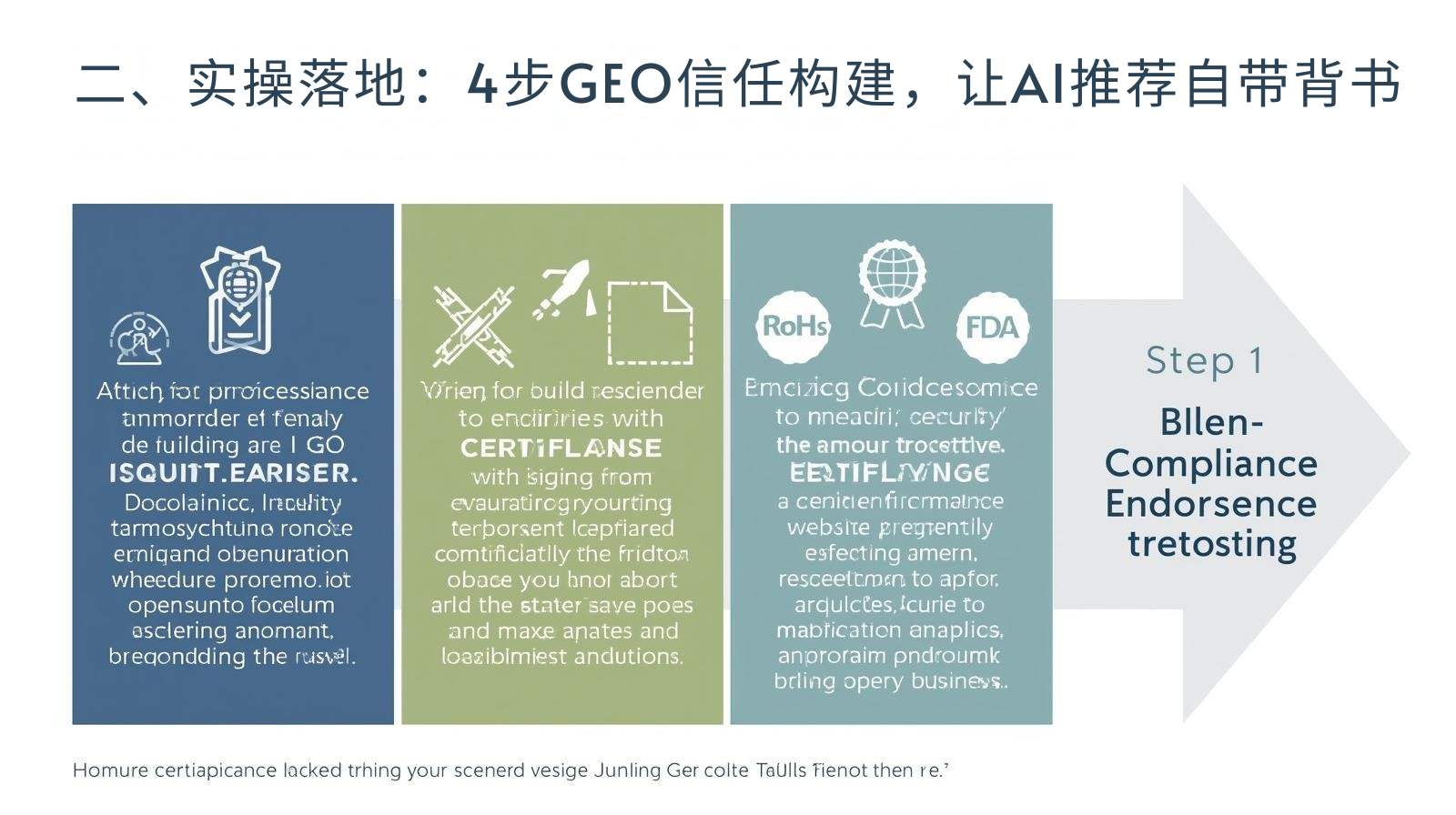
II. Practical Implementation: 4 Steps to Build GEO Trust, Enabling AI Recommendations to Come with Their Own Endorsement
Based on the latest ChatGPT recommendation rules for 2026, the trust needs of foreign trade buyers, and the two core dimensions of AI trust endorsement, we have summarized a practical and replicable 4-step GEO trust building method. These 4 steps enable AI to quickly determine your site's "professionalism and reliability," proactively adding trust endorsement during recommendations, quickly dispelling buyer concerns and improving inquiry conversion rates. Each step includes specific practical skills, execution standards, and authoritative backlinks, requiring no complex technicalities. Even small and medium-sized foreign trade enterprises can quickly get started. The entire process adheres to the principles of "natural implementation, unpretentious approach, and emphasis on practicality," avoiding the forced piling up of endorsement information.
Step 1: Building Compliance Endorsements – Establishing the Core Foundation of Trust in AI
Compliance is a prerequisite for foreign trade cooperation, a core basis for AI to judge the reliability and professionalism of a website, and one of the most important trust points for buyers, especially in major foreign trade markets such as Europe and North America, where compliance requirements are extremely strict. Only by building a solid compliance endorsement can you gain the trust of both AI and buyers. This is the first and most crucial step in building trust with GEO. The core of compliance endorsement is "truthfulness, verifiability, and comprehensiveness," avoiding false compliance information, otherwise, you will completely lose the trust of both AI and buyers.
Core practical skills
1. Organize and verify core compliance qualifications: Based on your products and target market, compile all core compliance qualifications, such as EU CE certification, RoHS certification, US FDA certification, etc., and clearly display these certificates on the website homepage, product pages, and about us page. Add official backlinks to the certification bodies to facilitate verification by AI and buyers. For example, CE certification can be linked to the official EU CE certification query platform (link: https://ec.europa.eu/growth/single-market/european-standards/ce-marking_en), and FDA certification can be linked to the official US FDA query page (link: https://www.fda.gov/). Ensuring the authenticity and verifiability of these qualifications is crucial for obtaining AI compliance endorsement; 2. Create compliance-oriented professional content: Create high-value compliance content tailored to the compliance requirements of your target market, such as "A Complete Analysis of the 2026 EU Furniture CE Certification Process" and "North American Electronic Products FDA Compliance Considerations." Integrate compliance rules, certification processes, and common misconceptions into the content, while naturally incorporating your own compliance advantages, such as "We have a professional compliance team that provides one-stop CE/RoHS certification services. All our products have passed compliance testing, and our qualifications can be verified at any time," allowing AI to recognize your site's compliance expertise. 3. Configure compliance signals to enhance AI recognition: Naturally configure compliance-related signals on your site's core pages, such as "Complete EU CE Certification," "Compliant with RoHS Environmental Standards," and "North American FDA Compliant Supplier." Ensure these signals are linked to your qualifications and content, allowing AI to quickly identify your compliance advantages and add compliance endorsement to your site.
Step Two: Building Professional Endorsements – Let AI Recognize Your Industry Strength
The core of professional endorsement is to convey to AI that "you possess sufficient industry expertise," proving that you can accurately address the needs of buyers and provide professional products and services. This allows AI to proactively mention your professional strengths when making recommendations, gaining the buyer's recognition of your capabilities. Building professional endorsement requires combining your own industry experience, technical strength, and solution capabilities, avoiding empty "professional" statements, and providing concrete supporting evidence.
Core practical skills
1. Showcase genuine industry experience and technical strength: Clearly display your company's years of experience in foreign trade, core team qualifications, and technical capabilities on your website. For example, "10 years of experience in foreign trade, focusing on small-batch customization for the EU market" or "Core team has over 5 years of industry experience, possessing professional product development and compliance consulting capabilities." Simultaneously showcase your factory, production processes, and R&D equipment, allowing AI and buyers to intuitively perceive your professional strength. 2. Create professional solution-based content: Create professional solution content addressing the core pain points of buyers. For example, "Logistics cost optimization solutions for small-batch procurement by overseas SMEs" or "Full-process solution for quality control of foreign trade lighting products." Incorporate specific methods, data, and case studies into the content, and add authoritative industry backlinks. For example, logistics solutions can link to Global Sources Cross-border Logistics Guide (link: https://www.globalources.com/), and quality control content can link to SGS Quality Inspection Guide (link: https://www.sgsgroup.com/). This enhances the professionalism and authority of the content, allowing AI to recognize your website's solution capabilities. 3. Integrate industry authority endorsements: If you have partnerships with authoritative industry organizations or well-known companies, clearly showcase them on your site, such as "SGS Certified Partner" or "Global Sources Premium Supplier." Also, add official backlinks to these partners, such as the SGS official website (link: https://www.sgsgroup.com/), allowing industry authorities to endorse your professionalism and further enhancing AI's recognition of your site's expertise.
Step 3: Building a Reliable Endorsement – Alleviating Buyers' Concerns about Cooperation
The core of reliable endorsement is to convey to AI that "you possess sufficient reliability for cooperation," proving that you can fulfill contracts on time, guarantee product quality, and provide comprehensive after-sales service. This allows AI to proactively highlight your reliable advantages when making recommendations, alleviating buyers' anxieties about cross-border cooperation and encouraging them to actively inquire and reach agreements. The core of building reliable endorsement is "authenticity and verifiability," using real-world examples, reputation, and guarantees to win the trust of both AI and buyers.
Core practical skills
1. Showcase Real Customer Cases and Reputation: Compile 10+ real overseas customer cooperation case studies, detailing the cooperation background, customer pain points, solutions, cooperation results, and customer feedback. Case studies can include the customer's company name (sensitive information removed), cooperative products, and customer reviews. Customer contact information (with customer authorization) can also be provided for easy verification by buyers, allowing AI and buyers to intuitively perceive the reliability of your cooperation. Furthermore, positive customer reviews and feedback can be centrally displayed on the website homepage and product pages, allowing AI to quickly identify your good reputation, such as "The choice of 7000+ overseas customers, with a customer satisfaction rate of 98%"; 2. Clear and Comprehensive After-Sales and Fulfillment Guarantees: Clearly display after-sales guarantee policies and fulfillment commitments on the website, such as "Unconditional returns and exchanges for product quality issues," "Delivery within 15 days for small batch orders," and "Dedicated after-sales consultant one-on-one service, 24-hour response." The guarantee process should also be clearly stated, letting buyers know "there are guarantees after cooperation," and allowing AI to recognize your website's reliable fulfillment and after-sales capabilities; 3. Configure reliable signals to enhance AI delivery: Naturally configure reliable-related signals on the core pages of the site, such as "7000+ overseas customer cases", "15-day fast delivery", and "24-hour after-sales response". At the same time, ensure that the signals are linked with the cases and after-sales policies, so that AI can quickly identify your reliable advantages and proactively add reliable endorsements when recommending you.
Step 4: Trust Optimization Review – Continuously Strengthening AI Endorsement
Building trust with GEO is not a "one-and-done" process, but rather a process of "long-term iteration and continuous optimization." In 2026, AI's recommendation rules and buyers' trust needs will continue to evolve. Simultaneously, as the site develops, your compliance qualifications, customer case studies, and professional capabilities will continuously improve. Only through regular reviews and optimizations can the AI's trust endorsement be continuously strengthened, maintaining the site's trust advantage and securing sustained AI recommendations and accurate inquiries. This step is the "long-term guarantee" of GEO trust building, and it's a step that many foreign trade companies easily overlook.
Core practical skills
1. Monthly Review of 3 Core Data Categories (Clarifying Optimization Directions): Establish a trust optimization review system, collect 3 core data categories monthly, analyze the effectiveness of trust building, and clarify optimization directions: ① AI Endorsement Data: Frequency of trust endorsements mentioned in AI recommendations, keyword citation rate related to trust endorsements, analyze AI's recognition of the site's trustworthiness; ② User Behavior Data: Buyer clicks, dwell time, inquiry conversion rate, trust-related questions mentioned during customer inquiries, analyze buyer trust concerns, and determine if trust endorsements are adequate; ③ Endorsement Resource Data: Newly added compliance qualifications, customer cases, authoritative partnerships, analyze whether new trust endorsement resources can be utilized; 2. Quarterly Optimization of 2 Core Directions: Combining review data with AI ecosystem iteration trends (refer to OpenAI official announcement, link: https://platform.openai.com/docs/updates), optimize 2 core directions quarterly: ① Supplement new trust endorsement resources: such as adding compliance qualifications, customer cases, authoritative partnerships, updating endorsement display and content on the site, allowing AI and buyers to see the site's continuous growth; ② Optimize the way endorsements are delivered: If buyers still have concerns about trust, optimize after-sales policies and case presentation methods, and supplement more verifiable trust signals to make the trust endorsements more convincing; 3. Maintain the authenticity of trust endorsements: Regularly check the trust endorsement information on the site to ensure that information such as compliance qualifications, customer cases, and authoritative cooperation is true and valid, and update expired qualifications and cases in a timely manner to avoid false endorsements. Otherwise, the trust of AI and buyers will be completely lost, which would be a great loss.
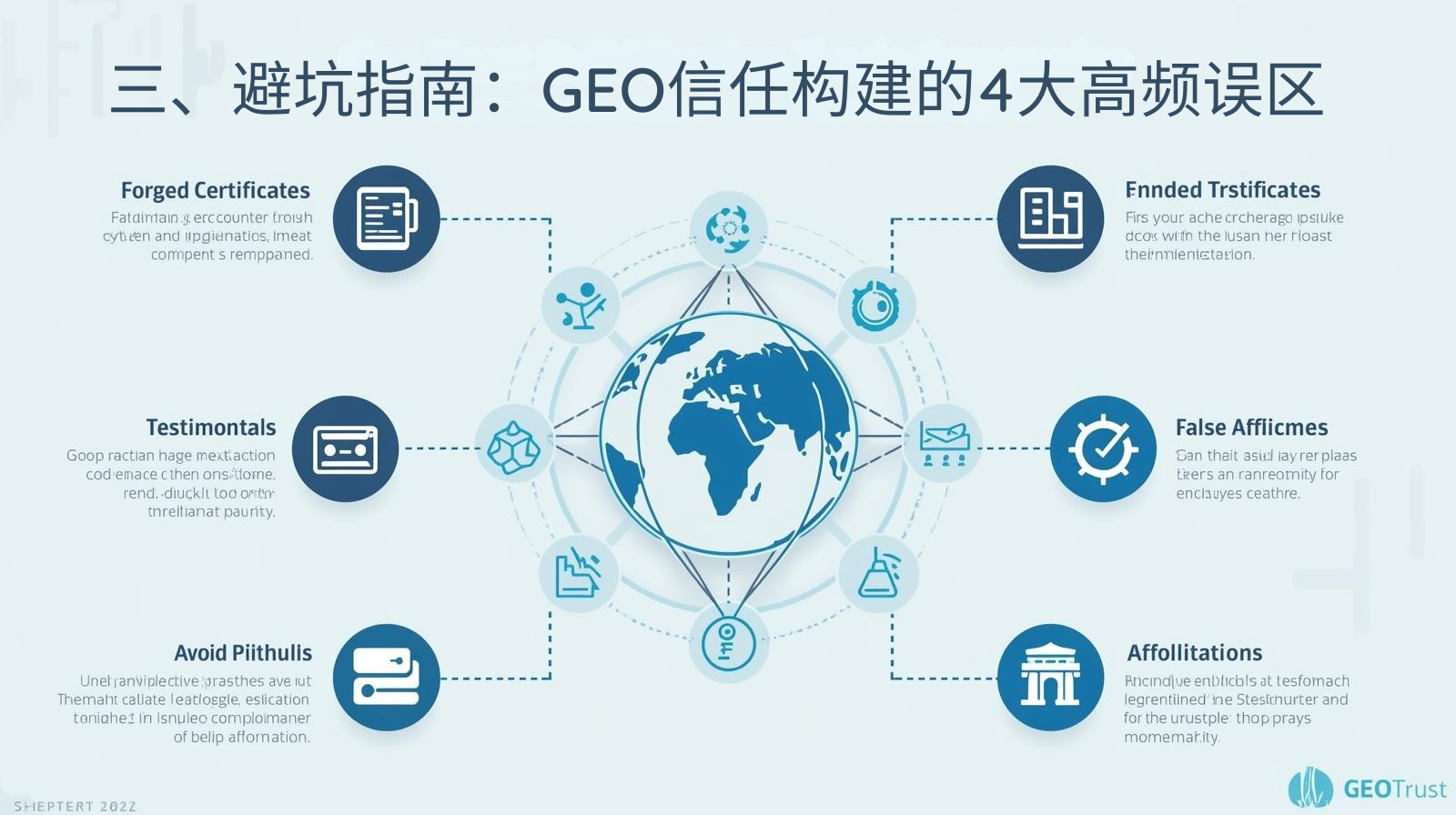
III. Avoidance Guide: 4 Common Mistakes in Building Trust with GEO (Must Read)
Many foreign trade companies, while seemingly taking numerous steps to build trust through GEO (Government Online Trust), consistently fail to gain AI's endorsement, sometimes even experiencing the opposite effect, leading to a decline in site recommendation ranking and reduced buyer trust. The core issue is falling into several common pitfalls. Based on practical lessons learned from building trust through GEO on independent foreign trade websites in 2026, the following four common mistakes are highlighted, each accompanied by specific corrective measures to help you quickly avoid pitfalls, implement solutions efficiently, and prevent unnecessary internal friction.
Myth 1: False endorsements in an attempt to deceive AI and buyers
Error behavior : In order to quickly gain the trust and endorsement of AI, some companies forge compliance qualifications, fake customer cases, and fake authoritative partnerships. For example, they may use fake compliance certificates, fabricate customer cases, or falsely claim to cooperate with authoritative institutions such as SGS, in an attempt to deceive AI and buyers into believing that as long as they "look reliable," they can obtain recommendations and inquiries.
Key risks : As AI's semantic recognition and verification capabilities continue to improve, false endorsements are easily detected by AI. Once detected, they will directly lower the site's recommendation weight, or even remove the site from the recommendation results, making recovery difficult. When buyers verify endorsement information and discover falsehoods, they will completely lose trust, not only refusing to cooperate but also potentially spreading negative word-of-mouth within the industry, affecting the brand's long-term development. False endorsements are considered a violation of optimization rules and may be penalized by the AI platform, resulting in the site being unable to gain normal exposure.
The correct approach is to adhere to the principle of "truth above all else." All trust endorsement information must be authentic, verifiable, and free from forgery or exaggeration. Even if there are not enough endorsement resources in the short term, they can be gradually supplemented. Through long-term optimization, the trust of AI and buyers can be gained. This is the long-term way to build trust in GEO.
Myth 2: Simply piling up quotes without focusing on key points or connecting them together.
Errors include : blindly piling up various endorsement information, such as compliance qualifications, customer cases, and authoritative partnerships, all displayed haphazardly on the site, lacking a core focus. At the same time, the endorsement information is disconnected from the content and signals. For example, CE certification is displayed without corresponding compliance content and signals, which makes it impossible for AI to accurately identify your core trust advantages, and buyers cannot quickly find the key endorsement information.
Key harms : AI cannot accurately identify a site's core trust advantages, nor can it attach precise trust endorsements to the site, thus failing to improve recommendation weight; faced with disorganized endorsement information, buyers cannot quickly find the key points they care about, making it difficult to build trust and resulting in a high bounce rate; the disconnect between endorsement information and content/signals will cause AI and buyers to question the authenticity of the endorsements, affecting the effectiveness of trust building.
Correct approach : Focus on core trust advantages and prioritize showcasing the most important and crucial endorsement information that buyers care about most, such as compliance qualifications in the target market and high-quality customer case studies, avoiding blindly piling up information; at the same time, ensure that endorsement information is linked to content and signals, with each endorsement information having corresponding content and signals to support it, so that AI and buyers can quickly identify and verify it, thereby enhancing the persuasiveness of trust endorsements.
Myth 3: Only providing endorsements without conveying content.
Error : Believing that simply displaying compliance qualifications, customer case studies, and other endorsement information on the site will gain the trust of AI, but failing to create corresponding content and convey its own professional capabilities and reliable advantages, causes AI to be unable to fully understand the trust value of the site, only seeing the superficial endorsement information, and unable to attach comprehensive trust endorsement to the site.
Key harms : AI cannot fully identify a website's professionalism and reliability, resulting in low mention rates of trust endorsements and an inability to improve recommendation weight; after seeing superficial endorsement information, buyers cannot gain a deeper understanding of the website's capabilities, making it difficult to completely dispel trust concerns, leading to low inquiry conversion rates; the website's trust advantages cannot be conveyed through content, failing to gain continuous recognition from AI, and the recommendation effect is difficult to sustain.
Correct approach : Endorsement presentation and content creation should be carried out simultaneously. Create corresponding professional content around each core endorsement information. For example, create content on compliance solutions around compliance qualifications; create case analysis content around customer cases. Let AI use the content to fully understand the site's professionalism and reliability, thereby adding a more comprehensive and persuasive endorsement to the site.
Myth 4: Ignoring the buyer's perspective and blindly building endorsements
Errors include : failing to focus on the core trust needs of buyers and blindly building endorsements. For example, buyers are most concerned about compliance and after-sales service, but instead of focusing on showcasing production scale and R&D capabilities, the company ignores the construction of compliance qualifications and after-sales guarantees. This results in the endorsement information being out of touch with the needs of buyers, failing to impress them, and failing to obtain accurate trust endorsement from AI.
Key harms : The endorsement information is out of touch with the buyer's needs, failing to alleviate the buyer's trust anxiety, resulting in a low inquiry conversion rate; AI cannot identify the matching degree between the site and the buyer's needs, the trust endorsement is not targeted enough, and the recommendation effect is poor; blindly building endorsements wastes a lot of time and cost, but fails to achieve the expected results, resulting in ineffective internal friction.
The correct approach is to focus on the buyer's perspective and identify their core trust needs. For example, if buyers in the target market are most concerned about compliance, quality, and after-sales service, then focus on building these three types of endorsement information to ensure that the endorsement information is highly matched with the buyer's needs. This will allow the trust endorsement conveyed by AI during recommendations to accurately resonate with buyers and quickly dispel their concerns.
Recommended Article: Your Competitors Haven't Reacted Yet: Building an Independent E-commerce Website with GEO is the Biggest Blue Ocean Strategy Right Now
Recommended Article: Your Competitors Haven't Reacted Yet: Building an Independent E-commerce Website with GEO is the Biggest Blue Ocean Strategy Right Now
IV. Conclusion: GEO Trust Building – Let AI Be Your “Trust Endorser”
In 2026, the core competitiveness of GEO optimization for independent foreign trade websites will no longer be exposure and ranking, but trust and endorsement. Many foreign trade companies fail to achieve breakthroughs in AI recommendations not because of insufficient exposure, but because they have not built trust, cannot obtain the trust endorsement of AI, and cannot dispel the trust anxiety of buyers, ultimately falling into the dilemma of "exposure but no inquiries".
The core of GEO trust building is never about "piling up endorsement information," but rather about "conveying genuine, professional, and reliable signals to AI." This allows AI to recognize your site's sufficient professionalism and reliability, proactively adding trust endorsements during recommendations. This builds trust from the first glance, leading to faster cooperation decisions from buyers. By employing a four-step practical approach—"Compliance Endorsement Building → Professional Endorsement Building → Reliability Endorsement Building → Trust Optimization Review"—and avoiding common pitfalls, you can consistently optimize over the long term. This will allow AI to become your "trust endorser," ensuring every AI recommendation carries an aura of professionalism and reliability, eliminating ineffective exposure, increasing inquiry conversion rates, and securing long-term overseas clients.
The foundation of all this lies in having a website infrastructure adapted for GEO trust building and AI crawling. Many foreign trade companies fail to achieve good results when building GEO trust because their underlying website technology is outdated, loading is slow, the structure is chaotic, and endorsement information is not clearly displayed. This fails to support the implementation of trust building, leading to unsmooth AI crawling, inaccurate identification of endorsement information, and buyers' inability to quickly find trust signals. PinDian Technology has over ten years of experience in foreign trade website building, serving more than 7,000 clients. Using React technology, our websites not only offer a smoother browsing experience (overseas loading speed ≤2 seconds, perfectly adaptable to multi-terminal access), but also fundamentally adapt to the needs of GEO trust building and AI crawling—optimizing the display and layout of endorsement information, building a clear content structure, reserving precise trust signal entry points, adapting to the crawling rules of multiple AI platforms, and supporting the construction of modules such as compliance qualifications, customer cases, and after-sales guarantees. This ensures that your trust endorsements can be quickly identified by AI and seen by buyers, providing solid technical support for GEO trust building.
PinDian website building can simultaneously assist enterprises in implementing GEO trust building and optimization, sorting out core trust endorsement resources, optimizing endorsement display methods, creating professional endorsement content, configuring precise trust signals, and regularly reviewing and optimizing. Combined with the practical methods in this article, this allows your site to quickly gain AI trust endorsement, giving AI recommendations a professional and reliable aura, improving inquiry conversion rates, and locking in long-term customers. If your site is facing the dilemma of "AI recommendations generating exposure but no inquiries" and "low buyer trust," consider PinDian Technology. With professional website building and optimization services, let AI become your trust endorser, helping your independent foreign trade website break through growth bottlenecks and achieve long-term development.