
A report titled "Foreign Trade GEO Optimization Effect Diagnostic Report" released by OpenAI and Ahrefs in February 2026 revealed that 83% of independent foreign trade websites, after implementing GEO (Generative Engine Optimization), fell into a predicament of "blind optimization without a basis"—investing only in content creation and signal implantation without ever using data-driven diagnostics to evaluate the search exposure effects on AI platforms such as ChatGPT. This made it impossible to determine the effectiveness of optimization actions or where the problems lay, ultimately leading to wasted optimization costs, stagnant or even declining AI exposure. In fact, the core closed loop of GEO optimization is "optimization-diagnosis-iteration," and data-driven diagnostics are the key bridge connecting "optimization" and "iteration." Through precise diagnosis across three core dimensions, it's possible to clearly understand the current state of search exposure on AI platforms, pinpoint optimization loopholes, provide clear direction for subsequent iterations, and make GEO optimization more targeted, achieving a double improvement in AI exposure and inquiry conversion rates.
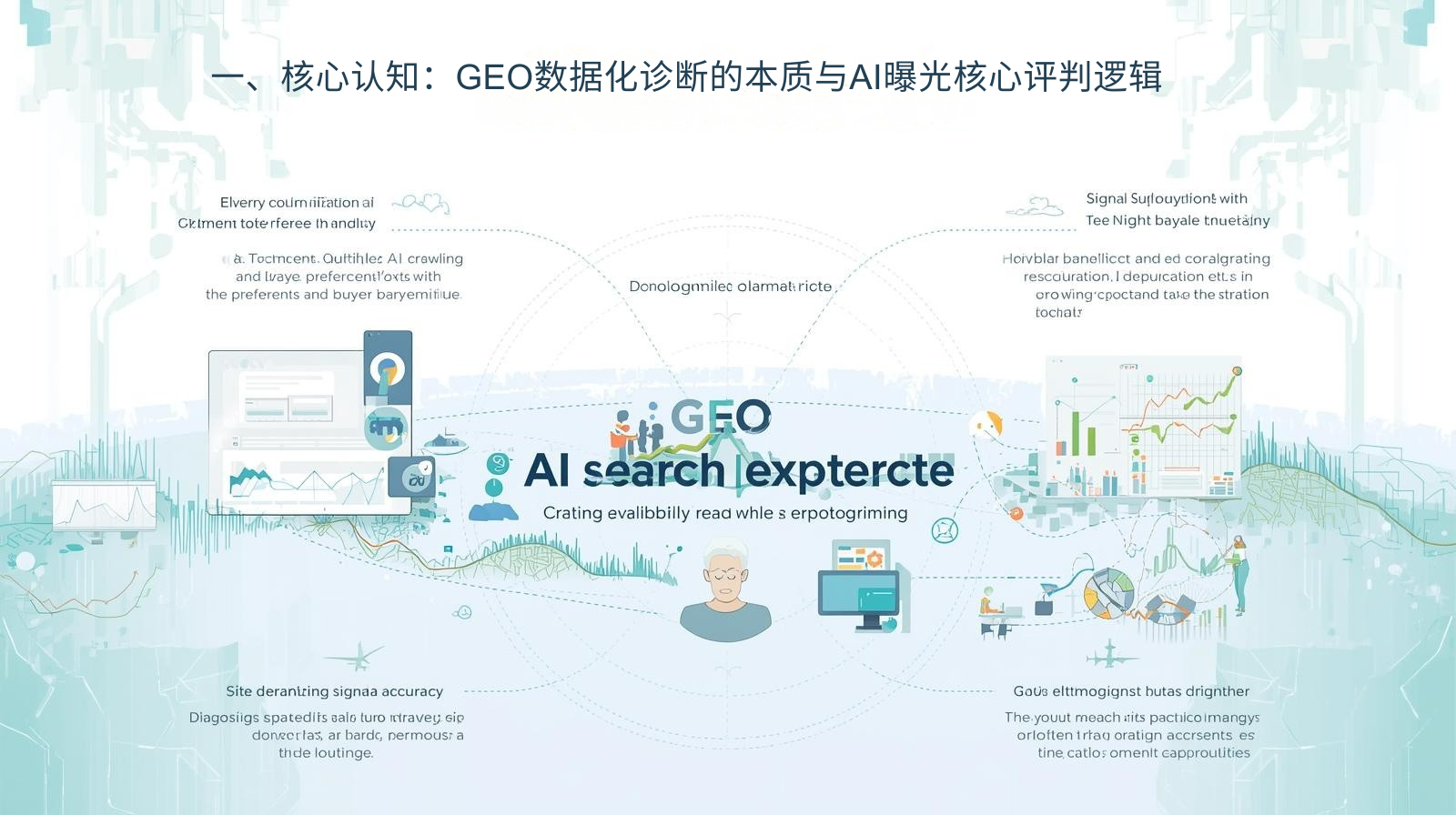
I. Core Understanding: The Essence of GEO Data-Driven Diagnostics and the Core Judgment Logic of AI Exposure
To conduct effective GEO data-driven diagnostics, it's crucial to avoid the misconception of focusing solely on exposure volume while ignoring core data. The essence of diagnostics lies not in simply compiling statistics, but in analyzing data to determine whether site GEO optimization aligns with AI crawling preferences and whether content and signals match buyer needs, thereby identifying optimization weaknesses. Simultaneously, it's essential to understand the core evaluation logic of AI platforms (primarily ChatGPT) for search exposure. This is the core basis for the three diagnostic dimensions and the key to ensuring accurate diagnostic results.
1.1 The Core Essence of GEO Data-Driven Diagnostics (Specifically for Foreign Trade Scenarios)
GEO data-driven diagnostics for independent e-commerce websites is essentially a process of "taking AI search exposure effects as the core, breaking down each aspect of GEO optimization through quantifiable data indicators, and evaluating whether content quality, signal accuracy, and site adaptability comply with AI crawling and recommendation rules." Unlike traditional SEO diagnostics, its core focus is on "AI platform-specific data," rather than search engine ranking data. It addresses three key questions: whether AI continuously crawls site content, whether the crawled content gains exposure, and whether the exposed content reaches targeted buyers. Referring to OpenAI's "GEO Optimization Data Diagnosis Guide" released in February 2026 (link: https://platform.openai.com/docs/guides/generative-search/data-diagnosis), it clearly states that data-driven diagnostics are a core prerequisite for improving AI exposure effects, potentially increasing optimization efficiency by over 60%.
1.2 Core Evaluation Logic of Search Exposure on the AI Platform (ChatGPT) (Latest 2026)
The exposure and recommendations for independent e-commerce websites by AI platforms like ChatGPT are not randomly assigned, but based on a three-layer core logic. This logic forms the core source of the subsequent three diagnostic dimensions. Each layer corresponds to quantifiable data indicators. Understanding these logics is crucial for accurately interpreting the diagnostic results: ① First layer: Crawling judgment. AI prioritizes crawling websites with "original content, complete signals, and smooth site loading," focusing on data such as "crawl frequency and crawled page percentage"; ② Second layer: Exposure judgment. AI prioritizes recommending content with "high content value, accurate signals, and matching with buyers' search needs," focusing on data such as "exposure volume and keyword matching degree"; ③ Third layer: Retention judgment. AI continuously recommends content with "long buyer dwell time, high interaction rate, and strong conversion intention," focusing on data such as "click volume, dwell time, and inquiry conversion rate." Referring to Ahrefs' 2026 AI Exposure Data Analysis (link: https://ahrefs.com/blog/ai-exposure-judgment/), these three layers of logic are interconnected, and any abnormality in the data at any layer will affect the final AI exposure effect.
1.3 Three core prerequisites for GEO data-driven diagnostics in foreign trade websites (must be met, otherwise the diagnostics will be invalid)
To ensure accurate and actionable diagnostic results and avoid "data misjudgment and misdirection," three core prerequisites must be met before diagnosis. These are also the core reasons why many foreign trade websites' diagnoses are ineffective, and must be implemented in advance: ① Adequate data monitoring tools are essential. A dual monitoring system of "AI exposure + site data" needs to be established. Core tools include Google Search Console (monitoring AI-captured data, link: https://search.google.com/search-console), Semrush (monitoring AI exposure and keyword data, link: https://www.semrush.com/), and Google Analytics (monitoring user interaction and conversion data, link: https://analytics.google.com/), ensuring that the data is quantifiable and traceable; ② A sufficient monitoring period is required. Monitoring should be continuous for at least one month. Avoid using "single-day data" as a basis for diagnosis. AI exposure data fluctuates, and monthly data is more valuable for reference, aligning with the cyclical patterns of AI capture in 2026; ③ Define clear diagnostic benchmarks, using the "average AI exposure data of similar sites in the same industry" as a benchmark (which can be queried through the Ahrefs tool), and combine it with your own site's optimization goals to determine whether the data is normal, avoiding blind comparisons and misjudging anomalies.
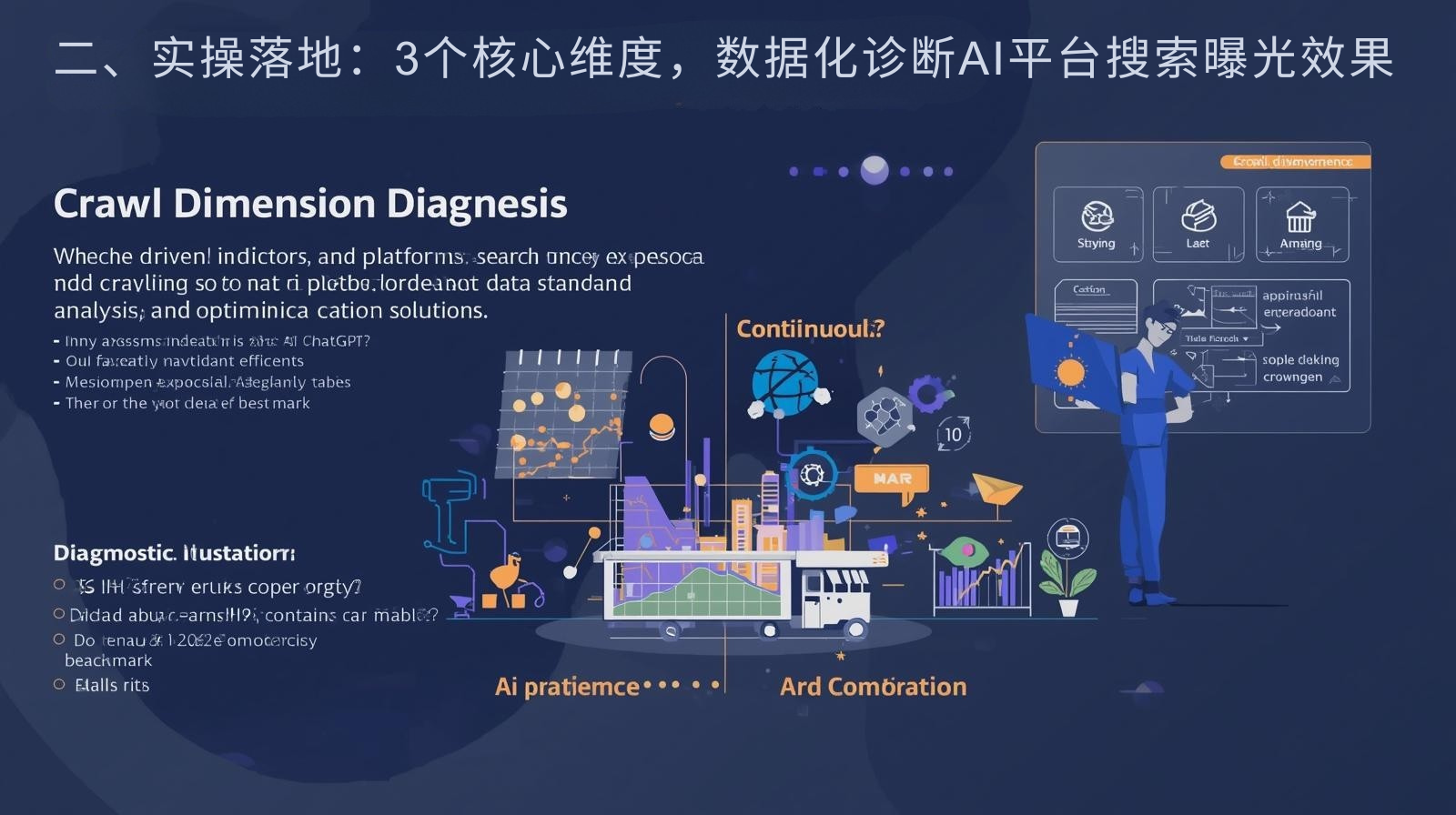
II. Practical Implementation: Three Core Dimensions for Data-Driven Diagnosis of AI Platform Search Exposure Effectiveness
This chapter focuses on the specific scenarios of independent foreign trade websites, breaking down the diagnosis into three core dimensions: "data crawling, exposure, and conversion." Each dimension clearly defines "core diagnostic indicators, diagnostic methods, data standards, anomaly analysis, and optimization solutions." The entire process is described in clear text, outlining the practical steps without any code-related content. It incorporates authoritative external links for support, and all data standards reference the 2026 foreign trade GEO optimization industry benchmark, making it directly replicable and implementable. Even without data diagnostic experience, it can accurately complete AI exposure effect evaluation.
Dimension 1: Site Crawl Diagnosis – Assessing whether the AI platform can continuously and efficiently crawl websites.
Core objective: To diagnose the site crawling behavior of AI platforms such as ChatGPT, and determine "whether the AI is crawling, whether the crawling frequency is reasonable, and whether the crawled pages contain core content." This is the foundation for AI exposure. If the crawled data is abnormal, subsequent exposure and conversion are out of the question. The core reference is the OpenAI 2026 AI crawling data standard (link: https://platform.openai.com/docs/guides/generative-search/crawl-standard).
1.2.1 Core Diagnostic Indicators and Data Standards (2026 Foreign Trade Industry Benchmark)
Focusing on four quantifiable metrics, each with a clearly defined industry benchmark, you can quickly determine if your site's data is normal by comparing it to your own: ① Crawling Frequency: Core content (product pages, compliance topic pages) should be crawled ≥3 times per week, auxiliary content (news) ≥1 time per week, and brand content ≥1 time per week. If it is lower than this standard, it indicates low AI crawling willingness; ② Crawled Page Percentage: Core pages should be crawled ≥90%, auxiliary pages ≥70%, and brand pages ≥80%. If the core page crawling percentage is lower than 80%, it indicates a problem with the site structure or signal; ③ Uncrawled Page Percentage: Overall uncrawled page percentage ≤10%, core page uncrawled percentage ≤5%. If it exceeds this standard, page problems need to be investigated; ④ Crawling Anomaly Rate: Crawling errors (dead links, loading timeouts) ≤3%. If it exceeds this standard, it indicates abnormal site loading or page occurrences, affecting AI crawling.
1.2.2 Specific diagnostic methods (ready to be implemented directly)
1. Data Extraction: Log in to Google Search Console, go to the "Crawl Statistics" section, filter data from the past month, and extract "Crawl Frequency, Number of Crawled Pages, Number of Uncrawled Pages, and Number of Crawling Errors." Distinguish between core pages, auxiliary pages, and brand pages, and compile statistics for each separately. 2. Data Comparison: Compare the extracted data with the 2026 foreign trade industry benchmark, and also compare it with your own site's crawl data from the past three months to determine if the data is increasing, decreasing, or remaining stable. 3. Problem Identification: If the data does not meet the standards, focus on three areas: site loading speed (tested using Cloudflare, link: https://www.cloudflare.com/), page structure (whether the hierarchy is clear and core content is prominent), and GEO signal integrity (whether any core signals are missing). You can combine this with the crawl detection function of Rank Math (link: https://rankmath.com/) to quickly locate specific issues with uncrawled pages.
1.2.3 Abnormal Situations and Optimization Solutions (Targeted Solutions)
1. Anomaly 1: Insufficient crawling frequency (core pages crawled <3 times per week): The core reasons are insufficient content originality, missing signals, or slow site loading speed; Optimization solutions: Use Copyscape to check content originality (link: https://www.copyscape.com/), modify non-original content, and ensure originality ≥90%; Supplement the four core GEO signals (compliance, demand, value, trust), focusing on adding official compliance certification backlinks (such as the EU REACH certification link: https://ec.europa.eu/growth/single-market/european-standards/ce-marking_en); Compress images using TinyPNG (link: https://tinypng.com/), optimize site loading speed, and ensure overseas loading ≤2 seconds.
2. Anomaly 2: Low core page crawling rate (<80%): The core reasons are a disorganized site structure, core pages being obscured by redundant content, or lack of internal links; Optimization solutions: Adjust the site structure to ensure a clear hierarchy of "core layer - auxiliary layer - brand layer" and place core pages in prominent positions; Add internal links to core pages in auxiliary and brand content to guide AI crawling; Clean up redundant site content and delete irrelevant pages to reduce the burden on AI crawling.
3. Anomaly 3: High crawling error rate (>3%): The core reasons are dead links, page load timeouts, or abnormal page formatting; Optimization solutions: Locate dead links using Google Search Console and delete or repair them promptly; Optimize site servers and CDN acceleration to reduce the probability of page load timeouts; Adjust page formatting to ensure it meets AI crawling requirements and avoid complex formatting obscuring content.
Dimension Two: Exposure Dimension Diagnosis – Assessing the Exposure Volume and Accuracy of the AI Platform
Core objective: To diagnose the website's exposure on AI platforms such as ChatGPT, and determine whether "exposure volume meets the standard, exposure keywords are accurate, and exposure content is core content." This is crucial for connecting with search engines and conversions. Insufficient exposure or low accuracy will affect subsequent inquiry conversions. The core reference is Hugo.com's 2026 Foreign Trade AI Exposure Benchmark Data (link: https://www.cifnews.com/ai-exposure-benchmark/).
2.2.1 Core Diagnostic Indicators and Data Standards (2026 Foreign Trade Industry Benchmark)
Focusing on four core metrics and considering the scale of foreign trade websites, we differentiate between standards for small and medium-sized websites and large websites to avoid blind comparisons: ① Monthly AI Exposure: Small and medium-sized foreign trade websites (≤50 products) ≥500 times, large foreign trade websites (≥100 products) ≥1500 times. If the exposure is below this standard for two consecutive months, it indicates insufficient exposure; ② Exposure Keyword Matching: The exposure ratio of accurate long-tail keywords (product + pain point + demand) ≥60%, the exposure ratio of core keywords ≤30%, and the exposure ratio of irrelevant keywords ≤10%. If the exposure ratio of accurate long-tail keywords is below 50%, it indicates low exposure accuracy; ③ Core Content Exposure Ratio: The exposure ratio of product pages and compliance special pages ≥70%, and the exposure ratio of auxiliary content and brand content ≤30%. If the exposure ratio of core content is below 60%, it indicates that the exposed content deviates from the core; ④ Exposure Growth Rate: The monthly exposure growth rate ≥10%. If there is negative growth for two consecutive months, it indicates that the optimization efforts are ineffective and the strategy needs to be adjusted.
2.2.2 Specific diagnostic methods (ready to be implemented directly)
1. Data Extraction: Log in to the Semrush tool, go to the "AI Search Exposure" section, filter data from the past month, and extract "monthly exposure volume, list of exposed keywords, exposure volume of each type of page, and exposure growth rate in the past 3 months." Simultaneously, differentiate between precise long-tail keywords, core keywords, and irrelevant keywords, and calculate the exposure percentage of each type of keyword. 2. Data Comparison: Compare the extracted data with industry benchmarks of the corresponding scale, and also compare it with your own site's exposure data from the past 3 months to determine if the exposure volume, accuracy, and growth rate are normal. 3. Problem Identification: If the data does not meet the standards, focus on three areas: keyword layout (whether it focuses on precise long-tail keywords), GEO signal accuracy (whether it matches the exposed keywords), and content value (whether it addresses the pain points of buyers). You can use Semrush's keyword analysis function to check the matching degree between exposed keywords and site content.
2.2.3 Abnormal Situations and Optimization Solutions (Targeted Solutions)
1. Anomaly 1: Insufficient Exposure (Small and Medium-sized Websites <500 times/month): The core reason is a broad keyword layout, lack of GEO signals, or insufficient content value; Optimization Solution: Use Semrush to screen high-frequency and precise long-tail keywords for buyers in 2026 (such as "EU compliant toy small batch customization MOQ50"), and naturally integrate them into the content and signals; Supplement with precise GEO demand signals to ensure a high degree of match between signals and keywords; Optimize content value, with each core piece of content focusing on a buyer's pain point, and add authoritative external links such as SGS testing reports (link: https://www.sgsgroup.com/) to enhance AI recommendation intention.
2. Anomaly 2: Low Exposure Accuracy (Accurate Long-Tail Keyword Ratio <50%): The core reason is a broad keyword layout, a disconnect between signals and content, and the insertion of irrelevant keywords; Optimization solution: Delete irrelevant keywords from content and signals, focus on accurate long-tail keyword layout, and control the density of core keywords; Adjust GEO signals to ensure a high degree of matching between signals and content and keywords, for example, emphasize compliance-related signals in compliance-related content; Create Q&A-style content to directly address the precise search needs of buyers and increase the proportion of accurate exposure.
3. Anomaly 3: Negative growth rate in exposure (for two consecutive months): The core reason is rigid optimization strategies, failure to keep up with AI algorithm updates, or untimely content updates; Optimization solutions: Keep up with ChatGPT algorithm updates in a timely manner (pay attention to OpenAI's official announcements, link: https://platform.openai.com/docs/updates), adjust the GEO optimization strategy; update 1-2 core articles per month, and supplement with the latest compliance information and industry data every quarter (refer to the Global Sources report, link: https://www.globalources.com/), improve site activity, and promote exposure growth.
Dimension Three: Conversion Dimension Diagnosis – Evaluating the Actual Value and Conversion Effectiveness of AI Exposure
Core objective: To diagnose the actual value of exposure on the AI platform and determine whether "exposure can be converted into clicks and clicks can be converted into inquiries." This is the ultimate goal of GEO optimization. If there is only exposure but no conversion, it indicates a serious flaw in the optimization. The core reference is Ahrefs' 2026 foreign trade AI exposure and conversion data (link: https://ahrefs.com/blog/ai-exposure-conversion/) to ensure that the diagnosis is relevant to the foreign trade conversion scenario.
3.2.1 Core Diagnostic Indicators and Data Standards (2026 Foreign Trade Industry Benchmark)
Focusing on four core conversion metrics, and considering the entire process from clicks, dwell time, inquiries, to conversion, we establish industry benchmarks and accurately assess conversion effectiveness: ① AI Exposure Click-Through Rate (CTR): ≥3%. If it is below 2%, it indicates that the exposed content is not attractive enough to attract buyers to click; ② Average Page Dwell Time: Core pages ≥2 minutes, auxiliary pages ≥1 minute. If it is below this standard, it indicates that the content value is insufficient and buyers have no intention to continue browsing; ③ AI Exposure Inquiry Conversion Rate: ≥2%, which can be relaxed to ≥1.5% for small and medium-sized websites. If it is below 1%, it indicates that there are problems with the conversion process; ④ Inquiry Accuracy: The matching degree between inquiries brought by AI exposure and the site's products and purchasing needs is ≥80%. If it is below 70%, it indicates that the exposure accuracy is insufficient and the conversion value is low.
3.2.2 Specific diagnostic methods (ready to be implemented directly)
1. Data Extraction: Log in to Google Analytics, go to the "User Behavior" and "Conversion" sections, filter data from the past month, and extract "AI impression click-through rate, dwell time on each page, number of inquiries generated by AI impressions, and list of inquiry content"; simultaneously log in to Semrush, correlate the AI impression data, and compare the conversion path data of impressions, clicks, and inquiries; 2. Data Comparison: Compare the extracted data with industry benchmarks, and also compare it with your own site's conversion data from the past 3 months to determine whether clicks, dwell time, and conversions are normal, and analyze the weak links in the conversion path; 3. Problem Identification: If the data does not meet the standards, focus on investigating three areas: content attractiveness (does it highlight the core selling points and pain point solutions), page guidance (is there a clear inquiry entry point), and trust endorsement (does it have sufficient compliance certifications and customer case studies), and combine this with the content of buyer inquiries to determine the accuracy of impressions and problems in the conversion path.
3.2.3 Abnormal Situations and Optimization Solutions (Targeted Solutions)
1. Anomaly 1: Low click-through rate (<2%): The core reason is that the exposed content title is unattractive and does not highlight the core selling points, failing to attract buyers to click; Optimization solution: Optimize the content title, adopting a "pain point + solution" format (e.g., "EU compliance certification difficult? This foreign trade product solves compliance pain points with one click"), naturally incorporating accurate long-tail keywords; highlight the core selling points at the beginning of the content (e.g., small batch customization, fast delivery) to enhance the content's appeal and guide buyers to click and browse.
2. Anomaly Two: Short dwell time (core pages < 2 minutes): The core reason is insufficient content value and a disorganized structure, making it difficult for buyers to quickly find the information they need. Optimization plan: Optimize the content structure by introducing pain points at the beginning, breaking down solutions in the middle, and guiding inquiries at the end, ensuring a clear hierarchy; supplement with practical, useful content, such as compliance processes and procurement tips, and add authoritative external links to enhance readability and usability; reduce redundant information and focus on presenting core information that buyers care about, such as compliance, MOQ, and delivery time.
3. Anomaly 3: Low inquiry conversion rate (<1%): The core reason is the lack of a clear inquiry entry point on the page and the absence of trust endorsements, resulting in a lack of willingness from buyers to inquire. Optimization solution: Add a clear inquiry entry point (such as online consultation, email, contact information) in a prominent position on core pages to simplify the inquiry process; supplement with trust endorsements such as compliance certifications, customer case studies, and after-sales guarantees; add logos and external links to authoritative platforms such as Made-in-China.com (link: https://www.made-in-china.com/) to enhance buyer trust; add guiding messages at the end of the content to specifically guide buyers to inquire.
III. Avoidance Guide: 4 Frequently Used Mistakes in GEO Data-Driven Diagnostics (Essential for Foreign Trade Websites)
Based on the practical lessons learned from the 2026 GEO data-driven diagnostics of independent foreign trade websites, the following four mistakes can directly lead to misjudgments in diagnostic results, deviations in optimization direction, wasted optimization costs, and even negative impacts on AI exposure. These mistakes must be carefully avoided, and each is accompanied by a specific corrective plan to ensure accurate diagnosis and effective optimization.
3.1 Error 1: Using single-day data as the basis for diagnosis, resulting in misjudgment of anomalies.
Error behavior : Only analyzing AI capture, exposure, and conversion data for 1-3 days, and judging that there is a serious problem with optimization when data fluctuations are found (such as a sudden drop in daily exposure), blindly adjusting optimization strategies, resulting in chaotic optimization actions, which in turn affects the long-term AI exposure effect.
Key risks : AI exposure data is inherently volatile, and single-day data is not reliable. Misjudging anomalies can cause optimization strategies to go astray, wasting optimization effort and costs. Frequent adjustments to optimization strategies can affect AI's judgment of site crawling, leading to a decrease in crawling frequency and unstable exposure.
Correct approach : Strictly adhere to a monitoring cycle of "at least one month," using monthly data as the core diagnostic basis, combined with trend data from the past three months, to determine whether the data is normal; do not pay excessive attention to daily data fluctuations, focus on the stability and growth rate of monthly data, and avoid blindly adjusting strategies.
3.2 Mistake 2: Focusing only on exposure volume while ignoring accuracy and conversion rate
Error : Focusing solely on AI exposure during diagnosis, believing that "the higher the exposure, the better the optimization effect," while ignoring core metrics such as keyword accuracy, click-through rate, and inquiry conversion rate. Even if the exposure reaches the target, accurate inquiries cannot be obtained, rendering the optimization worthless.
Key harms : Blindly pursuing exposure leads to broad keyword layout and chaotic signals, attracting a large number of irrelevant buyers to click, increasing the site's bounce rate, and actually reducing the priority of AI recommendations; it also makes it impossible to obtain accurate inquiries, and the optimization cost is disproportionate to the benefits, resulting in a dilemma of "high exposure, low conversion".
Correct approach : When diagnosing a problem, consider the three core aspects of "exposure, accuracy, and conversion effect," prioritizing the exposure ratio of accurate long-tail keywords and inquiry conversion rate, rather than simply increasing exposure. If exposure is high but conversion is low, focus on optimizing exposure accuracy and content guidance to improve conversion value, rather than continuing to increase exposure.
3.3 Error 3: Lack of data monitoring tools, resulting in a lack of diagnostic evidence.
Error manifestation : The system is not well-established for data monitoring, and core tools such as Google Search Console and Semrush are not used. Instead, subjective judgments of "whether the AI exposure effect is good or not" are made, or a small amount of data is manually collected, resulting in inaccurate diagnostic results, inability to locate specific problems, and no way to optimize.
Core harms : Diagnosis lacks data support, making it impossible to accurately locate optimization vulnerabilities, resulting in blind optimization actions and a waste of a lot of optimization costs; it is impossible to judge whether the optimization strategy is effective, making it difficult to achieve iterative upgrades, causing the AI exposure effect to stagnate for a long time, or even gradually decline.
Correct approach : Build a comprehensive data monitoring system in advance, install and become proficient in using core tools such as Google Search Console, Semrush, and Google Analytics to ensure that all core data such as crawling, exposure, and conversion are quantifiable and traceable; extract complete data before diagnosis, and then combine it with industry benchmarks to accurately determine the problem and formulate optimization solutions.
3.4 Mistake 4: Failure to implement optimizations after diagnosis; only "superficial diagnosis" is performed.
Error manifestation : After completing data-driven diagnosis and identifying optimization issues, no specific optimization plan is formulated, or the plan is formulated but not implemented. The diagnosis becomes a "superficial work" that cannot solve the actual problem. The AI exposure effect cannot be improved, and the initial diagnosis cost is wasted.
Key harms : Diagnosis loses its core meaning, optimization loopholes persist, AI exposure and conversion effects cannot be improved in the long term, wasting the initial diagnosis and optimization costs; sites cannot adapt to AI crawling and recommendation rules, are gradually eliminated by AI platforms, and lose precise customer acquisition opportunities.
Correct approach : After diagnosis, develop specific and feasible optimization plans based on the identified problems, clearly defining optimization actions, responsible persons, and completion milestones; establish an optimization implementation monitoring mechanism to ensure that every optimization action is implemented effectively; after optimization, continuously monitor data to assess the optimization effect, forming a complete closed loop of "diagnosis-optimization-monitoring-iteration".
Recommended Article: Your Competitors Haven't Reacted Yet: Building an Independent E-commerce Website with GEO is the Biggest Blue Ocean Strategy Right Now
Recommended Article: Your Competitors Haven't Reacted Yet: Building an Independent E-commerce Website with GEO is the Biggest Blue Ocean Strategy Right Now
IV. Conclusion: Data-driven diagnostics help GEO optimization move beyond blind approaches and seize the high ground in AI traffic.
By 2026, GEO optimization for independent foreign trade websites had long since moved beyond the era of "blindly creating and optimizing." Data-driven diagnostics had become an indispensable core element. Many foreign trade websites invest heavily in GEO optimization but consistently fail to achieve the desired AI exposure and inquiry conversion rates because they lack data-driven thinking. They don't know whether AI is capturing their content, whether the exposure is accurate, or where the conversion problems lie, leading to misguided optimization efforts and wasted time and resources.
In fact, the effectiveness of GEO optimization is never "based on luck," but rather "based on data." Through precise diagnosis of three core dimensions—capture, exposure, and conversion—it can clearly grasp the current status of search exposure on AI platforms and accurately locate optimization loopholes. This ensures that every optimization action is supported by data and has a clear direction, achieving "one optimization, one improvement." It gradually increases AI exposure, accuracy, and conversion rates, enabling independent foreign trade websites to obtain stable and accurate traffic on AI platforms such as ChatGPT.
To effectively implement GEO data-driven diagnostics and smoothly execute optimization solutions, a robust website infrastructure compatible with AI crawling and data monitoring is crucial. Many foreign trade websites struggle to obtain accurate data or achieve noticeable optimization results, even when using core monitoring tools. This is primarily due to outdated underlying technology, slow loading times, and disorganized structures, making them incompatible with AI crawling rules and data monitoring requirements. Even when problems are diagnosed, optimization efforts often fail to be recognized by AI, hindering increased exposure. PinDian Technology, with over a decade of experience in foreign trade website building and serving more than 7,000 clients, utilizes React technology for website construction. This not only ensures a smoother browsing experience (overseas loading speed ≤2 seconds, perfectly adapting to multi-device access) but also fundamentally adapts to GEO data-driven diagnostics and optimization needs. Built-in AI crawling adaptation modules and data monitoring tool interfaces optimize site structure and loading speed. Furthermore, it supports the creation of trust endorsement modules such as compliance certification and client case studies, giving the website inherent AI crawling friendliness. This helps foreign trade websites accurately complete GEO data-driven diagnostics and smoothly implement optimization solutions. PinDian website building can simultaneously assist enterprises in establishing a data monitoring system, interpreting and diagnosing data, developing customized optimization plans, and tracking the implementation effects of optimizations. Combined with the three-dimensional diagnostic methods described in this article, it helps your independent foreign trade website move beyond blind optimization, accurately seize AI traffic opportunities, and obtain stable and targeted buyer traffic and inquiries, allowing you to stand out in the competitive foreign trade landscape of 2026. If your site is facing the dilemma of "insufficient AI exposure, low conversion rates, and not knowing where the problem lies," consider PinDian Technology. Use professional website building and optimization services combined with a data-driven GEO strategy to achieve a breakthrough in both AI exposure and inquiry conversion.