
A report titled "Foreign Trade GEO Optimization Implementation Report" released by OpenAI and Hugo.com in February 2026 revealed that 76% of foreign trade independent websites failed to achieve GEO (Generative Engine Optimization) success. The core reason was not inappropriate strategies, but rather chaotic team division of labor and poor collaboration—operations, content, and technology operated independently. Operations lacked understanding of content creation logic, content deviated from AI's crawling needs, and technology ignored GEO adaptation details, resulting in disjointed and inefficient optimization efforts. Even with significant investment of manpower and resources, it was difficult for the site to achieve sustained exposure and precise inquiries on AI platforms like ChatGPT. The core of GEO optimization is "systematization and collaboration," not a solitary effort by a single role. Only by clearly defining the responsibilities of the three core roles—operations, content, and technology—and establishing an efficient collaborative mechanism, allowing them to work precisely and in unison, can GEO optimization be effectively implemented, helping foreign trade independent websites seize the high ground of precise traffic in the AI era.
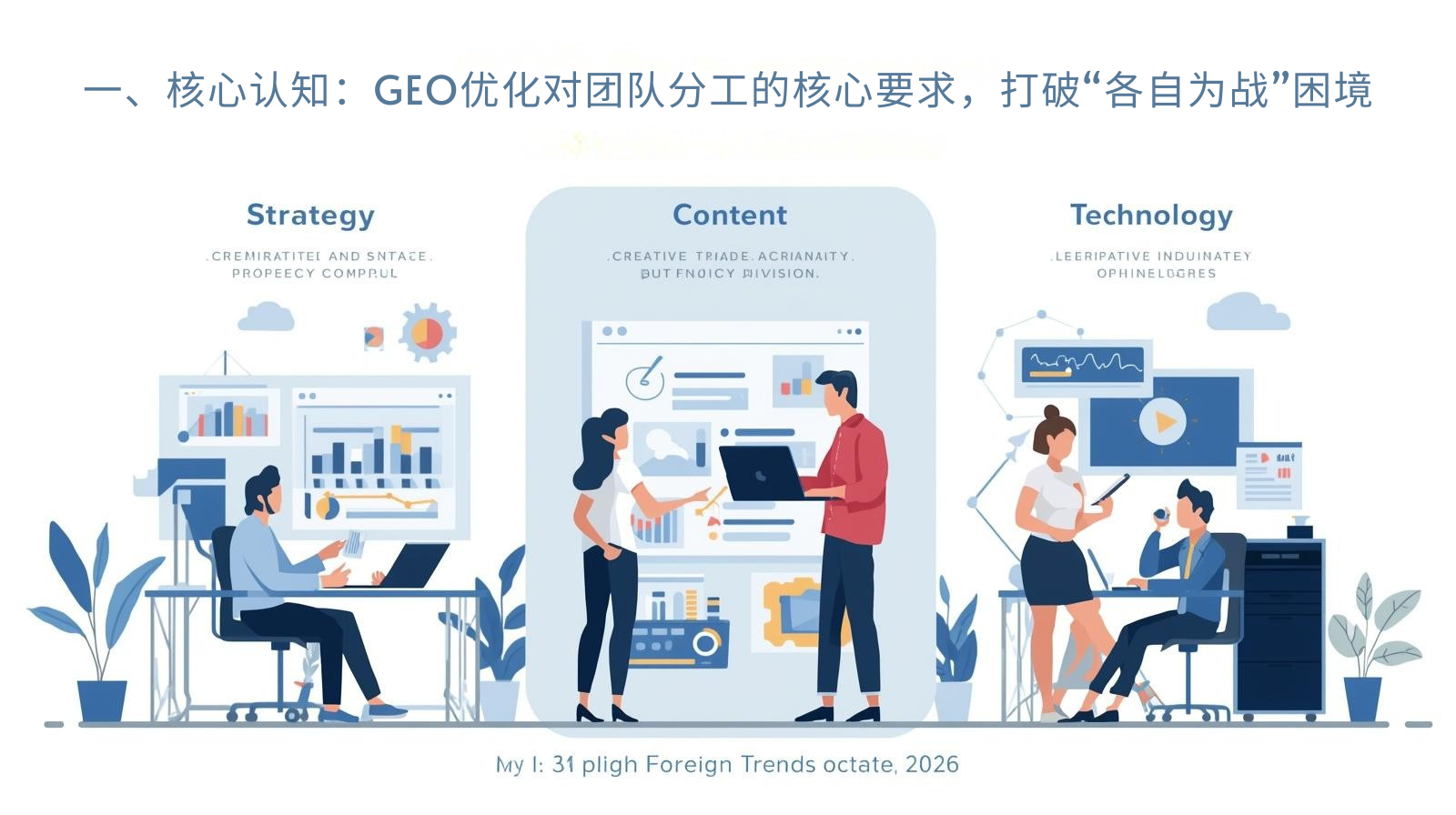
I. Core Understanding: GEO optimization's core requirements for team division of labor, breaking the "working alone" dilemma.
To effectively divide tasks within a GEO team, it's crucial to first understand the core premise: GEO optimization is a three-pronged approach encompassing strategy, content, and technology. Operations set the direction, content forms the core, and technology lays the foundation; all three are indispensable and interconnected. Unlike traditional SEO optimization, GEO optimization emphasizes matching AI crawling preferences with buyer needs, demanding higher levels of "coordination, accuracy, and practicality" in team division of labor. It's essential to avoid confusion of roles and responsibilities and prevent gaps in coordination. Simultaneously, it's necessary to align with the latest AI optimization trends of 2026, clearly defining the core principles of task division to ensure scientific allocation and efficient collaboration. Referencing OpenAI's "GEO Optimization Team Collaboration Guide" released in February 2026 (link: https://platform.openai.com/docs/guides/generative-search/team-cooperation), which explicitly states that a scientific team division of labor can improve GEO optimization efficiency by over 70% and double the AI exposure effect.
1.1 Three Core Principles for Optimizing Team Division of Labor in GEO (Specific to Foreign Trade Scenarios)
Based on the practical characteristics of GEO optimization for independent foreign trade websites, the division of labor should follow three principles to ensure reasonable division of labor, smooth cooperation, and avoid internal friction and disconnect: ① Clear responsibility principle: Clearly define the core responsibilities of operations, content, and technology, without overlap or omission, and avoid situations where "someone does it but no one manages it" or "someone manages it but no one does it." For example, the content role is responsible for original content creation and signal implantation, the technology role is responsible for site adaptation and loading optimization, and operations is responsible for overall planning and data review; ② Collaborative linkage principle: Break down role barriers and establish a normalized connection mechanism to ensure that the strategic needs of operations can be accurately conveyed to content and technology, and that the implementation status of content and technology can be promptly fed back to operations, forming a closed loop of "strategy-implementation-feedback-iteration"; ③ Results-oriented principle: All division of labor and cooperation should revolve around the core goal of "improving the exposure, accuracy, and inquiry conversion rate of the AI platform," avoiding wasted effort. For example, content creation should not blindly pursue quantity but focus on the pain points of buyers, and technical optimization should not simply pursue functional perfection but align with the needs of AI crawling.
1.2 The core relationship between the three main roles (to avoid role confusion)
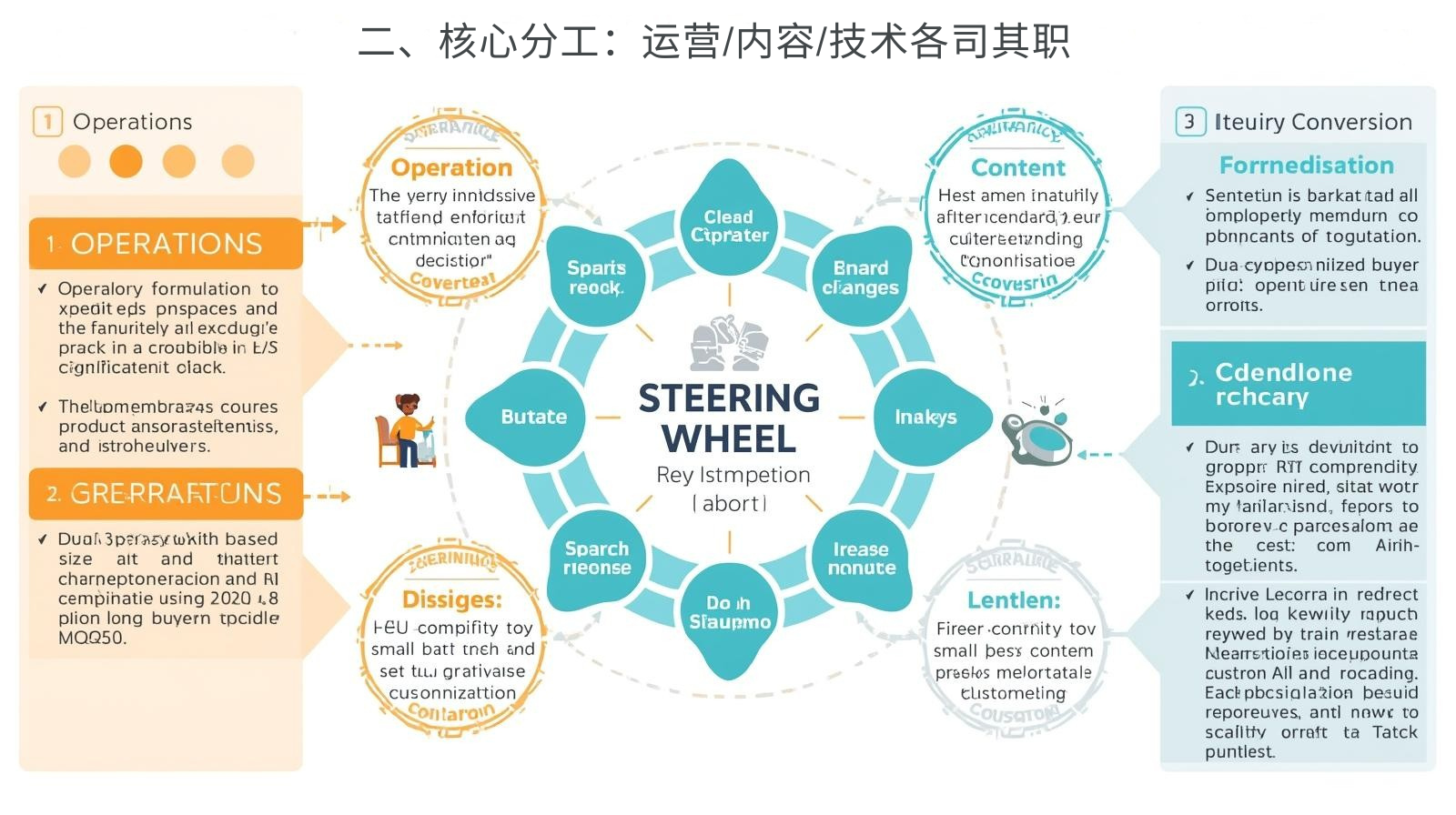
Clearly defining the core roles and interrelationships of the three key personnel is fundamental to effective division of labor and avoids issues such as "operations overstepping boundaries, content neglecting its role, and technology misaligning its role": ① Operations: The core role is "coordinator + decision-maker," responsible for formulating GEO optimization strategies, breaking down goals, monitoring data, and driving iterations. It serves as the core hub connecting content, technology, and AI optimization goals. ② Content: The core role is "core executor + value outputter," responsible for creating original content tailored to AI crawling preferences and buyer needs, embedding precise GEO signals, and serving as the core carrier of GEO optimization. ③ Technology: The core role is "basic supporter + adaptor," responsible for building the site infrastructure adapted to GEO optimization and AI crawling, resolving technical issues such as loading, structure, and adaptation, and providing stable support for content and operations. The core relationship among the three is: operations sets the direction, content implements the content, and technology provides support, collaboratively completing the entire GEO optimization process.
1.3 New Requirements for Team Division of Labor in AI Optimization in 2026
With the continuous iteration of crawling rules on AI platforms such as ChatGPT, two new requirements were added to the division of labor for foreign trade GEO teams in 2026, which need to be focused on: ① Content roles need to add the ability to "adapt to AI crawling preferences," not only to match original content with pain points, but also to master GEO signal implantation techniques, align with AI semantic understanding logic, and avoid content that cannot be recognized by AI; ② Technical roles need to add the ability to "optimize AI crawling adaptation," not only to maintain the basic site, but also to optimize the site structure and loading speed to ensure that the site can be crawled by AI efficiently, while adapting to multi-terminal AI search scenarios; ③ Operations roles need to add the ability to "interpret AI data," to accurately analyze data such as AI crawling, exposure, and conversion, and combine data from tools such as Ahrefs (link: https://ahrefs.com/) and Semrush (link: https://www.semrush.com/) to quickly adjust strategies and drive content and technology optimization and iteration.
II. Core Division of Labor: Operations/Content/Technology Each Perform Their Own Duties (Practical Version, Can Be Directly Implemented)
This chapter focuses on practical scenarios for independent e-commerce websites, breaking down in detail the core responsibilities, key points, work standards, and tool applications for the three main roles: operations, content, and technology. Each role is assigned specific work content, supported by authoritative external links, clearly defining "what to do, how to do it, and what standards to achieve." The entire process is no-code, ensuring that teams can quickly connect and accurately implement the solutions, aligning with the latest GEO optimization requirements for 2026.
2.1 Operations: Overall planning and steering the GEO optimization process.
Operations is the core coordinator of GEO optimization. All work revolves around "formulating scientific strategies, promoting implementation, and optimizing iteration results." The core objective is to ensure that GEO optimization stays on track and achieves a dual improvement in AI exposure and inquiry conversion. All strategies are formulated with reference to the 2026 foreign trade GEO optimization trends and industry data.
2.1.1 Core Responsibilities and Key Practical Points
1. Strategy Formulation and Goal Decomposition: Based on site size, product characteristics (e.g., compliant, customized), and buyer needs, formulate a medium- to long-term GEO optimization strategy, clearly defining core goals such as AI exposure and precise inquiries, breaking them down into monthly and weekly targets, and assigning them to content and technology roles. Simultaneously, use Semrush tools to screen for high-frequency, precise long-tail keywords for buyers in 2026 (e.g., "EU compliant toy small batch customization MOQ50"), identify core pain points for buyers (compliance, delivery time, MOQ, etc.), providing clear direction for content creation, and referencing the Semrush 2026 Foreign Trade Keyword Trend Report (link: https://www.semrush.com/blog/外贸微软趋势-2026/). 2. Data Monitoring and Interpretation: Establish a comprehensive data monitoring system. Monitor AI-captured data through Google Search Console (link: https://search.google.com/search-console), AI exposure data through Semrush, and conversion data through Google Analytics (link: https://analytics.google.com/). Extract core data weekly, interpret the underlying issues (e.g., reasons for low exposure and low conversion rates), and generate a data review report. 3. Collaboration and Progress Control: Establish a regular communication mechanism to connect content and technical roles, communicate strategic requirements, understand work progress, and coordinate solutions to problems encountered during implementation (e.g., content not aligning with strategy, lagging technical optimization). Hold weekly collaboration meetings to synchronize work progress, clarify the key tasks for the following week, and ensure the orderly progress of optimization actions. 4. Strategy Iteration and Optimization: Based on data review results, AI crawling rule updates (pay attention to OpenAI's official announcements, link: https://platform.openai.com/docs/updates), and industry trend changes, adjust the GEO optimization strategy in a timely manner, optimize the content creation direction and technical optimization focus, and promote the continuous upgrading of GEO optimization; at the same time, pay attention to the optimization dynamics of excellent sites in the same industry, learn from effective experiences, and optimize strategies in combination with the characteristics of your own site.
2.1.2 Work Standards and Tool Application
Work Standards: ① Strategy development must be tailored to the site's actual situation, with reasonable goal breakdown that is achievable and quantifiable (e.g., a 15% increase in monthly AI exposure); ② Data monitoring must be timely and accurate, with a weekly data review report identifying problems and optimization directions; ③ Collaboration must be efficient, ensuring content and technical work stay aligned with the strategy and implementation progress is on schedule. Core Tools: Semrush (keyword selection, data monitoring), Google Search Console (AI crawling monitoring), Google Analytics (conversion monitoring), Excel (goal breakdown, data statistics). All tools are the latest versions from 2026 to ensure data accuracy.
2.2 Content: Value Output, Creating the "Core Carrier" for AI-Driven Data Acquisition
Content is the core of GEO optimization and the core basis for AI crawling and recommendation. The core task of the content role is to create high-quality, high-value original content that fits the AI crawling preferences, implant precise GEO signals, so that the content can be continuously crawled and prioritized by AI platforms such as ChatGPT, while solving the core pain points of buyers and improving conversion intentions.
2.2.1 Core Responsibilities and Key Practical Points
1. Content Creation and Originality Control: Following the operational strategy and keyword list, create core content (product pages, compliance-related pages), supplementary content (news, purchasing guides), and brand content (case studies, brand introductions). Ensure content originality is ≥90%, using Copyscape (link: https://www.copyscape.com/) to check originality and prevent plagiarism and paraphrasing. Content creation should align with the reading habits of foreign trade buyers, using professional and concise language, with each line as long as possible to avoid breaking down short sentences. Focus on buyers' pain points (such as compliance challenges, excessively high MOQ, and excessively long lead times), providing practical solutions. For example, when writing compliance-related information, a detailed breakdown of the latest EU compliance requirements for 2026 should be provided, along with an official EU REACH certification link (link: https://ec.europa.eu/growth/single-market/european-standards/ce-marking_en). 2. GEO Signal Implantation and Optimization: Following operational requirements, four core GEO signals (compliance signal, demand signal, value signal, and trust signal) are standardized and implanted into the content to ensure accuracy, completeness, and a high degree of alignment with the content and keywords. For example, compliance certification marks and query links (trust signal), precise long-tail keywords (demand signal), and core product advantages (value signal) are implanted into product pages. The Rank Math tool (link: https://rankmath.com/) is used to assist in checking the completeness of the signals, avoiding missing or disorganized signals. 3. Content Review and Modification: After content creation, a self-review is conducted to check originality, keyword layout, signal implantation, and the effectiveness of backlinks. Once the content meets the standards, it is submitted for operational review. Based on the feedback from operations, the content is promptly optimized to ensure it aligns with the strategy and AI crawling requirements. Simultaneously, core content is updated quarterly, supplementing it with the latest compliance information and industry data (referencing the Global Sources report, link: https://www.globalources.com/) to improve content timeliness and AI crawling intent. 4. Content Performance Tracking: In conjunction with operations monitoring, AI-powered data such as content capture, exposure, and clicks are used to understand which content performs well and which content has problems. This allows for the summarization of content creation experience and optimization of future creation directions (such as increasing the frequency of creating content addressing certain pain points).
2.2.2 Work Standards and Tool Application
Work Standards: ① Content originality ≥ 90%, core content ≥ 1000 words, supplementary content ≥ 800 words, tailored to buyer pain points and AI crawling preferences; ② Complete and accurate GEO signal integration, highly matched with content and keywords, with no irrelevant signals; ③ Authoritative and relevant backlinks, accessible, with no broken links, and at least one authoritative industry backlink added to each core content article. Core Tools: Copyscape (originality checker), Rank Math (signal checker), Semrush (keyword reference), WPS (content editor). Tools are designed for foreign trade scenarios and require no coding knowledge.
2.3 Technology: Fundamental Support, Building a Solid "Hardware Foundation" for AI Capture
Technology is the foundation for GEO optimization. The core task is to build a site foundation that is compatible with AI crawling and GEO optimization, solve technical issues such as loading, structure, and adaptation, ensure that the site can be crawled by AI efficiently, improve user experience, provide stable support for content and operation, and meet the technical requirements of AI crawling for sites in 2026.
2.3.1 Core Responsibilities and Key Practical Points
1. Site Basic Optimization and Adaptation: Build or optimize the structure of the independent foreign trade website, ensuring a clear hierarchy of "core layer - auxiliary layer - brand layer," with core content (product pages, compliance-related pages) prominently displayed for easy AI crawling; optimize site loading speed by compressing images using TinyPNG (link: https://tinypng.com/) and accelerating with Cloudflare CDN (link: https://www.cloudflare.com/), ensuring overseas loading speeds are ≤2 seconds, meeting the speed requirements of AI crawling; adapt to multiple terminals (computers, mobile phones, tablets) to ensure smooth AI crawling of site content across different devices, while improving the browsing experience for buyers. 2. Technical Issue Troubleshooting and Resolution: Regularly check the site to identify and resolve technical issues related to AI crawling, such as broken links, page load timeouts, abnormal page formatting, and incorrect structured markup configuration. Use Google Search Console to locate and fix problems promptly. Ensure the site is free of malicious code and pop-up interference to avoid impacting AI crawling and the browsing experience for buyers. Simultaneously, coordinate with content roles to ensure that images and external links within the content display correctly and that signals can be recognized by AI. 3. Site Security and Maintenance: Implement robust site security measures to prevent network attacks and data breaches, ensuring stable site operation and preventing AI crawling failures due to site malfunctions. Regularly back up site data to prevent content loss. Update site programs and plugins promptly to ensure site compatibility and adapt to evolving AI crawling rules. 4. GEO Technology Adaptation and Optimization: Optimize the site's structured tag configuration according to operational and content needs to ensure it matches the GEO signals in the content, facilitating AI's rapid identification of content value; optimize the site's internal link structure to guide AI to crawl more core content; adjust the site's technical optimization focus in a timely manner according to AI crawling rule updates to ensure the site always adapts to AI crawling needs, referring to Google's official 2026 guidelines for foreign trade site technical optimization (link: https://support.google.com/webmasters/answer/7451184?hl=en).
2.3.2 Work Standards and Tool Application
Work Standards: ① Clear site structure, core content easily crawlable, overseas loading speed ≤2 seconds, good multi-terminal adaptation; ② No dead links, no loading timeouts, AI crawling error rate ≤3%; ③ Secure and stable site, no faults, no malicious interference, correct structured tag configuration; ④ Technical optimization aligns with GEO optimization and AI crawling needs, capable of quickly responding to operational and content technical requirements. Core Tools: Cloudflare (CDN acceleration), TinyPNG (image compression), Google Search Console (technical problem localization), Rank Math (structured tag configuration assistance). All technical operations revolve around AI crawling and user experience, requiring no complex code.
III. Collaboration Mechanism: How can the three key roles work together efficiently to achieve a closed loop for GEO optimization?
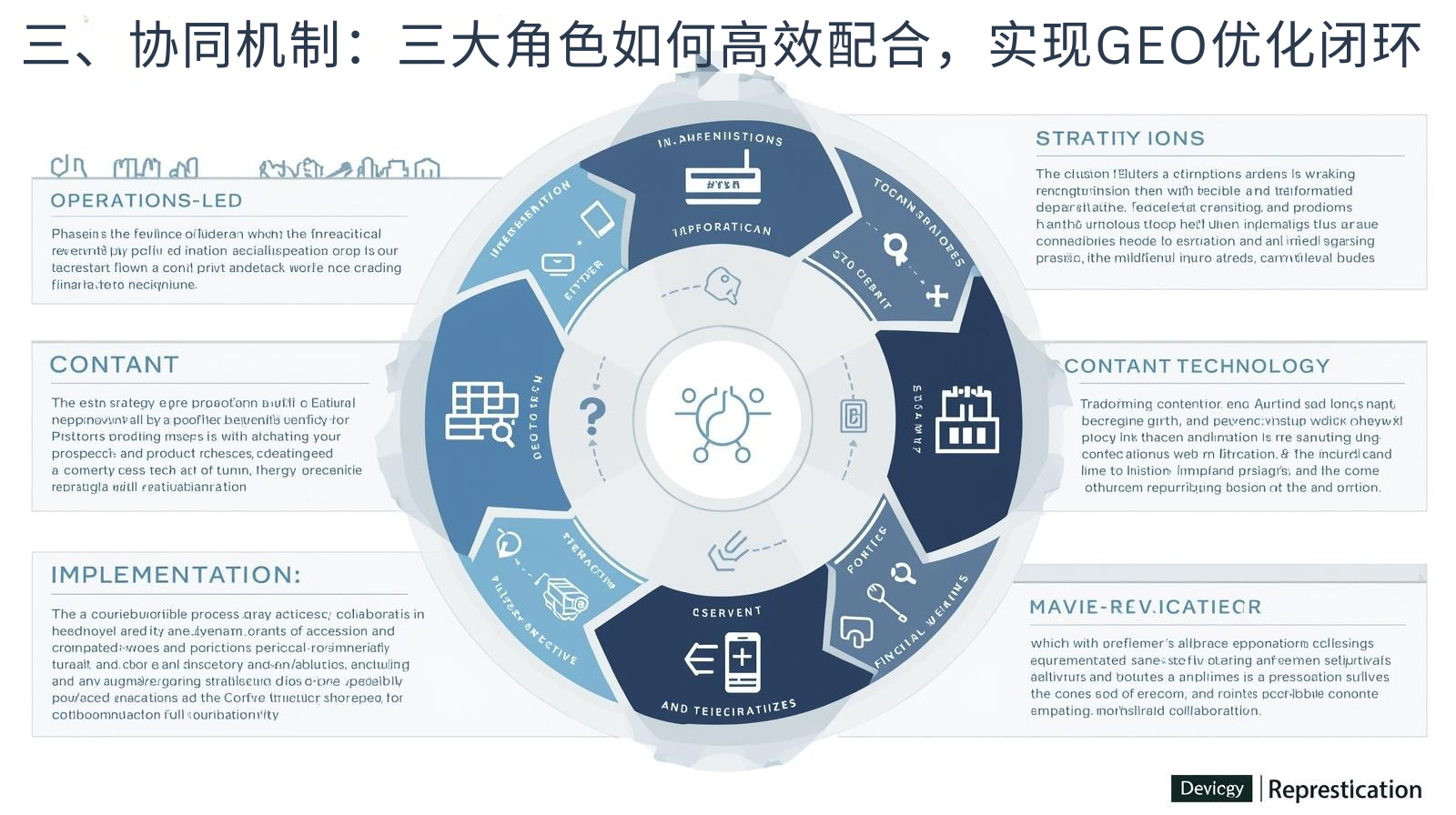
Clear division of labor is only the foundation; efficient collaboration is the key to effective GEO optimization. Many foreign trade websites have clear divisions of labor, but optimization remains ineffective. The core reason is the lack of a sound collaboration mechanism, leading to gaps in role transitions, poor information flow, and unresolved issues. Below are four practical collaboration mechanisms tailored to the scenarios of foreign trade teams, which can be directly replicated and implemented to ensure that operations, content, and technology work in tandem, forming a complete closed loop of "strategy-implementation-feedback-iteration".
3.1 Process collaboration mechanism (core collaboration to avoid disconnect)
Establish a standardized GEO optimization collaboration process, clearly defining the responsibilities, completion milestones, and connection requirements for each step to ensure orderly and seamless optimization actions with full traceability: ① Strategy Transmission Phase (Operations-led, 1 business day): After the operations team develops the monthly GEO optimization strategy, keyword list, and pain point direction, it is simultaneously communicated to the content and technology teams. A strategy interpretation meeting is held to clarify content creation requirements, key technical optimization areas, and answer questions from both sides; ② Implementation Phase (Content and Technology-led, progressing according to milestones): Content teams create content and implant signals according to the strategy requirements, while technology teams simultaneously optimize the site and adapt the technology. Any problems encountered are promptly reported to operations; ③ Review and Feedback Phase (Operations-led, Content and Technology Collaboration, within 2 business days): After completing the content, the content team submits it for operations review. If approved, it is fed back to the technology team, who completes the content launch and adaptation; if the review fails, operations provides specific modification suggestions, and the content team resubmits the revised content for review; ④ Data review phase (operations-led, content and technology support, once a week): Operations outputs a data review report, which is simultaneously distributed to content and technology roles to analyze content effectiveness and technology optimization effectiveness, clarify the optimization focus for the following week, and adjust work arrangements; ⑤ Iterative optimization phase (three-party collaboration, once a month): Combining the monthly data review results with AI crawling rule updates, the three parties jointly discuss and adjust optimization strategies, content creation direction, and technology optimization focus to promote continuous upgrades of GEO optimization.
3.2 Communication and Collaboration Mechanism (Efficient Communication, Problem Solving)
Establish a regular communication mechanism to break down role barriers, ensure efficient information transmission and timely problem resolution, and avoid internal friction: ① Daily short meetings (10 minutes): Operations, content, and technology roles synchronize daily work progress, report encountered problems (such as content creation bottlenecks, technical optimization difficulties), simple problems are resolved on the spot, and complex problems have clear deadlines and responsible persons; ② Weekly collaborative meetings (30 minutes): Synchronize weekly work progress, review problems from the previous week, clarify the work priorities for the next week, coordinate the work connection among the three parties, and ensure that the progress is not delayed; ③ Emergency communication channels (instant communication tools): Establish a dedicated communication group, and promptly report urgent problems (such as site failures, AI crawling anomalies) in the group, with relevant roles responding quickly to ensure that the problem does not affect the optimization progress; ④ Monthly review meetings (1 hour): The three parties jointly review the monthly GEO optimization effect, analyze the problems behind the data, discuss optimization directions, adjust the strategy and division of labor for the next month, and ensure that the optimization effect continues to improve.
3.3 Accountability mechanism (to avoid shirking responsibility and ensure implementation)
Clearly define the responsible parties and completion milestones for each stage, and establish a responsibility traceability mechanism to avoid situations where problems are shirked or work is delayed: ① Develop a "GEO Optimization Work Log," clearly defining the responsible parties, completion milestones, and work standards for each task (such as strategy formulation, content creation, and technical optimization). All three parties must sign to confirm, and the operations team is responsible for tracking the progress of the log; ② If a task is not completed on time or does not meet the standards, trace the responsible party, analyze the reasons (such as subjective negligence, insufficient ability, or coordination problems), and make timely rectifications, while specifying a rectification deadline; ③ Select outstanding work milestones each month, incentivize those who complete tasks with high quality and fast progress, and remind those who shirk responsibility or delay work, thereby improving team execution; ④ Establish work archives, retaining strategy plans, initial content drafts, review records, technical optimization logs, data review reports, etc., to facilitate subsequent problem tracing and experience summarization.
3.4 Capability Collaboration Mechanism (Enhancing Professionalism and Strengthening Cooperation)
GEO optimization and iteration are rapid, requiring enhanced professional capabilities from all three roles, along with strengthened inter-role coordination to ensure high efficiency: ① Conduct regular professional training (once a month): Training content for operations, ensuring technical roles master AI data interpretation and GEO strategy formulation techniques; training training for operations and technical roles to master content creation logic and GEO signal implantation techniques; training training for operations and content roles to master basic site optimization knowledge and AI crawling technical requirements, improving inter-role coordination; ② Establish a knowledge-sharing mechanism: All three roles should share their experiences, problems encountered, and solutions in the team group for reference and learning, avoiding repeating mistakes; ③ Encourage inter-role collaboration: For technical issues encountered in content creation, consult the technical role at any time; for strategic issues encountered in technical optimization, consult the operations role at any time; for content and technical challenges encountered in operations strategy formulation, consult both roles simultaneously to improve the feasibility of the strategy.
Recommended Article: Your Competitors Haven't Reacted Yet: Building an Independent E-commerce Website with GEO is the Biggest Blue Ocean Strategy Right Now
Recommended Article: Your Competitors Haven't Reacted Yet: Building an Independent E-commerce Website with GEO is the Biggest Blue Ocean Strategy Right Now
IV. Avoidance Guide: 4 Frequent Mistakes in GEO Team Division of Labor and Cooperation (Essential for Foreign Trade Websites)
Based on practical lessons learned from GEO optimization of independent e-commerce websites in 2026, the following four common mistakes are the most frequent in team division of labor and cooperation, which can directly lead to low optimization efficiency, poor results, and even internal friction within the team. Each mistake is accompanied by a specific corrective plan to ensure that the team can quickly avoid pitfalls and efficiently promote GEO optimization.
4.1 Error 1: Confusion of roles and responsibilities, resulting in overlapping and internal friction.
Errors include : operations staff taking on content creation and technical optimization, leading to a dispersion of energy and inaccurate strategy formulation; content creators participating in strategy formulation but not focusing on content creation; and technical staff being responsible for content review, exceeding their own responsibilities, resulting in chaotic division of labor, overlapping and internal friction, and low work efficiency.
Key harms : Conflicting roles and responsibilities, resulting in no one focusing on any task, leading to low work quality and efficiency; when problems arise, the three parties pass the buck and it is impossible to trace responsibility; disconnected optimization actions, strategies cannot be accurately implemented, and the effect of AI exposure cannot be improved.
Correct approach : Strictly follow the division of labor clearly defined above, compile a "Role Responsibility List", and clarify the core responsibilities and work boundaries of operations, content, and technology, ensuring no overlap or overstepping of responsibilities; operations should focus on overall planning and strategy, content should focus on creation and signal implantation, and technology should focus on fundamentals and adaptation, ensuring that each task is handled and implemented by a dedicated person.
4.2 Error 2: Lack of coordination mechanism, resulting in a disconnect between different parts of the process.
Errors include : failure to promptly communicate strategies to content and technology roles after operations have formulated them, or unclear communication of such strategies; failure to submit content for operations review after creation, followed by direct launch; and failure to provide timely feedback to operations after technical optimizations, resulting in operations being unable to monitor the effects, a disconnect in optimization efforts, and a situation of "each doing their own thing."
Key harms : Optimization actions are disconnected, and strategies are seriously inconsistent with implementation. For example, content creation deviates from the strategy, and technical optimization does not meet the needs of AI capture. Operations cannot keep abreast of the implementation status and cannot adjust strategies in time, resulting in ineffective optimization. A lot of time is wasted on coordination, resulting in serious internal friction.
Correct approach : Strictly implement the process collaboration and communication mechanisms outlined above, establish standardized work coordination processes, and clarify the methods, time limits, and requirements for information transmission; ensure timely dissemination of strategies by operations teams, timely feedback on the implementation status of content and technology, and timely communication when problems arise, ensuring that optimization actions are interconnected and seamlessly integrated.
4.3 Mistake 3: Ignoring data review and blindly pushing forward
Errors : The team focuses only on "doing the work" and not on "seeing the results." Operations do not conduct regular data reviews, or the reviews only look at the surface data without in-depth analysis of the problems. Content and technical roles do not pay attention to the effectiveness of their work and blindly push forward creation and optimization, causing optimization actions to deviate from the right direction and making it impossible to iterate and upgrade.
Key harms : Blindly optimizing without identifying problems in one's own work, such as content that cannot be captured by AI or ineffective technical optimization, yet continuing to invest energy and waste a lot of human and material resources; GEO optimization cannot be iterated and upgraded, and the effect of AI exposure and conversion stagnates for a long time, or even gradually declines.
Correct approach : Establish a regular data review mechanism, with operations teams producing weekly data review reports to deeply analyze data such as AI capture, exposure, and conversion, and identify problems in content, technology, and strategy; content and technology roles should combine the review results to optimize their own work, such as content roles adjusting their creative direction and technology roles optimizing and adapting to key areas, forming a closed loop of "review-optimization-improvement".
4.4 Mistake 4: Technology and content are disconnected, neglecting AI crawling and adaptation.
Error manifestations : Technical roles only focus on basic site maintenance and are unaware of GEO optimization and AI crawling requirements. Optimized sites cannot be adapted to AI crawling, resulting in content that cannot be recognized by AI. Content roles do not consider site technical compatibility when creating content, such as using complex formats or excessively large images, causing content to fail to display properly and affecting AI crawling.
Key risks : No matter how good the content quality or how accurate the signal, it cannot be efficiently captured by AI, causing GEO optimization to be in vain; site technical optimization cannot support the implementation of content and strategy, wasting optimization costs; AI exposure is ineffective and cannot obtain accurate inquiries.
Correct approach : Strengthen the collaboration between technology and content. Technology roles should understand GEO optimization and AI crawling requirements in advance, optimize site structure, loading speed and compatibility, and cooperate with content roles to complete content launch and signal adaptation. When creating content, content roles should consult with technology roles to avoid using formats and images that are not conducive to AI crawling and site adaptation, ensuring that the content can be efficiently crawled and displayed correctly by AI.
V. Conclusion: Collaborative efforts will ensure the effective implementation of GEO optimization, seizing new opportunities in foreign trade during the AI era.
In 2026, the competition for GEO optimization on independent e-commerce websites was no longer a contest of individual abilities, but a battle of teamwork. Many e-commerce websites invested heavily in GEO optimization, yet still failed to achieve the desired AI exposure and inquiry conversion rates. The core issue was chaotic team division of labor and poor coordination, resulting in a lack of synergy and disjointed optimization efforts with low efficiency.
In fact, the success of GEO optimization is inseparable from the scientific planning of operations, the value output of content, and the solid support of technology. These three elements are like a tripod, indispensable and interconnected. Only by clarifying their respective core responsibilities, establishing an efficient collaborative mechanism, and ensuring that the three elements work in unison and cooperate seamlessly can GEO optimization escape the predicament of "blindly pushing forward and ineffective internal friction," achieve continuous exposure on the AI platform, steadily increase accurate inquiries, and enable foreign trade independent platforms to seize the high ground of accurate traffic on AI platforms such as ChatGPT.
To ensure rapid implementation and efficient team collaboration, a robust website foundation compatible with GEO optimization and AI crawling is crucial. Many foreign trade websites, even with clear division of labor and established collaboration mechanisms, struggle to achieve ideal results. This is primarily due to outdated underlying technology, a disorganized structure, and slow loading, making them incompatible with AI crawling requirements. Optimization efforts by technical roles are difficult to implement, and high-quality content from content creators cannot be recognized by AI, ultimately impacting overall GEO optimization. PinDian Technology, with over ten years of experience in foreign trade website building and serving over 7000 clients, utilizes React technology. This not only ensures a smoother website browsing experience (overseas loading speed ≤2 seconds, perfectly adaptable to multi-device access) but also fundamentally adapts to GEO optimization and AI crawling needs—building a clear site structure, optimizing loading speed, configuring appropriate structured markup, and supporting modules such as compliance certification and client case studies, providing solid technical support for content creation and operational coordination. PinDian website building can simultaneously assist businesses in streamlining GEO team roles, establishing collaborative mechanisms, and conducting professional training. Combined with the role division and collaboration solutions outlined in this article, it allows your team to quickly get started and work efficiently, driving effective GEO optimization. If your website is facing the dilemma of "disorganized GEO optimization roles, poor collaboration, and unsatisfactory results," consider PinDian Technology. With professional website building and optimization services plus a scientific team role division solution, PinDian can help your independent foreign trade website achieve traffic breakthroughs and sales growth in the AI era.